Risk of nuclear war or climate breakdown? Buy tinned food!

Erm, following the nuclear holocaust, could you tell me when normal public services would be resumed?

Very fair question. We have got it in hand of course. Following Armageddon, we do hope to have public services working very smoothly fairly soon after the event. But I feel in all fairness, that I must point out to all of you, that it must needs be something in the nature of a skeleton service.

The Beyond the Fringe Civil Defence sketch, 1960

There are three key things to grasp about the Government’s Emergency advice to stock up on tinned food and bottled water to deal with possible pending emergencies.

  1. They expect these emergencies to happen; and one aspect of this advice is to get people to be fatalistic about that and not try to avert them.
  2. They expect people to respond to them primarily as individuals. The first job of government is to keep people safe, but if their policies lead to a disaster, its over to you.
  3. The preparations they propose are nowhere near adequate to deal with the scale of the emergencies.

Lets look at these in a bit more detail.

What kind of emergency?

They list four big ones.

  • Increased geopolitical tensions. This is a euphemism for getting ready for a war. Part of the “whole society approach” to the increases in war spending that are needed for the full scale war in Europe within ten years that the top brass have in mind is to get people psychologically prepared for it; so it becomes acceptable and conceivable without too much resistance. What’s missing in this bland phrase is that rising “geopolitical tensions” are primarily being driven by the UK’s core ally the USA and its unprecedented war drive, cutting medical coverage and food stamps to pay for a $1.5 Trillion war budget next year, making covert and overt interventions on every continent, fomenting an international race war while deploying a Black and Tans style militia (ICE) against its own ethnic minorities, pulling its allies into similar self impoverishing austerity and xenophobia. As any direct military threat to the UK comes from blowback from involvement in US sponsored wars and proxy wars, the key action that can be taken to keep the people safe is to stop being involved in them. If its possible for the Spanish government to stand up to Trump and refuse the use of their bases for bombing attacks on Iran, it should be possible for the UK to do the same and go further by pulling the RAF back from spy flights over Gaza. If we want to avoid a step by step escalation of the war in Ukraine to the point that the stakes are so high that nuclear weapons are used, we’d better start de escalating and negotiating now. Its what a majority of people in Ukraine want too.
  • Climate change impacts. You know. Those things that the fossil media tell us aren’t happening, or, if they are, are nothing to do with the climate actually changing. But, as we’ve seen, we are now in a situation in which wildfires are threatening urban areas. Homes are being burnt out. In the UK this is small so far (18 in Wennington in 2022, 37 across the whole country this year) but entire neighbourhoods have been burnt out in North America and Australia in recent years (over 6,000 homes burnt out in Palisades in LA last year) and in France this Summer 300,000 people were evacuated from around Bordeaux when a wildfire threatened the city. This Winter, we will see severe floods. And these will intensify in the years to come. In this context there are two obvious points. 1) The government should be shouting from the rooftops that climate change is a problem that requires a much bigger set of changes to limit the damage. The National Emergency Briefing campaign for a national TV broadcast to level with the population is an apposite demand, and this should be the first part of part of a plan to mobilise people to deal with a real existential threat with a sense of mission that its possible for us to save ourselves; and we’ll do it collectively, and not just at home but internationally. 2) Putting out a general appeal for people to prepare for emergencies in general doesn’t hack it. We’re not going to be able to ride out a wildfire or stop a flood with a stockpile of baked beans.The flood risks are known, fire risks not so predictably. The FBU’s call for a summit on fire risk is vital to get a proper grip on it beyond a vague contemplation to ban disposable barbecues. The local authorities in each area will need a plan for evacuations, emergency supplies and relocation centres and these will have to be widely known; especially to the people directly threatened. We have to bear in mind that, while all these events are local, there will be more and more of them happening simultaneously, so robust planning, and national back up, is essential to avoid being overwhelmed. In these circumstances, the market will not provide.
  • Cyber attack risks and Infrastructure vulnerabilities. These are relatively smaller scale than the big two above. A paradox of infrastructure vulnerability is that the only way to make it robust is to invest in it. If every spare penny is siphoned off into war preparation, infrastructure (from the small scale like potholes to large scale like the electricity grid) will continue to crumble and therefore remain vulnerable. Large scale cyber attacks big enough to require people either to have to stay at home or be evacuated would have to come from “state actors”; which would be blowback from a confrontational war policy pursued abroad – so the way to avoid that is to abandon that style of foreign policy and look to the sort of “win, win global cooperation” that China argues for.

The second and third points go together. The first issue is the need for government to actively avert the threat, not to exacerbate it by going slow on climate mitigation or adding to “rising geopolitical tensions” by pushing for a war. Anyone who thinks that doubling war spending to respond to a supposed “Russian threat” should reflect that the European NATO countries – on their own without the US – spend £3.50 for every £1 the Russian Federation spends on its armed forces and have twice as many service personnel. Aiming to double that can hardly be seen as a necessary defensive measure. Quite the contrary.

Supposing that there really is a war on the scale that they are contemplating, there is no way that it could avoid going nuclear. In which case, whether you have a few extra tins and bottles of water, or a wind up Radio to hear the King telling us to “Keep calm and carry on” as we all die, is going to be neither here nor there. There is an element of Protect and Survive about all this. In 1980, planning to introduce US nuclear cruise missiles to UK bases, the Thatcher government sent a pamphlet to every home in the country giving ludicrous instructions on how to make yourself safe in the event of a nuclear bomb being dropped on your city. This included making yourself an impromptu bomb shelter by unscrewing your bathroom door and hiding under it in the bath.
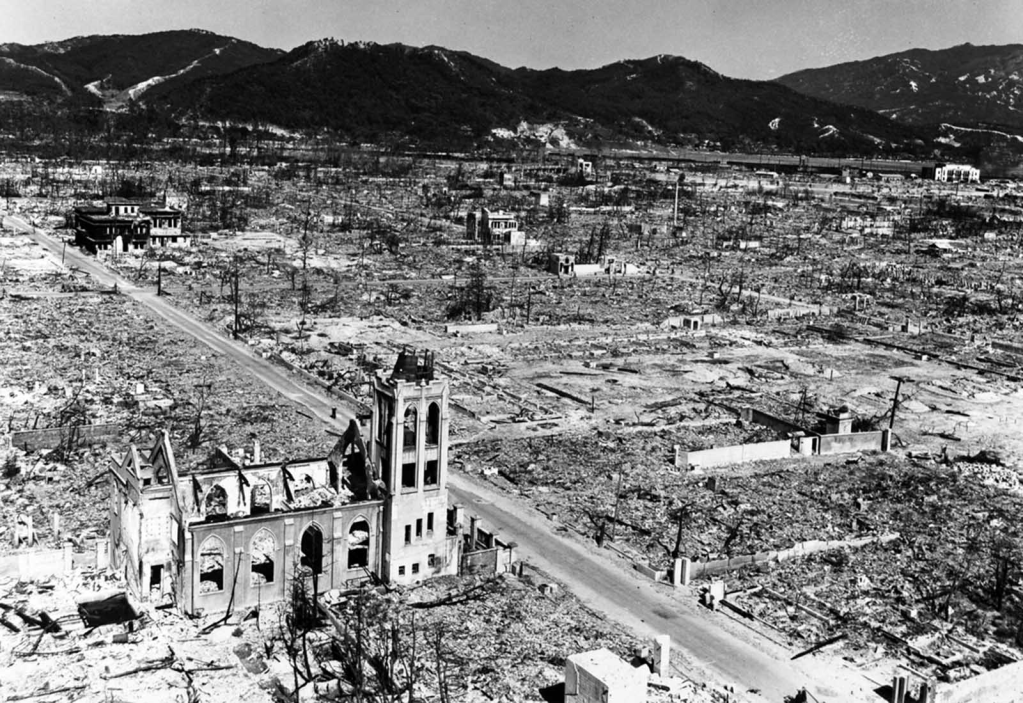
This image of Hiroshima after the bomb indicates how effective such an approach would be. Because people were aware of this at the time, the pamphlet proved to be a massive own goal for the government, anti missile groups mushroomed all over the country, and one of their campaigning tools was to act out Protect and Survive instructions in street theatre performances in town centres. Hundreds of thousands marched with slogans like “we won’t die for Thatcher” and “Jobs not bombs”.

The current instructions are more subtle. They don’t talk about nuclear war but “geopolitical tensions”, so the psychological conditioning is just enough to generate an unease that can be mobilised, but not enough to alarm people so much that there’s a mass backlash.

The deliberately small scale quality of the advice gives the impression that large scale disasters can be managed domestically. This is the equivalent of the bathroom door over the bath or the idea practiced dutifully in US schools during the 1950s that if you saw the flash of a bomb, you could survive the impact if you were to “duck and cover” under your school desk because “an atomic bomb can burn you worse than bad sunburn” (!!!) . As the schools would have been wholly incinerated, the purpose of these drills – and comparable civil defence drills for adults – was to keep the population in a mobilised Cold War mentality. It broke down by the end of the decade as people increasingly resisted taking part in them and responded to city wide drills by gathering in parks in protest against them.

The advice for a 72-Hour Emergency Kit is to stockpile, Important documents, Water (2L per person per day) Non-perishable food, Battery/wind-up radio, Torch and batteries, First aid kit, Medications, Phone charger, Cash. While it makes sense to have some of this in any case; what kind of war do they think would last for 72 hours? Perhaps the type that would make these preparations totally futile because we’d all be dead in an afternoon. Most of these items are not quantified, but the amount of water proposed is illustrative of how token this is. Two litres per person per day. At present, the average UK citizen uses 144 Litres a day, 32 of them to flush the toilet, 10 for drinking and cooking. Even being minimalist about it, 2 litres isn’t going to go very far. Trying to flush a blocked toilet with bottles of Evian? Perhaps the intention here isn’t to deal with large scale emergencies but to provide cover for water companies, which are increasingly disinclined to provide people with bottled water when they have been cut off fro long periods due to leaks. They are already under no obligation to compensate people if there is a water shortage due to “exceptional weather conditions” like the Summer droughts that are now becoming normative.

All this takes pressure of government to put in anything serious to back up public safety- and lets private companies off the hook to protect their profits. Serious public safety preparation is desperately necessary for climate breakdown, and completely pointless for a nuclear war. As they are actively preparing for the latter while ducking the former, the advice that they are offering actually puts us more at risk by psychologically prepping people to make war conceivable while playing down the consequences of climate change; which worst case projections (3C rise by 2050) now indicate could collapse the world economy by half between 2070 and 2090 and lead to the deaths of 4 billion people (almost one in two of the current global population) if the projected war doesn’t kill us first. There needs to be an urgent reversal of priorities, so the government acts consciously and consistently as a peacemaker while mobilising the entire population in a maximum effort to avert climate disaster.

Only by unthinking obedience to our leaders can we remain free?

Moments of crisis tend to expose unthinking mantras that have held up conventional wisdom for decades with the assurance of Doric columns on a bank; but which only look solid because they are unexamined.

The recent article – ‘Andy Burnham is right: Social cohesion is key to national security’– on Labour List by Sara Khan and Matthew Godwin (not Goodwin – a different character altogether) is a collection of such mantras. In previous times these may have locked together like an impervious Lego wall of unexamined presumptions, but now stand exposed as flimsy stage furniture for a play that has exceeded its run.

They start with a quote from Burnham. “I see strength at home and our strength in the world as indivisible”. This sounds similar to, but is a long way from, Clive Lewis MP’s argument that national security will be undermined if the transfer of spending from improving people’s lives onto war preparation impoverishes people and neglects social and physical infrastructure that is already crumbling. A modern version of a line an old Labour Party member in Bermondsey came out with at the start of the Thatcher Prime Ministership; “a few more years of this government, and we’ll all be living in tents surrounded by cruise missiles”.

Instead, they pose the sense that 61% of people in the UK have that “the social contract is broken” not on the feelings people get when they smash their suspension or bike wheels on pot holes, have to wait for 8 hours in A&E (and have to get a cab there because it will be quicker than an ambulance) struggle to cope in a heat wave, have to pay through the nose for heating because their house is badly insulated, see their rivers filling with toxic waste while the water companies falsify tests and bank their dividends: none of that. For them its the result primarily of ideological interventions by “our international adversaries – particularly Russia and Iran” who are seeking “the destabilisation of Western democracies” and to “disable the Western Alliance”.

They go on to outline a series of far right propositions that now have mass support, with 40% of people thinking of “Tommy Robinson’s” marches as “patriotic”, 33 per cent supporting calls for “remigration”, 31 per cent supporting the view that non-white people will never be as English/Scottish/Welsh as white people and 29 percent believing in the ‘Great Replacement’ theory. At no point do they join the obvious dots that these views reflect those we are being bombarded with from the world’s leading bully pulpit – the Presidency of the United States. They mention a meeting between “Tommy Robinson” and Elon Musk’s Nazi father without noting that “Robinson” is being funded by Musk; who is also promoting Rupert Lowe and Restore; who split from Reform because Farage was wary of linking up with him. Nor do they make any mention of the overlap between the US and UK Right and Far Right, seen recently in the ARC conference in London (an “anti elite” event that cost its participants £1500 for a ticket) denouncing everything from the reality of climate change to any notion of equality, nor the wholesale capitulation to them by the Conservative Party, nor the ongoing flow of funding, ideas and media, with US shock jock radio and Fox News the model for loss making but potent platforms like GB News, nor US tech bro platforms prioritising far Right content. This supplements the deep penetration of US influence at every level of the British state, particularly its military and Intelligence services. To misquote LBJs observation about J Edgar Hoover, in the case of British society, the USA is both in the tent and pissing in.

And this poses a big question about “Western Democracy” (with or without capital letters). Do the authors consider the United States to be democratic? They talk of the need to emphasise the differences between “Western Democracies” and “authoritarians”. Leaving aside Peter Theil and Alex Karp’s opposition to “democracy” (for the masses) as antithetical to “freedom” for the billionaires who run the show, and Marco Rubio’s racialised notion of “European civilisation” battling against the developing world, that should be kept in its place – and the people who live there, who should be kept out – that’s in the context of the Trump government unleashing ICE on communities across the country, levels of gerrymandering and voter suppression that are verging on the surreal, attempts to define social democratic opposition as “far Left Terrorism” by Secretary of State Marco Rubio. So, supporters of the Democratic Socialists of America, like New York Mayor Zohran Mamdani, AOC, and broadcasters like Amy Goodman, along with “anti-fascists” in general are now defined as “terrorists” by the administration. And that’s just domestically. Internationally they have sanctioned the International Criminal Court and its judges – international rule of law anyone? They have funded and backed Israel’s genocide in Gaza and invasion of Lebanon, backed and funded Far Right candidates across Latin America, put Cuba under siege in a way that is causing terrible suffering, launched a globally destabilising war on Iran which includes attacks on civilian infrastructure like hospitals, energy and water treatment plants that can only be described as war crimes, have bombed Nigeria and are lining up an intervention in Mali. And that’s leaving aside its trade wars and attempts to assert “Global Energy Dominance” by doubling down on the fossil fuels that are making the planet less and less habitable the more we burn them Its no wonder that a majority of people in a majority of countries across the world see the United States as the most destabilising country in the world. That includes majorities in the UK and…the United States.

It is this drive for a New American Century that underpins the rise of the Far Right in every country where the US has influence. In a country like Britain, where the US Embassy is a positively Viceregal building, this leads to “mainstream” parties bending the knee and repeating the lines they are fed from across the Atlantic to keep in line and out of the firing range. Hence Starmer’s “Island of Strangers” speech. That struck a bum note for most of us here, but its audience was in the White House. Its effect, along with the performative cruelty of immigration control measures modelled on the US, was to help legitimise “extremist views” so they are now indeed “polluting the mainstream”.

That is where “the root of hate” is.

For the authors, all this seems to have come from nowhere. There is no active agency involved. By omission, the US still stands as the core of the “Western democracies” that they want to defend – not what it actually is. For good measure, we should note that only a minority of people in the US think that their country is a democracy in Harvard’s surveys of opinion; because it is not run in the interests of the majority. The sense of broken social contract, particularly among young people, comes from “deep economic insecurity, eroding trust in democratic institutions, and growing social fragmentation”.

To put that another way, fail to improve people’s lives and that erosion will continue, handing people over on a plate to the far Right. Such a failure is baked in to the plans to increase war expenditure to a level that will suck the life out of any meaningful attempt to invest in improvements in anything else. In that situation, the house will indeed be divided against itself. Demands are arising for social justice, for proper levels of investment; something Andy Burnham is acknowledging with the real, albeit small, gestures in that direction in his first week, like the £2 bus fare cap. However, paying for that not by taxing the wealthy and reducing inequality but by seeking to squeeze money back from international climate finance is a wrong road and a short one. Similarly, more agency at local level in Burnham’s devolution agenda, while welcome, can only go so far without the investment needed to solve the problems that people identify. Once a renewed squeeze for arms spending kicks in, the pressure will be felt in all those unrealised aspirations. Can’t help but be. In that context, it becomes imperative for the ruling class to deflect any resistance downwards away from them and ruthlessly drive divisions among the majority, so the mainstreaming of racism isn’t something to be avoided for them, but a necessary tactic.

Khan and Godwin are, possibly despite their intentions, playing a soft part in this drift. In drawing a veil over the actual role of the United States, a veil with “Western Democracies” written on it, pointing to “international adversaries” (of the United States) as the culprits – and, inevitably, lazily and mendaciously smearing the movement against war and genocide in West Asia as “coopted” by “Islamic extremists” – they fail to deal with real contradictions that tear holes in their worn out world view; and become complicit in the suppression of democratic dissent that, again following US models, has banned Palestine Action as a “terrorist” organisation, gagged defendants, suppressed the rights of juries and threatened barristers with jail for reminding them that they have them.

Their solutions to “heal the wounds that divide us” do not involve any reassessment of the UK’s auxiliary role for the US; which at the moment is taking the form of aiding and abetting bombing runs into Iran from RAF Fairford that are primarily hitting civilian infrastructure. A big majority opposes this complicity. We are being ignored.

Instead they argue for a “Total Defence” strategy that requires ideological conformity at home as part of military credibility abroad. That in turn requires an even stricter policing of dissent on traditional and social media. The paradox of their argument is that they are right that far Right arguments have for the most part been capitulated to and promoted not tackled, but because they don’t identify where these arguments come from, nor in whose interests they are being put, they end up (start out) aligned with the very forces that are pushing them; and the “anti extremist” agenda, in being directed against US targets, boils down to policing internal dissent from the Left “like we did in the Cold War”. So much easier for the UK’s traditional alliances if no news from Gaza is allowed to filter through unmediated by “reliable sources”.

So, we end up with a “democratic” society in which deviation from standing to attention and saluting the right shibboleths – which will increasingly be the Right shibboleths – will be treated as treason and terror. Be prepared.

One is not supposed to weep at the Radetsky March

I have, nevertheless, been doing so since the Vienna New Years Day Concert in 2014. Barenboim was conducting, and, as he marched on stage for the traditional final encore with an imperious flick of his baton, rather than crashing straight into the opening chords, a snare drummer tapped out a call to arms – tappity tappity tappity tap – trrr rrrr – RAT TAT TAT!

A whole set of emotions welled up. That sort of rhythm is designed to do that, meant to rouse the listener into a heightened emotional state and carry them away to take the Emperor’s Schilling; and visions of drumhread recruitment in towns and villages all across the Austro Hungarian Empire – and the rest of Europe – invaded my mind, along with a historical memory of what happened next that none of those swept up in war euphoria, or war fatalism, a hundred years before could possibly have had.

Painting of a soldier undergoing surgery by surgeon and painter Henry Tonks circa 2015 from Faces of Britain by Simon Schama.

A quote from the same book. The nature of trench warfare, punctuated as it was by futile forays over the top, had exposed the heads of soldiers, nothwithstanding their helmets, to taking fire in the face. Exit wounds were gaping. Some shells had been designed to spray schrapnel, to devastating effect. Magnesium fuses were encased within, expressly intended to catch fire when lodged in tissue, resulting in the burning away of noses, eyes and cheeks.

More than 20 million dead at the end of it. And a comparable number wounded or mutilated. And World War 2 was worse. World War 3 has been unthinkable because there would be no one left at the end of it, brief though it would be.

Yet now we have the uncrowned heads of Europe and their media shils single mindedly trying to make it thinkable. Preparing us for a war with Russia by the end of the decade. Mark Rutte thinking he can succeed where Charles XII, Napoleon Bonaparte and Adolf Hitler failed.

Posing a war of choice as “defence”, as they always do, as every power did in 1914, avoiding any mention of the nuclear risks, avoiding any mention that they already outspend the Russians 3.5 to 1, avoiding any mention that Russia has neither the intention nor the capacity to invade the rest of Europe, avoiding mention of any alternative course, as if “war, war” is better than “jaw, jaw”.

This is part of a “whole society” approach aiming to make us stand to attention and salute without question. The most dangerous aspect of this sort of war fatalism, linked to escalation in arms build ups and suppression of dissent as treason, is that it poses war as inevitable – and when all sides accept that that is the case, war is what you get.

None of us has any interest in that. Not least because we’d all be dead at the end of it.

Yannick Nézet-Séguin did it again in this year’s concert. He made the usual speech before the encores – “music can unite all of us because we live on the same planet” – which felt peculiarly hollow this year, given the way the drums are beating all over Europe. Then off into Blue Danube and Radetsky, with the drum call to start and the well heeled Viennese spiessburger audience clapping enthusiastically along in a joyful romp towards Armageddon, just like so many of their ancestors did in 1914.

In an ironic counterpart, the final song in Jules Holland’s New Year Hootananny the previous evening was a singalong version of “Enjoy yourself (its later than you think)”.

New Year resolution for 2026, to beat a different rhythm and break up the march to war.

Remembrance 1: “We’re going to need a bigger moat”.

Its October and, as the clocks go back in more ways than one, scarlet paper poppies begin to bloom on the lapels of MPs and TV presenters. So begins the annual ritual of Remembrance; using the blood of its victims to turn a warning about the human costs of war into a sanctification of preparing for another.

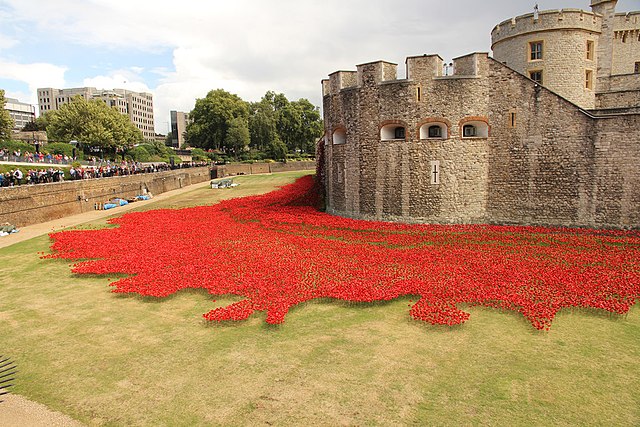
One of the most striking memorials to the outbreak of the First World War in 2014 was the “Blood swept lands and seas of red” installation at the Tower of London; which planted one ceramic poppy for every British and Empire fatality in the war. Estimates for how many of these there were vary. The installation used 888,246 poppies. The figure in Wikipedia is 887, 858. All the same, a lot of deaths. And the installation couldn’t help but numb and sorrow. Such an accumulation of individual losses made collective. Each individual poppy the colour of blood, and an echo of the scarlet of the state, as seen on phone and post boxes, London buses, the Brigade of Guards outside Buckingham Palace, and lost in it. Theirs had not been to reason why. And they had died.

On the Cenotaph in Whitehall, with an “unknown soldier” buried beneath, they are commemorated as “The Glorious Dead”; regardless of how they died or how inglorious it may have been.

Photo by Richard Croft. Creative Commons.

It is perhaps characteristic of a certain kind of British national narcissism that the only deaths commemorated were “ours”. Which underlines the limits of this sort of “Remembrance”. It becomes acelebration of victory sanctified by “sacrifice”. It tries to make it impossible to think past that sea of poppies to the losses suffered by other countries.

A commemoration of all the service personnel killed in the First World War would require a moat more than twenty times bigger, to register the 20 million or more of them killed. If you were to separate it out into national contingents, the French and Austrian sections would each be one and a half times the size of the British; that of Germany and Russia each more than twice as big. Having them all mixed up, in different colours perhaps, might underline their common humanity and the horrifying waste of it.

Civilian deaths in the First World War were a fraction of the military deaths, unlike the Second World War and most wars since. These are now running at about 67% of the total. Significantly more in Gaza. Commemorations that focus on WW1 tend to obscure that.

Civilian deaths from World War 3 would, of course, be total.

We are now in a period in which people who should know better are agitating for European NATO countries to prepare for a war with Russia by the end of the decade by doubling military expenditure (even though they already outspend them by 3.5 to 1) – a war that could not help but go nuclear – and it is a commonplace of US Foreign Policy thinking to envisage a war with China in the South China Sea – another war that could not help but go nuclear.

And, as Tom Lehrer once remarked, “if there are going to be any songs about World War 3, we’d better start writing them now”.

If we are foolish enough to allow our light headed and light minded leaders to make us collectively “pay undaunted the final sacrifice” in such insane adventures, age shall not weary us, nor the years condemn and at the going down of the sun and in the morning no one will be left to remember us.

Blue Labour Blueshirt Blues

‘Every day, we should drag a sacred cow of our party to the town market place and slaughter it until we are up to our knees in blood.’ Wes Streeting MP

O Rose thou art sick. 

The invisible worm, 

That flies in the night 

In the howling storm: 

Has found out thy bed

Of crimson joy:

And his dark secret love

Does thy life destroy.

William Blake

Last week, after a 44 year membership, I cancelled my standing order to the Labour Party. This morning I had a standard letter “will you hear us out” inviting me to rejoin.

I thought that it required the courtesy of a reply, so here it is.

Dear Gail

After many years in the Party, including being a ward and constituency officer, I now find that so much of “staying in the fight”, as you put it, requires opposition to what this government is doing.

In the 1970s, when I was scraping National Front stickers with the slogan “send them back” off lamp posts, I never thought that the Party I have voted for all my life would be boasting about how many people it is deporting. I fear that next May’s local elections will be a complete debacle because the attempt to cosplay Reform emboldens them while making Labour voters stay at home, or vote Green, or Lib Dem, or Your Party.

I could go on. Gaza. The gesture of recognising a Palestinian state while taking no measures to put real pressure on Israel to stop the genocide is unconscionable.

Signing up to an annual £77 billion black hole of increased military spending that will suck the life out of the investments we need in infrastructure and green transition. 

The abject attempts to talk up “the special relationship” at a time that the USA is going full rogue state on climate, trade, diplomacy, as its hegemony wanes, and threatens the world with war shackling us to a suicidal course for humanity.

And, because it knows that it is on thin ice on all these issues, the response of the Labour leadership is to close down debate, silence dissent; rule out motions that are awkward, decree entire areas out of bounds, deselect local councillors who do things they don’t like (like twinning with Palestinian towns). Peter Kyle MP responded to the “Unite the Kingdom” march by saying that it shows that “free speech is alive and well in the UK”. Free speech for who? There were 1500 police on duty at that march, which included violent attacks on police officers and counter demonstrators. There were 3000 on duty for the silent, peaceful sit in in protest at the bizarre categorisation of Palestine Action as terrorist (when most people can tell the difference between an Improvised Explosive Device and a tin of paint). Politics is indeed the language of priorities. 

There are still good people in Labour, who want it to remain Labour and not adopt “muscular Conservatism”, as I understand the new buzz phrase goes in leading circles, but I believe at this point that what might be called “Blue Labour Blueshirtism” will work its way through until Labour has shrunk to the depths of the French SP or PASOK in Greece.

The fight continues, and I will be part of it. I hope that many remaining Labour members will be part of it too. We are in unprecedented times, and the old road no longer leads onwards. Bob Dylan wrote a song about that…

Paul Atkin 

Blue Labour, whose organiser Maurice Glasman was the only person from the European Social Democratic tradition to be invited to Donald Trump’s inauguration. They organise on the slogan “Faith, Flag, Family”.

The Blueshirt reference in this is to Keir Starmer’s Chief of Staff Morgan McSweeney’s political origins in Fine Gael, the more right wing of the two traditional parties in Ireland, the one that grew from the Free State forces in the Irish Civil War and sent fighters to support Franco in the Spanish Civil War. Recalled bitterly in Christie Moore’s Viva La Quinta Brigada

When the bishops blessed the blueshirts in Dun Laoghaire, As they sailed beneath the swastika to Spain.

Once again, a song for our time.

Chagos : picking up the tab for the USA.

The headline in Monday’s Daily Telegraph was Starmer hid costs of Chagos surrender, with the strapline Official figures reveal total cost is ten times higher than the Prime Minister claimed.

Even in the Telegraph, which could have most of its headlines summarised in an emotional digested read as HRUMPH! this is almost poetic. A veritable broadside of misdirected kneekjerk reactions.

Lets start with Chagos surrender. What they mean by this is the return of the Indian Island archipeligo of the Chagos Islands to Mauritius. For Telegraph readers it is a no brainer that an island in the middle of the Indian Ocean is more appropriately administered by the remnants of the Colonial Office in London than another island nearby, let alone, perish the thought, the people who actually live there; because where once a British colonist has stood, the Union Jack should fly forever.

Surrender implies some shame, as the emotional freight of all those retreats from direct imperial control all through the 20th century gets concentrated on this tiny island far, far away; of which their readers know very little.

The notion of the cost of handing back the Chagos Islands to Mauritius is suspicious. Why would it cost anything to relinquish control? It sounds like reparations – the horrifying notion that countries that got rich from exploiting the resources of countries they conquered, keeping them in poverty for the duration, might actually owe them something. Hrumph, indeed! Can’t have THAT!

But as there is no cost to let go of Chagos, what is the cost actually for? Read the article and it admits that the cost is not for giving bup the island, but for leasing back the airbase that Britain expelled the Chagos islanders to build in the 1960s. This base, formally British, is actually used by the United States as a strategic centre for B2 bombers to range across Africa, West, Central and South and South East Asia, China and the Pacific.

Like the agreement to a 5% target for “defence” spending and the meek acceptance of Trump’s tariffs, any contribution to the costs to Britain of keeping this base going – this “terrible deal with huge costs to hard pressed British tax payers”, as Dame Priti Patel put it – is a financial tribute to the United States, so they can bomb half the world with impunity.

Any resentment at this should therefore be directed across the Atlantic, not at Mauritius. But that would involve 1. being honest and 2. punching up.

Their argument that these costs have been misleadingly reported is itself misleading. They argue that methods often used by the Treasury on long term costs to take account of inflation and the “Social Time Preference rate” is an “accountancy trick”. Not an argument they deploy in other contexts.

They then go on to say that the “nominal” cost £34.7 billion over 99 years would be equivalent “half the annual schools budget”. So, a salutory comparison of wasteful military costs with costs of schooling, unusual in the Telegraph, and only made because they have painted the price of subsiding as US air base as an act of reparation, but still comparing an annual cost (in the case of schools) with a cost spread over 99 years – so, not a strictly reasonable comparison.

They are operating more to type when they say that the cost of leaing the base is also equivalent to building “10 Elizabeth class aircraft carriers”; conjuring up a real wet dream of military nostalgia for all those retired Commodores who write them letters; for the days when the Royal Navy had mighty ships of the line and Scapa Flow was full of battleships; instead of being, as it is, a tiny, niche auxiliary force for the US Navy. Oddly enough, playing the same sort of subordinate role as the Air Force does for the Chagos Island base (and other bases here too).

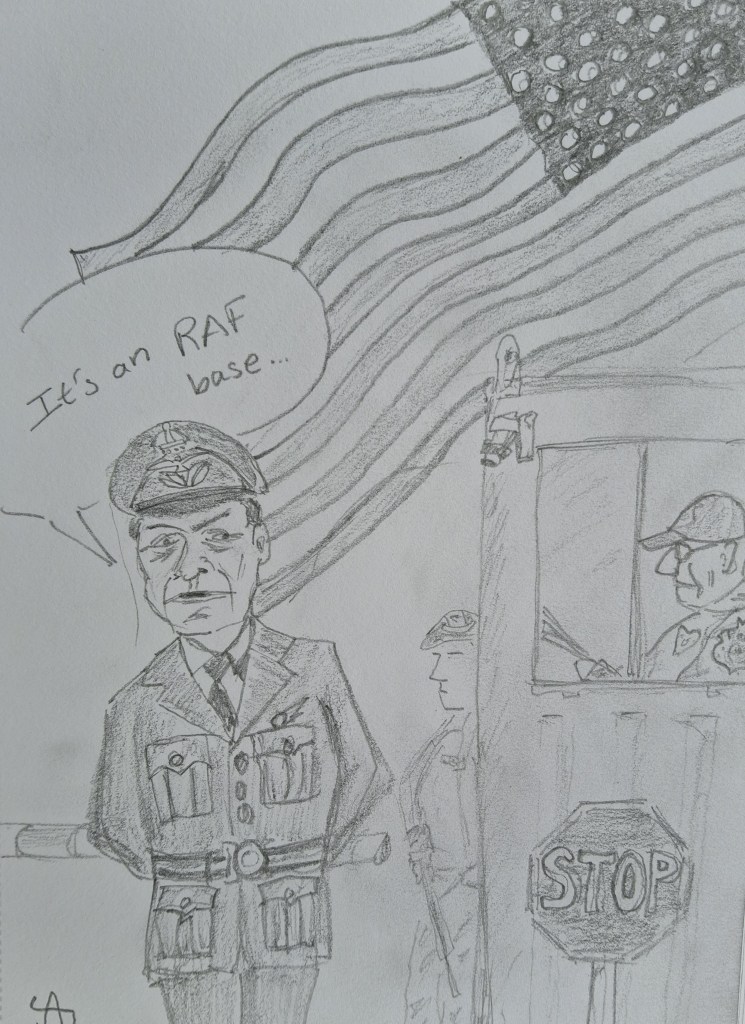
The Wingco at “RAF” Burtonwood.

I had direct experience of the fiction involved in this in the mid 1980s, when a delegation from Greater Manchester CND travelled down to the Burtonwood Air Base to hand in a letter to the base commander pointing out that any nuclear weapons stored there would put the population of Manchester, and the whole North West, at serious risk.

When we asked to see the base commander, a Royal Air Force Wingco came out. He looked a bit like Kenneth Moore, which I don’t suppose damaged his job application any. Everyone else in view was in US uniforms. When we said we wanted to see the actual base commander, he said “I’m the base commander. Its an RAF base”.

So we said, “Really, whats THAT?” pointing to the enormous stars and stripes fluttering on the flag pole behind him.

Previous

This morning, instead of the Guardian flopping onto the doormat at 4 in the morning, the great, grey, grim, gruesome masthead of the Daily Telegraph was visible poking through the letterbox like an ultimatum in Gothic.

The Telegraph is a gloriously reactionary paper, whose columnists barrage its readers with nerve edgy variations on the theme of “we’ll all be murdered in our beds” to keep them scared and angry, and its news sections are barely calmer. It was ever thus. When I worked permanent nights in a choclate factory many years ago, I used to read the Telegraph to keep me awake; because a mind that is boggling finds it hard to drift off.

A characteristic article this morning headlined Hunter gored to death by buffalo he was stalking explains how “a millionaire trophy hunter…was killed almost instantly by ‘a sudden and unprovoked attack’ by the animal”.

They write this with no sense of irony; after all, all he was doing was stalking it to shoot it. The natural order of things. No provocation at all. There’s a whole world view in that.

Doing its bit to calm down tensions over “migrant hotels”, their lead article on p4 is headed Migrants in hotels linked to hundreds of crimes, with the strapline, in case anyone misses the point, Residents have been charged with violence, child abuse,domestic assault and shoplifting and a little highlighted indent gives the figure 425 for the “number of offences people living in hotels the Home Office use to house migrants have been charged with”.

Many of their readers, happy to have their prejudices confirmed, that “they” are a threat to “us”; and that this is a characteristic that can be freely atributed to all “migrants”, will read no further. But the tortuous use of language in the headlines, for anyone paying attention, is explained by sentences buried deep in the story, but which explode it from the inside out, again, for anyone paying attention.

First, these are figures for people charged, not people convicted. So, this will be the highest possible number.

Second, Not every defendent who lists one of these hotels as their place of residence is necessarily an asylum seeker. It has not been possible to establish how many of the offenders identified by the Telegraph are currently applying for asylum in the UK”. So the highlighted number is bollocks. They know it. But they print it anyway.

Third, “The court records show that a significant proportion of these offences are alleged to have been perpetrated against other apparent asylum seekers”. Its notable that they don’t specify a figure, or proportion for this, though doubtless they could. Possibly because it draws the sting from the implication that “they” are a threat to “us”.

Showing the same inversion of reality that they deploy in the Big Game Hunter vs Buffalo story, they state “…police are under pressure to routinely disclose the nationality and migration status of suspects to protect community cohesion and to address a perception among some groups that asylum seekers are carrying out a disproportionate number of offences”. Note the unspecified character of “some groups”. Who might they be, I wonder?

Perish the thought that papers like the Telegraph, in its own revealing words, offering “a sense of the numbers involved”, and doing so by playing them up, could be promoting that “perception among certain groups” the better to whip them up, while retaining implausible deniability with weasel words.

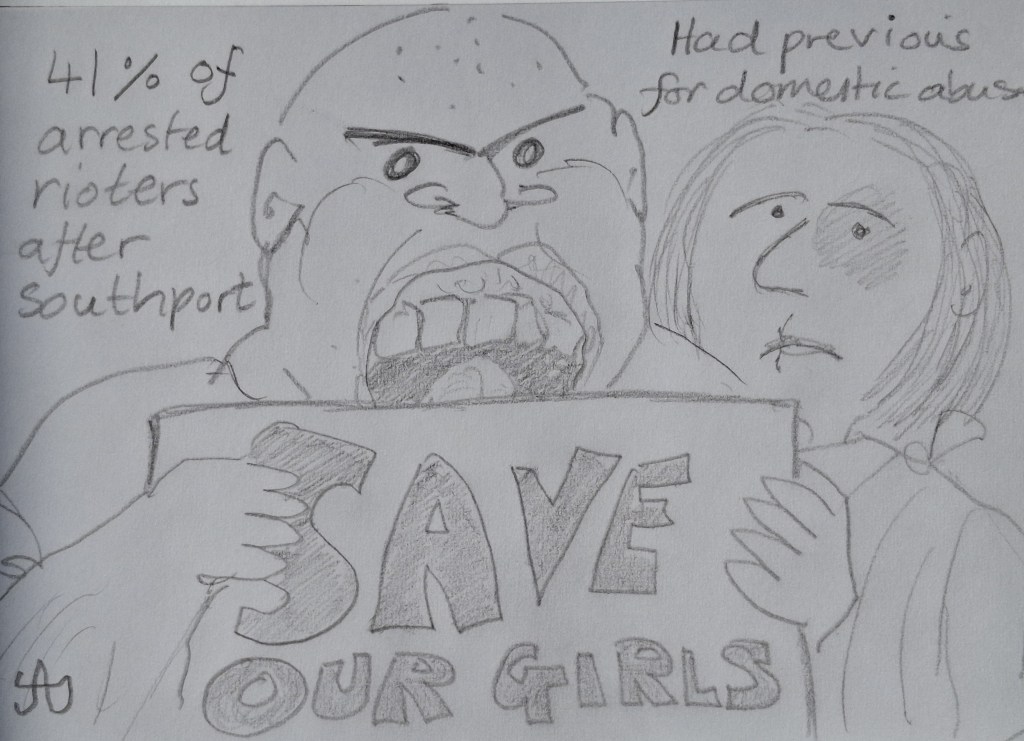
On this issue, as on so many others, like so many of those arrested in the racist riots last summer, the Telegraph definitely has previous.

Please note. If you like this blog please pass it on to anyone else who might find it interesting or useful. These blogs are blocked on Facebook because they “look like spam” incidentally.

Kaiser Franz solves a problem.

Emperor Franz Josef V, sighed, pulled on his weaved mutton chop whiskers – now Imperial regalia – and twisted the dial on his wireless to shift the channel from Das Lichtprogramm – playing its usual diet of whirling Waltzes by Johan Strauss the very, very, very much younger, as if to prove that music, like History, had nowhere to go but interminable circles – over to Der Heimat- Service for the latest reports from Today in Parliament.

There was something oddly comforting about these reports. Like all the Sturm and Drang of the Shipping Forecast: all those rising squalls and Force Ten Gales, that menacing low visibility in Sea areas with comfortingly obscure and poetic names – Varangian, Black, Dogged, Austrian Bight, Trieste, Italian Sea, Palermo automatic lighthouse weather station – full of sound and fury and signifying nothing, to him, more than how much more comfortable it was to be sitting by the fire with a cup of tea and a crumpet.

Reports from the Diet were always incomprehensible. All the way across the Greater Austro-Hungarian – Balkan Empire, from Bavaria in the West to the Caspian Sea in the East and Naples in the South, members of the diet were allowed to make speeches in their own languages; on the proviso that no translations were allowed. This meant that members could sound off in full fury, to be approvingly written up in the local papers at home, blaming everyone else for local problems, securing their continuous re election as local champions – safe in the knowledge that no one else in the Empire, unless they understood Slovak, or Azeri, or Sicilian dialect, would have a clue what they were saying, so everyone could remain friends. All the broadcasts were also in the original languages, so everyone could tune into their own bit and be reassured that their worries were being expressed, if not heard. Thus, peace and harmony could be assured, as a grievance carefully nurtured, with no hope of resolution, is a soothing balm for everyone who enjoys suffering from it and being able to complain about it. If these problems were to be resolved, people would be lost. They wouldn’t know who they were any more.

Kaiser Franz scratched idly at his paunch, feeling a bit sleepy, when the newsflash he had been waiting for came up right on time. A solemn burst of Bruckner – titanic, overwhelming, monumental and oddly static, like the Empire itself – was followed by an announcer sounding even more po faced than usual. The troublesome, playboy heir apparent, Archduke Ferdy, had met with an unfortunate accident while trying to act out the bow flight scene from Titanic on the 3:30 Zeppelin from Zagreb to Odesa while drunk (and drugged too, though he knew it not) to be followed by an Inquiry and four days of official mourning – because there was no point in overdoing it – announced by the Prime Minister, in his familiar flat nasal tone; the one that sounds a bit like he’s been chewing cardboard most of his life. Satisfied that Plan B, with its aerodrome arson squad and threat of high profile collateral damage (and all the awkward questions that go with it) had not been necessary, the Kaiser chuckled to himself and put Zadok the Priest on his record player.

May the King live, may the king live, may the king live FOREVER, Alleluhia, Alleluhia, Alleluhia, Amen…

This England (and Wales) – Summer 2025

In the 1960s the New Statesman used to have a short column of clips from right wing papers that illustrated the absurdity of their view of the world called “This England” (from John of Gaunt’s dying speech in Richard II; you know “This royal throne of kings, this sceptered isle, this earth of majesty, this seat of Mars…This blessed plot, this earth, this realm, this England”, the sort of pompous pontification that cued his nephew the King to remark, on hearing that he was dying, “Come, gentlemen, let’s all go visit him: Pray God we may make haste, and come too late!”

I was reminded of that in recent weeks by several parts of articles in the Guardian that I had to read twice to make sure that the point that I was reading really did say what it did; usually dropped in and passed on without comment; as though it were perfectly sensible, nothing to be bothered about.

Housing

The extra money (for affordable housing in the Spending Review) will help housing associations to buy up thousands of new units which have already been built by private developers as part of their affordable housing commitments, but which are sitting empty because they cannot afford them. My emphasis.

Housing projects that protect natural habitats, include public transport and divert wastewater from running ino local watercourses are deemed too expensive (by the government, as Labour’s message in the Planning and Infrastructure Bill is that the developer knows best and other considerations can take a back seat).

Prevent

Asked about the government’s counter extremism programme, Prevent, Cooper said she was “very concerned” by evidence of increasing extremism among young people. “We are seeing the counter terrorism caseload trebling in three years involving teenagers”, she said. She said there had also been a doubling of the numbers of young people being referred to Prevent since last summer. And yet…I continue to be concerned about the threshold ending up being too high and not enough Islamist extremist cases being referred to Prevent and the need to make sure more of those cases were being referred…”

Trubble at pit

These are not a quotes, simply retelling of comments from Any Answers on Radio 4 on 14/6/25. Any Answers can usually be relied upon for a rich vein of emotionally charged comments, more often than not unhinged from any knowledge of the subject being discussed. Nigel Farage’s proposal to reopen coal mines in South Wales that have been long flooded, and Blast Furnaces that have cooled solid, sparked several of these. One person thought it was a good idea in principle, but because no one local would want to do it they’d “have to import immigrants” to work in them – and that would never do. Another, in response to the same problem, argued that prisoners should be sent down the mines “like they do in America”. That’d learn ’em because, as we know, the problem with prisons is that they are “too soft”. Salt mines, unfortunately, are not available.

Legally illegal

“Britain’s decision to allow the export of F-35 fighter jet components to Israel, despite accepting they could be used in breach on international law in Gaza, was lawful, London’s High Court has ruled.”

Nazis in everyday life

A standard schtick of films and children’s TV dramas in the sixties was the moment that a previously anonymous villain was revealed to be a former middle ranking Nazi official, seeking to act as a seed for the regeneration of the movement; and thenceforth filmed looking Aryan while standing on yachts in front of mountains with a 1,000 Year Reich stare accompanied almost invariably by the crescendo from Wagner’s Tanhauser overture. (1)

This coincided with a lot of Nazi hunting stories sparked by the Eichmann trial in 1961, and the fact that no one had caught up with the Auschwitz “Angel of Death” Dr Josef Mengele, which gave the impression that the only surviving fragments of the old order – with the exception of Werner Von Braun, who was leading the US moon mission at the time and was therefore given a free pass – were leading lives of exiled obscurity in Argentina or Paraguay which, to be fair, some were. Mengele himself died when he drowned after suffering a stroke while swimming in Sao Paulo in 1979; having been given a passport in his own name by the West German Embassy in 1956 and actually visiting Europe using it in the late fifties.

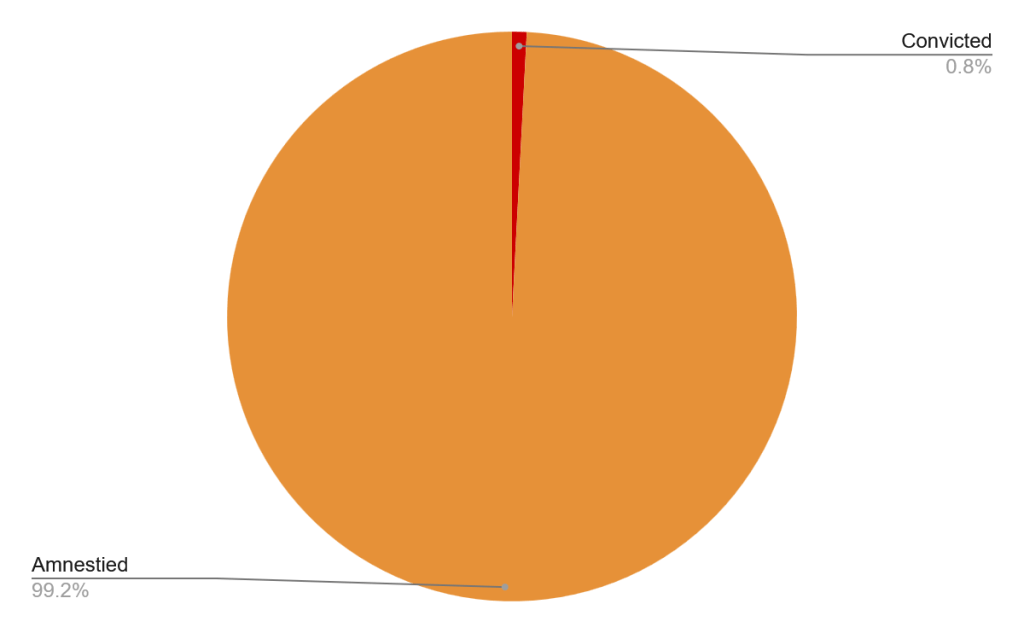
This is a fairly extreme example of the way that former Nazis were reabsorbed into West German society in a wave of amnesia and omerta as the Cold War dug in. Von Braun, it turns out, was more the norm than Mengele or Eichemann. Though the Nuremburg Trials in 1945 -6 pronounced death sentences against 12 leading Nazis including Herman Goering and Joachim Von Ribbentrop, the number of former Nazis convicted of war crimes in the post war years up to 1958 was just 6,093. In the same period 729,176 had been amnestied. That looks like this.

Total Nazi Party membership in 1945 was 8 million, so most of them had no process at all.

Many others, not members of the Party, who committed war crimes were never held to account and simply melted back into their pre war roles. The unit of Hamburg policemen who formed an Einsatzgruppen execution squad (2) following on behind the Wehrmacht to march Jews, and sometimes Poles, out into the woods and shoot them in the back of the head, simply went back to Hamburg to direct traffic, follow up on petty crime and do all the usual things the police do. Only their commanding officer was held to account, executed after being extradited to Poland because of a massacre of Polish villagers. Their interviews in the early sixties were for historical purposes, and they were never held to account. Similarly, lower level former army, and even SS, officers provided the backbone of the Bundeswehr when it was reformed in 1955.

1 A belting piece of music which is well worth a listen if you’ve never heard it.

2 Documented in Ordinary Men. As grim a piece of reading as you’ll ever do. Its front cover illustration is of a squad of these men looking relaxed and grinning with local Jewish civilians kneeling in front of them with their hands up, was so abhorent that I couldn’t leave the book face up while I was reading it. It is chillingly echoed by some of the gloating social media posts by IDF soldiers in Gaza that show that fascism can infect anyone in the wrong circumstances.