A flying visit to the ruins of the “thousand year Reich” in 1947

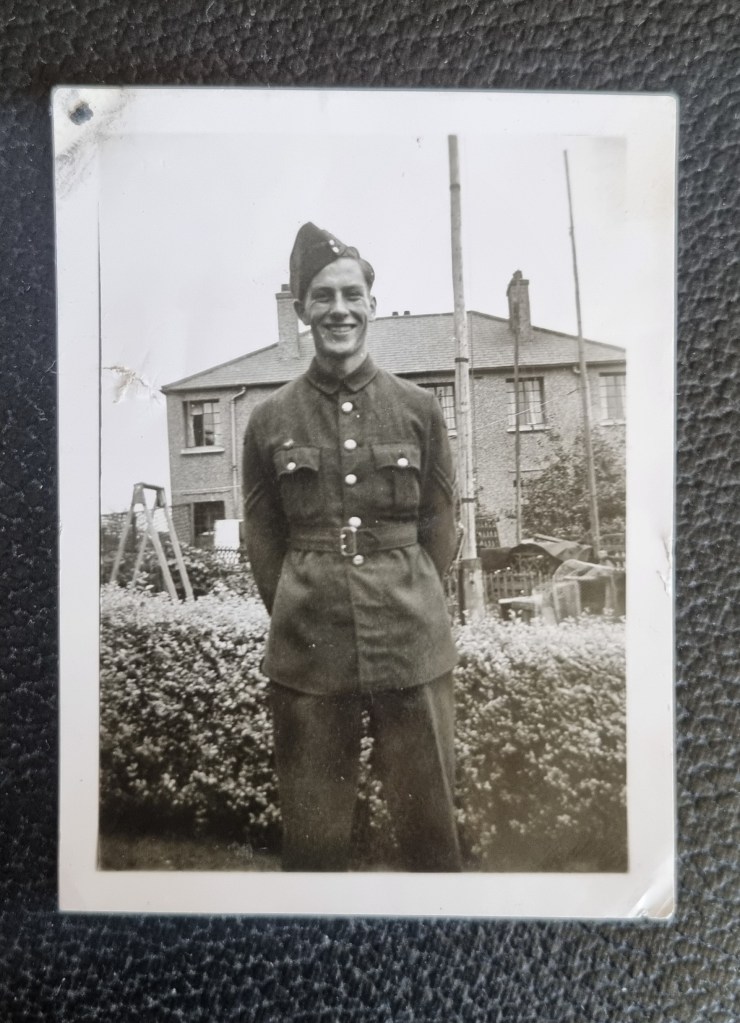
My Dad in ATC uniform in 1947.

My Dad was in the Air Training Corps towards the end of WW2 and for several years afterwards. It used to meet in the Main Hall at Grays Tech (now the Hathaway Academy) – where I was to stand through many an Assembly 20 years after.

The high point of being in the ATC, literally, was to get flight experience, usually in a Lancaster (painted white). The best of these was a trip in the ball turrent on the spine of the plane at the top. Some of these flights involved dogfight simulation, where a Spitfire or Mustang fighter would suddenly appear and act out an attack, so the bomber pilot would have to take evasive action, involving yawing, rolling and corkscrewing in a manner guaranteed to give everyone on board acute airsickness. My Dad felt he was very lucky to have avoided one of those.

In 1947, someone higher up in the RAF thought it would be a good idea to send keen cadets from the ATC to have a look at some of the places the RAF was based overseas. A brasshat came down and interviewed my dad and his cousin Len and, a little later sent a message through that they’d decided to send my Dad to Germany and Len to Egypt. Len’s Dad put a veto on that for him, but my Grandad didn’t. So, my Dad got a warrant to go to Northolt for the flight to Germany.

What’s weird about this is that they were sending 17 year old cadets off on their own, with no apparent plan or purpose beyond the trip as an end in itself. The aircrew Dad was flying with in their DC3 didn’t know he was coming, weren’t keen to have him aboard, and had no idea what to do with him. After a bit of discussion they decided to give him the title “Air Quartermaster”; and got him to dish out the sandwiches (dainty things from BOAC on the way out) coffee, and pass on messages – “we’re now over the Hague” etc. Air Safety demonstrations were not part of the job description, and he got to sit in the co-pilot’s seat which had an exellent view of the impenetrable cloud cover they were flying over.

When they arrived at Bucheburg (Bookyburg to them) the cloud cover was still solid and the pilot had to confer with the navigator to make sure they were in the right place – as the airfield was surrounded by hills on three sides; which at that time presented an obvious risk if he couldn’t see where he was. The Navigator being confident enough, they descended through the cloud flying in a spiral until they broke through to clear air beneath and landed.

On landing, no one knew what to do with my Dad, the crew had places to go and Frauleins to see and didn’t want a 17 year old cadet cramping their style, no one from the base was expecting him, nor had he been given any guidance on what he might do. One of the crew grudgingly took him to the bar on the base where the German barman protectively refused to serve Schapps when the crewman ordered it, possibly for the entertainment value – “not for the boy”. After a while the crew member went off leaving Dad to his own devices and to finish his beer. On a visit to the toilet he was approached by a German civilian who asked him for cigarettes – “Zigaretten?” – so he gave him three. In the late 1940s in Germany these were not usually to smoke, but use as currency.

He then walked a little way into the town, which was lively in a “Bachanalian orgy” sort of way. There were “no fraternisation” bans on relations with German civilians, but the RAF crews and the local women did not seem to be paying much attention to them. Leaning on a lampost at the corner of the street, taking some of this in, he was shouted at by a Military Policeman sitting in a jeep on the other side of the road. “Airman! Over here!” Standing in front of him the MP noticed the ATC patch on the shoulder of his uniform and asked what it was. The other MP in the back of the jeep said “He’s just a boy”, so the first one contented himself with telling Dad off for standing with his hands in his pockets. “It creates a bad impression”. Wouldn’t want that with a Bachanalian orgy going on.

The following morning at breakfast, the crew were sitting around regaling each other with tales of exploits and conquests from the previous night, some of which might have been true. Before the trip back Dad went for a walk to the hanger where the DC3 was waiting. The doors to the hold were open, giving off an overpowering smell of coffee – which implied a certain amount of off the books trading.

On the trip back – in which one of the passengers was a former German soldier in handcuffs heading for a war crimes trial – the “Air Quartermaster” had to dish out the sandwiches again – thick RAF doorsteps filled with Corned Beef this time – and, having landed was, as with every other step of this trip, left to his own devices to get home.

Other cadets must have had these trips, but there seems to have been no debriefing beyond the local ATC CO asking if it was a good trip. The expected (opaque) response “Yes Sir!” may not have been universal, because this particular experiment was never repeated. Unless it simply petered out in the same aimless way that it seems to have been set up.

So endeth my Dad’s first trip overseas.

Barbarism

I originally wrote this in December, shortly after Refaat Alareer was killed by the IDF, in the spirit of his poem If I must die but didn’t publish it at the time because I thought it didn’t do him justice.

But, now Netanyahu has repeated the line “We are in a battle of civilization against barbarism” in his deranged rant at the US Congress calling for more weapons to “finish the job faster”; so, time to fly the kite.

On the day this was written, Palestinian casualties stood at 18, 412. Today, it is more than twice that. What price “civilisation”?

Barbarism

In the battle of civilisation against barbarism

It is necessary for the civilised

To bomb the schools of the barbarians and kill their children

To bomb the homes of the barbarians and kill their families

To bomb the hospitals of the barbarians and kill their doctors and nurses

To stop the barbarians’ sources of fresh water, so they thirst

To stop the barbarians access to food, so they hunger

To cut off the barbarians’ access to medicines, so they sicken

To kill the barbarians teachers and poets to still their stories

To bulldoze the barbarians olive groves to empty their land

so you can say later that they were never on it

To flood the ground water with salt so nothing can grow

To bomb the barbarians libraries and archives to erase their history

in the futile hope that, this time, “the young will forget”

To drive the barbarians away from shelter

Make them move, again and again

To make sure that they despair

To strip barbarian prisoners to their underclothes and make them kneel in the dust

To kill a hundred or a thousand barbarians for every civilised casualty

So everyone knows that order is restored

Because every civilised mother knows

That their children can only sleep safely

When the barbarian children are all safely dead.

In a grave

Still digging…

12/12/23

Decolonising History in the Anthropocene – a proposal

“He (sic) who controls the past controls the future. He who controls the present controls the past.” George Orwell (1984)

In a civilisation facing an emerging climate catastrophe that its education system is ill equipped to cope with – we face the difficulty of having to imagine a future within a mental framework dictated by the limits of the society that is creating the crisis – and by people in charge who seem content to run on with business as usual until its too late. The way we teach and learn History is currently part of the problem and needs to be part of the solution. Those who control the present want to lock us into a narrative about the past that suits them; and prevent us imagining any future that does not.

The limits of a “national” framework”.

History is usually taught within a national framework – and therefore looks at the world in a distorted way. The way that each significant country prints maps that show it at the centre is a similar distortion in Geography. US maps split Eurasia in half to show the Americas as middle Earth, European maps centre on the Greenwich Meridian, Chinese maps centre on the Pacific and East Asian region – where most of the world actually lives to be fair. In these, the Americas are a fringe continent on the right and Europe tucked away and barely noticeable in the top left corner, while Britain is barely visible as a little blur of islands almost beyond Ultima Thule and of no significance whatsoever. Seeing one for the first time comes as a shock when you are used to seeing it smack in the middle.

So it is with the national framework for History. The use of History as “the national narrative” (“Our Island Story”) tends to be promoted by the centre right – as “national epic” by the far right. But, even without this being that explicit, looking at the world through the lens of a particular nation – which means through the views of the people who run it – is as disorienting as mapping the world in your head by absorbing Mercator’s projection. When I was in First Year Juniors in 1961, we had a huge world map on the wall – lots of it still coloured in pink – and – being a day dreamy sort of child – I spent a lot of time looking at it – the shapes, the colours, the relative sizes. Many years later, as an adult, I found it almost impossible to accept the reality that Brazil has a larger land area than the United States; because the map in my head was Mercator’s and – on his map – it doesn’t.

The purpose of nationally framed History is to create a shared mental space, a common imaginary identity built around a self image of a “people” with certain fundamental characteristics in common (which comer-inners have to integrate into) and a presumption of allegiance to time hallowed institutions and ways of doing things. This is the way “we” do it. The stories that are told may or may not be true. The way they are framed frequently owes more to myth than truth. The Washington Post ran a story last year about the way British History is perceived in Britain and the way it is perceived in the rest of the world. In Britain, people thought that the most significant and archetypal experience in British History was World War 2.  In the rest of the world, without exception, the most significant and archetypal experience in British History was seen as the British Empire. I suspect that the rest of the world – a large part of which was on the receiving end of it – has us bang to rights on that.

Eric Hobsbawm remarked (in Fractured Times) that no one knew how to teach History in Vienna in the 1920s. The old text books glorifying the Austro- Hungarian Empire were still in the schools, but the seemingly eternal Habsburg Emperors were no longer holding sway from the Hofburg, and the Empire had shattered, under the crushing pressure of World War, into disparate components run by nationalists with smaller, fiercer stories told in a vernacular closer to home. Some Austrians were soon to find their own version of this, but in the meantime, the History text books were glorifying a ghost.

At the time of America’s “unipolar moment” in the early 90’s – declared to be the “end of History” by Francis Fukuyama – there was a globalising version of this, with all previous human societies and social orders as preparations for the American way of life; now posed as a norm for the rest of the world to match up to; rather than the extraordinarily hollow, wasteful and precarious existence we know it to be. Rather like the way Hegel – teaching as he was in Berlin – interpreted the whole of human History – and the ultimate working out of the Weltgeist – as leading inexorably and benevolently towards its perfect incarnation in the Prussian state of the 1830s. Both these flatten out a key point about History – that human societies have been very diverse and there is no one model for them. They have changed. The present is unlike the past in many respects and the future need not be like it either.

None of these frameworks are of any use at all in understanding how humanity got to the current crunch and, if what we understand of history is to be anything other than stories we console ourselves with – or use to blame others – as the planet burns, it needs to be.

An Environmental Framework

We need a framework for History that looks at forms of human society in relation to their environment. All human societies have a definite mode of surviving that is defined by – and transforms – the environment in which they develop and lead to characteristic social relations, political and religious forms which define the character of conflicts and struggles within them.

What follows is a draft and meant to stimulate discussion and development. There is no attempt to look at pedagogy, nor what to teach when; more an attempt to sketch an initial brainstorm of what kind of understanding we need. There are huge gaps reflecting the limits of my own learning. This is not a chronological list. The list of examples at the end of each section is just that – not an attempt to be exhaustive nor to suggest that each of them has to be studied. References: Guns Germs and Steel Jared Diamond. What happened in history. V.Gordon Child.

Hunter gatherer (paleolithic) leading to Early Farming (neolithic)

Emergence of human species. 95% human existence has been as hunter gatherers.

Humans as social animals. Speech. Tools. Art. Polytheism. Matriarchy or patriarchy or both?

Currently existing hunter gatherer societies in rain forests.

Impact on environment. Extinction of mega fauna in the Americas and New Zealand after human arrival.

Farming emerging from and generating denser populations. Why did this happen in some places and not others?

Which plants could be grown and stored in sufficient amounts to be viable for farming and where were they?

Which animals can be domesticated and where were they? Diets and disease.

River based early local Empires (Bronze Age Eurasia – advanced stone age Americas)

Common features. A big river and/or irrigation. Ships for bulk transport. In Eurasia wheeled transport – carts and chariots. Bronze tools and weapons. Storage for surplus food. Armies. Specialisation of trades. Ploughs. Animal power – horse, buffaloes, camels, Llamas (in South America). Writing, keeping accounts, partial literacy. Monarchical theocracy with partially animal based gods. Priesthoods beginning to investigate the stars and develop mathematics. Oral story telling in poetic form. The first written stories and Holy Books. Monumental building. Life bound up with natural cycles and vulnerable to them (the years of the lean cow). The spread of the local empire dependent on the limits of horse power and the extent of controllable space.

The Maya as a study of a society hitting ecological limits? How did the Inca Empire get so big?

Possible examples. Mesopotamia, Indus Valley, Egypt, Shang Dynasty China, Maya, Inca,

Large Empires (Iron Age – medieval)

As above but more so. Iron tools and weapons. Water power. Roads. Emergence of more human like gods and development of monotheism in Rome and Arabia.

Monotheism as a cultural/moral/legal framework allowing expanded trade in medieval Christendom and Caliphates. Heresies and schisms.

Slavery and economic implosion (Rome). The impact of (natural) climate changes on agriculture after the “Roman optimum”. The impact of drought on nomadic movements.

Vulnerability to disease and climate shifts (effect of volcanic winter in 530’s and subsequent plague in Byzantium and elsewhere).

Early Chinese industrialisation – what stopped it taking off?

Rome. China. Caliphates. Khanates.

First Globalisation

Oceanic exploration – Ocean going ships from China and Europe. Why did China stop? Global trade, gunpowder, plantations, slavery and slave trade, racism, pandemic genocide of native Americans.

The “little ice age”. Why did it happen?

Industrialization

Surplus capital from above – Steam power. Machines. Mines. Factories. Mass production. Canals to railways. Mass transit. Mass migration. From sail to steam. From flintlocks to rifles. From wood to steel. From villages to cities. Massive rise in population.

Unevenness of development. World Empires, world wars 1740’s – 1815. Science turned to production, the production of science. Increased scientific exploration of everything. Mass education. Mass entertainment. Mass politics. Mass struggles. Gas power, electricity, chemicals, oil, motor vehicles.

Rise and fall of Pax Britannica. Sea based global power.

Carve up of Africa – colonial genocides and famines – resistance to and within Empires.

Empires turn on each other – WW1 and WW2. Revolutions and civil wars – Russia, China.

Cycles of growth and collapse. Great depression. Fascism. Holocaust. Dust bowl.

The Anthropocene

When did it start?

Atomic power and nuclear bombs.

The American Century? Rise and decline of the Pax Americana. Air based global power.

Decolonisation and neo colonialism. Cold wars up to 1989. Hot wars since. The collapse of the USSR and the rise of China.

“Green ” revolution and land degradation. Patenting nature. Industrialised agriculture and factory farming. 6th mass extinction.

“Just in time” patterns of global trade. Containerisation and the shift away from manufacturing in developed countries.

Space – the final frontier?

Climate change awareness. What is happening? Who is responsible? Who is already paying the price? Contemporary movements for change.
Throw them all in the river? The psycho – geography of statues.

This post was originally written last September after the huge global strike for climate; and was inspired partly by noting which statues the protesting children felt comfortable standing under and which they did not. Thoughts on the present moment at the end.

On the way down to last Friday’s climate strike and I found myself, not for the first time, staring up at the statue of Sir Douglas Haig in the middle of Whitehall.

Haig is sitting on a horse. He was a General and a cavalryman, so you might expect that. But there is something very odd about the horse. Haig looks as though he wants it to move on. He is leaning forward slightly, with a stubborn and bemused look on his face.

But his horse is an effigy of a horse. It has not been sculpted to show any sign of life, to look like a real horse frozen in a moment. It looks like a sculpture of a model of a horse, a statue of a statue. This peculiarly static quality might have been a subconscious expression of Haig’s inability to push his way through the trench systems at the Somme or Passchendaele; or possibly an ironic comment on his continuing belief in cavalry as a viable fighting arm right to the end of his life in 1928. He is riding a dead horse…as well as flogging one.

This is a bit like Diagalev’s comment to Ravel that his composition La Valse was not a ballet but a picture of a ballet. Composed as a tribute to Johan Strauss II and the classic waltzes of fin du seicle Vienna – the frivolous effervescence of a society in a condition that was “fatal, but not serious”- could not be anything else after the Empire that generated it was crushed into fragments by the First World War. The Habsburg Empire was dead. So was the Waltz.

So was the cavalry. The statue shows Haig as unaware – and he seems puzzled that he can’t make his horse move.

This is in contrast to the Blues and Royals trooper by Horse Guards Parade, who is sitting utterly rigidly, with the psychotic stare of the terminally bored – and the pornstache of thin men trying to be butch -with not a flicker of movement, but radiating hostility: while his horse takes a lively and friendly interest in the streams of striking school students pouring down towards Parliament Square.

Haig’s is the last equestrian statue on Whitehall. The last of the line. The final mounted military aristocrat after a thousand years of them. Behind him is the Duke of Cambridge. A plump late Victorian gentleman in full fig, commander of the British army for forty years, leaning casually back with complete self assurance; while his horse is showing signs that it is beginning to find his weight a bit too much to bear.

Haig is looking South towards the Cenotaph, memorialising all those men that he did for with his plans of attack. His head is bare, perhaps in penance: but his jaw is set and he looks stubborn enough to do it all again in exactly the same way because he does not have the imagination to think of anything else.

Looking back up at him are the craggier Generals of World War Two. Field Marshal Alexander is wearing jodphurs as a last echo of aristocratic horsemanship, his swagger stick behind his back, while Marshal Slim stands solidly with his huge slouch hat, grim jaw and mighty boots. Monty, on the other hand, looks straight across the road at Downing Street with a set and grim expression on his face – as though he doesn’t trust civilians to run the show.

In Parliament Square small children dance in the sun on the plinths of statues.

They seem to have chosen wisely – ones they feel safe on.

None are standing under Benjamin Disraeli, or Lord Palmerston, or General Smuts.

Some are standing among flowers, as though they have grown there.

Some are jumping up and down under the open hands of Nelson Mandela, giving them a protective benediction.

Other are doing the same under the spreading banner of Millicent Fawcett – “Courage calls to courage everywhere”- as Millicent stares sternly above their heads.

Ghandi has been left in peace, but someone has stuck an XR sticker on the hem of his shawl. He does not seem to be offended.

A few years ago I was showing a visiting South African Head teacher around London and, looking at the statues in Trafalgar Square, he murmured “Hmmm. Nation of warriors.”

I was quite shocked by that. Until that moment I hadn’t seen the message of these statutes. Had just taken them for granted. They had always just been there from when I was feeding pigeons as a toddler, part of the backdrop, somehow eternal, taken for granted, natural.

The messages that are most dangerous are the ones that are taken for granted, subliminally absorbed so they become just “what is”, common sense, normal.

What we choose to memorialise and honour in bronze and stone in our streets is a conscious choice. It defines our public space and who we think we are. They are like bronze bolts holding an oppressive reality together in our minds and making it seem inevitable.

The worship of the “heritage” that they represent is an endorsement of it. It does not mean an honest appraisal of Empire, but an attempt to cling on to its afterglow. Challenging their continued presence looming over us on their plinths is as freeing as clearing the air and roads of constant traffic has been soothing. It means the future need not be limited to the crimes of the past.

In acting together to take them down we are pledging ourselves to a future of possibilities beyond the limitations of the past, not an endless continuation of it “going forward.”

June 2020