“Terrorists” don’t litter pick

I have spent too long in the last two years feeling inhibited about wearing a keffiyeh; because it felt disrespectful to people who have been so relentlessly bombed and starved. To identify with them without undergoing what they are going through seemed somehow trivialising. Not worthy. This was, of course, absurd self indulgence. The point of wearing it is to show solidarity. Now that we are over two months into a “ceasefire” during which the IDF have carryied on relentlessly, remorselessly firing and killing people every single day, it feels disrespectful not to put it on.

On my way to the Palestine soldarity demonstration last Saturday, I was walking down an extremely steep hill that should probably have bannisters, when a woman coming out of her house spots my keffiyah and asks if I’m going to the football, before correcting herself, because its obviously not a team scarf. “No, the Palestine demonstration” I say cheerfully, smiling at her, because its something that should not be seen as an“out there” activity – the way the government and press presents it – only carried out by people you can put in a pigeon hole marked “dangerous” – when anyone can go, and a vast range of people who have basic human empathy do. As a result, its also a lot safer and more peaceful than a lot of football matches too of course; and a lot more good natured.

In something of the same spirit, as I’m leaving the flat with the keffiyeh on, and come across a pile of potato peelings, old spuds and eggshells that someone has considerately left splattered across the pavement, I go home, get my spade and food waste caddy and shovel it in; because “terrorists” don’t litter pick. And I am extra polite and considerate all day for the same reason. If you are wearing something that identifies you with people who are being attacked, and the commanding heights of government and media are portraying those people and anyone expressing solidarity with them as some sort of threat, opening the door for people, or gesturing for someone to get on the bus first with a smile, undercuts their smears about who we are. Speak softly and carry a strong message.

The opposite of the approach recomended by the pharmacist in my local chemists, with whom I often banter. “How you doing?” “OK, pootling along. One day at a time”. “Good idea. Keep your head down”.”Nah. Won’t be doing that!” At times like this, we need to keep our heads, and elbows, UP.

Walking on further, it occurs to me that during that whole hyped up broo ha ha about the ban on Tel Aviv Maccabees fans travelling to that game at Aston Villa, and subsequent witch hunting of the West Midlands chief constable out of his job – as if these fans didn’t have a reputation inside Israel for racist thuggery, and as if the Amsterdam riots hadn’t happened in the way we saw them do – put emotively as “Jews are being banned from watching football” (as if all Jewish people are complicit in their behaviour, as antisemitic an identification as any you could wish for) no one mentioned the fact that football teams, or players, from Gaza were routinely not allowed out of the strip in the “normal” conditions before Oct 7th nor that, as of August last year, the IDF has killed over 672 Palestinian athletes since, including over 240 footballers; so perhaps some sense or proportion might be in order.

A sartorial paradox is that I’m also wearing my Dad’s old raincoat, bought from Israel supporting Marks and Spencers. A strict interpretation of BDS would consign this garment to the bin, but in some ways wearing it could be seen as a sartorial expression either of a two state solution and/or a one state solution – an Israeli mac and a Palestinian keffiyeh coexisting alongside each other, or, indeed, together in one ensemble.

On my way past the last contingents streaming into Whitehall from the Strand two hours after it started, with a spirited version of Bella Ciao belting out from a mass drum band powering the sort of resistance dancing that uncowed people do, an old friend tells me to “watch out for the far right in Trafalgar Square”. The last bitter fragment of UKIP, people for whom Nigel Farage is too much of a softy sell out, a sliver of ice in the heart of the body politic, “the cold cursing the warmth for which it hungers” as Tolkein put it, had planned a march on Tower Hamlet that afternoon. Anything Oswald Mosley could try. Perhaps for their own protection, the police had banned them from doing so and given them a route provocatively close to the Palestine demo, perhaps hoping for incidents that could then be played up to ban future marches. Checking out their route before coming in to Central London so I wouldn’t walk into the middle of them unawares, I’d noticed that they had been given an embarassingly tiny, tiny patch of Marble Arch to assemble in; with strict instructions to stay on it or face arrest. Walking up alongside the Square, where they were supposed to be rallying, there was no sign of them until a small knot of people, that could at first glance be mistaken for a tourist walking party, could be glimpsed gathered in a desultory huddle outside the National Gallery. One or two Union Jacks, a couple of wooden crosses of the Christian nationalist persuasion and, at the back, a small phalanx of Iranian monarchist flags mark them out as the weird bloc they are. I head into St Martins crypt for a coffee and to meet a man about the climate crisis.

Fashion to lose your head over

Seen at Kingsbury tube station yesterday. Marie Antoinette, well known for taking the “off the shoulder look” to extremes. If the V&A cafeteria has not booked in extra supplies of cake, they are missing a trick.

On my search for sandalwood shaving cream from Taylors of Old Bond Street, because it makes having a shave more of a pleasure and less of a chore, I missed the shop because I was so gobsmacked by the prices in this tailor shop on the corner of Piccadilly Arcade. Taylors, although of Old Bond Street is, peculiarly enough, in Jermyn Street. Look at the price tag on the blue jacket.

I mean, its a nice jacket. But initially retailing at £1750, now a snip at £995? People who might think that a bit of a steal have no idea what life is like for most of us – or possibly do and don’t care a great deal. The slogan on the back of Melania Trump’s jacket stating exactly that while touring immigration detention facilities on the US Mexico border was such an in your face message – and so obviously true – that commentators tried to pretend that it was irony. Let them eat wormy food. The popularity of these people is now being shown in the attendance figures for her Biopic. Almost empty cinemas casting a hollow echo to their narcissistic presumption.

I wandered off down the street looking into other shop windows and found a pair of beautiful, highly polished brown shoes retailing at £605 (for the pair, not each). You would be afraid to actually wear a pair of shoes like that. Maybe you’d put them in a cabinet. Possibly at the V&A.

I recall once dispersing from a teachers unions march to defend our pensions, with my school union group banner slung over my shoulder, walking through the usual rush and bustle on the East side of Picadilly circus, all the tatty tourist barking from the Trocadero and that slight sense of sleaze that spills over from being so close to Soho, passing through a sort of portal at the top of Lower Regent Street, which was packed with black bomber jacketed Greek Football fans from one of those continental clubs that still thinks its 1935 (or wishes it was) to emerge into Picadilly proper and a different city, all Royal Academy and Fortnum & Masons; and finding myself being stared at by more than one man wearing a cravatte.

Taylors, however, when I walked back up the street and found it, was delightful. I was expecting a bit of being looked at down at along people’s noses, especially as I was wearing a Keffiyah, but everyone was extremely friendly, polite and helpful. Tiny little shop full of good quality products, attractively arranged, full of people buying them, in a away that felt more cosy than crowded; and an actual barbers shop at the back, smelling like a barbers, so a working shop with products and praxis rooting it in its job, with a couple of plump Turkish looking blokes with their sleeves rolled up ready to do the business wearing welcoming smiles – possibly because I was wearing the Keffiyah. A very polite young man, formally dressed, opened the door for me on the way out. Classy, in a good way.

Songs on the deaths of children: where racism leads you.

Brother Martin, are you sleeping?

Today’s busker at the junction of George St and the High St was a woman playing the accordion in a series of slow waltz like tunes that were hard to identify. One sounded a bit like “Chim Chimmeny, chim chimmeny, chim, chim cheeree” as reimagined by a Klezma band from Bucharest. There was something quite mournful about the tunes, but infectious enough to walk along in a waltzy sort of way, one, two, three… one two, three. Walking any other way would have been walking against the rhythm, in the street, in my head. As it was, I was the only one in step.

When Stephen Spielberg asked John Williams to compose the music for Schindler’s List, Williams told him that to do justice to the full horror of the death camps, he’d need a really Great Composer. Spielberrg said he agreed, but, regretfully, they were all dead. Implication, you’ll have to do.

In the event, Williams did a pretty moving job, but, listening to a version of the third movement of Mahler’s First Symphony, I think he could have used that. A slow tempo, mournful version of Bruder Martin (the German version of Frere Jacques) composed as a funeral march and reflecting on the deaths of children.

Throughout the nineteenth century, the child mortality rate in Austria – where Mahler lived – ran at roughly four children out of every ten dead before they reached the age of five. Every year for a hundred years. This only started to decline at the beginning of the twentieth century; too late for Mahler, eight of whose 14 siblings died in infancy, as did his eldest daughter.

Knowing that, its hardly surprising that he wrote a song cycle called Kindertotenlieder (songs on the deaths of children).

But, all that was from natural causes, poverty, squalor. The Nazi extermination drive was to kill 1.5 million children, mostly Jewish, on an industrial scale. The local library has a Holocaust Memorial Day table with a selection of reading. It struck me that there was nothing on it by Primo Levi, whose memoire stories like Moments of Reprieve and If This is a Man are remarkable for finding fragments of humanity in the most inhumane possible circumstances which in no way diminishes the horror of it, quite the reverse.

I asked the librarian if they had any of his books. She had never heard of him and looked him up on the system. “The chemist?” having found his scientific book The Periodic Table, which he wrote after the Auschwitz books. She looked a little further and found them. I recomended that they be put on the table, and I think she was going to do it.

As I left I remarked, “you could probably do with putting a sign with the books reading ‘This is where racism leads you’.” She smiled, made moue and said “we can’t be that direct”. A pity.

Why Peter Hain is wrong

Labour List published an article from Peter Hain this morning arguing that the government should take on debt to finance its war preparations. This is my letter in response, which I’m pleased to say that they published as the top letter. Some of the points will be familiar for anyone who reads these blogs, but bear repeating because they are routinely ignored in the mass media.

Peter Hain’s argument that the government should borrow to finance an armaments drive has three problems.

  1. The quantity of money required to reach 5% of GDP on war would be £77billion every year. George Robertson’s projection for Euro NATO standing alone without the United States is 7%. The costs of paying the interest on this rapidly accumulating debt would be crippling, and it would act as an enormous financial black hole sucking resources away from everything worth while that government can do. Overseas aid was just the start. A militarisation drive would impoverish us across the board, as well as, with “a whole society approach”, copper bottom restrictions on dissent and pose questioning as treason. “Military Keynesianism” is also a mirage. Investment in weaponry does not build anything worthwhile that people can use, or that makes life better, as investment in sustainable energy, health services, public transport etc do. 
  2. The presumption of an impending war with Russia – in which we should be prepared to “lose our children” -is a form of madness. It is posed as a defensive response to Russian aggression. But Russia has neither the capacity nor the desire to attack the rest of Europe. It has taken them four years to occupy parts of Ukraine that mostly speak Russian and where they have substantial local support. Trying to occupy Western Ukraine or, say, Poland, where they would face intense hostility from the top to the bottom of society would be, as US Conservative analyst John Mearsheimer puts it “like trying to swallow a porcupine” At the moment, Euro NATO, without the USA, already outspends the Russians by 3.5 to 1, has twice as many service personal and advantages in all kinds of war material that range from twice as many aircraft and tanks to three times as many artillery pieces. Trying to double this again cannot be seen as defensive, but is preparation for a possible offensive operation which, if carried out successfully, couldn’t help but trigger Russia’s nuclear thresholds so, to put it bluntly, this is a course that can only end in us all being killed by it. The alternative of finding a European modus vivendi with Russia through negotiation seems to have been lost in a red mist. Time to sober up.
  3. There is no collision with Trump. European NATO countries will not stand up to him over Greenland, they will accommodate. Justified hostility to Trump is being used to give him exactly what he wants – a huge arms drive that will further disadvantage European economies, lock them into a confrontation with Russia, to the mutual harm of both – and leave him with a free hand to intervene at will across the rest of the world while preparing for the ultimate military showdown with China  before its too late (before the US is overhauled by peaceful economic competition and its fatal, fossil fuel based paradigm of modernity tossed into the dustbin of history by the spread of cheap Chinese solar panels). 

None of us has any interest in any of that. We cannot afford to sleepwalk into World War 3 the way that the Great Powers did into World War 1; any talk of war being “inevitable” tends to become a self fulfilling prophecy. As we won’t survive such a war, it is profoundly irresponsible and light minded to become a cheer leader for the course towards it.

Please note that Facebook blocks my blogs, and doesn’t reply tom questions why, so, if you think these argumenst are worth getting about, please pass them on through other media.

One is not supposed to weep at the Radetsky March

I have, nevertheless, been doing so since the Vienna New Years Day Concert in 2014. Barenboim was conducting, and, as he marched on stage for the traditional final encore with an imperious flick of his baton, rather than crashing straight into the opening chords, a snare drummer tapped out a call to arms – tappity tappity tappity tap – trrr rrrr – RAT TAT TAT!

A whole set of emotions welled up. That sort of rhythm is designed to do that, meant to rouse the listener into a heightened emotional state and carry them away to take the Emperor’s Schilling; and visions of drumhread recruitment in towns and villages all across the Austro Hungarian Empire – and the rest of Europe – invaded my mind, along with a historical memory of what happened next that none of those swept up in war euphoria, or war fatalism, a hundred years before could possibly have had.

Painting of a soldier undergoing surgery by surgeon and painter Henry Tonks circa 2015 from Faces of Britain by Simon Schama.

A quote from the same book. The nature of trench warfare, punctuated as it was by futile forays over the top, had exposed the heads of soldiers, nothwithstanding their helmets, to taking fire in the face. Exit wounds were gaping. Some shells had been designed to spray schrapnel, to devastating effect. Magnesium fuses were encased within, expressly intended to catch fire when lodged in tissue, resulting in the burning away of noses, eyes and cheeks.

More than 20 million dead at the end of it. And a comparable number wounded or mutilated. And World War 2 was worse. World War 3 has been unthinkable because there would be no one left at the end of it, brief though it would be.

Yet now we have the uncrowned heads of Europe and their media shils single mindedly trying to make it thinkable. Preparing us for a war with Russia by the end of the decade. Mark Rutte thinking he can succeed where Charles XII, Napoleon Bonaparte and Adolf Hitler failed.

Posing a war of choice as “defence”, as they always do, as every power did in 1914, avoiding any mention of the nuclear risks, avoiding any mention that they already outspend the Russians 3.5 to 1, avoiding any mention that Russia has neither the intention nor the capacity to invade the rest of Europe, avoiding mention of any alternative course, as if “war, war” is better than “jaw, jaw”.

This is part of a “whole society” approach aiming to make us stand to attention and salute without question. The most dangerous aspect of this sort of war fatalism, linked to escalation in arms build ups and suppression of dissent as treason, is that it poses war as inevitable – and when all sides accept that that is the case, war is what you get.

None of us has any interest in that. Not least because we’d all be dead at the end of it.

Yannick Nézet-Séguin did it again in this year’s concert. He made the usual speech before the encores – “music can unite all of us because we live on the same planet” – which felt peculiarly hollow this year, given the way the drums are beating all over Europe. Then off into Blue Danube and Radetsky, with the drum call to start and the well heeled Viennese spiessburger audience clapping enthusiastically along in a joyful romp towards Armageddon, just like so many of their ancestors did in 1914.

In an ironic counterpart, the final song in Jules Holland’s New Year Hootananny the previous evening was a singalong version of “Enjoy yourself (its later than you think)”.

New Year resolution for 2026, to beat a different rhythm and break up the march to war.

Christmas Refomed by Reform

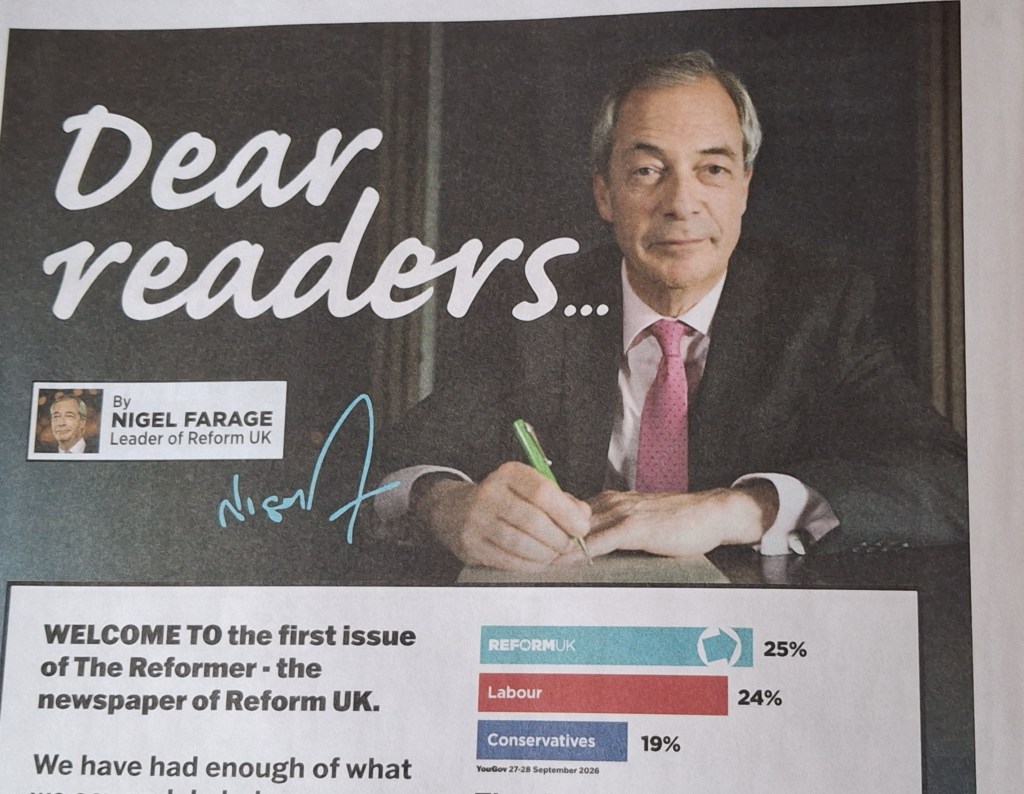
I see that Reform has launched a “Christians for Reform” movement for the sort of true believer who thinks that “turn the other cheek” is a reference to mooning someone you don’t agree with.

At the launch Sarah Pochin MP* said that “we are fundamentally a Christian country”; which might be seen as trying to bolt the door after most of the horses have fled. At the last census fewer than half of the population identified as Christian (46%: 13% fewer than ten years earlier); and these combine a multitude of sins. Most of them embracing the sort of values that Nigel Farage sees as “woke”, and gives as a reason for not going to Church.

So, Reform believes in Christianity, but not the Christianity expressed by the Church of England, or, for that matter, Jesus.

Lets see…

“Love thy neighbour as thyself”.

“It is easier for a camel to thread the eye of a needle than a rich man attain the kingdom of heaven”.

Neither of those will fit neatly into the manifesto.

Which makes Anne Widdicombe’s remark that this launch was “the day when Reform and Christianity are merged” sound like an attempted hostile takeover.

Similarly Tommy Robinson’s Union Jack bedecked Carol Service in Whitehall billed as “putting Christ back into Christmas”, comes across as stuffing Him back in there hard whether He likes it or not (once He’s had His head shaved, a bulldog tattooed on his forearm and his sandals replaced with bovver boots). I do wonder what they were singing…

Possible slogans for a Christian Nationalist Christmas.

There is definitely no room at the Inn.

The only good Samaritan is a dead Samaritan.

Blessed are the gobby.

Peace and Goodwill are for wimps.

Forgive us our historic trespasses, but crush those who we fear might trespass against us because of them.

Keep your widow’s mites, we want crypto.

*Last autumn Pochin famously complained about adverts being too “woke” because they were “full of Asian people”. So, she may not have noticed, is the Bible.

Horror shock! Miniscule proportion of sexual offences committed by tiny proportion of asylum seekers!

Its not every day that I read the Daily Mail. Finding one abandoned on the train to London, I read through it; which was a bit like wading through a river of sneering bile. One article in particular grabbed my attention, prompting this letter to the editor.

Sir,

Your article “The shocking map of Britain that reveals true scale of sex crimes by illegal migrants”, as a result of “the most comprehensive study of such incidents ever compiled, combing the records of crown and magistrates courts around the UK to document the vast number of asylum seekers…who have committed sexual offences over the last three years” managed to find 59 cases. 

Your reporters must be aware that in that three years 285,523 people claimed asylum in the UK. So, if 59 of those committed sexual offences, 285,464 did not. Which of these two numbers looks “vast” to you? I suppose a more accurate headline reading “Only 1 in every 4,758 asylum seekers committed a sexual offence in the last three years” would not have suited your purposes.

Just to underline this point, during the same three years there were a total of 592,882 recorded sexual offences. If, as you say, 59 of these were committed by asylum seekers, then 592,823 were not. If 59 is “vast”, what word would you use for 592,823?

Indeed, if you were to give coverage to all these offences, most of them carried out by born and bred Brits, to match the two and a bit page spread you gave to the 59, you would have needed a newspaper roughly 20,000 pages long to get them all in. I don’t suppose that would have conveyed the message you wanted either.

Is it too much to expect that you stop distorting the facts on this most emotive of issues?

Whose lives matter?

A complaint to the BBC.

In news coverage on TV and radio in the last two days there has been almost blanket coverage of the horrible antisemitic attack at Bondi Beach in Australia that killed 15 people.

Since the “ceasefire” in Gaza, the IDF has been directly killing an everage of 6 people every day (383 up to 12/12/25, so 32 times as many as were killed at Bondi).

People have also died from the less direct impact of malnutrition, illness, hunger and lack of shelter (with at least 12 dying from the effects of the floods over the weekend).

In the last two days, the IDF have shot and killed 2 children – one in Rafah, one in Jerusalem – and shot and injured two more.

May I ask why it is that there has not been similar blanket coverage of these horrible attacks in the interests of “balance”; particularly given the discrepancy in casualties and the suffering that brings?

If the gunmen in Bondi were unfeeling monsters to kill 12, what does that make the IDF to kill 32 times as many?

Where is your sense of proportion?

In anticipation of Remembrance for the next (last) Great European War

“If our country falters because it is not prepared to accept – let’s be honest – to lose its children… then we are at risk.” Chief of French Defence Staff General Fabien Mandon

This brings to mind Wilfred Owen’s The Parable of the Old Man and the Young

So Abram rose, and clave the wood, and went,
And took the fire with him, and a knife.
And as they sojourned both of them together,
Isaac the first-born spake and said, My Father,
Behold the preparations, fire and iron,
But where the lamb for this burnt-offering?
Then Abram bound the youth with belts and straps,
and builded parapets and trenches there,
And stretchèd forth the knife to slay his son.
When lo! an angel called him out of heaven,
Saying, Lay not thy hand upon the lad,
Neither do anything to him. Behold,
A ram, caught in a thicket by its horns;
Offer the Ram of Pride instead of him.

But the old man would not so, but slew his son,
And half the seed of Europe, one by one.

In the“season of peace and goodwill” the thoughts of our tiny leaders are turning to Armageddon. On the front page of the Daily Mail on 12th December, Minister for the Armed Forces, former Marine and MP for Selly Oak Al Carns is quoted as saying that “Britain is on a war footing” alongside NATO General Secretary Mark Rutte flagging up NATO intent with “Europe must prepare for the scale of war that our grandparents endured.”

There is something light minded about the way they pose this. As though it were conceptual. Something fictional. As if they can’t fully grasp the consequences of their actions, having never gone through anything on this scale – and lacking the inhibitions of previous generations that have.

In his foreword to Lord of the Rings, J R R Tolkein writes “One has indeed personally to come under the shadow of war to feel fully its oppression; but as the years go by it seems now often to be forgotten that to be caught in youth by 1914 was no less hideous an experience than to be involved in 1939 and the following years. By 1918 all but one of my close friends were dead.” Tolkein himself was at the Somme. As was my grandfather. And there is more than an echo of no mans land in the marshes of the dead outside Mordor, pale faces under water in shell holes reaching up to seize the minds of the living as they pass.

To be “caught in youth” in 2029 has every prospect of being not only “no less hideous” than 1914 or 1939, but also terminal for the rest of us too if we let them unleash the war they have in mind.

This is not solely a European problem, as this New York Times editorial openly calling for a US war with China, shows.

The UK Strategic Defence Review approaches this as a “whole society” mobilisation. That includes militarisation in our schools. Most of this will be about chilling dissent, but it will also involve a sharp increase in the number of Combined Cadet Corps that will be grooming our children to be killers (and be killed). In a secondary boys school I know of that has had a long tradition of having a CCF – as part of its aspiration to be as much like a public school in the 1920s as it can get away with – one of the consequences of it is that the War Memorial in the Hall is raw with recent names, former students barely into their twenties, dead in Afghanistan or Iraq. And those wars are side shows compared to what they are trying to get us to accept now. Like the late colonial skirmishes that preceded the mass slaughter after 1914. Just an overture.

In Germany a move to reintroduce “voluntary conscription” (as contradictory a phrase as you could even hope for – if its voluntary, it isn’t conscription, and if its conscription it can’t be voluntary) has already led to large scale youth and student mobilisations against it all across the country last weekend. We will need Refuseniks here too; and a movement of them.

In the spirit of Tom Lehrer’s remark that “if there are going to be any songs about World War 3 we had better start writing them now”, mourning the consequences of the war that the leaders of NATO in Europe are preparing for in advance is an essential part of preventing it.

There has been a sharp division on the Left over the war in Ukraine, but not such a division over opposition to increased military spending. Whatever anyone’s view of the former, its vital to be clear about the motivation of our own ruling classes. As they pose it, the need for increased arms spending and “putting our country on a war footing” is a response to “a rising threat” from Russia.

Leaving aside the strenuous effort that every power always makes in the run up to a war to convince itself and its population that its aggressive intent is solely defensive – Christopher Clark’s The Sleepwalkers details this for all the Great Powers in the run up to 1914, also emphasising how far they all genuinely believed that the best deterrent to war was being stronger than their opponent, which posed an escalating cycle or rearmanent and preparatory planning that locked them into the apocalypse that followed – that poses three questions.

  1. Does such a threat exist, is it “rising” and, if so, what scale of response is needed to face it?

This is the current balance of forces between Russian and the European NATO countries, leaving the USA and Canada out, as printed in the Observer during the Summer. To spell it out, it shows that Euro NATO, leaving aside Ukraine, has twice as many service personnel, three times as many tanks and artillery pieces and twice as many combat aircraft as the Russians have. And thats now. Are they seriously trying to convince us that doubling what is already a huge advantage is necessary to stop an attack from an evidently weaker power?

Doubling military expenditure only makes sense if they are not contemplating defence but attack. They would have a 7 to 1 advantage in military spending. Its a conventional military cliche that, to be sure of success, an attacker has to have a 3 to 1 advantage. 7 to 1 seems a bit excessive even for that, but for the powers planning to build it to be posing that as “defensive” – because they feel threatened by a power that currently has less than half their capacity stretches credulity a bit far.

2. What does Russia want? Strenuous efforts go into avoiding even posing this question. The source of the war in Ukraine is put down either to some inherent expansionist quality in the Russian character, or megalomaniac psychic flaws in its current leadership. What they have said they want is an end to NATOs eastward expansion – because they feel threatened by it – Ukraine to be a neutral country, a mutual security treaty with the rest of Europe and NATO; and for the Russian speaking areas of Ukraine to be recognised as having seceded and become part of the Russian Federation. Russia has no desire for a war with the rest of Europe. They will fight one if they are attacked, but they are not going to try to expand Westwards.

You don’t have to accept that this is solely from peaceful intent to recognise that any such ambition is militarily and politically impossible. The areas of eastern and southern Ukraine that consistently voted for Russia leaning Parties before 2014 could be absorbed into the RF and there be some prospect of peace afterwards. Absorbing Western Ukraine would be like “trying to swallow a porcupine” as US conservative analyst John Mearsheimer puts it. Poland and the Baltic States even more so. Let alone anywhere further West. As the USSR found out in Afghanistan, and the USA (and UK) in Iraq, you can’t hold a country that really doesn’t want you in occupation of it. There just aren’t enough troops.

3 How would such a war go? If we get to a point that the war preparations stumble, or are manipulated, into a confrontation that escalates into full scale war, there are two scenarios.

  • The better one is that it rapidly bogs down into the sort of horrific slog that has been going on in Ukraine for the last three years but on a bigger scale, killing, brutalising and impoverishing all of us as it consumes more and more of our children, lays waste to all the towns and cities on and around the front line, devastates energy and other infrastructure far behind the front. Thats the better scenario.
  • The other is that, it all goes very well for Euro NATO forces and they stand poised to break through deeply enough into the RF to crush and dismember it. At that point, Russia’s nuclear weapons would be deployed. Russia’s nuclear war fighting doctrine is that these weapons would be threatened/used in the event of an existential threat to the state. They do not have a “no first use” policy. Nor, in fact does any other nuclear armed power with the exception of China. US nuclear war fighting doctrine has been based on the notion of a succesful nuclear first strike since the early 1960s. So, in the context of Euro NATO “winning” there would be every prospect of the Russian leadership invoking a Europe wide Samson doctrine and bringing the whole continent down with them. A nuclear strike on that scale would not spare the rest of the world, as the nuclear winter effect from even the self immolation of a single continent would have a devastating impact, posing a sharp drop in temperature, harvest failure and global famine.

Remembrance for the victims of all this is best done in advance; and to take the from of mobilising to stop it and make sure there aren’t any.

In 1922, just after WW1, the Danish composer Carl Nielsen wrote part of his 5th Symphony as a battle between the percussion, representing war, and the rest of the orchestra, representing the forces of life. In the opening movement there is a point at which the snare drummer is asked to improvise “as if at all costs he wants to stop the progress of the orchestra” as loudly and intensely as possible to try to drown it out in volleys of explosive detonations, before the forces of life finally triumph and the drums retreat in an elegaic mourning for their previous frenzy.

It is now up to all of us in the labour and peace movements in every country to be that orchestra, and drown out the mad drummers that are trying to lead us to catastrophe.

Please note that Facebook does not allow my blogs to be posted. They claim that some people have complained that they are “abusive”. I find that accusation pretty abusive myself and reject it completely. I suggest that anyone reading this have a look through any of my blogs at random and make your own mind up about whether they are absive or not and, if you like them and really want to annoy Mark Zuckerburg, please post them around on other platforms.

The kindness of “strangers”

“We risk becoming an island of strangers” Keir Starmer.*

Now that I am old and full of sleep I find that people are occasionally starting to offer me their seat on the tube. It happened twice on a packed Metropolitan line train yesterday. Both the people offering were young women wearing hijabs.

We live almost at the summit of a very steep hill, so coming home laden with luggage is always a bit of a slog once we’ve got off one of the many buses that stops nearby but doesn’t dare try to ascend it. There are no routes. I suspect the drivers might need oxygen. At any rate, there is always a slight air of base camp about us as we pause at the bottom, look ruefully at each other, up at the slope, take a breath...”ready for this?”

Getting to that point close to midnight on Sunday in the rain, and a young black bloke in a car opposite starts shouting at us. We couldn’t make out what he was saying and initially weren’t sure he was talking to us, or had just stopped to shout at someone down his phone, or whether he was being threatening or not. So many urban myths, so little time. Thinking he might need directions, I wander over to talk to him; and it turns out he’s seen our predicament and was offering us a lift, which we very gratefully accepted. Friendly young man. Helped us in and out of the car with the luggage. Good deed for the day.

And on the way back, we struggled out of the lift at West Ham station just as our train was drawing swiftly in. Being a four carriage train it was sweeping ahead of us down to the far end of the platform, so we ran after it – limped in my case – as fast as we could, lugging backpacks, trundling wheely suitcases with bags balanced on top and pulling a heavily laden shopping trolley. On flopping down in a seat, having heaved all this up into the carriage- “pfff!” the Eastern European woman sitting opposite catches my eye, smiles and offers me a drink of water because “you look out of breath”.

Our neighbours aren’t strangers, and nor, it seems, are strangers.

* I know that Starmer now says that he deeply regrets using that phrase, but doing so was not an accident. All speeches of that sort are worked over many times by many people and every phrase is designed with calculated effect – which button will this push, which strings will that pull, what kneejerk reaction can we get with the other? His regret comes from being caught out as these calculations blew up in his face. He doesn’t, however, seem to have learned from this – that the xenophobes and racists he is trying to impress won’t be impressed and anyone who wants to fight them will be repelled – because he’s still on the same course towards disaster.