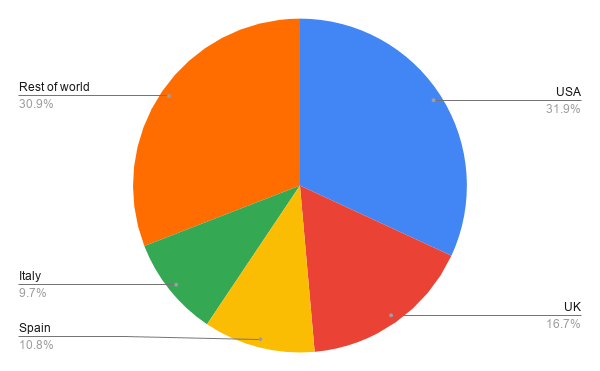
US and UK death rates stand out.

chart

This graph shows the totals of reported global deaths for April 10th. With the usual caveats that many places in the developing world may be under reporting – the figures for the USA and UK stand out starkly. One in three of all reported deaths in the USA. One in six in the UK.

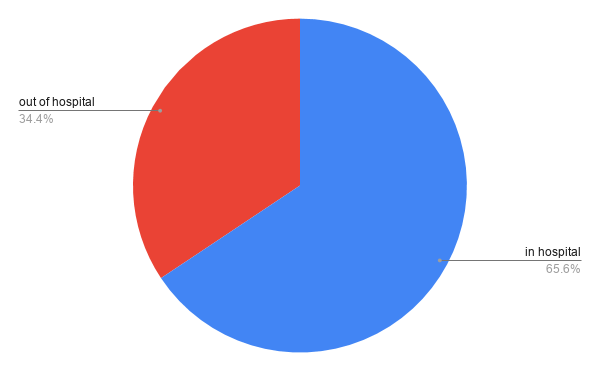
UK daily figures only include deaths in hospital, not those at home or in Care Homes; so the actual figures will be worse; probably significantly so. The Office for National Statistics will be updating these on Tuesday, so I will do another graph to take that into account then.

Three things to note.

  • The number of deaths in China on 10 April was zero.
  • With the UK death rate projected by the IHME (1) to hit a peak on April 17th with 1 674 deaths on that day, this is not a time to be prioritising talk of “exit strategies”.
  • Those concerened with these should be studying the Chinese experience of cranking society back into life – as the only country that has began to do so an a large scale.
  1. http://www.healthdata.org/covid/updates

Death and Exits. A stronger challenge needed from Labour.

The emergency measures being taken to deal with the immediate acute coronavirus crisis- and the preparedness to take them – can be seen as a model for the emergency measures we need to take to save ourselves from climate breakdown. Making extraordinary efforts to return to the “normal” functioning of an economy and society that is destroying the conditions for its own existence is like treating a patient to recover from an acute illness just to put them on palliative care only for a chronic underlying condition that has no need to be fatal. 
The Coronavirus is an acute challenge that could – if let rip – kill millions globally. All other issues are redefined by it. The crisis will go on for months and there will be no return to “normal” afterwards. So many things previously considered impossible have become inevitable in the last three weeks and some “impossible demands” will look absurdly moderate quite soon.
  • The necessary measures to effectively suppress coronavirus cost China a 20% drop in its economy in one quarter. They were prepared to do that, did it, and we should learn from them. In doing so they averted a potential 11.5 million deaths in a few months (assuming an 80% infection rate and 1% death rate).


  • The confused half measures being taken in the “West” will take longer and lead to more deaths.  This graphic from the FT illustrates the impact of the different approaches used in China and the US in deaths per million.

HubeiThis was from March 31st, so the Chinese bubbles will still be the same size. The US bubbles will now be significantly larger, and be even larger than that next week, and the week after. On March 31st 1550 had died in New York. By April 7th it had risen to 5489; so the New York bubble here should be just under four times as big.


  • This raises a real scream of financial pain from fractions of capital who are willing to sacrifice lives to keep the system running as it is. Open or covert advocates of “herd immunity” in the UK, Presidents Trump and Bolsonaro, the Wall Street Journal, columnists in the Times and Telegraph have taken this line; sometimes with absolute swivel eyed consistency (Bolsonaro); sometimes seeming to concede one moment, only for the content of the argument to pop up again even as the label is disavowed. This account of the argument in the cabinet on this is very revealing. (1)


  • We in the Labour movement have to be completely unambiguous that lives come first.  Herd immunity was not “probably” wrong (2). It was wrong full stop. If allowed to “work through” the population we could have had half a million deaths – which is more than the total UK casualties in World War 2. – by the autumn. The first step to an economy designed to serve the people is not to sacrifice the people for the economy. That applies directly to any “exit strategy”.


  • The best time to have taken all necessary measures to eliminate the virus was when we first knew about how dangerous it was – instead of dicking about for two months – the second best time is now. That includes the government using powers to require industry to manufacture PPE, ventilators and whatever equipment is needed to effectively expel this virus out of the population – as demanded by UNITE, UNISON, the BMA and RCN last Friday. (3) This kind of emergency measure to meet urgent human need – and over riding the imperatives of profit – is a model for reorganising the economy more broadly as companies crumble under the impact of prolonged shutdown.


  • Labour should be demanding that that is what is done. The government approach here is for the state to subsidise business with no social quid pro quo; and that cannot be accepted. George Osborne – who snuffed out a mild economic recovery in 2010 with his austerity policy – was on Radio 4 yesterday arguing for the state to take “equity shares” in medium size businesses to stop them collapsing. This is a repeat of the 2008 Bank bail out – satirised at the time as “socialism for bankers”. State led investment should be just that; job creating, socially necessary and environmentally imperative measures that will allow our society to recover on a sustainable basis.


  • With the UK projected to have the worst casualties in Europe as a result of the Conservative government’s approach, the Labour leadership should not give them any blank cheques in the name of “national unity”. The privilege being allowed into the room where the decisions are taken – even as spectators – is only ever extended by the Conservatives if they want someone else to become complicit in their failures and share the flak with them.
The deeper existential crisis is that of climate change – or more broadly the human impact on the environment. This is linked with coronavirus because viruses have jumped the species barrier both from
  • human encroachment on wildlife habitats and the use of wild animals for food – ebola, COVID19
  • and the intensification of factory farming – H1N1 Swine Flu – which emerged from gigantic (and disgusting) industrial pig farms in the US.

The wholesale overuse of antibiotics in this sort of “farming” is also a clear and present cause of the rise in anti-biotic resistance that is also a significant and growing health risk for all of us.

 
  • The economic “Exit Strategy” Labour should argue for – once the virus has been eliminated -is for the state to regenerate the economy and employment through investment in the transition to sustainability that we need. The plan is already there in the Green Industrial Revolution which Keir Starmer pledged in his campaign would be “at the heart of everything we do” but didn’t mention at all in his victory speech.


  • The proof of the pudding on this will be whether he and the Shadow cabinet COVID19 Committee make this the core of the recovery strategy and a clear line of divide with a government that will want to go back to the free market “ideology” they claim to have abandoned in a fit of bipartisan generosity; but actually because it gave no tools to deal with the Coronavirus crisis adequately and it won’t provide the tools for an effective recovery either. Dumping dosh onto companies in the hope they will use it wisely won’t work. Stating this is basic.


  • We can’t afford another wasted decade like the last one. The politics of austerity treated the profit motive and private ownership as a sacred cow. Only by creating the conditions for profitable production could companies be induced to invest. It failed. They didn’t do it. Huge cash piles were not deployed or invested.


  • The Tories are in government and will try this again. They will fail again at great cost to those least able to bear it.


  • The climate crisis really is one that we are all in together and we can’t wait for dealing with it to become profitable in the short term.


  • We have ten years to make a significant enough dent in carbon emissions that we are not toast in the medium term. If we don’t borrow from the future, there won’t be one.


  • We need those wind farms, insulated homes, reforested uplands, sustainable vehicles as part of the recovery – and that won’t happen without state investment.


Labour’s job is to keep banging away at this and in no way to become complicit in the idea that dealing with climate change can wait until we have regenerated the economy as it was enough to have enough left over to make a transition with what we can “afford” over and above normal functioning. We have to recover by and through the transition if we want a future.

 
2. Keir Starmer. Andrew Marr Show April 5th 2020

Are we in a “hokey-cokey” lockdown?

I suspect that we are being subject to “herd immunity” by stealth.

A failure to get a grip.

  • An absence of open source public data in the UK is an indication of this.
  • Publishing data is secondary to knowing what the situation is in the first place. Any data the government publishes – and they should – is just what Donald Rumsfeld would have called the known knowns.
  • Chris Whitty said – rather airily – at the point they abandoned what limited community testing they were doing, that there could have been ten times as many cases out there that they didn’t know about. Almost with a shrug. They didn’t test comprehensively in any targeted way from the outset; so had no idea who had it, or where they were. Put simply, they didn’t, and don’t, have a grip. Laura Kuensberg on the BBC – with her usual direct line to government thinking – has just revealed (World at One, 2 April) that they expected the virus to develop more slowly – giving them up to the middle of May before it hit hard. How they could have such a view in the face of how quickly it actually did develop in China, Iran and elsewhere beggars belief.
  • Further, the only figures they count as coronavirus related deaths are those that happen in hospital after a definite diagnosis and test. People who may die of it at home are not being counted in the official stats. Its all about the numbers and, as the relatively lax UK approach is likely to lead to many more deaths than those in Italy and Spain, you can see why they’d want to keep them as low as possible. Accuracy is a secondary consideration.


Alternative facts – or do you trust Mike Pence more than the WHO?

  • Its important to have data to limit the degree to which malignant interpretations of them can be made. As the US death toll rises above the Chinese number – in absolute terms let alone per capita* – it becomes a political imperative for the US administration to cast doubt on the Chinese figures; and/or accuse China of not sharing information in a timely way; even though they had alerted the WHO on Dec 8th and given a full alert on what the virus is and the scale of the danger it presents on Dec 31st; giving the US (and UK) governments two months to get prepared; which both squandered. This is the “alternative facts” strategy; which has to rely on people being prepared to trust Mike Pence and US Intelligence – who have never been known to fib – more than the World Health Organisation; or hoping that broadcasting the accusation loudly and widely enough will be sufficient to bury the facts.
Preparing for a Hokey Cokey half Lockdown.
There’s a rather chilling article on the BBC site today which argues the following.
  1. That most of the people dying with coronavirus are probably dying of something else. The virus is just the final straw and they would most likely have been dead within three months anyway. So the problem isn’t the deaths themselves, its that they will all happen at once, leading to knock on effects that cause more deaths as the hospitals are overwhelmed. Therefore its about managing the virus not suppressing it. This is the logic of the government’s initial declared “herd immunity” strategy in a new form.
  2. The effects of a lockdown will lead to a significant number of deaths anyway. This isn’t quantified. Nor is it related to the actual experience of lockdown in Wuhan. Its speculation designed to make people shrug at the accelerating rate of deaths that are happening. 560 in one day yesterday on a terrifying exponential curve that could double in three days at the current rate, and again three days after that.
  3. The point at which the economy collapses to a point at which more deaths are likely from lockdown than letting it rip is quantified in the article as a 6.8% drop in economic activity (which is about the same as the 2008 crash). I suspect that this is the rule of thumb being used by the government. In China the drop in economic activity was about 20% overall for the quarter affected by the lockdown. That is putting lives ahead of economic returns in a way that the UK government looks very reluctant to do.

We can therefore assume that the UK government will try to play a kind of hokey-cokey part lockdown in an attempt to limit the damage to “the economy” while “managing” the number of excess deaths and the pressure on the Health Service. Given that this government is considerably more adept at coming up with excuses for why they haven’t done things than doing them, I can’t see this working for either.

*As China has four times the US population, a more appropriate comparison.

Those who argue that “the cure is worse than the disease” are arguing for mass deaths. In graphs.

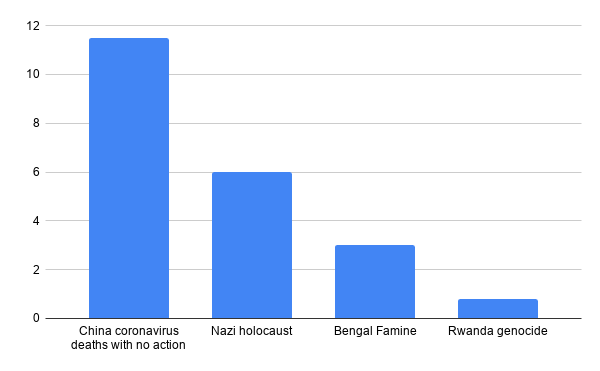
The measures taken in China have eliminated domestic infections and kept the total number of deaths to just over 3 000. This is a staggering achievement. The potential number of people who could have died can be worked out using the standard figures Health Experts are using throughout the world as a rule of thumb. 80% of the population infected with a 1% fatality rate. With a population of 1, 439, 000, 000 people this means that the number of people who could have died in China in a matter of months is 11,500,000 (1% of 80% of 1.439 million). Compare this with other disasters and you  get a better sense of the scale of this. The Y axis is in millions.

coronavirus china 2

The UK picture

The projection made by Imperial College for deaths in the UK  the attempt to ride the tiger implied by the “herd immunity” approach – is half a million in a matter of months. This is more than total UK casualties (military and civilian) through the whole of World War 2.coronavirus UK

The prospect for the United States

A similar projection of 80% infections and a 1% fatality rate would produce 2, 800,000 deaths in the United States. This would be the single most catastrophic loss of life in any one event in US history, more than twice as many dead as during the four years of the Civil War. The most recent domestic trauma, 9/11 with 3,000 dead, barely registers on this graph.

coronavirus US

These figures speak for themselves.

China is to be applauded for clamping down hard on this virus. Those in the “West” arguing to “take it on the chin” like Trump, Bolsonaro and their acolytes on the Alt right are careless of mass deaths among their own people.

‘I see dead people’. How we got here and where we’re going.

Perhaps I’m one of them. My local High Street is ghost town full of aspirant ghosts. This is a look at how we got here and what we might expect.

Phase one. Phoney war in the West

While China went into lock down and South Korea, Taiwan and Vietnam quickly closed borders, tested and traced, governments in “the West” reacted in a way that at first defies rational explanation; being more concerned with making political milage out of how China’s reaction was “Draconian” and not what could be contemplated “in a democracy” than making serious preparations for the impact on their own countries when the virus spread – as it was bound to do. At the same time, the conventional wisdom last month that Covid 19 is basically flu so nothing to get worked up about, we could “take it on the chin” with business as usual and power through it, lulled people into a false and fatal sense of security. In the local supermarket just two and a bit weeks ago the guy in front of me asked why the price of his item had gone up.

“We had a new delivery this morning. and the price was higher because of the situation.”

“What situation?”

“Coronavirus.”

With a dismissive sniff, “what’s Coronavirus? Just flu.”

I had to point out that it is twice as contagious and ten times more lethal than ordinary flu and appeal to everyone who was listening to please take it seriously. They all looked a bit shocked but took it in. There’s the evidence of a failure to launch a timely public information campaign right there.

Just two weeks ago only a few meetings or social events were being closed down and there was a sense that this might be being alarmist even amongst those of us starting to do it, but a sense of unease was building and there were signs all around of partial steps being taken before there was any serious steer from above. On the tube at Golders Green on March 7th, a small group of friends passing round hand sanitiser and rubbing it in before they got off. A young man sitting with two guitars and wearing a face mask, but seeming a bit bashful about it and keeping his eyes down. Not many people sitting apart from each other. There was soap and water in the public toilet but the water was running cold – and it probably still is. Something ominous coming but no one thoroughly prepared for the full measure of it. The cafes were full and the streets were busy.

There are three possible interpretations of this failure to meet a growing threat on the part of Western governments, and “the establishment”, the 1%, the ruling class, the bosses; whatever you want to call that layer of society who, as R. Taggart Murphy puts it are “the people who have first claim on economic resources and are the last to suffer when anything goes wrong, even when they are directly responsible for the damage.” (1).

  1. The ruling class are stupid. This is a very tempting interpretation, especially when watching Boris Johnson doing his Prime Minister impersonation or President Trump bullshitting his way through yet another daily briefing of lies, fantasies and insults; or contemplating the complete failure of the US, UK and EU to take account of the evidence that was being shoved under their noses by events and reinforced by the World Health Organisation. But, taken as a whole, these are highly sophisticated, well educated people capable of detailed analysis and highly intelligent manipulation of public reactions; so it would be a mistake to underestimate them.
  2. The ruling class are ruthless and have less regard for human life than the profitability of their system and the need to maintain their power. This would be indignantly rejected by most of them, and most people who tend to look kindly upwards with rose tinted glasses, but there always had to be ice in the veins of people who ran Empires built from the slave trade, in which millions died of famine while grain was exported, which waged wars for the right to sell opium; and it still runs in that of their descendants; who preside over a world still structured by the inequalities and injustices that are their legacy. The ability to “smile as you kill”, as John Lennon put it, the capacity to lie with total self belief and behave like a vandal while maintaining impeccable manners is built into the way these people are brought up through the elite public schools and institutions like the Bullingdon Club or US Frat Houses. The sort of character satirised by Shaw in St Joan, where the ghost of the Earl of Warwick explains with disarming charm to the ghost of Jean d’Arc that burning her to death was “nothing personal. Your death was a political necessity” could be written because he was so easily recognisable. This way of thinking is reflected in Dominic Cummins remark that “herd immunity” was worth pursuing because the deaths of “a few pensioners” was neither here nor there; and the article by a Daily Telegraph economics correspondent that the deaths of thousands of unproductive elderly people would be “mildly beneficial” to the economy “when looked at dispassionately.” A Malthusian approach to “the surplus population” (as Dickens’s Mr Scrooge puts it) is nothing new; and likely to be far more common in private than in public. Just consider the Grenfell fire in this context.
  3. Ruling class thinking is so dominated by the structures, relationships, laws and values that ensure their continuing wealth and power that any challenge to it – from wherever it comes – is literally unthinkable; so the first reaction to challenges that appear like a deus ex machina almost has to be denial. This comes across as a sort of hubris – that the normal functioning of business could defy an imperative that is beyond its limits. The element of “stupidity” – an inability to learn faced with incontrovertible evidence – is structured by this. This is corroborated by the experience of other challenges. On the crunch day of the 2008 financial crisis the CEO’s of the UK Banks that were about to crash and take the whole system down with them were sitting in a meeting with the Chancellor of the Exchequer and the Treasury team refusing to agree to the government bail out that saved their arses until the last possible minute; because they saw the terms on offer as an impossible and unacceptable restriction on their freedom of action; describing it afterwards as a “drive by shooting” – even though it socialised their debt at enormous cost to society with no consequent obligation on their part to restructure their operations to meet social needs. The case of climate change is even more evident. One example symbolically stands for all. In November last year the Veneto Regional Council, with its offices on Venice’s Grand Canal, voted down measures to reduce CO2 emissions barely two minutes before rising flood waters drove them out of their chamber. George Osborne’s asinine boast to the Conservative conference in 2011 that “We’re not going to save the planet by putting our country out of business” is still the mind set for those who hold our fates in their hands in the West – and evidence of why they don’t deserve to.

A deeper problem is that this way of thinking is also dominant in the general population, whose lived reality is within these structures and “values”, that define the limits and imperatives they bump into while trying to get by in a world constructed for someone else’s benefit, so they appear so much as common sense or normality to most people that it is barely possible to imagine living or thinking in any other way. Crises shake that and reveal to those with eyes to see that the Emperor’s clothes are – at least – threadbare. People imagine alternatives and start trying to construct them when they have to.

President Trump expresses ruling class thinking as an expression of pure id. Coherence and higher level thinking have nothing to do with it. He takes the old jokes that were so effective against Gerald Ford – “his library burned down and the tragedy was both books were burned – and one of them wasn’t coloured in yet” – and turns them into a strength. Who likes reading anyway? He is an impresario of knee jerk reactions. The targets of his barbs are finely calculated to avoid thought and go straight to fears and exploitable emnities. He is mobilising fears and turning them against targets that strengthen his position while throwing out false hopes – because people need to believe that this will be easier than it is and want to hang on to whatever shred of “normality” they can.

  • Initially claiming it to be a hoax perpetrated by the Democrats. This claim was loudly repeated by Fox News, so one of their commentators has since had to be sacked. Trump himself remains in place saying he doesn’t want to look back. Amnesia is a condition compulsory for true believers.
  • Initially saying it was “totally under control”, or since that this or that medicine might be a miracle cure that was already ready, or that it would “disappear’ like a “miracle”; none of which has or is going to happen, all of which have had to be denied by the FDA, some of which have led to people getting ill from taking inappropriate meds on his say so; but none of this matters because he “has a good feeling” about it.
  • Relentlessly labelling it as a “Chinese virus” or a “foreign virus”, as if diseases have a nationality and could be made subject to border control. With an irony that would be wonderful if the consequences weren’t so serious, the higher rate of infection in the US has led to the Mexicans closing the border against American visitors. Build that wall. His attempt to offer large sums to a German company for exclusive deployment of the vaccine they are developing for use in the US alone – an offer creditably turned down by the company which quite rightly declared that any vaccine it produced would be for everyone – and the continuing and intensifying exploitation of medical sanctions against vulnerable countries like Iran and Venezuela, highlights the nationalistic recklessness that is stripping US power bare of its previous “global leadership” and “human rights” pretensions and leaving it ugly and naked for all to see.

Meanwhile his followers round on anyone campaigning for an effective approach as “politicising the crisis”. Perish the thought. Similar charges are made in the UK where we are all supposed to “pull together” behind a government that helped dump us in the leaky boat we’re in and has taken initiatives when forced to do so not because they have ever been ahead of the curve.

Meanwhile petty sorcerer’s apprentice figures over here like Nigel Farage railed against the WHO. “The World Health Organisation is just another club of ‘clever people” who want to bully us and tell us what to do. Ignore.”  Can’t have ‘clever people” who might know what they are talking about telling us what we need to do to save our lives and bullying us into health. Where will it end? Just take back control, light up that fag, have another pint and infect all your mates. Tim Martin of Wetherspoons, just before the government finally moved to close down pubs and cafes, declared that his pubs would stay open because there had “hardly been any transmission” of Covid19 in pubs; so thats alright then. We can afford a few transmissions to keep the beer flowing. Its a matter of priorities after all. Never forget where this idiocy leads.

Phase two: Waking up to several months of Sundays

Last Saturday, the day after the government told cafes, pubs and restaurants to shut, most did in my local High Street; a few rapidly repositioning themselves to offer take out only with delivery. One or two were open with no signs. All but one were empty. There were fewer people but still too many, some wearing masks, some with scarves across their mouths and nose in an attempt to avoid viral roulette. Hopefully the Prime Minister won’t say they ‘look like bank robbers.’ Traffic, normally jammed on a Saturday, flowed freely. Walking past the barbers, the bloke who usually cuts my hair was working wearing a face mask – but he had pulled it down to breathe more easily – hoping – presumably – for symbolic protection. It was possible the next day to look out over West London from our living room window which – because we are on a hill – gives a vista right across past Wembley Stadium on the foreground all the way to the distant hills of Richmond park on the southern horizon – and appreciate the hush. The roofs seemed to be dreaming. For years you could count the aircraft flying East to West across the City to get to Heathrow, an orderly queue, one every thirty seconds. On Sunday, nothing. I counted three all afternoon, and no vapour trails. The sky is an unbroken blue of oddly celebratory weather.

The sudden change in the rules was way too slow and came partly from pressure from below and partly from pressure from other countries experiences. An example is what happened with schools.

  • At the beginning of the week the government was saying that there was no need to close schools.
  • Other countries, accepted to be only a week or two ahead of us in the trajectory of infections, had closed theirs and people could see that their health systems were already struggling. The shortage of ventilators and beds meaning that anyone over 60 was being left to sink or swim. In some cases ventilators were being removed from elderly patients to go into younger ones because they were the only ones available.
  • The National Education Union publicly asked for the modelling being used by the government to argue that keeping schools open was a safe course of action to be publicly shared. At the same time they told all of their members who were in vulnerable categories to inform their Head teachers that they would be self isolating at home from Monday and that if the Heads resisted that the union would see them in court.
  • The government failed to come up with its model, which undermined what authority their stance had – and as the week went on, more and more teachers went off, either with symptoms or as a measure of self protection, 2 000 more teachers joined the union and Reps emerged in quiet schools so they had a voice, while the Heads unions also expressed concerns. At the same time, an increasing number of parents took their children out without waiting for an instruction from government.
  • Faced with a chaotic break down of the school system the government ordered partial closure on the terms set down by the union – with some places left open for the children of key workers.
  • The experience this week has been that very few of those children have actually come in – even in those few schools that tried to hold open more places than the 10% maximum laid down.

The impact of all this is that rules and expectations previously taken to be imperative and unchallengeable have suddenly become optional. Deadlines have evaporated to be replaced by the incessant buzzing of WhatsApp messages from the local mutual help group; as real life proves that there is such a thing as society. Some basic lessons.

  • When it comes to the crunch the market can’t deliver. The state has to step in. The question there is the extent to which it is doing so in order to subsidise businesses and to what extent to guarantee a social need. In Spain they have requisitioned private health care. Here they have done a deal. Italy has renationalised Al Italia. Here Richard Branson wants a bail out. The pattern of 2008 is at risk of repeating itself but that is not inevitable. If people are to “all pull together” that can’t be in the interests of keeping Richard Branson in yachts and private islands while everyone else suffers.
  • Just in time deliveries and the production pattern that goes with them requires a society living on its nerve ends all the time.
  • Once a pattern of home working and zoom conferencing gets established there’s every possibility that they will become the norm.
  • Air travel looks like becoming far rarer.

TINA (“There is no alternative”) is dead, even “going forward”. This has enormous consequences for the movement to save us from the even greater challenge posed by climate change. If the government can nationalise railways, guarantee 80% of wages, direct car companies to produce ventilators, require non essential businesses to shut down (even Sports Direct and Wetherspoons) – at least for a while – mobilise volunteers to work in the Health Service, set up local co-ordinations of councils, the health service and voluntary organisations to meet emergency responses and require huge changes in social behaviour to save us from a virus, the taboo against taking similar action to repurpose our economy and society so that we can drastically cut carbon emissions and live in a sustainable way has been broken. We can think outside the box because the walls of the box have broken. There will be strenuous efforts to rebuild them as was in an attempt to go back to “normal” but we don’t have to let them get away with that.

Phase three: Whats next?

The genie is already out of the bottle and running riot. Because of the failure to test there is no grip on who has and who has not got this virus. Kings College has launched an App for people to log into with their state of health, so some backdated information can be gathered, but this depends on a critical mass of representative people taking part so patterns can be observed. Voluntary initiatives like this have come to the fore because there has not been an attempt to do this by the government, which needs to step up.

The measures taken so far have been too little too late, which will mean that they will have to be intensified for longer while increasing numbers of people die. None of us is invulnerable. I am acutely aware that I am writing this as a 66 year old with high blood pressure and a longstanding chronic cough.

So far there has been a certain amount of social discipline and a huge level of social mobilisation from the bottom up. 405 000 people have volunteered to help the NHS deliver medicine and probably food to vulnerable people on lockdown. The Communication Workers Union has volunteered en bloc to be the fourth emergency service and do similar (2). The government and much of the media will attempt to frame this outpouring of social solidarity in nationalist terms – as a patriotic duty more than social solidarity, precisely because the latter has the potential to go beyond the limitations of the former.  Johnson always appears for his daily briefings bracketed by Union Jacks, making him look as though he is framed in rather stuffy patriotic parentheses – which, of course, he is. Meanwhile people at home with their eyes misting up look at videos of Germans on balconies singing Bella Ciao in solidarity with Italy.

This social solidarity has partially broken down around panic buying. This reflects a genuine fear of being stuck at home without enough food (or toilet rolls) that was completely predictable and could have been blunted by a far more rapid imposition of limits on purchases of particular items. The notion that “the customer is always right” inhibited the needed response for far too long. We have also had some criminal elements trying to exploit the situation, either by profiteering on scarce goods or posing as volunteer support to get info and access to the bank accounts of vulnerable people. In one case very tastefully targeting people whose children are in free School Meals.

As this drags on, unless there is a deepening of the underpinning of economic security, and as the death toll climbs, that cohesion is likely to start fraying at the edges as those not covered by the wages guarantee start hearing the siren voices of those calling for a return to work before the virus has been eliminated. Further measures of socialisation – what we used to call “social security” – will have to be taken to prevent this. Employers of key workers who have not staggered start and stop times to take account of rush hour crushes on public transport – which make social distancing impossible for anyone caught up in it – will have to be instructed to do so.

As this crisis works its way through this summer there will be a three way divergence globally.

  • If China sustains its effective suppression of the virus and starts cranking its society and economy back up – as it is starting to do – it will be seen to have recovered with a relatively low level of casualties.
  • The total in Europe and the US will be far higher and the economic disruption far greater. Goldman Sachs estimates that US GDP could collapse by 25% in the next quarter, pushing unemployment up to 13%. This will have political as well as economic consequences. (3)
  • If and when the virus runs out of control in the developing world, the death rate is likely to be higher still unless there is a massive and co-ordinated international effort to strengthen health systems. China and Cuba are already trying, but can’t do this on their own. The approach of the current US administration, to maintain medical sanctions on threatened countries while whipping up racist reactions, is the opposite of what is needed.

Recognising this, Sadiq Khan’s appeal to Boris Johnson to step up to the global co-ordinating role played by Gordon Brown in the financial crash is almost surreal – not just because its Boris Johnson but because what Boris Johnson and his government believe in makes it impossible for them to play this role.

Conclusions will be drawn about global leadership through the experience of who is providing it in practice. This is dramatised by the scarcely believable statements from Trump and Brazil’s President Bolsonaro today and some US senators starting on Monday. Bolsonaro denounced city governments ordering lockdowns calling for people to “get back to work” while boasting that he personally could survive this virus because of his “athleticism”. The only thing missing was a box of Lemsip max strength poking out of his pocket. Trump – since Monday – has started talking about the cure being worse than the disease and floating a “return to work” around Easter Sunday and that having churches full to bursting on that day would be a “beautiful thing.” This is not because he is hoping for a miracle – though a connection with deeply atavistic sentiments about rising from the dead in Spring should not be ruled out – but is quite explicitly posed as putting the needs of the economy above the needs of the people. This means that there will be a political drive from forces animated by Trump to go back to business as usual as rapidly as possible if they can get away with it. No one should be in any doubt that this will kill many, many people. The extent to which they get away with this will be the extent to which there is mass revulsion and push back.

Out with them!

A personal post script

The meeting that I went to on March 7th was for XR Educators to work out their perspective in the wake of the general election. I was there for the NEU Climate Change Network. The immediate campaigning plans discussed at the meeting are all on hold because of the virus, but what I took away from it has been invaluable in another sense. in the crisis we now face.

I am not a member of XR and have a more traditional Labour movement way of operating. Some of that involves a rather functional approach to meetings. When doing introductions we usually just say who we are and who we’re representing. At this meeting – possibly reflecting the Quaker influence in the long tradition of non violent direct action that goes back through Occupy all the way to the Committee of a 100 – and possibly reflecting a need to face an existential crisis with some appreciation of life so as not to fall into despair – we were asked to introduce ourselves and say something we were grateful for. At the time I was grateful for my Freedom Pass because it enabled me to get to the meeting for nothing. Since then, every day I have felt and noticed things I am grateful for – the cloud of bees in the frothy white cherry blossoms on the tree outside my flat – the light reflecting on the ceiling as it comes through the curtains in the morning – the uplift at the end of Beethoven’s violin concerto, my wife’s wit, my daughter’s laugh and my son’s hugs. And I am grateful for the nudge to let that gratitude in.

  1. R Taggart Murphy. Privilege Preserved. Crisis and Recovery in Japan. New Left Review 121 Jan/Feb 2020
  2. https://www.cwu.org/news/here-is-a-vital-update-on-coronavirus-and-the-dispute-for-all-royal-mail-group-members/
  3. https://markets.businessinsider.com/news/stocks/us-gdp-drop-record-2q-amid-coronavirus-recession-goldman-sachs-2020-3-1029018308

Yes, we have no bananas.

It may have been the decision to close schools – or it may just have been the reassuring letters from supermarket chief executives promising to keep the shelves stocked – but this morning the local Sainsbury looked like the locusts had been in.

The long standing stripped aisle appearance of the toilet roll, eggs, soap and tinned goods aisles had spread to fresh fruit and veg, biscuits, bread, milk and dairy leaving only a few embarassed looking goods exposed and advertising their unloved status. Small tins of Heinz macaroni cheese clustered alone in the middle of the devastated canned goods aisle like the sole survivors of an asteroid strike. Even at a time of panic shopping, people looked at them and thought…”Nah.”

It changes the psychology of shopping in a wealthy developed economy – in which for years you have been able to take it for granted that just about anything on your list will be in stock in abundance. From being irritated if something on the list wasn’t on the shelf, in less than a week it has become a pleasure to find anything that is.

Meanwhile a rumour that Amazon was introducing a gift wrap option for orders of toilet rolls has – sadly – been denied. The wrap might have come in handy.

Empty shelves are a sign the market is dysfunctional and the government hasn’t got a grip.

Empty shelves in the supermarket are a sign of the breakdown of social trust.

This morning I was looking for an obscure item of shopping; and the supermarket worker who was showing me where it was – and who hitherto hadn’t strayed far from her station at the Deli counter- expressed shock at how many of the shelves had been cleared by panic buying – mostly toilet rolls, soap, staple carbs like pasta and rice. “I’ve never seen it like this” she said. Then paused. “I will be doing my panic buying tomorrow. We have 15% discount.”

When I suggested that essentials should be rationed, she said that at the moment there is no company policy on restricting sales – why would there be if the point of an enterprise is to sell as much as possible as fast as possible? Some public spirited managers were trying to put restrictions on, but this seemed to be in response to particularly over the top purchasing and not especially strong- like the woman who was trying to buy three boxes full of tinned soup. They restricted her to two.

Shop workers themselves – in the absence of a policy – are unable to challenge even the most gratuitous purchases because this is seen as “bad customer relations.” The consumer is king, even at their most anti-social.

Panic buying happens when people are nervous that they will not have access to things they consider essential – because no one is regulating the supply. The result is shortages for those least able to shop on a big scale. Government regulation limiting purchase of essential items should have been put in place pre-emptively. Leaving a situation like this to “the market” to sort out leaves the most vulnerable at the mercy of the hidden hand.

The Words of the Prophets…

…are written on the subway walls… pause to hum rest of tune.

A boarded up shop in Wembley High Road, stark white, has the words LAST DAY painted in black where the sign used to be. This must have refered to a closing down sale, but today it felt like a warning.

In the distance, a black railway bridge is half visible as the road turns. It looks like a portal to a grimmer place – more Mordor than South Kenton.

Opposite Wembley Park tube station – Dapper Dry Cleaners. The sign is filthy of course.

In so far as anything flies in Wembley, alongside the company flag and the Union Jack, EU flags still fly outside hotels by Wembley stadium in a limp celebration of inertia. Is this apparent defiance of the new order accidentally occassioned by negligence? Is keeping up the old flag just a way of removing the dilema of what else to use that third flagpole for? A transcontinental coach with German writing all over the back may give a clue as to why. If it makes commercial sense to make paying European guests feel at home, Brexit can stay undone – at least symbolically. Current transition negotiataions might need to bear that in mind more broadly.

With the High Road still busy with wary shoppers, keeping nervous and carrying on; Holland and Barrett declares a lack of hand sanitiser. When Boots in Brent Cross puts their daily stock out in the morning, we were told yesterday, its gone in ten minutes.  Outside emergencies – no access to soap and water – constant use of alcohol based hand sanitiser is probably counterproductive. The alcohol evaporates very quickly but strips the skin of its natural oils – leading to cracks; which is not good news if you want to avoid infections.

Nexagen – Labels 4 Less – displays large posters for Sri Raghavandrum Astrologer – Solve your problems today. They are holding a closing down sale.

Tony Blair – a warning.

“Sincerity – if you can fake that, you’ve got it made.” George Burns.

Last week Tony Blair came to Kings College on the 120th anniversary of the founding of the Labour Party to seek to bury it.

Four core points stuck out from a word cloud of vaguely progressive sounding phrases that were otherwise as substantial and hard edged as a bowl of blancmanc.

1) That Labour has only been in power for a quarter of its history.

2) That elections are won “on the centre ground” by “broadening the coalition”.

3) There is a need for a “progressive realignment” with the Liberal Democrats – on an entirely undefined political prospectus.

4) That the current membership of the Labour Party is full of people who are an obstacle to this – because of their commitment to “old fashioned” things like public ownership (and peace) and are therefore a problem.

This is the Third Way greatest hits playlist. He even re-heated his old “gotcha” anecdote about a Party member in the early 90s complaining that Blair’s strategy was to get people who voted Tory to vote Labour – but changed the context and the gender of the member in the retelling, thereby making it about as plausible as David Cameron’s “I met a black man once” story. The laughter that greets this story as the penny drops is designed to obscure the content of the complaint (if there ever was one); that he was aiming to make Labour safe for Tory voters by being as much like the Tories as possible; and that is more of a problem than he seems to think.

His notion that somehow Labour should have been in power far more often reveals that he either does not grasp – or seeks to ignore – the fact that Labour  was set up 120 years ago to give the working class a voice and has therefore always been more of a cross class coalition than either the Liberals or Conservatives; which have always been unambiguously ruling class parties. Even though the currents that seek to be “statesmanlike” and “credible” and “a reliable Party of government” have usually been in the ascendancy, letting Labour into office is therefore a concession by the powers that be that they would really rather never make. Labour is therefore always playing uphill with the wind in its face – even at the most favourable of times.

The key phrase he used here is “you decide first and unite after”. And what he wants unity on is a significant move rightwards. He skids over what this might consist of and just how far right he wants to move so as not to scare the horses in the middle of a leadership election. A way to imagine it is to recall that he put a lot of effort into courting Rupert Murdoch and had the endorsement of the Sun in 1997. Think about what policies you’d have to adopt to get such an endorsement now and that’s your Blair manifesto for 2024.

This is of course entirely consistent with the practice of the right of the Party during Jeremy Corbyn’s leadership. They did not agree with the decision of the members, so they did not unite; and many of them worked “every single day to bring forward the end of his tenure in Office” Peter Mandelson (1). Given the daily quantities of ordure dropped on Jeremy Corbyn from a great height since 2015 – with such significant sections of the Parliamentary Labour Party declaring him “unfit for office” right up to polling day – its quite miraculous we did as well as we did in the December election. Despite these attacks, Corbyn’s leadership and politics led to our two highest popular votes out of the four general elections held since the the 2008 crash and its important to register that, lest we lose ground in future. It should also be noted that Boris Johnson has given Ian Austen and John Woodcock peerages in eternal gratitude. Peter Mandelson already has one.

What is striking about this speech is the things he misses. He misses out the 2008 crash – and the impact this has had on removing the conditions for his sort of economic and political framework – altogether. He mentions the climate crisis but in an extraordinarily complacent way; as though its all in hand and will be taken care of one way or another by the wealthy and intelligent people (like him) who run the planet. He doesn’t mention the completely catastrophic economic and political course being followed by the United States in sabotaging the Paris process and doubling down on fossil fuels in an attempt to stave off the rise of China – scheduled to have an economy much bigger than the US by 2030 at current rates of growth. Nor that if the US succeeds we’re screwed and if they fail (given the scale of the Chinese investment in renewables) – there’s some hope. Its not surprising that he does this given his “pro western” orientation (which is entirely consistent – it seems- with him offering lucrative advice to the President of Kazakhstan).

His comments on antisemitism are very revealing. The problem he says is not so much antisemitism, but “the world view” of people who are pro Palestinian, or the “hard left” in general.  That world view is opposition to imperialism; which he sees as not “patriotic” and “anti Western”. The distinction between antisemitism and people having a dim view of Israel passes him by because he wants to elide the two. If they were in fact one and the same, the 54% of people in the UK who have a negative view of Israel would translate into a comparable figure for racist attitudes towards Jewish people. It doesn’t – thankfully. The rate for that is 4%. He ducked a question about military interventions – lest we remember what his abject subordination to the United States led to and how many people died as a result.

He uses lots of soothing phrases in a comforting montage of cliches – that all sound good if you like political muzak but have no content. “Modern”. “Future”. “Forward looking”. But on what we’d need to do he has nothing to say apart from negatives. He says the right will respond to the climate crisis and Artificial Intelligence in the wrong way, but doesn’t spell out how, nor what the correct way might be. The left way forward – the colossal state investment in the green transition that’s being done in China, and was being done in Bolivia until the coup – he dismisses as old fashioned stateism that the “public” is bound to reject. The close election result in 2017 passed him by it seems. The problem with this is that if we never elect a government that will do what needs to be done with democratic consent, and popular mobilisation, to do it, we will end up faced with one that does far more authoritarian things as a matter of necessity when the consequences of inaction are crashing life support systems all around us (and many of us will die as a result). As the The Age of Consequences: The Foreign Policy and National Security implications of Global Climate Change report chillingly put it “Governments with resources will be forced to engage in long nightmarish episodes of triage; deciding what and who can be salvaged from engulfment by a disordered environment. The choices will need to be made primarily among the poorest, not just abroad but at home.” (2)

His notion that there should be an re-alignment of “progressive” forces begs a number of questions about what makes a party “progressive”. The Lib Dems went into coalition with the Tories not just because the parliamentary arithmetic stacked up that way but because they were more aligned on economics. Blair would have been aligned that way too – and so would the people who supported his wing of the party – from Alasdair Darling to Chris Lesley. This would not be a “progressive” realignment but a centre right bloc with nowhere to go but austerity and “hard choices” dumping the costs of the crisis on those least able to bear them.

Four key points underline why a Blair is wrong and a “move to the centre” cannot work.

  1. No “return to normalcy” is on the cards and the future looks more like a trap than  a promise

The period we are in is defined by the 2008 crash and its aftermath. The “sweet spot” of the USA’s unipolar moment from 1991 to 2008, with cheap and ever expanding credit, buy now pay (through the nose) later PFI deals, cheap imports allowing governments to be grudgingly tolerated and re-elected with low votes while life slowly got better for most people has gone and won’t come back. People are insecure, pressured, uncertain, more political; but rarely well thought out about it. We  are – perhaps – about to hit another economic crash; with very little prospect of the same methods being viable to get out of it. At that point all sorts of unthinkable things will start to happen.

We also have the climate crisis inexorably becoming more apparent. . It is becoming apparent that we can no longer take our environment for granted as a generally safe space. People are waking up – and not just “woke” people. 

In such circumstances people tend to polarise – to either cling on hard to certainties that used to make sense, dancing ever more frantically to the old failed nationalist tunes, while snatching gratefully after small mercies – or look for answers beyond borders. On a global scale this can be simplified as a retreat into nationalism (America – or Britain – or wherever – First) and a “New Dark Age” (as the Daily Telegraph enthusiastically put it) or Global Green New Deal.

Parties of the  Left have to embrace the latter with policies and campaigns that both pose solutions and develop deeper social roots; so what we are proposals an expression of where our communities are at and overcome the fear of change that freezes them like hedgehogs in headlights waiting to be squashed. 

The Green New Deal must be right at the heart of things – but also posed as – “this is what it will mean for our town, city, neighbourhood”. In the run up to the General election, Labour Local Authorities had been asked – for example – to make plans for home insulation so that an incoming Labour government could hit the ground running and get this done. Putting those plans on the leaflets, citing examples of where such plans had began to be implemented, holding meetings about them in the affected communities could have been very effective in making the prospect of positive change real for people who might be sceptical about it.  

2. There is no individualist “aspirational” solution.

People want life to be better. We want our children to have decent work and security.  This has too often been posed as “aspirational” in the sense of “getting up and out” with “social mobility”. There is virtually no social mobility in the UK. We are the most unequal society in Europe and Brexit will copper bottom that. The individual route up and out is effectively blocked for almost everyone. This will only get worse under Johnson. We either try to organise collective solutions in this pressure cooker situation or people turn on each other with – expertly choreographed – blame games.

3. Neo -liberalism is bust.

Neo-liberalism – in shorthand – is the acceptance of the Thatcherite economic settlement.  It encompasses those strains of thought that argue that politics should be subordinated to a free market economics in which deregulation and privatisation are seen as solutions and the best those at the bottom can hope for is that the prosperity that this channels to the top will “trickle down”. This was a foundation stone for Tony Blair’s governments and made them acceptable to the powers that be. Since 2008 it has survived on life support because it functions very well for the 1%. It does nothing for the rest of us. Life expectancy in the UK is now in decline. As a foundation for a Labour government now it would be sand.

In 2010 part of the problem for Labour was that it embraced austerity almost as strongly as the Tories did in a bid to be “credible”. If you track the opinion polls from the 2010 election, the point at which Labour ceased to be gaining ground on the Tories was when Alasdair Darling announced that the cuts Labour would make would be more severe than Thatcher’s. “Credibility” was not credible with the voters.

To add insult to injury, in  George Osborne’s first budget, when he announced his eye watering £19 billion in cuts, he was at pains to point out that this was £1 billion less than he had been advised to cut by Alasdair Darling.

Had Labour been in office with such a policy – in the “national interest”- the effect would have been catastrophic; not only for the people affected by the cuts but also the Party. 

The fate of the European Social Democratic parties that have imposed such a programme in government, is an eloquent warning for where this leads. 

In Ireland it was not the Irish Labour Party that smashed the old sterile centre right duopoly in the General election this month, but Sinn Fein on an anti austerity programme. Irish Labour, having been in a coalition government with Fine Gael imposing austerity between 2011 and 2016 saw its share of the vote drop to 6% – below the Greens.

In Germany, the SPD, in a terribly responsible middle of the road coalition with Angela Merkel’s Christian Democrats, are currently polling at 14%.

In France, the Parti Socialiste never recovered from Francois Holland’s lacklustre pro austerity Presidency. It now has just 25 of 577 members of the National Assembly, its membership collapsed from 173 000 in 2012 to 40 000 in 2017 and is now polling at just 11%. The realignment of the “progressive centre” advocated by Blair and personified by Emmanuel Macron – which took a substantial slice of SP voters and members with – it has now collided brutally with the French trade unions in a series of bruising general strikes and is shedding both MPs and popular support. His Party, La Republique en Marche, is now polling at 18% with Macron himself having a 30% disapproval rating. (4)

The danger in all this is that opposition to the status quo is ceded to ethno-nationalist currents who blame immigrants – from the Alternative fur Deutschland to the Rassemblement Nationale (or the Brexit Party).

This is where Blair’s course leads.

We should compare this experience that of the Socialist Parties in Portugal and Spain which have opposed austerity in government and have formed governing coalitions with “Hard left” Parties like Podemos or the Portuguese Left bloc for a way ahead that we need to stick to. We have such a coalition already inside the Labour Party. Tony Blair would like to suicidally split it by driving out the left.

4. There are no “national” solutions and the Pax Americana guarantees war

There is an established view of what might be called the “national mission” which is replete with symbols and imagery from WW2 and Empire which holds us back into a nostalgia and fantasies of a “special relationship” with the United States. This has more hold with the old than the young, many of whom can see through it, but going beyond it – which we will need to do – requires us to  not so much live up to our past but live it down, and make up for it too –  as something we are not just doing for ourselves but the world.

This is a crucial issue because the glue that holds the right of the Labour Party together is not so much Europhilia as Atlanticism. Blair has – for now – abandoned any idea of rejoining the EU. This from the man that wanted to join the Euro. Quite what the glue would be to combine Labour with the Lib Dems in this context is unclear, but Atlanticism would be part of it. This is a tricky act to pull off in the age of Trump, who makes no concessions to the vanity of his auxiliaries; and its rather difficult to argue that we should be forever Robin to America’s Batman when Batman is behaving more and more overtly like the Joker: but it won’t stop them trying.  

Being “pro Western”, in the way the Labour right supports, means being signed up to a Pax Americana that’s in crisis. It is not a “safe” option. Not only because the US’s global thrashing around to hold on to its dominance in the face of a level of Chinese growth that will make the Chinese economy half as big again as its own within the decade, nor the prospect of being pulled in Trump’s wake into the international axis for climate change denial, but because of the domestic consequences flowing from Johnson’s projected post Brexit US trade deal. This poses ever deepening national subordination and humiliation at the hands of the Americans as their pharmaceutical companies latch on to the NHS and UK labour regulations are degraded to US levels. To pick two examples. the US is the only developed economy in which there is no guaranteed right to paid maternity leave and US holiday entitlements are half the European average. This will  hit the people who voted for Brexit – thinking that it would return them to a period of decent jobs with decent terms and conditions and less pressured public services – very hard indeed. They don’t know what’s going to hit them. Blair’s commitment to “get up the arse of the White House and stay there” (5) means that Labour would have no realistic framework to resist this.

The US is now smashing up many of the multilateral institutions that have previously mediated its dominance into a series of bilateral relationships that its easier for it to dominate – they are even blocking the selection of new judges for the World Trade Organisation Court because they don’t want to be held accountable to it. So there is no doubt that part of the price of the deal Johnson is lining up with Trump will be ever enthusiastic participation in US interventions, not just being a cheerleader for its destabilisation efforts across the world. The rapidity with which Dominic Raab flipped from calling for de-escalation to dropping right into line on Iran is the shape of things to come with this government. Not following suit is vital for Labour.

All this explains why Blair’s speech had to cover the consequences of following his line with such an easy listening soundtrack of soothing political muzak. He was very clear that a move slightly towards the centre – as with Keir Starmer – would not be enough for the forces he represents. The ruthless logic of recognising that Labour will no longer be tolerated as a safe alternative government by the ruling class so long as it retains a programme that challenges it, a mass membership that supports it, and institutional links to mass working class self organisation in the form of trade unions, leads inexorably in the direction of a Macron type formation jettisoning the left, or a US style Democrat Party without the Sanders/AOC wing. Those who start out on that road thinking that it need not lead so far or require the abandonment of so much have been warned and should take stock. This is a search for office without power. The challenge to us posed by the December result – on the contrary – is to organise to shift power at every level, utilising whatever levers and handles there are to struggle inside and through every level of what Gramsci described as the outworks of the state; so that an election victory represents genuine mobilised support throughout society out of the deep seated resistances to the tumultuous attacks we are about to face.

  1. https://www.theguardian.com/politics/2017/feb/21/peter-mandelson-i-try-to-undermine-jeremy-corbyn-every-day
  2. https://csis-prod.s3.amazonaws.com/s3fs-public/legacy_files/files/media/csis/pubs/071105_ageofconsequences.pdf
  3. NLR 120 Nov/Dec 2019. Snipers in the kitchen – State Theory and Latin America’s Left cycle. Juan Carlos Monodero
  4. https://www.politico.eu/europe-poll-of-polls/france/
  5. https://www.theguardian.com/books/2005/nov/13/biography.politicalbooks
White van graffiti – and two flags for the price of one.

In the week before the general election someone started spraying the word “TORY” all over the place around the down at heel suburb where I live in NW London – on bus shelters and walls – even on the sides of white vans. This must have been very upsetting for the owners, even if that’s how they voted.

It was hard to tell initially whether this was a declaration of support by a new sort of edgy vandal activist inspired by the US alt right spraying allegiance over his locality like a tom cat sprays urine- the spidery black lines showing a shock abandonment of all pretence at being law abiding and staying within bounds – reflecting times in which the leader of the Party could say “Fuck business” and their attack dog newspapers call for “traitors” to be cleared out of the Judiciary and House of Lords – or a false flag operation meant to look like someone from Labour was spraying an accusation of being a Tory on the sides of “white van man” vans – and the Kingsbury road temple – to propel people to the polls out of indignation.

This week, a variation on a theme confirmed that it was the former, with the word “TRUMP” in the same writing on the side of another vehicle – in this case a small truck – neatly symbolising the relative weight of UK and US Conservatism. The local Conservatives will presumably not put “spray cans” in their election expenses return and this is probably a “lone wolf cub” operation, but the writing is on the wall (and the vans) that we are in a new and unstable kind of politics.

A more light hearted and less indelible piece of graffiti was seen in Grays High Street a couple of years ago, where a similar van had the words “also available in white” scrawled into the tidal wave of sludge that covered its paintwork.

Meanwhile, our pro Brexit neighbour down the hill – who has had a “Get Ready for Brexit” ad in his window for several months – showed his British patriotism by putting up an England flag on 31st January. To be fair, this may have been for the Six Nations rubgy match the following day, in which England – having swaggered into Paris claiming they were going to “beat up” the French – were beaten in a way that was very therapeutic for anyone worried about nationalist triumphalism. As I walked past a week later, it looked as though he was putting up two flags in time for the Scotland match. But it turned out he was swapping one for the other – like a monk with a habit – one to wear, one in the wash – so it looks like this display might be permanent.

For anyone whose idea of heaven is an intense political discussion in a cafe, trying out a new coffee adds an additional layer to the experience. Turkish coffee in the Sim Sim bakery arrives with a flourish. Twice the size of an espresso but just as black and intense, set off in a small white cup and saucer. The spiritual opposite of cappuccino. No creamy, milky frothiness. Nothing easy drinking about it. Deep, dark, bitter; the bottom third like a mud bank of grounds. To be sipped slowly; a mouth can only take so much of an assault at once. An antidote to chugging. Almost an ordeal, it requires a slow, careful, thoughtful, disciplined approach that affects the way you think too. Profoundly mindful. Looking out of the plate glass window, another discussion going on silently. A man with a large head and close cropped curly beard is holding forth while smoking. His silent words come out with puffs of smoke.

The local library is buzzing. A dozen people working on the computers at the back. About twenty women learning English in the middle, their teacher moving round checking their writing. Old – slightly grumpy looking – guys reading the very grumpy papers. People checking books in and out; children hopping around the kids section. Toilets that are not “for customers only” as a community facility not a commercial one. The kindness of the public sector.