The Shadow of Long Covid

Figures from the ONS (1) show the impact of “Long Covid”. While deaths have resulted from 6.2% of known infections, the rate for Long Covid is 25.1%.


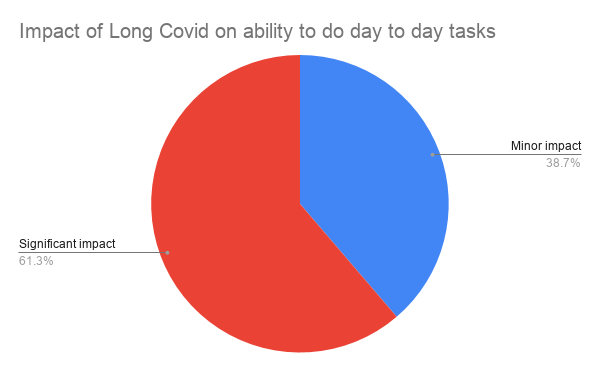
This is proving to be debilitating for a long period for a significant proportion of those affected. The ONS reports that 1.7% of the total UK population is suffering long term ongoing symptoms. The figure for long term debilitating symptoms is about 1% at the moment.


As the ONS points out, we are at early stage in understanding what is likely to happen and it is unclear whether these symptoms will be permanent or how far they will fade, nor how far this will vary between people and what patterns might start to emerge over time. Nevertheless, in the immediate term, there is going to be a significant impact both on the health of the people concerned, and therefore on their ability to work or participate in social life.


The profile of people disproportionately affected is the same as for mortality rates; those in front line jobs, living in poorer areas or with poorer health, ethnic minorities; but with a greater impact among younger age groups and slightly more women than men.
This has a particular impact on certain roles. 


Health and care workers and educators are the two worst hit – and both will be under pressure from government to “catch up” – which could become unbearable and unsustainable. (2) Both of these workforces are heavily female. 77% of NHS staff, 73% of teachers and 93% of teaching assistants are women.


6.4% of the total NHS workforce has Long Covid, alongside the 1.5% currently off sick with Covid symptoms. 


The proportion of educators is even higher, at 10.8% of the whole workforce. Even if Gavin Williamson’s arguments for longer school days held any water educationally – they don’t, as anyone who has worked or learnt in a school with a longer day will tell you – the impact of trying to push it with a workforce not only stretched and exhausted by a year of teaching in person and online, but also  decimated by Long Covid – is likely to push many people – if not the system as a whole – beyond breaking point.

  1. https://www.ons.gov.uk/peoplepopulationandcommunity/healthandsocialcare/conditionsanddiseases/bulletins/prevalenceofongoingsymptomsfollowingcoronaviruscovid19infectionintheuk/1april2021#main
  2. https://www.theguardian.com/society/2021/apr/03/nhs-feels-strain-tens-thousands-staff-long-covid

Good News and Bad News. Impact of Schools Reopening Week 4.

There is good news (with a caveat) on the rate of infection in the three areas I am monitoring this week. 
All have declined, with the overall suppressive impact of the wider social lockdown combining with mass vaccination to counteract the upward pressure from schools being open en masse. 

While this is very welcome, the effect in all three places taken together is that infection rates are now only a little below the level they were when schools reopened. This is also true nationally. 


The comparison with an extrapolation of the previous trend shows how this has missed a golden opportunity to bear down on the virus to near extinction point. 


The impact of schools reopening can be seen in the higher rate of infections for school age cohorts than any others – explained very clearly here by the NEU

The next two weeks, with schools on Easter break, will reduce that upward pressure.


These are therefore the last weeks in which the reopening of schools is the main upward driver of infections, before the loosening of restrictions from April 6th begins to have an effect from about April 20th onwards – and the scheduled further loosening on April 12th kicks in from about April 28th. 

The government calculation is that a wide enough vaccination roll out will reduce hospitalisations and death enough to be able to reopen on a far wider scale and get away with “living with the virus.”

The attempt to live with the virus in the absence of a high enough mass vaccination rate can be seen in Brazil; where Bolsonaro’s Bossa Nova is an unambiguous dance of death.

A reliance on mass vaccination as a single line of defence depends on the virus not evolving any variants that resist the vaccines. If it does, all countries that have not carried out a zero covid strategy will be back in the morass.

Impact of school reopening on Covid infection after three weeks.

The only way is up?


This week’s figures from the NEU Covid map for the local authority areas around my three exemplar primary schools show an acceleration of the trend that was already apparent barely a week into schools reopening. The rate of infection per 100,000 is increasing in all of them. With just under another week to go to the Easter break, we can expect this to continue; before the impact of that break would briefly take it down again if no other measures are taken to ease restrictions. 


If the government sticks with dates over data and relaxes further restrictions on Monday (29 March) we can expect two weeks or so in which infection rates overall will still be primarily affected by the schools being open. After which the impact will be combined.


None of these measures wll reduce infection rates. Stay as we are and they will rise. Open up further and they will rise more quickly.


The government is gambling that the vaccine roll out will sufficiently reduce hospitalisations and deaths that the increase in infections can be ridden out; and Chris Whitty has argued this week that a zero covid policy is impossible, but that we should be aiming to keep it as low as possible. 


There are a number of problems with this.

  1. A lot of serious scientists disagree with Prof Whitty on zero covid, as you can see here.
  2. The difficulty of keepng track of covid is very different problem when infections have been brought down to a very low level. While it can be assumed that there will be undetected cases out there – if there is an efficient test and trace system every newly identified case can be back tracked to prior contacts, who can then be tested and isolated as required. This has worked very effectively in South Korea, where they have had fewer infectyions than we have had deaths. Had schools been kept mostly shut until the end of the Easter holidays and all the other restrictions kept on, we’d have been at a low enough level to keep a lid on things. A few hundred a day. Having opened up – we won’t be. 
  3. So Whitty’s fatalism gives the government carte blanche and becomes a self fulfilling prophecy. 

The wider consequences of a world in which the virus is a permanent feature are incompatible with going “back to normal” – or status quo ante virus – let alone building back better. If we accept that the genie is out of the bottle and can’t be got back in for large parts of the world, including us, a number of things follow. 

  1. Those parts of the world that have suppressed it – and don’t want to let it back in – will have continued border controls/quarantine indefinitely. They will also be able to have a more social society than those that have not and their economies will also grow relatively strongly. At present that is a large minority of the world, with China by far the largest component, but also includes Vietnam, Australia and New Zealand.
  2. Those countries trying to “live with” the virus will be in a constant state of evolutionary struggle with it, as it mutates; necessarily becoming more infectious and vaccine resistant as it does. The bottom-line strategy of taking restrictive measures to stop health services being overwhelmed combined with a permanent cycle of mass innoculations is therefore a permanent prospect, as is a built in and residual popular caution – which will feed in to social behaviour and limit cultural and economic possibilities. An alternative scenario – that is not mutually exclusive – is that the Bulldog Drummond tendency gets its way and we let it all hang out in a last days in Nazi Berlin hedonistic frenzy (roaring twenties) in which a load of people die all at once and we go with the survival of the fittest. Either way, there is no quick fix and the next pandemic could be on us before we’ve cleaned up this one – just as the rate of natural disasters caused by climate breakdown will accelerate and intensify and overlap from here on.
  3. Viruses can be eliminated. Polio. Smallpox. Therefore, should be. Like climate change, the consequences of not dealing with it are far worse than doing so. One strategy for so doing was set out very well by Devi Shridar in her recent New Statesman article
  1. The economic motivation for what the government is doing is well developed here. The popular view of “the economy” is that the ruling class operates it in a Benthamite spirit, primarily concerned with use values and the “greatest happiness of the greatest number”. In practice everything is subordinated to profit; and, in this crisis, some sectors have done spectacularly badly – hospitality, culture, mass tourism, others have done very well, online retail, pensions insurance; and the balance of forces between the classes has definitely shifted the wrong way and the stock market has boomed.  They are not letting a good crisis go to waste.
  1. Labour’s policy is a classic exercise in what Gramsci would have called corporate politics. Manoeuvring within the framework of your opponent. It helps consolidate the government’s position – because when they do become critical it comes across as churlish. Starmer seems less interested in winning than being a safe opposition on the off chance of being allowed into office as the fall-back option for the powers that be.

Red, White and Blue blues. Flagging Enthusiasm.

The current imperative for Ministers – and Shadow Ministers, now they have imbibed a  heavy swig of Blue Labour Kool Aid – to flank their desks with ever bigger Union Jacks, and the new regulations demanding that all public buildings fly it all the time not just on “flag days”, reminds me of the final scene in Moby Dick; in which, as the whaling ship sinks quickly beneath the waves, a last sailor going down with the ship – for want of anything better to do – nails a flag to its masthead.


We really do now live in a country in which the penalty for assaulting a statue of a slave owner can be greater than that for assaulting your neighbour, a Member of Parliament can consider it a serious question to ask the Director General of the BBC how many Union Jacks were incorporated in the Corporation’s latest annual report, and others can go on the radio claiming that having flags everywhere will “unify the country”. These are the same people who think the Brexit referendum has been a great step forward for national unity, on the basis that anyone who does not thrill to the flag and believe in the glorious new global Britain is evidently a traitor who can f*** right off.  


But, seriously; unify the country by having an emblem that not everyone feels represents them thrust in their faces? In the North of Ireland? Or Scotland? Oddly enough, many of the people keenest on this regulation are also those who told a YouGov poll they would be happy for Scotland to break away from the rest of the UK if this was needed to carry through Brexit. Funny kind of Unionism.

The absurdity of the claim that this measure “unites the country” is demonstrated straight off the bat because the regulation does not apply to the whole country. The North of Ireland is exempt, just as it is from Prevent legislation requiring schools teach “Fundamental British Values”; for reasons which should be obvious, but dealt with in anecdotal detail later in case it isn’t. The Democratic Unionists – aleady panicking that the half baked oven ready Brexit deal has “sold them down the river” to Dublin and the EU with its customs border in the Irish sea, which has also led to Loyalist paramilitiaries ominously announcing their rejection of the Good Friday Agreement – have smelt a rat in this too and are demanding the flags regulation be extended to them too; as a symbolic assertion of unionism as its economic foundations crumble.

Their wheeze of changing the regulations to allow TWO flags on one flag pole, so you could have, say, a Union Jack and a Saltire on the same pole, begs the question which one of them goes at the top. This either means they haven’t anticipated this, or they think the fight is useful for them. They know quite well that it divides the country, but does so in a way that is far more beneficial to the Conservative Party than – perish the thought – emphasising the division that exists over selling the Health Service off bit by bit to the private sector and US Medical Insurance companies. Which is not good for them at all if we dwell on it for a moment. Best not think about that. Look at the flags instead! 


But, even when you do, there are obvious issues.


I must have been about 5 the first time I came across a Union Jack. My Dad was digging it out of the back of our old pantry – a cold room used to store perishable food before fridges were widely affordable; but keeping bits and bobs of miscellaneous other stuff cool too, one of which was “our national emblem.” It was a rather battered and faded specimin, probably left over from VE day fourteen years before. It was the day of the Thurrock Carnival. This was nothing – nothing – like the event with the same name that happens in Notting Hill – and as unlike Mardis Gras as its possible to imagine. A sort of mobile mid-summer Harvest Festival in which the local factories, firms and anyone else with an interest in self publicity, would pile a selection of their goods into a display on the back of a truck, and drive them in a rather prosaic convoy through the town and on up to Blackshots Fields – where everything ended in an annual fairground; where dodgems could be ridden, helterskelters descended and goldfish won. At the time it felt like a celebration of plenty. We’d never had it so good. In its heavily industrial way, it was all a bit Soviet (though without the Cossack dancing and Red Army choir) and, being Thurrock in 1959, completely monocultural. No fabulous dancing groups with spectacular winged costumes, exploding like peacocks with thundering rhythms, aspiring to flight and transformation from suppression to freedom – like you get in Notting Hill – just the boggler, boggling rumbling of diesel engines carrying pyramids of soap powder, or sacks of cement, with a few girls done up in pink dresses perched on top and told to wave like the Queen; followed by the steady tramp of the Boys Brigade bugle band playing something wholesome. Rather conveniently, it came up our road; so we dutifully went out to watch and, to add some spice, waved the flag at it. As you did.


That was also the year we got a TV for the first time. On the News there were some regular set pieces that caught the attention. One of them was the Queen bashing Champagne bottles on the prows of ships while fluting “I name this ship Shippy Mcship Face. May God go with her and all who sail in her” in her high pitched tones and Windsor vowels, with everyone cheering as the metal monster gathered speed down the slipway and sloshed mightily into the Clyde or the Tyne, with a version of the flag drooping from the stern. Another – as the winds of change blew through Africa and the Caribbean – was a flag ceremony; invariably with a stuffy looking white bloke in an even whiter uniform and enormous cocked hat festooned with feathers saluting amidst a big crowd of happy looking black people, as “our national emblem” was slowly lowered; and something altogether more adventurous looking hauled up in its place.


Having it explained at cubs a few years later – in between playing spin the bottle, singing Scout classics like “ging gang goolly” and “Dad’s got a head like a ping pong ball” (to the tune of the William Tell Overture) and practicing knots. The montage of the saints flags of England, Ireland and Scotland, symbolising a three in one unity that was better than the sum of its parts, was presented as though the countries concerned had just decided to make friends. Possibly by shaking little fingers. “Make friends, make friends, never, never break friends.” As you did. The actual history was absent. The deal of convenience in 1707 merging the Edinburgh and Westminster Parliaments – at Westminster – with the Scots signing up as a junior partner in a joint imperial enterprise with the English that put the Saltire behind the St Georges cross (taking up a lot of space, but definitely underneath); and the more coerced Act of Union of 1801, adding the St Patricks cross; after Irish attempts at self assertion and home rule, emulating the American Revolution with Grattan’s Parliament in the 1780’s and the French with the United Irishmen rebellion in 1797, were crushed. And the Welsh? Just incorporated incognito as an adjunct to England which has always been primus inter pares. Crushing “rebelious Scots” is, after all, in the national anthem as one of the necessary measures required to make the King/Queen “victorious” – and possibly “happy and glorious” too.


At about this time Union Jack pennants started appearing on the antennae of the Lambrettas and Vespas that the local Mods parked up outside the Wimpy bar opposite the War Memorial; before pootling patriotically off down to Brighton at about 3 miles per hour, with RAF roundels painted on the backs of their parkas, aiming to pick a fight with some Rockers.


A few years after that Union Jacks started appearing on posters that had been stuck on the hoardings outside the local library by the National Front. “We’ve joined. Have you?” Average looking white family, short back and sides, ordinary perm, two kids; wanting to stop immigration. Then on their nasty little racist stickers that spread like a rash all over local lamp posts – which I spent the next ten years scraping off – with coins in case they’d stuck a razor blade underneath of course. And on the bigger stickers that appeared on the backs of Morris Travellers and such in comfortable parts of the countryside; “Support our Kith and Kin in Rhodesia”. 


And in pop culture, the collapse of the old territorial Empire, and the loss of faith in the “chinless wonders” of the ruling class that had presided over it, expressed itself in some odd ways. A search for modernity that moved on quickly from the debacle, even as nasty imperial rearguard actions sputtered on in Aden – the “white heat of the technological revolution”, hovercrafts and the post office tower, a search for compensatory highs like a few Gold medals in Tokyo in 1964, winning the World Cup in 1966 and a splattering of Union Jack imagery over guitars and jackets worn by pop stars who were “conquering America”. This was both disrespectful and reaffirming. A bit like the dialogue in the Beatles Hard Days Night film, in which a crusty mustachioed city chap in a bowler hat hrumphs at Ringo “I fought a war for people like you” to get the reply “I bet you’re sorry you won.”  But this was about to become ever more bitter and twisted as the notion that “British is Best” went down the pan with the devalued currency, the shipyards, the textile industry and BSA motor cycles. No matter how many company secretaries declared they were “backing Britain” by working through their tea breaks – the Japanese and Germans seemed to be able to make better goods cheaper, by the dastardly trick of actually investing in their manufacturing. “Who won the bloody war anyway?”


“The flag” by the mid seventies was neither innocent nor hopeful. You could occasionally still see one on a leftish demonstration on an issue like Anti Apartheid, as an affirmation by members of the Communist Party that the “Road to Socialism” in Britain would indeed be British. But even in pop culture it was no longer bright and shiny, as it had been for the Who. In punk it was tattered and torn, hung with safety pins. “No future. No future. No future for you.” Waved on football terraces by competing squads of thugs, and brandished in ugly street demonstrations by the National Front marching through areas with high immigrant populations to intimidate them; it was a flag for regression and nostalgia with overtones of brutality. The bunting for the Queen’s Silver Jubilee in 1977 had the look of similar Jubilees for Victoria at the height of Empire; and had a sense of being part of a ritual to gods that had died a long time ago. Though that made the believers believe ever more fiercely and kick harder to rage against the dying of the light. As it does.


In large parts of the country, a sight of “the flag” caused people’s hearts to beat faster out of a sense of threat, as it stood for a conquest and dominion, even on home ground. The sort of intimidating marches the NF staged in Southall and Leicester, with drums beating and flags flying and the police enforcing their right to do so, just as they had with Mosley in the thirties, were an annual cultural tradition for the Loyalists in the North of Ireland; aimed at keeping the 40% or so of the local population that wanted to unify with the South – or at least be treated fairly and equally – to stay in their place. 


In the eighties the far right imploded, partly because Thatcher’s Tories moved on to their ground and waved the same flag against enemies without and within – from the North of Ireland to the South Atlantic to Toxteth to Orgreave and even the tail fins of British Airlines aircraft; while enterprises that had previously been owned in common – from gas, to electricity to telecoms and council housing – were sold off. The objective basis for a sort of comfortable social democratic patriotism, based on all this and a large manufacturing sector with reasonably decently paid unionised jobs was gone – as containerisation from the early seventies dramatically reduced the costs and increased the speed of shipping goods globally, cutting the legs off domestic manufacturing – the destabilising impact of mass unemployment just about massaged into acceptability by North Sea Oil rents – which kept the pound patriotically high -. but allowed whole areas of the country to become post industrial wastelands. 


This too was sold to us as a patriotic mission to reinvigorate the nation, just as the last gasp of British Leyland – the Mini Metro – was advertised with no sense of irony as a vehicular echo of the opening credits for Dad’s Army: an arrow wedge of cars deploying aggressively on top of the White Cliffs to show Johnny Foreigner what an underpowered and rust prone small family car could look like. Who do you think you are kidding Mr Volkswagen? “Now we’re motoring!”  
And we could all be entrepreneurs or owners of stocks – “If you see Sid, tell him.”  A nation of rentiers building out of scale porticos around our ex council house doorways just to show we’d bought it. “My pink half of the drainpipe, separates me from you”.  It didn’t work of course. Black Friday – as a graphic demonstration that the UK could not match Germany enough economically to tie the pound the the deutchemark – was the first step to leaving the EU. 
By the mid nineties, when things could only get better, Tony Blair made a point of getting the Party members who turned up to greet his arrival in Downing Street to wave Union Jacks. This wave of “reclaiming the flag” had a hollow, self conscious, derivative quality to it – just as “Cool Britannia” was a pale echo of “Swinging London” and the Millennium Dome an ersatz Festival of Britain with no mission or confidence. 

And now, here we are with a government that has no better idea – now its out of the EU – than to form square around the colours – buy more nukes – pull up the drawbridge against comer inners and maybe send them to rot in camps on the Falkland Islands, clamp down on protest, restrict the franchise and sing the old songs as the climate breaks down, the pandemic drags on and on, austerity kicks in and the young face a bleak future unless they organise to break with all this. Corbynism was the first attempt to do so. There will be more. In the meantime, paradoxically, attempts to grip harder from the centre also threatens to squeeze the Celtic fringes through Westminster’s fingers – pulling the flag itself apart. 


The ease with which this could become violent is possibly not apparent to some of the Home Counties golf club bores who throng the Conservative Party – inside Parliament and out.


On a visit to Belfast in 1981 – after 12 years of the “Troubles” and armed insurgency had reached a peak in the IRA hunger strikes; a journey by cab down the Falls Road – the only way to do it with no buses – revealed a landscape of symbolic challenges. There were Irish tricolours everywhere. Almost anything taller than head height seemed to have one. The post boxes and kerb stones had all been painted green, white and gold in a forceful statement of allegiance. Small boys in green Harringtons and Dr Martens, classic skinhead look, collected for the Hunger Strike Committee along the middle of the road – and were doing a roaring trade. Looking up at a twinned block of flats many storeys high I could see small figures jumping from one to the other. Terrifying teenage kicks. Nothing to do with a flag, but a sign of a place on the edge and people prepared to leap across it. 


Staying with a friend in the strongly Republican Andersonstown area, I went for a walk across a patch of waste ground with my head down in thought. Stepping back onto a road, I noticed that the kerb stones were no longer painted green, white and gold, but red, white and blue. Looking up, I saw a standard looking council estate. Every window had a Charles and Di wedding poster; in a conspicuous display of loyalty to a doomed project. At the end of the road was a small British Army fort with a big Union Jack over it. Not – in this context – an emblem that brought people together. Quite the opposite. A phrase Republicans used to describe it was “the butcher’s apron”, referring to the millions of casualties of the British Empire; and in particular, those in Ireland itself, 700 years of them, including the famine in the 1840s which killed so many people that the population of Ireland today is still lower than it was then. Something of which they were far more aware than most people in Britain ever have been. 


Going with my friend and his partner and four year old on the way out to the countryside, he drove over a burnt out barricade and a nail burst his tyre. He jumped out and was making a change that would have done well for speed at Brands Hatch as a British Army armoured vehicle ground slowly up the hill on the other side of the road with a soldier standing shotgun on the back plate. The four year old girl, in an enormous voice, yelled “BOOO! BULL BOYS!” My friend looked startled. “Wheesht! Remember where y’are!” The soldier looked across quizzically as the Pig ground past. The kerb stones were painted red, white and blue; colour coding a welcome and a warning, depending on who you were.


No one wants to go back to that. The Good Friday Agreement has kept the peace precisely because it has relaxed the issues of identity – made it possible to coexist with multiple identities in the same space, with a series of fudged and overlapping constitutional arrangements. Irish, British, European. Putting Union Jacks on every public building in the North of Ireland will not go down well with anyone who’d prefer to see an Irish tricolour up there.  

The DUP demand that this is done is like sitting on a drum of petrol playing with matches. The government has carelessly supplied them with the box
Impact of School Reopening on Viral Infection Rates. Week 1.

The wholesale reopening of schools on March 8th has already had an impact on the rate of viral transmission.

The National Education Union has a site that measures the rate of infection per 100,000 people in the areas around every school in the country. I have looked at the figures for the areas around three Primary schools with which I have a personal connection – the one I went to, one I taught in, and the one my children went to. I will be updating these on a weekly basis, every Thursday.

The impact of schools reopening can be seen clearly. No other significant measures have been taken to ease lockdown at this point, so this passes the “fair test” criteria for identifying the impact of a single variable (1).

You can check out what is happening in schools near you by going on the NEU covid map site. I would be surprised if the pattern were any different anywhere else.

In Islington, the infection rate is still declining, but the rate of decline is leveling off.

In Brent, the rate of infection has leveled off almost completely, from a previously sharp decline.

In Thurrock, there has been a very small increase, from a rate of decline that was previously similar to Brent’s.

This is quite a disturbing immediate impact. My presumption is that, other things being equal, these trends will continue between now and the Easter break.

The tragedy of this is that keeping schools shut until after the easter break could have got infections down to a point at which and effective Teast and Trace system would have been in a position to eliminate domestic infections.

  1. Level 3 in Key Stage 2 Science.

Jim Crow in Woking. Voter Suppression in the UK redefines “Fundamental British Value”.

There are now over 240 bills going through Republican controlled States in the USA to bring back Jim Crow by restricting the voting rights of any demographic that is unlikely to vote for them; preparing the ground for a Trump revival in the mid terms and 2024 Presidential election. These measures in “the best democracy money can buy” has has its counterpart in a proposal currently under consideration in the UK – and being trialed in Woking (1) a Tory controlled town hitherto mostly famous for its Pizza Express – to require presentation of photo i/d to be a condition of voting in any election from 2023. The next General Election is scheduled for 2024.

This is designed to exclude anyone that does not have photo i/d from the right to vote.

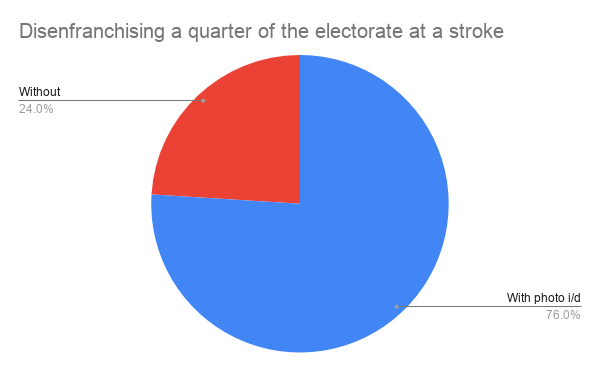
The two main forms of photo i/d in the UK are passports and car licenses. So, the determining factor in whether you have the right to vote or not will be whether or not you can afford to drive a car or take overseas holidays. 24% of potential voters do neither.

So this proposal would disenfranchise one in four of the electorate. The quarter with the least resources.

So, the worst off will be most disenfranchised. When you add ethnicity to this, it becomes even more poisonous. 24% of White people do not have a driving license, compared to 39% identifying as Asian and 47% of Black people. So, Black people are twice as likely to be excluded from the right to vote as White people. Younger people are also less likely to own cars – often for very positive reasons – as are people who live in cities. In Brent, for example, 42% of households have no access to a car or van. So, its clear who this measure is designed to shuffle off the register. A cursory look at opinion polls indicates why.

The Tories like to argue that “Democracy” is a “Fundamental British Value” (with capital letters) but this is the single biggest roll back of voting rights in British history. So not so much a fundamental value, more an expendable expedient. Something they’d put up with when it offered no threat. But, Corbynism gave them a scare in 2017. And – as post Brexit, less than global Britain shrinks into a mean and twisted cartoon of its worst features – they are still haunted by the ghost of it; knowing that the future is neither bright nor orange.

  1. https://www.theguardian.com/politics/2021/mar/01/woking-council-accused-of-discouraging-vulnerable-voters-postal-vote-id

2. https://www.theguardian.com/politics/2021/mar/09/warning-over-photo-id-law-change-for-uk-wide-and-english-elections

Holes in the Schools Safety Net. What can we expect from Monday.

Sailors on ships of the line about to be hit by a broadside would quietly intone grace. “For what we are about to receive, may the Lord make us truly grateful.” And so it is with the wholesale reopening of schools on Monday.

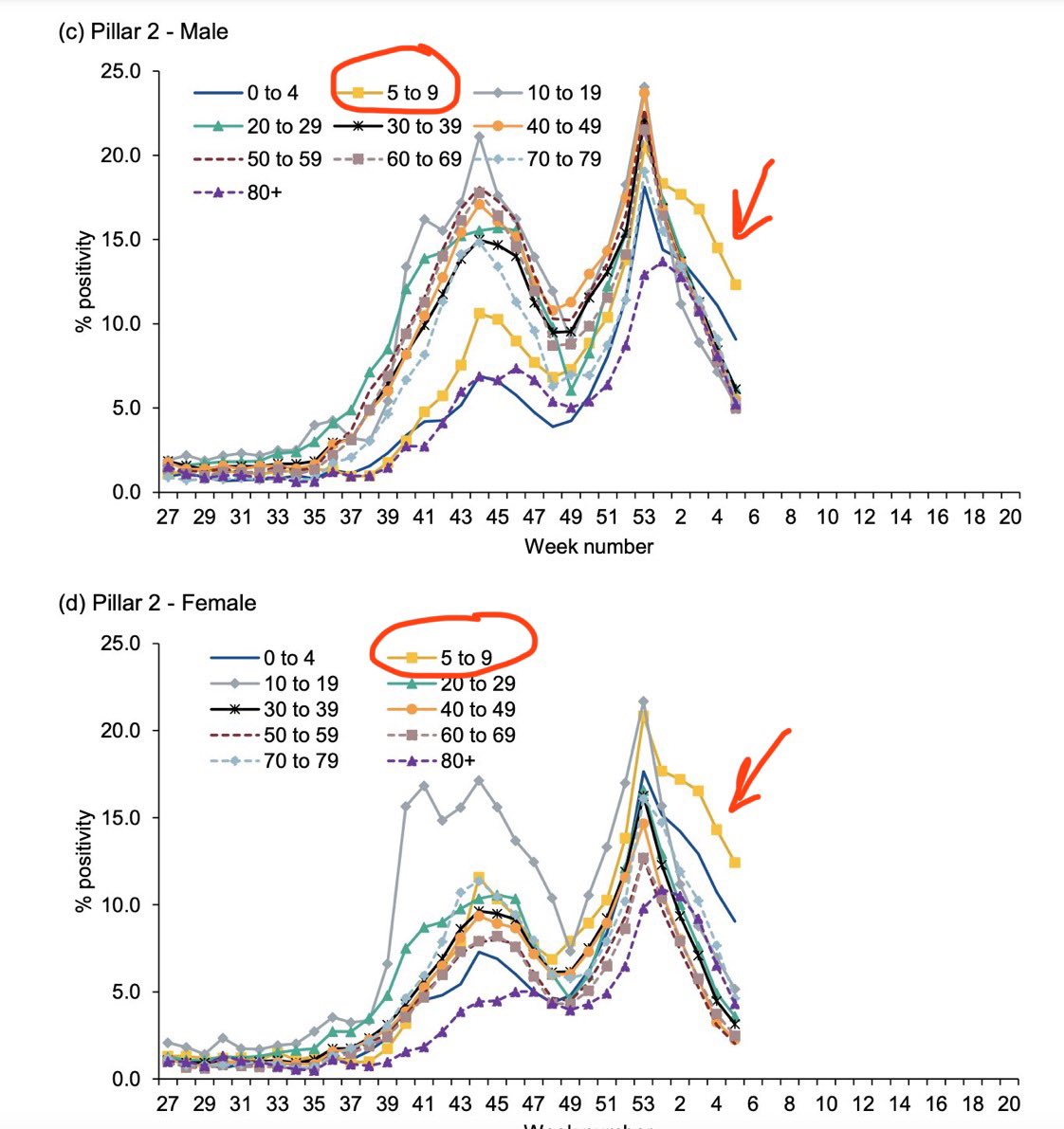
This is particularly the case given that for the last four weeks there has been a significantly larger percentage of positive cases in the 5-9 age group in England, for both boys and girls. (1) A similar trend has been seen in Israel and some sharp localised outbreaks in Italy have been centred on schools.

Image

In this context, looking at what happened in practice the last time that schools were fully open will give us a guide to what is likely to happen.

In the Autumn term the Health And Safety Executive carried out spot checks and inspections on schools to make sure that COVID safety measures were being implemented effectively. As these measures “have not been substantially changed” since then, their findings are instructive. (2)

It should be stressed that none of this addresses the wider safety issues of whole school reopening – particularly the journeys in and out – which are only covered obliquely in the guidance – but will involve a sudden rush of millions of daily interactions; which are bound to boost the overall R rate. Nor does it cover the likely effect of encouraging a sense that “things are getting back to normal” as swarms of kids reappear in the streets in the mornings and afternoons – with a knock on effect of people beginning to relax and drop their guard.

HSE spot checks and inspections in primary and secondary schools from September to December 2020.

“HSE contacted 5000 schools in England and Wales to check they were following the relevant government guidelines. This followed similar spot checks carried out in August on schools in Scotland.”

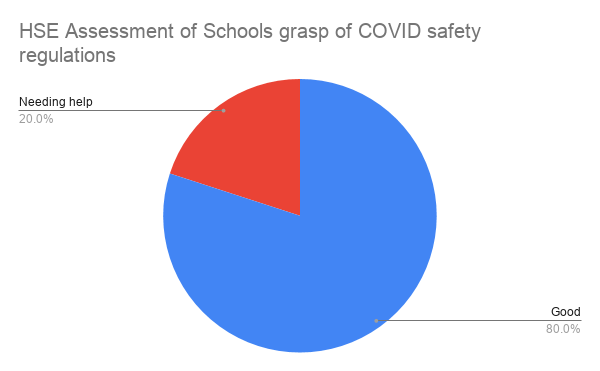
“Following the initial calls, HSE found that around 80% of schools had a good understanding of the guidance and what it means to be COVID-secure.”

The HSE makes no judgement on how much safer schools could have been if the unions 10 point recovery plan had been taken up by the DFE (3) but the 80% figure here is a testament to the hard work and dedication of school managements and the serious input made by the Education unions, whose safety checklist was used by Reps all over the country to make sure that risk assessments and procedures were in place and schools made as safe as it was possible to do within the limitations of the investment the government was prepared to put in. Sometimes school Heads who had previously been institutionally hostile to their union groups found themselves working constructively with Reps because the union guidance was so sound and thorough. However, some did not. 80% is a good figure, but that still leaves one school in five with a poor grasp of safety measures which are a matter of life and death. With 24, 372 schools in England, extrapolating their sample and assuming all other factors remain equal, that would mean that roughly 4, 875 schools had a poor grasp of the guidance. One in five. That would be the sort of place where Heads tried to insist on physical parents evenings or open days taking place, or in person staff meetings, or people of the CEV list coming in to work, or Christmas performances that would presumably be protected by God.

“For those schools, HSE undertook over 1000 follow up site inspections to check the measures they had in place.” While these schools responded positively and “nearly all …had implemented COVID-secure measures in accordance with the relevant government guidelines” by the end of term, obviously, this only covered the schools they had initially contacted; so potentially the remaining 3,875 slipped through the net.

Just under ” 1% identified contraventions of health and safety requiring formal interventions and improvement.” 1% of 24,372 schools is about 240. Not many, but more than enough.

If there is a similar pattern in the next three weeks up to Easter and beyond into the Summer term, the sort of concerns Inspectors had “included social distancing in staff rooms and kitchen/canteens, cleaning regimes, and ventilation in school buildings.”

Ventilation was a particular issue, so the HSE has updated its guidance (4) which will be useful for anyone in a school where this has not been sorted.

Other problems included:

  • Generic risk assessments being used which sometimes lacked specific detail for the school.
  • Lack of effective systems for regular monitoring and review of risk assessments.
  • Fire doors being propped open to aid ventilation.
  • Inappropriate rooms being used for isolating suspected cases.
  • Arrangements for managing external visitors and/or contractors.

good ideas they noted included:

  • Promoting social distancing by issuing pupils with coloured lanyards to identify their bubble and to help avoid mixing between different groups.
  • Using brightly coloured floor markings in school playgrounds to encourage two metre social distancing between parents and pupils during drop-off and collection times.
  • One school used a year seven science project looking at handwashing and UV light as a means of promoting effective hand hygiene.
  • Producing video walkthroughs explaining COVID-secure arrangements for pupils and parents.
  • Use of classroom seating plans to help with self-isolation measures.
  • A click-and-collect app to purchase food from the canteen to reduce queues and avoid crowding.
  • Using video conferencing for staff meetings and phones in classrooms to speak to other staff to reduce face-to-face contact.

The HSE has guidance on being COVID-secure and information on spot checks and inspections is available on their website.

The role of unions in each workplace, making sure that these guidelines are upheld, has been essential in limiting the damage so far, and will be just as urgently needed in the next period, as the government once again skids over thin ice with its eyes shut and fingers crossed.

  1. https://twitter.com/DrEricDing/status/1367448762025672704?s=08

    2. All quotes from HSE Education and schools eBulletin: March 2021

3. https://neu.org.uk/recovery-plan

4.  ventilation and air conditioning 

April in February

“Isn’t it lovely?” And so it is. Soft winds. A hint of blossom. Sticky buds starting to uncurl. Everything that little bit lighter and fresher. And you can respond on that level. Yes. Its lovely. There are crocuses of hope. Spring has more than one meaning. This early though…Our light. bright days are the accompaniment to the wild gyrations of the jet stream, the blazing forests of Australia, the melting ice packs of Greenland and Antarctica, the freezing of Texas* and the floods here in Storm Cristophe just last month, which Sir James Bevan, the Chief Executive of the Environment Agency, reports came within one centimeter of the tops of flood defences – constructed to Reasonable Worst Case Scenario Standards – that protect 49,000 homes from inundation. (1) Crocuses of hope could well give way to daffodils of despair if we don’t get our act together. Of course, in a conversation with a neighbour, being the Cassandra who is always pointing out the dark cloud that is the condition for the silver lining makes you a prophet of doom that no one wants to listen to, lest it ruin their good mood.

At the supermarket, a young woman pushes her baby buggy steadily down the aisle with one hand, looking sideways at her mobile phone completely absorbed, legs on cruise, navigating by muscle memory; her toddler is a small mirror image, looking to the left at his phone with the same frown of concentration.

Around the end of the Park, the first school crocodile of spring. Teacher striding out briskly at the head without a backward look. Neat little rows in the papal scarlet of the local Catholic primary going in two by two, with barely a need to be shepherded by the TAs at the back. Eighteen of them. And they look liked one class. Quite a lot even before the reckless reopening next week. The “normality” of it coming as a shock.

*“I’ll believe in climate change when Texas freezes over” Senator Ted Cruz.

  1. https://www.gov.uk/government/speeches/watching-the-wolf-why-the-climate-emergency-threatens-us-all

How to Avoid a Climate Disaster. All countries have more to do – but some have more to do than others.

In his friendly review of Bill Gates’s How to Avoid a Climate Disaster, former UK Prime Minister Gordon Brown argues that the 2010 Copenhagen summit failed to lead to the breakthrough we needed because of both “the reluctance of the US to make legally binding commitments, and the deep suspicion of China, India and the emerging economies of any obligations that they believed might threaten their development”. (1) He then anecdotally glosses over the former and emphasises the latter by recounting the rather startling image of “Australian Prime Minister, Kevin Rudd” having to be “physically restrained from punching the Chinese negotiator.” What an unreconstructed colonial incident that would have been. (2)

It might seem odd that the man who, as Chancellor in 2005, campaigned to “Make Poverty History” should put an equals sign between the refusal of the US – the worlds heaviest emitter per capita and the country with the biggest global legacy of carbon emissions – to see world leadership as anything other than getting away with the most it could, at the expense of those less powerful than itself – and the desire of the developing world not to stay poor; let alone foreground the latter. The way that he does this – possibly unconsciously – could stand as a warning that this attitude – that seeks a global division of labour in which the worse off and worst hit parts of the world do the heavy lifting, and restrain their development in the common interest, while the wealthiest countries try to make only those moves that maintain existing patterns of wealth, power and ways of life – is likely to find expression again and again in the run up to, at, and beyond the COP in November. There is already a significant effort going in to paint the more industrialised parts of the developing world in general – and China in particular – as the flies in the global ointment.

A recent report from US Researchers shows how much more work every country has to do if we are to hit the Paris target of keeping the global temperature rise within 1.5C – beyond which we are likely to be in danger of feedback loops that will make it incredibly difficult for us to control. (1) The additional effort needed for a selection of key countries looks like this.

Please note that this is what is required to have a 50:50 chance of staying within a 1.5C rise.

So, China has to do 41% more, just under half as much again as its already doing, while the UK has to almost double its efforts (97%) and the USA, India and Japan roughly quadruple theirs (203%, 190%, 229% respectively) and South Korea almost nine times as much. So, while John Kerry’s argument that China “isn’t doing enough” is true, nobody is, and the Washington has far more to do than Beijing; so a little humility might be in order. Closer to home, the frequent trope from UK Ministers that we “lead the world” on this are neither true – we are well behind the Chinese – nor relevant. It doesn’t matter if you are leading a pack of slower runners, if you are not going to get to the finish line before nature calls time on the race.

This blog is the first in a short series.

1. https://www.nature.com/articles/s43247-021-00097-8#Tab1 The worrying thing about this Report is that it puts a lot of emphasis that only an 80% increase in global effort would be needed to stay within 2C, as if it would not be extremely damaging and dangerous for us to end up there and it is just too much to expect that we could do what we need to if it was remotely inconvenient in the short term.

2. https://www.theguardian.com/books/2021/feb/17/how-to-avoid-a-climate-disaster-by-bill-gates-review-why-science-isnt-enough

Schools + Big Bang = Bad Move!

By late Monday afternoon we will know just how lucky Boris Johnson feels.

We will also know whether Chief Medical Officer Chris Whitty – reported to be deeply concerned about a rush to open schools wholesale on March 8th – is going to play the role of a Fauci, by refusing to be window dressing for a move he knows will cost lives, or that of a Birx, grimacing through whatever “form of words” Downing Street comes up with to massage its intent.

The government – not for the first time – is sending contradictory signals. The Education Unions, all of them, are not. They describe the prospect of schools being open to all students from March 8th as “reckless”. (1)

While the government is saying that it will only publish the Scientific advice after the event – an indication that they are not at all sure that it supports a big bang – what we do know appears not to.

As a result of the lockdown, infections are coming down quite fast. Halving every 15 days. With the infections on 18 Feb running at just over 12,000 – other things being equal – they would still be at just under 6,000 a day on March 8th; well above where they were in September last year the last time this was tried (1,295 on September 1st). And we should all recall what happened then. This time round, we are looking at a daily infection rate five times worse than then with a virus that is considered up to 70% more contagious.

Not likely to go better than September is it?

At the current rate of decline, the projection is that infection rates would take until the Easter holidays to be down to 1000 a day. Add the two weeks off for Easter with all other restrictions in place and we could be down to 250 a day by mid April. That is a level at which the virus could be hounded to domestic extinction with a proper test and trade system, run through the Health Service and Local Authorities not SERCO.

The government, instead, wants to rely on vaccines and a lot of hope – and probably some contradictory forms of words as the big bang blows up in our faces. Caution with freedom. Recklessness with responsibility. What more can you expect from us? The buck stops with you. If they do go for this, it will be seen as a green light by the take it on the chin brigade, who want the economy re-opened regardless of the casualties. In the words of Thurrock MP Jackie Doyle Price “The moment you open schools up then there no excuse for not opening up the rest of the economy”.

While there has been a real but marginal impact of vaccinations on infections among the over 80s, this has no bearing at all on schools. No children will be vaccinated. No vaccine has been licensed for the under 16s. Very few teachers or TAs will have had even one injection. At the moment, the age groups which has had the slowest trajectory of decline in infections are young adults (18-24) and primary school age children (5-12). “Researchers say that this may be because a significant proportion of primary pupils have still been in classrooms during lockdown”. (2) The current level of attendance in Primary is around 20-25%. Bump this back up to the pre pandemic norm of 95% and how hard is it to predict whats going to happen?

The impact of a partial reopening – on the lines being tried in Scotland from Monday – is likely to be damaging enough, with primary schools becoming a permanent viral reservoir. Their experience must be watched closely to see what happens, though it must be noted that Scotland has an infection rate that is lower than that in England (1:180 compared to 1:115) and the two weeks between Monday and March 8th is a short period to provide anything definitive about how quickly the virus rebounds. However, opening all schools for all students and all educators is bound to slow down the rate of infection decline significantly and, in the worst case, may even reverse it.

The Education unions, parents, independent SAGE and others are arguing for damage limitation. That if there is to be a partial widening of access to schools from March 8th, this should be on a limited basis and the results studied before considering wholesale reopening. That appears to be the plan in Wales, with Early Years and Infants back next week but a projected fuller opening for the rest of Primary and some Secondary year groups contingent on a continuing improvement in infection reduction. A government concerned with public health would listen to them. Labour should back them – and call for the Zero Covid strategy that is within our grasp, but the Tories fail to sieze

1 https://neu.org.uk/press-releases/joint-statement-wider-opening-schools-england

2 https://www.theguardian.com/education/2021/feb/19/whitty-at-odds-with-johnson-over-big-bang-reopening-of-schools-in-england