Erm, following the nuclear holocaust, could you tell me when normal public services would be resumed?
Very fair question. We have got it in hand of course. Following Armageddon, we do hope to have public services working very smoothly fairly soon after the event. But I feel in all fairness, that I must point out to all of you, that it must needs be something in the nature of a skeleton service.
The Beyond the Fringe Civil Defence sketch, 1960
There are three key things to grasp about the Government’s Emergency advice to stock up on tinned food and bottled water to deal with possible pending emergencies.
- They expect these emergencies to happen; and one aspect of this advice is to get people to be fatalistic about that and not try to avert them.
- They expect people to respond to them primarily as individuals. The first job of government is to keep people safe, but if their policies lead to a disaster, its over to you.
- The preparations they propose are nowhere near adequate to deal with the scale of the emergencies.
Lets look at these in a bit more detail.
What kind of emergency?
They list four big ones.
- Increased geopolitical tensions. This is a euphemism for getting ready for a war. Part of the “whole society approach” to the increases in war spending that are needed for the full scale war in Europe within ten years that the top brass have in mind is to get people psychologically prepared for it; so it becomes acceptable and conceivable without too much resistance. What’s missing in this bland phrase is that rising “geopolitical tensions” are primarily being driven by the UK’s core ally the USA and its unprecedented war drive, cutting medical coverage and food stamps to pay for a $1.5 Trillion war budget next year, making covert and overt interventions on every continent, fomenting an international race war while deploying a Black and Tans style militia (ICE) against its own ethnic minorities, pulling its allies into similar self impoverishing austerity and xenophobia. As any direct military threat to the UK comes from blowback from involvement in US sponsored wars and proxy wars, the key action that can be taken to keep the people safe is to stop being involved in them. If its possible for the Spanish government to stand up to Trump and refuse the use of their bases for bombing attacks on Iran, it should be possible for the UK to do the same and go further by pulling the RAF back from spy flights over Gaza. If we want to avoid a step by step escalation of the war in Ukraine to the point that the stakes are so high that nuclear weapons are used, we’d better start de escalating and negotiating now. Its what a majority of people in Ukraine want too.
- Climate change impacts. You know. Those things that the fossil media tell us aren’t happening, or, if they are, are nothing to do with the climate actually changing. But, as we’ve seen, we are now in a situation in which wildfires are threatening urban areas. Homes are being burnt out. In the UK this is small so far (18 in Wennington in 2022, 37 across the whole country this year) but entire neighbourhoods have been burnt out in North America and Australia in recent years (over 6,000 homes burnt out in Palisades in LA last year) and in France this Summer 300,000 people were evacuated from around Bordeaux when a wildfire threatened the city. This Winter, we will see severe floods. And these will intensify in the years to come. In this context there are two obvious points. 1) The government should be shouting from the rooftops that climate change is a problem that requires a much bigger set of changes to limit the damage. The National Emergency Briefing campaign for a national TV broadcast to level with the population is an apposite demand, and this should be the first part of part of a plan to mobilise people to deal with a real existential threat with a sense of mission that its possible for us to save ourselves; and we’ll do it collectively, and not just at home but internationally. 2) Putting out a general appeal for people to prepare for emergencies in general doesn’t hack it. We’re not going to be able to ride out a wildfire or stop a flood with a stockpile of baked beans.The flood risks are known, fire risks not so predictably. The FBU’s call for a summit on fire risk is vital to get a proper grip on it beyond a vague contemplation to ban disposable barbecues. The local authorities in each area will need a plan for evacuations, emergency supplies and relocation centres and these will have to be widely known; especially to the people directly threatened. We have to bear in mind that, while all these events are local, there will be more and more of them happening simultaneously, so robust planning, and national back up, is essential to avoid being overwhelmed. In these circumstances, the market will not provide.
- Cyber attack risks and Infrastructure vulnerabilities. These are relatively smaller scale than the big two above. A paradox of infrastructure vulnerability is that the only way to make it robust is to invest in it. If every spare penny is siphoned off into war preparation, infrastructure (from the small scale like potholes to large scale like the electricity grid) will continue to crumble and therefore remain vulnerable. Large scale cyber attacks big enough to require people either to have to stay at home or be evacuated would have to come from “state actors”; which would be blowback from a confrontational war policy pursued abroad – so the way to avoid that is to abandon that style of foreign policy and look to the sort of “win, win global cooperation” that China argues for.
The second and third points go together. The first issue is the need for government to actively avert the threat, not to exacerbate it by going slow on climate mitigation or adding to “rising geopolitical tensions” by pushing for a war. Anyone who thinks that doubling war spending to respond to a supposed “Russian threat” should reflect that the European NATO countries – on their own without the US – spend £3.50 for every £1 the Russian Federation spends on its armed forces and have twice as many service personnel. Aiming to double that can hardly be seen as a necessary defensive measure. Quite the contrary.
Supposing that there really is a war on the scale that they are contemplating, there is no way that it could avoid going nuclear. In which case, whether you have a few extra tins and bottles of water, or a wind up Radio to hear the King telling us to “Keep calm and carry on” as we all die, is going to be neither here nor there. There is an element of Protect and Survive about all this. In 1980, planning to introduce US nuclear cruise missiles to UK bases, the Thatcher government sent a pamphlet to every home in the country giving ludicrous instructions on how to make yourself safe in the event of a nuclear bomb being dropped on your city. This included making yourself an impromptu bomb shelter by unscrewing your bathroom door and hiding under it in the bath.
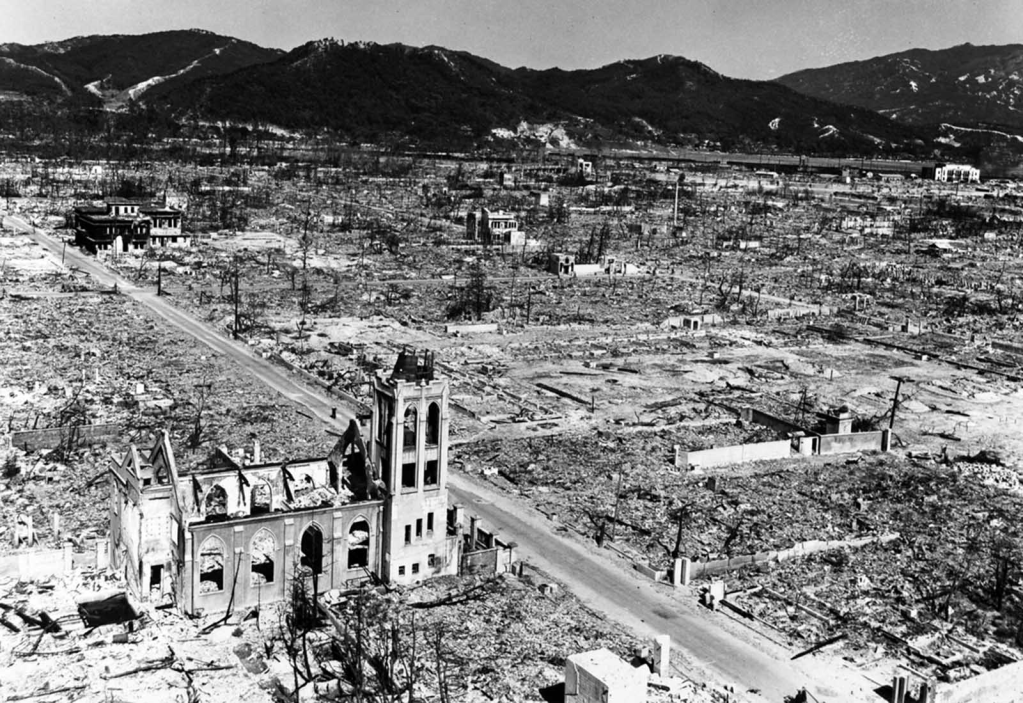
This image of Hiroshima after the bomb indicates how effective such an approach would be. Because people were aware of this at the time, the pamphlet proved to be a massive own goal for the government, anti missile groups mushroomed all over the country, and one of their campaigning tools was to act out Protect and Survive instructions in street theatre performances in town centres. Hundreds of thousands marched with slogans like “we won’t die for Thatcher” and “Jobs not bombs”.
The current instructions are more subtle. They don’t talk about nuclear war but “geopolitical tensions”, so the psychological conditioning is just enough to generate an unease that can be mobilised, but not enough to alarm people so much that there’s a mass backlash.
The deliberately small scale quality of the advice gives the impression that large scale disasters can be managed domestically. This is the equivalent of the bathroom door over the bath or the idea practiced dutifully in US schools during the 1950s that if you saw the flash of a bomb, you could survive the impact if you were to “duck and cover” under your school desk because “an atomic bomb can burn you worse than bad sunburn” (!!!) . As the schools would have been wholly incinerated, the purpose of these drills – and comparable civil defence drills for adults – was to keep the population in a mobilised Cold War mentality. It broke down by the end of the decade as people increasingly resisted taking part in them and responded to city wide drills by gathering in parks in protest against them.
The advice for a 72-Hour Emergency Kit is to stockpile, Important documents, Water (2L per person per day) Non-perishable food, Battery/wind-up radio, Torch and batteries, First aid kit, Medications, Phone charger, Cash. While it makes sense to have some of this in any case; what kind of war do they think would last for 72 hours? Perhaps the type that would make these preparations totally futile because we’d all be dead in an afternoon. Most of these items are not quantified, but the amount of water proposed is illustrative of how token this is. Two litres per person per day. At present, the average UK citizen uses 144 Litres a day, 32 of them to flush the toilet, 10 for drinking and cooking. Even being minimalist about it, 2 litres isn’t going to go very far. Trying to flush a blocked toilet with bottles of Evian? Perhaps the intention here isn’t to deal with large scale emergencies but to provide cover for water companies, which are increasingly disinclined to provide people with bottled water when they have been cut off fro long periods due to leaks. They are already under no obligation to compensate people if there is a water shortage due to “exceptional weather conditions” like the Summer droughts that are now becoming normative.
All this takes pressure of government to put in anything serious to back up public safety- and lets private companies off the hook to protect their profits. Serious public safety preparation is desperately necessary for climate breakdown, and completely pointless for a nuclear war. As they are actively preparing for the latter while ducking the former, the advice that they are offering actually puts us more at risk by psychologically prepping people to make war conceivable while playing down the consequences of climate change; which worst case projections (3C rise by 2050) now indicate could collapse the world economy by half between 2070 and 2090 and lead to the deaths of 4 billion people (almost one in two of the current global population) if the projected war doesn’t kill us first. There needs to be an urgent reversal of priorities, so the government acts consciously and consistently as a peacemaker while mobilising the entire population in a maximum effort to avert climate disaster.


Such an excellent article it would be good if it was slightly edited and sent to every MP, every newspaper, every local authority, including departments of Education – calling for a public discussion and information paper on the way forward in a call for peace.
LikeLike
Hi Nora By all means pass it on. These blogs get blocked on Facebook – for reasons that remain mysterious and unappealable, so circulation to friends and networks from people they know is always good. I see from your email address that you support the right team too! Paul
LikeLike