There is a lot of media hype that Andy Burnham will approve the Rosebank oilfield and the Jackdaw gas field in his first week as PM, even though the government has been very clear up to now that doing so won’t take a penny off bills nor help energy security, as most of the production would be for export.
They would also do virtually nothing to defend jobs. The most optimistic projections of jobs creation from Adura – the lash up of Shell and Equinor set to run the projects – is for 3,500 jobs “at peak production”, so short term construction jobs, and 880 long term jobs to keep them going. This is a much larger projection than that of the BBC in 2023, which had 1600 in construction and 450 long term; but taking it as good coin, it is a miniscule proportion of the jobs lost (at a rate of 725 a month) since 1979.
That looks like this (even using Adura’s, possibly inflated, figures).
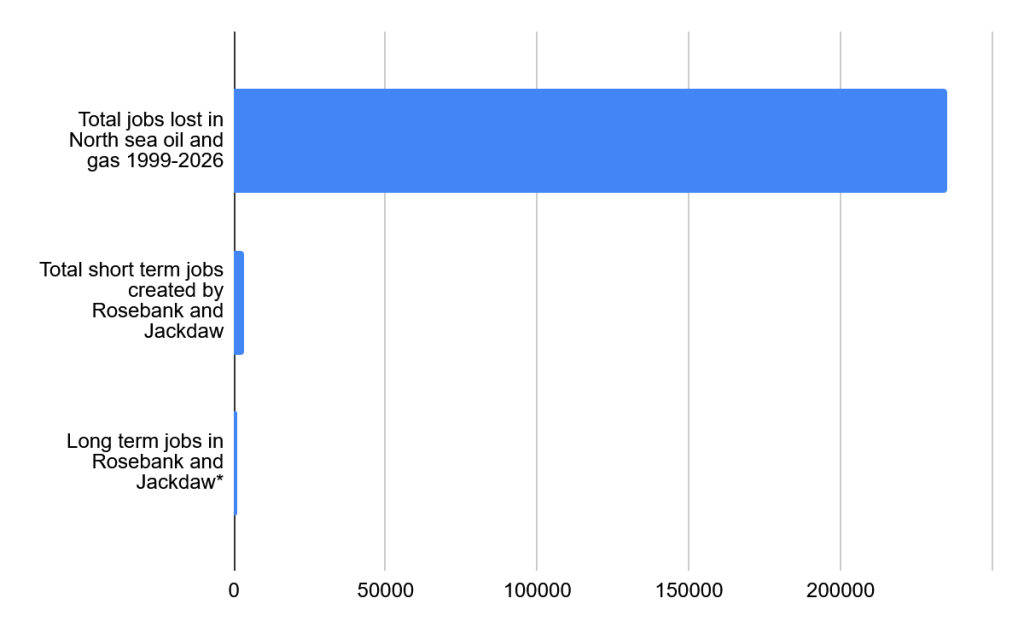
As you can see, the long term jobs are barely visible. Comparing the new Rosebank and Jackdaw jobs with the projected jobs decline up to the early 2030s shows a similar picture.

Assuming that government policy changes and these fields are approved. It is quite evident that the long term jobs in Rosebank and Jackdaw are a drop in the bucket and no amount of additional licences and tie ins will make any qualitative difference to the scale and speed of the job losses; as there are no other substantial fields left, and the remaining North Sea reserves cannot be “economically” extracted.
From a jobs point of view its a distraction from the main issue, because, without a plan for a transition to offshore renewables work, 60,000 workers will still lose their jobs within the decade whether they open or not. We need unity between all the North Sea unions and the climate movement to campaign for such a plan; which is the campaign we should have had all along.

