This is a brief letter to Labour List, which they published in their “Letters of the Week”section.
Marco Rubio’s speech to the Munich Security Conference was a call for a reassertion of unashamedly racist “Western” imperial dominance, for Europe to slash its welfare states and green transition, to prepare to compete for “new frontiers” of exploitation in the global South through assertions of raw military power. The audience gave him a standing ovation. This is a route to catastrophe; austerity and crumbling infrastructure at home, along with tearing our communities apart ICE style, and military adventurism abroad – replacing aid with raids. It should be utterly rejected, not greeted with “sighs of relief”.
Laura Kyrke-Smith and Melanie Ward’s argumentthat Europe “must stand strong” on its own does not confront the projection by George Robertson that doing so militarily within the current framework of escalating the confrontation with Russia, would cost not 5% of GDP but 7%. That’s an additional £135 billion every year. That would be ruinous in the immediate term and, in so far as it sucks resources away from the energy transition, will kill us in the longer term, even if the temptation to use all this hardware is resisted and it didn’t lead to nuclear war within the decade.
What we need instead is meaningful peace negotiations with Russia over Ukraine to resolve this European civil war, reintegrate our economies within a mutual security arrangement that would also help us form a more developmental relationship with China and the rest of the global South.
With less concern for brevityI could have added that
“Europe lay in ruins” in 1945 precisely because the dog eat dog rivalrybetween imperial powers that Rubio sees as a model for the future, came home to roost in the imperial heartlands in two World Wars once the global South had been fully carved up.
Saying “we are not afraid of climate change”is an attempt to will it away instead of dealing with it; empty bragadochio an expression of fears that have been suppressed.
In claiming the Rolling Stones as exemplars of White Western Civilisation, he obviously hadn’t done his homework on who the Rolling Stones themselves were inspired by, or heard anything by Muddy Waters.
Labour List published an article from Peter Hain this morning arguing that the government should take on debt to finance its war preparations. This is my letter in response, which I’m pleased to say that they published as the top letter. Some of the points will be familiar for anyone who reads these blogs, but bear repeating because they are routinely ignored in the mass media.
Peter Hain’s argument that the government should borrow to finance an armaments drive has three problems.
The quantity of money required to reach 5% of GDP on war would be £77billion every year. George Robertson’s projection for Euro NATO standing alone without the United States is 7%. The costs of paying the interest on this rapidly accumulating debt would be crippling, and it would act as an enormous financial black hole sucking resources away from everything worth while that government can do. Overseas aid was just the start. A militarisation drive would impoverish us across the board, as well as, with “a whole society approach”, copper bottom restrictions on dissent and pose questioning as treason. “Military Keynesianism” is also a mirage. Investment in weaponry does not build anything worthwhile that people can use, or that makes life better, as investment in sustainable energy, health services, public transport etc do.
The presumption of an impending war with Russia – in which we should be prepared to “lose our children” -is a form of madness. It is posed as a defensive response to Russian aggression. But Russia has neither the capacity nor the desire to attack the rest of Europe. It has taken them four years to occupy parts of Ukraine that mostly speak Russian and where they have substantial local support. Trying to occupy Western Ukraine or, say, Poland, where they would face intense hostility from the top to the bottom of society would be, as US Conservative analyst John Mearsheimer puts it “like trying to swallow a porcupine” At the moment, Euro NATO, without the USA, already outspends the Russians by 3.5 to 1, has twice as many service personal and advantages in all kinds of war material that range from twice as many aircraft and tanks to three times as many artillery pieces. Trying to double this again cannot be seen as defensive, but is preparation for a possible offensive operation which, if carried out successfully, couldn’t help but trigger Russia’s nuclear thresholds so, to put it bluntly, this is a course that can only end in us all being killed by it. The alternative of finding a European modus vivendi with Russia through negotiation seems to have been lost in a red mist. Time to sober up.
There is no collision with Trump. European NATO countries will not stand up to him over Greenland, they will accommodate. Justified hostility to Trump is being used to give him exactly what he wants – a huge arms drive that will further disadvantage European economies, lock them into a confrontation with Russia, to the mutual harm of both – and leave him with a free hand to intervene at will across the rest of the world while preparing for the ultimate military showdown with China before its too late (before the US is overhauled by peaceful economic competition and its fatal, fossil fuel based paradigm of modernity tossed into the dustbin of history by the spread of cheap Chinese solar panels).
None of us has any interest in any of that. We cannot afford to sleepwalk into World War 3 the way that the Great Powers did into World War 1; any talk of war being “inevitable” tends to become a self fulfilling prophecy. As we won’t survive such a war, it is profoundly irresponsible and light minded to become a cheer leader for the course towards it.
Please note that Facebook blocks my blogs, and doesn’t reply tom questions why, so, if you think these argumenst are worth getting about, please pass them on through other media.
I have, nevertheless, been doing so since the Vienna New Years Day Concert in 2014. Barenboim was conducting, and, as he marched on stage for the traditional final encore with an imperious flick of his baton, rather than crashing straight into the opening chords, a snare drummer tapped out a call to arms – tappity tappity tappity tap – trrr rrrr – RAT TAT TAT!
A whole set of emotions welled up. That sort of rhythm is designed to do that, meant to rouse the listener into a heightened emotional state and carry them away to take the Emperor’s Schilling; and visions of drumhread recruitment in towns and villages all across the Austro Hungarian Empire – and the rest of Europe – invaded my mind, along with a historical memory of what happened next that none of those swept up in war euphoria, or war fatalism, a hundred years before could possibly have had.
Painting of a soldier undergoing surgery by surgeon and painter Henry Tonks circa 2015from Faces of Britain by Simon Schama.
A quote from the same book. The nature of trench warfare, punctuated as it was by futile forays over the top, had exposed the heads of soldiers, nothwithstanding their helmets, to taking fire in the face. Exit wounds were gaping. Some shells had been designed to spray schrapnel, to devastating effect. Magnesium fuses were encased within, expressly intended to catch fire when lodged in tissue, resulting in the burning away of noses, eyes and cheeks.
More than 20 million dead at the end of it. And a comparable number wounded or mutilated. And World War 2 was worse. World War 3 has been unthinkable because there would be no one left at the end of it, brief though it would be.
Yet now we have the uncrowned heads of Europe and their media shils single mindedly trying to make it thinkable. Preparing us for a war with Russia by the end of the decade. Mark Rutte thinking he can succeed where Charles XII, Napoleon Bonaparte and Adolf Hitler failed.
Posing a war of choice as “defence”, as they always do, as every power did in 1914, avoiding any mention of the nuclear risks, avoiding any mention that they already outspend the Russians 3.5 to 1, avoiding any mention that Russia has neither the intention nor the capacity to invade the rest of Europe, avoiding mention of any alternative course, as if “war, war” is better than “jaw, jaw”.
This is part of a “whole society” approach aiming to make us stand to attention and salute without question. The most dangerous aspect of this sort of war fatalism, linked to escalation in arms build ups and suppression of dissent as treason, is that it poses war as inevitable – and when all sides accept that that is the case, war is what you get.
None of us has any interest in that. Not least because we’d all be dead at the end of it.
Yannick Nézet-Séguin did it again in this year’s concert. He made the usual speech before the encores – “music can unite all of us because we live on the same planet” – which felt peculiarly hollow this year, given the way the drums are beating all over Europe. Then off into Blue Danube and Radetsky, with the drum call to start and the well heeled Viennese spiessburger audience clapping enthusiastically along in a joyful romp towards Armageddon, just like so many of their ancestors did in 1914.
In an ironic counterpart, the final song in Jules Holland’s New Year Hootananny the previous evening was a singalong version of “Enjoy yourself (its later than you think)”.
New Year resolution for 2026, to beat a different rhythm and break up the march to war.
“If our country falters because it is not prepared to accept – let’s be honest – to lose its children… then we are at risk.”Chief of French Defence Staff General Fabien Mandon
This brings to mind Wilfred Owen’s The Parable of the Old Man and the Young
So Abram rose, and clave the wood, and went, And took the fire with him, and a knife. And as they sojourned both of them together, Isaac the first-born spake and said, My Father, Behold the preparations, fire and iron, But where the lamb for this burnt-offering? Then Abram bound the youth with belts and straps, and builded parapets and trenches there, And stretchèd forth the knife to slay his son. When lo! an angel called him out of heaven, Saying, Lay not thy hand upon the lad, Neither do anything to him. Behold, A ram, caught in a thicket by its horns; Offer the Ram of Pride instead of him.
But the old man would not so, but slew his son, And half the seed of Europe, one by one.
In the“season of peace and goodwill” the thoughts of our tiny leaders are turning to Armageddon. On the front page of the Daily Mail on 12th December, Minister for the Armed Forces, former Marine and MP for Selly Oak Al Carns is quoted as saying that “Britain is on a war footing” alongside NATO General Secretary Mark Rutte flagging up NATO intent with “Europe must prepare for the scale of war that our grandparents endured.”
There is something light minded about the way they pose this. As though it were conceptual. Something fictional. As if they can’t fully grasp the consequences of their actions, having never gone through anything on this scale – and lacking the inhibitions of previous generations that have.
In his foreword to Lord of the Rings, J R R Tolkein writes “One has indeed personally to come under the shadow of war to feel fully its oppression; but as the years go by it seems now often to be forgotten that to be caught in youth by 1914 was no less hideous an experience than to be involved in 1939 and the following years. By 1918 all but one of my close friends were dead.” Tolkein himself was at the Somme. As was my grandfather. And there is more than an echo of no mans land in the marshes of the dead outside Mordor, pale faces under water in shell holes reaching up to seize the minds of the living as they pass.
To be “caught in youth” in 2029 has every prospect of being not only “no less hideous” than 1914 or 1939, but also terminal for the rest of us too if we let them unleash the war they have in mind.
This is not solely a European problem, as this New York Times editorial openly calling for a US war with China, shows.
The UK Strategic Defence Review approaches this as a “whole society” mobilisation. That includes militarisation in our schools. Most of this will be about chilling dissent, but it will also involve a sharp increase in the number of Combined Cadet Corps that will be grooming our children to be killers (and be killed). In a secondary boys school I know of that has had a long tradition of having a CCF – as part of its aspiration to be as much like a public school in the 1920s as it can get away with – one of the consequences of it is that the War Memorial in the Hall is raw with recent names, former students barely into their twenties, dead in Afghanistan or Iraq. And those wars are side shows compared to what they are trying to get us to accept now. Like the late colonial skirmishes that preceded the mass slaughter after 1914. Just an overture.
In Germany a move to reintroduce “voluntary conscription” (as contradictory a phrase as you could even hope for – if its voluntary, it isn’t conscription, and if its conscription it can’t be voluntary) has already led to large scale youth and student mobilisations against it all across the country last weekend. We will need Refuseniks here too; and a movement of them.
In the spirit of Tom Lehrer’s remark that “if there are going to be any songs about World War 3 we had better start writing them now”, mourning the consequences of the war that the leaders of NATO in Europe are preparing for in advance is an essential part of preventing it.
There has been a sharp division on the Left over the war in Ukraine, but not such a division over opposition to increased military spending. Whatever anyone’s view of the former, its vital to be clear about the motivation of our own ruling classes. As they pose it, the need for increased arms spending and “putting our country on a war footing” is a response to “a rising threat” from Russia.
Leaving aside the strenuous effort that every power always makes in the run up to a war to convince itself and its population that its aggressive intent is solely defensive – Christopher Clark’s The Sleepwalkers details this for all the Great Powers in the run up to 1914, also emphasising how far they all genuinely believed that the best deterrent to war was being stronger than their opponent, which posed an escalating cycle or rearmanent and preparatory planning that locked them into the apocalypse that followed – that poses three questions.
Does such a threat exist, is it “rising” and, if so, what scale of response is needed to face it?
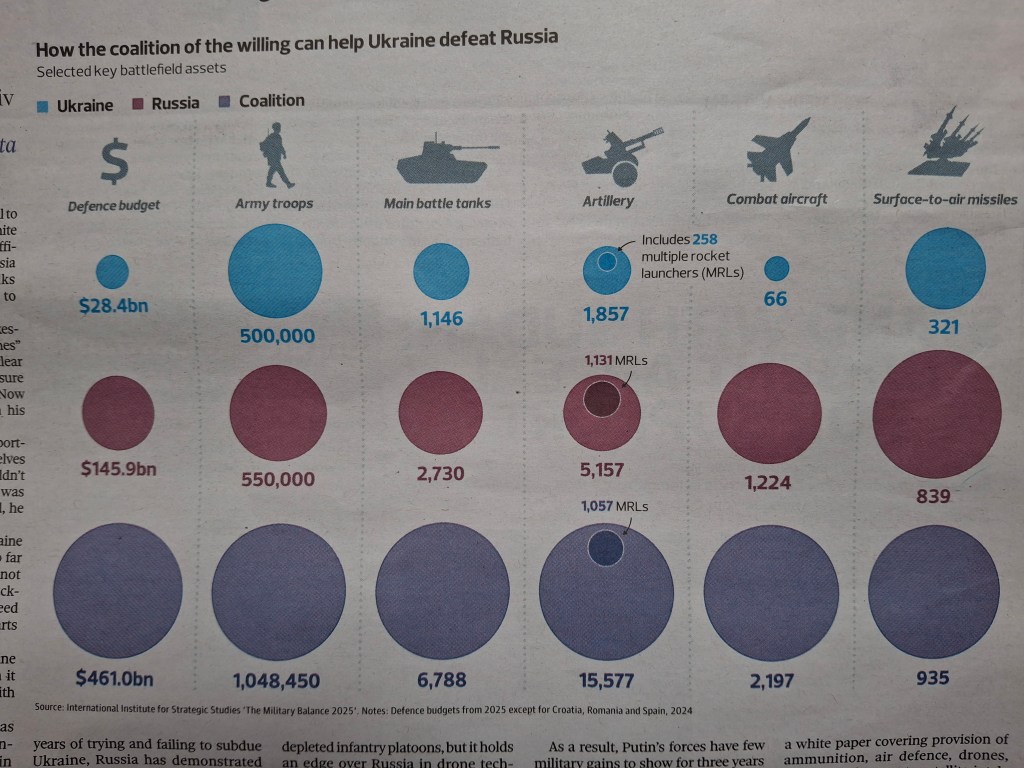
This is the current balance of forces between Russian and the European NATO countries, leaving the USA and Canada out, as printed in the Observer during the Summer. To spell it out, it shows that Euro NATO, leaving aside Ukraine, has twice as many service personnel, three times as many tanks and artillery pieces and twice as many combat aircraft as the Russians have. And thats now. Are they seriously trying to convince us that doubling what is already a huge advantage is necessary to stop an attack from an evidently weaker power?
Doubling military expenditure only makes sense if they are not contemplating defence but attack. They would have a 7 to 1 advantage in military spending. Its a conventional military cliche that, to be sure of success, an attacker has to have a 3 to 1 advantage. 7 to 1 seems a bit excessive even for that, but for the powers planning to build it to be posing that as “defensive” – because they feel threatened by a power that currently has less than half their capacity stretches credulity a bit far.
2. What does Russia want? Strenuous efforts go into avoiding even posing this question. The source of the war in Ukraine is put down either to some inherent expansionist quality in the Russian character, or megalomaniac psychic flaws in its current leadership. What they have said they want is an end to NATOs eastward expansion – because they feel threatened by it – Ukraine to be a neutral country, a mutual security treaty with the rest of Europe and NATO; and for the Russian speaking areas of Ukraine to be recognised as having seceded and become part of the Russian Federation. Russia has no desire for a war with the rest of Europe. They will fight one if they are attacked, but they are not going to try to expand Westwards.
You don’t have to accept that this is solely from peaceful intent to recognise that any such ambition is militarily and politically impossible. The areas of eastern and southern Ukraine that consistently voted for Russia leaning Parties before 2014 could be absorbed into the RF and there be some prospect of peace afterwards. Absorbing Western Ukraine would be like “trying to swallow a porcupine” as US conservative analyst John Mearsheimer puts it. Poland and the Baltic States even more so. Let alone anywhere further West. As the USSR found out in Afghanistan, and the USA (and UK) in Iraq, you can’t hold a country that really doesn’t want you in occupation of it. There just aren’t enough troops.
3 How would such a war go? If we get to a point that the war preparations stumble, or are manipulated, into a confrontation that escalates into full scale war, there are two scenarios.
The better one is that it rapidly bogs down into the sort of horrific slog that has been going on in Ukraine for the last three years but on a bigger scale, killing, brutalising and impoverishing all of us as it consumes more and more of our children, lays waste to all the towns and cities on and around the front line, devastates energy and other infrastructure far behind the front. Thats the better scenario.
The other is that, it all goes very well for Euro NATO forces and they stand poised to break through deeply enough into the RF to crush and dismember it. At that point, Russia’s nuclear weapons would be deployed. Russia’s nuclear war fighting doctrine is that these weapons would be threatened/used in the event of an existential threat to the state. They do not have a “no first use” policy. Nor, in fact does any other nuclear armed power with the exception of China. US nuclear war fighting doctrine has been based on the notion of a succesful nuclear first strike since the early 1960s. So, in the context of Euro NATO “winning” there would be every prospect of the Russian leadership invoking a Europe wide Samson doctrine and bringing the whole continent down with them. A nuclear strike on that scale would not spare the rest of the world, as the nuclear winter effect from even the self immolation of a single continent would have a devastating impact, posing a sharp drop in temperature, harvest failure and global famine.
Remembrance for the victims of all this is best done in advance; and to take the from of mobilising to stop it and make sure there aren’t any.
In 1922, just after WW1, the Danish composer Carl Nielsen wrote part of his 5th Symphony as a battle between the percussion, representing war, and the rest of the orchestra, representing the forces of life. In the opening movement there is a point at which the snare drummer is asked to improvise “as if at all costs he wants to stop the progress of the orchestra” as loudly and intensely as possible to try to drown it out in volleys of explosive detonations, before the forces of life finally triumph and the drums retreat in an elegaic mourning for their previous frenzy.
It is now up to all of us in the labour and peace movements in every country to be that orchestra, and drown out the mad drummers that are trying to lead us to catastrophe.
Please note that Facebook does not allow my blogs to be posted. They claim that some people have complained that they are “abusive”. I find that accusation pretty abusive myself and reject it completely. I suggest that anyone reading this have a look through any of my blogs at random and make your own mind up about whether they are absive or not and, if you like them and really want to annoy Mark Zuckerburg, please post them around on other platforms.
Its October and, as the clocks go back in more ways than one, scarlet paper poppies begin to bloom on the lapels of MPs and TV presenters. So begins the annual ritual of Remembrance; using the blood of its victims to turn a warning about the human costs of war into a sanctification of preparing for another.
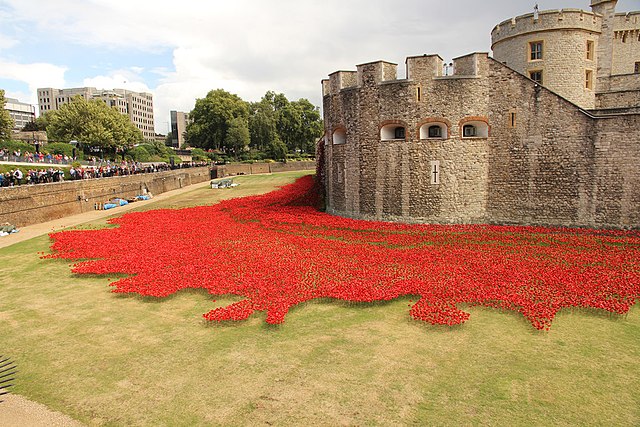
One of the most striking memorials to the outbreak of the First World War in 2014 was the “Blood swept lands and seas of red” installation at the Tower of London; which planted one ceramic poppy for every British and Empire fatality in the war. Estimates for how many of these there were vary. The installation used 888,246 poppies. The figure in Wikipedia is 887, 858. All the same, a lot of deaths. And the installation couldn’t help but numb and sorrow. Such an accumulation of individual losses made collective. Each individual poppy the colour of blood, and an echo of the scarlet of the state, as seen on phone and post boxes, London buses, the Brigade of Guards outside Buckingham Palace, and lost in it. Theirs had not been to reason why. And they had died.
On the Cenotaph in Whitehall, with an “unknown soldier” buried beneath, they are commemorated as “The Glorious Dead”; regardless of how they died or how inglorious it may have been.
Photo by Richard Croft. Creative Commons.
It is perhaps characteristic of a certain kind of British national narcissism that the only deaths commemorated were “ours”. Which underlines the limits of this sort of “Remembrance”. It becomes acelebration of victory sanctified by “sacrifice”. It tries to make it impossible to think past that sea of poppies to the losses suffered by other countries.
A commemoration of all the service personnel killed in the First World War would require a moat more than twenty times bigger, to register the 20 million or more of them killed. If you were to separate it out into national contingents, the French and Austrian sections would each be one and a half times the size of the British; that of Germany and Russia each more than twice as big. Having them all mixed up, in different colours perhaps, might underline their common humanity and the horrifying waste of it.
Civilian deaths in the First World War were a fraction of the military deaths, unlike the Second World War and most wars since. These are now running at about 67% of the total. Significantly more in Gaza. Commemorations that focus on WW1 tend to obscure that.
Civilian deaths from World War 3 would, of course, be total.
We are now in a period in which people who should know better are agitating for European NATO countries to prepare for a war with Russia by the end of the decade by doubling military expenditure (even though they already outspend them by 3.5 to 1) – a war that could not help but go nuclear – and it is a commonplace of US Foreign Policy thinking to envisage a war with China in the South China Sea – another war that could not help but go nuclear.
And, as Tom Lehrer once remarked, “if there are going to be any songs about World War 3, we’d better start writing them now”.
If we are foolish enough to allow our light headed and light minded leaders to make us collectively “pay undaunted the final sacrifice” in such insane adventures, age shall not weary us, nor the years condemn and at the going down of the sun and in the morning no one will be left to remember us.
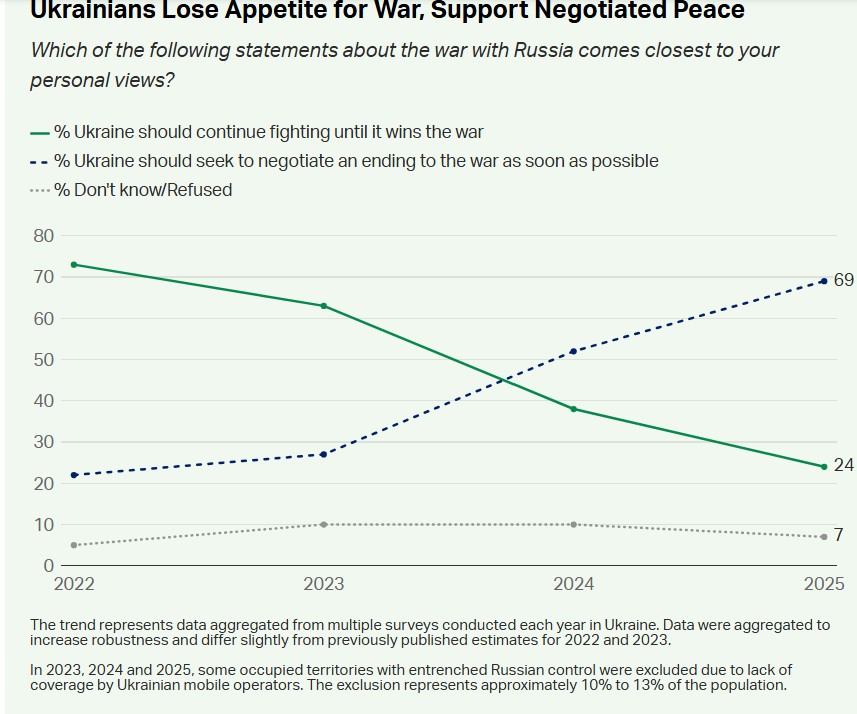
More than three years into the war, Ukrainians’ support for continuing to fight until victory has hit a new low. In Gallup’s most recent poll of Ukraine — conducted in early July — 69% say they favor a negotiated end to the war as soon as possible, compared with 24% who support continuing to fight until victory.
This marks a nearly complete reversal from public opinion in 2022, when 73% favored Ukraine fighting until victory and 22% preferred that Ukraine seek a negotiated end as soon as possible.
With a majority of Ukrainians now wanting peace,
and recognising that reconquest of Russian speaking territory in the East and Crimea is not realistic, even if they wish it were,
and driving the war on and on is now dependent on increasingly aggressive and deeply unpopular press ganging,
as soldiers from the front desert in increasing numbers
USC nevertheless continues to play its role of covering NATO’s control of Western Ukraine with a series of progressive sounding fig leaves.
On the one hand they call for “trade unions and civil society” to bloc with the British, European “and allied” imperial states to carry on cheerleading for the war, on the other they call for outcomes which cannot possibly be achieved through working class subordination to such a bloc.
The chance of a Ukrainian reconstruction under the aegis of Western powers that does not leave Ukraine’s natural resources exploited “by Western corporations and oligarchs” is nil. The existing reconstruction plan, agreed by the Ukrainian government and the West in 2022 hands the job over to Blackrock. This simply cements the process of privatisation of land and assets that accelerated sharply after 2014, and is partly what Western intervention in Ukraine is FOR.
Likewise, what level of fantasy do you have to be capable of to imagine that any reconstruction deal in Ukraine, run by its current Oligarchy in subordination to the EU and US, would “empower Ukrainian trade unions and civil society” or “withdraw the proposed Labour Code that restricts workers’ rights and unions”? Thats the last kind of deal they’d even consider, unless they are defeated. The authors of this “plan” must be aware of that, but they put it up all the same.
To achieve either of these aims would require the defeat or overthrow of the Ukrainian oligarchy. Or sufficient pressure on it by a mobilised working class in western Ukraine, with international support in the context of a defeat, that would force it to make concessions. This is not possible if sections of the Left in Ukraine, and internationally, continue to subordinate the working class to backing the war effort in a framework of a national unity that lionises Fascists like Stepan Bandera, denies self determination to the large Russian speaking minority, and seeks to “Ukrainise” the others. When the resistence to conscription becomes a movement for peace, on this “plan”, USC will oppose it.
Trying to mobilise support for increased weapons flows, and the (unspecified but enormous) finance required, means an attack on working class living standards across Europe. Do John McDonnell, or any of the other signatories, imagine that European imperialist governments are going to put the costs of this war onto the backs of the class whose interests it serves? And, if we did have governments committed to massive wealth redistribution in the imperial heartlands, would they also not be looking for a peaceful modus vivendi with the Russians, and others?
This line of thinking becomes positively farcical when they state that we have to “Recognise Trump’s alignment with Putin”. Really? Now?
This line was a convenient one for the European ruling classes, who have used it to mobilise support for exactly what Trump wants, a doubling of European “defence” expenditure, when they already outspend the Russian by 3.5 to 1, during the period when Trump was trying to woo the Russians away from their international bloc with China – the better to pick them both off later. This has been characterised as a “reverse Nixon” or “reverse Kissinger”; which underlines one reason it hasn’t worked. The Russians have a bitter experience of how that worked out for them last time.
Commentators from Timothy Garton Ash to George Monbiot talked this up a storm while they could; and its possible they believed in it. Its a bit more difficult to sustain now that Trump is shooting his mouth off about apocalyptic sanctions on countries that continue to trade with the Russians and deploying nuclear armed submarines “close” to Russia as an explicit warning. And, after a brief revival during the Alaska talks Trump is now making statements like this.
“It is very hard, if not impossible, to win a war without attacking an invaders country. It’s like a great team in sports that has a fantastic defense, but is not allowed to play offense. There is no chance of winning! It is like that with Ukraine and Russia”.
“Crooked and grossly incompetent Joe Biden would not let Ukraine FIGHT BACK, only DEFEND. How did that work out? Regardless, this is a war that would have NEVER happened if I were President – ZERO CHANCE. Interesting times ahead!!!”
Making Trump’s “betrayal” of Ukraine, as if it was ever anything other than a poisoned pawn for US interests, a major plank in mobilising opposition to his state visit in September now looks absurd as well as self defeating. Getting angry that the core of global imperialism is not being aggressive enough in one of its proxy wars, is a self destructive emotion. What do they want him to do, send more nuclear subs?
Now he knows that his wooing attempt on the Russians has failed, Trump is trying to cut his losses. If he goes for a deal at the Alaska talks, this will be to try to freeze the conflict more or less as it is, so that the current inexorable Russian advances are stopped before the Ukrainian Armed Forces collapse like the South Vietnamese Army did in 1975 – putting the asset stripping deal he has already made with Kyiv at risk. This is not inevitable, but tipping points do get reached. Either way, even if he doesn’t, he has already outsourced the resourcing of the war to Europe. So, if the war continues, Ukrainians will fight and die, US arms firms will profit, and the European working class will pay for it.
This is not in our interests.
The last, and probably most important, point is what they mean by a “just peace”. It seems an a priori position on their part is that a “just peace” is one that does not take any Russian concerns into account; a Western imposed one.
In my last blog on this issue I asked USC supporters three questions about the initial Russian proposals to settle the conflict in Ukraine without a war in 2021. These were;
No further NATO expansion
No forward deployment of US forces or weapons into Eastern Europe
A ban on Intermediate Range Missiles
A limit on military manouvres and activities
Limits on nuclear weapons
A Mutual Security Pledge
Establishment of Consultation Mechanisms
An Indivisibilty of Security Principle.
These seem to me to be to be the basis of a just peace, not simply for Ukraine, but for Europe as a whole. The questions for USC supporters are
which of of these proposals do you disagree with?
Would an agreement on these lines be a viable way to end the war?
Would an agreement on these lines have avoided it in the first place?
I have had no answers. The silence is deafening.
As it is impossible at this point in the war for the West to impose a peace on its terms, the USC “plan” is nothing more than the subaltern Left playing its part in NATOs current attempt to spin the war out in the hope that something will turn up, while it retools its military industrial complex enough to intervene more directly by the end of the decade.
This would, of course, be a suicidal course of action that will be averted by resistance to rearmament and a NATO defeat in Ukraine; at which point “another Ukraine” becomes impossible to avoid.
In his February article, Ukraine’s defeat and the fall of the West, Owen Jones argued that “if we were always going to end up at a point where Russia was going to take land, and Western leaders thought that, but claimed otherwise and made promises to Ukraine to keep the war going to achieving what they believed to be unachievable – well, what that means in terms of countless wasted lives is truly hideous“; noting that this has been in pursuit of what the Washington Post described as “a sensible, cold-blooded strategy for the United States — to attrit an adversary at low cost to America, while Ukraine was paying the butcher’s bill”.
We are now getting to that point.
The way the war ends, or is spun out, is of enormous consequence to whether Europe will remain locked in an escalatory spiral towards the fever dream of a further, wider, deeper – and suicidal – pan European war that infects the minds of General Staffs and newspaper editorial boards; or whether there is an attempt to find a sustainable modus vivendi with Russia that enables de escalation, avoids mutually assured destruction and dislocates Europe from the US imperative to shore up its slipping global dominance with ever more adventurist wars.
The media here reflexively dismisses Russia’s bottom lines for ending the war as “maximalist”; by definition unreasonable, to be dismissed with no further thought or examination. This is of a piece with their usual tactic of obscuring reality with adjectival clouds of emotive association, so it is vital for even those sections of the Left that have cheered on the war, and are still doing it even as a majority of Ukrianians want peace, to get beyond the emotional red mists and look seriously at what the Russians are actually proposing.
These are the key points from the published text of the draft “Treaty between the United States of America and the Russian Federation on Security Guarantees” that Russia presented to Biden in December 2021; and which the US/NATO dismissed out of hand and refused to discuss.
No further NATO expansion
The US would commit to preventing further enlargement of NATO, specifically barring Ukraine and other former Soviet republics from joining the alliance.
This also included a ban on NATO military activity in Ukraine, Eastern Europe, the Caucasus, and Central Asia.
2. No Deployment of US Forces or Weapons in Certain Countries
The treaty would forbid the US from deploying military forces or weaponry in countries that joined NATO after May 1997 (such as Poland, the Baltic states, Romania, and others).
NATO infrastructure would have to be rolled back to pre-1997 locations.
3 Ban on Intermediate-Range Missiles
Both Russia and the US would be prohibited from deploying ground-launched intermediate-range and shorter-range missiles outside their national territories, as well as in areas of their own territory where such missiles could strike the other’s territory.
4 Limit Military Maneuvers and Activities
Limits on heavy bombers and surface warship deployments: Both sides would restrict the operation of heavy bombers and warships in areas from which they could strike targets on the other’s territory. (Note: In September 2020, Trump’s DOD authorized a B-52 to fly along the Ukrainian coast in the Black Sea.)
5 Nuclear Weapons Restrictions
All nuclear weapons would be confined to each country’s own national territory. Neither side could deploy nuclear weapons outside its borders. (Note: US just sent a batch of nukes to England.)
Withdrawal of all US nuclear weapons from Europe and elimination of existing infrastructure for their deployment abroad.
6 Mutual Security Pledge
Each side would agree not to take any security measures that could undermine the core security interests of the other party.
7. Establishment of Consultation Mechanisms
Proposals included the renewal or strengthening of direct consultation mechanisms, such as the NATO–Russia Council and the establishment of a crisis hotline.
8 Indivisibility of Security Principle
Included a reaffirmation that the security of one state cannot come at the expense of the security of another, formalising Russia’s interpretation of the “indivisible security” concept.
The three questions that supporters of the Ukraine Solidarity Campaign should ask themselves is,
which of of these proposals do you disagree with?
Would an agreement on these lines be a viable way to end the war?
Would an agreement on these lines have avoided it in the first place?
Trigger warning. This blog contains sycophancy in high places.
Those on the pro European Right like Timothy Garton Ash, and most other opinion columnists in the Guardian, even George Monbiot, who have argued that “Europe” should increase military spending to break with the US, and those on the Left who are arguing that there is now a fundamental rift between the US and its subordinate allies, should consider the following three quotes addressed to Donald Trump from former Dutch Prime Minsiter and NATO General Secretary Mark Rutte at the end of the NATO Summit.
“You are flying into another big success”
“Congratulations and thank you for your decisive action in Iran. That was truly extraordinary, and something no on else dared to do.”
“It was not easy, but we’ve got them all signed on to 5%! You will achieve something NO American president in decades could get done. Europe is going to pay in a BIG way , as they should, and it will be your win. Safe travels, and see you at his Majesty’s dinner.”
“Daddy sometimes has to use strong language.”
And these from Trump describing the 5% target as “something that no one thought possible. And they said ‘you did it, sir, you did it’. Well I don’t know if I did it…but I think I did“and “a monumental win for the United States” and “a big win for Europe and for actually Western Civilisation” because Europe would be “stepping up to take more responsibility.”
So, there you have it.
Increasing military spending is giving Trump exactly what he wants.
European NATO governmnets will now seek to impoverish their populations and stunt their own development to find the resources to double militray spending.
Europe tooling up for a future continent wide confrontation with Russia gives him a free hand, with his now $1 trillion”defence” budget to prepare for military confrontation with China.
And not only does none of this undermine Trump’s push to domestic authoritarianism; it requires it at home. Proscribing Palestine Action in the UK is part of a drive to a more militarised society in which our children are dragooned into cadet corps, non violent direct action is elided with “terrorism” and Yvette Cooper’s desire to “lower the threshold” for Prevent referrals to catch more “Islamists” is aimed clearly at the mass pro Palestinian movement in an attempt to define dissent of foreign policy as “pre terrorist ideology” that can be legally harassed and crushed even more than it already is.
Speaking today, the Prime Minster stated that the UK has to get into a position to fight a war with Russia. It is a premise of the “Defence” Review that such a threat exists.
However, last week’s Observer published a graphic that shows the actual balance of forces now in Europe, between the European NATO powers and Russia. This reflects a level of spending that is three and half times the Russian level.
This is it. Have a look at this and ask yourself, who is threatening who here?
Then consider that the proposed 10 fold increase in lethality of the UK armed forces is part of a Europe wide drive to get the imbalance of spending between Euro NATO and Russia up to 10 or 11 to 1. So, this is not about “defence”. It is about being in a position to launch a war. Our current crop of lightweight leaders don’t seem to have studied much History. Invasions of Russia do not go well. As Charles XII, or Napoleon Bonaparte, and Adolf Hitler found out.
Given that Russia is a nuclear power with a nuclear war doctrine that would use nuclear weapons in the face of an existential threat to the country, the suicidal futlity of this drive boggles the mind. Needless to say, NONE of the interveiwers on the Radio or TV today have posed any questions of this sort. In fact, the Veterans Minister told the BBC Interviewer on PM this evening that it would be part of his job to “tell the truth”, which he interpreted as telling a story that projects “the national interest”. So, don’t ask the awkward questions. Close them down. Like we have now, but more so.
Four short points.
The Review states that “you can’t defend on the goal line”. What they mean by this is that the UK armed forces would be fighting wars in other countries – as they have done regularly and consistently since WW2. Nothing new there. But there is a particular emphasis on Russia. How they envisage fighting even a conventional war with Russia without utter devastation for any country unfortunate enough to be on the front line, or within reach of even conventional missiles, isn’t elaborated on. We just get the old chestnut that to defend peace we have to be able to fight and win a war. That’s what everyone said in the run up to 1914, and look how well that turned out.
The Review envisages mobilising the whole population for war readiness. That means a huge propaganda effort directed at civil society and through the school curriculum, presumably boosting cadets corps as part of the process, and weeding out dissent, either through Prevent or something more bespoke. A robust resistance to this from educators in defence of peace and sanity will be essential. As the Minister on PM said, this will be what we did “in the Cold War”. Similar conscientious objection will be needed, as it was then, to attempts to impose a stifling conformity, and any of the rituals deployed to shore that up.
Complaints have been made in the press that the Armed Forces are losing people faster than they can recruit them, “even though the government has pledged to provide peacekeepers for Ukraine”. Has it not occured to them that this might be one of the reasons why more peopple are leaving than joining?
The government is keen to talk about “military Keynesianism” rebuilding the economy, and some unions will go along with that on a “British Bombs for British Workers” line. This is nonsense. Military investment is, hopefully, wasted. The weaponry produced doesn’t build anything. Quite the reverse if used. This is unlike investment in, say, Health or Green transition, both of which produce much greater returns in value added and job creation. Explored in depth here. So, this is a dead end, in both respects.
The bottom line is that this is a political and military posture of choice. Impoverishing our society to ramp up arms spending, some of which will be exported to allies like Israel or Saudi Arabia to pursue genocidal attacks on Gaza or Yemen, in pursuit of a confrontation with Russia that will kill all of us if it follows its own impetus to full scale war, is not inevitable, not an imperative. Seeking a peaceful resolution to the Ukraine war and an ongoing modus vivendi with Russia that cools off military confrontation across the whole of Eurasia is an alternative that the whole Left should fight for. Some of the framework for this is explored in the Alternative Defence Review produced by CND and the RMT.
Please note. My Blogs are banned of Facebook because they say they “look like spam”. This has somewhat reduced their reach. If you think the arguments are worth passing on, and want to help break the ideological blockade embodied in this sort of action, please pass it on to anyone who you think might find it interesting or useful.
“I don’t want anyone else to die,” Natalya says, crying. “Our little trooper is the youngest of all those who lie here.” “Here” is the military cemetary in Lviv. Her son was 18.
What follows are a series of quotes from an article in Meduza based on interviews with people across Ukraine. Meduza is a Latvian based English and Russian language news blog with an unofficial motto “make the Kremlin sad”.
Despite that. what is striking about this selection is how the views expressed differ from the limited range of Ukrainian voices we get to hear in the official media here; which is why I have highlighted them in concentrated form in this blog.
I want to stress that for each of these views in the full article – which is worth reading – there is another arguing for carrying on fighting until the 1991 borders are restored, “otherwise what have we been fighting for?”
In these arguments, the deaths of the future are sanctified in advance and made imperative by the deaths of the past. None of the people who put this view, however, argue that it is possible. It is posed more as as a moral imperative, a revulsion against sacrifice in a lost cause; thereby carrying within it the prospect of a backlash not only against any peace terms that Ukraine accepts, but also those who have conducted an ultimately futile war. So the question “WHAT have we been fighting for?” is inextricably entwined with,“WHO have we been fighting for?” especially as the Kyiv oligarchy’s US puppet masters measure up the country’s natural resources as compensation for defeat.
“This is a separatist city; there are many zhduny here,” he ( a young soldier in the Ukrainian army) says of Sloviansk (a city in Northern Donetsk, close to the front line now) using a Ukrainian term for people who are “waiting for Russia.”“Even the local grandmas look at me like they want me to drop dead.”
According to Oleksandr, Sloviansk residents with pro-Russian views no longer speak openly “because they understand it will cause them grief.” But Lera says that in some local Telegram groups, they refer to the Russians as “ours,” and local taxi drivers and shopkeepers often use the word “ruble” instead of “hryvnia.”
This confirms that pro-Russian views in eastern Ukraine are a reality, not a “Putin talking point”.In other parts of the country, sentiments like these are expressed.
“If I were [in the politicians’ place], I’d have come to an agreement already, to be honest. I just want the war to end.”
“Yes, we’d like the 1991 borders to be ours, but not [if we have to fight] to the last Ukrainian. If so, let everything remain as it is. Not at this price.”
Borys says he wishes “Zelensky would stop this.” He thinks that Ukraine’s occupied territories should receive neutral status or become part of Russia, so long as the majority of Ukrainians are left alive; joining NATO isn’t worth such losses, he says.
“I think we should start negotiations [with Russia] and then decide the fate of [the Donetsk and Luhansk] regions through an honest poll. So people can decide for themselves which country they want to be in,” chimes in his friend Ihor, 18.
“Are we going to sacrifice a million [people] for Crimea? And then what will we get?” Valetov continues. “I’m going to say something [that sounds] bad, but the people in Donetsk and Luhansk are no longer ours — with the help of television and Telegram, you can flush everything [Ukrainian] out of people’s minds in 11 years.”
She worries that politicians have gradually turned the war “into a business,” and she doesn’t understand how the money sent to help Ukraine is spent. “I have a lot of friends at the front whose [relatives] equipped them,” she says. “[It’s like,] You want normal body armor and a good helmet? Get it yourself.”
“I don’t understand why our boys are at the front, but guys from Donetsk come here in their big flashy cars and live it up,” she cries (Maryanivka is about 500 kilometers, or 310 miles, from the front line in Donbas). “Why don’t they go there and defend their territory?!”
Ukrainians are tired of the war for many reasons, including because many of them donate money to support the army only to hear about constant shortages of weapons and equipment. She’d like the war to end with Ukraine getting back its occupied territories, but “if it were going to happen, it would have happened long ago,”
“Do you know what a Pyrrhic victory is? I don’t want such a victory,” he says. “But if our territories are given to Russia, this would be a capitulation, which isn’t right either. Therefore, just freeze the conflict. But on one condition: our country introduces the death penalty for embezzlement today. I’m no supporter of the death penalty, but I think it’s time.”
“They’re stealing our boys!” cries Yevhenia (name changed). Her draft-age son “was taken right from the bus stop” to basic training, even though he should have received an exemption as his grandmother’s caregiver. Yevhenia says her son failed to submit his documents to the military enlistment office in time. “If I’d known that would happen I never would’ve let him go out!” she says, practically in tears.
“It feels like they just want to destroy us,” he explains. “Not just the Russians, but our command, as well. We’ve been sitting at the front endlessly. It’s as if they’re saying, ‘There’s no one to replace you, [so] you have to die here.’”
According to Stanislav, morale is low and soldiers are just trying to survive. “Anyone who talks about peremoha should grab a Kalashnikov and go for it,” he says, using the Ukrainian word for “victory.” “On the Zaporizhzhia front, the Russians are making concrete and fortifying their positions with it. How are we going to break through? I’m horrified at the thought of going on the attack there. We’ll just drown in blood.”
Asked what to do about the so-called Donetsk and Luhansk “people’s republics,” Stanislav argues that the easiest solution is to “amputate” the Donbas region. Mentioning the fact that Ukrainians live there makes him roll his eyes. “Oh, for fuck’s sake,” he says with a sigh.




 Urban ramblings