Remembrance 1: “We’re going to need a bigger moat”.

Its October and, as the clocks go back in more ways than one, scarlet paper poppies begin to bloom on the lapels of MPs and TV presenters. So begins the annual ritual of Remembrance; using the blood of its victims to turn a warning about the human costs of war into a sanctification of preparing for another.

One of the most striking memorials to the outbreak of the First World War in 2014 was the “Blood swept lands and seas of red” installation at the Tower of London; which planted one ceramic poppy for every British and Empire fatality in the war. Estimates for how many of these there were vary. The installation used 888,246 poppies. The figure in Wikipedia is 887, 858. All the same, a lot of deaths. And the installation couldn’t help but numb and sorrow. Such an accumulation of individual losses made collective. Each individual poppy the colour of blood, and an echo of the scarlet of the state, as seen on phone and post boxes, London buses, the Brigade of Guards outside Buckingham Palace, and lost in it. Theirs had not been to reason why. And they had died.

On the Cenotaph in Whitehall, with an “unknown soldier” buried beneath, they are commemorated as “The Glorious Dead”; regardless of how they died or how inglorious it may have been.
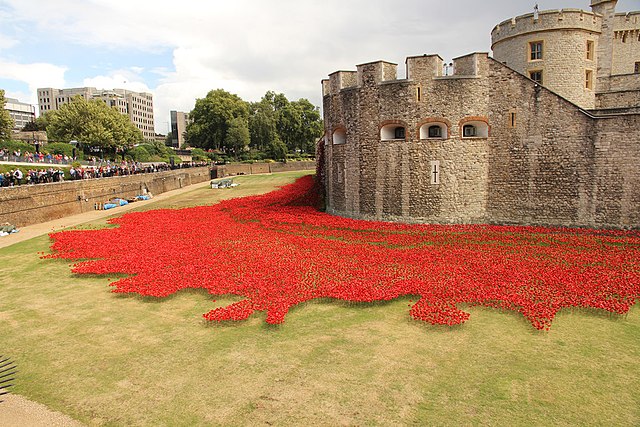
Photo by Richard Croft. Creative Commons.

It is perhaps characteristic of a certain kind of British national narcissism that the only deaths commemorated were “ours”. Which underlines the limits of this sort of “Remembrance”. It becomes acelebration of victory sanctified by “sacrifice”. It tries to make it impossible to think past that sea of poppies to the losses suffered by other countries.

A commemoration of all the service personnel killed in the First World War would require a moat more than twenty times bigger, to register the 20 million or more of them killed. If you were to separate it out into national contingents, the French and Austrian sections would each be one and a half times the size of the British; that of Germany and Russia each more than twice as big. Having them all mixed up, in different colours perhaps, might underline their common humanity and the horrifying waste of it.

Civilian deaths in the First World War were a fraction of the military deaths, unlike the Second World War and most wars since. These are now running at about 67% of the total. Significantly more in Gaza. Commemorations that focus on WW1 tend to obscure that.

Civilian deaths from World War 3 would, of course, be total.

We are now in a period in which people who should know better are agitating for European NATO countries to prepare for a war with Russia by the end of the decade by doubling military expenditure (even though they already outspend them by 3.5 to 1) – a war that could not help but go nuclear – and it is a commonplace of US Foreign Policy thinking to envisage a war with China in the South China Sea – another war that could not help but go nuclear.

And, as Tom Lehrer once remarked, “if there are going to be any songs about World War 3, we’d better start writing them now”.

If we are foolish enough to allow our light headed and light minded leaders to make us collectively “pay undaunted the final sacrifice” in such insane adventures, age shall not weary us, nor the years condemn and at the going down of the sun and in the morning no one will be left to remember us.
Chagos : picking up the tab for the USA.

The headline in Monday’s Daily Telegraph was Starmer hid costs of Chagos surrender, with the strapline Official figures reveal total cost is ten times higher than the Prime Minister claimed.

Even in the Telegraph, which could have most of its headlines summarised in an emotional digested read as HRUMPH! this is almost poetic. A veritable broadside of misdirected kneekjerk reactions.

Lets start with Chagos surrender. What they mean by this is the return of the Indian Island archipeligo of the Chagos Islands to Mauritius. For Telegraph readers it is a no brainer that an island in the middle of the Indian Ocean is more appropriately administered by the remnants of the Colonial Office in London than another island nearby, let alone, perish the thought, the people who actually live there; because where once a British colonist has stood, the Union Jack should fly forever.

Surrender implies some shame, as the emotional freight of all those retreats from direct imperial control all through the 20th century gets concentrated on this tiny island far, far away; of which their readers know very little.

The notion of the cost of handing back the Chagos Islands to Mauritius is suspicious. Why would it cost anything to relinquish control? It sounds like reparations – the horrifying notion that countries that got rich from exploiting the resources of countries they conquered, keeping them in poverty for the duration, might actually owe them something. Hrumph, indeed! Can’t have THAT!

But as there is no cost to let go of Chagos, what is the cost actually for? Read the article and it admits that the cost is not for giving bup the island, but for leasing back the airbase that Britain expelled the Chagos islanders to build in the 1960s. This base, formally British, is actually used by the United States as a strategic centre for B2 bombers to range across Africa, West, Central and South and South East Asia, China and the Pacific.

Like the agreement to a 5% target for “defence” spending and the meek acceptance of Trump’s tariffs, any contribution to the costs to Britain of keeping this base going – this “terrible deal with huge costs to hard pressed British tax payers”, as Dame Priti Patel put it – is a financial tribute to the United States, so they can bomb half the world with impunity.

Any resentment at this should therefore be directed across the Atlantic, not at Mauritius. But that would involve 1. being honest and 2. punching up.

Their argument that these costs have been misleadingly reported is itself misleading. They argue that methods often used by the Treasury on long term costs to take account of inflation and the “Social Time Preference rate” is an “accountancy trick”. Not an argument they deploy in other contexts.

They then go on to say that the “nominal” cost £34.7 billion over 99 years would be equivalent “half the annual schools budget”. So, a salutory comparison of wasteful military costs with costs of schooling, unusual in the Telegraph, and only made because they have painted the price of subsiding as US air base as an act of reparation, but still comparing an annual cost (in the case of schools) with a cost spread over 99 years – so, not a strictly reasonable comparison.

They are operating more to type when they say that the cost of leaing the base is also equivalent to building “10 Elizabeth class aircraft carriers”; conjuring up a real wet dream of military nostalgia for all those retired Commodores who write them letters; for the days when the Royal Navy had mighty ships of the line and Scapa Flow was full of battleships; instead of being, as it is, a tiny, niche auxiliary force for the US Navy. Oddly enough, playing the same sort of subordinate role as the Air Force does for the Chagos Island base (and other bases here too).

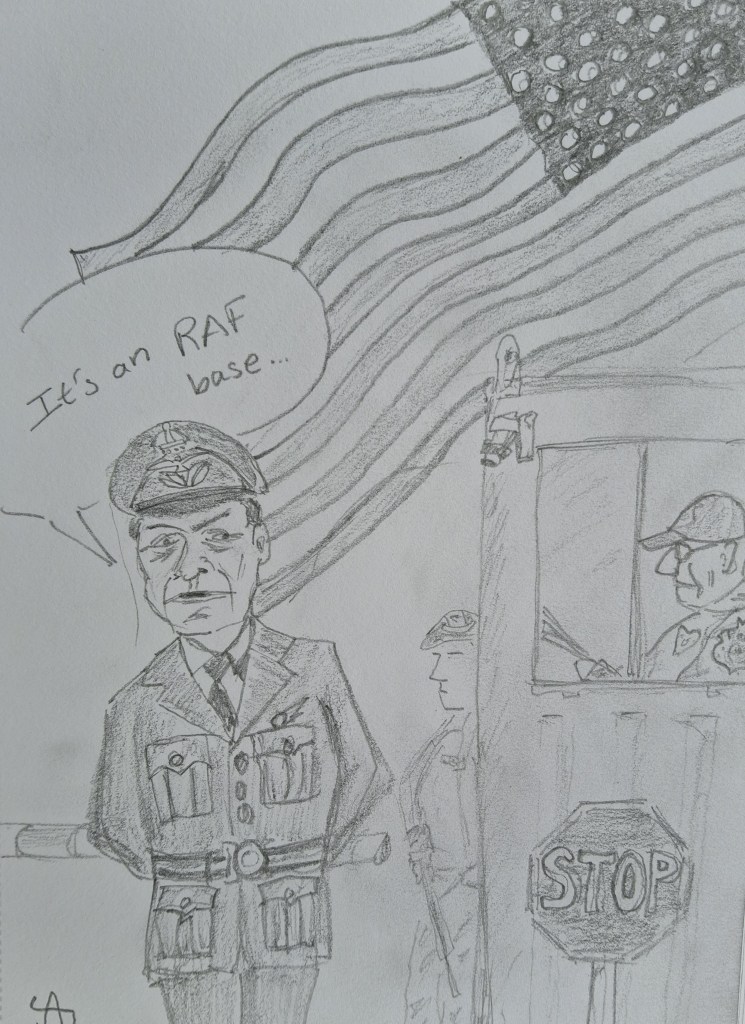
The Wingco at “RAF” Burtonwood.

I had direct experience of the fiction involved in this in the mid 1980s, when a delegation from Greater Manchester CND travelled down to the Burtonwood Air Base to hand in a letter to the base commander pointing out that any nuclear weapons stored there would put the population of Manchester, and the whole North West, at serious risk.

When we asked to see the base commander, a Royal Air Force Wingco came out. He looked a bit like Kenneth Moore, which I don’t suppose damaged his job application any. Everyone else in view was in US uniforms. When we said we wanted to see the actual base commander, he said “I’m the base commander. Its an RAF base”.

So we said, “Really, whats THAT?” pointing to the enormous stars and stripes fluttering on the flag pole behind him.

Previous

This morning, instead of the Guardian flopping onto the doormat at 4 in the morning, the great, grey, grim, gruesome masthead of the Daily Telegraph was visible poking through the letterbox like an ultimatum in Gothic.

The Telegraph is a gloriously reactionary paper, whose columnists barrage its readers with nerve edgy variations on the theme of “we’ll all be murdered in our beds” to keep them scared and angry, and its news sections are barely calmer. It was ever thus. When I worked permanent nights in a choclate factory many years ago, I used to read the Telegraph to keep me awake; because a mind that is boggling finds it hard to drift off.

A characteristic article this morning headlined Hunter gored to death by buffalo he was stalking explains how “a millionaire trophy hunter…was killed almost instantly by ‘a sudden and unprovoked attack’ by the animal”.

They write this with no sense of irony; after all, all he was doing was stalking it to shoot it. The natural order of things. No provocation at all. There’s a whole world view in that.

Doing its bit to calm down tensions over “migrant hotels”, their lead article on p4 is headed Migrants in hotels linked to hundreds of crimes, with the strapline, in case anyone misses the point, Residents have been charged with violence, child abuse,domestic assault and shoplifting and a little highlighted indent gives the figure 425 for the “number of offences people living in hotels the Home Office use to house migrants have been charged with”.

Many of their readers, happy to have their prejudices confirmed, that “they” are a threat to “us”; and that this is a characteristic that can be freely atributed to all “migrants”, will read no further. But the tortuous use of language in the headlines, for anyone paying attention, is explained by sentences buried deep in the story, but which explode it from the inside out, again, for anyone paying attention.

First, these are figures for people charged, not people convicted. So, this will be the highest possible number.

Second, Not every defendent who lists one of these hotels as their place of residence is necessarily an asylum seeker. It has not been possible to establish how many of the offenders identified by the Telegraph are currently applying for asylum in the UK”. So the highlighted number is bollocks. They know it. But they print it anyway.

Third, “The court records show that a significant proportion of these offences are alleged to have been perpetrated against other apparent asylum seekers”. Its notable that they don’t specify a figure, or proportion for this, though doubtless they could. Possibly because it draws the sting from the implication that “they” are a threat to “us”.

Showing the same inversion of reality that they deploy in the Big Game Hunter vs Buffalo story, they state “…police are under pressure to routinely disclose the nationality and migration status of suspects to protect community cohesion and to address a perception among some groups that asylum seekers are carrying out a disproportionate number of offences”. Note the unspecified character of “some groups”. Who might they be, I wonder?

Perish the thought that papers like the Telegraph, in its own revealing words, offering “a sense of the numbers involved”, and doing so by playing them up, could be promoting that “perception among certain groups” the better to whip them up, while retaining implausible deniability with weasel words.

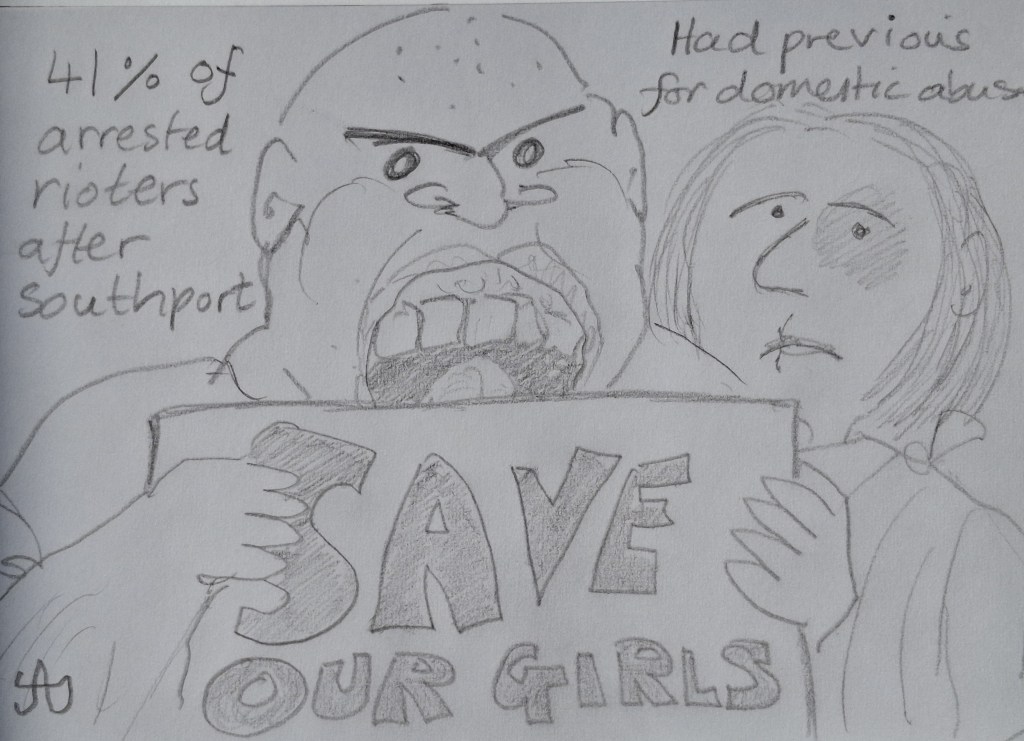
On this issue, as on so many others, like so many of those arrested in the racist riots last summer, the Telegraph definitely has previous.

Please note. If you like this blog please pass it on to anyone else who might find it interesting or useful. These blogs are blocked on Facebook because they “look like spam” incidentally.

Nazis in everyday life

A standard schtick of films and children’s TV dramas in the sixties was the moment that a previously anonymous villain was revealed to be a former middle ranking Nazi official, seeking to act as a seed for the regeneration of the movement; and thenceforth filmed looking Aryan while standing on yachts in front of mountains with a 1,000 Year Reich stare accompanied almost invariably by the crescendo from Wagner’s Tanhauser overture. (1)

This coincided with a lot of Nazi hunting stories sparked by the Eichmann trial in 1961, and the fact that no one had caught up with the Auschwitz “Angel of Death” Dr Josef Mengele, which gave the impression that the only surviving fragments of the old order – with the exception of Werner Von Braun, who was leading the US moon mission at the time and was therefore given a free pass – were leading lives of exiled obscurity in Argentina or Paraguay which, to be fair, some were. Mengele himself died when he drowned after suffering a stroke while swimming in Sao Paulo in 1979; having been given a passport in his own name by the West German Embassy in 1956 and actually visiting Europe using it in the late fifties.

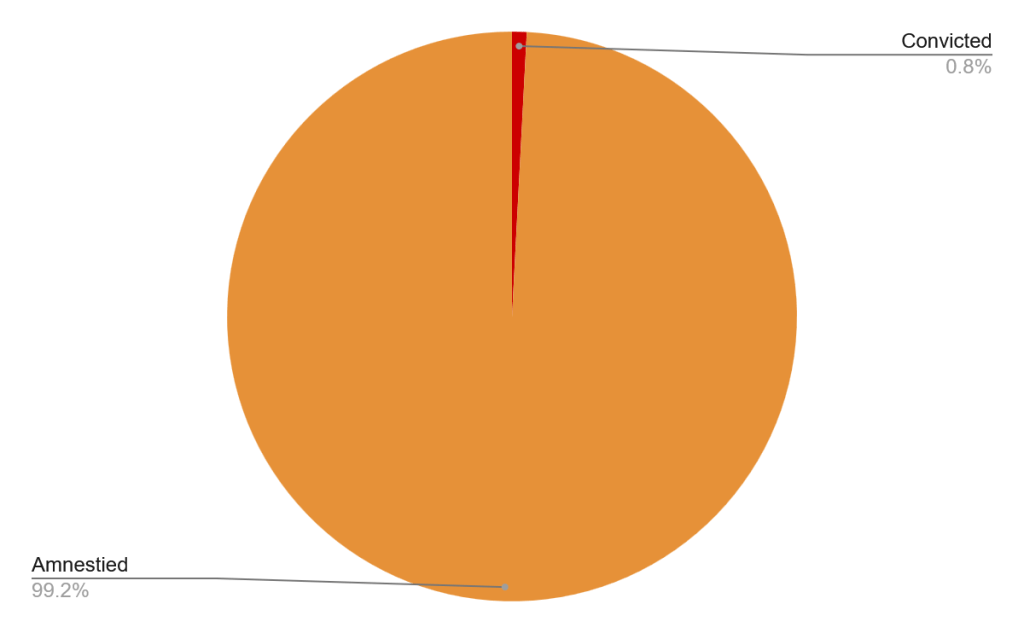
This is a fairly extreme example of the way that former Nazis were reabsorbed into West German society in a wave of amnesia and omerta as the Cold War dug in. Von Braun, it turns out, was more the norm than Mengele or Eichemann. Though the Nuremburg Trials in 1945 -6 pronounced death sentences against 12 leading Nazis including Herman Goering and Joachim Von Ribbentrop, the number of former Nazis convicted of war crimes in the post war years up to 1958 was just 6,093. In the same period 729,176 had been amnestied. That looks like this.

Total Nazi Party membership in 1945 was 8 million, so most of them had no process at all.

Many others, not members of the Party, who committed war crimes were never held to account and simply melted back into their pre war roles. The unit of Hamburg policemen who formed an Einsatzgruppen execution squad (2) following on behind the Wehrmacht to march Jews, and sometimes Poles, out into the woods and shoot them in the back of the head, simply went back to Hamburg to direct traffic, follow up on petty crime and do all the usual things the police do. Only their commanding officer was held to account, executed after being extradited to Poland because of a massacre of Polish villagers. Their interviews in the early sixties were for historical purposes, and they were never held to account. Similarly, lower level former army, and even SS, officers provided the backbone of the Bundeswehr when it was reformed in 1955.

1 A belting piece of music which is well worth a listen if you’ve never heard it.

2 Documented in Ordinary Men. As grim a piece of reading as you’ll ever do. Its front cover illustration is of a squad of these men looking relaxed and grinning with local Jewish civilians kneeling in front of them with their hands up, was so abhorent that I couldn’t leave the book face up while I was reading it. It is chillingly echoed by some of the gloating social media posts by IDF soldiers in Gaza that show that fascism can infect anyone in the wrong circumstances.

Of raincoats, spies and actors

Because of a brief break in the drought, that left the roofs and pavements dark and shiny, and everything green breathing more freshly, I had to borrow my dad’s old raincoat to get up to London without becoming a sodden mess. It was hanging up in the hall, from whenever it was that he wore it last. Some years ago now. Old styling, but high quality polyester and clean and unrumpled. It didn’t go with my peaked sky blue hat and I briefly considered borrowing Dad’s flat cap, which would have matched it very well; but thought better of it because it would have felt as though I were cosplaying my dad.

Wearing an unaccustomed outer garment, in a style that you normally wouldn’t, makes you feel as though you are someone else anyway; because you have shucked off your normal outer appearance to some extent. Dressing differently confers a sort of anonymity, or an opening up of other possibilities. I suppose that the essence of acting is to inhabit these alternative selves. In the case of spies, to inhabit the anonymity, to fade into the background while making mental notes, the acute observer going unobserved – or so he hopes. Or being a plausible enough facsimilie of the role being played, that an equally astute observer will be taken in. One of John Le Carre’s themes is that a personality type that can make an effective spy – especially a double agent – is not so much someone burning with conviction, but a shape shifter, a con man who has enough empathy to at least temporarily be able to become a person with completely different values and convictions and be believable. One or two of his characters find the tension of this unbearable. The coat itself, an ambiguous shade veering between grey, green and a particularly hideous brown seemed to be an embodiment of this idea.

Walking up to the station, I am passed by a fast walking lean man with darty snake like eyes, a killer jaw, sandpapery, grizzled, set, but trembling slightly, a tan suit and shiny black shoes…a hit man in beige. But if he was, you’d notice him. He’d need a raincoat.

Just before Limehouse station (when did that stop being Stepney?) there is an athletics track. The main stand was half full, but in a concentrated sort of way, people all bunched up in a companionable triangular clump. But nothing seemed to be going on. Spectators with no spectacle.

Just after Limehouse, there is a repurposed cinema, the Roxy, with its name painted in huge vertical letters on the end facing the railway tracks. A bit of decoration at the top that looks like the letter “t” gives the impression that it has been transplanted from Yorkshire. “Let’s go to t’Roxy”*. In the middle of the O, they have painted King Kong’s face, as though he is staring out of a huge porthole at you. On the way up to London, in a burst of sunlight, he looked quite benign; a bit like Hugh Jape in Willy the Wimp. On the way back, in the dark, he looked moody and menacing; as well he might.

The ceramic poppies set in a V shape on the White Tower seem to me to have lost some of their poignancy. The horror of all those lives lost, buried twice over in a celebration of winning. Its the V that you notice. An embodiment of the despair that all that sacrifice is being exploited to try to make people prepared to do it again. The real flush of actual poppies, delicate scarlet life bursting through the waste space by railway tracks and in back alleys, is like a burst of hope that we can do better.

*It turns out that it is the Troxy after all.

Return of the Bodyless Heads?

Every year during the Autumnal years in the early sixties, when I was in my last years of Primary school, as the nights drew in and visibility declined on the playing field at the heart of the estate I grew up on, some of my friends claimed that it was haunted by bodyless heads that they had seen floating across it in the middle distance. There was much heated debate about this, with most of us quite sceptical, but the sheer vehemence of those that had “seen” was enough to bring on a wary shudder in our lizard brains – of the same sort that made us nervous of walking up the alleyway behind Cromwell Road in the dark, because the bush half way up, which we knew perfectly well was a bush, looked like a gigantic bear reaching across to grab and eat us. Some Winter evenings we got a bit of the way up, saw the bear bush, hesitated and turned back. An irrational fear that we knew was irrational, but potent nonetheless.

The bodyless heads turned out in the end to be some older kids who’d started the story as a lark, and backed it up by running across the field shining torches up into their faces, giving the impression of eery ghost lit heads floating at speed and sparking shouts of “ITS THE BODYLESS HEADS!” from the gangs of younger kids still mooching about after it was too dark to play football but too early to go home to bed and hasten the next day…and school. Even though we could see the bodies running along, dimly, somehow it was more fun to believe than not.

I was reminded of all that by these bodyless heads in the local precinct. Decapitated dummies, oddly cloned, modelling hijabs and other stylish headgear, balanced on the top of rollable purple luggage; in some ways even more eery than the original fantasy in the field. Somehere, there are complementary headless bodies…

This one looks a bit resentful that someone has taken a lump out of her nose.

Talking to my brother about this revealed an alternative origin story for the bodyless heads. Long before Halloween was a thing in England – we used to do “penny for the Guy” for Guy Fawkes night and no one had heard of Trick or Treating (or “trickle treating”, as the kids in my class used to say) – one of our more creative Primary school teachers got us to carve a Jack o Lantern. Being England in the 1960s, we didn’t have pumpkins, so I think we used Swedes. They smelt really bad anyway. They were quite small and a bit pallid looking, but we put candles in them, and I think some of my classmates might have put them on top of the fence posts at the ends of their back gardens facing onto the Field; so, from a distance in the twilight, the legend of the bodyless heads would have been born. The kids with torches would have been playing into it for a laugh.

On the Beach – 1938

Back Row: Cecil (Tom) Atkin (with parasol), Henry Cunningham. Middle Row: Fred Pond, Win Pond, Ruth Atkin, Daisy Cunningham (all three sisters, formerly Ellis). Front Row: Len Cunningham (with ball) Ron Atkin (with life belt).

A week of collective freedom

This picture captures some of the excitement and happiness unleashed by the legislation that set up a weeks paid holiday for workers introduced in 1938, after “a tough battle, one that pitted campaigners against government intransigence and resistance from employers”.

Plus ca change, plus c’est le meme chose.

The French here is deliberate; as one of the pressures on the government here came from legislation introduced by the Popular Front government in France for the 40 hour week and paid holidays for all two years earlier, after a massive wave of strikes and factory occupations, as well as similar developments in Belgium, Norway and the USA (with FDR’s New Deal).

So, to some extent, my family owe the good time they had and their carefree smiles to Leon Blum.

Daan to Margit...a long time before Chas n Dave

My Dad’s family, like so many others, took off for Margate for the week. The back of the photo shows it to be a post card. So photographers would set up a bespoke postcard from holidaymakers that they could have taken and copied to send off home, as a personal and more taseful alternative to the “cheeky” sort.

My Mum’s family, not pictured here, did the same. “We went to Margate. It was so COLD”. Miles of lovely beach, but the wind was so cold.” Both families stayed in B&Bs. “When you went back to where we were staying all you could smell all through the house was greens being cooked” (Mum).

Sunday School outings

Margate came at the end of a train journey, and gave a more exciting view of a seaside more expansive and a seaside town grander by far than those provided by the Sunday School charabang trips to Maldon, travel sickness included, that both my parents had been on for the preceding couple of years to see the sea; complete with refreshments from a tent that served up mugs of very brown tea from enormous enamel pots.

Woolly Cozzies

My Dad is wearing quite a classy boys swimsuit here. Not the one his Mum had knitted for him, as a lot of Mums did at that time; because it was much cheaper than buying one. These had the advantage of being warm before you went in the water, but had the downside of becoming incredibly heavy (and hard to keep up) as soon as you did.

Not Lobby Lud

As workers on holiday were much less likely to buy a daily paper – getting away from it all meaning getting away from it all – so, with all the factories closing pretty much at once, and facing a disastrous, if temporary, slump in circulation, the Daily Mirror and a few others like the News Chronicle used to publish a photo of a repesentative who would be present at the seaside during the holiday, so people who recognised him could approach and say “You are Lobby Lud and I claim my £5”; but with a variation printed only in that morning’s paper without which it wouldn’t work.

With average worker’s wages at 1 shilling and 2 pence an hour in 1938, this was equivalent to two weeks wages; so, worth buying a paper for.

At one point on this holiday, my grandfather was convinced he’d seen him, walked over and staked his claim. To no avail. The man said he wasn’t the mark. So, he bought a Daily Mirror to get the right form of words and tried again and, once again, and slightly more irritated, the man said he wasn’t. So, perhaps he was, but was off duty for a bit and was therefore irritated to be approached. Or he was a Lobby Lud lookalike and got approached all the time; in which case its a wonder he wasn’t more irritated than he was.

Darkness at noon?

Fred, sitting at the end of the line with the parasol, had a dark skin. After the outbreak of World War 2, just over a year later, he was in the RAF and, like a lot of other RAF personnel, was sent to Southern Africa for training; where he found that his uniform was no guarantee of being allowed into “Whites Only” bars or cafes, applying the strict colour bar that was the precursor to the fully fledged Apartheid entrenched there after 1948.

This photo was taken 20 years after the end of the First World War, and just over a year before the start of the Second. No cloud seems to dim the happiness. The sun is shining. The wind is fresh. The sand is soft and gritty. The ice creams are cold and sweet. A little bit of heaven outside the daily grind and in between two horrors.

Sketches from Pakistan 3. Calls to Prayer

When the Imams call to prayer from the loudspeakers in their minarets, it is so loud and all embracing that it is as though the whole country is steaming with spirituality.

It is almost possible to believe that a divine order reigns, a different reality, brought about by sufficient belief.  A life defined by Allah overlays and defines the problems of everyday life.

Sermons broadcast in Arabic through the loudspeakers – part words, part music of words –  create an ambient aural background that is all pervasive.

But, because this is so normal, life goes on.

The loudspeakers blare as wedding guests sit chatting impassively, building workers pull down scaffolding and pile up bricks, traffic buzzes and honks by, the fruit sellers keep selling fruit… and the last prayer sinks into a muzak hum, like a radio stuck between channels.


building worker
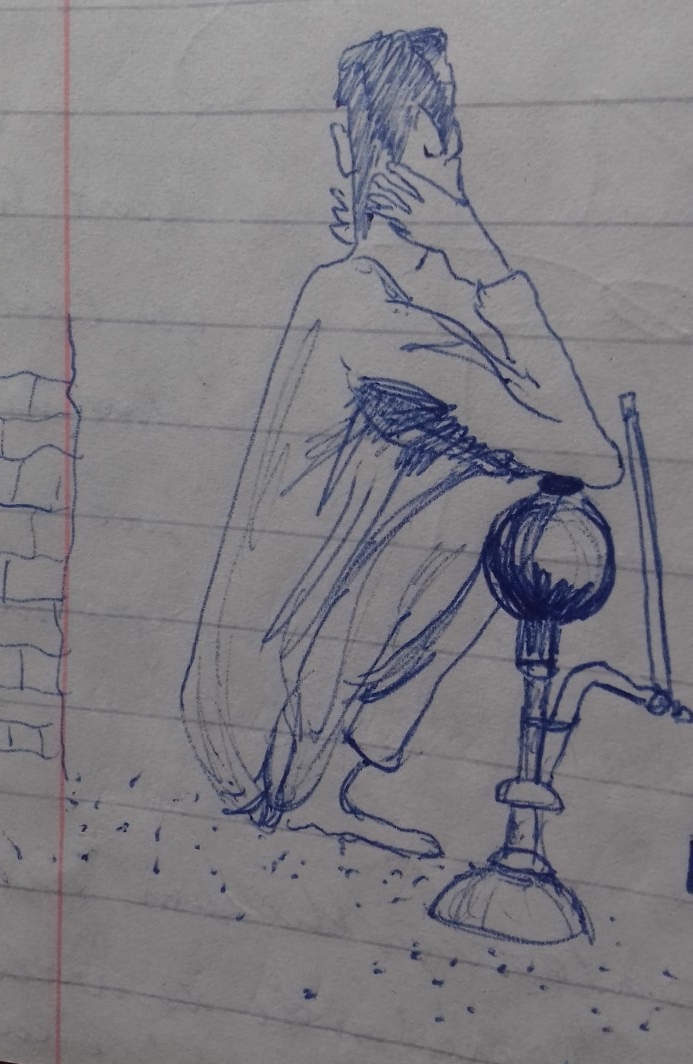
Building worker on a break 25/12/92


Sketches of Pakistan 2 – Karachi

Karachi airport was all cool, swish, green plants, white paint, shiny floor. Security guards with black berets, military sweaters, neat black machine pistols and seriously psycho stares patrol the immaculate corridors.  Green tailed PIA Jumbos slumber on the tarmac in the shimmering heat.

All of us pile into a tiny car. Seven people in a car designed to fit four at a squash. The luggage is jammed into between us in a masterpiece of spatial improvisation worthy of a Timelord. There are no seat belts of course. R relaxes in the open boot space in the rear like a Khan on a cushion.”Welcome to Pakistan” says J.

Karachi cool dude
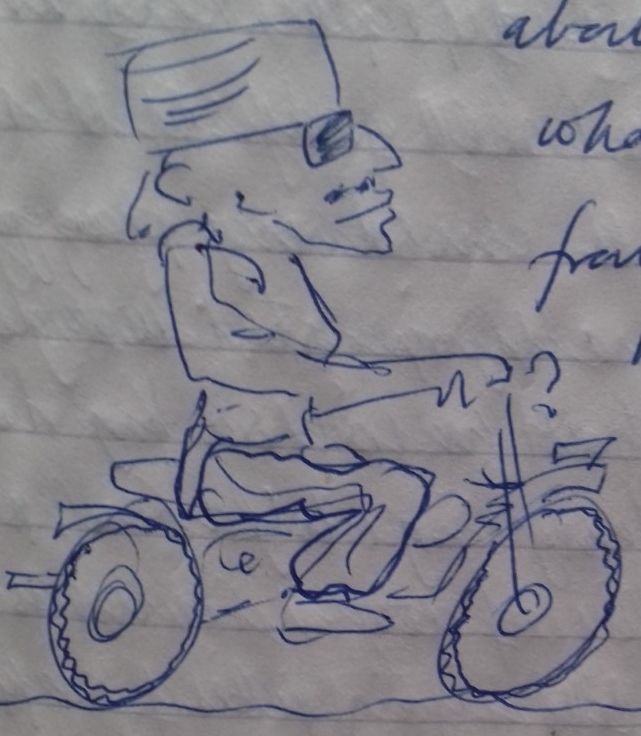
“Cool Dude” with wheels, shades and astrakhan hat.

On the road, buses and auto-rickshaws, tingling with dangling mirrors, brightly reflective with polished chrome, fluttering and flaunting with plumes, flags and tassels, honk and shriek. Mopeds weave wildly carrying stick backed men trying to look like film stars, pop popping along at about ten miles an hour, or whole families, father in front, son in the middle, mother and baby on the back horns honking with a wildness that is at the same time completely routine. Pedestrians walking blithely into lines of oncoming traffic with complete faith in divine protection. They will get to the far side, inshallah.

The sides of the road look quite desperate but full of life. Crowds of people exuding an electric energy, half wrecked buildings in a state of constant make do and mend piled full of dusty merchandise, street stalls, a children’s playground with a manually operated wooden big dipper that wasn’t so big but was heavy enough and full of laughing children, piles of junk, piles of goods, adverts high over shops on dizzying piles of scaffolding.

Karachi family bike
All aboard – En famille en route a des aventures nouvelles.

Karachi is under martial law, so at junctions and in the middle of roundabouts we zip past pill boxes with light machine guns poking out, oiled, manned and ready to be used; the soldiers in WW2 era steel helmets and light khaki uniforms. Big houses belonging to society’s higher ups are barricaded off and guarded by more soldiers, standing with a relaxed aggression and casual arrogance; confident in their control of superior weaponry to any potential challengers.

We pass a grimy industrial waste land with no industry full of shanties – all wriggly tin and flapping canvas.

Journey’s end – a cool oasis – R’s family house – huge white building with three generations of the family living in it; both elderly grandparents, two married sons with their wives and children, three unmarried daughters and two more unmarried sons: over ten adults and several children under five. Nevertheless, it is calm and peaceful. The noise outside is somehow in a different dimension, as though its an echo from somewhere else that is far, far away that you can choose to heed or not – the calls of fruit sellers, the honking of horns.


There and back again. Pakistan 1992 – Part 1. Getting there by Aeroflot.

In Pakistan it is said that PIA – the initials of the national airline – stand either for “Perhaps I’ll arrive” or “Please Inform Allah.” We went one better than that and traveled by Aeroflot. This was in the first flush of post Soviet gangster capitalism in which life expectancy in Russia was falling to 57 (for men) and Aeroflot’s aircraft were falling out of the sky almost as rapidly.

“Vy did you come so late?” huffed a squat, fierce eyed Aeroflot official, who looked like she was taking a break from putting shots for the Red Army; her eyes arched and nose quivering. “Traffic” we lied smoothly, so as not to slow ourselves down even more and satisfy a giant ego in a tiny uniform.

Russian pilots wear enormous hats to show how important they are.

The inside of the airport looked like a 1930s cinema with no screen. The plane itself was comfortingly big and looked sturdy and no nonsense. Decorated throughout in brown formica. Style by committee. Worn, carpet backed seats had seat numbers on the backs. That meant that most of the first time Aeroflot travelers used to western airlines sat in the seat behind the one they were meant to be in; leading to a lot of confusion and flustered hostesses; exasperated beyond measure because this happened so often and they didn’t seem to have worked out why.

In 1992 Aeroflot found it hard to cope with vegetarians. The iron trolleys clunked down the aisles like a convoy of T72s, pushed by a hostess who looked like Meryl Streep with a sneer. We asked for vegetarian meals and she looked startled and disgruntled – as though this was the final straw. She pulled out a napkin with a list of seat numbers, waved it under our noses and muttered – “I only haf TEN meals – you are not HERE” and that – as far as she was concerned – was that. We explained that we had definitely booked them and her colleague – a plump baby faced guy with a gentle demeanor under a pile of curly blond hair leaned over coaxingly – “Vould you like Feesh?” – presumably on the basis that meat is murder but fish is justifiable homicide. Puzzled that we wouldn’t, he wandered away promising to try to sort something out in the fullness of time, with a Micawber like faith that something would turn up. Wandering back later in his amiable way – possibly having put this problem into the “leave them long enough and they’ll put up with it” box – we asked him again. He frowned, remembered vaguely, waved a finger to denote that all things come to those who wait and drifted off to the galley – where one unclaimed veggie meal sat resplendent in green eco tinfoil. He presented it to us with the graceful apology of one of nature’s gentlemen and we shared it.

It turned out quite tasty, despite the rather grey appearance of the baby sweetcorn. Everything was enhanced – potentially- by Aeroflot mustard. This stuff was a real nose blaster – a coarse oral dynamite that exploded its way from the taste buds to tingling nasal extremities with a terrifyingly rapid inevitability; making each mouthful an exciting and dangerous challenge. Very good for colds. Highly recommended.

Moscow Airport

Midnight. Minus 8 degrees. Misty. A few pale lights. Heavy snow. An articulated truck with a bus on the back drove emptily by. A hyper modern terminal needing a good clean. Tall brown columns holding up the roof looked like giant toilet roll tubes. Hard face guards in furry hats.

A shuttered enclave of feverish capitalism in a cold climate; a toehold of speculative trading – a levis shop, duty free booze and perfumes, and the heart of the place, a brightly signposted “Irish Bar”, a replica Dublin pub complete with Guinness and Shamrocks, shiny wooden bar and beer pumps but neither soul nor craic and, of course, closed.

A seed of the reborn Russian spiv imperialism that was the best that Yeltsin and Gaidar could offer was embodied in the flinty faced woman at the all night hard currency cafe who asked for £1.70 for a (disgustingly watery) cup of instant coffee (6 times what you’d have paid for it in London at the time) then offered to pour it into two glasses so we wouldn’t steal the cup in revenge.

People were sleeping in doorways all round the terminal. An island of souls in transit from here to there or back again, never making contact with the Russia outside this oddly dispiriting bubble of a place.

The toilets had neither seats nor paper.  Graffitti in English read – “This toilet is made of total crap”.

Outside, in a flurry of light winter snowdrifts and eddies and shifting air currents, snow was softly, gently burying newly arrived aircraft and the runway in thick drifts like icing on a wedding cake.

Inside, a leading member of the SWP and his partner drifted past with incongruous familiarity amid fierce denunciation of someone’s deviations – “and that article he wrote was disgusting!”

On to Karachi

Before we could get into the air again they had to blast the snow off the wings, and they did. This had settled several inches thick and they had to use a hose on a mobile gantry. Completely routine. Going on all over the airport with a calm efficiency. In a climate like that, all engineering had to be seriously heavy duty and watching it work was a wonder.

On the plane, the hostesses had their own solution to the usual seat confusion. “Sit where you like – its free seats.”

Opposite us, a thick set blond youth was fidgety with exhaustion. He kept putting his feet up onto the seat in front – forcing it sharply forwards so the bloke sitting in it got upset, turned round a swore at him. So, he tried plan B and laid down in the aisle, forcing people to step over him. After enough of them had stepped on him instead, he tried Plan C, leaning his head awkwardly onto his food tray; causing the bloke in front to recline his seat and squash him. So, he sat up and pushed back and the bloke in front turned round and hit him. We wondered whether he was on something.

We dozed fitfully though the early hours until woken by a flood of white light through all the windows. It was like light from another dimension. Not the soft, washed out water colour light back home, it was a light so bright it was almost an assault; so many stages higher on the path to heaven.

Down below, the pock marked desert; a baked and crumbling moon landscape, brown and khaki, utterly arid, breaking into the jumbled sprawl of Karachi – shanty town shoved against shanty town, punctuated by clusters of higher flats and offices, all bleached white in the light and crushed up together with more shanties squeezed into every available space.