Russia’s “Maximalist demands”? Three questions for supporters of the Ukraine Solidarity Campaign.

In his February article, Ukraine’s defeat and the fall of the West, Owen Jones argued that “if we were always going to end up at a point where Russia was going to take land, and Western leaders thought that, but claimed otherwise and made promises to Ukraine to keep the war going to achieving what they believed to be unachievable – well, what that means in terms of countless wasted lives is truly hideous“; noting that this has been in pursuit of what the Washington Post described as “a sensible, cold-blooded strategy for the United States — to attrit an adversary at low cost to America, while Ukraine was paying the butcher’s bill”.

We are now getting to that point.

The way the war ends, or is spun out, is of enormous consequence to whether Europe will remain locked in an escalatory spiral towards the fever dream of a further, wider, deeper – and suicidal – pan European war that infects the minds of General Staffs and newspaper editorial boards; or whether there is an attempt to find a sustainable modus vivendi with Russia that enables de escalation, avoids mutually assured destruction and dislocates Europe from the US imperative to shore up its slipping global dominance with ever more adventurist wars.

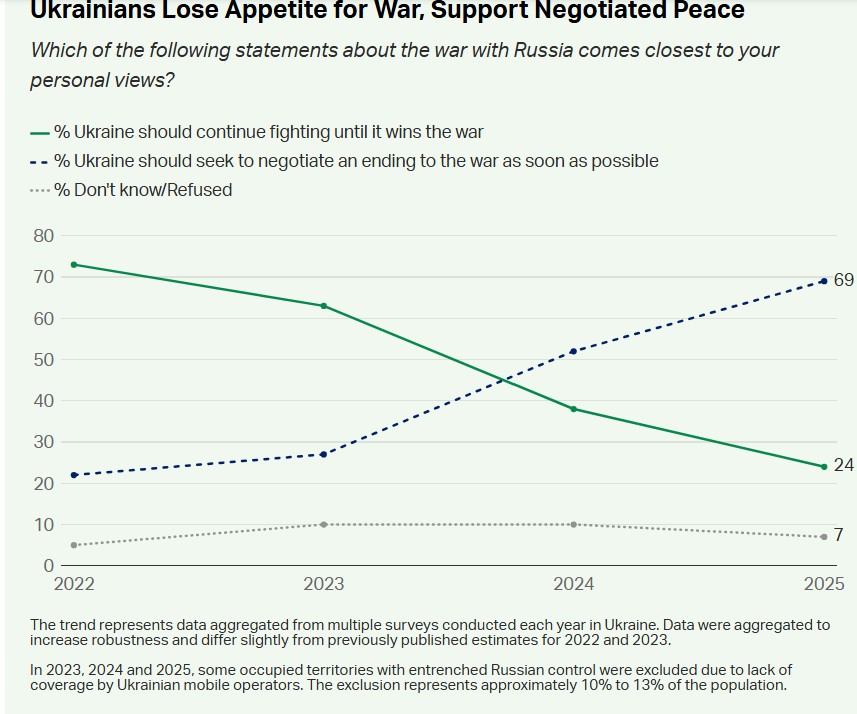
The media here reflexively dismisses Russia’s bottom lines for ending the war as “maximalist”; by definition unreasonable, to be dismissed with no further thought or examination. This is of a piece with their usual tactic of obscuring reality with adjectival clouds of emotive association, so it is vital for even those sections of the Left that have cheered on the war, and are still doing it even as a majority of Ukrianians want peace, to get beyond the emotional red mists and look seriously at what the Russians are actually proposing.

A majority of Ukrainains want peace.

These are the key points from the published text of the draft “Treaty between the United States of America and the Russian Federation on Security Guarantees” that Russia presented to Biden in December 2021; and which the US/NATO dismissed out of hand and refused to discuss.

  1. No further NATO expansion
  • The US would commit to preventing further enlargement of NATO, specifically barring Ukraine and other former Soviet republics from joining the alliance.
  • This also included a ban on NATO military activity in Ukraine, Eastern Europe, the Caucasus, and Central Asia.

2. No Deployment of US Forces or Weapons in Certain Countries

  • The treaty would forbid the US from deploying military forces or weaponry in countries that joined NATO after May 1997 (such as Poland, the Baltic states, Romania, and others).
  • NATO infrastructure would have to be rolled back to pre-1997 locations.

3 Ban on Intermediate-Range Missiles

  • Both Russia and the US would be prohibited from deploying ground-launched intermediate-range and shorter-range missiles outside their national territories, as well as in areas of their own territory where such missiles could strike the other’s territory.

4 Limit Military Maneuvers and Activities

  • Limits on heavy bombers and surface warship deployments: Both sides would restrict the operation of heavy bombers and warships in areas from which they could strike targets on the other’s territory. (Note: In September 2020, Trump’s DOD authorized a B-52 to fly along the Ukrainian coast in the Black Sea.)

5 Nuclear Weapons Restrictions

  • All nuclear weapons would be confined to each country’s own national territory. Neither side could deploy nuclear weapons outside its borders. (Note: US just sent a batch of nukes to England.)
  • Withdrawal of all US nuclear weapons from Europe and elimination of existing infrastructure for their deployment abroad.

6 Mutual Security Pledge

  • Each side would agree not to take any security measures that could undermine the core security interests of the other party.

7. Establishment of Consultation Mechanisms

  • Proposals included the renewal or strengthening of direct consultation mechanisms, such as the NATO–Russia Council and the establishment of a crisis hotline.

8 Indivisibility of Security Principle

  • Included a reaffirmation that the security of one state cannot come at the expense of the security of another, formalising Russia’s interpretation of the “indivisible security” concept.

The three questions that supporters of the Ukraine Solidarity Campaign should ask themselves is,

  • which of of these proposals do you disagree with?
  • Would an agreement on these lines be a viable way to end the war?
  • Would an agreement on these lines have avoided it in the first place?

Gaza – the Holocaust and the Bengal famine.

“Dead or dying children in a Calcutta Street. Photograph published by the Statesman, Calcutta, on August 22nd, 1943.”, Public Domain

Even right wing newspapers now have front pages showing Palestinian children who look just like these with headlines like “For Pity’s sake stop this” (Daily Express 23/7/25) without saying how. The limitations of the Excpress approach are well explored here.

The latest UN Report states

  • Gaza’s one million children continue to bear the brunt of continued bombardment, deprivation of access to life’s essentials, including food, water and adequate health care, and exposure to traumatic events. In a briefing to the UN Security Council on 16 July, Catherine Russell, Executive Director of the United Nations Children’s Fund (UNICEF), stated that more than 17,000 children have reportedly been killed and 33,000 injured in Gaza over 21 months, which is the equivalent of a classroom of 28 children killed in Gaza on average each day. (My emphasis)

Starvation is already the common lived experience of everyone in Gaza.

Genocide by industrialised intent.

In the 1940s, the Nazi’s industrialised the mass extermination of people, mostly Jews, that they considered “untermensch”, lesser humans. Around 6 million were killed, initially by being shot by Einsatzgruppen, marching them out into the woods (see Ordinary Men by Christopher Browning) then by mass gassing, starvation and being worked to death in the extermination camps. No one kept exact records, but the scale and horror of it is in no doubt.

Genocide by neglect.

In the same decade, around 3 million colonial subjects of the British Raj in Bengal starved to death in the Bengal famine. Again, no one kept exact records, and estimates vary from just under a million to just under 4 million, but the scale and horror of it is in no doubt.

It is, however, much less well known. They died “from starvation, malaria and other diseases aggravated by malnutrition, population displacement, unsanitary conditions, poor British wartime policies and lack of health care.” What Wikipedia describes as “poor British wartime policies” covers limiting food aid overall, on the argument that this was needed for the war effort, and manipulation of what food aid there was to communities that were considered politically loyal. This was a material factor in exacerbating communal tensions that were later to explode at partition.

This was not an aberation in British India. It took independence to end famines. See Mike Davies, Late Victorian holocausts.

Genocide by deliberate deprivation.

Without food, people can survive for just over two months before they starve to death. In 1981, the longest lasting IRA Hunger Striker, Kieren Doherty, survived for 73 days, the shortest, Martin Hurson, died after just 46. Most died after 60, 61 or 62 days. Two months. And these were fit young men who were able to drink clean water.

Without food, the entire population of Gaza is a risk of starving to death by the end of the summer. 43 have died in the last three days, and this is accelerating.

The deliberate, calculated, performative cruelty of the GHF “aid” operation will slow the pace of this a little, spin out the suffering, but also aims to destroy community. As Alex de Waal of the World Peace Foundation puts it, “You can’t approach starvation as a biological phenomenon experienced by individuals, but it is also a collective social experience. Very often that societal element – the trauma, the shame, the loss of dignity, the violation of taboos, the breaking of social bonds – is more significant in the memory of survivors than the individual biological experience. All these traumas are why the Irish took almost 150 years before they could memorialise what they experienced in the 1840s. Those who inflict starvation are aware of this.”

So are we. This cannot be allowed. Demonstrate on Friday. Let’s break our government’s complicity in it. The six demands of the Bogota Declaration are a good basis for getting beyond David Lammy’s stance of wringing his hands while passing the ammunition.

Local actions so far

Thursday, 24 July

Hastings: Murial Matters House, TN34 3UY, 6pm

Friday, 25 July

Abergavenny: St. John’s Square, 6pm

Birmingham: Barclays Bank, 79-84 High Street, B4 7TE, 5pm

Cambridge: Addenbrooke’s Roundabout, 6pm

Cardiff: UK Government Building, Central Square, CF10 1EP, 6pm

Coventry: Foleshill Road/Ring Road roundabout (near Eden School), CV1 4FS, 4.30pm

Exeter: Bedford Square, High Street, 6pm

Leeds: City Square, LS1 2ES, 6pm

Liverpool: Lime Street Station, 5.30pm

London – Hackney: Hackney Town Hall, 6pm

London – Ilford: Wes Streeting’s office, 12a High View Parade, Woodford Ave., IG4 5EP, 6pm

London – Newham: Stratford Station, 6pm

Milton Keynes: Milton Keynes Central Station, 302 Eldergate, MK9 1LA, 6pm

Newport: Jessica Morden’s office, Clarence House, NP19 7AA, 6.30pm

Oxford: Carfax Tower, Queen Street, OX1 1ET, 6pm

Portsmouth: Constituency Office, 72 Albert Road, Southsea, PO5 2SL, 6pm

Reading: Central Railway Station, RG1 1LZ, 6pm

Sheffield: Sheffield Train Station, Sheaf St., 5pm

Slough: Aldi, Farnham Road, SL1 4BX, 6pm

Worcester: Cathedral Square, WR1 2QE, 6pm

Saturday, 26 July

Brighton: Churchill Square, 12pm

Carlisle: Barclays, 33 English St, CA3 8JX, 1pm

Slough: Meet outside Empire Cinema, SL1 1DD, 11.30am; 12noon departure for march

Kaiser Franz solves a problem.

Emperor Franz Josef V, sighed, pulled on his weaved mutton chop whiskers – now Imperial regalia – and twisted the dial on his wireless to shift the channel from Das Lichtprogramm – playing its usual diet of whirling Waltzes by Johan Strauss the very, very, very much younger, as if to prove that music, like History, had nowhere to go but interminable circles – over to Der Heimat- Service for the latest reports from Today in Parliament.

There was something oddly comforting about these reports. Like all the Sturm and Drang of the Shipping Forecast: all those rising squalls and Force Ten Gales, that menacing low visibility in Sea areas with comfortingly obscure and poetic names – Varangian, Black, Dogged, Austrian Bight, Trieste, Italian Sea, Palermo automatic lighthouse weather station – full of sound and fury and signifying nothing, to him, more than how much more comfortable it was to be sitting by the fire with a cup of tea and a crumpet.

Reports from the Diet were always incomprehensible. All the way across the Greater Austro-Hungarian – Balkan Empire, from Bavaria in the West to the Caspian Sea in the East and Naples in the South, members of the diet were allowed to make speeches in their own languages; on the proviso that no translations were allowed. This meant that members could sound off in full fury, to be approvingly written up in the local papers at home, blaming everyone else for local problems, securing their continuous re election as local champions – safe in the knowledge that no one else in the Empire, unless they understood Slovak, or Azeri, or Sicilian dialect, would have a clue what they were saying, so everyone could remain friends. All the broadcasts were also in the original languages, so everyone could tune into their own bit and be reassured that their worries were being expressed, if not heard. Thus, peace and harmony could be assured, as a grievance carefully nurtured, with no hope of resolution, is a soothing balm for everyone who enjoys suffering from it and being able to complain about it. If these problems were to be resolved, people would be lost. They wouldn’t know who they were any more.

Kaiser Franz scratched idly at his paunch, feeling a bit sleepy, when the newsflash he had been waiting for came up right on time. A solemn burst of Bruckner – titanic, overwhelming, monumental and oddly static, like the Empire itself – was followed by an announcer sounding even more po faced than usual. The troublesome, playboy heir apparent, Archduke Ferdy, had met with an unfortunate accident while trying to act out the bow flight scene from Titanic on the 3:30 Zeppelin from Zagreb to Odesa while drunk (and drugged too, though he knew it not) to be followed by an Inquiry and four days of official mourning – because there was no point in overdoing it – announced by the Prime Minister, in his familiar flat nasal tone; the one that sounds a bit like he’s been chewing cardboard most of his life. Satisfied that Plan B, with its aerodrome arson squad and threat of high profile collateral damage (and all the awkward questions that go with it) had not been necessary, the Kaiser chuckled to himself and put Zadok the Priest on his record player.

May the King live, may the king live, may the king live FOREVER, Alleluhia, Alleluhia, Alleluhia, Amen…

This England (and Wales) – Summer 2025

In the 1960s the New Statesman used to have a short column of clips from right wing papers that illustrated the absurdity of their view of the world called “This England” (from John of Gaunt’s dying speech in Richard II; you know “This royal throne of kings, this sceptered isle, this earth of majesty, this seat of Mars…This blessed plot, this earth, this realm, this England”, the sort of pompous pontification that cued his nephew the King to remark, on hearing that he was dying, “Come, gentlemen, let’s all go visit him: Pray God we may make haste, and come too late!”

I was reminded of that in recent weeks by several parts of articles in the Guardian that I had to read twice to make sure that the point that I was reading really did say what it did; usually dropped in and passed on without comment; as though it were perfectly sensible, nothing to be bothered about.

Housing

The extra money (for affordable housing in the Spending Review) will help housing associations to buy up thousands of new units which have already been built by private developers as part of their affordable housing commitments, but which are sitting empty because they cannot afford them. My emphasis.

Housing projects that protect natural habitats, include public transport and divert wastewater from running ino local watercourses are deemed too expensive (by the government, as Labour’s message in the Planning and Infrastructure Bill is that the developer knows best and other considerations can take a back seat).

Prevent

Asked about the government’s counter extremism programme, Prevent, Cooper said she was “very concerned” by evidence of increasing extremism among young people. “We are seeing the counter terrorism caseload trebling in three years involving teenagers”, she said. She said there had also been a doubling of the numbers of young people being referred to Prevent since last summer. And yet…I continue to be concerned about the threshold ending up being too high and not enough Islamist extremist cases being referred to Prevent and the need to make sure more of those cases were being referred…”

Trubble at pit

These are not a quotes, simply retelling of comments from Any Answers on Radio 4 on 14/6/25. Any Answers can usually be relied upon for a rich vein of emotionally charged comments, more often than not unhinged from any knowledge of the subject being discussed. Nigel Farage’s proposal to reopen coal mines in South Wales that have been long flooded, and Blast Furnaces that have cooled solid, sparked several of these. One person thought it was a good idea in principle, but because no one local would want to do it they’d “have to import immigrants” to work in them – and that would never do. Another, in response to the same problem, argued that prisoners should be sent down the mines “like they do in America”. That’d learn ’em because, as we know, the problem with prisons is that they are “too soft”. Salt mines, unfortunately, are not available.

Legally illegal

“Britain’s decision to allow the export of F-35 fighter jet components to Israel, despite accepting they could be used in breach on international law in Gaza, was lawful, London’s High Court has ruled.”

Trump and NATO – Europe picks up the tab

Trigger warning. This blog contains sycophancy in high places.

Those on the pro European Right like Timothy Garton Ash, and most other opinion columnists in the Guardian, even George Monbiot, who have argued that “Europe” should increase military spending to break with the US, and those on the Left who are arguing that there is now a fundamental rift between the US and its subordinate allies, should consider the following three quotes addressed to Donald Trump from former Dutch Prime Minsiter and NATO General Secretary Mark Rutte at the end of the NATO Summit.

“You are flying into another big success”

“Congratulations and thank you for your decisive action in Iran. That was truly extraordinary, and something no on else dared to do.”

“It was not easy, but we’ve got them all signed on to 5%! You will achieve something NO American president in decades could get done. Europe is going to pay in a BIG way , as they should, and it will be your win. Safe travels, and see you at his Majesty’s dinner.”

“Daddy sometimes has to use strong language.”

And these from Trump describing the 5% target as “something that no one thought possible. And they said ‘you did it, sir, you did it’. Well I don’t know if I did it…but I think I did and “a monumental win for the United States” and “a big win for Europe and for actually Western Civilisation” because Europe would be “stepping up to take more responsibility.”

So, there you have it.

Increasing military spending is giving Trump exactly what he wants.

European NATO governmnets will now seek to impoverish their populations and stunt their own development to find the resources to double militray spending.

Europe tooling up for a future continent wide confrontation with Russia gives him a free hand, with his now $1 trillion”defence” budget to prepare for military confrontation with China.

And not only does none of this undermine Trump’s push to domestic authoritarianism; it requires it at home. Proscribing Palestine Action in the UK is part of a drive to a more militarised society in which our children are dragooned into cadet corps, non violent direct action is elided with “terrorism” and Yvette Cooper’s desire to “lower the threshold” for Prevent referrals to catch more “Islamists” is aimed clearly at the mass pro Palestinian movement in an attempt to define dissent of foreign policy as “pre terrorist ideology” that can be legally harassed and crushed even more than it already is.

Nazis in everyday life

A standard schtick of films and children’s TV dramas in the sixties was the moment that a previously anonymous villain was revealed to be a former middle ranking Nazi official, seeking to act as a seed for the regeneration of the movement; and thenceforth filmed looking Aryan while standing on yachts in front of mountains with a 1,000 Year Reich stare accompanied almost invariably by the crescendo from Wagner’s Tanhauser overture. (1)

This coincided with a lot of Nazi hunting stories sparked by the Eichmann trial in 1961, and the fact that no one had caught up with the Auschwitz “Angel of Death” Dr Josef Mengele, which gave the impression that the only surviving fragments of the old order – with the exception of Werner Von Braun, who was leading the US moon mission at the time and was therefore given a free pass – were leading lives of exiled obscurity in Argentina or Paraguay which, to be fair, some were. Mengele himself died when he drowned after suffering a stroke while swimming in Sao Paulo in 1979; having been given a passport in his own name by the West German Embassy in 1956 and actually visiting Europe using it in the late fifties.

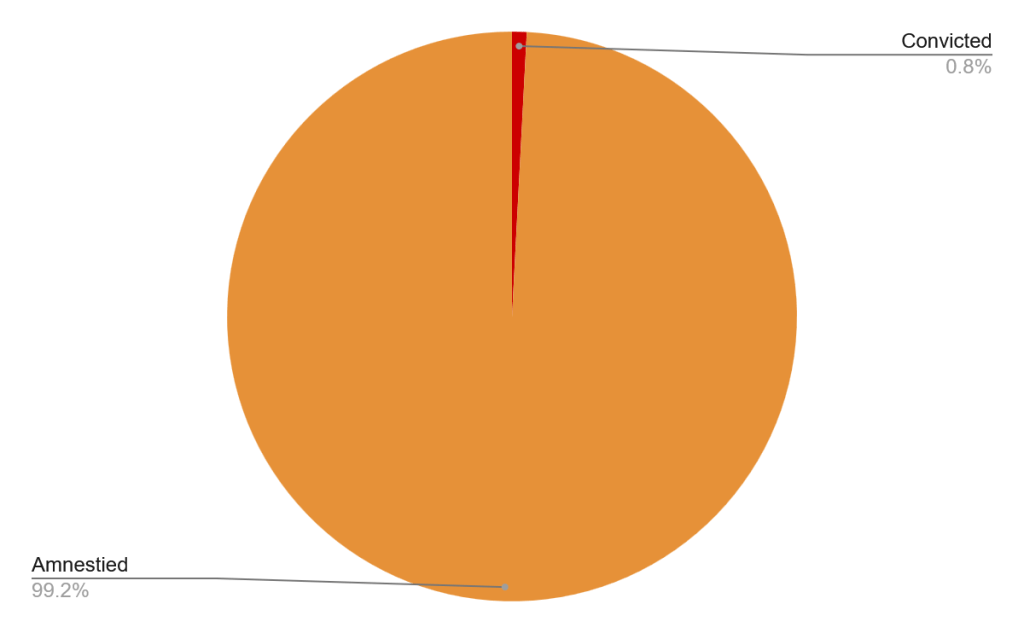
This is a fairly extreme example of the way that former Nazis were reabsorbed into West German society in a wave of amnesia and omerta as the Cold War dug in. Von Braun, it turns out, was more the norm than Mengele or Eichemann. Though the Nuremburg Trials in 1945 -6 pronounced death sentences against 12 leading Nazis including Herman Goering and Joachim Von Ribbentrop, the number of former Nazis convicted of war crimes in the post war years up to 1958 was just 6,093. In the same period 729,176 had been amnestied. That looks like this.

Total Nazi Party membership in 1945 was 8 million, so most of them had no process at all.

Many others, not members of the Party, who committed war crimes were never held to account and simply melted back into their pre war roles. The unit of Hamburg policemen who formed an Einsatzgruppen execution squad (2) following on behind the Wehrmacht to march Jews, and sometimes Poles, out into the woods and shoot them in the back of the head, simply went back to Hamburg to direct traffic, follow up on petty crime and do all the usual things the police do. Only their commanding officer was held to account, executed after being extradited to Poland because of a massacre of Polish villagers. Their interviews in the early sixties were for historical purposes, and they were never held to account. Similarly, lower level former army, and even SS, officers provided the backbone of the Bundeswehr when it was reformed in 1955.

1 A belting piece of music which is well worth a listen if you’ve never heard it.

2 Documented in Ordinary Men. As grim a piece of reading as you’ll ever do. Its front cover illustration is of a squad of these men looking relaxed and grinning with local Jewish civilians kneeling in front of them with their hands up, was so abhorent that I couldn’t leave the book face up while I was reading it. It is chillingly echoed by some of the gloating social media posts by IDF soldiers in Gaza that show that fascism can infect anyone in the wrong circumstances.

“Defence” Review is completely insane.

And the end of the Tale, is the widow’s veil, that she got from the Russian steppes. Bertold Brecht from What was sent to the soldier’s wife?

Speaking today, the Prime Minster stated that the UK has to get into a position to fight a war with Russia. It is a premise of the “Defence” Review that such a threat exists.

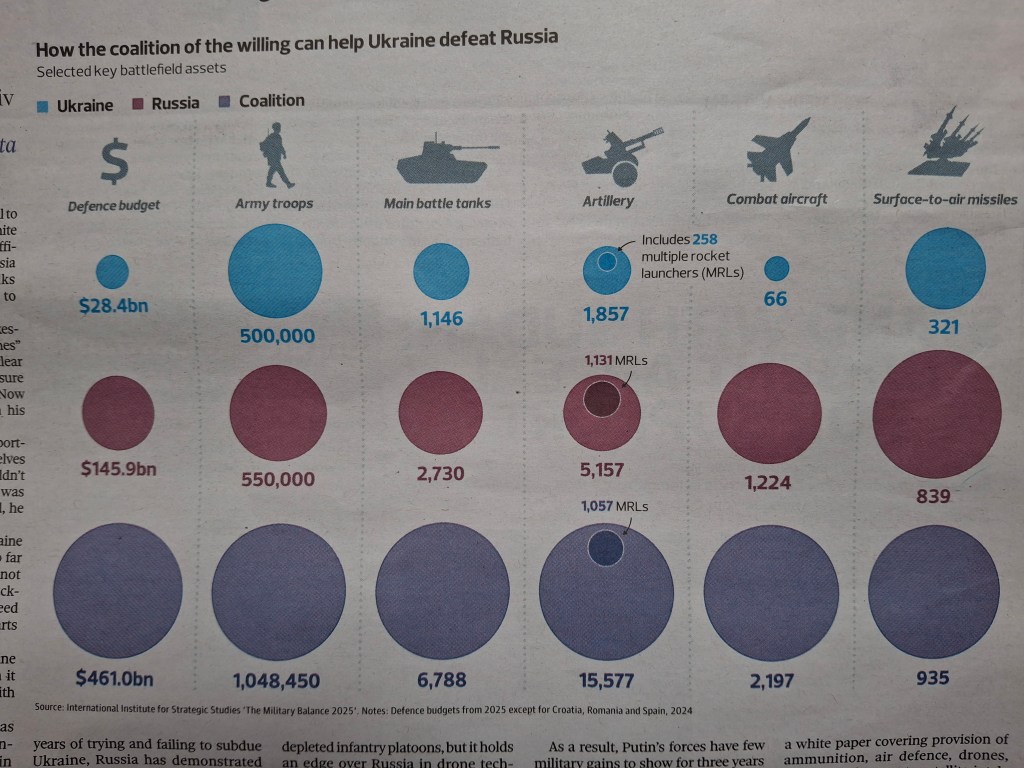
However, last week’s Observer published a graphic that shows the actual balance of forces now in Europe, between the European NATO powers and Russia. This reflects a level of spending that is three and half times the Russian level.

This is it. Have a look at this and ask yourself, who is threatening who here?

Then consider that the proposed 10 fold increase in lethality of the UK armed forces is part of a Europe wide drive to get the imbalance of spending between Euro NATO and Russia up to 10 or 11 to 1. So, this is not about “defence”. It is about being in a position to launch a war. Our current crop of lightweight leaders don’t seem to have studied much History. Invasions of Russia do not go well. As Charles XII, or Napoleon Bonaparte, and Adolf Hitler found out.

Given that Russia is a nuclear power with a nuclear war doctrine that would use nuclear weapons in the face of an existential threat to the country, the suicidal futlity of this drive boggles the mind. Needless to say, NONE of the interveiwers on the Radio or TV today have posed any questions of this sort. In fact, the Veterans Minister told the BBC Interviewer on PM this evening that it would be part of his job to “tell the truth”, which he interpreted as telling a story that projects “the national interest”. So, don’t ask the awkward questions. Close them down. Like we have now, but more so.

Four short points.

  1. The Review states that “you can’t defend on the goal line”. What they mean by this is that the UK armed forces would be fighting wars in other countries – as they have done regularly and consistently since WW2. Nothing new there. But there is a particular emphasis on Russia. How they envisage fighting even a conventional war with Russia without utter devastation for any country unfortunate enough to be on the front line, or within reach of even conventional missiles, isn’t elaborated on. We just get the old chestnut that to defend peace we have to be able to fight and win a war. That’s what everyone said in the run up to 1914, and look how well that turned out.
  2. The Review envisages mobilising the whole population for war readiness. That means a huge propaganda effort directed at civil society and through the school curriculum, presumably boosting cadets corps as part of the process, and weeding out dissent, either through Prevent or something more bespoke. A robust resistance to this from educators in defence of peace and sanity will be essential. As the Minister on PM said, this will be what we did “in the Cold War”. Similar conscientious objection will be needed, as it was then, to attempts to impose a stifling conformity, and any of the rituals deployed to shore that up.
  3. Complaints have been made in the press that the Armed Forces are losing people faster than they can recruit them, “even though the government has pledged to provide peacekeepers for Ukraine”. Has it not occured to them that this might be one of the reasons why more peopple are leaving than joining?
  4. The government is keen to talk about “military Keynesianism” rebuilding the economy, and some unions will go along with that on a “British Bombs for British Workers” line. This is nonsense. Military investment is, hopefully, wasted. The weaponry produced doesn’t build anything. Quite the reverse if used. This is unlike investment in, say, Health or Green transition, both of which produce much greater returns in value added and job creation. Explored in depth here. So, this is a dead end, in both respects.

The bottom line is that this is a political and military posture of choice. Impoverishing our society to ramp up arms spending, some of which will be exported to allies like Israel or Saudi Arabia to pursue genocidal attacks on Gaza or Yemen, in pursuit of a confrontation with Russia that will kill all of us if it follows its own impetus to full scale war, is not inevitable, not an imperative. Seeking a peaceful resolution to the Ukraine war and an ongoing modus vivendi with Russia that cools off military confrontation across the whole of Eurasia is an alternative that the whole Left should fight for. Some of the framework for this is explored in the Alternative Defence Review produced by CND and the RMT.

Please note. My Blogs are banned of Facebook because they say they “look like spam”. This has somewhat reduced their reach. If you think the arguments are worth passing on, and want to help break the ideological blockade embodied in this sort of action, please pass it on to anyone who you think might find it interesting or useful.

“Island of Strangers” my arse! Labour List’s apologetics for Starmer’s dive into the gutter

On my way back from the shops yesterday, I passed two neighbours chatting in the street outside their houses. A woman in a hijab with her small child was bantering about ice cream with the bloke next door, who was audibly Eastern European. They obviously knew each other well, and got on. Friends, not starngers.

This is in Thurrock, an area that was Brexit central, with a 72.6% leave vote in 2016. I find that, nevertheless, this is an area that is converging with Brent, where I normally live, the most ethnically diverse borough in the country. My neighbours in both places are not simply diverse, they are also ethnically mixed. As is my family.

When I used to analyse the ethnic monitoring stats for the school I used to work at in Islington, the fastest growing group was “mixed”. So, far from immigration making us an “island of strangers” many of us are getting on well enough to be as intimate as you can get.

In this context, and in the wake of Keir Starmer’s pedestrian dog whistling about immigration on Monday, Labour List’s article Local elections: Reform took four times more Labour seats than other parties is disingenuous. It implies, without stating it, that the loss of SEATS to Reform must mean that there is a loss of VOTES to them. And what follows from that is that there is a need – in the framework of the sort of electoral pragmatism that cares not what platform a Party stands on so long as it wins on it – to “address the concerns” of Reform voters in order to win those votes back.

This is a fallacy for three reasons and one principle.

  1. Reform has the momentum on the Right, and cannibalised the Conservative vote. Whether they will eat the whole Party before the next General Election is open to speculation, but it seems likely. These elections were held for the most part in Tory held areas that have been Conservative since the Jurassic and have now voted for a different, even worse, kind of Conservative Party (in the hopes of getting back there).
  2. The Labour vote did not migrate to Reform in a big way. It mostly stayed at home. Feedback from the doorsteps in the Runcorn and Helsby by election was that it was the cuts to winter fuel allowance that was the biggest demobiliser; so people who voted for a change from austerity and “hard decisions” taken at the expense of the poorest last Summer, were now less than enthused by what the Party had to offer.
  3. The government has been trying to cosplay Reform for some time, even to the extent of putting out ads boasting about how many people they have deported in Reform colours (which would be taken by most people as a Reform ad anyway, so self harm in more than one respect). The week of the elections saw announcements on a tougher line on immigration from Yvette Cooper on the presumption that the approach “Reform is right about immigration, we are trying to stop it, vote for us to stop Reform” would do anything other than legitimise them; and demoralise anti racist Labour voters. And, so it came to pass…

Tony Blair remarked after the 2017 General Election that if Corbynism was the way to win, he didn’t want to take it. Given the interests that have made him an extremely wealthy hollowed out husk of a man, this is hardly surprising. But the point applies in the opposite direction. Anyone even pretending to be on the Left who starts trying to exploit – and create – false divisions in our communities is doing the Right’s job for it. For the Labour Party, a lurch onto Reform’s xenophobic turf is a jump into quicksand.

The next lot of local elections will be in the cities. Reform is likely to still make the running on the Right. Labour, if it carries on trying to compete with it on its own terms, while presiding over austerity and an arms drive, instead of making a sharp turn to wealth taxes and investment in infrastructure, public services and green transition, will shed a collosal number of votes, to the Greens, to Independents (especially purged former councillors) even to the Lib Dems in some places, and many will stay at home.

Apologetics of the type that Labour List just published, will help drive that outcome.

How might the war end? Discordant voices from Ukraine.

“I don’t want anyone else to die,” Natalya says, crying. “Our little trooper is the youngest of all those who lie here.”Here” is the military cemetary in Lviv. Her son was 18.

What follows are a series of quotes from an article in Meduza based on interviews with people across Ukraine. Meduza is a Latvian based English and Russian language news blog with an unofficial motto “make the Kremlin sad”.

Despite that. what is striking about this selection is how the views expressed differ from the limited range of Ukrainian voices we get to hear in the official media here; which is why I have highlighted them in concentrated form in this blog.

I want to stress that for each of these views in the full article – which is worth reading – there is another arguing for carrying on fighting until the 1991 borders are restored, “otherwise what have we been fighting for?”

In these arguments, the deaths of the future are sanctified in advance and made imperative by the deaths of the past. None of the people who put this view, however, argue that it is possible. It is posed more as as a moral imperative, a revulsion against sacrifice in a lost cause; thereby carrying within it the prospect of a backlash not only against any peace terms that Ukraine accepts, but also those who have conducted an ultimately futile war. So the question “WHAT have we been fighting for?” is inextricably entwined with,“WHO have we been fighting for?” especially as the Kyiv oligarchy’s US puppet masters measure up the country’s natural resources as compensation for defeat.

“This is a separatist city; there are many zhduny here,” he ( a young soldier in the Ukrainian army) says of Sloviansk (a city in Northern Donetsk, close to the front line now) using a Ukrainian term for people who are “waiting for Russia.” “Even the local grandmas look at me like they want me to drop dead.” 

According to Oleksandr, Sloviansk residents with pro-Russian views no longer speak openly “because they understand it will cause them grief.” But Lera says that in some local Telegram groups, they refer to the Russians as “ours,” and local taxi drivers and shopkeepers often use the word “ruble” instead of “hryvnia.” 

This confirms that pro-Russian views in eastern Ukraine are a reality, not a “Putin talking point”. In other parts of the country, sentiments like these are expressed.

“If I were [in the politicians’ place], I’d have come to an agreement already, to be honest. I just want the war to end.”

“Yes, we’d like the 1991 borders to be ours, but not [if we have to fight] to the last Ukrainian. If so, let everything remain as it is. Not at this price.”

Borys says he wishes “Zelensky would stop this.” He thinks that Ukraine’s occupied territories should receive neutral status or become part of Russia, so long as the majority of Ukrainians are left alive; joining NATO isn’t worth such losses, he says.

“I think we should start negotiations [with Russia] and then decide the fate of [the Donetsk and Luhansk] regions through an honest poll. So people can decide for themselves which country they want to be in,” chimes in his friend Ihor, 18. 

“Are we going to sacrifice a million [people] for Crimea? And then what will we get?” Valetov continues. “I’m going to say something [that sounds] bad, but the people in Donetsk and Luhansk are no longer ours — with the help of television and Telegram, you can flush everything [Ukrainian] out of people’s minds in 11 years.”

She worries that politicians have gradually turned the war “into a business,” and she doesn’t understand how the money sent to help Ukraine is spent. “I have a lot of friends at the front whose [relatives] equipped them,” she says. “[It’s like,] You want normal body armor and a good helmet? Get it yourself.” 

“I don’t understand why our boys are at the front, but guys from Donetsk come here in their big flashy cars and live it up,” she cries (Maryanivka is about 500 kilometers, or 310 miles, from the front line in Donbas). “Why don’t they go there and defend their territory?!”

Ukrainians are tired of the war for many reasons, including because many of them donate money to support the army only to hear about constant shortages of weapons and equipment. She’d like the war to end with Ukraine getting back its occupied territories, but “if it were going to happen, it would have happened long ago,”

“Do you know what a Pyrrhic victory is? I don’t want such a victory,” he says. “But if our territories are given to Russia, this would be a capitulation, which isn’t right either. Therefore, just freeze the conflict. But on one condition: our country introduces the death penalty for embezzlement today. I’m no supporter of the death penalty, but I think it’s time.”

“They’re stealing our boys!” cries Yevhenia (name changed). Her draft-age son “was taken right from the bus stop” to basic training, even though he should have received an exemption as his grandmother’s caregiver. Yevhenia says her son failed to submit his documents to the military enlistment office in time. “If I’d known that would happen I never would’ve let him go out!” she says, practically in tears.

“It feels like they just want to destroy us,” he explains. “Not just the Russians, but our command, as well. We’ve been sitting at the front endlessly. It’s as if they’re saying, ‘There’s no one to replace you, [so] you have to die here.’”

According to Stanislav, morale is low and soldiers are just trying to survive. “Anyone who talks about peremoha should grab a Kalashnikov and go for it,” he says, using the Ukrainian word for “victory.” “On the Zaporizhzhia front, the Russians are making concrete and fortifying their positions with it. How are we going to break through? I’m horrified at the thought of going on the attack there. We’ll just drown in blood.” 

Asked what to do about the so-called Donetsk and Luhansk “people’s republics,” Stanislav argues that the easiest solution is to “amputate” the Donbas region. Mentioning the fact that Ukrainians live there makes him roll his eyes. “Oh, for fuck’s sake,” he says with a sigh.

Rearmament is a preparation for war, not peace.

Questions in the YouGov daily chat are invariably manipulative, but today there was one that was ludicrous.

In the event of a wider war in Europe, involving the UK, how do you think you would cope? Well? Badly? Other?

My response was, as a wider war in Europe, involving the UK couldn’t help but go nuclear, we’d all be dead. FFS get real! I normally keep polite on these polls, but really!

We are now, of course, in an extraordinarily dangerous situation in which a drive towards war is being presented as an attempt to secure peace and all right thinking people across all mainstream parties and media are agreed on it.

Discussions in the media are framed within the presumption of a Russian threat. No one questions the premise, largely because its false and s doesn’t stand up under the remotest scrutiny.

The same programmes sometimes have military speakers like Lord Dannat who assert that “Russia’s military is on its last legs”, as a way to argue that sustaining the war, in the way that the US is no longer willing to do, would soon lead to a NATO win, presumably with one last heave.

The incompatibility of this wishful thinking with the otherwise dominant line that a peace deal in Ukraine would lead to the Russians steamrollering across Europe is never noticed. Its almost as if they are doing it on purpose.

Without making any false assumption of an impending Russian collapse, lets look at the actual balance of forces between Russia and the European NATO powers.

According to GFP – strength in numbers, the leading annual global defense review since 2005 (in their own words) the European members of NATO, excluding the USA and Canada, are spending $445.7 billion on their militaries this year,

Russia is spending $126 billion. So, the FT assertion that Russia is spending three times as much as “Europe” is the opposite of the truth.

That means that without the USA and Canada, European NATO countries are already outspending the Russians by 3.5 to 1 on their militaries.

Add Ukraines $54 billion and the ratio gets to 4 to 1. That looks like this.

Put teeth on this and it looks like Pacman.

Add the USA and Canada’s $936 billion and it gets to just over 11 to 1, but even without them, given this imbalance, it is patently ludicrous to argue that the Russians, already outspent on this scale, have any capacity to attack NATO countries in Europe, even if they wanted to, which they have repeatedly pointed out that they do not.

Therefore, if the aim is “peace” and “defence”, even assuming a continued hostile stance between the EU and Russia, with no attempts to reset the relationship, reduce tensions and find a mutually acceptable modus operandi that would ensure a lasting peace, rather than a pause to tool up for Round Two, there is no need for increased arms spending. The orthodox militray presumption is that a succesful military attack require the attackers to have a 4:1 superiority. That leaves aside the political issue that an attacking power would have to have some degree of popular support to sustain an occupation. As the US and its allies found out in Iraq, even a crushing technological and military superiority is not enough to sustain a grip on a country if the people you are occupying hate your guts and want you to leave.

The current balance in military material is shown by this graphic from Germany, which shows an upward trend in spending from 2014 onwards, and also the greater NATO force in every form of weaponry, even if the US is removed from the equation. The only area in which Russia has more material that European NATO is in satellites and, narrowly, short range rockets; in military personnel, artillery, tanks and other AFVs, ships, aircrafyt and combat helicopters, Euro NATO already has a very powerful advantage; with a million more soldiers, three times as much artillery and attack helicopters, five times as many tanks and six times as many ships.

So, the proposed increases in military spending are not about “defence”.

Particularly not the massive EU military spending pledge by Ursula Von Der Leyen today. 800 billion Euros. Thats $860 billion. Add that to the current spending and you get to $1360 billion.

Compare that to current Russian military spend and you get this.

This is not preparation for defence, it is preparation for war; a war that, with Russia prepared to use nuclear weapons to defend itself, would kill all of us if it were to be engaged in. With the current UK “defence review” arguing that we are in a “pre war situation”, we should take the insanity of those that rule us sufficiently seriously to oppose them.

Post script: the state of public opinion

A YouGov poll reported in the Guardian (7/3/25) shows that the propaganda is working, up to a point.

  • 60% of respondents in the UK thought – falsely -that Russia would attack other European countries within the next ten years. The figures for France and Germany were more sceptical, Italy even more so. Rather important therefore for the reality of the actual balance of forces to be kept from them.
  • Even with this view however, only 24% of respondents in the UK thought that the current level of military support to Ukraine (£3 billion) should be increased and, despite the avalanche of emotive coverage in the last week or two, fewer than half in the UK support an increase in “defence” spending; which will mean increasing resistance to doing so as the cuts needed to sustain it start to bite. Support for increases is also a minority view in France, Spain and, especially, Italy.
  • Only between a quarter and a third in each country believe that the European powers can substitute for the US, which makes the other positions a Potemkin village of a posture with nothing behind it.
  • There is now a lot of hostility to the US within European populations; with 58% -78% now considering it to be “a big or fairly big threat to peace and security in Europe”.