Nazis in everyday life

A standard schtick of films and children’s TV dramas in the sixties was the moment that a previously anonymous villain was revealed to be a former middle ranking Nazi official, seeking to act as a seed for the regeneration of the movement; and thenceforth filmed looking Aryan while standing on yachts in front of mountains with a 1,000 Year Reich stare accompanied almost invariably by the crescendo from Wagner’s Tanhauser overture. (1)

This coincided with a lot of Nazi hunting stories sparked by the Eichmann trial in 1961, and the fact that no one had caught up with the Auschwitz “Angel of Death” Dr Josef Mengele, which gave the impression that the only surviving fragments of the old order – with the exception of Werner Von Braun, who was leading the US moon mission at the time and was therefore given a free pass – were leading lives of exiled obscurity in Argentina or Paraguay which, to be fair, some were. Mengele himself died when he drowned after suffering a stroke while swimming in Sao Paulo in 1979; having been given a passport in his own name by the West German Embassy in 1956 and actually visiting Europe using it in the late fifties.

This is a fairly extreme example of the way that former Nazis were reabsorbed into West German society in a wave of amnesia and omerta as the Cold War dug in. Von Braun, it turns out, was more the norm than Mengele or Eichemann. Though the Nuremburg Trials in 1945 -6 pronounced death sentences against 12 leading Nazis including Herman Goering and Joachim Von Ribbentrop, the number of former Nazis convicted of war crimes in the post war years up to 1958 was just 6,093. In the same period 729,176 had been amnestied. That looks like this.
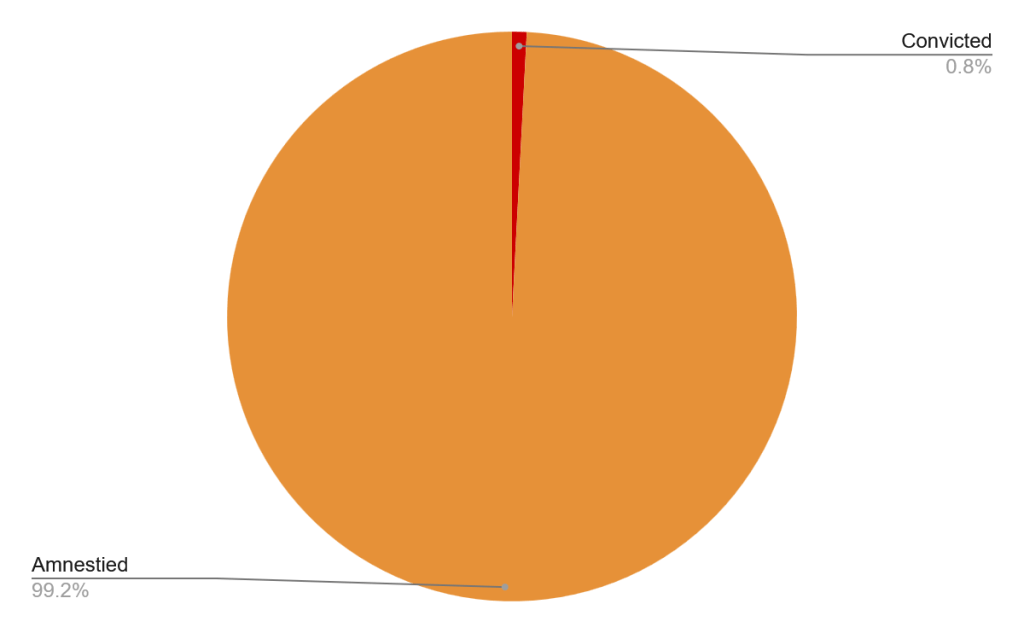
Total Nazi Party membership in 1945 was 8 million, so most of them had no process at all.

Many others, not members of the Party, who committed war crimes were never held to account and simply melted back into their pre war roles. The unit of Hamburg policemen who formed an Einsatzgruppen execution squad (2) following on behind the Wehrmacht to march Jews, and sometimes Poles, out into the woods and shoot them in the back of the head, simply went back to Hamburg to direct traffic, follow up on petty crime and do all the usual things the police do. Only their commanding officer was held to account, executed after being extradited to Poland because of a massacre of Polish villagers. Their interviews in the early sixties were for historical purposes, and they were never held to account. Similarly, lower level former army, and even SS, officers provided the backbone of the Bundeswehr when it was reformed in 1955.

1 A belting piece of music which is well worth a listen if you’ve never heard it.

2 Documented in Ordinary Men. As grim a piece of reading as you’ll ever do. Its front cover illustration is of a squad of these men looking relaxed and grinning with local Jewish civilians kneeling in front of them with their hands up, was so abhorent that I couldn’t leave the book face up while I was reading it. It is chillingly echoed by some of the gloating social media posts by IDF soldiers in Gaza that show that fascism can infect anyone in the wrong circumstances.

Nordstream 2 – “the silence shouts in your ear” (Graham Greene)

I wrote this yesterday evening after listening to PM. Whatever your views on the Ukraine war, the way the blowing up of Nordstream 2 is being reported is so transparently manipulative that they must know they are doing it. The almost complete silence on Seymour Hersch’s story in particular is almost deafening.

The Ministry of Truth? User:Canley, CC BY-SA 3.0 http://creativecommons.org/licenses/by-sa/3.0/, via Wikimedia Commons

During the discussion with Frank Gardner about the blowing up of the Nordstream pipeline and the current information from Germany that they are investigating a “pro Ukrainian group” for carrying it out, Gardner complained that the Russians were calling for an international investigation that they should be part of. Given that it was their pipeline, that doesn’t seem so odd.

He went on to say that the Russians were considered the main suspects for some time, without clarifying that they were considered to be this by the West, and that this would be -as “false flag” operations go – a spectacular example of cutting off their nose to spite their face given

1) that cutting Germany off from cheap Russian gas has been a strategic objective of the US for some time (and stated as such)

2) that blowing it up helps undermine peace movements in Germany seeking and end to the bloodshed and a deal that could get their cheap gas back (blow up the pipeline, no prospect of gas)

3) thereby removing a significant piece of Russian diplomatic leverage. this is about as plausible as the stories that the Russians were shelling their own troops at the Zaporizhzhiya power station which were repeated – or at best muddied – by your programme too.

Even more striking was that at no point did Gardner, or Evan Davies, refer to the Seymour Hersch story based on leaks from US Special Services that they carried out the attack. Hersch has a long record of getting embarrassing stories for the US bang to rights – from the My Lai massacre to Abu Ghraib. I appreciate that you guys are under heavy manners to keep to the agreed script, but it makes me wonder if Vietnam was happening now, you’d close down the My Lai story too.

Probably…

This is the key sentence in what the BBC write when you complain to them about a News item, so it doesn’t hurt to do it.


We’ll normally include your complaint in our overnight report to producers and management. This will circulate your and all complaints with other reaction we receive today (but with any personal details removed) so it will then be available for the right team to read tomorrow morning.

How Germans see the war in Ukraine

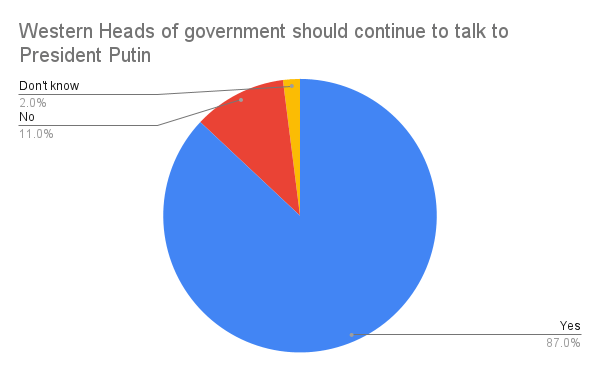
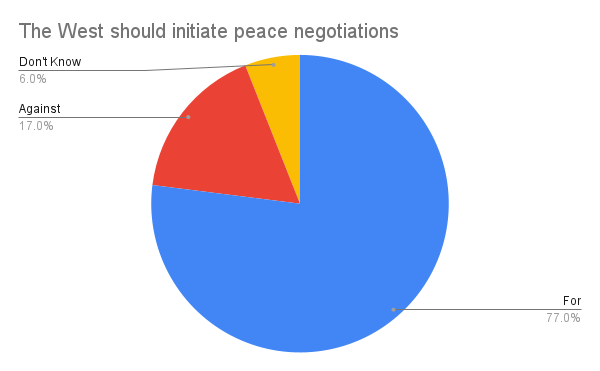
In a survey conducted recently by opinion research institute Forsa for the RTL / ntv “Trend barometer” there are very strong majorities for “the West” to initiate peace negotiations (Graph 1) for “Western leaders” to keep talking to Russian President Putin (Graph 2).

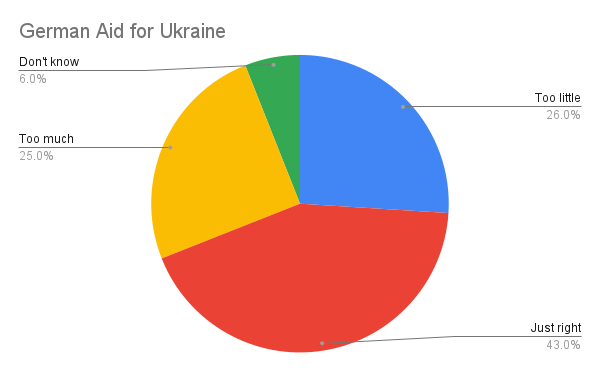
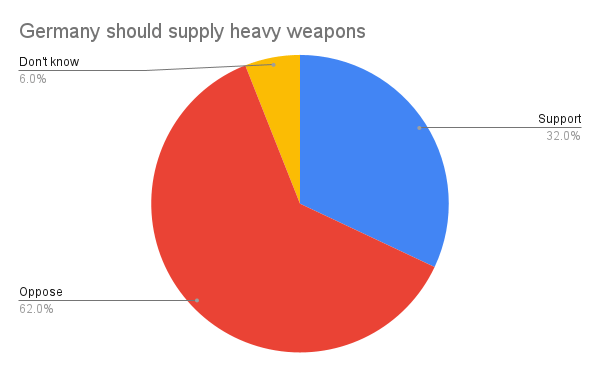
While there is majority support for supporting Ukraine at least at the current level about a quarter of people think that it is too much, balancing similar numbers who think it too little (graph 3) but there is equally strong opposition to specific escalation (graph 4).

Opinion in the UK – with less dependence on Russian gas and a bigger role for the military in its national psyche – is more bellicose, but the strong sentiment for the sort of peace negotiations that China and India have called for in the key state in the EU indicates that its government will face increasing difficulties in maintaining a pro war stance as the winter crisis unravels.