Why the education system does not meet the challenge of climate breakdown…yet

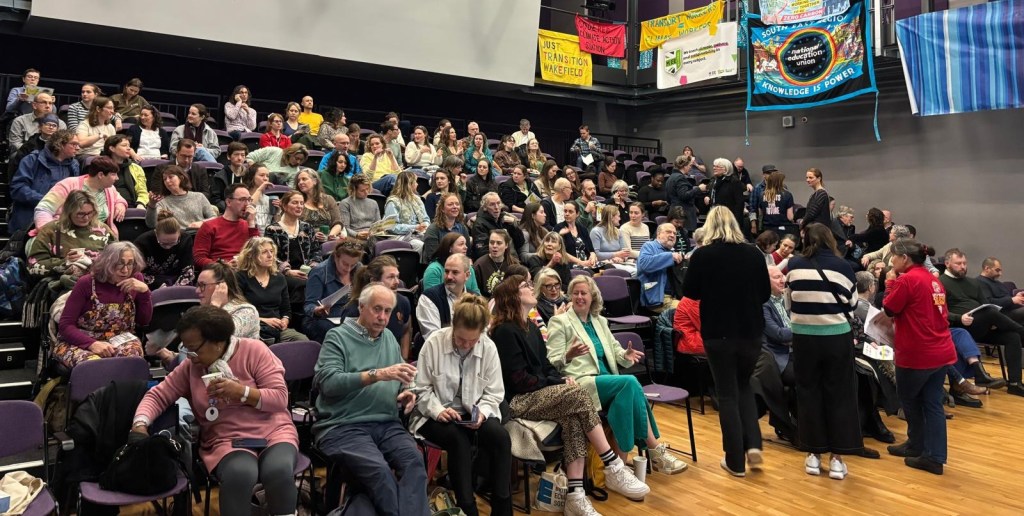
Photo: Suzanne Jeffery

This is the text of my talk at the Climate and Nature Education Festival on 14th March.

  1. It is obviously in the interests of humanity as a whole to act together to limit the damage done by GHG emissions.
  2. But this isn’t happening – fast enough – because the society/economy/polity/education system we have globally isn’t based on the interests of humanity as a whole and the interests of nations not on the interests of the nation as a whole. When Donald Trump says “America will make a lot of money” on the back of the current oil price strike arising from his attack on Iran, he means the US oil companies that will rake it in from inflated prices, not the people paying through the nose for increased petrol prices at the pumps. On a more parochial level, we hear a lot about “the national interest” and it’s important to be clear that this is not the interests of the people who live in the country, but that of the people who OWN it; which is not only not the same thing but often – usually – contradicts it.
  3. An anecdote. My Dad worked for Proctor and Gamble at the West Thurrock factory for most of his life. When he was about 40 he and several other shop floor “mature work oriented individuals”, as the company put it, were put on a course to make them more valuable and motivated human capital for the company. As part of this they were asked “What do you think the company is for?” Thinking about what they did all day, and being use value oriented, as working class people tend to be, they said “to make soap powder”. “That’s where you’re wrong” they said “The purpose of the company is to make money (Exchange Value in Marxist terms) If we could make more money doing something else, we’d do it”. That’s probably why P&G manufactured both Sunny Delight and Napisan (and in blind taste tests…)
  4. And that’s the crunch. When it comes to many aspects of the green transition that we need, it cuts across profitability. Take insulation. If done properly that cuts demand, costs and CO2 emissions. Win, win, win for us. But lose, lose, lose for the companies that make money off selling the fuel. The same goes for efficiency standards. It’s why Trump is relaxing them. 
  5. And on the level of profitability, for Oil and Gas companies that were flirting with renewable divisions a few years ago (Beyond Petroleum and all that) Fossil Fuel investment has a rate of return between 4 and 5 times greater than investment in renewables. It may be going to kill us to keep doing it, but the bottom line is the bottom line. This is judged in quarterly returns…and in the long term, as Keynes so rightly said, we’re all dead. And that doesn’t just motivate the direct FF companies, but also the banks that lend to them. A CEO of one of the big US banks that pulled out of Mark Carney’s attempt to set up a global financial alliance for transition investment said they were doing so because putting any consideration other than maximum returns for shareholders is “immoral”. This was also expressively put by Sam Altman, CEO of Open AI who said “I think AI will probably, most likely, sort of lead to the end of the world. But in the meantime, there will be great companies created with serious machine learning.” So, that’s alright then…
  6. So, the transition won’t simply not be led by these people, they have been, are and will resist it. And this is not simply at the level of companies and civil society, but state capture. The Trump administration in the US is the acme of this. I’d argue that Trump is not an aberration but an expression of Tech Bro Fossil Fuel dominance in the world’s leading imperialist and petro state in an attempt to reassert its slipping global dominance by bullying other countries into buying their oil and LNG and throwing its immense military weight around ($1.5 Trillion war budget coming next year, so the manic pace that we’ve already seen this year is just an overture) before the 60% of the world that has already passed peak FF use really consolidate that with a flood of cheap Chinese solar panels and get out from under.
  7. A central aspect of this is a war on scientific truth on climate and environmental protection that defunds and deplatforms both study and teaching – presumably on the philosophy that what you don’t know can’t hurt you. And the promotion of abject subaltern political formations that will do likewise across the world, like Reform here. And not just Reform. “The model” for Kemi Badenoch (and this is a quote) “is Javier Millei”. We can guarantee that a Reform/Tory government will mean a direct assault on any attempt to address climate change in schools.
  8. I’d also argue it is no accident that the core of industrial/energy transition globally is China – where, even though they have a very powerful private sector – in the final analysis, the economic plan is determined by the state (and 50% of wind/solar installations are done by state owned enterprises).

I’ll end with some thoughts from Antonio Gramsci, who argued that any education system exists to replicate the social order that it serves. And that’s not just a matter of educating for necessary technical skills, but also attitudes, morals, aspiration and narrative frameworks that sustain that society as it is. Our problem is that the society/economy/polity that we have is unsustainable and that sets up a tension and contradictions that we have to fight our way through. The need to anticipate and prepare not simply for “the jobs of the future” but prepare future citizens for a social and economic order that we don’t have yet runs slap up against all the inertia and commanding heights of an education system designed to sustain the order that we have. In that context we have to use whatever levers and footholds we have within the system – embodied in eg the DFE NZ strategy like sustainability leads, climate action plans, national education nature park etc to prise these contradictions apart and push them further – for whole school curricular and campus transformation initiatives and pushing through the ambiguities of the DFE’s “Impartiality Guidance” – on the basis that recognising the reality of climate change is – as the guidance states – true; so Parties that deny it are not basing their politics on reality…and should be treated as such. A clear consensus for the education unions on this point – that climate change is not “above politics” but foundational to any relevant politics is essential – if we want to safeguard our students from Fossil Fuel glove puppets and charlatans.

Writing off the Working Class in Education?

How the framing of the debate changes!

Time was that relative educational underachievement of global majority children in English schools was put down to ethnicity. Exam results “proved” that these kids were inherently less able than their white peers. Books were written. Media talking heads nodded sagely, “the figures don’t lie”. The shadow of racial status from Empire still loomed across the later 20th Century.

A variation on this was a big scare in the 1980s, that, if there were too many of them, children for whom English was an additional language would inevitably hold back the progress of their classmates for whom it was their only language. A Head teacher from Bradford called Ray Honeyford made a big fuss on these lines and was given credence by TV News, and then platformed as their go to talking head on every other educational issue – on the same lines as Katherine Birbalsingh is today because, after all, Head teachers are all the same.

So, why would you want to talk to more than one?

This argument has disappeared since. In my experience over thirty years of teaching, a child fluent in another language would rapidly pick up English. Even the least fluent picked up F*** off! within a week of playtime. Needs must. Problems with an academic curriculum would come in if the child’s home language, whatever it was, was underdeveloped. Often, a bilingual child would have access to two blunt linguistic instruments. A child with English as a sole language, would have one. The solution for this was innovative, language rich, experiential learning, with lots of practical activity and talk. This benefitted all the students, however many languages they spoke at home. As the phrase went “good English as an Additional Language practice, is good practice”.

But now that some white pupils are doing worse “even than Afro Caribbean students” as one Radio 4 commentator put it yesterday, the clutching at pearls almost audible – “Daphne! The smelling salts!” – this is no longer put down to ethnic inadequacy on the part of the failing students, because the shadow of racial status from Empire still casts its darkness; it must be about something else.

If this were about material factors holding back all working class children, that would represent progress. However, the framing once again emphasises the ethnic aspect of this, and in a way that does not recognise that, in addition to all the other factors that hold back working class kids, global majority kids have to deal with racism as well.

The implication of the media narrative now, is that this has been turned on its head, so global majority students must be being unfairly favoured in some way. A favourite target is any attempt to learn in a curriculum that does not reinforce racist narratives. This is absolutely overt in the United States, with inclusive curriculla scrapped and books banned; so our derivative Right will want to echo that to show how patriotically subservient they are to the Big White Chief in Washington. If you’ve had privilege for long enough, equality always looks like a threat.

So, their line is that any effort to allow global majority children to see themselves in the curricullum, or for History in particular to be decolonised, is an attempt to “make white children feel bad about themselves”. Which is odd, because you’d only feel bad about, say, the slave trade, if you identify with the slave traders, not the slaves, out of misplaced ethnic solidarity.

When people like Michael Gove talked about being “proud of our History”, that white solidarity cutting across class and stretching back through time, is what he wanted to reinforce. Let the statues of the slave traders (Colston) and imperial buccaneers (Rhodes, Clive) stand forever for us to look up to, holding us in our place like so many bronze paper weights.

There is a massive difference between wanting to “erase History” and wanting to hold it up to the light. For Gove and his ilk, the point of national history teaching is to provide a national narrative based on the fond delusion that “we” were always the good guys, so anything we do now must be ok. Its that that erases history and makes understanding it impossible. All so we can watch our armed forces bomb and occupy other people’s countries and still feel good about ourselves; and definitely not resist it. While it is often said that “those who don’t learn from history are doomed to repeat it” it is equally true that “those who prevent history being fully taught intend to repeat it”.

An article in the Daily Telegraph – White working class pupils are being written off says Philipson (11/8/25) demonstrates rather well how this is now being framed. In a paper that argues on the same day that too many students are going to University; too many of the wrong sort of students, you know, the sort that should be learning practical skills that can then be hired by the people who do, and whose families always have; they approvingly quote Education Secretary Bridget Philipson as saying that “it is a “national disgrace that so many young people are written off and don’t get what they need to achieve and thrive. Far too many young people, particularly white working class British (sic) students, don’t get the results they need at GCSE or A Level to allow them to continue to University.” I emphasised British there, partly for its redundancy, but also for the implied “us and them” dog whistle. What are the other students then? Not British? A foreshadowing of “remigration”?

The paradox of the Telegraph’s line lies in the conflict between thinking that working class kids shouldn’t really be going to University, should know their place and stay in it, with the racist indignation that if global majority kids are doing better than any white kids, this is an outrage that cannot stand.

Not that they have any concrete proposals to deal with it. Least of all addressing structural issues that put so many children below the poverty line, 2 child benefit cap perhaps, or investing more into schools – both in resources and educational input – in the most deprived areas. This approach worked very well in London with the London Challenge between 2003 and 2011, which saw Inner London’s exam results going from bottom to top in eight years.

This is relevant because demographic divergence means that economically declining poorer towns, sometimes, but not always on the coast, or in former industrial areas where the industry has died – places young people with hope and educational motivation move away from not into – often retain a proportionately high white working class population. Some of them, to be fair, have moved there from cities because of that, hitching up their ox wagons and making the great trek from London (with no ethnic majority) to, say, Clacton (95.3% white). The paradox of this is that areas with a healthy ethnic mix tend to have schools with higher results, but also higher results among all ethnic groups, so they are running away from better prospects for their kids.

The last Conservative government tried to deal with this by changing the funding formula so that the existing education budget was redistributed. This would have raised spending outside of cities at the expense of running down spending in them. The obvious problem with this is that an improvement does not sustain itself on inertia. The level of investment needed last year will still be needed this year just to stand still. Cut it away, and it all goes backwards.

So, if they were serious about addressing this, there would need to be a London Challenge type intervention – preferably less top down and more engaging with educators – in all deprived areas.

But that takes resources.

And you can’t have that if you need every penny for the Ministry of Defence. Far better to let things languish so that angry and alienated people are pointed towards Reform not a solution.

Here’s how they frame it “Labour is facing pressure to address issues facing white working class Britons amid the growing threat from Reform”. In this framing dividing and ruling the working class is the foundation of the narrative. Solutions that benefit all working class kids don’t get a look in. Instead we have Angela Rayner quoted citing “high levels of immigration” as “threatening social cohesion among Britain’s poorest communities” in a way that “risks fresh disorder”.

So, the issue is not the lack of investment in schools, because little will be on offer; “immigration” is posed as the problem. The problem for Labour is that chasing Reform votes by parroting their poisonous themes instead of genuinely addressing the issues and putting the resources in, will compound and exacerbate exactly the problems she says she fears.

Because, when they talk about “white working class” the active part of the formula is “white”. The last thing they want is any pride in being working class (unless that is clearly defined in the sort of plucky subordinate role – like the way working class characters provided the light relief in Brief Encounter – in which we know our place).

Better demoralisation than class solidarity. And demoralisation of the sort that leads to about double the number of kids now often missing school days than before the pandemic can only be addressed with hope. Of the sort that is now denied by the society we have. Hope of a job. A worthwhile job preferably. Somewhere affordable to live. Preferably decent in a healthy, culturally lively green community. A future not threatened by war or climate breakdown, and education that does not act as an enabler to the first and dampen down serious mobilisation to stop the latter.

Above all, an education that offers working class kids self respect, as unique individuals, but as part of the class that, as Bernadette McAliskey put it on a Bloody Sunday Commemoration Rally on a frozen Sunday in Kilburn forty years back “you built this country…every last stick of it!”

Can’t have kids being aware of that. They might want to build it better.

The Shadow of Long Covid

Figures from the ONS (1) show the impact of “Long Covid”. While deaths have resulted from 6.2% of known infections, the rate for Long Covid is 25.1%.


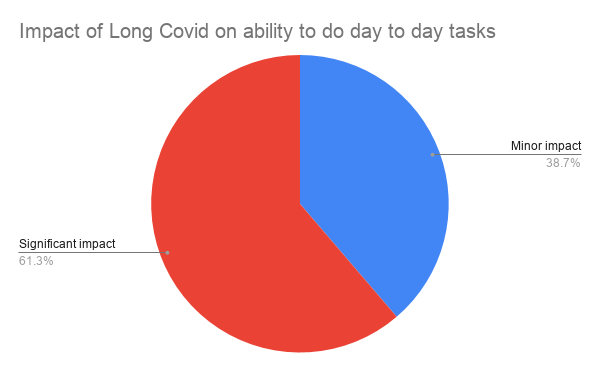
This is proving to be debilitating for a long period for a significant proportion of those affected. The ONS reports that 1.7% of the total UK population is suffering long term ongoing symptoms. The figure for long term debilitating symptoms is about 1% at the moment.


As the ONS points out, we are at early stage in understanding what is likely to happen and it is unclear whether these symptoms will be permanent or how far they will fade, nor how far this will vary between people and what patterns might start to emerge over time. Nevertheless, in the immediate term, there is going to be a significant impact both on the health of the people concerned, and therefore on their ability to work or participate in social life.


The profile of people disproportionately affected is the same as for mortality rates; those in front line jobs, living in poorer areas or with poorer health, ethnic minorities; but with a greater impact among younger age groups and slightly more women than men.
This has a particular impact on certain roles. 


Health and care workers and educators are the two worst hit – and both will be under pressure from government to “catch up” – which could become unbearable and unsustainable. (2) Both of these workforces are heavily female. 77% of NHS staff, 73% of teachers and 93% of teaching assistants are women.


6.4% of the total NHS workforce has Long Covid, alongside the 1.5% currently off sick with Covid symptoms. 


The proportion of educators is even higher, at 10.8% of the whole workforce. Even if Gavin Williamson’s arguments for longer school days held any water educationally – they don’t, as anyone who has worked or learnt in a school with a longer day will tell you – the impact of trying to push it with a workforce not only stretched and exhausted by a year of teaching in person and online, but also  decimated by Long Covid – is likely to push many people – if not the system as a whole – beyond breaking point.

  1. https://www.ons.gov.uk/peoplepopulationandcommunity/healthandsocialcare/conditionsanddiseases/bulletins/prevalenceofongoingsymptomsfollowingcoronaviruscovid19infectionintheuk/1april2021#main
  2. https://www.theguardian.com/society/2021/apr/03/nhs-feels-strain-tens-thousands-staff-long-covid