Of Pies and Doughnuts – 30 theses on Political and Economic issues in Green Transition.

“I wouldn’t start from here if I were you…” Trad.

  1. The first point that we have to be clear about is that we are now in a period of damage limitation. Continued emissions of greenhouse gases are putting humanity well behind the curve of saving ourselves from the breakdown of the climactic conditions needed for the survival of human civilisation. In the current relationship of forces, the question is not whether we can avoid the crisis, but how much damage we can avoid. As we need far more dramatic shifts that current political and economic relations allow, we have to seize and build on any and every change that is immediately possible in order to bank it – limit the damage – and build on it to have any prospect of breaking through the limits of those conditions. It is imperative to do both.
  2. The paradox is that fossil fuel interests are now under such a threat from the transition that is already taking place, even at its current slow pace, that they are putting significant resources into political movements that are either denialist, like Trump, Bolsonaro, Milei, or go slow, like Sunak. The dynamic of this is towards denialism; in practice if not in theory. This dovetails with the impasse of neoliberalism, which requires a dramatic shift in the balance of power against the working class and Global South to restore profitability and capital formation in the US allied countries. This tends towards fascism; because “normal” politics will be incapable of imposing that scale of defeat required. The question here is not whether Trump, for example, is a fascist, but whether the movement he fronts up (and which is an expression of very powerful class forces) is heading in that direction. This tendency is not inevitable, but has to be seen for what it is. As the inequality of wealth, and stratospheric concentration among the wealthiest has increased, political acceptance of democratic constraints among the wealthiest has declined sharply. Resistance to this is one of the motors of transformation.
  3. Fascism is a last resort for ruling classes because it is ultimately suicidal, requires exponential escalation of confrontation to a point of total victory or total defeat: but the prospect of ecological collapse makes this less of an inhibition in a kind of last days of Nazi Berlin recklessness; and generates the sort of exuberantly self indulgent celebration of irrationality that is such a feature of movements like MAGA.
  4. The capitalist class is divided on climate, however. Significant capital is going into renewable energy, electric vehicles, and other key transition sectors. Others are perturbed about the future, and want there to be one. We should note that there was a significant participation from private school students in the climate strikes for example. If you expect the world to be your oyster, then find out it is going to hell in a handcart, you’re going to be upset about it. It is also noticeable that the active cadre of climate denialism in the Global Warming Policy Foundation are not only rich enough to be part of the global 1%, they are also almost entirely over 70 years old. Lord Lawson, of course, is already dead.
  5. This division also plays out not simply in “green sector” businesses, among scientists and academia, but also at different levels in government. Cities are vital laboratories for a green social shift. The C40 movement, the most important legacy of the Livingstone Mayoralty in my view, knits together the Mayors of nearly 100 of the world’s biggest cities from New York to London to Jakarta to Beijing, Paris and Buenos Aires. All of them are working on ways to green construction, transport, urban planning, waste and recycling; and sharing the results in a vast process of mutual experimentation and shared learning. You can read about that here. The need to make such a conscious shift in every aspect of life is a new challenge and no one has all the answers. We are making it up as we go along, and any and every lever we have any access to is vital. Every small step that works is a seed, because it shows what might be done on a bigger scale. These cities cover a multitude of political sins, and at present it could not be otherwise. And they make a big contribution to the Paris process. Actions taken by US cities aligned with C40, and to some extent States, reduced the impact of Trump’s rollback on climate measures during his last Presidency by about half. Whatever the political character, and limitations, of the Mayors of NY and LA and the other cities involved, this is essential work. This could be seen as an application of Gramsci’s notion that we are in a war of position, seeking to gain ground in a myriad of social forms and organisations as part of the process of shifting hegemony towards a point that the old unsustainable order cracks.
  6. Nevertheless, pro Net Zero views among capitalists tends to a kind of techno Micawberism – the view that technological changes alone, leaving existing social and economic structures intact – will be enough. Given the studies by Oxfam and others that show that the carbon emissions of the wealthiest 10% will, at current consumption rates, take us beyond 1.5C on their own, regardless of what the rest of us do, this poses the limits of any bloc with them, and also a rule of thumb guideline for how much income is too much in global terms; roughly anything above £75,000 per person at the moment. For people above this, getting to sustainability will be harder than a camel threading a needle, but there we are. We can travel to sustainability, but not in private jets or yachts.
  7. The climate movement is necessarily broad. We should be prepared for united fronts across wide disagreements on other matters and to have debates within the movement; and also form blocs with different class forces on particular issues without doing so on their terms. Offshore wind companies, for example, are as ruthless to their workers as any others. This is a contradiction that we have to fight out within the imperative to have as many of them built as we can.
  8. The same applies to limited and inadequate political choices which reflect capitalist interests first and human imperatives a long way below. A continued Biden Presidency, for example, would continue to pursue an “America First” green transition, as well as its global war drive against China, arming the IDF assault on Gaza, channeling capital into military spending and sucking green investment away from even its subordinate allies. A Trump Presidency would make the US a complete rogue state on climate, smash up the Paris process, double down on fossil fuels, and spice up the war drive with what Boris Johnson calls “unpredictable violence”. Leon Trotsky’s argument in The Struggle Against Fascism in Germany –that when you are confronted by two people who are going to kill you, but one has a gun and the other some slow poison, you bloc with the poisoner against the gunman, while building up your own forces so you can deal with the poisoner later – is relevant to this.
  9. Either way, the dominant ruling class in the US centred Global North bloc, for all its protestations of global leadership, will not lead humanity into sustainability. The ease with which they have found billions for wars, and now escalating military spending, compares starkly with the difficulty they seem to have providing climate finance for the Global South.
  10. The ideologues of the world’s imperial core have warned us of what they are going to do. In “The Age of Consequences” a projection of potential climate scenarios drawn up by allies of Al Gore in the US Democrat Party in 2008 stated quite clearly that in conditions in which climate driven “massive non linear events” began to unravel societies, “Governments with resources will be forced to engage in long, nightmarish episodes of triage, deciding what and who can be salvaged from engulfment by a disordered environment. The choices will need to be made primarily among the poorest, not just abroad but at home.” When someone tells you who they are, believe them.
  11. This is not simply a question of a confrontation with capitalism, it is a question of confronting imperialism in the first instance. The concentration of the major imperial powers into a US led Global North bloc – described by the Tricontinental Institute as Hyper Imperialism – is the last stand of an order that extracts wealth from the rest of the world, seeks to make its own working classes complicit in doing so, is arming itself to the teeth to confront the consequences of its failure to deal with the climate crisis; and is risking war rather than peacefully come to terms with China becoming economically weightier than the US, thereby accepting multipolarity. This means that we may not live long enough to experience the full consequences of climate breakdown, should the kind of US strategic thinkers advocating a war with China in the next five years manage to provoke one. If we manage to avert this – and it will take efforts on our part – the diversion of investment into military spending will cut essential investment in climate transition and do enormous and unnecessary damage anyway. We won’t get this time back.
  12. John Bellamy Foster’s call for an anti imperialist climate movement to address the twin threats of 21st Century exterminism, the US war drive and climate breakdown, is essential, in that there needs to be clarity on this on the Left, but also insufficient, in that there need to be united fronts with forces that are not on the Left, and forces on the Left that don’t see themselves as anti imperialist in the way that Bellamy Foster (or I) would; and this is a dynamic process.
  13. The role of the countries that see themselves as Socialist is a more positive one than they are usually given credit for in the climate and labour movements in the Global North. Whether this is Cuba being considered a sustainability model by the UN, or China investing twice as much in energy transition as the US and EU put together this year, or high speed rail investments as part of the Belt and Road initiative. This is examined in some detail here.  I use the phrase “countries that see themselves as Socialist” because large parts of the Left in the Global North don’t think that these countries are what they think Socialism is, but its important to take on board the fact that 90 million Chinese Communist Party members disagree with them – and that should pose (at least) a debate, with them, not about them. A good place to start getting a flavour of their views, and that of quite a broad range of the non Party Left is Wenhua Zongheng.
  14. Monthly Review has also made a serious reassessment of the Soviet Union’s ecological record, stressing that the ecological disasters, for which it is well known, generated a significant environmental movement, and big shifts in state policy with real impacts, particularly in the 1980s after Chernobyl; and that its overall environmental impact was no worse than that of the US. Anyone who has seen post industrial wastelands in the US will not find that hard to believe.
  15. The current escalation of extreme weather events is just the overture to impacts that will, on current trajectories, become locally or regionally unmanageable in the coming decades; posing political climate emergencies declared by local ruling classes seeking to survive at everyone else’s expense, confronting working class and popular resistance, forced into revolutionary solutions to seek survival. Developments of this sort can’t help but have a dramatic political ripple effect, transforming debate and actions globally. Columbian President Petro’s insight that Gaza is a dress rehearsal for what the Global North will increasingly impose on the rest of the world as the climate breaks down should also be seen as a promise of the sort of global solidarity it has generated. with the sharp political learning curve, shake up and shake down of allegiances and organisations that goes with it. As Bellamy Foster puts it; “A revolt by the world’s environmental proletariat …, in which hundreds of millions, even billions, of people will inevitably take part, is destined to come about in the coming decades as a result of the struggle for ecological survival.”
  16. We are the majority and should act to mobilise it. When Just Stop Oil in the UK says “We need a revolution”, they are proposing a combination of continued non violent direct actions with assemblies to mobilise local communities around matters of concern. We should not be formulaic about what forms “assemblies” should take; as they will necessarily be multiple and will obviously include workplaces; and in some cases, these will be the core of a wider social mobilisation, as they are at GKN Firenze.
  17. We should also be clear that any NVDA must be directed at appropriate targets and all actions be aimed at mobilising the majority opinion in favour of more urgent climate action, not substituting for that in ways that provide climate deniers with a popular stick to beat us with. JSO has not always been sensitive to that. Nevertheless, initiatives like this are part of the war of position. Revolutions, and counter revolutions, take place when a social order breaks down to a point that it can no longer go on. That is when the war of position becomes a war of manoeuvre and ecological breakdown or economic impasse or military confrontations can all be causes of that. (See point 13 above).
  18. In the UK, the biggest wave of climate activism, and optimism, coincided with the Corbyn leadership of the Labour Party, which held out the prospect of a UK government that would qualitatively up the investment in green transition. This fed off, and fed, a series of mass movements outside Parliament and Parliamentary thinking that nevertheless led to Parliament declaring a climate emergency and embedded concern for climate as a top 4 issue ever since.
  19. A Parliamentary Road to Sustainability now looks too long and winding to get to its destination anything like fast enough; with the level of investment being proposed by Labour quantitatively better than that already in place, but not to the qualitative degree we need. This is a damaging and retrograde choice by the Labour leadership. The failure of economic logic is examined here. Sir Nicholas Stern and others at the Grantham Institute have also demonstrated that the UK needs at least 1% of GDP to be invested in infrastructure every year to keep abreast of other developed countries. 1% of GDP is £26 billion. Which is a familiar sounding figure. Anything short of that allows continued decay.
  20. Rachel Reeves recent Mais lecture got the relationship between climate transition and “growth” completely the wrong way round; with the notion that any investment in green transition will flow from “growth” in the existing economy; within the framework of restrictive fiscal rules and respecting Tory spending plans that have baked in another five years of austerity. Reeves argues that Labour will aim to “grow the pie”, addressing issues of productivity with selective state pump priming. The scale of this is the problem. Cutting planned investment from £28 billion a year to only a little over what the Conservatives have already pencilled in, means that few pumps will be primed. Even with a “growth unit” in the Treasury, there will therefore be little growth, because there won’t be enough investment to generate it; and what growth there will be will primarily reproduce existing patterns of unsustainable production and consumption, not the sharp shift in the economy to a much lower carbon intensity overall that we need. Its not so much that the pie needs to be bigger, but it does need better, more nutritious ingredients, and to be shared qualitatively more equitably. That follows the climate imperative to reduce the overconsumption of the richest 10% outlined above. But Reeves’s approach rejects social redistribution, with all but the most limited taxes on the wealthy ruled out. We should not accept the poverty of low aspirations that passes for “realism” in Labour leadership circles and push for what is realistically necessary.
  21. “Growth” in the sense that Reeves poses it, is a way to generate benefits without confronting unsustainable inequalities of wealth and power; leaving them intact. Without differentiating between what is sustainable and what is not. “A rising tide lifts all boats”, but in current conditions, it also drowns all coastal cities.
  22. However, “degrowth” is not a good description of what we are trying to do; all too easily translated, in current circumstances, as “austerity”, or an unjust transition requiring the 90% to pay the price for the continued indulgence of the wealthiest 10%. Growth is completely legitimate and necessary in the developing world. The importance of a massive shift in investment to it is to enable this to happen without reliance on outmoded fossil fuel technology, in the same way that Africa has leapfrogged landlines to use Satphones. The failure of the Washington Consensus finance structure to make this finance available is structural and condemns the majority world to continued poverty and a pattern of development that is slow and unsustainable. In the Global North our movement has to be about transformation and regeneration, lowering carbon intensity without crashing majority living standards.
  23. The US bloc is trying to unravel globalisation, as it no longer provides it with global dominance. In cutting the world economy into parts, it breaks up shared efficiencies of scale, making all progress towards sustainability more costly. Local production is not always better than working with a global division of labour, and is often less so, even when transport costs are taken into account.
  24. “Extractivism” is also not a useful formulation, as, if we are to make anything at all, we need the raw materials to construct it; and that involves mining, refining and so on. The point here is to have the most economic – sparing – use of these materials, including the most effective possible circular reuse; and the best possible terms and conditions for the workers employed in the global supply chains; which is part of increasing the living standards of workers across the world as we head for sustainability.
  25. The food metaphors used in this discussion are unfortunate as, given the choice, most people would go for a fat pie over a thin doughnut.
  26. It is a statement of the obvious that, if we are to survive, some sectors of the economy have to shrink dramatically and, in some cases disappear, while others have to expand while the overall carbon intensity of everything made or done has to decrease. That requires continued technological innovation. We can’t presume a magic bullet, and can’t afford to wait for one, but at present there is a 2% annual improvement in efficiency and, according to the IEA, that needs to double to get us on track. That needs investment and coordination. So, the transition is necessarily technologically intense. The figures from the study that drew up maximum sustainable per capita energy consumption in Jonathan Essex’s recent article on the Greener Jobs Alliance blog were based on a presumption of everyone having equal access to the most advanced technology available. This is a long way from “Fully Automated Luxury Communism” but the technological dimension of maintaining a decent and sustainable way of life will be huge (and require the commensurate level of skills to sustain it).
  27. At present in the UK, even with stagnant “growth” in the conventional sense, and a transition that is going too slow, the number of jobs being created in “green” sectors is greater than those being lost in carbon heavy sectors.According to the ONS, in 2022, 8,500 jobs were lost in oil and gas, while 40,000 were created in low carbon and renewable energy sectors (almost 5 gained for every one lost). But, they are different jobs in different places. All investment, transition related or not, tends to substitute capital for labour, so transition for workers in threatened sectors must be addressed by any government, or movement, serious about making a shift with public support and avoid devastating local impacts like that at Port Talbot. Our movement should be about anticipating those shifts and for the unions and communities concerned to be ahead of what’s coming to make the appropriate demands for job guarantees, retraining and redeployment. If that does not happen, we end up in the ridiculous position whereby unions representing North Sea Oil and Gas workers campaign against the freeze on new exploration proposed by Labour, even though this is contrary to the interests of the working class as a whole.
  28. If you go to the TUC HQ in London, there is a magnificent painting by Dan Jones of the demonstration outside Pentonville prison in 1972 that was the strongest expression of the General Strike that freed the Pentonville 5. If you look at the banners being carried, most of them are from unions and union organisations that no longer exist. SOGAT. The Port of London Joint Shop Stewards Committee etc. This should stand as a warning to us today. A trade unionism that limits itself to bread and butter issues and the immediate perceived interests of members confines itself to trying to get a better deal in someone else’s world; and leaves strategic decisions about the future in the hands of a ruling class that will make them in a self interested way that will destroy whole sections of our movement. This is trade unionism that Gramsci would have described as “subaltern” and “corporate”. Another way to put it is that it is trade unionism that, however militant, ultimately knows its place.
  29. We need, instead, to push for Just Transition bodies at every level, in every sector and in every community; and push for a government that could, for example, approach the highly skilled workers making private jets and ask them, “with your skills, and this kit, what could you make instead that would benefit everyone?” and coordinates all initiatives through a National Climate Service. There are vast reservoirs of creativity, imagination and preparedness for hard work that could be harnessed in a universally understood human mission to save ourselves.
  30. Article 12 of Paris Agreement states that all signatories have to educate their populations on the nature of the crisis and the measures needed to deal with it. We should not interpret that as a sectoral point, but as a whole society obligation whereby society mobilises itself to deal with the crisis. Our movement has to lead that, or it won’t happen.

To baldly go. Jeff Bezos’s final frontier.

“With great power comes great responsibility.” Possibly Voltaire, definitely Spider Man, but not, it seems, Jeff Bezos.

Jeff Bezos, in an interview with Business Insider in 2018 (when he was “worth” $132 billion) said, “The only way that I can see to deploy this much financial resource is by converting my Amazon winnings into space travel. I am going to use my financial lottery winnings from Amazon to fund that.”

There is a current among the uber wealthy to project space as their future – as though they can avoid the problems involved in destroying the conditions for human survival on Earth by getting “off world”.  As though they were exposed to too many plays of “The Final Countdown” at an impressionable age. The fantasy in that song, that – having trashed the Earth – everyone could head off to live on Venus (not an enticing prospect with an surface temperature hot enough to melt lead, air pressure at ground level 92 times greater than Earth’s – and enough to crush anyone unfortunate enough to be standing on it – and an atmosphere largely comprised of dense clouds of sulphuric acid) and that the Venusians would be welcoming to a species that had just destroyed their own habitat and wanted to have another go in theirs; is only marginally less absurd than the idea that life on Mars (with virtually no oxygen, no water cycle, no vegetation, an average temperature of -67C and dust storms thousands of kilometres wide that last for months) would be remotely desirable compared to living – say – in an upscale part of Seattle.

In an interview with CBS News in July 2019 Bezos said “Human beings are in the process of destroying this planet” and – in a leap of imagination that treats planetary destruction as a given premise instead of an avoidable problem – produces a wild fantasy of off world manufacturing, with factories on the Moon within a few hundred years. Seeing William Shatner echoing these delusions this week was like hearing an echo of the blithe optimism of the 1960s that his character in Star Trek embodied- in which the future was all flying cars and galactic exploration – well out of its time. Kirk out.

What Bezos seems to be missing here is that the Amazon – the other one – is on fire NOW; and we don’t have a few hundred years to deal with keeping our planet habitable. We have a decade to make a serious dent in greenhouse gas emissions if we are to have half a chance of getting through to the end of the century with a civilisation intact. Recognising that business as usual – including his business as usual – is “destroying this planet” would probably make most people think that anyone with a spare $132 billion might want to put most or all of it into stopping the destruction. This does not seem to have occurred to him.

Its the phrasesmy financial lottery winnings from Amazon” and  the only way that I can see to deploy this much financial resource” that stick out from his original quote (my emphasis).

His “winnings” from Amazon are not a lottery but the result of profoundly ruthless and dehumanising management systems that are part of the reason our planet is being destroyed in the first place. Mr Bezos’s “winnings” are the flip side of the following.

  • Amazon pays 15% below average wage rates for warehouse workers.
  • Workers employed at the Amazon depot in Dunfermline were found sleeping in tents near the factory because the cost of transport took such a huge chunk out of their meagre wages that they couldn’t afford to commute.
  • In Ohio, 700 of their workers are on food stamps.
  • Workers are often employed as “permatemps” to minimise their legal rights at work.
  • Delivery workers are paid by the package, putting them under huge pressure to zip round as quickly as possible – the implications of this for safe driving should concern everyone.
  • In 2013, they had the second highest turnover of workers of any company in the Fortune 500 Index. According to a Study by Pay Scales, the average Amazon worker can’t stick it out beyond a year.
  • Warehouse workers are tied to electronic monitors that keep them to targets that are set just beyond what they can do if they work flat out without a breather. Some workers have taken to peeing in bottles so they don’t lose the time taken in going to the loo.
  • As a result, in the UK, there have been 600 ambulance calls to Amazon Warehouses in the last 3 years. Just over one every other day. The Rugely depot in particular looks like a place to avoid getting a job if you possibly can – with 115 call outs.

The “logic” of this is – while the company is waiting for robots to take over, they will treat their workers as much like robots as possible. Seen this way, people are robots with needs that present as flaws.

Treating workers as throw away resources is of a piece with treating the Earth’s resources in the same way.

Amazon made $3 billion profits on $180 billion in sales in 2017. It paid no Federal taxes in the United States in 2017 and 2018. In the UK between 2016 and 2017, even though business increased by a third, the tax paid was halved – to a tiny £4 million (about the same as the annual budget for one medium sized secondary school).

So we have a company that treats its workers like robots, burns them up and spits them out, does not contribute to the social costs of creating its labour force or the infrastructure that sustains them, or the transport infrastructure along which the company’s goods are delivered, or anything else. An essentially parasitic relationship.

And we have an owner who thinks he, personally, has the right not only to keep his “lottery winnings” but to blow them on space exploration rather than the million and one tasks that face us in keeping this planet habitable for the next generation.

The sheer entitled self indulgence of people like this shows them up as unfit to control such concentrations of wealth; and any society that sets them up as “aspirational” role models – because what else should you aspire to if not to become filthily, selfishly, rich – is dooming itself to self destruction. A future future determined by people like this is not  good enough for humanity, nor is it viable. Saving ourselves means becoming more human, more social, less robotic, less exploited and exploiting.

We can do better than them.

April in February

“Isn’t it lovely?” And so it is. Soft winds. A hint of blossom. Sticky buds starting to uncurl. Everything that little bit lighter and fresher. And you can respond on that level. Yes. Its lovely. There are crocuses of hope. Spring has more than one meaning. This early though…Our light. bright days are the accompaniment to the wild gyrations of the jet stream, the blazing forests of Australia, the melting ice packs of Greenland and Antarctica, the freezing of Texas* and the floods here in Storm Cristophe just last month, which Sir James Bevan, the Chief Executive of the Environment Agency, reports came within one centimeter of the tops of flood defences – constructed to Reasonable Worst Case Scenario Standards – that protect 49,000 homes from inundation. (1) Crocuses of hope could well give way to daffodils of despair if we don’t get our act together. Of course, in a conversation with a neighbour, being the Cassandra who is always pointing out the dark cloud that is the condition for the silver lining makes you a prophet of doom that no one wants to listen to, lest it ruin their good mood.

At the supermarket, a young woman pushes her baby buggy steadily down the aisle with one hand, looking sideways at her mobile phone completely absorbed, legs on cruise, navigating by muscle memory; her toddler is a small mirror image, looking to the left at his phone with the same frown of concentration.

Around the end of the Park, the first school crocodile of spring. Teacher striding out briskly at the head without a backward look. Neat little rows in the papal scarlet of the local Catholic primary going in two by two, with barely a need to be shepherded by the TAs at the back. Eighteen of them. And they look liked one class. Quite a lot even before the reckless reopening next week. The “normality” of it coming as a shock.

*“I’ll believe in climate change when Texas freezes over” Senator Ted Cruz.

  1. https://www.gov.uk/government/speeches/watching-the-wolf-why-the-climate-emergency-threatens-us-all

‘I see dead people’. How we got here and where we’re going.

Perhaps I’m one of them. My local High Street is ghost town full of aspirant ghosts. This is a look at how we got here and what we might expect.

Phase one. Phoney war in the West

While China went into lock down and South Korea, Taiwan and Vietnam quickly closed borders, tested and traced, governments in “the West” reacted in a way that at first defies rational explanation; being more concerned with making political milage out of how China’s reaction was “Draconian” and not what could be contemplated “in a democracy” than making serious preparations for the impact on their own countries when the virus spread – as it was bound to do. At the same time, the conventional wisdom last month that Covid 19 is basically flu so nothing to get worked up about, we could “take it on the chin” with business as usual and power through it, lulled people into a false and fatal sense of security. In the local supermarket just two and a bit weeks ago the guy in front of me asked why the price of his item had gone up.

“We had a new delivery this morning. and the price was higher because of the situation.”

“What situation?”

“Coronavirus.”

With a dismissive sniff, “what’s Coronavirus? Just flu.”

I had to point out that it is twice as contagious and ten times more lethal than ordinary flu and appeal to everyone who was listening to please take it seriously. They all looked a bit shocked but took it in. There’s the evidence of a failure to launch a timely public information campaign right there.

Just two weeks ago only a few meetings or social events were being closed down and there was a sense that this might be being alarmist even amongst those of us starting to do it, but a sense of unease was building and there were signs all around of partial steps being taken before there was any serious steer from above. On the tube at Golders Green on March 7th, a small group of friends passing round hand sanitiser and rubbing it in before they got off. A young man sitting with two guitars and wearing a face mask, but seeming a bit bashful about it and keeping his eyes down. Not many people sitting apart from each other. There was soap and water in the public toilet but the water was running cold – and it probably still is. Something ominous coming but no one thoroughly prepared for the full measure of it. The cafes were full and the streets were busy.

There are three possible interpretations of this failure to meet a growing threat on the part of Western governments, and “the establishment”, the 1%, the ruling class, the bosses; whatever you want to call that layer of society who, as R. Taggart Murphy puts it are “the people who have first claim on economic resources and are the last to suffer when anything goes wrong, even when they are directly responsible for the damage.” (1).

  1. The ruling class are stupid. This is a very tempting interpretation, especially when watching Boris Johnson doing his Prime Minister impersonation or President Trump bullshitting his way through yet another daily briefing of lies, fantasies and insults; or contemplating the complete failure of the US, UK and EU to take account of the evidence that was being shoved under their noses by events and reinforced by the World Health Organisation. But, taken as a whole, these are highly sophisticated, well educated people capable of detailed analysis and highly intelligent manipulation of public reactions; so it would be a mistake to underestimate them.
  2. The ruling class are ruthless and have less regard for human life than the profitability of their system and the need to maintain their power. This would be indignantly rejected by most of them, and most people who tend to look kindly upwards with rose tinted glasses, but there always had to be ice in the veins of people who ran Empires built from the slave trade, in which millions died of famine while grain was exported, which waged wars for the right to sell opium; and it still runs in that of their descendants; who preside over a world still structured by the inequalities and injustices that are their legacy. The ability to “smile as you kill”, as John Lennon put it, the capacity to lie with total self belief and behave like a vandal while maintaining impeccable manners is built into the way these people are brought up through the elite public schools and institutions like the Bullingdon Club or US Frat Houses. The sort of character satirised by Shaw in St Joan, where the ghost of the Earl of Warwick explains with disarming charm to the ghost of Jean d’Arc that burning her to death was “nothing personal. Your death was a political necessity” could be written because he was so easily recognisable. This way of thinking is reflected in Dominic Cummins remark that “herd immunity” was worth pursuing because the deaths of “a few pensioners” was neither here nor there; and the article by a Daily Telegraph economics correspondent that the deaths of thousands of unproductive elderly people would be “mildly beneficial” to the economy “when looked at dispassionately.” A Malthusian approach to “the surplus population” (as Dickens’s Mr Scrooge puts it) is nothing new; and likely to be far more common in private than in public. Just consider the Grenfell fire in this context.
  3. Ruling class thinking is so dominated by the structures, relationships, laws and values that ensure their continuing wealth and power that any challenge to it – from wherever it comes – is literally unthinkable; so the first reaction to challenges that appear like a deus ex machina almost has to be denial. This comes across as a sort of hubris – that the normal functioning of business could defy an imperative that is beyond its limits. The element of “stupidity” – an inability to learn faced with incontrovertible evidence – is structured by this. This is corroborated by the experience of other challenges. On the crunch day of the 2008 financial crisis the CEO’s of the UK Banks that were about to crash and take the whole system down with them were sitting in a meeting with the Chancellor of the Exchequer and the Treasury team refusing to agree to the government bail out that saved their arses until the last possible minute; because they saw the terms on offer as an impossible and unacceptable restriction on their freedom of action; describing it afterwards as a “drive by shooting” – even though it socialised their debt at enormous cost to society with no consequent obligation on their part to restructure their operations to meet social needs. The case of climate change is even more evident. One example symbolically stands for all. In November last year the Veneto Regional Council, with its offices on Venice’s Grand Canal, voted down measures to reduce CO2 emissions barely two minutes before rising flood waters drove them out of their chamber. George Osborne’s asinine boast to the Conservative conference in 2011 that “We’re not going to save the planet by putting our country out of business” is still the mind set for those who hold our fates in their hands in the West – and evidence of why they don’t deserve to.

A deeper problem is that this way of thinking is also dominant in the general population, whose lived reality is within these structures and “values”, that define the limits and imperatives they bump into while trying to get by in a world constructed for someone else’s benefit, so they appear so much as common sense or normality to most people that it is barely possible to imagine living or thinking in any other way. Crises shake that and reveal to those with eyes to see that the Emperor’s clothes are – at least – threadbare. People imagine alternatives and start trying to construct them when they have to.

President Trump expresses ruling class thinking as an expression of pure id. Coherence and higher level thinking have nothing to do with it. He takes the old jokes that were so effective against Gerald Ford – “his library burned down and the tragedy was both books were burned – and one of them wasn’t coloured in yet” – and turns them into a strength. Who likes reading anyway? He is an impresario of knee jerk reactions. The targets of his barbs are finely calculated to avoid thought and go straight to fears and exploitable emnities. He is mobilising fears and turning them against targets that strengthen his position while throwing out false hopes – because people need to believe that this will be easier than it is and want to hang on to whatever shred of “normality” they can.

  • Initially claiming it to be a hoax perpetrated by the Democrats. This claim was loudly repeated by Fox News, so one of their commentators has since had to be sacked. Trump himself remains in place saying he doesn’t want to look back. Amnesia is a condition compulsory for true believers.
  • Initially saying it was “totally under control”, or since that this or that medicine might be a miracle cure that was already ready, or that it would “disappear’ like a “miracle”; none of which has or is going to happen, all of which have had to be denied by the FDA, some of which have led to people getting ill from taking inappropriate meds on his say so; but none of this matters because he “has a good feeling” about it.
  • Relentlessly labelling it as a “Chinese virus” or a “foreign virus”, as if diseases have a nationality and could be made subject to border control. With an irony that would be wonderful if the consequences weren’t so serious, the higher rate of infection in the US has led to the Mexicans closing the border against American visitors. Build that wall. His attempt to offer large sums to a German company for exclusive deployment of the vaccine they are developing for use in the US alone – an offer creditably turned down by the company which quite rightly declared that any vaccine it produced would be for everyone – and the continuing and intensifying exploitation of medical sanctions against vulnerable countries like Iran and Venezuela, highlights the nationalistic recklessness that is stripping US power bare of its previous “global leadership” and “human rights” pretensions and leaving it ugly and naked for all to see.

Meanwhile his followers round on anyone campaigning for an effective approach as “politicising the crisis”. Perish the thought. Similar charges are made in the UK where we are all supposed to “pull together” behind a government that helped dump us in the leaky boat we’re in and has taken initiatives when forced to do so not because they have ever been ahead of the curve.

Meanwhile petty sorcerer’s apprentice figures over here like Nigel Farage railed against the WHO. “The World Health Organisation is just another club of ‘clever people” who want to bully us and tell us what to do. Ignore.”  Can’t have ‘clever people” who might know what they are talking about telling us what we need to do to save our lives and bullying us into health. Where will it end? Just take back control, light up that fag, have another pint and infect all your mates. Tim Martin of Wetherspoons, just before the government finally moved to close down pubs and cafes, declared that his pubs would stay open because there had “hardly been any transmission” of Covid19 in pubs; so thats alright then. We can afford a few transmissions to keep the beer flowing. Its a matter of priorities after all. Never forget where this idiocy leads.

Phase two: Waking up to several months of Sundays

Last Saturday, the day after the government told cafes, pubs and restaurants to shut, most did in my local High Street; a few rapidly repositioning themselves to offer take out only with delivery. One or two were open with no signs. All but one were empty. There were fewer people but still too many, some wearing masks, some with scarves across their mouths and nose in an attempt to avoid viral roulette. Hopefully the Prime Minister won’t say they ‘look like bank robbers.’ Traffic, normally jammed on a Saturday, flowed freely. Walking past the barbers, the bloke who usually cuts my hair was working wearing a face mask – but he had pulled it down to breathe more easily – hoping – presumably – for symbolic protection. It was possible the next day to look out over West London from our living room window which – because we are on a hill – gives a vista right across past Wembley Stadium on the foreground all the way to the distant hills of Richmond park on the southern horizon – and appreciate the hush. The roofs seemed to be dreaming. For years you could count the aircraft flying East to West across the City to get to Heathrow, an orderly queue, one every thirty seconds. On Sunday, nothing. I counted three all afternoon, and no vapour trails. The sky is an unbroken blue of oddly celebratory weather.

The sudden change in the rules was way too slow and came partly from pressure from below and partly from pressure from other countries experiences. An example is what happened with schools.

  • At the beginning of the week the government was saying that there was no need to close schools.
  • Other countries, accepted to be only a week or two ahead of us in the trajectory of infections, had closed theirs and people could see that their health systems were already struggling. The shortage of ventilators and beds meaning that anyone over 60 was being left to sink or swim. In some cases ventilators were being removed from elderly patients to go into younger ones because they were the only ones available.
  • The National Education Union publicly asked for the modelling being used by the government to argue that keeping schools open was a safe course of action to be publicly shared. At the same time they told all of their members who were in vulnerable categories to inform their Head teachers that they would be self isolating at home from Monday and that if the Heads resisted that the union would see them in court.
  • The government failed to come up with its model, which undermined what authority their stance had – and as the week went on, more and more teachers went off, either with symptoms or as a measure of self protection, 2 000 more teachers joined the union and Reps emerged in quiet schools so they had a voice, while the Heads unions also expressed concerns. At the same time, an increasing number of parents took their children out without waiting for an instruction from government.
  • Faced with a chaotic break down of the school system the government ordered partial closure on the terms set down by the union – with some places left open for the children of key workers.
  • The experience this week has been that very few of those children have actually come in – even in those few schools that tried to hold open more places than the 10% maximum laid down.

The impact of all this is that rules and expectations previously taken to be imperative and unchallengeable have suddenly become optional. Deadlines have evaporated to be replaced by the incessant buzzing of WhatsApp messages from the local mutual help group; as real life proves that there is such a thing as society. Some basic lessons.

  • When it comes to the crunch the market can’t deliver. The state has to step in. The question there is the extent to which it is doing so in order to subsidise businesses and to what extent to guarantee a social need. In Spain they have requisitioned private health care. Here they have done a deal. Italy has renationalised Al Italia. Here Richard Branson wants a bail out. The pattern of 2008 is at risk of repeating itself but that is not inevitable. If people are to “all pull together” that can’t be in the interests of keeping Richard Branson in yachts and private islands while everyone else suffers.
  • Just in time deliveries and the production pattern that goes with them requires a society living on its nerve ends all the time.
  • Once a pattern of home working and zoom conferencing gets established there’s every possibility that they will become the norm.
  • Air travel looks like becoming far rarer.

TINA (“There is no alternative”) is dead, even “going forward”. This has enormous consequences for the movement to save us from the even greater challenge posed by climate change. If the government can nationalise railways, guarantee 80% of wages, direct car companies to produce ventilators, require non essential businesses to shut down (even Sports Direct and Wetherspoons) – at least for a while – mobilise volunteers to work in the Health Service, set up local co-ordinations of councils, the health service and voluntary organisations to meet emergency responses and require huge changes in social behaviour to save us from a virus, the taboo against taking similar action to repurpose our economy and society so that we can drastically cut carbon emissions and live in a sustainable way has been broken. We can think outside the box because the walls of the box have broken. There will be strenuous efforts to rebuild them as was in an attempt to go back to “normal” but we don’t have to let them get away with that.

Phase three: Whats next?

The genie is already out of the bottle and running riot. Because of the failure to test there is no grip on who has and who has not got this virus. Kings College has launched an App for people to log into with their state of health, so some backdated information can be gathered, but this depends on a critical mass of representative people taking part so patterns can be observed. Voluntary initiatives like this have come to the fore because there has not been an attempt to do this by the government, which needs to step up.

The measures taken so far have been too little too late, which will mean that they will have to be intensified for longer while increasing numbers of people die. None of us is invulnerable. I am acutely aware that I am writing this as a 66 year old with high blood pressure and a longstanding chronic cough.

So far there has been a certain amount of social discipline and a huge level of social mobilisation from the bottom up. 405 000 people have volunteered to help the NHS deliver medicine and probably food to vulnerable people on lockdown. The Communication Workers Union has volunteered en bloc to be the fourth emergency service and do similar (2). The government and much of the media will attempt to frame this outpouring of social solidarity in nationalist terms – as a patriotic duty more than social solidarity, precisely because the latter has the potential to go beyond the limitations of the former.  Johnson always appears for his daily briefings bracketed by Union Jacks, making him look as though he is framed in rather stuffy patriotic parentheses – which, of course, he is. Meanwhile people at home with their eyes misting up look at videos of Germans on balconies singing Bella Ciao in solidarity with Italy.

This social solidarity has partially broken down around panic buying. This reflects a genuine fear of being stuck at home without enough food (or toilet rolls) that was completely predictable and could have been blunted by a far more rapid imposition of limits on purchases of particular items. The notion that “the customer is always right” inhibited the needed response for far too long. We have also had some criminal elements trying to exploit the situation, either by profiteering on scarce goods or posing as volunteer support to get info and access to the bank accounts of vulnerable people. In one case very tastefully targeting people whose children are in free School Meals.

As this drags on, unless there is a deepening of the underpinning of economic security, and as the death toll climbs, that cohesion is likely to start fraying at the edges as those not covered by the wages guarantee start hearing the siren voices of those calling for a return to work before the virus has been eliminated. Further measures of socialisation – what we used to call “social security” – will have to be taken to prevent this. Employers of key workers who have not staggered start and stop times to take account of rush hour crushes on public transport – which make social distancing impossible for anyone caught up in it – will have to be instructed to do so.

As this crisis works its way through this summer there will be a three way divergence globally.

  • If China sustains its effective suppression of the virus and starts cranking its society and economy back up – as it is starting to do – it will be seen to have recovered with a relatively low level of casualties.
  • The total in Europe and the US will be far higher and the economic disruption far greater. Goldman Sachs estimates that US GDP could collapse by 25% in the next quarter, pushing unemployment up to 13%. This will have political as well as economic consequences. (3)
  • If and when the virus runs out of control in the developing world, the death rate is likely to be higher still unless there is a massive and co-ordinated international effort to strengthen health systems. China and Cuba are already trying, but can’t do this on their own. The approach of the current US administration, to maintain medical sanctions on threatened countries while whipping up racist reactions, is the opposite of what is needed.

Recognising this, Sadiq Khan’s appeal to Boris Johnson to step up to the global co-ordinating role played by Gordon Brown in the financial crash is almost surreal – not just because its Boris Johnson but because what Boris Johnson and his government believe in makes it impossible for them to play this role.

Conclusions will be drawn about global leadership through the experience of who is providing it in practice. This is dramatised by the scarcely believable statements from Trump and Brazil’s President Bolsonaro today and some US senators starting on Monday. Bolsonaro denounced city governments ordering lockdowns calling for people to “get back to work” while boasting that he personally could survive this virus because of his “athleticism”. The only thing missing was a box of Lemsip max strength poking out of his pocket. Trump – since Monday – has started talking about the cure being worse than the disease and floating a “return to work” around Easter Sunday and that having churches full to bursting on that day would be a “beautiful thing.” This is not because he is hoping for a miracle – though a connection with deeply atavistic sentiments about rising from the dead in Spring should not be ruled out – but is quite explicitly posed as putting the needs of the economy above the needs of the people. This means that there will be a political drive from forces animated by Trump to go back to business as usual as rapidly as possible if they can get away with it. No one should be in any doubt that this will kill many, many people. The extent to which they get away with this will be the extent to which there is mass revulsion and push back.

Out with them!

A personal post script

The meeting that I went to on March 7th was for XR Educators to work out their perspective in the wake of the general election. I was there for the NEU Climate Change Network. The immediate campaigning plans discussed at the meeting are all on hold because of the virus, but what I took away from it has been invaluable in another sense. in the crisis we now face.

I am not a member of XR and have a more traditional Labour movement way of operating. Some of that involves a rather functional approach to meetings. When doing introductions we usually just say who we are and who we’re representing. At this meeting – possibly reflecting the Quaker influence in the long tradition of non violent direct action that goes back through Occupy all the way to the Committee of a 100 – and possibly reflecting a need to face an existential crisis with some appreciation of life so as not to fall into despair – we were asked to introduce ourselves and say something we were grateful for. At the time I was grateful for my Freedom Pass because it enabled me to get to the meeting for nothing. Since then, every day I have felt and noticed things I am grateful for – the cloud of bees in the frothy white cherry blossoms on the tree outside my flat – the light reflecting on the ceiling as it comes through the curtains in the morning – the uplift at the end of Beethoven’s violin concerto, my wife’s wit, my daughter’s laugh and my son’s hugs. And I am grateful for the nudge to let that gratitude in.

  1. R Taggart Murphy. Privilege Preserved. Crisis and Recovery in Japan. New Left Review 121 Jan/Feb 2020
  2. https://www.cwu.org/news/here-is-a-vital-update-on-coronavirus-and-the-dispute-for-all-royal-mail-group-members/
  3. https://markets.businessinsider.com/news/stocks/us-gdp-drop-record-2q-amid-coronavirus-recession-goldman-sachs-2020-3-1029018308

Climate Change. The Conservative Manifesto is playing chicken with Physics.

Reading the section of the Conservative Manifesto on climate change- one page tucked away as a sort of afterthought – one item among so many – on page 55 (out of 64) to show just how important they think it is – I can’t help but be reminded of a 1971 meeting between Thurrock Friends of the Earth and the local Young Tories. We were from different planets of course. Thurrock FOE – like a foretaste of the UKSCN -was made up entirely of school students. Mostly working class high flyers from Grays and Aveley Tech and the Convent Girls School living on estates in Grays, Stifford Clays and Tilbury. In the Conservative Party it was possible at that time to be considered “young” at the age of 35, but the two brittly over confident chaps who came to talk with us weren’t much older than we were. They were also from Orsett, a well to do rural enclave that could double for Ambridge on a good day.

Our concerns were global, systemic. Even before climate change was recognised as the threat that it is, there was a sense that we were using resources in a way that was reckless for our own survival. We picketed Tescos because of overpackaging and worried about the built in obsolescence of so much of the tat that was being produced – the philosophy at the time being neatly skewered in Tom Stoppard’s play “Jumpers” as “no problem is insoluble; given a large enough plastic bag.” We picketed the motor show over safety and pollution. We worried about the air we were breathing. With the huge cement works by the Dartford Tunnel, where Lakeside is now, and the predominantly westerly winds, everyone between there and the Estuary was breathing solid lungfuls of cement dust on a daily basis. That then blew across the North Sea and contributed to the acid rain that was killing European forests at the time. We worried about Dutch elm disease as the local variant of deforestation – all the magnificent elms in Dell Woods, Alfred Russel Wallis’s* abandoned arboretum, were dying- and we were beginning to see all this as a manifestation of a system driven by profit.

The Young Conservatives saw the fundamental issue with “the environment” as being litter. More to the point, litter and fly tipping being brought in by people from Basildon – at that time a relatively new New Town full of decanted Londoners and therefore deeply suspect. It struck me at the time that this missed the point on every level that it was possible to miss it on.

Today’s Conservative Manifesto – written as it is by a consultant for a fracking company – does much the same. It starts with a self soothing pat on the back for achievements they have not made.

“Our Government’s stewardship of the natural environment, its focus on protecting the countryside and reducing plastic waste, is a source of immense pride.”  Really? Walk down any urban street and check out how successful they have been at “reducing plastic waste”. Take a deep breath and savour the air that has led them to being taken to court – twice – by the European Union for failing to clear up dangerous levels of air pollution. Bear in mind that this was the government that wanted to sell off National Parks and – for a while – was prepared to contemplate fracking within them.

“But today, the climate emergency means that the challenges we face stretch far beyond our borders.”

This would be the climate emergency that was introduced into parliament by Jeremy Corbyn and the Labour Party and on which most Conservative MPs abstained. Note that the challenge that stretches beyond our borders is one that “we” face. Not a global problem that has to be faced together, but one that has to be seen through the distorting lens of nation. The challenges being faced now under the impact of climate change in the developing world are seen in the framework of a possibly threatened cosy domesticity.

“Thanks to the efforts of successive Governments, the UK has cut carbon emissions by more than any similar developed country. We are now the world’s leader in offshore wind – a fantastic success story of Government and the private sector working hand in hand to cut costs and deliver ever more electricity at plummeting costs.” 

This sentence stands boldly and four square on the thinnest of thin ice.

  • The UK has cut its carbon emissions by a sharp shift away from coal for energy generation and by offshoring significant parts of manufacturing industry to China and other developing countries. The cement dust in the air I grew up with is no longer in Thurrock, but in Chongking. The goods that are consumed in the UK are not counted towards its carbon emissions. If they were, UK carbon emissions from consumption would almost double.
  • There is no mention here of onshore wind – which the Conservatives have hobbled. Onshore wind installation – now the cheapest form of energy generation – fell by 80% in 2018 because of planning restrictions brought in by the Conservative government.
  • Nor is there a reference to solar. The removal of the solar subsidy – on the grounds that a “mature industry” should stand on its own two feet in an open market – led to new solar installation falling by half in 2016 and again in 2017.
  • Fossil fuel subsidy in UK in 2018 was running at £12 billion – the highest level in the EU. So much for mature industries competing on a level playing field.

These decisions are perverse and suicidal – not something anyone could be proud of. We should also note that without the colossal Chinese investment in wind technology which have reduced its costs to below those of fossil fuel equivalents, there would be no expansion even of offshore wind. Freeloading of the efforts of others while taking credit for them is ever the Conservative way.

“Unlike Jeremy Corbyn, we believe that free markets, innovation and prosperity can protect the planet.”

This translates as, leave it to the good old boys in charge- when have they ever let you down? Such complacency in the face of all the evidence to the contrary. How far have “free markets, innovation and prosperity” reduced carbon emissions so far? Innovation requires a level of investment that the private sector is proving remarkably resistant to making. Prosperity is an odd word to lay claim to after ten years of austerity. More urgently, business as usual free market investment decisions, already taken and in the pipeline, threaten the world with a 4C temperature rise. That is not according to Jeremy Corbyn. That is according to the Governor of the Bank of England. The fossil fuel companies spend millions on subverting any decisions that might affect their profits in the short term – in the same way that the tobacco companies and the asbestos companies did. Left to itself the “free market” is knowingly pushing us to hell in a handcart.

Lets look at what the Conservatives propose to do if re-elected.

“We will lead the global fight against climate change by delivering on our world-leading target of Net Zero greenhouse gas emissions by 2050, as advised by the independent
Committee on Climate Change.”

2050 is better than many but not world leading. Sweden is aiming for 2045, Finland 2035 and Norway by 2030. But more significant than the date is the action taken to meet it. The Parliamentary Science and Technology Committee pointed out in August that “Fundamental change is required, but government keeps papering the cracks instead of fixing the foundations.” Current plans, none of them revised by this Manifesto, mean the UK will miss its existing targets and increasingly fall behind in the next ten crucial years – which, as Labour rightly points out – have to be front loaded with initiatives if we are to have a chance of keeping temperature rises below 2C, let alone 1.5C. The Conservatives seem content to keep playing chicken with physics. We really can’t afford to let them keep doing that.

“We have doubled International Climate Finance. And we will use our position hosting the UN Climate Change Summit in Glasgow in 2020 to ask our global partners to match
our ambition.”

“Doubled” sounds impressive, but the actual quantity of International climate Finance coming from the UK is £5.8 billion over 5 years (2016-21); about a billion a year. Developed countries – acting under the Paris Agreement – are supposed to be transferring £100 billion a year to developing countries to allow development without carbon emissions, but the actual transfer is running at between a tenth and a fifth of that. Meanwhile the UK continues to use development funding through UK Export Finance to finance fossil fuel developments (amounting to 96% of UKEF funding over five years of £2.4 billion to developing countries). The ambition we need from Glasgow is an awful long way beyond the compromised, hesitant half steps taken by the UK so far.

We will set up new international partnerships to tackle deforestation and protect vital landscapes and wildlife corridors. We will establish a new £500 million Blue Planet Fund to
help protect our oceans from plastic pollution, warming sea temperatures and overfishing, and extend the Blue Belt programme to preserve the maritime environment. We will continue to lead diplomatic efforts to protect 30 per cent of the world’s oceans by 2030.

Half a billion pounds – to “protect our oceans from plastic pollution, warming sea temperatures and overfishing”.  Very grandiose ambitions for such a tiny amount of money. This is a quarter of what they propose to spend on filling in potholes in roads. The phrase “drop in the ocean” comes to mind. No budget for the “international partnerships to tackle deforestation.” It should be noted that planting lots of trees has recently been adopted by sections of the right internationally as an alternative to taking any other action on climate change.

Our first Budget will prioritise the environment: investing in R&D ; decarbonisation schemes ; new flood defences, which will receive £4 billion in new funding over the coming
years; electric vehicle infrastructure including a national plug-in network , and gigafactory; and clean energy. In the next decade, we will work with the market to deliver two million new high quality jobs in clean growth. We have ambitious targets:

All this is what might be called feelgood broad brush. There are no budgets or timescales.  “We will invest” an unspecified amount in all sorts of things that sound terribly good but we’re not going to say what they are or how much or what results we expect nor by when. “I shall do such things. what they are I know not.” *The key phrase is “we will work with the market”. Working with the market means that the interests of private sector profit trumps everything else and the state will help it along. This has not worked out well so far and there is little reason to suppose there will be any change in the immediate future. And we don’t have long.

Their record on this is not good. Once David Cameron decided to “clear out the green crap” Conservative policies in the renewable energy sector led to a third of the jobs being lost between 2014 and 2017. There is no sign in this manifesto of the either the policies required to reverse this nor the scale of investment that would be needed to get anywhere near the figure of two million jobs; which they seem to have sucked out of their thumbs by taking Labour’s promise and doubling it but with neither the required level of investment nor the sector by sector analysis of where these jobs would come from (or be). Labour’s plan has more precise and credible projections – 98,000 jobs building an additional 7,000 offshore and 2,000 onshore wind turbines. 450,000 jobs by upgrading every home in Britain by 2030 to cut emissions. 26,500 jobs in Hydrogen production in Yorkshire, the Humber and the north-east. 195,000 jobs in electric car production. 25,000 in nine new recycling sites.

Nor is there any reason to suppose that – if re-elected “the green crap” would sit around very long before being cleared out again. This is quite evident in their section on fracking – which they completely reversed before the manifesto even went out.

We placed a moratorium on fracking in England with immediate effect.
Having listened to local communities, we have ruled out changes to the planning system. We will not support fracking unless the science shows categorically that it can be done safely.

This is quite outrageous. Just two days after announcing their “ban”, not only did they re-designate it a “moratorium”, but government documents were released that foreshadowed proposals to allow fracking “at will” with no planning permission, making fracking “as easy as building a conservatory.” The shape of things to come if we allow them back in.

It is also indicated by their approach to transport.

We will support clean transport to ensure clean air, as well as setting strict new laws on air quality. We will consult on the earliest date by which we can phase out the sale of new conventional petrol and diesel cars.

Its tempting to say that this is “breathtaking”. They have been taken to court TWICE by the EU on air quality. They have been in government for TEN YEARS. Where have the “strict new laws” been all that time? More to the point – what will they say? Given that Conservative candidates often make opposition to clean air zones one of the points in their campaigns “strict” should not be taken at face value. “Support” for clean transport can mean anything from being pleased that there is a bit of it coming on stream to actually taking steps to ensure that there is. There is a definite big budget for building roads. Building new roads tends to increase motor traffic; the opposite of what we need. No budget for bus services, reopening or electrifying rail lines nor for making sure that the vehicles running on these roads are actually “clean”. The consultation on the earliest date to phase out sale of new petrol/diesel vehicles gives the game away. If you consider whose interests have been prioritised every time the Conservatives launch a consultation its clear that they will dance to the tune of the motor manufacturers, not set them the tough targets we need to actually make the transition.

This graphic summary of the financial projections for these “ambitious targets” listed here, alongside what they plan to spend on building roads and filling in potholes illustrates just how lacking in ambition they are. This is a deeply perverse set of priorities.
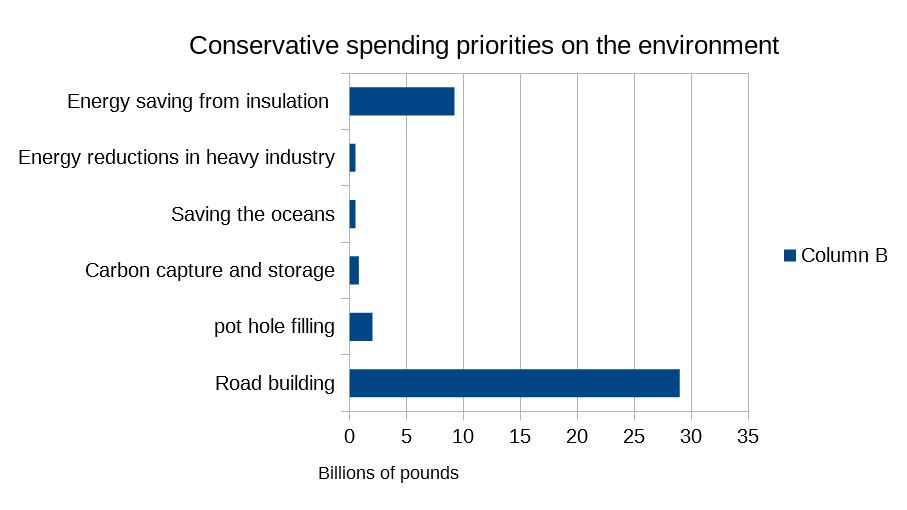
Conservative investment in Environment priorities

Their one relatively substantial commitment is this.

We will help lower energy bills by investing £9.2 billion in the energy efficiency of homes, schools and hospitals.

This is one twenty fifth of what Labour would do and would barely scratch the surface; so, by 2030 we’d still have the overwhelming majority of our homes leaking carbon at a ludicrous rate with people paying the energy companies through the nose for the privilege. Labour would fix that problem in both respects.
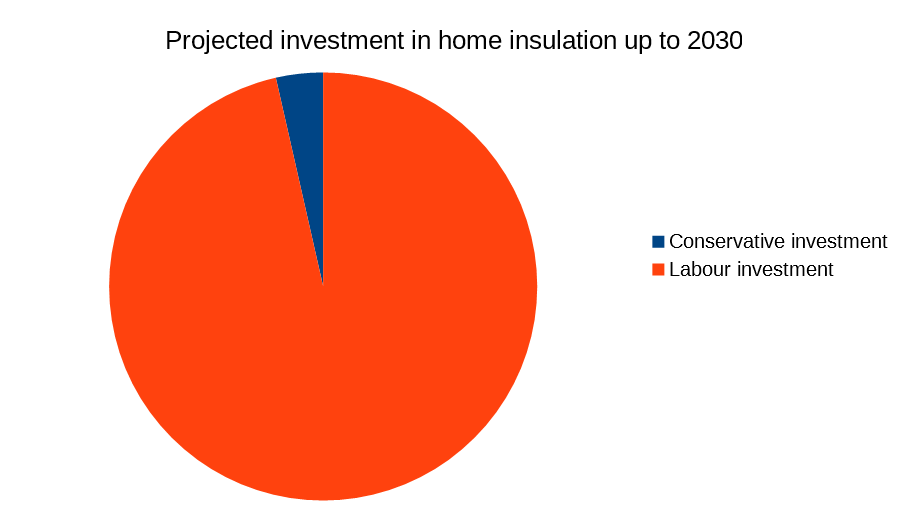
Home insulation investment

This graphic is a suitable illustration of the different scale of Party ambition. What we have with the Conservative manifesto is muddling on with business as usual, kicking the can further down a road that we are about to run out of, a little tweak here, a little tweak there, but nothing that recognises either the scale of the crisis nor the level of urgency with which it has to be tackled because of its deep seated aversion to the necessary state action.

*Alfred Russel Wallace came up with the theory of evolution at the same time as Darwin. In fact, it was a letter from Russel Wallace that persuaded Darwin to publish, out of fear that Russel Wallace would do it first. He lived for a while in Grays in the early 1870s building one of the world’s first concrete houses, later used as a convent (!) and now converted into flats. The grounds of the house included a 16 acre walled arboretum along a steep hill which has been disused and run wild for over a hundred years – a place of mystery and darkness for generations of local children.

*Shakespeare. King Lear.

Climate crisis -The stakes in the UK election.

The key task for the climate change movement in the UK between now and the end of the year is to get rid of Boris Johnson’s government.

Movements like XR argue that they are “above politics” and its quite right to aim to mobilise everyone regardless of existing affiliations or leanings. However this election offers a stark choice that can’t be ducked because the resulting government will either be one that will push ahead with the most ambitious green investment strategy in any developed country, or be one that will be trailing in the wake of Donald Trump’s denialist international.

The movement will either have a government it can work with – or one that it will have to keep mobilising against.

And we don’t have a lot of time.

Boris Johnson himself has not voted for any practical measure to reduce carbon emissions since he has been in parliament. By contrast Jeremy Corbyn and Caroline Lucas have voted for 92% of them. Conservative MPs have on average voted for less than half of these measures; Labour for more than half. The Guardian has a useful graph on this which shows the 50% mark mostly red above and blue below (1). Jo Swinson is on 50% and the Lib Dem record is wildly inconsistent.

Johnson is in an explicit alignment with Donald Trump.

If elected we can be sure that he would move Conservative government rhetoric away from current greenwash into line with his voting record.

The Conservative manifesto is being written by a lobbyist for a fracking company (2).

By contrast Labour’s Green Industrial Revolution pledges the following; and its worth reading all of this. What follows is a lightly updated and edited version of the full document from earlier in the year to take account of conference decisions. If there are significant alterations in the Manifesto I will update this blog accordingly.

ENERGY

 Decarbonise the energy grid by the 2030s. Fracking banned.
 Support the development of tidal lagoons,
 Upgrade and invest in flexible energy networks capable of supporting a transition to decentralised renewable energy
 Remove the barriers to onshore wind put in place by the Conservative government…invest in wind, solar and other renewable projects. Five times as much offshore and three times as much onshore wind.
 Work closely with energy unions to support energy workers and communities through transition

HOUSING
 Upgrade 4 million homes to Energy Performance Certificate (EPC) band C in five years, investing £2.3bn per year to provide financial support for households to insulate their homes, with a zero carbon standard for new-build homes introduced as soon as possible.
 Insulation schemes to be done by local authorities working street to street to save at least £275 per year for affected households, improve the health and well being of families, reduce costs to the NHS and create thousands of new skilled jobs.

 Prioritise affordable homes in the new zero carbon homes programme,  provide funding to support councils and housing associations to build new homes to Passivhaus standards
 Tighten regulation of privately rented homes, blocking poorly insulated homes
from being rented out
 Introduce new legal minimum standards to ensure properties are fit for human habitation and empower tenants to take action if their rented homes are sub-standard

TRANSPORT
 Introduce a new Clean Air Act.
 Expand public transport, bring our railways back into public ownership, cap fares, and support the creation of municipal bus companies run for passengers not profit.

 Expand and electrify the railway network across the whole country, including in Wales and the South West and build Crossrail for the North linked to HS2
 Encourage greater use of public transport, introducing free bus travel for under
25s where local authorities regulate or own local bus services – paid
for with money ring-fenced from Vehicle Excise Duty

INVESTMENT
 Position the UK at the forefront of the development, manufacture and use of ultra-low emission vehicles
 Retrofit thousands of diesel buses in areas with the most severe air quality problems to
Euro 6 standards
 Airport expansion must adhere to our tests  to address, noise levels, air quality and the UK’s climate change obligations.

WATER
 Establish new democratic public water companies which will be mandated by
DEFRA to meet environmental and social objectives

FARMING, FISHING, HABITATS AND WILDLIFE MANAGEMENT
 Funds for farming and fishing to support sustainable practices,
 Embed and enhance in policy the responsibility for farmers to conserve, enhance and create safe habitats for birds, insects and other wild animals, and encourage the growth of wildflowers.

 New guidance to end the use of antibiotics for routine, preventative purposes with farm animals.
 A science innovation fund to promote the most sustainable forms of farming and fishing, with support earmarked for our small-scale fishing fleet
 Review the allocation of UK fishing quota to promote the most sustainable fishing
practices
 Protect habitats and species in the ‘blue belts’ of the seas and oceans surrounding
the United Kingdom and its overseas territories,
 Set targets for plastic bottle deposit schemes,
 Strengthen the Hunting Act, end the badger cull, make illegal hunting and all wildlife crime a reportable offence,
 Initiate a large tree planting programme, working with farmers and foresters to
promote biodiversity and better flood prevention
 End rotational heather burning and launch a review into the economic, environmental and wildlife impacts of grouse shooting
 Ban wild animals in circuses

INTERNATIONAL
 Put the environment and human rights at the heart of our foreign policy,  drive forward new multilateral environmental agreements,  direct our armed forces to devote more resources to tackle humanitarian emergencies
 Negotiate a future relationship with the EU that maintains and extends all environmental rights, standards and protections as a baseline, while introducing more ambitious domestic environmental policy than that guaranteed at the European level
 Develop a cross-government strategy to ensure UN Sustainable Development
Goals are implemented and reported on annually to Parliament
 Commit to supporting climate mitigation and adaptation in the Global South, and to support countries severely affected
 Oppose investor-state dispute systems in international trade and investment agreements, and other trade rules that can be used to undermine domestic or international environmental protections
 Ensure UK aid does not support fossil fuel projects, divesting DFID away from fossil
fuels towards renewable energy sources
 Promote UK Export Finance support for the energy sector towards low-carbon projects
in place of its overwhelming support for fossil fuel projects in previous years

This programme cannot be left to government ministers to get on with. Its not a matter of voting for it and sitting back. It will only happen if the whole movement engages with it and mobilises support for it and works on its implementation at every level and through every lever available to us.

Decolonising History in the Anthropocene – a proposal

“He (sic) who controls the past controls the future. He who controls the present controls the past.” George Orwell (1984)

In a civilisation facing an emerging climate catastrophe that its education system is ill equipped to cope with – we face the difficulty of having to imagine a future within a mental framework dictated by the limits of the society that is creating the crisis – and by people in charge who seem content to run on with business as usual until its too late. The way we teach and learn History is currently part of the problem and needs to be part of the solution. Those who control the present want to lock us into a narrative about the past that suits them; and prevent us imagining any future that does not.

The limits of a “national” framework”.

History is usually taught within a national framework – and therefore looks at the world in a distorted way. The way that each significant country prints maps that show it at the centre is a similar distortion in Geography. US maps split Eurasia in half to show the Americas as middle Earth, European maps centre on the Greenwich Meridian, Chinese maps centre on the Pacific and East Asian region – where most of the world actually lives to be fair. In these, the Americas are a fringe continent on the right and Europe tucked away and barely noticeable in the top left corner, while Britain is barely visible as a little blur of islands almost beyond Ultima Thule and of no significance whatsoever. Seeing one for the first time comes as a shock when you are used to seeing it smack in the middle.

So it is with the national framework for History. The use of History as “the national narrative” (“Our Island Story”) tends to be promoted by the centre right – as “national epic” by the far right. But, even without this being that explicit, looking at the world through the lens of a particular nation – which means through the views of the people who run it – is as disorienting as mapping the world in your head by absorbing Mercator’s projection. When I was in First Year Juniors in 1961, we had a huge world map on the wall – lots of it still coloured in pink – and – being a day dreamy sort of child – I spent a lot of time looking at it – the shapes, the colours, the relative sizes. Many years later, as an adult, I found it almost impossible to accept the reality that Brazil has a larger land area than the United States; because the map in my head was Mercator’s and – on his map – it doesn’t.

The purpose of nationally framed History is to create a shared mental space, a common imaginary identity built around a self image of a “people” with certain fundamental characteristics in common (which comer-inners have to integrate into) and a presumption of allegiance to time hallowed institutions and ways of doing things. This is the way “we” do it. The stories that are told may or may not be true. The way they are framed frequently owes more to myth than truth. The Washington Post ran a story last year about the way British History is perceived in Britain and the way it is perceived in the rest of the world. In Britain, people thought that the most significant and archetypal experience in British History was World War 2.  In the rest of the world, without exception, the most significant and archetypal experience in British History was seen as the British Empire. I suspect that the rest of the world – a large part of which was on the receiving end of it – has us bang to rights on that.

Eric Hobsbawm remarked (in Fractured Times) that no one knew how to teach History in Vienna in the 1920s. The old text books glorifying the Austro- Hungarian Empire were still in the schools, but the seemingly eternal Habsburg Emperors were no longer holding sway from the Hofburg, and the Empire had shattered, under the crushing pressure of World War, into disparate components run by nationalists with smaller, fiercer stories told in a vernacular closer to home. Some Austrians were soon to find their own version of this, but in the meantime, the History text books were glorifying a ghost.

At the time of America’s “unipolar moment” in the early 90’s – declared to be the “end of History” by Francis Fukuyama – there was a globalising version of this, with all previous human societies and social orders as preparations for the American way of life; now posed as a norm for the rest of the world to match up to; rather than the extraordinarily hollow, wasteful and precarious existence we know it to be. Rather like the way Hegel – teaching as he was in Berlin – interpreted the whole of human History – and the ultimate working out of the Weltgeist – as leading inexorably and benevolently towards its perfect incarnation in the Prussian state of the 1830s. Both these flatten out a key point about History – that human societies have been very diverse and there is no one model for them. They have changed. The present is unlike the past in many respects and the future need not be like it either.

None of these frameworks are of any use at all in understanding how humanity got to the current crunch and, if what we understand of history is to be anything other than stories we console ourselves with – or use to blame others – as the planet burns, it needs to be.

An Environmental Framework

We need a framework for History that looks at forms of human society in relation to their environment. All human societies have a definite mode of surviving that is defined by – and transforms – the environment in which they develop and lead to characteristic social relations, political and religious forms which define the character of conflicts and struggles within them.

What follows is a draft and meant to stimulate discussion and development. There is no attempt to look at pedagogy, nor what to teach when; more an attempt to sketch an initial brainstorm of what kind of understanding we need. There are huge gaps reflecting the limits of my own learning. This is not a chronological list. The list of examples at the end of each section is just that – not an attempt to be exhaustive nor to suggest that each of them has to be studied. References: Guns Germs and Steel Jared Diamond. What happened in history. V.Gordon Child.

Hunter gatherer (paleolithic) leading to Early Farming (neolithic)

Emergence of human species. 95% human existence has been as hunter gatherers.

Humans as social animals. Speech. Tools. Art. Polytheism. Matriarchy or patriarchy or both?

Currently existing hunter gatherer societies in rain forests.

Impact on environment. Extinction of mega fauna in the Americas and New Zealand after human arrival.

Farming emerging from and generating denser populations. Why did this happen in some places and not others?

Which plants could be grown and stored in sufficient amounts to be viable for farming and where were they?

Which animals can be domesticated and where were they? Diets and disease.

River based early local Empires (Bronze Age Eurasia – advanced stone age Americas)

Common features. A big river and/or irrigation. Ships for bulk transport. In Eurasia wheeled transport – carts and chariots. Bronze tools and weapons. Storage for surplus food. Armies. Specialisation of trades. Ploughs. Animal power – horse, buffaloes, camels, Llamas (in South America). Writing, keeping accounts, partial literacy. Monarchical theocracy with partially animal based gods. Priesthoods beginning to investigate the stars and develop mathematics. Oral story telling in poetic form. The first written stories and Holy Books. Monumental building. Life bound up with natural cycles and vulnerable to them (the years of the lean cow). The spread of the local empire dependent on the limits of horse power and the extent of controllable space.

The Maya as a study of a society hitting ecological limits? How did the Inca Empire get so big?

Possible examples. Mesopotamia, Indus Valley, Egypt, Shang Dynasty China, Maya, Inca,

Large Empires (Iron Age – medieval)

As above but more so. Iron tools and weapons. Water power. Roads. Emergence of more human like gods and development of monotheism in Rome and Arabia.

Monotheism as a cultural/moral/legal framework allowing expanded trade in medieval Christendom and Caliphates. Heresies and schisms.

Slavery and economic implosion (Rome). The impact of (natural) climate changes on agriculture after the “Roman optimum”. The impact of drought on nomadic movements.

Vulnerability to disease and climate shifts (effect of volcanic winter in 530’s and subsequent plague in Byzantium and elsewhere).

Early Chinese industrialisation – what stopped it taking off?

Rome. China. Caliphates. Khanates.

First Globalisation

Oceanic exploration – Ocean going ships from China and Europe. Why did China stop? Global trade, gunpowder, plantations, slavery and slave trade, racism, pandemic genocide of native Americans.

The “little ice age”. Why did it happen?

Industrialization

Surplus capital from above – Steam power. Machines. Mines. Factories. Mass production. Canals to railways. Mass transit. Mass migration. From sail to steam. From flintlocks to rifles. From wood to steel. From villages to cities. Massive rise in population.

Unevenness of development. World Empires, world wars 1740’s – 1815. Science turned to production, the production of science. Increased scientific exploration of everything. Mass education. Mass entertainment. Mass politics. Mass struggles. Gas power, electricity, chemicals, oil, motor vehicles.

Rise and fall of Pax Britannica. Sea based global power.

Carve up of Africa – colonial genocides and famines – resistance to and within Empires.

Empires turn on each other – WW1 and WW2. Revolutions and civil wars – Russia, China.

Cycles of growth and collapse. Great depression. Fascism. Holocaust. Dust bowl.

The Anthropocene

When did it start?

Atomic power and nuclear bombs.

The American Century? Rise and decline of the Pax Americana. Air based global power.

Decolonisation and neo colonialism. Cold wars up to 1989. Hot wars since. The collapse of the USSR and the rise of China.

“Green ” revolution and land degradation. Patenting nature. Industrialised agriculture and factory farming. 6th mass extinction.

“Just in time” patterns of global trade. Containerisation and the shift away from manufacturing in developed countries.

Space – the final frontier?

Climate change awareness. What is happening? Who is responsible? Who is already paying the price? Contemporary movements for change.

Living in the End Times?

The Daily Telegraph used to be a reassuring newspaper in its way. I once had a mind numbingly mechanical job on the night shift in a chocolate factory; and one of the ways to keep awake was to read the Telegraph every night to keep my blood pressure up out of indignation.

Though the Peter Simple column – with its fabulously nostalgic stock cast of grim booted, iron chained Northern Aldermen, and disclaimers of annexationist demands on the letters page – is long gone; the letters page itself is still full of carefully crafted missives from retired Commodores living in Surrey with double barreled names and strong views  – not blustery as they were in the immediate fallout from Empire, but quietly, thoughtfully defensive of an order that is setting us up for a fall out that will prove far greater – if we don’t stop it.

Alongside these are increasingly shrill columnists painting that fall out as an inevitability, not a matter of choice. One – Sherelle Jacobs -writing about Brexit (of course) – argued recently that “as the world turns Medieval” we are facing “a new global dark age” in which the only way forward is a renewed nationalism. British of course, not Scottish, Irish or Welsh.

There are limits old chap.

She recognises that the crisis of the world economic order is a crisis of the dominance of the United States but – in the age of “America First” manages to recast an abject subordination of the UK to the falling American star – by leaving the EU and integrating ever more closely with the US economic model

  • as careless of the environment as it is of its workers
  • with its horrendous health care,
  • convoluted and gerrymandered politics and brutal racist prison system,
  • alongside even closer subordination of military and intelligence
  • and abandoning any pretence to an independent foreign policy

as a buccaneering piece of national self assertion. Boris Johnson and Nigel Farage are trying to pull the same stunt. We will see in the next couple of months how far – and how long – people can be fooled by this. And what the fall out is if they get away with it on October 31st and the roller coaster ride begins in earnest.

She also manages to ignore the genuine threat of a new dark age as a result of social breakdown resulting form the degradation of the climate conditions that make it possible for us to – among other things – grow food. The Syrian drought between 2006 and 2011 that drove 2 – 3 million people off land they could no longer live on into cities that could not cope with them leading straight into civil war and everything else that has followed is – among many other recent events – a stark warning.

One of the most disturbing pieces in This is not a Drill – the Extinction Rebellion Handbook* is Douglas Rushkoff’s account of being paid a huge sum (half his annual professor’s salary) to brief five super wealthy hedge fund bosses about “the future of technology”.

It turned out that what they were most concerned about was how to escape the impact of climate breakdown as individuals. They were not in denial about it. They know it is happening. They are not concerned about how to use their wealth to try to avert or mitigate it. They are like passengers in first class on the Titanic less concerned about avoiding the iceberg than looking for lifeboats just for them.

They wanted to know whether Alaska or New Zealand would be less affected by climate change, and which would provide a better bolt hole. One admitted that he had already nearly completed building an underground bunker complex to move into when society breaks down, and wanted to know “How do I maintain authority over my security force after the event?” Money, of course, would have no value.

  • How could they stop the armed guards just bumping them off and taking over?
  • How could they make sure they could control a supply of food – with locks to which only they knew the combination?
  • Could they make the guards wear control collars?
  • Could they use robot guards instead?
  • Could the technology could be developed in time?

The future as zombie apocalypse movie, with most of the rest of us as the zombies.

These people are not isolated individuals. Steve Bannon, who acts as a guru for the whole international alt right, commented while he was an adviser to Donald Trump – “Half the world is going to burn and there’s nothing anyone can do about it.”

Actually there’s plenty we could do. We are already (globally) doing about a quarter of what we need to. We just need to step up the pace and work together to do it. But to do so we need to change the economic and political systems that give people like those hedge fund managers the power and wealth that they have. This is becoming a matter of life or death.

Bannon’s answer to this is to try to build walls around the world’s wealthier countries so the burning takes place elsewhere – as it has already began to do. A necessary part of this is the dehumanisation of anyone who lives in the “shithole countries” (D. Trump) that are going to burn; so the citizens of the US can watch them do so with equanimity. If that means describing desperate refugees fleeing social breakdown as criminals and terrorists, interning them indefinitely, separating children from parents, depriving them of the most basic care and amenities (bedding, toothpaste, soap) – or, in the European case – letting thousands of them drown in the Mediterranean, then so be it.

This was put in a more anodyne form by Wells Griffith, Trump’s energy and climate adviser, who said this at the Katowice summit in November 2018. “We strongly believe that no country should have to sacrifice their economic prosperity or energy security in pursuit of environmental sustainability.” This extraordinary sentence recognises that the current engines of “economic prosperity” and “energy security” in the United States are not environmentally sustainable – and are undermining the conditions for human survival – but strongly believes that that this can be ignored until everything collapses.

This is in the context of the current challenge to the Pax Americana posed by the rise of China. Sherrelle Jacobs argues that China is a “stillborn superpower” due an economic collapse. People in the West have been saying that for twenty years, not grasping that a country dominated by state led investment does not operate on the same lines as those for which the imperatives of private sector dominance trump other considerations.

Whatever critique people may wish to make of China, the current trade war

  • in which the US is doubling down on fossil fuels while China is investing massively in renewable energy generation,
  • Donald Trump prohibits mention of Climate Change in US government publications and sabotages scientific research into it, while Xi Xinping is talking about building an “ecological society”,
  • the US is planning to withdraw from the Paris Agreement and stands against international co-operation, while the Chinese favour “win win” solutions and are set to achieve their 2030 targets between 5 and 9 years early

is a dramatic illustration that there is more than one engine of prosperity and energy security. The dominant western global elite are sticking with the wrong one because they can do no other – they would cease to be an elite if they were to embrace state led investment as a way forward. Even as they are staring at total panic and terrible consequences for the majority of humanity in the medium term.

The popularity of evangelical rapture Christianity among these people – in which we are living in the “end times” waiting for the second coming and sudden miraculous escape from all our problems to those who believe hard enough –  and the increasingly delirious and irrational mode of political debate has its roots in the same fears.

This is a cry of despair from a class that can no longer claim to represent humanity as a whole – in the way they have tried to do since 1789. Every day that passes produces more evidence like this that the people who rule us are unfit to do so.

Variations on this theme are fantasies of living “off world” in space stations or – even – Mars – though Antarctica is a more benign environment -with Elon Musk’s electric car in space as a symbolic gesture in this direction. If it weren’t for the resources required to get them there it would be tempting just to let them go – in an inverted version of Ursula Le Guin’s novel “The Dispossessed” – in which a political conflict was resolved by exiling all the anarchists to the nearest moon.

*Just published by Penguin. Essential reading, but don’t order it on Amazon; ask your local library to stock it instead.