Ursula Von der Liar

When Ursula Von der Leyen sealed the EU’s abject capitulation to Donald Trump, adding to the Euro NATO pledge for 5% of GDP to be spent on “defence” by the end of the decade and doing a “deal” for a lower tariff than Trump had originally threatened with no reciprocal obligations on the part of the US; she copper bottomed it with a pledge to import $750 billion worth of US fossil fuels in coming years.

This is a core part of Trump’s attempt to dig in on the fuels of the past – he has to bully his subordinate allies into buying the stuff, even if its not in their economic interests to do so; and they will struggle to find a use for it. As long as they cough up, that’s not his concern.

Von der Leyen, in the process, seems to have caught Trump’s habit of telling giant lies with breezy self confidence. She repeated her comment from December last year that US LNG is cheaper than Russian natural gas. “We still get a lot of LNG (liquefied natural gas) through Russia, from Russia. Why not replace it with U.S. gas, which is cheaper for us and reduces our gas prices?” she said at the time.

This is not simply untrue, it is the OPPOSITE of the truth. Ask any German consumer or business. At the end of last year Germans were paying 74% more per unit of gas than they were before the sanctions imposed on Russia and the blowing up of the Nordstream pipeline.

Possibly more disturbing than the lying, is the way that these comments are reported without being debunked, as are Trump’s continuous assertions that wind is “the most expensive form of energy”, when it is one of the cheapest, which is why it is growing so fast.

We should also note that US LNG has a carbon footprint 33% worse than coal.

Dancing in the Haunted Darkness – Moments of Reprieve

When I was an over serious teenager in the early 1970s, making myself very unpopular by putting a CND poster showing a mushroom cloud erupting out of a skull in a 6th Form Common Room full of people who just wanted to listen to Led Zeppelin and have a good time, I developed a philosophy of life that decreed that, in the face of global hunger, the threat of nuclear war and the destruction of the natural world it was immoral to enjoy it.

At the time, this was described as a “denial of life” by some of my closest friends and partners. But it seemed to me that a sense of guilt was a motivator, that the resolution of inhuman acts was a precondition for any happiness that could be justified; without reflecting that moments of joy don’t have to be justified; and a capacity to carry on wouldn’t be possible without them.

I expect I am not alone in getting vicarious imaginary montages, seeing horrific scenes from the news projected onto everyday landscapes. The first time J and I went into central London after the IDF started its mass bombing campaign in Gaza, we talked about how fragile the buildings in Leicester Square now seemed, how easily they could be shattered. Going to Basildon Hospital for my Mum’s most recent appointment we passed the three tower blocks that mark the northern edge of Chadwell and dominate the surrounding countryside, and I couldn’t help thinking that in Ukraine they would be a heavily shelled command post, a fortress in a waste land. While the hospital, so calm, friendly and orderly, humming along so functionally with its shops and cafe and pharmacy, would be a smoking hulk with desperate hungry staff trying to treat patients in the ruins with no anaesthetic, little or no medicine and no beds were it in Gaza. These are virtual, vicarious flash backs, not part of lived experience with no smells, little sound, just images, like a ghostly son et lumiere in the mind, but becoming an everyday part of psychic life.

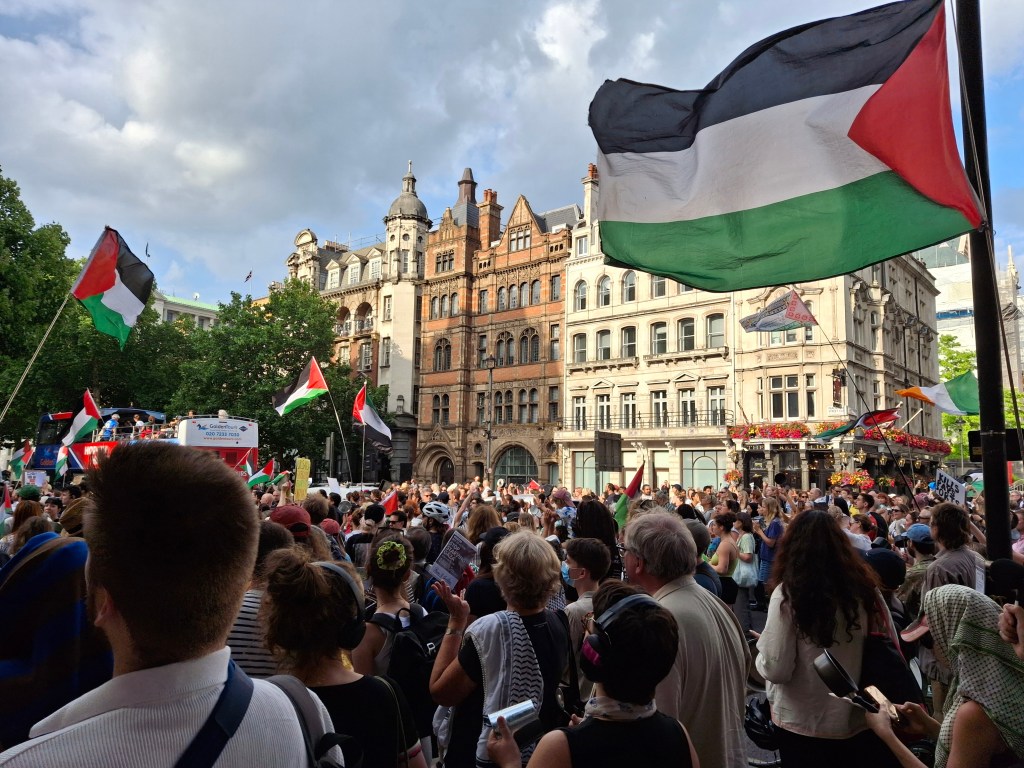
In this context, when S and I were an hour early to the pots and pans protest for Gaza outside Downing Street last night, we took our sandwiches and sat under the shade of the plane trees in St James Park to catch a breath. We watched the geese and herons, moor hens and ducks like we had when she was little; the children eating ice creams in the sunlight.

On one level, given what we were there for, it seemed almost obscene to be enjoying this, the peace of it; even eating while 2 million people are being deliberately starved, but on another level it was an act of defiance. Finding moments of peace, moments of joy, moments of human kindness or wonder is a reprieve when under unendurable attack. When not under such attack, but aware of it, it becomes almost a duty to experience as much of our humanity as we can in the face of such strenuous efforts to degrade and dehumanise.

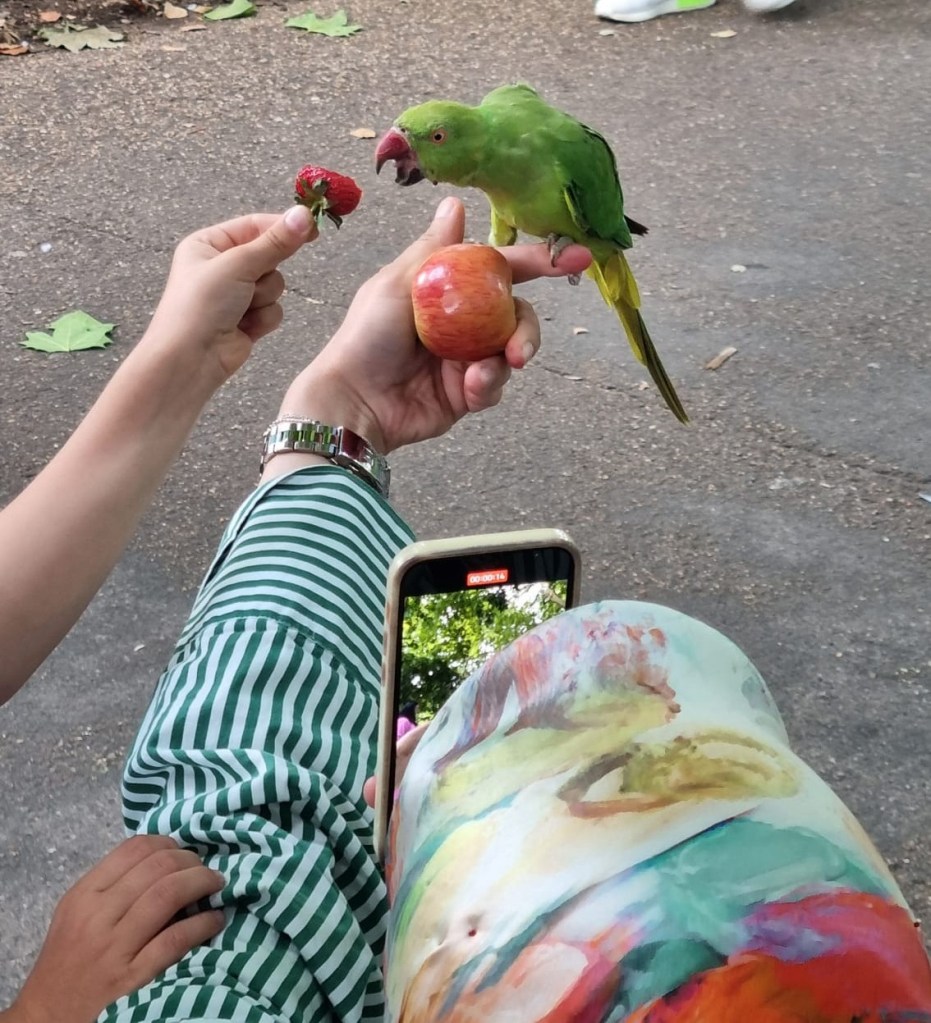
On the way out of the park we came across a Mum in a bright hijab and her daughter feeding a parakeet with an apple and half a strawberry. Parakeets are always exhilarating. This one kept fluttering down from rustling about in the tree above with the rest of its loudly chattering squadron, stretching out its neck and its bright red beak, then flinching back as it got too close. The little girls eyes were wide and bright with wonder.

In Moments of Reprieve, Primo Levi is making an argument for finding any human salvage you can in the most inhumne possible conditions, writing a set of short stories as an elegy to prisoners in Auschwitz, who through tiny affirmations of their humanity – a juggling trick, finding a slice of apple – discover ‘bizarre, marginal moments of reprieve’ amidst the horror.

In a discussion of the finale of Beethoven’s 7th Symphony on Radio 3 this morning, Tom Service argued that the ending of the movement is “off the wall”, because Beethoven has the double basses at the bottom of the register accompanied by the rest of the strings in a grinding and remorseless grim cycle of a theme in a lower key than the rest of the orchestra, which is hurtling around in a whirlwind of a joyful dance that ends in a blazing triumph; and the one is the condition for the other.

The conductor Charles Hazelwood, who was abused as a child, has said that “when I conduct Beethoven I feel the abuse in every bar”, because Beethoven’s Dad punched lumps out of him as a child, and as a result “It’s horribly uncomfortable for me to work with, right until the final performance which is always pure ecstasy”. Even when that mournful, somewhat depressive teenager, Beethoven always did that for me too, because his music absorbs the horror and misery and is driven by it to triumph over it.

As we must now.

The Power of Percussion

At the pots and pans protest at our government’s complicity in the attempted starvation of 2 million Gaza Palestinians in Whitehall this evening, I was attempting to beat out the rhythm of the Nibelungs in Wagner’s Rheingold – old moles hammering away in their mines – with a saucepan and wooden spoon. This was an effort to create an air of collective subteranean proletarian menace. Needless to say, loud though it was, it did not catch on.

The cacophony of thousands beating pans with spoons nevertheless settled into a series of steady rhythms, sometimes echoing chants, sometimes settling into that most basic one, two, one two that is like marching feet and a heartbeat at the same time.

A kippah and a Keffiyah side by side against genocide.

The power of the percussion made me think of the scene in the Tin Drum in which Oscar subverts a Nazi Rally by beating a different rhythm under the grandstand, throwing the Nazi band off its stroke so its loses its bombastic march and only recovers by finding a waltz rhythm, leading the rally to dissolve as the rigid ranks melt into whirling dancers. A scene that shows the potential of people and nations to shift, affirm hope and life and fluidity over rigidity, conformity and racist militarism; and affirming that though Germany produced Hitler and Himmler and Heydrich, it also produced Beethoven and Schiller and Schubert.

In a way, when the Left is campaigning properly, it is attempting to do what Oscar does in this scene.

On the train on the way home there was that announcement; “if you see anything that doesn’t look right”…I see an awful lot of things, on the News mostly, but reporting them to the British Transport Police wouldn’t do a lot of good, sadly.

I don’t think they had many takers.

Russia’s “Maximalist demands”? Three questions for supporters of the Ukraine Solidarity Campaign.

In his February article, Ukraine’s defeat and the fall of the West, Owen Jones argued that “if we were always going to end up at a point where Russia was going to take land, and Western leaders thought that, but claimed otherwise and made promises to Ukraine to keep the war going to achieving what they believed to be unachievable – well, what that means in terms of countless wasted lives is truly hideous“; noting that this has been in pursuit of what the Washington Post described as “a sensible, cold-blooded strategy for the United States — to attrit an adversary at low cost to America, while Ukraine was paying the butcher’s bill”.

We are now getting to that point.

The way the war ends, or is spun out, is of enormous consequence to whether Europe will remain locked in an escalatory spiral towards the fever dream of a further, wider, deeper – and suicidal – pan European war that infects the minds of General Staffs and newspaper editorial boards; or whether there is an attempt to find a sustainable modus vivendi with Russia that enables de escalation, avoids mutually assured destruction and dislocates Europe from the US imperative to shore up its slipping global dominance with ever more adventurist wars.

The media here reflexively dismisses Russia’s bottom lines for ending the war as “maximalist”; by definition unreasonable, to be dismissed with no further thought or examination. This is of a piece with their usual tactic of obscuring reality with adjectival clouds of emotive association, so it is vital for even those sections of the Left that have cheered on the war, and are still doing it even as a majority of Ukrianians want peace, to get beyond the emotional red mists and look seriously at what the Russians are actually proposing.

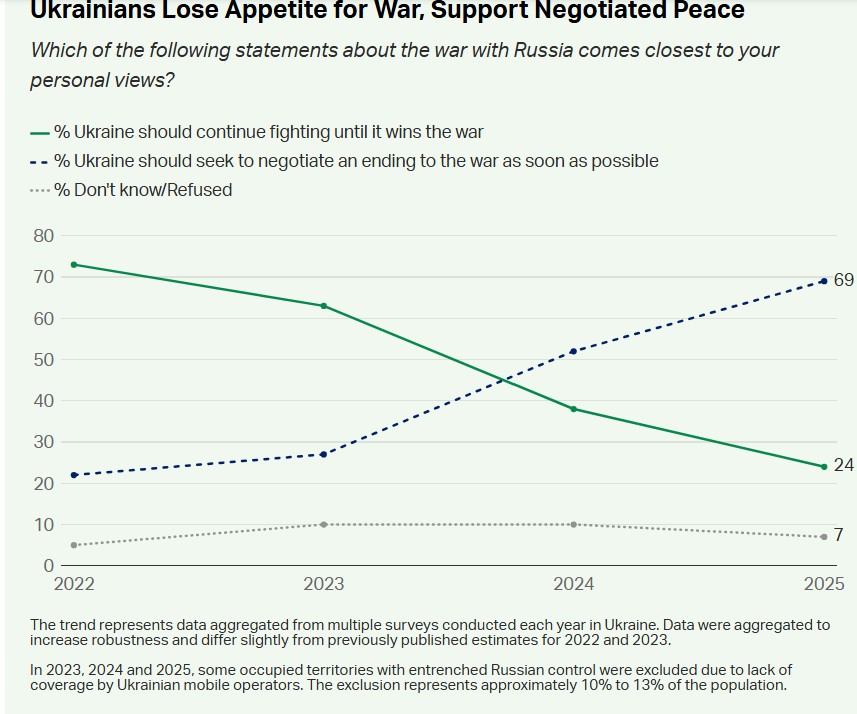
A majority of Ukrainains want peace.

These are the key points from the published text of the draft “Treaty between the United States of America and the Russian Federation on Security Guarantees” that Russia presented to Biden in December 2021; and which the US/NATO dismissed out of hand and refused to discuss.

  1. No further NATO expansion
  • The US would commit to preventing further enlargement of NATO, specifically barring Ukraine and other former Soviet republics from joining the alliance.
  • This also included a ban on NATO military activity in Ukraine, Eastern Europe, the Caucasus, and Central Asia.

2. No Deployment of US Forces or Weapons in Certain Countries

  • The treaty would forbid the US from deploying military forces or weaponry in countries that joined NATO after May 1997 (such as Poland, the Baltic states, Romania, and others).
  • NATO infrastructure would have to be rolled back to pre-1997 locations.

3 Ban on Intermediate-Range Missiles

  • Both Russia and the US would be prohibited from deploying ground-launched intermediate-range and shorter-range missiles outside their national territories, as well as in areas of their own territory where such missiles could strike the other’s territory.

4 Limit Military Maneuvers and Activities

  • Limits on heavy bombers and surface warship deployments: Both sides would restrict the operation of heavy bombers and warships in areas from which they could strike targets on the other’s territory. (Note: In September 2020, Trump’s DOD authorized a B-52 to fly along the Ukrainian coast in the Black Sea.)

5 Nuclear Weapons Restrictions

  • All nuclear weapons would be confined to each country’s own national territory. Neither side could deploy nuclear weapons outside its borders. (Note: US just sent a batch of nukes to England.)
  • Withdrawal of all US nuclear weapons from Europe and elimination of existing infrastructure for their deployment abroad.

6 Mutual Security Pledge

  • Each side would agree not to take any security measures that could undermine the core security interests of the other party.

7. Establishment of Consultation Mechanisms

  • Proposals included the renewal or strengthening of direct consultation mechanisms, such as the NATO–Russia Council and the establishment of a crisis hotline.

8 Indivisibility of Security Principle

  • Included a reaffirmation that the security of one state cannot come at the expense of the security of another, formalising Russia’s interpretation of the “indivisible security” concept.

The three questions that supporters of the Ukraine Solidarity Campaign should ask themselves is,

  • which of of these proposals do you disagree with?
  • Would an agreement on these lines be a viable way to end the war?
  • Would an agreement on these lines have avoided it in the first place?

Gaza – the Holocaust and the Bengal famine.

“Dead or dying children in a Calcutta Street. Photograph published by the Statesman, Calcutta, on August 22nd, 1943.”, Public Domain

Even right wing newspapers now have front pages showing Palestinian children who look just like these with headlines like “For Pity’s sake stop this” (Daily Express 23/7/25) without saying how. The limitations of the Excpress approach are well explored here.

The latest UN Report states

  • Gaza’s one million children continue to bear the brunt of continued bombardment, deprivation of access to life’s essentials, including food, water and adequate health care, and exposure to traumatic events. In a briefing to the UN Security Council on 16 July, Catherine Russell, Executive Director of the United Nations Children’s Fund (UNICEF), stated that more than 17,000 children have reportedly been killed and 33,000 injured in Gaza over 21 months, which is the equivalent of a classroom of 28 children killed in Gaza on average each day. (My emphasis)

Starvation is already the common lived experience of everyone in Gaza.

Genocide by industrialised intent.

In the 1940s, the Nazi’s industrialised the mass extermination of people, mostly Jews, that they considered “untermensch”, lesser humans. Around 6 million were killed, initially by being shot by Einsatzgruppen, marching them out into the woods (see Ordinary Men by Christopher Browning) then by mass gassing, starvation and being worked to death in the extermination camps. No one kept exact records, but the scale and horror of it is in no doubt.

Genocide by neglect.

In the same decade, around 3 million colonial subjects of the British Raj in Bengal starved to death in the Bengal famine. Again, no one kept exact records, and estimates vary from just under a million to just under 4 million, but the scale and horror of it is in no doubt.

It is, however, much less well known. They died “from starvation, malaria and other diseases aggravated by malnutrition, population displacement, unsanitary conditions, poor British wartime policies and lack of health care.” What Wikipedia describes as “poor British wartime policies” covers limiting food aid overall, on the argument that this was needed for the war effort, and manipulation of what food aid there was to communities that were considered politically loyal. This was a material factor in exacerbating communal tensions that were later to explode at partition.

This was not an aberation in British India. It took independence to end famines. See Mike Davies, Late Victorian holocausts.

Genocide by deliberate deprivation.

Without food, people can survive for just over two months before they starve to death. In 1981, the longest lasting IRA Hunger Striker, Kieren Doherty, survived for 73 days, the shortest, Martin Hurson, died after just 46. Most died after 60, 61 or 62 days. Two months. And these were fit young men who were able to drink clean water.

Without food, the entire population of Gaza is a risk of starving to death by the end of the summer. 43 have died in the last three days, and this is accelerating.

The deliberate, calculated, performative cruelty of the GHF “aid” operation will slow the pace of this a little, spin out the suffering, but also aims to destroy community. As Alex de Waal of the World Peace Foundation puts it, “You can’t approach starvation as a biological phenomenon experienced by individuals, but it is also a collective social experience. Very often that societal element – the trauma, the shame, the loss of dignity, the violation of taboos, the breaking of social bonds – is more significant in the memory of survivors than the individual biological experience. All these traumas are why the Irish took almost 150 years before they could memorialise what they experienced in the 1840s. Those who inflict starvation are aware of this.”

So are we. This cannot be allowed. Demonstrate on Friday. Let’s break our government’s complicity in it. The six demands of the Bogota Declaration are a good basis for getting beyond David Lammy’s stance of wringing his hands while passing the ammunition.

Local actions so far

Thursday, 24 July

Hastings: Murial Matters House, TN34 3UY, 6pm

Friday, 25 July

Abergavenny: St. John’s Square, 6pm

Birmingham: Barclays Bank, 79-84 High Street, B4 7TE, 5pm

Cambridge: Addenbrooke’s Roundabout, 6pm

Cardiff: UK Government Building, Central Square, CF10 1EP, 6pm

Coventry: Foleshill Road/Ring Road roundabout (near Eden School), CV1 4FS, 4.30pm

Exeter: Bedford Square, High Street, 6pm

Leeds: City Square, LS1 2ES, 6pm

Liverpool: Lime Street Station, 5.30pm

London – Hackney: Hackney Town Hall, 6pm

London – Ilford: Wes Streeting’s office, 12a High View Parade, Woodford Ave., IG4 5EP, 6pm

London – Newham: Stratford Station, 6pm

Milton Keynes: Milton Keynes Central Station, 302 Eldergate, MK9 1LA, 6pm

Newport: Jessica Morden’s office, Clarence House, NP19 7AA, 6.30pm

Oxford: Carfax Tower, Queen Street, OX1 1ET, 6pm

Portsmouth: Constituency Office, 72 Albert Road, Southsea, PO5 2SL, 6pm

Reading: Central Railway Station, RG1 1LZ, 6pm

Sheffield: Sheffield Train Station, Sheaf St., 5pm

Slough: Aldi, Farnham Road, SL1 4BX, 6pm

Worcester: Cathedral Square, WR1 2QE, 6pm

Saturday, 26 July

Brighton: Churchill Square, 12pm

Carlisle: Barclays, 33 English St, CA3 8JX, 1pm

Slough: Meet outside Empire Cinema, SL1 1DD, 11.30am; 12noon departure for march

Epping ‘eck!

True to form, the BBC reported the far Right riot in Epping last week, in which they attacked a peaceful anti racist demonstration while seeking to force the closure of an Asylum seekers hotel, on the same lines as the riots last year which tried to burn them down, as a “two sides” issue, even though their pictures clearly showed the far Right mob throwing bricks and bottles at a group of Stand Up to Racism people who were simply holding placards.

The disconnect between the words and images could not have been clearer..

Nick the Pope! “Fundamental British Values” in action

On reading about the case in which armed police in Canterbury threatened a woman with arrest under the Terrorism Act for holding a Palestinian flag and holding signs saying “Free Gaza” and “Israel is committing genocide” – because her placard might be “reasonably interpreted” as expressing an “opinion or belief that is supportive of a proscribed organisation” and that “mentioning freedom of Gaza, Israel, genocide, all of that all comes under proscribed groups, which are terror groups that have been dictated by the government,” and that the phrase “Free Gaza” is “supportive of Palestine Action” – my daughter said “be careful what you write on your Blog Dad.”

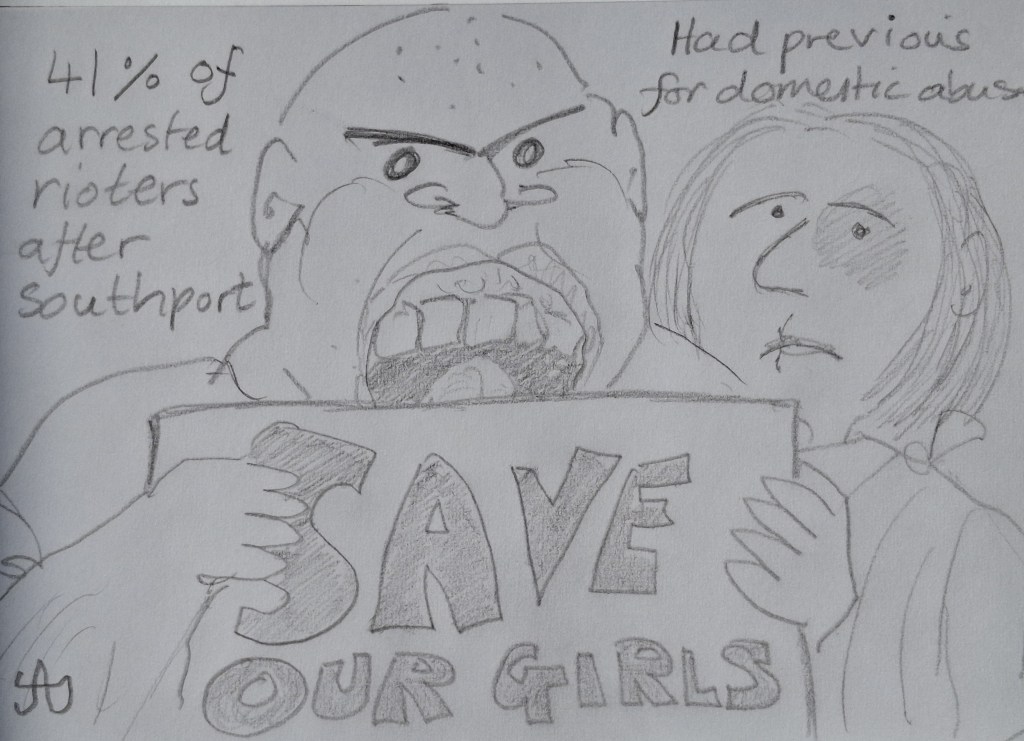
Seeing that the Pope has just called for an end end to the barbarity in Gaza, I thought I’d draw something instead.

The question in all of this is whether this kind of insane over reach is an unintentional consequence of panic in the Home Office, faced with a mass movement that keeps on coming, keeps saying “we see you” and exposes a core ally as a genocidal state, and therefore puts into question the nature of our own state; or it is a deliberate attempt to freeze and intimidate that movement, while retaining plausible deniability. Was the armed Plod who threatened arrest just dimly applying his own limited understanding of the situation and relying on his tried and tested repressive instincts, or was he kite flying under instruction? Lets see how far we can get away with this?

Either way, it is backfiring. “Democracy” let us not forget, is supposed to be a “Fundamental British Value”. And, as the policeman put it so well, “the government has dictated that”.

Kaiser Franz solves a problem.

Emperor Franz Josef V, sighed, pulled on his weaved mutton chop whiskers – now Imperial regalia – and twisted the dial on his wireless to shift the channel from Das Lichtprogramm – playing its usual diet of whirling Waltzes by Johan Strauss the very, very, very much younger, as if to prove that music, like History, had nowhere to go but interminable circles – over to Der Heimat- Service for the latest reports from Today in Parliament.

There was something oddly comforting about these reports. Like all the Sturm and Drang of the Shipping Forecast: all those rising squalls and Force Ten Gales, that menacing low visibility in Sea areas with comfortingly obscure and poetic names – Varangian, Black, Dogged, Austrian Bight, Trieste, Italian Sea, Palermo automatic lighthouse weather station – full of sound and fury and signifying nothing, to him, more than how much more comfortable it was to be sitting by the fire with a cup of tea and a crumpet.

Reports from the Diet were always incomprehensible. All the way across the Greater Austro-Hungarian – Balkan Empire, from Bavaria in the West to the Caspian Sea in the East and Naples in the South, members of the diet were allowed to make speeches in their own languages; on the proviso that no translations were allowed. This meant that members could sound off in full fury, to be approvingly written up in the local papers at home, blaming everyone else for local problems, securing their continuous re election as local champions – safe in the knowledge that no one else in the Empire, unless they understood Slovak, or Azeri, or Sicilian dialect, would have a clue what they were saying, so everyone could remain friends. All the broadcasts were also in the original languages, so everyone could tune into their own bit and be reassured that their worries were being expressed, if not heard. Thus, peace and harmony could be assured, as a grievance carefully nurtured, with no hope of resolution, is a soothing balm for everyone who enjoys suffering from it and being able to complain about it. If these problems were to be resolved, people would be lost. They wouldn’t know who they were any more.

Kaiser Franz scratched idly at his paunch, feeling a bit sleepy, when the newsflash he had been waiting for came up right on time. A solemn burst of Bruckner – titanic, overwhelming, monumental and oddly static, like the Empire itself – was followed by an announcer sounding even more po faced than usual. The troublesome, playboy heir apparent, Archduke Ferdy, had met with an unfortunate accident while trying to act out the bow flight scene from Titanic on the 3:30 Zeppelin from Zagreb to Odesa while drunk (and drugged too, though he knew it not) to be followed by an Inquiry and four days of official mourning – because there was no point in overdoing it – announced by the Prime Minister, in his familiar flat nasal tone; the one that sounds a bit like he’s been chewing cardboard most of his life. Satisfied that Plan B, with its aerodrome arson squad and threat of high profile collateral damage (and all the awkward questions that go with it) had not been necessary, the Kaiser chuckled to himself and put Zadok the Priest on his record player.

May the King live, may the king live, may the king live FOREVER, Alleluhia, Alleluhia, Alleluhia, Amen…

What Empire looks like – Overseas Military bases in 2025

The new report on overseas military bases from worldbeyonwar.org makes it very clear that the United States not only has 70% of them, and that it has them dug into 95 different countries all around the world, but also that the lions share of the remainder are run by direct US allies like the UK and Turkiye.

All the countries that are direct allies of the US, or have a security arrangement with them, are coloured in varying shades of blue in the graph above.

Worth bearing in mind when people here talk about rising threats and “deadly quartets”.

Kinder Surprises

A toddler, in the sort of pink for girls very popular with Eastern european families, is being pushed along past the park in her heavy duty pushchair. Her arms are determinedly folded, a fierce frown and pouted lips, like a minature Mussolini en route to his balcony.

A red faced little boy wearing spiderman pyjama’s and crying forcefully is walked back to the bus stop by his Mum, where his half a dozen siblings are standing about – all about the same size with the same bullet headed haircuts – where he promptly belts his brother in the face. The brother starts crying, as well he might. “Spiderman” looks satisfied for a moment, then cries even more fiercely, to maintain a parity of percieved pain.

On the Thameslink train heading for Farringdon a Scottish family with two small children gamefully keep them entertained. The Dad holds the toddler up by the doors and shows him sights out of the window, adverts, anything to keep him interested. The Mum reads a story to the litttle girl, who sometimes looks at the book, sometimes out of the window, following it intermittently. One of the main characters in the book is a dog called “tramp” and, at one point, she pronounces it as “Trump” and laughs.