Megalithic Kerb Stones

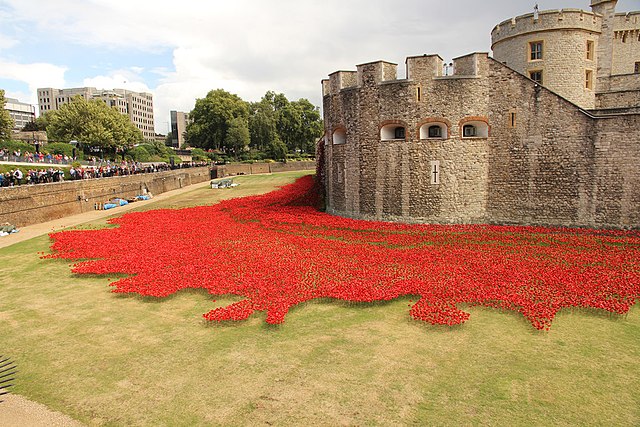
The view towards Harrow across Roe Green Park from the top of Highfield Avenue.

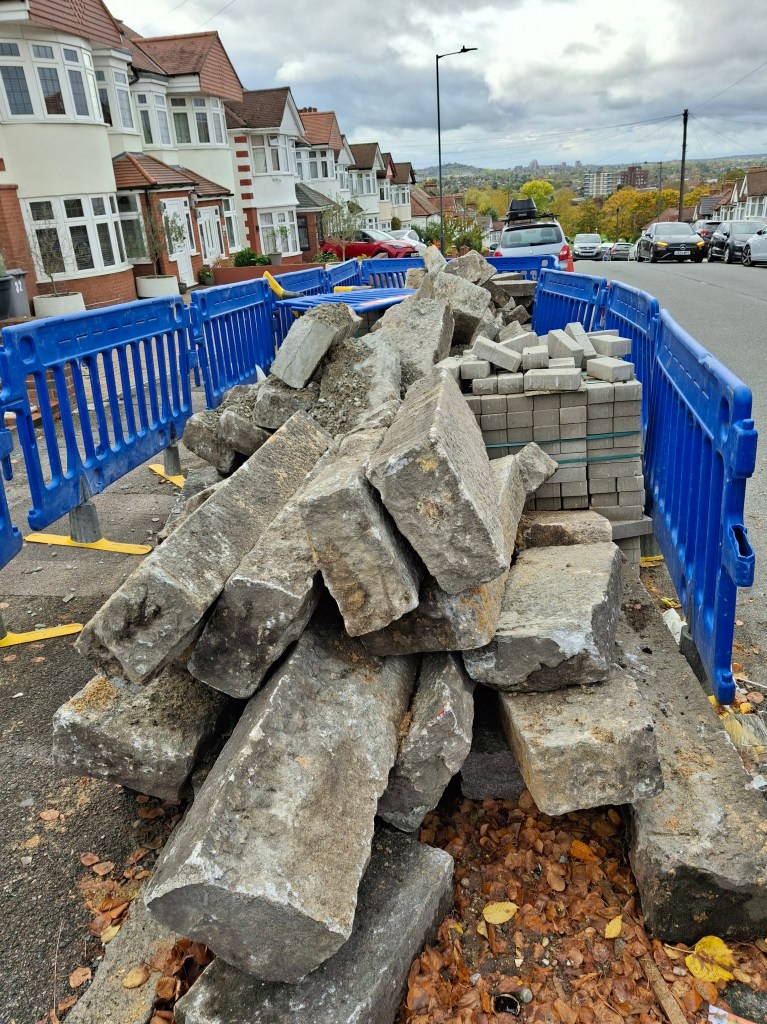
You tend to think of kerb stones as a bit like an insubstantial, almost conceptual, demarcation between road and pavement. Its only when the pavement is being redone, and they are exhumed and piled up, that you realise how huge and heavy and almost elemental they are. Parts of a Mesolithic henge reduced a more workaday function like fallen gods.

Another Life well lived. Patricia Joan Atkin (formerly Burford) 23/1/1930 – 6/9/2025

This is the story of my Mum’s life written and told by me and my brother at her funeral on 15/10/2025.

CHRIS We would like to welcome you all to this commemoration and celebration of the life of our mother Patricia Joan Atkin. In particular, Shirley and her family who are joining us from New Zealand, Colin and his family in Spain, Brian in Lincolnshire and Penny in Shetland.

It is lovely to see so many of you once again, just 4 months or so since we said goodbye to Dad. We always said they would not want to be parted for long and so it has proved.

In accordance with Mum’s wishes this is a non-religious ceremony, but there will be moments later for reflection, contemplation and prayer if you so wish.

PAUL Mum was born in January 1930, slightly closer to the start of WW2 than the end of WW1, to very young parents, Bill and Mabel Burford, who were both 20 at the time.

She spent her first four years in her maternal grandparent’s very crowded house in Bedford Road, with her parents, grandparents Charlie and Jinny, and their youngest children, Edie, Arthur and Syd; the last two of which were young enough to be playmates as well as uncles, and she was always very close to Edie.

Mum’s first memories were of being terrified by an army pipe and drum band that came skirling out of Grays Park while she was playing in the street, running home and banging on the door to find a place of safety from “that terrible noise”. Mum never liked sudden, loud noises (like me, or her Mum, doing the washing up).

CHRIS She did indeed instil in us a concern about being quiet and thinking of others; If we arrived home late from a trip out with Mum and Dad, she would always insist we didn’t slam the car door, talk loudly or make a noise as ‘there might be babies asleep’. As a pre-school child I remember crawling up the stairs as silent as a ninja on the rare occasions she allowed me to go upstairs for something when Dad was on night shift.

So it must have been an act of adolescent rebellion to some extent when I started to learn the drums in my teenage years. She was surprisingly tolerant of this, but her legacy had an impact as I couldn’t help checking the immediate environment surrounding any gig we might play and think ‘what if a baby is asleep…?’

PAUL An early memory she often mentioned, was of being taken out in her pram by one of the girls down the street and coming home with a dandelion shoved up her nose. Mum never liked bullies, so when she started school she went with a group of kids who were going to look after her. Crossing the road to meet them she was hit by a car which, luckily for her, and us, was going slowly enough just to leave her with bruises and a serious concern about road safety.

When she was 2, her grandmother died and, after a while, her grandfather remarried a woman she did not remember fondly – “old Maud” – and she did not get on with Maud’s daughter, with whom she had to share a room. So, her parents moved into 131 Hathaway Road, one of the new “Homes fit for Heroes” council houses that had been built less than ten years before.

Mum therefore had to change schools and went to Quarry Hill Primary where she came across a boy in the same class – memorable because his was always the first name to be called in the boy’s register, as hers was in the girl’s. She helped him find some lost drumsticks during a school Xmas performance and, as dad said “she’s been helping me ever since”.

As a child Mum played on the playing field (except on Sundays when the council chained up the equipment to preserve the Sabbath) and watched the Council dig trench shelters on it during the Munich crisis in 1938.

On her birthday the next year, she’d wanted a bike. What she got was her baby brother John. I know the family has always inclined to be neat and tidy, but sharing a birthday with a nine year gap might be thought taking this to extremes.

CHRIS Within 9 months of John being born, WW2 broke out and the family was moved to Dumbarton. Mum’s Dad Bill being a docker, was in a reserved occupation essential to war work and the docks just outside Glasgow were thought safer than those in Tilbury.

However, because the family were so homesick, when Bill received call-up cards by an administrative error, he didn’t challenge it and was drafted into the Royal Engineers so called “Dock lot”.

The rest of the family came back to Grays where Nan worked with the Rationalisation Committee at the Coop and Mum spent a lot of nights in an Anderson Shelter with a wireless, lamp and a map she put pins in to follow movements on various fronts. This followed another very brief evacuation to Wales with a friend that lasted several weeks, during which Mum climbed trees by the railway line and made plans to stowaway on a train to London to get back home. Holding on to home was very important to her, and she never moved out of Thurrock her entire life.

The family didn’t get through the war unscathed. Syd, Mum’s youngest uncle and the closest to her, was killed in Tunisia, when his lorry drove over a landmine just days after the Afrika Korps had surrendered. The date of that was burned into Mum’s memory; and his older brother Arthur, who Mum said used to sit by the fireside cracking jokes, died in 1952 of a virus he picked up in Burma with the 14th Army. Syd’s name is on the War Memorial in Grays. Arthur’s isn’t.

PAUL The wartime experience of rationing and “make do and mend” made Mum see food as sacred – there was nothing worse than wasting it – and very careful with resources, keeping things “that might come in handy”. That included an enormous green bottle of calomine lotion that lived under the sink for decades because there was just too much of it to throw out with a good conscience. It took us a long time to persuade her to let it go. Reduce, Reuse Recycle being reflexes for Mum that long predated the environment movement.

On Matriculating from Palmers Girls, Mum got a job as a Secretary with Scottish Widows in the City and enjoyed commuting up there with a friend who worked nearby. She also did evening classes at Grays Tech, where Dad spotted her, ran down the road and asked her out to the pictures. Mum said, “he seemed nice and chatty, so I said yes”. And that was that for the next 80 years.

After Mum and Dad got married in 1952, looking like a pair of film stars (I always thought Mum looked like a prettier version of the Queen and Dad was like Gregory Peck with a stronger jaw) they lived with Dad’s parents in the top two rooms of their house on Ireton Place. That worked out very well and I was born in 1954.

After a short move to a flat in Tilbury we moved back to Hathaway Road – which seems to have a pull like a benevolent black hole – and stayed there ever after. After two years of doing it up in the long lost modernising spirit of Barry Bucknell – remember him? -and John coming to stay with us when his parents moved to Kent; Chris was born there in 1959. During her pregnancy, Mum was offered Thalidomide, but didn’t accept it because she thought she’d manage better without it. A good call. Though, if President Trump is watching, she almost certainly took paracetamol, and made very sure we were vaccinated.

CHRIS Looking back, it feels now like we grew up in a kind of Ladybird book; Mum and Dad took on unchallenged 1950s gender roles, largely because they hadn’t been challenged; with Dad going to work and Mum staying at home to look after us, part cook, part cleaner, part nursery-nurse, teacher, part accountant and manager of home economics.

One of Mum’s roles was passenger in charge of navigation when we took any trips in the car to holiday destinations or other places. A huge OS map across her knees and instructions such as ‘keep on going on this blue road, then we need to turn right onto a red road..’

My very earliest memories are of just me and mum- pre-school years; waving Paul off to school in the deep snow of ‘big freeze’ winter of 1962-1963, always being given a choice of what to play with so she was free to be industrious in the kitchen, being taught to recognise and spell my name, doing a jigsaw of the Beatles together and inadvertently locking ourselves in the cupboard under the stairs. Mum had to call for our neighbour- Mr Barton- through the small window to come to rescue us. She told me some years ago that the incident had terrified her, but she gave absolutely no indication of that at the time. Mind you, she once said that I didn’t actually speak until I was 4 years old and I’m pretty sure that’s untrue.

PAUL Mum being very organised, there was a definite routine to all this. Elevenses, a coffee and a biscuit, was always at 11. Not exactly on the dot, but near enough. We always had a break to “Listen with Mother” at a quarter to 2 on the Home Service because, at the time, this wasn’t just the title of a programme, but an instruction passed down apostolically from Lord Reith. Big jobs had definite days, a bit like the Scaffold song. “Monday’s washing Day, Tuesday’s Soooop”. Washing originally done boiling sheets in a big pan with tongs, a washboard and a mangle.

Mum was a great cook and baker, and made mince pies that would definitely be in line for a Hollywood handshake on Bake Off (an ounce of extra fat in the pastry is the trick – and Jamie always uses that when he bakes, so the tradition lives). At one point in the sixties she went on a World Cookery course, which seemed to focus mostly on chicken, and tried out Coc Au Vin and an extraordinary Mexican dish that involved chicken, chocolate and chilies – they were wonderful; but we never had them again…

CHRIS Mum’s Chocolate Cake was my favourite and I always requested it for birthdays or special occasions. The other thing I loved that mum made was Fish Pie. She complained that it was fiddly and bit complicated to make and when I left home she gave me the recipe. For over 40 years I have made many lovely Fish Pies, but never have I managed to make one like she did, or as taste good as she did. I have never even attempted to make a Chocolate Cake…

PAUL When we all caught chicken pox in 1959 and couldn’t go on holiday. Mum and Dad bought a telly instead. Mum and Dad always watched “the news”; to which Mum’s reactions were often quite fierce. Probably the first time this made a strong impression on me was Mum exploding at a report of the Sharpeville massacre in 1959, when South African police wearing coal scuttle helmets shot down anti apartheid protestors. “JUST LOOK AT THEM! They even LOOK like Nazis!”

Mum had definite views. Always voted Labour, liked Michael Foot and Tony Benn, voted Remain, thought Nigel Farage was a dangerous charlatan; and, during a recent dementia assessment, when asked “who is the President of the United States?” replied, “I don’t know, but I do know that I don’t like him!”

CHRIS She went back to work in the early 1970s when I started secondary school – first with the DHSS, then the local Education Department before settling in to being a librarian – which is very appropriate because, for Mum, if anything was more sacred than food, it was BOOKS. And if there was something more sacred than books, it was LIBRARY books. Because they belong to everyone, and other people would be reading them, they deserved special care. The same personal responsibility for social goods that meant you didn’t drop litter or put your feet up on bus or train seats that other people would have to sit on. And you washed out your milk bottles and recycled tins.

She read constantly and widely. Biographies, novels, crime, Armando Iannucci and Alan Bennett. And she had similarly wide musical taste, from Jack Jones and Charles Aznavour to Glenn Miller, Mozart and many more from what Tom Lehrer called “that crowd“; who she found thrilling.

Retirement in the 1990s coincided with the arrival of grandchildren – which was good timing – first Joe, then Sasha and Jamie; and she was an engaged and loving grandmother who all of the kids felt safe with and nurtured by; while she also helped look after her Mum in her last decade. Retirement also meant walking, Tae Chi, visiting family and friends.

PAUL Ill health in the last ten years or so, came in the form of falling over several times – “I go to walk and my legs don’t move” as she put it, then arthritis in her hip, which made walking even with a stick or frame quite painful; so she didn’t move about much. As she said “its alright when I’m sitting down”. So we watched a lot of Heartbeat and Midsomer murders and Vera.

In the end, Mum went suddenly, pretty much how she’d have wanted it. Quick and relatively easy on her and everyone else. On the Friday, Chris and I took her for a spin around the field in the wheelchair, and she reminisced about playing on it 90 years before. On the Saturday, woken in the morning by a headache that turned out to be a cerebral haemorrhage, she was beyond all pain and sensation by the time we got her to Basildon, quickly though that was, and just drifted away by the evening with us around her during the day.

I think the word that comes to mind most thinking about Mum is “animated”. In just about everything she did, or was involved in, she took enormous delight in what seems to be the smallest of things. “Cup of tea Mum?” “Ooh! LOVELY!” Its heartbreaking not to be able to wake her up in the morning with that question, a kiss and a weather report.

CHRIS I want to leave you with a fanciful thought. We were and are not a spiritual family, but a incident happened that although certainly just serendipity gives me some comfort.

On Mum’s last day in hospital it was obvious that she was no longer with us- just her body in existence and beginning to be at peace when I took Juhi and Sasha back to Hathaway Road. After a short stay I went to get in my car and noticed a plane flying in parallel to Hathaway Road and opposite Ireton Place.

Dad was always fascinated by planes and flight. It was some sort of fighter type and I thought- ‘oh, there goes Dad’. A minute earlier or later and I’d have missed it. Then I thought, ‘of course, he’s gone to pick Mum up’ and I have a very clear image of Dad in the front concentrating on piloting the plane and Mum in the seat behind with her bag and cardigan on and an OS map across her knees saying ‘we follow this red road, then turn left by the river and follow it to the sea’. I’m not sure where they are going, but they are going together.

Diacritical Presidents, Light Christians and why the Old Testament God is a bit of a shit.

In a recent Guardian quick crossword, one of the clues used the phrase “diacritical marks”, so I looked it up. These are the accents put above or below letters to modify their sound that are relatively rare in English; only appearing in loan words, usually from French, like cafe. So rare that they don’t make an appearance on keyboards, which is why the accent on the final “e” in cafe isn’t there in the sentence above (implying that you’d have to pronounce it cayff, if you didn’t know better).

Looking through the list of marks revealed that a “Macron” is a straight line above a letter elongating its sound. So a macron over the “r” in Macron would be read Macrrron, or over the “o” would read Macrooon. Such a pity that there isn’t a Chancellor Umlaut. Though, I suppose, he, or she, would be a bit dotty.

One of the many repurposings of Congress House, that used to be the Coop Department Store in Grays – which was named after the TUC HQ and seemed to be the future in 1961- is “The light Christian school”, which seems to have opened recently to cater for the growing number of evangelicals in the town.

The Warehouse area at the back of the old store is now a big charismatic church, with a poster proclaiming that God can do anything: which begs the question of what He, or She, is doing about Gaza. Not a lot, by the looks of it. Reminiscent of the only joke that David Baddiel has ever told that has made me laugh, in a bitter sort of way. “God realises that he hasn’t heard any jokes about the holocaust, so he asks a survivor to tell him one. So he does. God says, “that’s not very funny” The survivor says, “well, I suppose you had to have been there to get it”.

The old Ritz cinema, with seating for 1500, has also been a mega church since 2016, having survived a post film half life as a Bingo Hall, a sort of purgatory before rapture, as is the old snooker hall above Burtons the tailors in the High Street – which now lives down its sinful past with small but very visible congregation that dresses in long white dresses and what look like chefs hats.

The same is true of the local Conservative Party; one of the factors driving its former white racist base towards Reform.

The title of the school is a bit ambiguous. “Christian light” might be thought of as linked to enlightenment, in a rapture oriented sort of way: “I see the light!” But “light Christian” implies either that is for Christians who don’t take theology all that seriously – “too heavy, man” – but find that a light smattering of Faith is helpful to get by day to day, with scripture as a series of Hallmark posters papering over existential cracks with uplifting moral thoughts, or it could, literally, be for light Christians, those with a Body Mass Index acceptable to the Kingdom of Heaven.

There is a high density of preachers in the High Street. If there isn’t a busker, who are usually uplifting, playing songs that strike chords and you can sing along to as you walk past, there’s someone with a microphone and a Bible. A bit like Northern Ireland in the seventies, except that instead of a red faced middle aged man in a dusty black suit, the preachers are whip smart young black guys, or aunties.

Sometimes this has an air of desperation about it, with the preacher shouting verses from an open Bible in a slightly wild eyed way. People drift by. No one gathers to listen, or even dispute. As in the parable of the sower. “And some fell upon stony ground”. Perhaps this gives the preacher a sense of elect distinction, that she/he is offering a way out to the heedless masses, who wander by getting on with everyday life oblivious of the heavenly apocalypse to come – as they ignored Noah before The Flood. You can lead a horse to salvation, but you can’t make it get on the Ark.

Sometimes its more discursive, as though the preacher is trying to convince themselves. Recently, as I walked past, one was arguing that the “apple” in the Garden of Eden was actually sex. I’m not sure how he got to that, as a believer in the literal truth of The Book. Take it literally, the apple is an apple. I suppose the tree of knowledge can be seen as the tree of KNOWLEDGE, as in carnal. Which begs the question of why an omnisceint and omnipresent deity would set Adam and Eve up with the temptation. Just to see if they could resist it? But, if God is omniscient, He/She would have known what was going to happen before He/She set it up. Which seems a bit sadistic. As Shakespeare put it in King Lear, “As flies to wanton boys are we to the gods; They kill us for their sport.” For “gods” read “God”.

Musing on this evident theological imperative towards sexual repression as I walked home with the shopping, I was reminded of Wilhelm Reich’s observations about debates between the German Communist and Catholic Youth Movements in the late 1920s. He said that most of these consisted of the speakers talking past each other. The Communist would talk about the Party’s economic programme. The Catholic, would talk about personal morality. Reich himself would short curcuit this by asking the Catholic speaker if they believe that God designed the human body. When they said “yes”, he would ask, “so, why did he design the clitoris?” Which opened a whole different way of looking at life. You could take this further. If you believe that “man” was “created in the image of God”, what is the divine dick for? Does God pee and poo?

China and Climate – the Question of Leadership

Image from Tricontinental Instutute for Wenhua Zongheng China’s Ecological Transition Dec 2024.

This is the full version of a talk I gave as part of a Panel on China’s leadership role in fighting climate change at the Friends of Socialist China Conference in Bolivar Hall on 27th September. As it would have extended to twice as long as I had, a drastically pruned version was delivered, and an even pithier version was published in the Morning Star during the week. I’m putting this up here for anyone who might find the missing bits stimulating.

I edit the Greener Jobs Alliance Newsletter and convene the National Education Union Climate Change Network, but am speaking in a personal capacity because both organisations contain a range of views about China and its role in climate change. These are mine.

Marx used to quote Hegel’s dictum that “The owl of Minerva spreads its wings only with the falling of dusk” to note that people by and large learn from events only after they have happened. In the case of the climate crisis, dusk is falling already and we know what is happening. 

IPCC Reports are very clear about the increase in greenhouse gases, the increase in global temperatures that arise from that, and the impacts are increasingly documented, as well as reported as they happen. We are experiencing it. It’s not a single cataclysm that may or may not happen some time in the future. It is happening now. Slowly from the point of view of political/electoral cycles, but with terrifying rapidity in geological terms; such that we are in a crucial decade in the century that will make or break human civilization. 

I’d add that from COP to COP the IPCC sets out possible scenarios for how the crisis will unfold. So far, we have been heading consistently along the “unlikely worst case scenario”. 

I’d also add that most people see the unfolding of this crisis as following an almost Fabian path of inevitable gradualism, but, in physics as in politics, the tendency is to have a long period of apparent stasis, in which forces build until you hit a tipping point, and there are then sudden dramatic shifts that are unimaginable until they happen, but make the previous period unimaginable once they have. 

As the joke used to go, “Whoops comrades, yet another unforeseen historical inevitability”. 

The impact of the crisis on China itself is already severe (at 1.3C globally above pre industrial averages, but China already at 1.6C above). 

  • this July 2025 alone, the value of “direct economic losses” due to flooding, landslides, earthquakes and drought was equivalent to $7.3bn and “road damages” amounted to $2.2bn, according to the Ministry of Transport.
  • The 30,000 deaths related to heatwaves in 2023 was almost double the average between 1986-2005. 
  • Droughts in 2024 hit more than 11 million people, more than 1.2m hectares of crops and the Chinese Academy of Agricultural Sciences estimates that climate-related yield reductions could amount to 5% to 10% by 2030 – so, in five years – under current warming trends. 
  • One study estimates that key cereal crops could lose around 2.6% yield per degree Celsius of warming, with more vulnerable regions facing up to a 12.7% loss. Another study projected up to 37% yield decline within decades if warming continues unchecked.

Challenges

China’s response aims to build a moderately prosperous socialist society as an ecological civilisation. The connection between the two is expressed in the Two Mountains proposition popularised by Xi Jinping – that green mountains with clear water are as valuable as mountains of gold and silver.  So, as China grows, it will grow greener. So it’s not Socialism with green bits, let alone a Kruschevite vision of the conquest of nature, but Green Socialism.

And the socialism is essential to the greenness. One Australian commentator put it in the grudging way that Western commentators who grasp the reality nevertheless can’t help but do 

“The authoritarian regime put the heft of the state behind clean technologies at a scale and pace difficult to imagine in most democracies.” 

What this means is that if you have socialist planning you can make strategic decisions for the common good that won’t be sabotaged by the vested interests that buy elections and control “western democracies”.

Or, as a Canadian commentator put it. “China is pushing power sector transformation through central planning. It can build clean infrastructure quickly”, as “China sees the old fossil fuel growth model as not sustainable and increasingly unable to sustain long-term prosperity.” To put that another way, if the socialism that’s built isn’t green, it won’t last.

But China’s colossal state driven investment in what it calls “the three news” – solar power – electric vehicles and batteries – along with wind power-  is leading to a global tipping point as the cost of renewable energy is now cheaper than that generated by any fossil fuel – and set to become even more so. And this is having an impact on countries in the rest of the world that are far from being socialist.

Last year, crude oil imports to China fell for the first time in two decades, with the exception of the pandemic. The International Energy Agency expects China to hit peak oil in 2027.

As China had driven two-thirds of the growth in global oil demand in the decade to 2023, global demand set to plateau then drop before 2030. This makes continued investment in fossil fuel exploration, or power plants, increasingly risky. Banks that have traditionally put huge resources into FF investments are beginning to get cold feet, even as they row back on explicit green commitments. This is, paradoxically, putting the US Fossil Fuel drive at odds with markets.

This is because the sheer scale of China’s investment is mind boggling and this is increasingly the core driver of China’ economy; which in turn is having a global knock on effect.

  • With just 17.2% of the world’s people, China has half of the world’s solar, half of the world’s wind power and half of the world’s electric cars. 
  • Of every four” offshore wind turbines installed globally in 2025, 3 of them will be in China.
  • In April this year, China installed more solar power than Australia has in all its history 45.2GW. In one month – at a rate equivalent to a power station every 8 minutes. 
  • Last year China installed as much renewable power in one year as the US has in its entire history, and this will accelerate.
  • They are building enormous solar and wind farms in arid parts of the Western interior. To give an idea of the scale of these things, they are two thirds of the way through building a solar farm in Tibet that is the size of Chicago. (Projects like this all over arid areas are also having a positive impact on holding back desertification and boosting agriculture, as condensation from the panels feeds grasses which can be grazed by sheep).

As a result China’s domestic emissions are peaking, even as demand for energy increases. In fact energy prices went down in the summer even as demand for a/c boomed during heatwaves. Emissions were down 1.6% in the first half of this year. That’s vital because China’s emissions are 30% of the global total. If China gets this wrong, we’re in real trouble. 

China now has 57% of its energy generated by renewables, compared to just over 50% for the UK. 

Coal power is still massive in China, and its rise to prosperity came through climbing up a mountain of it. 

However, coal is now explicitly being defined as back up to a grid structured around renewables and there is now significant overcapacity – leading to these plants only operating around 50% of the time. Coal consumption dropped by 2.6% in the first half of this year, even as the economy grew by 5%, showing that the shift in reliance is picking up pace.

A question that this poses as quite an urgent matter is planning for transition in heavy coal dependent provinces like Shanxi, which is 75% dependent on coal mining and coal derivative industries. If the transition is as fast as it might be, this could pose a serious problem locally unless alternative industries are planned and built in as part of the process. I’d be interested in any debate going on in China about how that will be addressed.

Global impact

All this is feeding through globally and this is crucial. Taken individually, there are a number of European countries, like Finland, that have made a faster shift away from fossil fuels and have a higher per capita investment, but you’d expect wealthier countries to be able to do that. The stunning thing is not that some have, but that most haven’t. And none of them are having the global impact that China is.

Though there are a few residual projects, China’s decision to abandon coal investment overseas has been a pivotal decision. 

More than 60% of emerging and developing economies are leapfrogging the US and Europe in clean electrification thanks mostly to China’s exports of cheap solar panels. 

  • Pakistan last year added as much capacity in rooftop solar as they’d previously been able to generate from their entire grid. 
  • This is now being picked up in parts of Africa, with solar panel exports from China up 60% this year. This is from a low base, but the potential is enormous. In countries like Kenya, Morocco, Algeria, Ethiopia, the DRC, Botswana, Zambia Nigeria and South Africa solar imports have grown by factors of between 3 to 8. The liberating potential of no longer being dependent on imported fossil fuels, the capacity to install micro grids and distributed power to widespread rural communities could provide the same technological leapfrog as when SATphones (mobiles) made landline technology redundant in Africa. Abundant, cheap solar electricity also allows the continent to be slung together with a High Speed Rail network, not dependent on medium range flights burning kerosene. 
  • Outside Africa, in countries like Brazil and Vietnam, the adoption of solar, wind and battery storage is outpacing not only fossil fuels, but also the business-as-usual strategies of many rich economies, let alone the delirious reactionary stance of the USA. 

China’s clean energy exports in 2024 alone shaved 1 per cent off global emissions outside of China, according to Carbon Brief, and this will accelerate during the next 30 years. 

Reuters reports that  87% of power generation investment in emerging economies and China flowed into clean energy in 2024; and as China is the pivot nation in the global system, three-quarters of global fossil demand is now in nations that have already peaked.

Three factors underlie this. And these are quotes from Reuters, so not from a source the right wing press here would call “eco fanatic”.

  1. Physics: Fossil fuels are wasteful: two-thirds of the energy in coal, oil or gas is lost to heat or inefficiency. Solar, electric motors, and heat pumps are two to four times as efficient. We can do more with less energy at far lower cost. That is expressed very well in this graphic. 
  1. Economics: Fossil fuels are commodities built on extraction: as reserves deplete, it gets more expensive to access what’s left. Look at the North Sea. Electro-based technology is manufactured: so the more that gets built, the cheaper and better it becomes. On average, costs fall by around 20% every time deployment doubles. In most of the world, solar and wind are now the lowest-cost new power. Investment follows – today, two-thirds of global energy capital flows into “electrotech”, while oil majors are investing more in stock buybacks than in new wells.
  2. Geopolitics: The old energy system left three-quarters of humanity dependent on expensive, imported fuels. Electro-based technologies unlock local resources. Almost all countries have enough sun and wind to meet their energy needs many times over. In fact, emerging and developing economies hold 70% of the world’s solar and wind resources and 50% of the critical minerals for the energy transition.

What this means is that the Western model of development is not needed for the majority of the world. Thanks to China’s investments in renewables, they can modernise in their own way – and that means that the future does not, and cannot, look like the USA.

So, to elaborate on the last point, China is leading on climate because it is not doing what the US is doing, nor following it in a race to the bottom

Ma Zhaoxu ,China’s vice-foreign minister says, “regardless of how the international situation evolves, China’s proactive actions to address climate change will not slow down”.

The Trump administration, as we know, is locking the US into a suicidal entrenchment in increasingly outmoded FF technology. “Drill baby drill”. 

In rolling back Biden’s attempt to suck green investment into the US, Trump has, as many commentators have noted, abandoned the future. This doesn’t simply involve domestic economic self sabotage, with more expensive FF plants kept running and pushing up bills, offshore wind farms cancelled imperilling supply in regions like New England, but also a completely reckless wrecking ball taken to disaster emergency relief and any state scientific or academic research related to the climate and the impacts of it – setting up a vetting committee to make sure that published papers don’t challenge the administration’s line (so US academics at international conferences have taken to using burner phones). 

That means that US policy is based on a set of lies about climate change, and actively has to suppress the truth about it. Ultimately, a policy based on lies comes back to bite you.

The US is now the world’s leading petro state. And part of Trump’s trade offensive has been to get the US’s subordinate allies to buy its exports of LNG – whether they need it or not. 

Some of this involves fantasy figures. The EU deal to buy $750 billion worth of US LNG exceeds the capacity of the industry to produce it, tanker fleet to transport it and European LNG terminals to process it (and the EU can’t mandate member states to buy it anyway). The US/UK nuclear deal is similarly fanciful. They are aiming beyond the capacity of their own system.

But the purpose of it is to lock as much of the world as possible into FF bondage. They actually have a Department of Energy Dominance. And it’s why the increasingly shrill arguments coming from the most overt political subordinates of the US – Reform here, with the incredible shrinking Conservative Party yapping along in their wake, with an increasingly panicky right wing press in full sneering support – are actually aiming at consolidating UK energy dependence on the US, no matter how ruinous the cost. 

Which is why they have to invert the truth and argue that getting to sustainability is too costly. The OBR reckons it  will cost 19p a day per person up to 2050, a cost already eclipsed by just the food price rises from two bad harvests in the last two years. But, having to buy US LNG instead of using the sun and wind will impoverish us and risk the future.

This sets up a politics and diplomacy of volatile delirium based on wishful thinking backed up with open and extreme violence. The renaming of the Dept of Defence at the Dept of War shows how they have taken the mask off now. 

Given the factors outlined above, a success for the US would lock the world, and the US itself, into climate collapse. The sort of scenario outlined by one of their own think tanks in 2008 as a situation in which “countries with resources would have to engage in nightmarish episodes of triage. Deciding who, and what, can be salvaged from a disordered environment. The choices would primarily have to be made among the poor, at home and abroad”.

Something it’s in all of our interests to avoid. 

But, while the US still makes some of the weather – literally in this case – it’s no longer able to determine the direction of the world and, in my view, Trump is increasingly looking like the Emperor Diocletian, who restored the old pagan rites for the last time when their time had already gone. He is standing on thin ice, that’s getting thinner as the ice caps melt. As Bill McKibbon puts it in his optimistic article “Here comes the Sun”; “Big Oil spent more money on last year’s election cycle in my country than they’ve ever done before. And it’s why they’re now being rewarded with a whole variety of measures designed to slow this transition down, which may succeed. I mean, it’s possible that 20 years from now, America will be a kind of museum of internal combustion that other people will visit to see what the olden days were like.

But it’s not going to slow the rest of the world down much, I don’t think.” 

There is obviously a tension now in the UK government, with its attempt to dodge tariffs by bending the knee and crippling any possibility of positive investment by committing to an annual £77 billion black hole in “defence” spending, and the stated direction of the Department of Energy Security and Net Zero to make the UK an “electrostate”, which involves some cooperation with China, but would require more investment than the military spend will allow. US pressure has already excluded Huawei from 5G telecoms, and from the nuclear programme (which will make it unaffordable as well as useless). 

As this crisis unfolds and deepens, the cost of being shackled to the US and the cold war stance it requires against China will become more and more apparent. And a more live debate in the climate movement. And something we need to inject into “mainstream politics” in and through the unions, Labour, the Greens and Your Party.

Blue Labour Blueshirt Blues

‘Every day, we should drag a sacred cow of our party to the town market place and slaughter it until we are up to our knees in blood.’ Wes Streeting MP

O Rose thou art sick. 

The invisible worm, 

That flies in the night 

In the howling storm: 

Has found out thy bed

Of crimson joy:

And his dark secret love

Does thy life destroy.

William Blake

Last week, after a 44 year membership, I cancelled my standing order to the Labour Party. This morning I had a standard letter “will you hear us out” inviting me to rejoin.

I thought that it required the courtesy of a reply, so here it is.

Dear Gail

After many years in the Party, including being a ward and constituency officer, I now find that so much of “staying in the fight”, as you put it, requires opposition to what this government is doing.

In the 1970s, when I was scraping National Front stickers with the slogan “send them back” off lamp posts, I never thought that the Party I have voted for all my life would be boasting about how many people it is deporting. I fear that next May’s local elections will be a complete debacle because the attempt to cosplay Reform emboldens them while making Labour voters stay at home, or vote Green, or Lib Dem, or Your Party.

I could go on. Gaza. The gesture of recognising a Palestinian state while taking no measures to put real pressure on Israel to stop the genocide is unconscionable.

Signing up to an annual £77 billion black hole of increased military spending that will suck the life out of the investments we need in infrastructure and green transition. 

The abject attempts to talk up “the special relationship” at a time that the USA is going full rogue state on climate, trade, diplomacy, as its hegemony wanes, and threatens the world with war shackling us to a suicidal course for humanity.

And, because it knows that it is on thin ice on all these issues, the response of the Labour leadership is to close down debate, silence dissent; rule out motions that are awkward, decree entire areas out of bounds, deselect local councillors who do things they don’t like (like twinning with Palestinian towns). Peter Kyle MP responded to the “Unite the Kingdom” march by saying that it shows that “free speech is alive and well in the UK”. Free speech for who? There were 1500 police on duty at that march, which included violent attacks on police officers and counter demonstrators. There were 3000 on duty for the silent, peaceful sit in in protest at the bizarre categorisation of Palestine Action as terrorist (when most people can tell the difference between an Improvised Explosive Device and a tin of paint). Politics is indeed the language of priorities. 

There are still good people in Labour, who want it to remain Labour and not adopt “muscular Conservatism”, as I understand the new buzz phrase goes in leading circles, but I believe at this point that what might be called “Blue Labour Blueshirtism” will work its way through until Labour has shrunk to the depths of the French SP or PASOK in Greece.

The fight continues, and I will be part of it. I hope that many remaining Labour members will be part of it too. We are in unprecedented times, and the old road no longer leads onwards. Bob Dylan wrote a song about that…

Paul Atkin 

Blue Labour, whose organiser Maurice Glasman was the only person from the European Social Democratic tradition to be invited to Donald Trump’s inauguration. They organise on the slogan “Faith, Flag, Family”.

The Blueshirt reference in this is to Keir Starmer’s Chief of Staff Morgan McSweeney’s political origins in Fine Gael, the more right wing of the two traditional parties in Ireland, the one that grew from the Free State forces in the Irish Civil War and sent fighters to support Franco in the Spanish Civil War. Recalled bitterly in Christie Moore’s Viva La Quinta Brigada

When the bishops blessed the blueshirts in Dun Laoghaire, As they sailed beneath the swastika to Spain.

Once again, a song for our time.

Quite Wrong!

It was quite disconcerting yesterday to be sitting opposite this poster on the Jubilee Line. Being stared at by Michael Gove in full condescending mode, dressed in a waistcoast and shirt sleeves, which is perhaps to indicate informality and “getting down to business”, but actually just makes him look like a bleached out version of Jarwahalal Nehru (but without the rose) while Madeline Grant (the Daily Telegraph’s Parliamentary Sketch writer) rolls her eyes; its hard to know what at, herself, Gove, or all those silly people out there who don’t think quite like she does.

The new Spectator podcast is getting a lot of advertising, full length posters on the platforms and these little ones staring down from a height in the cars. Its title is a weak pun. Quite right. As in quite RIGHT. So, its right wing, with the presumption that this also makes it “right”, as in “not wrong”; allowing the homynim to do a lot of heavy lifting. But also that its QUITE right. Nothing TOO right. Nothing vulgar. No street thugs, but maybe just a bit of gentle encouragement for them with a lot of plausible deniability. Just “common sense”, nothing that will threaten the presumptions of comfortably off people. And nothing to scare the horses, especially as these are by and for people who ride them more than most and can afford to be Spectators from a position of impunity and financially well padded social safety.

It struck me that it was missing a strapline. Underneath The new podcast for politics, culture and common senseQuite right! – With Michael Gove and Madeline Grant, the words because at times like this you wouldn’t want to listen to actual experts, would you? would more accurately identify what this thing is for.

And the odd little yellow ribbon with OUT NOW on it should end with an exclamation mark and be in an arrow pointing at the presenters.

Flagging Enthusiasm

The weather is never kind to bunting, which has a short shelf life.

This Summer has not been quite as mad as the last one, with no full scale riots outside the North of Ireland, but more insidious. The demonstrations outside hotels housing refugees (“illegals”, as they like to say) have hyped up the sexual threat to “our girls” from the “invasion of fighting age men in small boats”, pushed by the Far Right (Homeland Party, Britain First and the like) echoed by the Inside Far Right (Farage) and the dominant Farageiste wing of the incredible shrinking Conservative Party (Jenryk, Philp and other slithey toves) and completely capitulated to by the government, who are trying to fight Reform by being as much like them as possible on immigration.

The demonstrations have actually been quite small, often attended by the sort of blokes who think assaulting women and girls is their job, and often out mobilised by Stand Up to Racism. Nevertheless, they are said by Keir Starmer and Yvette Cooper to have “legitimate concerns”, while the hundreds of thousands who demonstrate against genocide in Gaza are one step removed from “terrorists”, and the government falls over itself to boast about how deportations are up on the numbers the Tories managed, the new restrictions they are bringing in on refugee families, how they plan to house them in containers on old industrial sites, and on and on. 

The success of this strategy can be seen in the polling numbers, which show Labour well behind Reform, as it alienates left voters and fails to attract those lining up with Reform with an air of self righteous indignation: though it should be obvious to them that Farage is a charletan and a bit of a spiv; the sort of bloke who, in wartime, would loudly proclaim his patriotism while nursing a bone spur or two to keep him safely at home in a snappy suit, and then flog you knocked off nylons down the market.

The press is really whipping this up. The headline in the Sun on the day that Lucy Connolly – who’d been inside for a year after writing online encouragement to burn down asylum hotels was “Mum’s Home!” Because nothing says “Mum” more than inciting a mob to burn people to death. She was a matryr to “two tier justice” apparently.

The move to fly Union Jacks and St George’s crosses in public areas – attached to lamp posts and so on – is quite extensive in some areas. Particularly where Far Right activists have painted red crosses on the white stripes on roundabouts and zebra crossings. Why they want people walking on the flag I’m not sure. Some of these in Kent are being flown from quite well to do properties, which should remind us that Nigel Farage is a stockbroker from Sevenoaks, who shows that he is a “man of the people” by banking with Coutts.

This is very reminiscent of Northern Ireland, where Loyalists paint their kerbstones red, white and blue, and Nationalists paint theirs green, white and gold; so you know where you are. The difference is that this sort of identity is entrenched in the Loyalist areas every Summer with vast angry bonfire ceremonies, burning effigies of people they fear and hate, bonding in atavistic loathing. Wickermen for the 21st Century. This year, models of refugees in boats were a popular target; a celebration of the pogrom in Ballymena. Nationalist areas, by contrast, have abandoned bonfires in recent years and turned to more open, hopeful, music and cultural festivals. Better craic by a long way. People looking to make a better future, not marinade in the dubious glories of a lost past, for want of being able to imagine anything better.

To watch the news, you’d think this was everywhere, but when I went into London the week after it started, I kept an eye out and only saw two flags (and one of those was Palestinian) on the whole journey through the East End. I’d have expected more, given that its the Women’s Rugby World Cup and England are favourites; which usually generates a bigger, more innocent, crop of them.

In Grays, there’s a little cluster in a side road off the High Street, where the Conservative Club used to be and just opposite a weird little shop that sells second hand reconditioned white goods (which is almost a metaphor) and those life size tin silhoeuttes of WW1 soldiers that have started populating War Memorials since 2014. (See photos) The shops nearby include a Halal Butchers, several Eastern European Delis (and the wonderful Lulu’s cakes and bakes with its encroaching cafe street culture) an Asian/East African General Store (good spice collection) and a couple of charismatic church venues in repurposed shops; which is probably what they don’t like.

There are quite a few flags in Chadwell. But even there – on the Western fringe of James Murdoch’s seat – former Leeman Brothers banker, elected for Reform even after a conviction for kicking his girlfriend – “save our girls” – but he’d taken out loans for a couple of dubious companies during COVID, one of which had no employees – almost all of them are attached to lamp posts along the main road and alongside the A1089, the massive road that now slices up to the A13 from Tilbury Docks. So, this is a bit like the old NF sticker campaigns but more effective. But, as the saying goes. “Posters in windows means you’ve got support, Posters stuck up in the streets means you’ve got glue” or, in this case, plastic ties and a ladder.

This was also the case right across East Thurrock to Basildon, where, on the long bus ride back from the hospital, I counted just eight flags or strings of bunting in anyone’s windows; and we passed hundreds of houses. There were more on lamp posts, but only in enclaves, not generalised.

The response of Yvette Cooper, in her last week as Home Secretary, was to say that there should be more of them because the flag “brings us together”. This is in the context of a couple of youngish blokes in Basildon who filmed themselves painting St Georges crosses on the white background of some first floor flats above a row of shops while abusing a woman in a hijab, “Oi! Raghead!” etc. Really bringing us together. They have, thankfully, been arrested for criminal damage and racial abuse. It takes a really dim sense of entitlement to assume you can film yourself doing stuff like this and for it not to be taken down and used in evidence. If Reform were in government I guess they’d just recruit them to the British version of ICE, so they can deport most of the people who look after us in Care Homes and Hospitals.

I note in passing that Gary Lineker has just won the BBC presenter of the year award. Cue Match of the Day theme.

Looking droopy

Erasing Banksy – Art that is a hammer must be suppressed!

“Art is not a mirror, its a hammer” Bertold Brecht.

This image enhances the original, with the symbolic figure of the man in black with a hard hat, almost like the rear view of a CRS riot policeman in the Days of May. The authorities have become part of the performance Art and have confirmed and amplified their role in the mural.

Scrubbing the Banksy mural off the Royal Courts of Justice shows that this is Art that matters. They couldn’t commodify it, market it, sell it, or accept it.

Erasing it from the wall, like the way the “Intelligence Services” destroyed the Guardian hard drive with the Wikileaks documents on it, is self defeating though.

Now we see the image online all over the world, and we see the erasure, and in erasing it, they expose themselves for what they are.

So, the hammer that shapes understanding is in our hands, not theirs.

The only war that matters is the war against the imagination/ all other wars are subsumed in it. Diane Di Prima.

Yvette Cooper’s evasions on “terrorism” invite ridicule.

For a newspaper that uses Orwell’s “The enemy of nonsense” as a motto/mission statement, the Observer doesn’t half print a lot of it.

Yvette Cooper’s article “Palestine Action’s violent criminality is not lawful protest” (Observer 17/8/25) is a case in point.

What is revealing about it is the extent to which she has to use arguments that distinguish the mass protest movement from the NVDA tactics of PA, while trying to elide the distinction between NVDA and “terrorism”. This is a victory of sorts, because one of the aims of this action was precisly to make this smear spread, as we saw with some of the clumsier police actions in the immediate aftermath of the ban; which might be interpreted as taking an over enthusiastic interpretation of it, but could also be seen as testing the water for how far they could go and how much they could get away with.

Let’s see what she says and examine it.

“Faced with the intolerable scenes of suffering and devastation in Gaza, people across the country are feeling desperate and angry about what is happening and many have joined protests on the streets”. Quite so. Where have you been Yvette? Why have you not joined us if you think that these “scenes” are “intolerable”? More to the point, why does your government tolerate it, continuing with arms shipments, trade, spy flights? Why is there no meaningful pressure on Israel (who you don’t mention in this sentence) to stop?

“Each month the police work with organisers to facilitate safe, lawful protests, and will continue to do so.” The experience of the march organisers is that the police have increasingly placed restrictions on where marches can assemble, their routes, whether they can march at all, and, at the end of one, they arrested the head stewards and General Secretaries of PSC, CND and Stop the War when they tried to walk to the BBC to hand in a letter. This is not facilitating lawful legal protest. It is harassing it.

“Hundreds of thousands have joined pro Palestinian protests, while only a tiny minority have been arrested for breaking the law”, despite the very tight restrictions on protest that are now law and the attempt to interpret slogans like “from the River to the Sea, Palestine will be Free!” as “antisemitic”, as if Palestinian freedom is incompatible with Jewish freedom, a contention that is zero sum communalism; and as if Palestine can be free somewhere else. Anywhere but Palestine in fact.

“Anyone who wants to protest against the catastrophic humanitarian situation and crimes against humanity in Gaza, to oppose Israel’s military offensive. or to criticise the actions of any and every governmnet, including our own, has the feedom to do so.” This is posed as though this “freedom” (under the constraints above) is a concession we should be grateful for from a government that has no complicity in the “catastrophic humanitairian situation and crimes against humanity “ being carried out by UK ally Israel in Gaza (and the West Bank).

But, lets bank that. Write it down and show it to any over zealous copper who thinks otherwise, because when she writes; “The recent proscription of the group Palestine Action does not prevent those protests, and to claim otherwise is nonsense” she seems to be unaware that police on the ground, in Kent and elsewhere, have interpreted it as exactly that. If she is backing off from that, good. Carve it in stone. The attempt to chill debate and undermine mass support and mass actions from fear of being accused of terrorism has failed already, not least from well deserved ridicule. The passive voice in her sentence is a bit of a giveaway that she is trying to distance herself from the decision. It is something that simply happened, like the genocide in Gaza, nothing to do with me, Guv’.

However, although she is in a hole, she is still digging. In trying to maintain the argument that NVDA is “terrorism” she has to use arguments that are deeply shallow.

“A group that has conducted an escalating campaign involving not just sustained criminal damage, including to Britain’s national security infrastructure, but also, intimidation, violence, weapons and serious injury to individuals” she runs together the overwhelming majority of actions with one case, in which one individual who, in the Observer’s words, “faces charges of GBH and 2 charges of ABH against two police officers …the only significant acts of violence against a person in the group’s 365 actions since it was founded in 2020.” We should also note that the defendent has pled not guilty. Nevertheless, the Home Secretary seems to have concluded

1. that if charged they must be guilty

2. that if guilty, these actions are characteristic of the group as a whole (which it is evident that they are not)

3 that this level of violence (what you’d find outside quite a lot of pubs on a Friday night) is the same thing as “terrorism”.

This lack of a sense of proportion is the nub of the matter. It is always reassuring when the “grown ups in the room”, those responsible for supposedly keeping us “safe”, can’t tell the difference between firecrackers and hand grenades, pots of paint and Improvised Explosive Devices. Arguing, as Cooper does, that “the UK’s world leading counter terrorism system” (close your eyes and it could be Boris Johnson) advised her that PA could be proscribed under the “tests in the Terrorism Act 2000” simply exposes the attempt of that Act to blur necessary distinctions that the person in the street (or Clapham Omnibus) can see plainly, but the Act intends to smear. Regardless of the loose, baggy definition of “terrorism” in the 2000 Act, taking NVDA against companies that produce weapons systems to try to prevent a genocide is a long way away from putting a bomb on a tube train; and everyone knows it.

This is evident in her line, having listed charges that are being prosecuted and defended under ordinary criminal law, that these are considered, in “the assessment of the Crown prosecution Service, a terrorism connection”. What exactly does that mean?

  • Is it that the actions had a “terrorism connection”? In which case any other defendent charged with such actions should reasonably expect to be charged as a terrorist too.
  • Or, is it that the group had terrorism connections. in which case, what are they? Cooper doesn’t say. Perhaps because she’s chancing her arm here, as she is with her dark hints of secret briefings from the ever reliable Intelligence Services (the team that brought us Weapons on Mass Destruction in Iraq) about what PA is really up to (as opposed to what it has actually done. There is no repeat of the story the Home Office put round that PA had funding from Iran; quickly dropped because they knew it wouldn’t stand up to scrutiny. If the state has to lie about something like this, as it has so obviously done, it is a sign that they realise that they are standing on thin ice.

So, as it stands, the wheels look like they will be coming off this particular bus before they have gone round and round much further.

Coming back to the basics, when Cooper says that there will be “desperate calls for peace in the Middkle East”, I think its reasonable to ask “where are yours?” especially, as she says “the humanitarian crisis worsens, the conditions for hostages deteriorate, the prospects for peace are diminished, and the scenes of children being shot and starved get ever more horrific.” As Cooper is a leading member of a government that is allied to Israel, the state that is doing all this, again, I think its reasonable to ask, what the f*** are you doing to stop it?

The agenda she puts – ceasefire, hostage release (not that she notices any Palestinian hostages) “urgent humanitarian aid” – is what the mass demonstrations have pushed for for nearly two years, and her government has been dragged kicking and screaming to go along with, but it is totally without pressure on their part; and is posed as a regretful word in the ear of an ally that has gone too far under understandable provocation and should be restrained in its own interests.

Where is the arms embargo? Where are the sanctions? Where is the removal of military and intelligence cooperation?

Instead, we have the threat to recognise a “Palestinian state” as a token gesture instead. This is in the context of proposals for a Bantustan – or a series of them -under strict Israeli and allied tutelage.

To shout down dissent as “terrorism” in this context is both desperate and ridiculous and, far from frightening opposition, Cooper finds that she is being laughed at. Truly fatal.

Trying to kill the Truth.

This brilliant graph by Nicki Draper shows what the killing rate for journalists in Gaza actually is. The initial graph is bad enough, but adjusted for time it shows that this is not an average loss of life in a risky job. Does anyone really think that this can be anything other than a deliberate policy, to kill the eyes and ears, stifle the witnesses, carry on the genocide in silence and darkness?

The scale of the killing of journalists by Israeli forces in Gaza has been so great that their colleagues in Western media can’t avert their eyes anymore.

Though the framing is still often grotesque. Jonathan Crook’s question How is it possible for a BBC reporter to have made the following obscene observation in his segment on Israel’s murder at the weekend of Al-Jazeera journalist Anas al-Sharif: “There’s the question of proportionality. Is it justified to kill five journalists when you were only targeting one?” goes to the heart of the racist double standards applied by the Western media to their own colleagues in Gaza. How much collateral damage is OK?

As Cook points out, if studio with Jeremy Bowen, Lyse Doucet, Yollande Knell, Lucy Williamson and Jon Donnison was been hit by an Israeli strike, and all five killed: would any BBC reporter ask “There’s the question of proportionality. Is it justified to kill five journalists when you were only targeting one?”

The reporter’s question is also absurd. The IDF does not target individual journalists. It targets journalists. No one from outside is allowed in. Anyone on the inside has a target on them.

They do not want the facts getting out. They would prefer it if everyone went about their lives in an innocent bubble, untroubled by disturbing images and news.

But we see them. We know. The bloody tooth paste is out of the tube and you will never get it back in. We will tell others. We will mobilise. This will end.