Small story from September 20th

In Parliament Square small children dance in the sun on the plinths of statues.

They seem to have chosen wisely – ones they feel safe on.

None are standing under Benjamin Disraeli, or Lord Palmerston, or General Smuts.

Some are standing among flowers, as though they have grown there.

Some are jumping up and down under the open hands of Nelson Mandela, giving them a protective benediction.

Other are doing the same under the spreading banner of Millicent Fawcett – “Courage calls to courage everywhere”- as Millicent stares sternly above their heads.

Ghandi has been left in peace, but someone has stuck an XR sticker on the hem of his shawl. He does not seem to be offended.

Rubbish Art

20190916_094546

Since the council no longer has the money to maintain street cleaning, there has been a tendency for more people to just chuck rubbish on the ground – on the principle that rubbish attracts more rubbish.

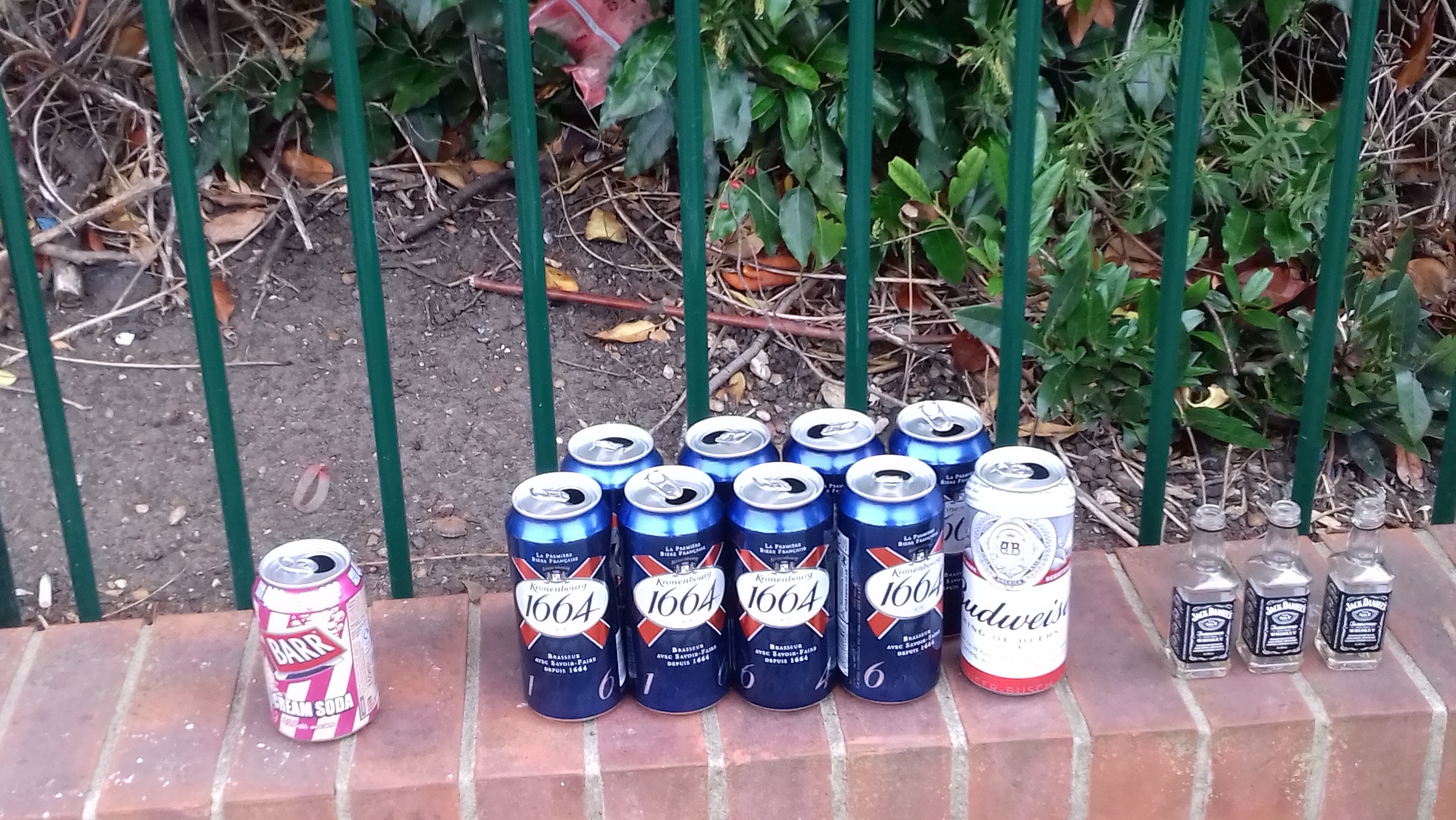
At the bottom of the hill there is a low wall next to a telecoms junction box that regularly has a small crowd of street drinkers; who just leave their cans and bottles on the ground- or post them through the railings. I’ve got into the habit of picking them up and putting them in the bin by the bus stop in a desperate attempt to be socially useful – and on the principle that having less rubbish on the streets will attract fewer additions.

But today I picked them up and arranged them in a line, with the labels all present and correct like the Guards Brigade on parade as a more challenging statement – and perhaps to suggest to other passers by that the litterbugs had become anally retentive.

Of bogies, dopplegangers, Brexit punditry in the chemists and Muharram in Kingsbury.

Pootling down the hill, the pizza moped delivery driver is steering with one hand and assiduously picking his nose with the other.

At the bottom of the hill, the neighbour who looks like a very plump version of Kaiser Franz Josef of Austria- Hungary – all shiny bald head fringed with gigantic mutton chop whiskers blending into a walrus mustache – says good morning as he sits half out of his Mercedes trying to psyche himself up to walk to his front door.

Every time I go to the chemists – now I am a pensioner I qualify for a loyalty card – the head pharmacist – a man who sees his job as to get to know everyone, not just transact with them – always sees me looking up at the news, silently blurbing on from the TV above the counter, and asks me “what’s going on?” Brexit of course. He is very nervous about his supply of medicines, as my daughter’s employer at the bakery is concerned about his supply of flour – which comes via the EU because British flour isn’t of high enough quality. I go off about Johnson being boxed in by Parliament, his majority and Party in tatters but – with Parliament about to be prorogued – still in office and going for no deal with far less scrutiny. Other customers look on a bit bemused. If the worst predictions of Operation Yellowhammer come to pass, they will be angry.

On the way down to the shops on Saturday and there’s an unusual stall being set up with an air of bustling importance outside the Saaqi Mall – a collection of tiny cubicle emporiums carved out of a bankrupt shoe shop, selling sugar cane ground into juice through a mangle, the world’s smallest jewelers, a place that teaches Maths and English (one person at a time presumably, given the space) and has a side line in Visas, a tiny travel agents and a few sad vacant spaces. The three men on it are giving out cups of tea from an ornate looking samovar and distributing snacks.

Next door, outside the shop where you can wire money back to relatives who need it more, another guy is sitting peacefully in front of a huge black banner thick as a carpet emblazoned with enormous Arabic letters in bright scarlet; designed to look as though they are dripping blood.  This is quite alarming, so I go over and ask him what it is. He removes his camouflaged ear muffs –  the army surplus of a very considerate militia – smiles broadly and says “Hussein. Imam Hussein.” So, its Muharram.

Muharram is when the Shia become visible. Cars fly white flags with Arabic writing in red. The Sim Sim bakery and other shops shut and sellotape posters to their shutters.


Climate Crisis – which states are our allies?

Human civilisation is on course for a breakdown in the benign and stable climactic conditions that have been the condition for its development. This is a result of the rapid increase in greenhouse gas emissions generated by human agricultural and industrial activity, particularly since the industrial revolution, and especially in the last twenty years. The scale of this is greater than in any of the natural cycles of warming and cooling that have taken place throughout the holocene period (current interglacial). The last time there was a greater concentration of CO2 in the atmosphere as there is today was before human evolution.

The trouble we have stored up for ourselves is becoming increasingly apparent in extreme weather events – hurricanes, floods, droughts, and their consequences, forest fires, unfarmable land, climate refugees, conflicts and wars resulting from the foregoing; alongside related issues like the accelerating loss of biodiversity and mass extinction.

Scenarios to avoid this written by academics are often premised on political conditions that we do not have – a presumption that the world has one political or economic system without significant variation – or a degree of universal understanding and political consensus that we don’t have either. There is no world government capable of re-wilding 50% of the planet or imposing a carbon ration: and if we had one, it would run into a lot of conflict if it tried to do it.

We nevertheless have to get from where we are now to where we need to be. And as quickly as we can.

The first point is that States Matter

In the absence of global governance, what different states do – and whose interests they represent – is of overwhelming importance. Protests are – in the last analysis – an attempt to get the state to do something, or to change a government, or transform it altogether if it does not. In the current state of international state relations, some states are part of the solution and are generally allies of the environmental movement – and some are not.

The Paris Agreement is both essential and inadequate. Countries will make targets and commit to reducing carbon emissions, then ratchet up those targets. If met, the projection is that the current targets would still leave us with 3C of heating by the end of the Century and, if not 4.3 – 4.8C; so the scale of the targets and the speed with which they are implemented need to be scaled up sharply if we are to cut off global heating at 1.5C, or even 2C.

The decisive crisis in this process is that the United States – currently the single wealthiest and most powerful country in the world – is pulling out of the Paris Agreement and pulling other countries – like Brazil – with it. Alongside it are countries like Saudi Arabia, Poland, Australia and Russia, which remain in the Agreement for now, but act to slow it down and impede its progress.

This abdication of global leadership by the US, and its move to actively sabotage what needs to be done, is a stark expression of the decline of the Pax Americana; which can no longer claim to stand as an example for humanity as a whole. Faced with the rise of China (symbolised by  Chinese technology companies edging ahead of US competition in 5G) the USA under Trump is projecting “America First” – breaking up and disrupting multilateral institutions which have hitherto bolstered its global predominance.

Trump and his supporters in the fossil fuel industries have been widely characterised as “climate change deniers”. This is not accurate. When Wells Griffith, Trump’s international energy and climate adviser argued at the Katowice COP that “we” (we, here, meaning the US government) “strongly believe that no country should have to sacrifice their economic prosperity or energy security in pursuit of environmental sustainability” he is recognising that the current ways of ensuring prosperity are not sustainable, but will carry on doing it anyway – projecting a future in which the system we have accelerates faster and faster and higher and higher until it runs out of road, crashes and burns and we all burn with it.

Steve Bannon put this more graphically, “Half the world is going to burn and there’s nothing anyone can do about it.” These guys know what’s happening. The 2007 US think tank report The Age of Consequences – The Foreign Policy and National Security implications of Global Climate Change  projects the following “expected scenario” based on IPCC reports- “massive food and water shortages, devastating natural disasters, and deadly disease outbreaks”. Given that IPCC reports have tended to underplay the pace of developments – with levels of arctic ice melt already at levels not expected until mid century, its likely that the more severe scenario they sketch out is in their minds. In the event of environmental feed back loops getting out of control, instead of gradual degradation that we have time to adapt to, there is a sudden breakdown that overwhelms us, collapsing agricultural and economic systems and states. They state unblinkingly that “Governments with resources will be forced to engage in long nightmarish episodes of triage: deciding what and who can be salvaged from engulfment by a disordered environment. The choices will need to be made primarily among the poorest, not just abroad but at home.” Just think about that for a moment and imagine it. Its quite clear who the half of the world that they expect to burn is. And not all of them are on the wrong side of Trump’s wall.

Some of the uber wealthy are seeking to escape the consequences are trying to find themselves bolt holes from this – buying estates in New Zealand, building underground bunker homes, or fantasising about living “off world”. Trump wants to build a wall, making the whole US a gated community. At least Wotan, at the end of Gotterdamerung, having condemned the world to die in flood and fire, has the good grace to sit in Valhalla with his broken spear, waiting patiently to be engulfed, so a new world can be born.

A change of President and change of course away from confrontation and towards a Green New Deal from 2020 is crucial both for the chances of the world meeting its targets and for the US transforming itself into a society with some chance of becoming sustainable. The version of the Green New Deal put forward by the US Green Party – to finance it by cutting US defence spending in half – thereby freeing up just under $350 billion a year- is something of a challenge for US democracy – but has the merit of pointing out that it is a strange version of “defence” to spend as much on armaments as the rest of the world put together, while deploying soldiers, aircraft and ships in “around 600” overseas bases (according to the Pentagon). Any other country doing that would be denounced as an aggressive predator and threat to democracy.

In the Trump trade war with China, which will continue for four more years if he is re-elected next year, the US is doubling down on fossil fuels and locking itself into an outmoded technology: with subsidised petrol (and the fracking and wars for oil that go with it) relaxed emissions standards, overuse of internal flights (no high speed rail) sprawling energy hungry suburbs and crumbling interstates – the American way of life. In so far as it has a vision of the future it is a peculiarly old fashioned one (the present, only more so) that – crucially – requires climate change denial.

The world view of neo-liberalism, which is not confined to Trump and his supporters – that the current form of human relations is natural and eternal, that “there is no alternative” that “business as usual” is “going forward” forever and ever world without end – is unable to take on board the reality of climate change. In its own discourse it reduces it to being an idea among other ideas that can be argued with or denied – not a reality we can see and feel around us and that we have to respond to. It has been pointed out that, while the Chinese government is composed for the most part of scientists and engineers *- people whose whole being is geared to solving real world problems – the highest levels of US government are filled with lawyers – people whose role is trying to cheat the facts and conjure up a deceptive self serving narrative if that’s what it takes to win a case; which works fine in court, but not if you are trying to argue with the laws of physics (which are starting to sit in terrible judgement).

The Chinese – on the other hand – get it . This is symbolised in a startling statistic. Of the 425 000 electric buses in the world, 5 000 of them are not in China. Just think about what that means for a moment. Here are some further contrasts.

  • The US is doubling down on fossil fuels while China is investing massively in renewable energy generation, which has brought down the costs of solar panels so far that India and Vietnam – previously committed to  a big expansion of coal plants – are now going solar in a big way – and this is having a global effect even in wealthier countries too. China itself already has double the renewable energy capacity of the US and is still investing in it at a qualitatively greater rate (another £292 billion going in by next year).
  • Donald Trump prohibits mention of Climate Change in US government publications and sabotages scientific research into it, presumably on the principle that what you don’t know can’t hurt you, while Xi Xinping is talking about building an “ecological society”,
  • the US is planning to withdraw from the Paris Agreement, abandoning targets that were already quite lenient, and stands against international co-operation; while the Chinese favour “win win” solutions, are set to achieve their 2030 Paris targets between 5 and 9 years early and will ratchet them up.

None of this implies that China has always got everything right, nor that improvements can’t be made. Its huge tree planting programme – which has significantly increased forest cover – has been widely criticised for lacking biodiversity; creating woods more like Forestry Commission plantations than restored ancient woodland; so projects using diverse native species are now being brought in to address this.

The overall conclusion however is clear. On the most decisive question facing humanity, China is part of the solution while the US is part of the problem; and the environmental movement in the West needs to be very clear about that. The result of this clash – and the fall out from it – will be decisive in determining how much of a future the world has.

Its important to stress this because the news we receive in the UK is heavily filtered through a world view in which the US’s own assessment of itself as a globally progressive guarantor of human rights – as compared with any competing power -is taken as good coin. To argue that China is doing more for humanity than the US has to fight its way past a wall of scepticism. But, just consider this. The US prison system holds seven times as many people per head of population as China does. It even locks up more people in absolute terms (2.1 million in the US to 1.6 million in China) with a population barely a quarter the size. So far, this year, the number of people shot and killed by the police in the US is 614 (Washington Post). In China, its 2 (Wikipedia).

These figures jolt because they invert comfortable settled presumptions about the US’s relative standing that might be expected in most of the media; but they are also the dominant view throughout society and even in some sections of the left and environment movements. This is despite experience to the contrary.

There is therefore a certain vulnerability on the part of these movements to campaigns waged indirectly by the US designed to use us for its own ends. These are usually run through the National Endowment for Democracy. This body is funded by the US Congress to organise “human rights” organisations in countries that the US wishes to destabilise; which usually run very noisy  social media campaigns designed to go straight to people’s emotions. It is important to bear in mind that even where there are concerns that need to be addressed in either the policy or the practice of the states concerned, the aim of the US backed campaign will be directed at portraying everything about the country concerned through this lens, usually in a wildly exaggerated way, with an aim to bring down a regime that is unfavourable to its interests, partly by inoculating public opinion across the world against it. The extent to which “human rights” are a genuine concern can be gauged by the way the US has operated in Latin America almost from its foundation.

An exchange in Congress between Rep Ilhan Omar and Trump’s envoy to Venezuela Elliott Abrams is very revealing. Abrams stated that protecting human rights is “always the policy of the United States.” This is the same Elliott Abrams who was Ronald Reagan’s Assistant Secretary for Inter American Affairs in the 1980s. In this role he oversaw support for Contra Terrorists in Nicaragua, Death Squads in El Salvador and an anti insurgency campaign in Guatemala that led to the President at the time being charged with genocide by a later government. Yet, the protection of human rights is “always the policy of the United States.”

The intervention of NED activists into the crisis of the Amazon rain forest fires is a warning. Keen to divert attention from the culpability of President Bolsonaro in Brazil – who is in favour of forest clearances in the Amazon to bolster soya production, dismantled the protections brought in by the previous Workers Party governments and even now is only imposing a moratorium on slash and burn fires for 60 days – they sought to divert attention to fires in Boliva – a tiny fraction of those in Brazil – and blame President Evo Morales – a thorn in the US side who is firmly committed to the Paris Agreement – and who is facing an election in November. Morales, declared a national state of emergency and suspended his re-election campaign to fight the fires, sending in 4 000 troops, firefighters and vets and contracting a Boeing 747 supertanker to help douse the flames; with the result that 85% of them were out within eight days. Buying and selling land in the affected areas has been banned to stop profiteers moving in, and his government has been praised by the United Nations for its swift and decisive action. By contrast Bolsonaro was more concerned to claim that NGO’s had deliberately started the fire to discredit him than to find any practical solutions. This was of no concern to the NED activists who focussed entirely on Bolivia and mentioned Bolsonaro not at all. 

So, the environmental movement needs to be very clear about who its allies are at state level in the current global struggle. Recognising that Morales is part of the solution while Bolsonaro is a – big – part of the problem is part of this. Disagreement or criticism of an ally should take a different form from criticism of an enemy and we need to be clear who is who. This is not always easy. In the context of an increasingly delirious form of political discourse – in which exaggerated and unrestrained claims are made and images hyped for emotional impact – it behoves us all to keep a cool head and the overall picture in mind: so we are not stampeded off in a direction that is the opposite of the one we need to be heading.

End of part 1. Part 2 will look at strategy in the UK.


*https://gineersnow.com/leadership/chinese-government-dominated-scientists-engineers
Mooning Jeff Bezos

“With great power comes great responsibility.” Possibly Voltaire, definitely Spider Man, but not, it seems, Jeff Bezos.

Jeff Bezos, in an interview with Business Insider last year (when he was “worth” $132 billion) said, “The only way that I can see to deploy this much financial resource is by converting my Amazon winnings into space travel. I am going to use my financial lottery winnings from Amazon to fund that.”

There is a current among the uber wealthy to project space as their future – as though they can avoid the problems involved in destroying the conditions for human survival on Earth by getting “off world”.  As though they were exposed to too many plays of “The Final Countdown” at an impressionable age. The fantasy in that song, that – having trashed the Earth – everyone could head off to live on Venus (not an enticing prospect with an surface temperature hot enough to melt lead, air pressure at ground level 92 times greater than Earth’s – and enough to crush anyone unfortunate enough to be standing on it – and an atmosphere largely comprised of dense clouds of sulphuric acid) and that the Venusians would be welcoming to a species that had just destroyed their own habitat and wanted to have another go in theirs; is only marginally less absurd than the idea that life on Mars (with virtually no oxygen, no water cycle, no vegetation, an average temperature of -67C and dust storms thousands of kilometres wide that last for months) would be remotely desirable compared to living – say – in an upscale part of Seattle.

In an interview with CBS News in July this year Bezos said “Human beings are in the process of destroying this planet” and – in a leap of imagination that treats planetary destruction as a given premise instead of an avoidable problem – produces a wild fantasy of off world manufacturing, with factories on the Moon within a few hundred years.

What he seems to be missing here is that the Amazon – the other one – is on fire NOW; and we don’t have a few hundred years to deal with keeping our planet habitable. We have a decade to make a serious dent in greenhouse gas emissions if we are to have half a chance of getting through to the end of the century with a civilisation intact. Recognising that business as usual – including his business as usual – is “destroying this planet” would probably make most people think that anyone with a spare $132 billion might want to put most or all of it into stopping the destruction. This does not seem to have occurred to him.

Its the phrasesmy financial lottery winnings from Amazon” and  the only way that I can see to deploy this much financial resource” that stick out from his original quote (my emphasis).

His “winnings” from Amazon are not a lottery but the result of profoundly ruthless and dehumanising management systems that are part of the reason our planet is being destroyed in the first place. Mr Bezos’s “winnings” are the flip side of the following.

  • Amazon pays 15% below average wage rates for warehouse workers.
  • Workers employed at the Amazon depot in Dunfermline were found sleeping in tents near the factory because the cost of transport took such a huge chunk out of their meagre wages that they couldn’t afford to commute.
  • In Ohio, 700 of their workers are on food stamps.
  • Workers are often employed as “permatemps” to minimise their legal rights at work.
  • Delivery workers are paid by the package, putting them under huge pressure to zip round as quickly as possible – the implications of this for safe driving should concern everyone.
  • In 2013, they had the second highest turnover of workers of any company in the Fortune 500 Index. According to a Study by Pay Scales, the average Amazon worker can’t stick it out beyond a year.
  • Warehouse workers are tied to electronic monitors that keep them to targets that are set just beyond what they can do if they work flat out without a breather. Some workers have taken to peeing in bottles so they don’t lose the time taken in going to the loo.
  • As a result, in the UK, there have been 600 ambulance calls to Amazon Warehouses in the last 3 years. Just over one every other day. The Rugely depot in particular looks like a place to avoid getting a job if you possibly can – with 115 call outs.

The “logic” of this is – while the company is waiting for robots to take over, they will treat their workers as much like robots as possible. Seen this way, people are robots with needs that present as flaws.

Treating workers as throw away resources is of a piece with treating the Earth’s resources in the same way.

Amazon made $3 billion profits on $180 billion in sales in 2017. It paid no Federal taxes in the United States in 2017 and 2018. In the UK between 2016 and 2017, even though business increased by a third, the tax paid was halved – to a tiny £4 million (about the same as the annual budget for one medium sized secondary school).

So we have a company that treats its workers like robots, burns them up and spits them out, does not contribute to the social costs of creating its labour force or the infrastructure that sustains them, or the transport infrastructure along which the company’s goods are delivered, or anything else. An essentially parasitic relationship.

And we have an owner who thinks he, personally, has the right not only to keep his “lottery winnings” but to blow them on space exploration rather than the million and one tasks that face us in keeping this planet habitable for the next generation.

The sheer entitled self indulgence of people like this shows them up as unfit to control such concentrations of wealth; and any society that sets them up as “aspirational” role models – because what else should you aspire to if not to become filthily, selfishly, rich – is dooming itself to self destruction. A future future determined by people like this is not  good enough for humanity, nor is it viable. Saving ourselves means becoming more human, more social, less robotic, less exploited and exploiting.

We can do better than them.


Hot, hot, hot. Just direct your feet, to the shady side of the street.

When I went to India in 1979, it was the first time that I had ever got into the habit of seeking out the shady side of the street. Even in the long hot summer of 1976 it had never occurred to me before that sunlight – however hot – was something to be avoided – even if it led to headaches and dehydration. The grey, raining pastel norms of weather in the UK made a bit of suffering for sunlight well worthwhile. Some people paid a fortune to have overseas holidays to get scorched like that, so turning it down when it was blazing away for free seemed somehow churlish and ungrateful. Its different today. I find myself standing in bizarre places to get a bit of shade. In an unforgivingly exposed bus shelter on Kingsbury Road, I have discovered that the bus stop sign is just long and wide enough – when you take the panel with the bus info on it into account – to stand in profile with your head in a cooling dark patch while everything around swelters and shrivels. I see other people doing the same everywhere. People hang back from the bus stop by the Park so they can stand under the trees. In the Park proper, families picnic in the shade under the trees and people have taken to shade bathing.

By the outdoor gym in the Park a small cadre of people are lying prostrate in the sunlight, facing south east, apparently Muslims praying. It seems like an odd venue for it and conjures thoughts of a confessional keep fit group having a break. As I pass however, a tough looking woman with a stop watch and commanding voice tells them how much longer they have to keep planking. A bit of prayer might have left them looking a little less frazzled.

On the pavement beyond Kingsbury Fruit and Veg, a blue shirted evangelical with a microphone but no charisma talks to the passing crowds – none of whom stop or engage in dialogue. The Word hangs in the air like intrusive muzak or ideologically charged noise pollution. This does not seem to bother him and he presses on with the single mindedness of faith; presuming that God approves.

On one of the Historical Tube posters on display up the stairs at Kingsbury station there is one of the Prince of Wales from about 45 years ago looking excited that he is in the front cab of a new train. Somehow, he manages to look like Noddy AND Big Ears.


Living in the End Times?

The Daily Telegraph used to be a reassuring newspaper in its way. I once had a mind numbingly mechanical job on the night shift in a chocolate factory; and one of the ways to keep awake was to read the Telegraph every night to keep my blood pressure up out of indignation.

Though the Peter Simple column – with its fabulously nostalgic stock cast of grim booted, iron chained Northern Aldermen, and disclaimers of annexationist demands on the letters page – is long gone; the letters page itself is still full of carefully crafted missives from retired Commodores living in Surrey with double barreled names and strong views  – not blustery as they were in the immediate fallout from Empire, but quietly, thoughtfully defensive of an order that is setting us up for a fall out that will prove far greater – if we don’t stop it.

Alongside these are increasingly shrill columnists painting that fall out as an inevitability, not a matter of choice. One – Sherelle Jacobs -writing about Brexit (of course) – argued recently that “as the world turns Medieval” we are facing “a new global dark age” in which the only way forward is a renewed nationalism. British of course, not Scottish, Irish or Welsh.

There are limits old chap.

She recognises that the crisis of the world economic order is a crisis of the dominance of the United States but – in the age of “America First” manages to recast an abject subordination of the UK to the falling American star – by leaving the EU and integrating ever more closely with the US economic model

  • as careless of the environment as it is of its workers
  • with its horrendous health care,
  • convoluted and gerrymandered politics and brutal racist prison system,
  • alongside even closer subordination of military and intelligence
  • and abandoning any pretence to an independent foreign policy

as a buccaneering piece of national self assertion. Boris Johnson and Nigel Farage are trying to pull the same stunt. We will see in the next couple of months how far – and how long – people can be fooled by this. And what the fall out is if they get away with it on October 31st and the roller coaster ride begins in earnest.

She also manages to ignore the genuine threat of a new dark age as a result of social breakdown resulting form the degradation of the climate conditions that make it possible for us to – among other things – grow food. The Syrian drought between 2006 and 2011 that drove 2 – 3 million people off land they could no longer live on into cities that could not cope with them leading straight into civil war and everything else that has followed is – among many other recent events – a stark warning.

One of the most disturbing pieces in This is not a Drill – the Extinction Rebellion Handbook* is Douglas Rushkoff’s account of being paid a huge sum (half his annual professor’s salary) to brief five super wealthy hedge fund bosses about “the future of technology”.

It turned out that what they were most concerned about was how to escape the impact of climate breakdown as individuals. They were not in denial about it. They know it is happening. They are not concerned about how to use their wealth to try to avert or mitigate it. They are like passengers in first class on the Titanic less concerned about avoiding the iceberg than looking for lifeboats just for them.

They wanted to know whether Alaska or New Zealand would be less affected by climate change, and which would provide a better bolt hole. One admitted that he had already nearly completed building an underground bunker complex to move into when society breaks down, and wanted to know “How do I maintain authority over my security force after the event?” Money, of course, would have no value.

  • How could they stop the armed guards just bumping them off and taking over?
  • How could they make sure they could control a supply of food – with locks to which only they knew the combination?
  • Could they make the guards wear control collars?
  • Could they use robot guards instead?
  • Could the technology could be developed in time?

The future as zombie apocalypse movie, with most of the rest of us as the zombies.

These people are not isolated individuals. Steve Bannon, who acts as a guru for the whole international alt right, commented while he was an adviser to Donald Trump – “Half the world is going to burn and there’s nothing anyone can do about it.”

Actually there’s plenty we could do. We are already (globally) doing about a quarter of what we need to. We just need to step up the pace and work together to do it. But to do so we need to change the economic and political systems that give people like those hedge fund managers the power and wealth that they have. This is becoming a matter of life or death.

Bannon’s answer to this is to try to build walls around the world’s wealthier countries so the burning takes place elsewhere – as it has already began to do. A necessary part of this is the dehumanisation of anyone who lives in the “shithole countries” (D. Trump) that are going to burn; so the citizens of the US can watch them do so with equanimity. If that means describing desperate refugees fleeing social breakdown as criminals and terrorists, interning them indefinitely, separating children from parents, depriving them of the most basic care and amenities (bedding, toothpaste, soap) – or, in the European case – letting thousands of them drown in the Mediterranean, then so be it.

This was put in a more anodyne form by Wells Griffith, Trump’s energy and climate adviser, who said this at the Katowice summit in November 2018. “We strongly believe that no country should have to sacrifice their economic prosperity or energy security in pursuit of environmental sustainability.” This extraordinary sentence recognises that the current engines of “economic prosperity” and “energy security” in the United States are not environmentally sustainable – and are undermining the conditions for human survival – but strongly believes that that this can be ignored until everything collapses.

This is in the context of the current challenge to the Pax Americana posed by the rise of China. Sherrelle Jacobs argues that China is a “stillborn superpower” due an economic collapse. People in the West have been saying that for twenty years, not grasping that a country dominated by state led investment does not operate on the same lines as those for which the imperatives of private sector dominance trump other considerations.

Whatever critique people may wish to make of China, the current trade war

  • in which the US is doubling down on fossil fuels while China is investing massively in renewable energy generation,
  • Donald Trump prohibits mention of Climate Change in US government publications and sabotages scientific research into it, while Xi Xinping is talking about building an “ecological society”,
  • the US is planning to withdraw from the Paris Agreement and stands against international co-operation, while the Chinese favour “win win” solutions and are set to achieve their 2030 targets between 5 and 9 years early

is a dramatic illustration that there is more than one engine of prosperity and energy security. The dominant western global elite are sticking with the wrong one because they can do no other – they would cease to be an elite if they were to embrace state led investment as a way forward. Even as they are staring at total panic and terrible consequences for the majority of humanity in the medium term.

The popularity of evangelical rapture Christianity among these people – in which we are living in the “end times” waiting for the second coming and sudden miraculous escape from all our problems to those who believe hard enough –  and the increasingly delirious and irrational mode of political debate has its roots in the same fears.

This is a cry of despair from a class that can no longer claim to represent humanity as a whole – in the way they have tried to do since 1789. Every day that passes produces more evidence like this that the people who rule us are unfit to do so.

Variations on this theme are fantasies of living “off world” in space stations or – even – Mars – though Antarctica is a more benign environment -with Elon Musk’s electric car in space as a symbolic gesture in this direction. If it weren’t for the resources required to get them there it would be tempting just to let them go – in an inverted version of Ursula Le Guin’s novel “The Dispossessed” – in which a political conflict was resolved by exiling all the anarchists to the nearest moon.

*Just published by Penguin. Essential reading, but don’t order it on Amazon; ask your local library to stock it instead.

Mad dogs (and dead beer bottles) in the noon day sun.

Outside the Lodge – with its eastern European barbecue music and universal barbecue smells, a slightly sadistic dog owner watches as his terrier stands silently tensed, one leg lifted, eyes fixed on an insouciant squirrel that is pottering about about half way between the dog and a tree and casually getting closer. As the dog explosively makes his move, the squirrel bursts away and up the tree. We ask the owner what it would have done had it caught the squirrel. “He’d have shaken it to death then carried it around the park, dropping it from time to time and barking.” This was quite close to the children’s playground. An important life lesson luckily missed. Nice.

After the gale force winds the other night a chestnut tree lay uprooted across the path in majestic ruin. Other trees are decorated with half finished water bottles shoved into the boughs as a sort of offering; or some sort of perverse decorative impulse.

In the evening a large circle of middle aged and elderly men sit on folding chairs smoking hookahs and taking it in turns to hold forth in Arabic and humming agreement like some sort of middle eastern Entmoot. A backgammon set sits with a game almost ready to go.

Two middle aged women sitting romantically side by side chatting energetically on the end of the concrete ping pong table in the park.

On the scrappy bit of grass by the 204 bus stop on Roe Green dozens of beer bottles, crushed cans and plastic water bottles lie like the dead bodies of soldiers in some doomed attack. Picking them up into a similarly discarded box and shoving them in the nearest recycling bin feels like a tiny gesture against human carelessness in the face of the burning amazon or melting arctic – which somehow makes it even more important to sanity to make it.


Tales from the Riverbank part 4. Visiting the Wind in the Willows as a stoat.

20190813_183627 (2)Walking from Brentford to Hampton Court along the Thames Path is to move between worlds more peculiarly different than in a sci-fi time slip between parallel universes. The same river and the same country, but very different worlds.

Brentford – South of Acton

Brentford is a place most people pass over – swishing way above on the Chiswick flyover; only noticing the upper floors of newly shiny tall buildings. Down below, in the underworld, quiet, twee little houses cluster shyly along the noisy fringes of the North Circular Road. Cars pass above and below, to north and south, east and west. Not a place to stop.

A motorist is a convertible shoots past towards Heathrow, the tan head rests in his back seats looking as though he’s taking two Sontaran visitors out for a spin.

The point at which the River Brent spills into the Thames, Brentford became the river junction for the Grand Union Canal and an area of higgeldy piggeldy workshops, a collection of eyesores all squeezed together in an improvised scuzzy mess around the Thames lock. The lack of self respect for trade in an area surrounded by zones of affluent consumption. Almost as though it is rubbing their faces in it. A well ordered wood yard, impeccably clean and functional, stands out in the chaos; as though keeping its head when all those about it had lost theirs. A busy yard with forklift trucks moving restlessly sports a sign – “No entrance unless under the guidance of a Banksman”- that sounds like something out of Dungeons and Dragons.

A place where boats and buses come to die; London’s largest functioning boat yard sits in a canal dog leg, three large covered dry docks, one working from the sound of the hammering and whining of drills, two absolutely overflowing with junk. Rusty metal, parts of boats, parts of engines, broken pipes piled up and spilling out. More a knackers yard than a hospital. Nothing new and shiny and proud being built, just the old and clapped out being gutted for parts. In a flat bottom barge in the canal alongside, more discarded metal, a whole earth mover rusted through, useless scrap from gutted machines; all just sitting there in a floating skip with nowhere to go.

Along the bank the buddleia and, amongst them and across the water, the dragonflies winking like jewels, their abdomens swaying contentedly as they suck nectar.

Houseboats sit at rest along every available bank. Some are wrecked; a queue of them either waiting for the short trip to the breakers yard, or just gently decaying at their moorings. Some, further on, and still lived in, have a tired and worn out air about them. One has a Union flag on its mainmast and a Red Duster aft – both faded by sunlight and worn thin and ragged by winds, but still nailed to the mast as a memory of departed glories; and an obvious metaphor for the state of a nation in which too many are too wedded to the past to be able to imagine a future that might be different.

Cormorants flash by, or stand sentinel preening their wings. Wooded islands dream on in mid channel – some of them with disused boat yards or tumble down buildings.

At the Morrisons, to which we repair for energy bars to power our feeble legs, the headlines from planets Times and Telegraph are that polls show “the people” want Brexit “done” by 31 October, by riding roughshod over Parliament to do it if need be. With a country as divided as it is, how they think that such a course of action could be healing, or anything other than a prelude to an extended period of trouble and disturbance is beyond me. Referenda only settle an issue if the result is overwhelming. That one wasn’t. Neither side will be happy with the victory of the other and no one will be happy with a compromise. Perhaps no accident that they are recruiting more police and building more prisons.

Just beyond Morrisons is Brentford Bridge – where an English Civil War battle took place in 1642 during Charles I’s push to retake London. The advancing Royalist Infantry nudged back a Parliamentary Foot Regiment that had dug in behind a barricade they had built across the road; and from which they had initially held off a cavalry attack. Parliamentary barges carrying artillery upriver were then sunk or captured. Victory in this skirmish was short lived and Charles’s attempts to advance much further were held off. He was never strong enough to threaten London again and ended up in Whitehall without his head seven years later. The commemorative plaque for the battle notes that both sides ravaged the surrounding area for forage and that one person out of every twenty five died in the war. The death rate in World War 1 was half that. Civil wars are always peculiarly brutal.

The Houses in between

Long stretches of the Thames Path in this part of London should be renamed the Not Quite Thames Path or The Path that would be the Thames Path if we had access to the Riverbank. Beyond the industrial cloaca of Brentford the housing becomes more elegant and expensive – some of it Poundbury style mock Georgian – and a riverfront is part of the cachet; so the Thames Path has to follow the next roads in. These could be anywhere and, as views go, are reminiscent of the music hall song

“With a ladder and some glasses,

you could see to Hackney Marshes,

if it wasn’t for the houses in between.”

To pass the time, in the absence of visual stimulation, we have geeky conversations about who Edith Piaf was, Film Noir and the debt owed by spaghetti westerns to Kurosawa, whether bus numbers that start with a letter are somehow second class (and speculating on how many numbered routes there are in London; more than 700 it turns out) the tendency for sci-fi films to break the logic of their own “scientific laws”  – and why 2+2-2=20 works in Javascript.

And we wept when we remembered Syon

One of the biggest and oldest of the houses commanding its own river front is Syon Park. This has been the London seat of the Dukes of Northumberland for 400 years; built in the 1500s in huge deer park grounds in border castle style, austere, with corner castles and battlements; as though expecting a party of Scottish border reivers to come whooping over the horizon at any moment: or perhaps just to remind the owners of who they were and what they were supposed to be all about. As Shakespeare’s Prince Hal puts it of Harry Percy – his contemporary and rival –

“He who kills me some six or seven dozen Scots each morning before breakfast,

washes his hands and says to his wife,

fie upon this quiet life, I want work.”

To one side of it is a hugely domed greenhouse that looks like an outpost from Kew Gardens, just across the river, or something out of The Prisoner, with a Garden Centre and cafe doing a roaring trade beneath it. The clientele in the cafe are entirely middle and upper class – eating the fat, fluffy chips of prosperity from woven baskets and talking in entitled tones. Elderly women in big floppy hats that they might wear painting oils in a field. Chaps with specs on ribbons. Boys called Horace.

Isleworth

The elegance of the riverside housing in Isleworth, all slim wrought iron balconies, humanely scaled, organically and gracefully linked, studded with trees and looking like a place of rest; is horribly undermined by being on the flight path in to Heathrow. Every 30 seconds or so a huge airliner barrels in on its way to land – low enough to cast large shadows and make a permanent strain on ears and psyches. The impact on CO2 levels doesn’t bear thinking about. They want to expand to a third as much again.

Richmond

A little further on and the impact of the airport fades away. Everyone walking past now exudes wealth. Young men with headphones and insouciant looks walk well permed poodles or King Charles Spaniels. A man with the deep tan of the freshly holidayed walks past in a bright blue jacket that is as fresh as if he has never worn it, trousers that look like he dry cleans them every day and a pair of shoes that look as if they have been worn once. Wealthy people never look as though they sweat unless they want to. Looking up at the curve of Richmond Bridge, that looks as though it was built to be painted, its easy to see why this area swings politically between the Conservatives and the Liberal Democrats. Living round here, and thinking it normal, how could you not think that more or less all was ok with the world; or that those parts of it that were not ok could most easily be seen as a threat?

On the river, well worn houseboats along tow paths are giving way to neat little cruisers and yachts that are tied up at the end of private sloping gardens as routinely as cars in suburbia – neatly tarpaulined and clean. This becomes even more so as we get up to Teddington lock and the last of the saltwater river is left behind. Not far beyond the long pouring weirs and there are people swimming by the banks. Swim in the Thames much further east and you’d need stomach pumps, tetanus jabs and a gut full of antibiotics. Up here – despite the signs warning of deep water and strong currents – intrepid young people take a dip and a whole class of excited primary age kids in bright orange life jackets and safety helmets near Kingston take the plunge at once, while their friends haul in sail boards.

The mid channel islands are now entirely green and bucolic. The paths are busy with walkers and cyclists.

In the river are the first scullers, elegant brown racing boats swiftly pulled through the dappled water by teams of two, occasionally urged to greater effort by someone with a loud voice made harsh by loudhailer, following on in a motorboat and making up for their lack of physical effort by shouting more intensely.

By Kingston there is a long row of canal barges all lashed together with dour purpose, like Octavian’s triremes at Actium.

Twickenham

In the riverside Park there is the happiest war memorial I have ever seen. A World War 1 soldier is walking boldly forwards, holding his big heavy Enfield rifle behind him by the top of the muzzle and waving his soft peaked cap in an elated way,  beaming all over his face. His steel bowler is left at his heel, to show he is finally released from all that misery and suffering. It looks like he has just come home on leave – or that the war is over and he has survived and is showing all his pent up relief. It seems more a celebration of survival than a commemoration of loss. Goodbye to all that – one way or another.

Hampton Court

Another huge deer park with a long stone wall all around. An endless arc of stony river path over- arched with boughs that makes it feel like walking through an green cathedral for urban penitents. Fewer people. A young woman in a woven cloche hat stands motionless to one side; seemingly contemplating something deep and dark.

The house itself comes into view in a symphony of chimneys. I am impressed. Jamie is not. We cross the bridge and find ourselves in Surrey. Astonished to find that leaving London has not turned us into pumpkins, we hasten to the bus stop and head for the Kingsbury Nandos. Journeys end.