Ukraine war – Observer gives the game away

Like a chess player in time trouble, moments of crisis can produce moves that undermine a whole position. So it is in this week’s Observer, arguing that Euro-NATO can go it alone in pursuing the Ukraine war without the US, and printing a graph that shows what the real balance of military forces already is, they can’t help but undermine the core case for increases in military spending instead of a peace settlement, that without it the Russians will invade Europe.

This is the graphic they published. Hence this letter to the editor.

Now that you have published a graphic (As Trump steps back, Ukraine looks to Europe for a way of defeating Putin) that shows that NATO in Europe, without the USA and without Ukraine, outspends the Russians on defence by three to one – which shows up in twice as many troops and aircraft, three times as many tanks and artillery pieces, and even an advantage in Surface to Air Missiles – can we please have an end to articles arguing that if there is a peace in Ukraine that respects the rights of Russian speakers in the South and East of the country, this will be a cue for a Russian invasion of the rest of Europe? And, indeed, pretending that the proposed increases in Euro NATO military spending up to 2030 – aimed at increasing that ratio to a staggering 10:1 – are a necessary defensive measure, rather than a preparation for a war of aggression – impoverishing us in the immediate term and threatening nuclear annihilation should it be launched?

Please note. My Blogs are banned of Facebook because they say they “look like spam”. This has somewhat reduced their reach. If you think the arguments are worth passing on, and want to help break the ideological blockade embodied in this sort of action, please pass it on to anyone who you think might find it interesting or useful.

Of raincoats, spies and actors

Because of a brief break in the drought, that left the roofs and pavements dark and shiny, and everything green breathing more freshly, I had to borrow my dad’s old raincoat to get up to London without becoming a sodden mess. It was hanging up in the hall, from whenever it was that he wore it last. Some years ago now. Old styling, but high quality polyester and clean and unrumpled. It didn’t go with my peaked sky blue hat and I briefly considered borrowing Dad’s flat cap, which would have matched it very well; but thought better of it because it would have felt as though I were cosplaying my dad.

Wearing an unaccustomed outer garment, in a style that you normally wouldn’t, makes you feel as though you are someone else anyway; because you have shucked off your normal outer appearance to some extent. Dressing differently confers a sort of anonymity, or an opening up of other possibilities. I suppose that the essence of acting is to inhabit these alternative selves. In the case of spies, to inhabit the anonymity, to fade into the background while making mental notes, the acute observer going unobserved – or so he hopes. Or being a plausible enough facsimilie of the role being played, that an equally astute observer will be taken in. One of John Le Carre’s themes is that a personality type that can make an effective spy – especially a double agent – is not so much someone burning with conviction, but a shape shifter, a con man who has enough empathy to at least temporarily be able to become a person with completely different values and convictions and be believable. One or two of his characters find the tension of this unbearable. The coat itself, an ambiguous shade veering between grey, green and a particularly hideous brown seemed to be an embodiment of this idea.

Walking up to the station, I am passed by a fast walking lean man with darty snake like eyes, a killer jaw, sandpapery, grizzled, set, but trembling slightly, a tan suit and shiny black shoes…a hit man in beige. But if he was, you’d notice him. He’d need a raincoat.

Just before Limehouse station (when did that stop being Stepney?) there is an athletics track. The main stand was half full, but in a concentrated sort of way, people all bunched up in a companionable triangular clump. But nothing seemed to be going on. Spectators with no spectacle.

Just after Limehouse, there is a repurposed cinema, the Roxy, with its name painted in huge vertical letters on the end facing the railway tracks. A bit of decoration at the top that looks like the letter “t” gives the impression that it has been transplanted from Yorkshire. “Let’s go to t’Roxy”*. In the middle of the O, they have painted King Kong’s face, as though he is staring out of a huge porthole at you. On the way up to London, in a burst of sunlight, he looked quite benign; a bit like Hugh Jape in Willy the Wimp. On the way back, in the dark, he looked moody and menacing; as well he might.

The ceramic poppies set in a V shape on the White Tower seem to me to have lost some of their poignancy. The horror of all those lives lost, buried twice over in a celebration of winning. Its the V that you notice. An embodiment of the despair that all that sacrifice is being exploited to try to make people prepared to do it again. The real flush of actual poppies, delicate scarlet life bursting through the waste space by railway tracks and in back alleys, is like a burst of hope that we can do better.

*It turns out that it is the Troxy after all.

“Island of Strangers” my arse! Labour List’s apologetics for Starmer’s dive into the gutter

On my way back from the shops yesterday, I passed two neighbours chatting in the street outside their houses. A woman in a hijab with her small child was bantering about ice cream with the bloke next door, who was audibly Eastern European. They obviously knew each other well, and got on. Friends, not starngers.

This is in Thurrock, an area that was Brexit central, with a 72.6% leave vote in 2016. I find that, nevertheless, this is an area that is converging with Brent, where I normally live, the most ethnically diverse borough in the country. My neighbours in both places are not simply diverse, they are also ethnically mixed. As is my family.

When I used to analyse the ethnic monitoring stats for the school I used to work at in Islington, the fastest growing group was “mixed”. So, far from immigration making us an “island of strangers” many of us are getting on well enough to be as intimate as you can get.

In this context, and in the wake of Keir Starmer’s pedestrian dog whistling about immigration on Monday, Labour List’s article Local elections: Reform took four times more Labour seats than other parties is disingenuous. It implies, without stating it, that the loss of SEATS to Reform must mean that there is a loss of VOTES to them. And what follows from that is that there is a need – in the framework of the sort of electoral pragmatism that cares not what platform a Party stands on so long as it wins on it – to “address the concerns” of Reform voters in order to win those votes back.

This is a fallacy for three reasons and one principle.

  1. Reform has the momentum on the Right, and cannibalised the Conservative vote. Whether they will eat the whole Party before the next General Election is open to speculation, but it seems likely. These elections were held for the most part in Tory held areas that have been Conservative since the Jurassic and have now voted for a different, even worse, kind of Conservative Party (in the hopes of getting back there).
  2. The Labour vote did not migrate to Reform in a big way. It mostly stayed at home. Feedback from the doorsteps in the Runcorn and Helsby by election was that it was the cuts to winter fuel allowance that was the biggest demobiliser; so people who voted for a change from austerity and “hard decisions” taken at the expense of the poorest last Summer, were now less than enthused by what the Party had to offer.
  3. The government has been trying to cosplay Reform for some time, even to the extent of putting out ads boasting about how many people they have deported in Reform colours (which would be taken by most people as a Reform ad anyway, so self harm in more than one respect). The week of the elections saw announcements on a tougher line on immigration from Yvette Cooper on the presumption that the approach “Reform is right about immigration, we are trying to stop it, vote for us to stop Reform” would do anything other than legitimise them; and demoralise anti racist Labour voters. And, so it came to pass…

Tony Blair remarked after the 2017 General Election that if Corbynism was the way to win, he didn’t want to take it. Given the interests that have made him an extremely wealthy hollowed out husk of a man, this is hardly surprising. But the point applies in the opposite direction. Anyone even pretending to be on the Left who starts trying to exploit – and create – false divisions in our communities is doing the Right’s job for it. For the Labour Party, a lurch onto Reform’s xenophobic turf is a jump into quicksand.

The next lot of local elections will be in the cities. Reform is likely to still make the running on the Right. Labour, if it carries on trying to compete with it on its own terms, while presiding over austerity and an arms drive, instead of making a sharp turn to wealth taxes and investment in infrastructure, public services and green transition, will shed a collosal number of votes, to the Greens, to Independents (especially purged former councillors) even to the Lib Dems in some places, and many will stay at home.

Apologetics of the type that Labour List just published, will help drive that outcome.

Save our Swifts…

Since my Dad died, one of the few things that has uplifted me is an unexpected brush with nature, especially in the air.

A glimpse of a Red Kite circling effortlessly in the far sky.

Seeing bats flitting across my Mum’s back garden in the dark, acrobatic in the twilight.

Which is why the news that the government is considering rowing back on a pledge to require new built homes to have a nest brick built into them came as a such a puzzling shock.

Nest bricks aim to make up for the absence of nesting spaces under the eaves of modern homes, which has helped cut our swallow and sparrow population by half in the last few decades.

They cost £35 per house, so not an onerous burden on developers.

The apparent reasoning is that encouraging the recovery of bird life will be “unpopular with voters”. I really don’t know who they might have been talking to. Perhaps they are the sort of people who hear the word “green” and reach for their chain saw.

It makes me wonder whether the Ministers who are pondering this have ever seen a swallow. They will have the opportunity in the next few weeks. I’d urge them to get their noses out of their red boxes and look up. They’ll feel so much better for it if they do; then make the decision to give more of us a chance to keep doing it.

Wordsworth once wrote “my heart leaps up when I behold a rainbow in the sky”. If you don’t feel the same about swallows, your soul is dead.

Please sign the petition to show that people actually like to live with and in inspirational nature and pass it on.

Return of the Bodyless Heads?

Every year during the Autumnal years in the early sixties, when I was in my last years of Primary school, as the nights drew in and visibility declined on the playing field at the heart of the estate I grew up on, some of my friends claimed that it was haunted by bodyless heads that they had seen floating across it in the middle distance. There was much heated debate about this, with most of us quite sceptical, but the sheer vehemence of those that had “seen” was enough to bring on a wary shudder in our lizard brains – of the same sort that made us nervous of walking up the alleyway behind Cromwell Road in the dark, because the bush half way up, which we knew perfectly well was a bush, looked like a gigantic bear reaching across to grab and eat us. Some Winter evenings we got a bit of the way up, saw the bear bush, hesitated and turned back. An irrational fear that we knew was irrational, but potent nonetheless.

The bodyless heads turned out in the end to be some older kids who’d started the story as a lark, and backed it up by running across the field shining torches up into their faces, giving the impression of eery ghost lit heads floating at speed and sparking shouts of “ITS THE BODYLESS HEADS!” from the gangs of younger kids still mooching about after it was too dark to play football but too early to go home to bed and hasten the next day…and school. Even though we could see the bodies running along, dimly, somehow it was more fun to believe than not.

I was reminded of all that by these bodyless heads in the local precinct. Decapitated dummies, oddly cloned, modelling hijabs and other stylish headgear, balanced on the top of rollable purple luggage; in some ways even more eery than the original fantasy in the field. Somehere, there are complementary headless bodies…

This one looks a bit resentful that someone has taken a lump out of her nose.

Talking to my brother about this revealed an alternative origin story for the bodyless heads. Long before Halloween was a thing in England – we used to do “penny for the Guy” for Guy Fawkes night and no one had heard of Trick or Treating (or “trickle treating”, as the kids in my class used to say) – one of our more creative Primary school teachers got us to carve a Jack o Lantern. Being England in the 1960s, we didn’t have pumpkins, so I think we used Swedes. They smelt really bad anyway. They were quite small and a bit pallid looking, but we put candles in them, and I think some of my classmates might have put them on top of the fence posts at the ends of their back gardens facing onto the Field; so, from a distance in the twilight, the legend of the bodyless heads would have been born. The kids with torches would have been playing into it for a laugh.

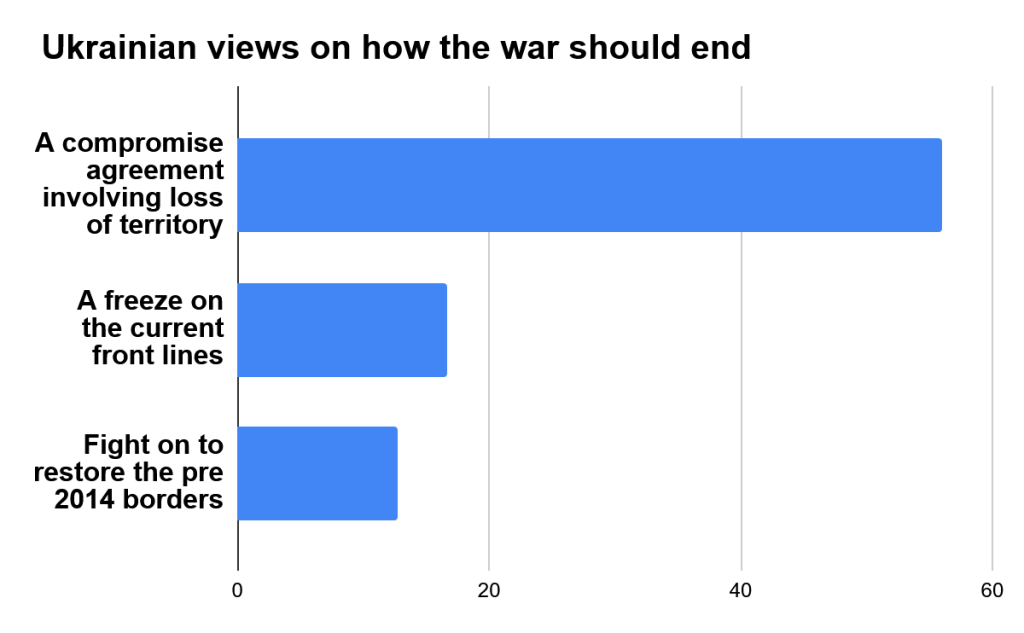
How might the war end? Discordant voices from Ukraine.

“I don’t want anyone else to die,” Natalya says, crying. “Our little trooper is the youngest of all those who lie here.”Here” is the military cemetary in Lviv. Her son was 18.

What follows are a series of quotes from an article in Meduza based on interviews with people across Ukraine. Meduza is a Latvian based English and Russian language news blog with an unofficial motto “make the Kremlin sad”.

Despite that. what is striking about this selection is how the views expressed differ from the limited range of Ukrainian voices we get to hear in the official media here; which is why I have highlighted them in concentrated form in this blog.

I want to stress that for each of these views in the full article – which is worth reading – there is another arguing for carrying on fighting until the 1991 borders are restored, “otherwise what have we been fighting for?”

In these arguments, the deaths of the future are sanctified in advance and made imperative by the deaths of the past. None of the people who put this view, however, argue that it is possible. It is posed more as as a moral imperative, a revulsion against sacrifice in a lost cause; thereby carrying within it the prospect of a backlash not only against any peace terms that Ukraine accepts, but also those who have conducted an ultimately futile war. So the question “WHAT have we been fighting for?” is inextricably entwined with,“WHO have we been fighting for?” especially as the Kyiv oligarchy’s US puppet masters measure up the country’s natural resources as compensation for defeat.

“This is a separatist city; there are many zhduny here,” he ( a young soldier in the Ukrainian army) says of Sloviansk (a city in Northern Donetsk, close to the front line now) using a Ukrainian term for people who are “waiting for Russia.” “Even the local grandmas look at me like they want me to drop dead.” 

According to Oleksandr, Sloviansk residents with pro-Russian views no longer speak openly “because they understand it will cause them grief.” But Lera says that in some local Telegram groups, they refer to the Russians as “ours,” and local taxi drivers and shopkeepers often use the word “ruble” instead of “hryvnia.” 

This confirms that pro-Russian views in eastern Ukraine are a reality, not a “Putin talking point”. In other parts of the country, sentiments like these are expressed.

“If I were [in the politicians’ place], I’d have come to an agreement already, to be honest. I just want the war to end.”

“Yes, we’d like the 1991 borders to be ours, but not [if we have to fight] to the last Ukrainian. If so, let everything remain as it is. Not at this price.”

Borys says he wishes “Zelensky would stop this.” He thinks that Ukraine’s occupied territories should receive neutral status or become part of Russia, so long as the majority of Ukrainians are left alive; joining NATO isn’t worth such losses, he says.

“I think we should start negotiations [with Russia] and then decide the fate of [the Donetsk and Luhansk] regions through an honest poll. So people can decide for themselves which country they want to be in,” chimes in his friend Ihor, 18. 

“Are we going to sacrifice a million [people] for Crimea? And then what will we get?” Valetov continues. “I’m going to say something [that sounds] bad, but the people in Donetsk and Luhansk are no longer ours — with the help of television and Telegram, you can flush everything [Ukrainian] out of people’s minds in 11 years.”

She worries that politicians have gradually turned the war “into a business,” and she doesn’t understand how the money sent to help Ukraine is spent. “I have a lot of friends at the front whose [relatives] equipped them,” she says. “[It’s like,] You want normal body armor and a good helmet? Get it yourself.” 

“I don’t understand why our boys are at the front, but guys from Donetsk come here in their big flashy cars and live it up,” she cries (Maryanivka is about 500 kilometers, or 310 miles, from the front line in Donbas). “Why don’t they go there and defend their territory?!”

Ukrainians are tired of the war for many reasons, including because many of them donate money to support the army only to hear about constant shortages of weapons and equipment. She’d like the war to end with Ukraine getting back its occupied territories, but “if it were going to happen, it would have happened long ago,”

“Do you know what a Pyrrhic victory is? I don’t want such a victory,” he says. “But if our territories are given to Russia, this would be a capitulation, which isn’t right either. Therefore, just freeze the conflict. But on one condition: our country introduces the death penalty for embezzlement today. I’m no supporter of the death penalty, but I think it’s time.”

“They’re stealing our boys!” cries Yevhenia (name changed). Her draft-age son “was taken right from the bus stop” to basic training, even though he should have received an exemption as his grandmother’s caregiver. Yevhenia says her son failed to submit his documents to the military enlistment office in time. “If I’d known that would happen I never would’ve let him go out!” she says, practically in tears.

“It feels like they just want to destroy us,” he explains. “Not just the Russians, but our command, as well. We’ve been sitting at the front endlessly. It’s as if they’re saying, ‘There’s no one to replace you, [so] you have to die here.’”

According to Stanislav, morale is low and soldiers are just trying to survive. “Anyone who talks about peremoha should grab a Kalashnikov and go for it,” he says, using the Ukrainian word for “victory.” “On the Zaporizhzhia front, the Russians are making concrete and fortifying their positions with it. How are we going to break through? I’m horrified at the thought of going on the attack there. We’ll just drown in blood.” 

Asked what to do about the so-called Donetsk and Luhansk “people’s republics,” Stanislav argues that the easiest solution is to “amputate” the Donbas region. Mentioning the fact that Ukrainians live there makes him roll his eyes. “Oh, for fuck’s sake,” he says with a sigh.

Sacred Chord in the High Street

The busker – Your Local Music Man – at the strategic pedestrianised T junction, where the shoppers from Morrisons wandering up George Street past the hulk of the State and the stalls selling funnel cakes, ersatz perfumes at £10 for a bag of three, and hunks of meat in plastic bags, interweave with those meandering along the High Street, is playing Leonard Cohen’s Hallelujah.

Now I’ve heard there was a secret chord
That David played and it pleased the Lord

But you don’t really care for music, do ya?
It goes like this, the fourth, the fifth
The minor fall, the major lift

The baffled king composing “Hallelujah”
Hallelujah, Hallelujah

I love this song. If only because you’ve got to admire the chutzpah of a man who can rhyme “Hallelujah”, with “do ya”. I realise, as I try to sing along (quietly) that that is the only line I can remember, apart from the chorus (which is a bit hard to forget). I notice a woman walking with her partner in the opposite direction who is also singing along quietly, almost under her breath; meaning that the busker has at least two private duets going on that he is probably unaware of.

An alternative title for this blog could have been “Loneliness of the long distance busker”: to try to capture the peculiarity of playing music to sparse streets and individuals who drift by without stopping. Only the buskers themselves are present for the whole performance. Everyone else picks up whisps and fragments, more present when you’re close and you know the song, gradually fading into the distance and past if you tune out, or when you turn a corner or get further away. A momentary intrusion, usually welcome, into constant internal monologues, derailing trains of thought in hopefully fruitful ways into wistful memories, or the communion with others that you get from singing along, even when no one else is doing it.

I realsie, also, that I’d done a mondegreen on the first line. The actual lyric is “secret chord” which, given the way that Cohen’s songs are so often drenched in religious poetry, I had always heard as “sacred”. I suppose this is the revenge of the light side to all those Faustian musical deals with the devil you get in crossroads blues and, indeed, School of Rock.

Rearmament is a preparation for war, not peace.

Questions in the YouGov daily chat are invariably manipulative, but today there was one that was ludicrous.

In the event of a wider war in Europe, involving the UK, how do you think you would cope? Well? Badly? Other?

My response was, as a wider war in Europe, involving the UK couldn’t help but go nuclear, we’d all be dead. FFS get real! I normally keep polite on these polls, but really!

We are now, of course, in an extraordinarily dangerous situation in which a drive towards war is being presented as an attempt to secure peace and all right thinking people across all mainstream parties and media are agreed on it.

Discussions in the media are framed within the presumption of a Russian threat. No one questions the premise, largely because its false and s doesn’t stand up under the remotest scrutiny.

The same programmes sometimes have military speakers like Lord Dannat who assert that “Russia’s military is on its last legs”, as a way to argue that sustaining the war, in the way that the US is no longer willing to do, would soon lead to a NATO win, presumably with one last heave.

The incompatibility of this wishful thinking with the otherwise dominant line that a peace deal in Ukraine would lead to the Russians steamrollering across Europe is never noticed. Its almost as if they are doing it on purpose.

Without making any false assumption of an impending Russian collapse, lets look at the actual balance of forces between Russia and the European NATO powers.

According to GFP – strength in numbers, the leading annual global defense review since 2005 (in their own words) the European members of NATO, excluding the USA and Canada, are spending $445.7 billion on their militaries this year,

Russia is spending $126 billion. So, the FT assertion that Russia is spending three times as much as “Europe” is the opposite of the truth.

That means that without the USA and Canada, European NATO countries are already outspending the Russians by 3.5 to 1 on their militaries.

Add Ukraines $54 billion and the ratio gets to 4 to 1. That looks like this.

Put teeth on this and it looks like Pacman.

Add the USA and Canada’s $936 billion and it gets to just over 11 to 1, but even without them, given this imbalance, it is patently ludicrous to argue that the Russians, already outspent on this scale, have any capacity to attack NATO countries in Europe, even if they wanted to, which they have repeatedly pointed out that they do not.

Therefore, if the aim is “peace” and “defence”, even assuming a continued hostile stance between the EU and Russia, with no attempts to reset the relationship, reduce tensions and find a mutually acceptable modus operandi that would ensure a lasting peace, rather than a pause to tool up for Round Two, there is no need for increased arms spending. The orthodox militray presumption is that a succesful military attack require the attackers to have a 4:1 superiority. That leaves aside the political issue that an attacking power would have to have some degree of popular support to sustain an occupation. As the US and its allies found out in Iraq, even a crushing technological and military superiority is not enough to sustain a grip on a country if the people you are occupying hate your guts and want you to leave.

The current balance in military material is shown by this graphic from Germany, which shows an upward trend in spending from 2014 onwards, and also the greater NATO force in every form of weaponry, even if the US is removed from the equation. The only area in which Russia has more material that European NATO is in satellites and, narrowly, short range rockets; in military personnel, artillery, tanks and other AFVs, ships, aircrafyt and combat helicopters, Euro NATO already has a very powerful advantage; with a million more soldiers, three times as much artillery and attack helicopters, five times as many tanks and six times as many ships.

So, the proposed increases in military spending are not about “defence”.

Particularly not the massive EU military spending pledge by Ursula Von Der Leyen today. 800 billion Euros. Thats $860 billion. Add that to the current spending and you get to $1360 billion.

Compare that to current Russian military spend and you get this.

This is not preparation for defence, it is preparation for war; a war that, with Russia prepared to use nuclear weapons to defend itself, would kill all of us if it were to be engaged in. With the current UK “defence review” arguing that we are in a “pre war situation”, we should take the insanity of those that rule us sufficiently seriously to oppose them.

Post script: the state of public opinion

A YouGov poll reported in the Guardian (7/3/25) shows that the propaganda is working, up to a point.

  • 60% of respondents in the UK thought – falsely -that Russia would attack other European countries within the next ten years. The figures for France and Germany were more sceptical, Italy even more so. Rather important therefore for the reality of the actual balance of forces to be kept from them.
  • Even with this view however, only 24% of respondents in the UK thought that the current level of military support to Ukraine (£3 billion) should be increased and, despite the avalanche of emotive coverage in the last week or two, fewer than half in the UK support an increase in “defence” spending; which will mean increasing resistance to doing so as the cuts needed to sustain it start to bite. Support for increases is also a minority view in France, Spain and, especially, Italy.
  • Only between a quarter and a third in each country believe that the European powers can substitute for the US, which makes the other positions a Potemkin village of a posture with nothing behind it.
  • There is now a lot of hostility to the US within European populations; with 58% -78% now considering it to be “a big or fairly big threat to peace and security in Europe”.

Ozymandias in Gaza

I think Shelley got Trump in one…

I met a traveller from an antique land
Who said: “Two vast and trunkless legs of stone
Stand in the desert . . . Near them, on the sand,
Half sunk, a shattered visage lies, whose frown,
And wrinkled lip, and sneer of cold command,
Tell that its sculptor well those passions read
Which yet survive, stamped on these lifeless things,
The hand that mocked them, and the heart that fed:
And on the pedestal these words appear:
‘My name is Ozymandias, king of kings:
Look on my works, ye Mighty, and despair!’
Nothing beside remains. Round the decay
Of that colossal wreck, boundless and bare
The lone and level sands stretch far away.”

Thus do I exist, between my ears…

Sleepwalking to war?

The juxtaposition of the headlines from the Guardian and City AM, as they flopped onto the mat this morning, was unintentionally instructive. “Fight for peace” is in inverted commas perhaps because the Guardian has a vague historical memory that “Peace through Strength” was what all the great powers were relying on in the run up to World War 1, and it worked really well; until it didn’t.