Reflections on the National Climate and Nature Emergency Briefing

Introducing the National Climate and Nature Emergency Briefing to a packed Westminster Central Hall last Thursday morning. Chris Packham noted that this was the first briefing of its kind, aiming to present the facts from eminent scientists aimed at “decision makers”; MPs, Local Authority, business, faith and union leaders, cultural influencers, so that the state of the crisis can be fully appreciated and acted upon with the level of urgency that it demands.

It is little short of a scandal that this briefing had to be generated from the bottom up, when it is an obligation of all countries that have signed the Paris Agreement – under Article 12 – to educate their population on the nature and state of the crisis and the measures needed to deal with it. This should be being done by the government, and by the media.

The follow up campaigning from this Briefing is aimed at getting them to do just that, putting a similar event on all major TV channels with a proper level of government support. Everyone should sign their letter demanding that. Link here.

Packham stressed the importance of following the science, and noted the failures to do so that have just come out in the Covid inquiry. The delay to the first lockdown against scientific advice. The “eat out to help out” scheme, devised by Rishi Sunak in the Treasury, with no scientific input at all, both of which led to unecessary deaths. In the case of climate breakdown, ignoring the science will repeat the history, but this time as even more of a tragedy and even less of a farce.

There were nine speakers emphasising different aspects of the crisis, which overlapped in places. I’m summarising here, with a few additional comments.

Professor Natalie Seddon argued that Nature should be seen as “critical national infrastructure”. The UK is in the bottom 10% of most nature depleted countries, with an overall decline of 19% in wildlfie abundance since 1970, only 3% of land area protected and only 25% of peatlands, 14% of rivers and 7% of woodlands considered to be in a healthy condition.

Without the restoration of peatlands and wetlands and measures in urban areas like Copenhagen’s Sponge Parks, the 5 million properties currently at risk of flooding will grow in number and frequency of risk.

The benefits for mental, and physical, health from access to nature and urban green space is recognised by the more than 50% of people who think that the government isn’t doing enough to regenerate it; and the paradox of trying to “build, baby build” by removing environmental regulations on developers is that nature depletion through short termist eco system degradation damages GDP.

Professor Kevin Anderson laid out the bare bones of Greenhouse gas emissions in a way that pointed to the intense weather, social, economic and political turbulence we are heading into at pace.

He noted that the range of variation in GHG emisisons during the ice ages, from deepest ice age to warm interglacial periods, was no more tha 100 parts per million (PPM). During the Anthropocene, the entire period from about 10,000 years ago to the last two centuries, the variation was no more than 20 PPM. Since 1750, the increase has been from 280 PPM to 425 PPM – 145 PPM (half as much again as between ice age and interglacial) in just 300 years. And its still rising. The central – absurd – contention of climate change denial is that this has no impact.

An average global temperature rise of 2C will be extermely dangerous. Current climate impacts are at 1.4C. Getting to 3C or 4C poses generalised social and economic breakdown and war.

The remaining “Carbon Budget”, the amount of total extra emissions allowed before a temperature limit is breached is 130 Gigatonnes for 1.5C. At present rates of emisison, that will be breached in three years. It is 530 GT for 2C. That will be breached in 13 years at current emissions. Current projections are that emissions will begin to fall this decade, but at a rate far too slow to avoid these breaches.

Emissions would have to fall 20% a year to save 1.5C and 8% a year for 2C.

The UK tends to be self congratulatory about its record, but has only reduced emissions at a rate of 0.6% a year since 1990. To meet an equitable target, as a wealthy country with a long record of carbon emisisons that are way higher than its global fair share, it would have to reach zero carbon emissions by 2039 and reduce them at a rate of 13% a year to get there. On this basis, the Net Zero by 2050 target allows the UK to have three times its fair share of carbon emissions; so a bit more humility about “global leadership” might be in order.

Doing this requires the right kind of technology and changes in social norms.

We need to go flat out for renewable energy, electric transport and insualtion, while avoiding “delay technologies” like Carbon Capture and Storage (which has been hyped for thirty years but only managed to sequester 0.03% of fossil fuel emissions in 2024). These tend to be high cost (for us) and high profit (for owners).

The damage done by the discretionary income of high income, high emitting people has to be confronted as we need a society of “private sufficiency and public luxury”, as “it is now too late for non-radical futures”.

Professor Hayley Fowler examined oncoming weather impacts, pointing out that the climate we have now is “the least extreme climate you will experience in your lifetime” and that, so far, both rainstorms and heatwaves have been more intense than models have predicted.

Mega storms, in which 8 months worth of rain falls in a few days, are becoming more common. The damage done is unimaginable until it happens.

By 2050, on current trajectories, 1 in 4 homes would be at risk of flooding

Our current infrastructure is built for a world that no longer exists. So, if adaptation to whats coming isn’t built into all planning, we will be in a state of permanent crisis management, as “natural” disasters pile up and intensify. So, every pound spent now to avert as much of this as possible will save many pounds in having to deal with it.

Professor Tim Lenton explored Tipping Points. These are sudden dramatic shifts for the worse just from carrying on doing business as usual. As we are currently at 1.4C additional average global heating and heading for 1.5C by 2030, we are already seeing drastic impacts on coral reefs, the Amazon and methane emissions from melting permafrost in the Arctic. All these together have the potential for a runaway scale of emissions that will be beyond our ability to mitigate.

The biggest and most apocalyptic of these is the risk of overturning the Gulf Stream (AMOC), as the Greenland Ice Shelf pours billions of tonnes of cold fresh water into the North West Atlantic. All surveys show that the AMOC is weakening. The only question is how much and how fast. Some climate models for a 2C increase world project a situation in which the Arctic sea ice in February would reach as far as The Wash, average temperatures in London would be -20C – in Edinburgh -50C – with two frozen months in mid Winter. Summers, however, would be hotter than they are now. It would be impossible to grow food and there would be insufficient water to sustain the population in the South East in the Summer. Infrastructure engineered for a temperate climate would buckle under conditions more severe than currently in Irkutsk. That would mean most people from the UK would find themselves climate refugees: looking for a safe place in a world rapidly running out of them, as in this scenario, harvests from bread basket areas would halve.

Countering these prospects are the need to promote positive technological and social tipping points in power generation, transport, and residential emission, with strong mandates to phase out fossil fuel use.

Professor Paul Behrens looked in more detail at Food Supplies, noting that the Syrian civil war resulted from a several years long drought that forced farmers off the land into cities in conditions of precarity and poverty.

At present, the chance of a major crop failure in major bread basket areas is 1 year in every 16. When we get beyond a 1.5C increase, that comes down to 1 year in every 3. At 2C, its every other year. As we are certain to be beyond 1.5C by 2030, we are heading for hungry times – and everything that goes with them.

The UK has had 3 of its 5 worst recorded harvests in the last ten years. 80% of its farmers see climate change as a threat to their futures. At present the UK grows 54% of its food, so 46% is imported. 25% of UK food imports are from the Mediterranean region, which is being hit hard by climate change too.

A third of price inflation in 2023 was driven by climate impacts, helping generate an increasingly febrile politics. 40% of food experts believe widespread civil unrest linked to food shortages is ‘possible or likely’ in the UK within the next 10 years. Over 50 years, nearly 80% of experts believe civil unrest was either possible, more likely than not.

To avert this, we need a sharp shift in diet to eat a lot less meat. A mostly plant based diet would cut about 60% of UK agricultural emissions and free up a lot of land to grow more food as, at present in the UK, more than half of agricultural land is devoted to animal farming. This would also have positive health impacts, saving the NHS £55 million a year and his remark “if we don’t adapt, it will be forced upon us” drew a spontaneous round of applause.

This point was reinforced by Professor Hugh Montgomery’s contribution on Health, who noted that a shift to a plant based diet and more active travel would have a positive impact on strokes and cardiovascular, cancer, lung diseases, diabetes, and most other common illnesses and causes of death. At the same time, a consequent reduction on obesity could save the NHS up to £126 billion a year.

He also stressed that, as an emergency doctor, when faced with an emergency “you don’t treat it with words and homeopathy” and you have to be very frank with patients about what their situation is and whether they are prepared for the struggle to get through it.

He noted that actuaries, not climate scientists, have assessed that, in a 3C world there is a likelihood of 4 billion deaths from socio political failure (almost 1 in every 2 people) and concluded that we need “transformational change”.

At present, the food industry is concerned that it cannot rely on “predictability of supply”.

This was again underlined by Lt General Richard Nugee, speaking on National Security, who noted that food inflation is already at 4.9% and cited Alfred Henry Lewis’s 1906 remark that “There are only nine meals between mankind and anarchy.” He argued that climate change is a “threat multiplier” that parts of the world are becoming uninsurable and there is a grave risk of “cascading crises” which erode trust and social solidarity, overwhelming governments and undermining consent, leading to an ungovernable state. In this he echoed the assessment of the US military in 2019 that, as climate impacts broke down US society, the armed forces would be drawn in, first as emergency support, but inexorably taking on state functions as civil society broke down and, eventually, overwhelmed themselves.

More problematic was his stolid framing within the UKs current “defence” orthodoxy, enshrined in the Strategic Defence Review; which cements the UK’s alliance with the United States which, under the Trump adminstration, is a complete rogue state on climate; seeking “global energy dominance” by doubling down on fossil fuels and trying to drag the rest of the world down with it. Any country that allies with that, and everything that flows from it, is part of the problem.

While he hinted that “authoritarian populism” is a threat to “Western Democracy”, he did not specify whether he was referring to Trump and Farage as enemies within, or whether this was code for the conventional “rising powers” narrative directed at Russian and China that underpins the SDR – possibly both. This left him with an impossible contradiction; that its possible to spend an additional £77 billion a year on “defence” – the amount required to meet 5% of GDP – and at the same time invest enough to avert climate disaster within our existing economic system. It isn’t. And simply asserting that we “must” doesn’t resolve it. A choice has to be made between a military confrontation of choice, and global cooperation to avert climate breakdown and, as the General said himself. “Climate change is a threat now; and one thing I was taught in the military is that you have to face the threat in front of you as it actually is, not how you’d wish it to be”.

Professor Angela Francis looked at the economics of transformation, noting that “the status quo can seem attractive, even if its a dangerous place to be”, but the cost of inaction is far greater than the cost of action; and it won’t be cheaper later.

The All Party Parliamentary Climate Change Committee projection is that the UK’s current Net Zero by 2050 pathway would cost just 0.02% of GDP.

A fast transition would save the global economy $12 trillion of damage. A slow transition just $6 Trillion. No transition… just takes the hit.

An example of this is that energy price inflation would have been 11% lower had we made a faster shift to heat pumps. So, the damage from delay is already being felt.

She stressed that market economics takes the environment for granted. Stable weather. Fresh water. Free pollinators. Fertile soil. And that without regulation, any investment comes as an additional cost. So, strict regulation is essential.

Faced with the consequences of their actions, fossil fuel companies, could have diversified and shifted. Orsted is an example of one that has. But most haven’t, and are digging in on their core product, because fossil fuels are very profitable. We therefore need a massive, permanent windfall tax to make it less so.

Her final point that the transition has to be made to work for “low and middle income” people was underlined by Tessa Khan from Uplift, who noted that the decline of the North Sea, with half the jobs going in the last 15 years even as new investment continued, has to be met by a structured plan for transition to decent jobs in renewable energy and that electrification has to be more affordable than the status quo.

This can be done. Half the UKs recessions since the 1970s have been caused by fossil fuel price spikes. The cost of subsidising the spike in gas prices at the start of the Ukraine war was £64 billion and the additional costs to households and busiensses was another £60 billion. The UK is still dependent on gas to heat over 80% of its homes.

In an energy system based on renewables the fuel inputs from the sun and the wind are free forever. Prices for renewable technologies are falling steeply. Down 50% for offshore wind and 70% for solar and 80% for battery storage in the last ten years.

Renewables are more efficient that fossil fuels. A typical ICE car will only use 25% of its fuel to actually move its wheels and the FF system as a whole wastes about 2/3 of the energy that goes into it.

But, at this point, we need a lot of upfront investment to make the shift; upgrading the grid, shifting to heat pumps. That is a matter of political priorities and energy bills can be restructured to match the lower costs of renewable energy generation.

The governments plan for a million clean energy jobs in the electrification of our energy system needs investment to make it work comparable to the wholesale shift from town gas to natural gas that was done in just under ten years in the 60s and 70s.

A point nudged at here is that this would require the state to take back control of the sectors needed to do this. In the 60s, British Gas was a nationalised company. In the same period it was possible to build hundreds of thousands of affordable council homes because Local Authorities had substantial Direct Labour Organisations (and most architects worked for LAs). When Angela Francis talked of the need for “trusted” companies to carry out the wholesale insulation of housing that we need, she begged the question of which companies they might be – given the fragmentation and fly by night character of far too much of the current UK construction sector. To do the job, we need the right tools. We can’t do it with the broken ones we have.

Professor Tim Berners Lee, chairing and summing up set a challenge to “reset the national conversation” using the clips of the speeches and upcoming film that will be put on tour in the Spring arguing that the “survival of society” depends on a “WW2 level of leadership”, but that the necessary emergency legislation and investment will need consistent public pressure to challenge the misinformation and gaslighting and force the pace so that the UK can “come together and lead the world out of trouble…along with other proactive countries”. Although framed in traditional unreconstructed nostalgic British narratives (that terrible yearning to “lead the world”, when the UK did so much damage the last time it tried to) that recognition that that would have to be done with “other proactive countries” hints at a dawning recognition that geopolitical alignments will have to shift to respond adequately to the imperatives of the climate emergency.

He ended with the point that “hope is a dicipline” which, together with Brian Eno’s remark from the floor that “movements catch fire when they recognise themselves” are good thoughts to sustain us.

There is a further urgent point, implied by the Briefing but not explored by it. Kevin Anderson’s point about the pace at which climate limits are being breached overlaps with the impacts on food supply and severe weather impacts which are already developing. These warnings have usually been posed to political leaders as warnings. This is what will happen if you don’t react enough. The student protests before the pandemic had a similar focus. Here’s the truth. Act on it. These impacts are already beginning, and whatever is done now they are likely to deepen in the immediate future. This poses serious economic and political disruption.

The purpose of political formations like Reform, or Tommy Robinson’s current – here and elsewhere – and the reason they are so lavishly funded by the likes of Musk, is to make sure that the political response to that combines climate denial and xenophobia, to take the heat off the people who have caused the crisis and make us fight each other instead.

This poses a challenge to the labour movement both on how we resist this and, in conditions of social crisis, how we collectivise a response based on solidarity – whether thats to food shortages (which are usually managed by the market with price increases that further impoverish the poorest but could be addressed by rationing policed by unions taking control of resources in supermarkets and warehouses, in the event government doesn’t step up) or whole communities inundated by floods (which private insurance will no longer cover).

This is a link to the materials from the Briefing which can be used to get discussions going with people you know.

Climate Myth Busting

This is the content of a talk I gave on a lunchtime Teams meeting with members of the Public and Commercial Services Union (PCS) as part of a series they are holding this week to help kick start the Year of Trade Union Climate Action. Now that, for the first time, elements of the far right launched a physical attack on a climate march in Manchester at the weekend we can see how weaponised lies have violent consequences; making combatting them all the more urgent.

What I aim to do in this brief talk is identify the main sorts of climate denialist mythmaking – firstly on the science, secondly on the social and economic front – identify where they come from and why they can be so potent and suggest sources of info to counter them.

The overarching aim of climate misinformation is to muddy the science, to confuse, deflect and delay. As such it doesn’t have to be coherent or consistent.

Climate Science itself is very clear.

1 Gases like CO2 and methane trap heat in the atmosphere. As you add more of them, you trap more heat. Do this continuously and you will get a trend of global heating – a greenhouse effect.

2 The main source of greenhouse gases is industrial and agricultural activity, primarily burning fossil fuels. Since the start of the industrial revolution in around 1750 the concentration of CO2 in the atmosphere has been pumped up from 280ppm to around 425 ppm today.

You sometimes get people who say that temperatures aren’t rising, most often as sarcky asides during cold snaps – where’s that global warming then, huh? But most people most of the time now know temperatures are going up, because its what they are experiencing. The hottest years on record are all in the last ten.

So the arguments you tend to get are that that these rising temperatures aren’t due to greenhouse gases but due to other “natural” factors. Temperature has always varied. Its been hotter and colder in the past. Its all due to other, natural factors that are way more powerful than anything we are doing. All these arguments amount to an absurd proposition. That you can add 145ppm of ghgs into the atmosphere in just under 300 years with no effect whatsoever.

Nevertheless, to briefly touch on these arguments

1 Volcanic activity tends to have a cooling effect. The year without a summer in 1816 caused by the eruption of Mount Tambora. Not a useful explanation for things generally heating up.

2 Solar activity goes in cycles and in the last 40 years the variation as been below 0.1%. Since 1750, the burning of FFs has had 270 times the impact of solar activity. So, no explanation there.

3 Long term variations in the Earths orbit and tilt, caused by the gravitational pull of the larger planets, which have indeed been responsible for much more dramatic shifts in global temperature than we are seeing now, “snowball Earth”, forests at the South Pole, go in what are called Milankovitch cycles which take place over 100s of 1000s of years. The cycle we are in the middle of now would imply a slight cooling effect at the moment, if we weren’t forcing the pace. So, yes, things have been significantly hotter and colder at points in the past, but those factors are not operating now, while the forcing effect of greenhouse gas emissions IS happening now.

One last one on the science. Farage and the like express incredulity that CO2 is classed as “pollution” when it is actually plant food. A wonderful illustration of the principle that a little knowledge can be a dangerous thing. CO2 is NOT classed as pollution – paradoxically pollution has tended to act to cool the atmosphere, and successful attempts to clean it up, like in China in the last decade or so, has accelerated heating. CO2 is a greenhouse gas. And that’s the problem. It does encourage some plant growth, but this is limited, and counteracted by the impact on plants of rising temperatures on habitats – as trees can’t migrate – and extreme weather on harvests. As we’ve seen in the UK in the last couple of years. And as rising chocolate and coffee prices are witness.

Leaving aside social media, and the algorithms promoted by big tech, which generate excessive attention for emotive misinformation – if you read most UK newspapers you get a very weird and hyped view of the world just from their choice of adjectives.

Climate targets are always “unhinged”, or “lunatic”, or “eye watering”. Politicians identified with them, like Ed Miliband, are always “swivel eyed” or “eco loons” or “hypocrites”.

Renewable energy is always derided as “expensive” and/or “unreliable”.

All of these are free floating. They don’t attach to any reasoned argument, but the constant repetition of “the eye watering costs of net zero” creates a delusion that is taken for granted. Its what the press does on many issues of course.

This venom is being generated from the fossil fuel industry and its political tools, from Trump to Farage to Claire Coutinho.

Like any industry facing an existential threat to its profits FF companies are acting with the same sense of social responsibility as the asbestos and tobacco companies did before them in denying any association between their products and cancer – and are acting from the same playbook – funding “think tanks”, buying up lobbyists and astroturf media outlets like GB News, running bot farms to deny, deflect and delay.

As they now Donald Trump in the White House, pushing for “Global US Energy Dominance” through doubling down on fossil fuels and trying to force the rest of the world to do the same – they now have control of the world’s biggest bully pulpit to speak power to truth.

Part of this is an ideological war on reality. Defunding and closing down government departments scientific and academic bodies that research or monitor or regulate climate impacts or wider harms to the environment, banning use of climate related terms in government documents, even setting up a Federal body to edit academic papers so that they don’t challenge the Administration’s line that “climate change is a hoax”. US academics at international conferences have taken to using burner phones.

This works very directly at home, and there is straight government to government pressure to shift policy against renewable energy, but through the immense financial clout of FF billionaires they are also funding pro Fossil Fuel political formations like Reform in the UK, to which the more traditional Right is bending. As Kemi Badenoch put it to the FT in the summer, for the Conservatives now “the model is Javier Millei”.

The formula that the BBC use about this is “the political consensus on net zero has broken”. What they do not note is that the scientific consensus has NOT. What was a 97% agreement on the human causes of climate change among scientists according to surveys in 2013 has now risen to 99%. We need to be clear that what this means is that Parties like Reform and the Conservatives do not have a policy that grasps reality, which means that having an “impartial” or “balanced” debate on this issue gives undue weight and attention to bad faith fantasists.

Looking at some of the things they say.

Overall, its going to cost too much to meet NZ targets. As if doing nothing, or doing things more slowly, can be done with impunity. We are already in a situation in which the costs of failing to act earlier are starting to hit us. “Natural” disasters are becoming more intense and frequent. Recovering from them increasingly costly and debilitating. Parts of Canada, Florida and California and the rest of the world are becoming uninsurable. The UK environment agency has projected that 1 in 4 UK homes will be at risk of flooding by 2050. And, in a sign of the decline of business ethics that comes with this, a third of the victims of the recent US wildfires were subject to scams in the aftermath. We will have reached a civilisational tipping point when the costs and effort involved in recovery is too great, as we are hit by one impact after another like a flurry of blows from a boxer that will KO us. The OBR has projected that, if unaddressed, climate related risks could drive the UK’s national debt to 270% of GDP by 2070, up from less than 100% today. THAT would be eye watering.

By contrast, the OBR also projects that the cost of meeting the UK’s net zero targets over the 25 years to 2050 is £116 billion; less than £70 per person per year, or 19p per person per day. Are anyone’s eyes watering at the prospect of that. A snip at the price I’d say, and certainly worth the investment to secure a liveable planet for our grandchildren.

Specific arguments they raise…

  • The UK is only 1% of emissions, so what we do doesn’t matter.

The UK is responsible for its 1%, as every other country is responsible. No one gets a free pass, or is entitled to freeload on the efforts of others. The UK’s historic emission are far higher than average or our fair share, one estimate in the Lancet was that it was 7%. That’s from a few years ago and might be on the high side as estimates go, but we do have some living down to do. Also, emissions by consumption in the UK are 2% of the global total, so we have to carry our own can.

  • The UK is ahead of other countries, taking on an unfair burden and there are no prizes for coming first

This isn’t an approach they’d advocate for the Olympics, but the prize is a liveable planet; rather more important than a gold medal and worth forcing the pace on.

The UK is not in the lead. We are about seventh – which is pretty good and we should be proud of it – but this isn’t about where we are in relation to other countries, and wanting to slack off and drop back into the pack that’s just jogging along and hoping for the best, its grasping the fact that the faster we move the more we limit the damage. That’s the prize.

  • What’s the point of the UK doing anything when China/India…?

There’s a point because if we weren’t doing anything, everything would be worse, irrespective of what anyone else does.

In the case of China, which has a per capita carbon footprint somewhat higher than the UK but half that of the US, its emissions are peaking and have been at a plateau for about 18 months. Coal production has peaked and their coal fired power stations are currently operating at about 50% capacity as they are redefined as back up. The projection from the IEA and others is that China’s emissions will fall much more quickly than they have in the developed countries because their deployment of renewable energy and EVs is on such a vast and rapid scale – solar farms the size of Bristol. This is having a knock on effect globally, with the export of renewable technology alone knocking 1% off global emissions last year and the impact of EVs replace FF cars significantly reducing global oil demand. India is also moving very fast towards renewables and their per capita carbon footprint is about half that of the UK. Its worth noting that 60% of developing countries are more advanced in getting their electricity from renewable sources, and electrifying their entire energy supply, than the US is.

  • Your energy bills are high because of “stupid net zero”

UK energy bills are high because 1. they are set by the price of gas, which is higher than the cost of electricity generated from renewable sources. In fact Analysis by the Energy and Climate Intelligence Unit (ECIU) shows that in 2024 UK wholesale electricity prices would have been over 30 per cent higher if there had been no wind power generated in the UK 2. 25% of the bill goes in profits for the energy companies.

  • Heat pumps don’t work when its cold

This will come as an enormous surprise to the 60% of people who use them in Norway.

  • EVs have a higher carbon footprint than FF cars

The manufacture of EVs is more carbon intense than for FF cars, but over their lifetime, the impact of the manufacture is cancelled out after about 2 years or 15,000 miles. As batteries become more efficient and last longer, this will become ever more the case. And, in passing, all the elements of batteries, and wind turbines for that matter, can be recycled, so we are not going to be left with mountains of toxic waste (as if we don’t have that now, take a trip to Rainham).

  • We can’t stop global heating, we just have to live with it

Trying to implement the Paris Agreement has cut the projected increase in global temperatures for 2100 from a catastrophic 4C to 2.8C on current policies and between 2.3 – 2.5C on current pledges. That’s still bad, but we’re moving in the right direction and need to accelerate not slack off. Every 10th of a degree makes a difference to how damaging and costly this will be.

Adaptation without mitigation would be impossible because the damage would be so severe that we couldn’t cope with it. Swiss Re has compiled a list of countries that are most likely to face ecological collapse if heating is left unabated. It starts with South Africa and Australia, which the rest of the world might be able to cope with, but number three on the list is India; one in every 5 people on the planet, with conditions deteriorating everywhere else too. Nightmare.

It ain’t (just) what you do, its the way that you do it

Some genuine problems are built into not transition itself, but the way its being done. An example is the botched insulation schemes run by successive governments which have been based on providing subsidies for householders to employ barely competent, or downright fraudulent, white van men – with the same sense of social responsibility as the FF companies – to use inappropriate materials, installed in an inappropriate way leading to 93% of them causing black mould and having to be redone. This growing wheat in flower pots, consumer led approach takes the fly by night, fragmented, micro business dominated UK construction industry as a given and will continue to cause disasters if persisted with in any warm homes programme. What we need instead is a proper level of investment in the reconstruction of Local Authority Direct Labour Organisations, with properly trained and educated unionised workers (who see insulation as part of a social mission to rescue their communities and therefore see their work as important to get right and a source of pride, not just a job) through local FE colleges, working on a street by street plan to get the maximum economies of scale, insulating the areas with the worst fuel poverty first to get the earliest and greatest reduction in costs, in fuel use and carbon emissions and all the health benefits that flow from that (including the mental health benefits of no longer being under the cosh from the meter).

Cuba’s solar turn

This is the text of a talk I gave at the National Education Union’s inspirational Cuba Solidarity Education Conference on 15th November.

In the last year there have been numerous reports of the fragility of Cuba’s power grid, resulting from four major incidents of widespread power cuts.

The problems of the grid are based on

  • over reliance on ageing oil fired power stations, supplying 84% of electricity supply, which have been difficult to maintain under the US sanctions regime
  • fuel shortages, as most of the oil is imported from Russia or Venezuela, both of which are also under stringent US sanctions; one of which is in a proxy war with the US, the other threatened with imminent invasion by it.
  • the impact of US financial sanctions choking off access to loans to finance improvements in the system.

Peak daytime demand can reach up to 2500 MW, leaving a gap of between 800 and 1300 MW leading to widespread cuts.

These power cuts – not uncommon in the global South – have a hard impact on people’s lives, from cutting off water pumps and refrigeration (so you’re food goes bad) to knocking out communications. Back up generators are often insufficient because they also depend on diesel, which is in short supply, thanks to the sanctions again

The way out of this crisis has had two aspects.

1) Investment in repair and maintenance and energy efficiency in the existing fossil fuel grid with some engineering support from Russia, firming up 850 MW of supply.

2) Work with Chinese assistance this year to build 55 solar farms capable of generating 1200 MW, which should be enough to cover any shortfalls by the end of the year – with a further 37 solar farms due to be completed by the end of 2028 to account for increases in demand and provide a bit of a buffer. On a smaller scale, 22 wind turbines are being refurbished to generate another 30MW.

We should not that this development is not peculiar to Cuba, but is becoming a pattern across the global South. 60% of developing countries now have a higher proportion of their electricity generated by sustainable sources than the US does.

Fig 1 shows the pace of this.

As the US under the Trump administration abandons Biden’s ambitions for an America First energy transition, with the inflation reduction Act as a magnet to pull green investment into the USA and away from its competitors (and allies) – with, as now the world’s leading petro state – a straightforward reactionary attempt to prolong the fossil fuel era as long as possible- the rest of the world, when it can avoid being strong armed into forced contracts to buy environmentally ruinous US LNG with a carbon footprint 30% worse than coal per unit of energy – is moving fats towards electrification.

This is underpinned by several factors.

1. Its cheaper, especially solar – and getting more so. As a relatively new technology we are seeing rapid gains in efficiency and cost reductions. Costs fall about 20% every time deployment doubles. And we’re currently on course for more than doubling by 2030 and trebling by 2035. So, now 2/3 of global energy capital goes into electro-tech. FFs by contrast are becoming more expensive as old established fields like the North Sea dry up and new fields are relatively difficult and expensive to extract from.

2. It cuts costs long term because once the panels are in and the wind turbines up, there’s no need to import fuel. The wind blows. The sun shines. The batteries store. No charge. This underpins related decisions like Ethiopia banning the import of FF cars because they want to cut their fuel import bills.

3. Fossil fuels are wasteful. 2/3 of energy generated is lost. Electric motors are 2 to 4 times as efficient. So we can do a lot more with a lot less. A way to envisage this is in Fig 2. One container ship of SPs will generate as much electricity as 50 ships full of LNG and 100 ships full of coal. This is also true of mining, in which the total amount of extracted metals required for sustainability by mid century as equivalent to the amount of coal mining that had to be done to meet demand just in 2023.

With 70% of the world’s renewable energy potential in the global south and the massive potential supply, primarily from China, that we can see in Fig 3, there is now a real potential for generating a non polar world, in which each place becomes free to express its unique version of our common humanity by breaking the lock hold that FF based imperialist countries have on them.

The Trump administration’s attempt to assert “US Global Energy Dominance” is currently taking the form of a threatened invasion of Venezuela, to get direct control of the world’s largest energy reserves and the rare earths it needs, not for the energy transition but for its military.

One last domestic point. While delegates at the COP have been heard expressing relief that the US government isn’t there sabotaging the process from the inside – they are corralling their political supporters everywhere on common toxic themes of climate change denial, racism, repression, deregulation and privatisation, militarisation and the insidious intrusion of big US tech companies into monitoring every aspect of our lives. As Kemi Badenoch puts it to the FT, for the Conservative Party now “The model is Javier Millei”.

In this sense, the NEU’s internationalism, anti war, anti racism and climate campaigning come together, and we should coordinate more.

Gaza: A sense of proportion about bodies that matter, and bodies that don’t.

This is from the daily UN OCHA Report on Gaza.

On the night between 31 October and 1 November, the remains of three bodies were transferred to the Israeli authorities. According to forensic tests, they do not belong to any of the 11 deceased Israeli hostages believed to remain in the Gaza Strip.

Given the difficulties of finding the right 11 corpses amongst the tens of thousands under the rubble, perhaps the Palestinians should just carry on doing this. Send the Israelis three random bodies a day on the assumption that eventually, the right eleven should show up.

Going on the conservative assumption of 60,000 dead, that should all be done and dusted in 54 years and nine months.

Remembrance 1: “We’re going to need a bigger moat”.

Its October and, as the clocks go back in more ways than one, scarlet paper poppies begin to bloom on the lapels of MPs and TV presenters. So begins the annual ritual of Remembrance; using the blood of its victims to turn a warning about the human costs of war into a sanctification of preparing for another.

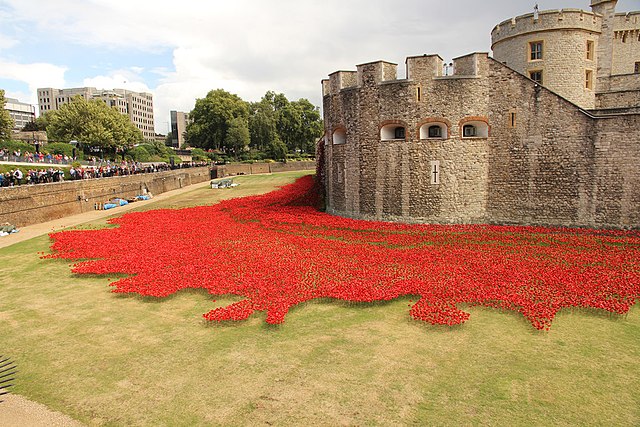
One of the most striking memorials to the outbreak of the First World War in 2014 was the “Blood swept lands and seas of red” installation at the Tower of London; which planted one ceramic poppy for every British and Empire fatality in the war. Estimates for how many of these there were vary. The installation used 888,246 poppies. The figure in Wikipedia is 887, 858. All the same, a lot of deaths. And the installation couldn’t help but numb and sorrow. Such an accumulation of individual losses made collective. Each individual poppy the colour of blood, and an echo of the scarlet of the state, as seen on phone and post boxes, London buses, the Brigade of Guards outside Buckingham Palace, and lost in it. Theirs had not been to reason why. And they had died.

On the Cenotaph in Whitehall, with an “unknown soldier” buried beneath, they are commemorated as “The Glorious Dead”; regardless of how they died or how inglorious it may have been.

Photo by Richard Croft. Creative Commons.

It is perhaps characteristic of a certain kind of British national narcissism that the only deaths commemorated were “ours”. Which underlines the limits of this sort of “Remembrance”. It becomes acelebration of victory sanctified by “sacrifice”. It tries to make it impossible to think past that sea of poppies to the losses suffered by other countries.

A commemoration of all the service personnel killed in the First World War would require a moat more than twenty times bigger, to register the 20 million or more of them killed. If you were to separate it out into national contingents, the French and Austrian sections would each be one and a half times the size of the British; that of Germany and Russia each more than twice as big. Having them all mixed up, in different colours perhaps, might underline their common humanity and the horrifying waste of it.

Civilian deaths in the First World War were a fraction of the military deaths, unlike the Second World War and most wars since. These are now running at about 67% of the total. Significantly more in Gaza. Commemorations that focus on WW1 tend to obscure that.

Civilian deaths from World War 3 would, of course, be total.

We are now in a period in which people who should know better are agitating for European NATO countries to prepare for a war with Russia by the end of the decade by doubling military expenditure (even though they already outspend them by 3.5 to 1) – a war that could not help but go nuclear – and it is a commonplace of US Foreign Policy thinking to envisage a war with China in the South China Sea – another war that could not help but go nuclear.

And, as Tom Lehrer once remarked, “if there are going to be any songs about World War 3, we’d better start writing them now”.

If we are foolish enough to allow our light headed and light minded leaders to make us collectively “pay undaunted the final sacrifice” in such insane adventures, age shall not weary us, nor the years condemn and at the going down of the sun and in the morning no one will be left to remember us.

Megalithic Kerb Stones

The view towards Harrow across Roe Green Park from the top of Highfield Avenue.

You tend to think of kerb stones as a bit like an insubstantial, almost conceptual, demarcation between road and pavement. Its only when the pavement is being redone, and they are exhumed and piled up, that you realise how huge and heavy and almost elemental they are. Parts of a Mesolithic henge reduced a more workaday function like fallen gods.

Another Life well lived. Patricia Joan Atkin (formerly Burford) 23/1/1930 – 6/9/2025

This is the story of my Mum’s life written and told by me and my brother at her funeral on 15/10/2025.

CHRIS We would like to welcome you all to this commemoration and celebration of the life of our mother Patricia Joan Atkin. In particular, Shirley and her family who are joining us from New Zealand, Colin and his family in Spain, Brian in Lincolnshire and Penny in Shetland.

It is lovely to see so many of you once again, just 4 months or so since we said goodbye to Dad. We always said they would not want to be parted for long and so it has proved.

In accordance with Mum’s wishes this is a non-religious ceremony, but there will be moments later for reflection, contemplation and prayer if you so wish.

PAUL Mum was born in January 1930, slightly closer to the start of WW2 than the end of WW1, to very young parents, Bill and Mabel Burford, who were both 20 at the time.

She spent her first four years in her maternal grandparent’s very crowded house in Bedford Road, with her parents, grandparents Charlie and Jinny, and their youngest children, Edie, Arthur and Syd; the last two of which were young enough to be playmates as well as uncles, and she was always very close to Edie.

Mum’s first memories were of being terrified by an army pipe and drum band that came skirling out of Grays Park while she was playing in the street, running home and banging on the door to find a place of safety from “that terrible noise”. Mum never liked sudden, loud noises (like me, or her Mum, doing the washing up).

CHRIS She did indeed instil in us a concern about being quiet and thinking of others; If we arrived home late from a trip out with Mum and Dad, she would always insist we didn’t slam the car door, talk loudly or make a noise as ‘there might be babies asleep’. As a pre-school child I remember crawling up the stairs as silent as a ninja on the rare occasions she allowed me to go upstairs for something when Dad was on night shift.

So it must have been an act of adolescent rebellion to some extent when I started to learn the drums in my teenage years. She was surprisingly tolerant of this, but her legacy had an impact as I couldn’t help checking the immediate environment surrounding any gig we might play and think ‘what if a baby is asleep…?’

PAUL An early memory she often mentioned, was of being taken out in her pram by one of the girls down the street and coming home with a dandelion shoved up her nose. Mum never liked bullies, so when she started school she went with a group of kids who were going to look after her. Crossing the road to meet them she was hit by a car which, luckily for her, and us, was going slowly enough just to leave her with bruises and a serious concern about road safety.

When she was 2, her grandmother died and, after a while, her grandfather remarried a woman she did not remember fondly – “old Maud” – and she did not get on with Maud’s daughter, with whom she had to share a room. So, her parents moved into 131 Hathaway Road, one of the new “Homes fit for Heroes” council houses that had been built less than ten years before.

Mum therefore had to change schools and went to Quarry Hill Primary where she came across a boy in the same class – memorable because his was always the first name to be called in the boy’s register, as hers was in the girl’s. She helped him find some lost drumsticks during a school Xmas performance and, as dad said “she’s been helping me ever since”.

As a child Mum played on the playing field (except on Sundays when the council chained up the equipment to preserve the Sabbath) and watched the Council dig trench shelters on it during the Munich crisis in 1938.

On her birthday the next year, she’d wanted a bike. What she got was her baby brother John. I know the family has always inclined to be neat and tidy, but sharing a birthday with a nine year gap might be thought taking this to extremes.

CHRIS Within 9 months of John being born, WW2 broke out and the family was moved to Dumbarton. Mum’s Dad Bill being a docker, was in a reserved occupation essential to war work and the docks just outside Glasgow were thought safer than those in Tilbury.

However, because the family were so homesick, when Bill received call-up cards by an administrative error, he didn’t challenge it and was drafted into the Royal Engineers so called “Dock lot”.

The rest of the family came back to Grays where Nan worked with the Rationalisation Committee at the Coop and Mum spent a lot of nights in an Anderson Shelter with a wireless, lamp and a map she put pins in to follow movements on various fronts. This followed another very brief evacuation to Wales with a friend that lasted several weeks, during which Mum climbed trees by the railway line and made plans to stowaway on a train to London to get back home. Holding on to home was very important to her, and she never moved out of Thurrock her entire life.

The family didn’t get through the war unscathed. Syd, Mum’s youngest uncle and the closest to her, was killed in Tunisia, when his lorry drove over a landmine just days after the Afrika Korps had surrendered. The date of that was burned into Mum’s memory; and his older brother Arthur, who Mum said used to sit by the fireside cracking jokes, died in 1952 of a virus he picked up in Burma with the 14th Army. Syd’s name is on the War Memorial in Grays. Arthur’s isn’t.

PAUL The wartime experience of rationing and “make do and mend” made Mum see food as sacred – there was nothing worse than wasting it – and very careful with resources, keeping things “that might come in handy”. That included an enormous green bottle of calomine lotion that lived under the sink for decades because there was just too much of it to throw out with a good conscience. It took us a long time to persuade her to let it go. Reduce, Reuse Recycle being reflexes for Mum that long predated the environment movement.

On Matriculating from Palmers Girls, Mum got a job as a Secretary with Scottish Widows in the City and enjoyed commuting up there with a friend who worked nearby. She also did evening classes at Grays Tech, where Dad spotted her, ran down the road and asked her out to the pictures. Mum said, “he seemed nice and chatty, so I said yes”. And that was that for the next 80 years.

After Mum and Dad got married in 1952, looking like a pair of film stars (I always thought Mum looked like a prettier version of the Queen and Dad was like Gregory Peck with a stronger jaw) they lived with Dad’s parents in the top two rooms of their house on Ireton Place. That worked out very well and I was born in 1954.

After a short move to a flat in Tilbury we moved back to Hathaway Road – which seems to have a pull like a benevolent black hole – and stayed there ever after. After two years of doing it up in the long lost modernising spirit of Barry Bucknell – remember him? -and John coming to stay with us when his parents moved to Kent; Chris was born there in 1959. During her pregnancy, Mum was offered Thalidomide, but didn’t accept it because she thought she’d manage better without it. A good call. Though, if President Trump is watching, she almost certainly took paracetamol, and made very sure we were vaccinated.

CHRIS Looking back, it feels now like we grew up in a kind of Ladybird book; Mum and Dad took on unchallenged 1950s gender roles, largely because they hadn’t been challenged; with Dad going to work and Mum staying at home to look after us, part cook, part cleaner, part nursery-nurse, teacher, part accountant and manager of home economics.

One of Mum’s roles was passenger in charge of navigation when we took any trips in the car to holiday destinations or other places. A huge OS map across her knees and instructions such as ‘keep on going on this blue road, then we need to turn right onto a red road..’

My very earliest memories are of just me and mum- pre-school years; waving Paul off to school in the deep snow of ‘big freeze’ winter of 1962-1963, always being given a choice of what to play with so she was free to be industrious in the kitchen, being taught to recognise and spell my name, doing a jigsaw of the Beatles together and inadvertently locking ourselves in the cupboard under the stairs. Mum had to call for our neighbour- Mr Barton- through the small window to come to rescue us. She told me some years ago that the incident had terrified her, but she gave absolutely no indication of that at the time. Mind you, she once said that I didn’t actually speak until I was 4 years old and I’m pretty sure that’s untrue.

PAUL Mum being very organised, there was a definite routine to all this. Elevenses, a coffee and a biscuit, was always at 11. Not exactly on the dot, but near enough. We always had a break to “Listen with Mother” at a quarter to 2 on the Home Service because, at the time, this wasn’t just the title of a programme, but an instruction passed down apostolically from Lord Reith. Big jobs had definite days, a bit like the Scaffold song. “Monday’s washing Day, Tuesday’s Soooop”. Washing originally done boiling sheets in a big pan with tongs, a washboard and a mangle.

Mum was a great cook and baker, and made mince pies that would definitely be in line for a Hollywood handshake on Bake Off (an ounce of extra fat in the pastry is the trick – and Jamie always uses that when he bakes, so the tradition lives). At one point in the sixties she went on a World Cookery course, which seemed to focus mostly on chicken, and tried out Coc Au Vin and an extraordinary Mexican dish that involved chicken, chocolate and chilies – they were wonderful; but we never had them again…

CHRIS Mum’s Chocolate Cake was my favourite and I always requested it for birthdays or special occasions. The other thing I loved that mum made was Fish Pie. She complained that it was fiddly and bit complicated to make and when I left home she gave me the recipe. For over 40 years I have made many lovely Fish Pies, but never have I managed to make one like she did, or as taste good as she did. I have never even attempted to make a Chocolate Cake…

PAUL When we all caught chicken pox in 1959 and couldn’t go on holiday. Mum and Dad bought a telly instead. Mum and Dad always watched “the news”; to which Mum’s reactions were often quite fierce. Probably the first time this made a strong impression on me was Mum exploding at a report of the Sharpeville massacre in 1959, when South African police wearing coal scuttle helmets shot down anti apartheid protestors. “JUST LOOK AT THEM! They even LOOK like Nazis!”

Mum had definite views. Always voted Labour, liked Michael Foot and Tony Benn, voted Remain, thought Nigel Farage was a dangerous charlatan; and, during a recent dementia assessment, when asked “who is the President of the United States?” replied, “I don’t know, but I do know that I don’t like him!”

CHRIS She went back to work in the early 1970s when I started secondary school – first with the DHSS, then the local Education Department before settling in to being a librarian – which is very appropriate because, for Mum, if anything was more sacred than food, it was BOOKS. And if there was something more sacred than books, it was LIBRARY books. Because they belong to everyone, and other people would be reading them, they deserved special care. The same personal responsibility for social goods that meant you didn’t drop litter or put your feet up on bus or train seats that other people would have to sit on. And you washed out your milk bottles and recycled tins.

She read constantly and widely. Biographies, novels, crime, Armando Iannucci and Alan Bennett. And she had similarly wide musical taste, from Jack Jones and Charles Aznavour to Glenn Miller, Mozart and many more from what Tom Lehrer called “that crowd“; who she found thrilling.

Retirement in the 1990s coincided with the arrival of grandchildren – which was good timing – first Joe, then Sasha and Jamie; and she was an engaged and loving grandmother who all of the kids felt safe with and nurtured by; while she also helped look after her Mum in her last decade. Retirement also meant walking, Tae Chi, visiting family and friends.

PAUL Ill health in the last ten years or so, came in the form of falling over several times – “I go to walk and my legs don’t move” as she put it, then arthritis in her hip, which made walking even with a stick or frame quite painful; so she didn’t move about much. As she said “its alright when I’m sitting down”. So we watched a lot of Heartbeat and Midsomer murders and Vera.

In the end, Mum went suddenly, pretty much how she’d have wanted it. Quick and relatively easy on her and everyone else. On the Friday, Chris and I took her for a spin around the field in the wheelchair, and she reminisced about playing on it 90 years before. On the Saturday, woken in the morning by a headache that turned out to be a cerebral haemorrhage, she was beyond all pain and sensation by the time we got her to Basildon, quickly though that was, and just drifted away by the evening with us around her during the day.

I think the word that comes to mind most thinking about Mum is “animated”. In just about everything she did, or was involved in, she took enormous delight in what seems to be the smallest of things. “Cup of tea Mum?” “Ooh! LOVELY!” Its heartbreaking not to be able to wake her up in the morning with that question, a kiss and a weather report.

CHRIS I want to leave you with a fanciful thought. We were and are not a spiritual family, but a incident happened that although certainly just serendipity gives me some comfort.

On Mum’s last day in hospital it was obvious that she was no longer with us- just her body in existence and beginning to be at peace when I took Juhi and Sasha back to Hathaway Road. After a short stay I went to get in my car and noticed a plane flying in parallel to Hathaway Road and opposite Ireton Place.

Dad was always fascinated by planes and flight. It was some sort of fighter type and I thought- ‘oh, there goes Dad’. A minute earlier or later and I’d have missed it. Then I thought, ‘of course, he’s gone to pick Mum up’ and I have a very clear image of Dad in the front concentrating on piloting the plane and Mum in the seat behind with her bag and cardigan on and an OS map across her knees saying ‘we follow this red road, then turn left by the river and follow it to the sea’. I’m not sure where they are going, but they are going together.

Diacritical Presidents, Light Christians and why the Old Testament God is a bit of a shit.

In a recent Guardian quick crossword, one of the clues used the phrase “diacritical marks”, so I looked it up. These are the accents put above or below letters to modify their sound that are relatively rare in English; only appearing in loan words, usually from French, like cafe. So rare that they don’t make an appearance on keyboards, which is why the accent on the final “e” in cafe isn’t there in the sentence above (implying that you’d have to pronounce it cayff, if you didn’t know better).

Looking through the list of marks revealed that a “Macron” is a straight line above a letter elongating its sound. So a macron over the “r” in Macron would be read Macrrron, or over the “o” would read Macrooon. Such a pity that there isn’t a Chancellor Umlaut. Though, I suppose, he, or she, would be a bit dotty.

One of the many repurposings of Congress House, that used to be the Coop Department Store in Grays – which was named after the TUC HQ and seemed to be the future in 1961- is “The light Christian school”, which seems to have opened recently to cater for the growing number of evangelicals in the town.

The Warehouse area at the back of the old store is now a big charismatic church, with a poster proclaiming that God can do anything: which begs the question of what He, or She, is doing about Gaza. Not a lot, by the looks of it. Reminiscent of the only joke that David Baddiel has ever told that has made me laugh, in a bitter sort of way. “God realises that he hasn’t heard any jokes about the holocaust, so he asks a survivor to tell him one. So he does. God says, “that’s not very funny” The survivor says, “well, I suppose you had to have been there to get it”.

The old Ritz cinema, with seating for 1500, has also been a mega church since 2016, having survived a post film half life as a Bingo Hall, a sort of purgatory before rapture, as is the old snooker hall above Burtons the tailors in the High Street – which now lives down its sinful past with small but very visible congregation that dresses in long white dresses and what look like chefs hats.

The same is true of the local Conservative Party; one of the factors driving its former white racist base towards Reform.

The title of the school is a bit ambiguous. “Christian light” might be thought of as linked to enlightenment, in a rapture oriented sort of way: “I see the light!” But “light Christian” implies either that is for Christians who don’t take theology all that seriously – “too heavy, man” – but find that a light smattering of Faith is helpful to get by day to day, with scripture as a series of Hallmark posters papering over existential cracks with uplifting moral thoughts, or it could, literally, be for light Christians, those with a Body Mass Index acceptable to the Kingdom of Heaven.

There is a high density of preachers in the High Street. If there isn’t a busker, who are usually uplifting, playing songs that strike chords and you can sing along to as you walk past, there’s someone with a microphone and a Bible. A bit like Northern Ireland in the seventies, except that instead of a red faced middle aged man in a dusty black suit, the preachers are whip smart young black guys, or aunties.

Sometimes this has an air of desperation about it, with the preacher shouting verses from an open Bible in a slightly wild eyed way. People drift by. No one gathers to listen, or even dispute. As in the parable of the sower. “And some fell upon stony ground”. Perhaps this gives the preacher a sense of elect distinction, that she/he is offering a way out to the heedless masses, who wander by getting on with everyday life oblivious of the heavenly apocalypse to come – as they ignored Noah before The Flood. You can lead a horse to salvation, but you can’t make it get on the Ark.

Sometimes its more discursive, as though the preacher is trying to convince themselves. Recently, as I walked past, one was arguing that the “apple” in the Garden of Eden was actually sex. I’m not sure how he got to that, as a believer in the literal truth of The Book. Take it literally, the apple is an apple. I suppose the tree of knowledge can be seen as the tree of KNOWLEDGE, as in carnal. Which begs the question of why an omnisceint and omnipresent deity would set Adam and Eve up with the temptation. Just to see if they could resist it? But, if God is omniscient, He/She would have known what was going to happen before He/She set it up. Which seems a bit sadistic. As Shakespeare put it in King Lear, “As flies to wanton boys are we to the gods; They kill us for their sport.” For “gods” read “God”.

Musing on this evident theological imperative towards sexual repression as I walked home with the shopping, I was reminded of Wilhelm Reich’s observations about debates between the German Communist and Catholic Youth Movements in the late 1920s. He said that most of these consisted of the speakers talking past each other. The Communist would talk about the Party’s economic programme. The Catholic, would talk about personal morality. Reich himself would short curcuit this by asking the Catholic speaker if they believe that God designed the human body. When they said “yes”, he would ask, “so, why did he design the clitoris?” Which opened a whole different way of looking at life. You could take this further. If you believe that “man” was “created in the image of God”, what is the divine dick for? Does God pee and poo?

China and Climate – the Question of Leadership

Image from Tricontinental Instutute for Wenhua Zongheng China’s Ecological Transition Dec 2024.

This is the full version of a talk I gave as part of a Panel on China’s leadership role in fighting climate change at the Friends of Socialist China Conference in Bolivar Hall on 27th September. As it would have extended to twice as long as I had, a drastically pruned version was delivered, and an even pithier version was published in the Morning Star during the week. I’m putting this up here for anyone who might find the missing bits stimulating.

I edit the Greener Jobs Alliance Newsletter and convene the National Education Union Climate Change Network, but am speaking in a personal capacity because both organisations contain a range of views about China and its role in climate change. These are mine.

Marx used to quote Hegel’s dictum that “The owl of Minerva spreads its wings only with the falling of dusk” to note that people by and large learn from events only after they have happened. In the case of the climate crisis, dusk is falling already and we know what is happening. 

IPCC Reports are very clear about the increase in greenhouse gases, the increase in global temperatures that arise from that, and the impacts are increasingly documented, as well as reported as they happen. We are experiencing it. It’s not a single cataclysm that may or may not happen some time in the future. It is happening now. Slowly from the point of view of political/electoral cycles, but with terrifying rapidity in geological terms; such that we are in a crucial decade in the century that will make or break human civilization. 

I’d add that from COP to COP the IPCC sets out possible scenarios for how the crisis will unfold. So far, we have been heading consistently along the “unlikely worst case scenario”. 

I’d also add that most people see the unfolding of this crisis as following an almost Fabian path of inevitable gradualism, but, in physics as in politics, the tendency is to have a long period of apparent stasis, in which forces build until you hit a tipping point, and there are then sudden dramatic shifts that are unimaginable until they happen, but make the previous period unimaginable once they have. 

As the joke used to go, “Whoops comrades, yet another unforeseen historical inevitability”. 

The impact of the crisis on China itself is already severe (at 1.3C globally above pre industrial averages, but China already at 1.6C above). 

  • this July 2025 alone, the value of “direct economic losses” due to flooding, landslides, earthquakes and drought was equivalent to $7.3bn and “road damages” amounted to $2.2bn, according to the Ministry of Transport.
  • The 30,000 deaths related to heatwaves in 2023 was almost double the average between 1986-2005. 
  • Droughts in 2024 hit more than 11 million people, more than 1.2m hectares of crops and the Chinese Academy of Agricultural Sciences estimates that climate-related yield reductions could amount to 5% to 10% by 2030 – so, in five years – under current warming trends. 
  • One study estimates that key cereal crops could lose around 2.6% yield per degree Celsius of warming, with more vulnerable regions facing up to a 12.7% loss. Another study projected up to 37% yield decline within decades if warming continues unchecked.

Challenges

China’s response aims to build a moderately prosperous socialist society as an ecological civilisation. The connection between the two is expressed in the Two Mountains proposition popularised by Xi Jinping – that green mountains with clear water are as valuable as mountains of gold and silver.  So, as China grows, it will grow greener. So it’s not Socialism with green bits, let alone a Kruschevite vision of the conquest of nature, but Green Socialism.

And the socialism is essential to the greenness. One Australian commentator put it in the grudging way that Western commentators who grasp the reality nevertheless can’t help but do 

“The authoritarian regime put the heft of the state behind clean technologies at a scale and pace difficult to imagine in most democracies.” 

What this means is that if you have socialist planning you can make strategic decisions for the common good that won’t be sabotaged by the vested interests that buy elections and control “western democracies”.

Or, as a Canadian commentator put it. “China is pushing power sector transformation through central planning. It can build clean infrastructure quickly”, as “China sees the old fossil fuel growth model as not sustainable and increasingly unable to sustain long-term prosperity.” To put that another way, if the socialism that’s built isn’t green, it won’t last.

But China’s colossal state driven investment in what it calls “the three news” – solar power – electric vehicles and batteries – along with wind power-  is leading to a global tipping point as the cost of renewable energy is now cheaper than that generated by any fossil fuel – and set to become even more so. And this is having an impact on countries in the rest of the world that are far from being socialist.

Last year, crude oil imports to China fell for the first time in two decades, with the exception of the pandemic. The International Energy Agency expects China to hit peak oil in 2027.

As China had driven two-thirds of the growth in global oil demand in the decade to 2023, global demand set to plateau then drop before 2030. This makes continued investment in fossil fuel exploration, or power plants, increasingly risky. Banks that have traditionally put huge resources into FF investments are beginning to get cold feet, even as they row back on explicit green commitments. This is, paradoxically, putting the US Fossil Fuel drive at odds with markets.

This is because the sheer scale of China’s investment is mind boggling and this is increasingly the core driver of China’ economy; which in turn is having a global knock on effect.

  • With just 17.2% of the world’s people, China has half of the world’s solar, half of the world’s wind power and half of the world’s electric cars. 
  • Of every four” offshore wind turbines installed globally in 2025, 3 of them will be in China.
  • In April this year, China installed more solar power than Australia has in all its history 45.2GW. In one month – at a rate equivalent to a power station every 8 minutes. 
  • Last year China installed as much renewable power in one year as the US has in its entire history, and this will accelerate.
  • They are building enormous solar and wind farms in arid parts of the Western interior. To give an idea of the scale of these things, they are two thirds of the way through building a solar farm in Tibet that is the size of Chicago. (Projects like this all over arid areas are also having a positive impact on holding back desertification and boosting agriculture, as condensation from the panels feeds grasses which can be grazed by sheep).

As a result China’s domestic emissions are peaking, even as demand for energy increases. In fact energy prices went down in the summer even as demand for a/c boomed during heatwaves. Emissions were down 1.6% in the first half of this year. That’s vital because China’s emissions are 30% of the global total. If China gets this wrong, we’re in real trouble. 

China now has 57% of its energy generated by renewables, compared to just over 50% for the UK. 

Coal power is still massive in China, and its rise to prosperity came through climbing up a mountain of it. 

However, coal is now explicitly being defined as back up to a grid structured around renewables and there is now significant overcapacity – leading to these plants only operating around 50% of the time. Coal consumption dropped by 2.6% in the first half of this year, even as the economy grew by 5%, showing that the shift in reliance is picking up pace.

A question that this poses as quite an urgent matter is planning for transition in heavy coal dependent provinces like Shanxi, which is 75% dependent on coal mining and coal derivative industries. If the transition is as fast as it might be, this could pose a serious problem locally unless alternative industries are planned and built in as part of the process. I’d be interested in any debate going on in China about how that will be addressed.

Global impact

All this is feeding through globally and this is crucial. Taken individually, there are a number of European countries, like Finland, that have made a faster shift away from fossil fuels and have a higher per capita investment, but you’d expect wealthier countries to be able to do that. The stunning thing is not that some have, but that most haven’t. And none of them are having the global impact that China is.

Though there are a few residual projects, China’s decision to abandon coal investment overseas has been a pivotal decision. 

More than 60% of emerging and developing economies are leapfrogging the US and Europe in clean electrification thanks mostly to China’s exports of cheap solar panels. 

  • Pakistan last year added as much capacity in rooftop solar as they’d previously been able to generate from their entire grid. 
  • This is now being picked up in parts of Africa, with solar panel exports from China up 60% this year. This is from a low base, but the potential is enormous. In countries like Kenya, Morocco, Algeria, Ethiopia, the DRC, Botswana, Zambia Nigeria and South Africa solar imports have grown by factors of between 3 to 8. The liberating potential of no longer being dependent on imported fossil fuels, the capacity to install micro grids and distributed power to widespread rural communities could provide the same technological leapfrog as when SATphones (mobiles) made landline technology redundant in Africa. Abundant, cheap solar electricity also allows the continent to be slung together with a High Speed Rail network, not dependent on medium range flights burning kerosene. 
  • Outside Africa, in countries like Brazil and Vietnam, the adoption of solar, wind and battery storage is outpacing not only fossil fuels, but also the business-as-usual strategies of many rich economies, let alone the delirious reactionary stance of the USA. 

China’s clean energy exports in 2024 alone shaved 1 per cent off global emissions outside of China, according to Carbon Brief, and this will accelerate during the next 30 years. 

Reuters reports that  87% of power generation investment in emerging economies and China flowed into clean energy in 2024; and as China is the pivot nation in the global system, three-quarters of global fossil demand is now in nations that have already peaked.

Three factors underlie this. And these are quotes from Reuters, so not from a source the right wing press here would call “eco fanatic”.

  1. Physics: Fossil fuels are wasteful: two-thirds of the energy in coal, oil or gas is lost to heat or inefficiency. Solar, electric motors, and heat pumps are two to four times as efficient. We can do more with less energy at far lower cost. That is expressed very well in this graphic. 
  1. Economics: Fossil fuels are commodities built on extraction: as reserves deplete, it gets more expensive to access what’s left. Look at the North Sea. Electro-based technology is manufactured: so the more that gets built, the cheaper and better it becomes. On average, costs fall by around 20% every time deployment doubles. In most of the world, solar and wind are now the lowest-cost new power. Investment follows – today, two-thirds of global energy capital flows into “electrotech”, while oil majors are investing more in stock buybacks than in new wells.
  2. Geopolitics: The old energy system left three-quarters of humanity dependent on expensive, imported fuels. Electro-based technologies unlock local resources. Almost all countries have enough sun and wind to meet their energy needs many times over. In fact, emerging and developing economies hold 70% of the world’s solar and wind resources and 50% of the critical minerals for the energy transition.

What this means is that the Western model of development is not needed for the majority of the world. Thanks to China’s investments in renewables, they can modernise in their own way – and that means that the future does not, and cannot, look like the USA.

So, to elaborate on the last point, China is leading on climate because it is not doing what the US is doing, nor following it in a race to the bottom

Ma Zhaoxu ,China’s vice-foreign minister says, “regardless of how the international situation evolves, China’s proactive actions to address climate change will not slow down”.

The Trump administration, as we know, is locking the US into a suicidal entrenchment in increasingly outmoded FF technology. “Drill baby drill”. 

In rolling back Biden’s attempt to suck green investment into the US, Trump has, as many commentators have noted, abandoned the future. This doesn’t simply involve domestic economic self sabotage, with more expensive FF plants kept running and pushing up bills, offshore wind farms cancelled imperilling supply in regions like New England, but also a completely reckless wrecking ball taken to disaster emergency relief and any state scientific or academic research related to the climate and the impacts of it – setting up a vetting committee to make sure that published papers don’t challenge the administration’s line (so US academics at international conferences have taken to using burner phones). 

That means that US policy is based on a set of lies about climate change, and actively has to suppress the truth about it. Ultimately, a policy based on lies comes back to bite you.

The US is now the world’s leading petro state. And part of Trump’s trade offensive has been to get the US’s subordinate allies to buy its exports of LNG – whether they need it or not. 

Some of this involves fantasy figures. The EU deal to buy $750 billion worth of US LNG exceeds the capacity of the industry to produce it, tanker fleet to transport it and European LNG terminals to process it (and the EU can’t mandate member states to buy it anyway). The US/UK nuclear deal is similarly fanciful. They are aiming beyond the capacity of their own system.

But the purpose of it is to lock as much of the world as possible into FF bondage. They actually have a Department of Energy Dominance. And it’s why the increasingly shrill arguments coming from the most overt political subordinates of the US – Reform here, with the incredible shrinking Conservative Party yapping along in their wake, with an increasingly panicky right wing press in full sneering support – are actually aiming at consolidating UK energy dependence on the US, no matter how ruinous the cost. 

Which is why they have to invert the truth and argue that getting to sustainability is too costly. The OBR reckons it  will cost 19p a day per person up to 2050, a cost already eclipsed by just the food price rises from two bad harvests in the last two years. But, having to buy US LNG instead of using the sun and wind will impoverish us and risk the future.

This sets up a politics and diplomacy of volatile delirium based on wishful thinking backed up with open and extreme violence. The renaming of the Dept of Defence at the Dept of War shows how they have taken the mask off now. 

Given the factors outlined above, a success for the US would lock the world, and the US itself, into climate collapse. The sort of scenario outlined by one of their own think tanks in 2008 as a situation in which “countries with resources would have to engage in nightmarish episodes of triage. Deciding who, and what, can be salvaged from a disordered environment. The choices would primarily have to be made among the poor, at home and abroad”.

Something it’s in all of our interests to avoid. 

But, while the US still makes some of the weather – literally in this case – it’s no longer able to determine the direction of the world and, in my view, Trump is increasingly looking like the Emperor Diocletian, who restored the old pagan rites for the last time when their time had already gone. He is standing on thin ice, that’s getting thinner as the ice caps melt. As Bill McKibbon puts it in his optimistic article “Here comes the Sun”; “Big Oil spent more money on last year’s election cycle in my country than they’ve ever done before. And it’s why they’re now being rewarded with a whole variety of measures designed to slow this transition down, which may succeed. I mean, it’s possible that 20 years from now, America will be a kind of museum of internal combustion that other people will visit to see what the olden days were like.

But it’s not going to slow the rest of the world down much, I don’t think.” 

There is obviously a tension now in the UK government, with its attempt to dodge tariffs by bending the knee and crippling any possibility of positive investment by committing to an annual £77 billion black hole in “defence” spending, and the stated direction of the Department of Energy Security and Net Zero to make the UK an “electrostate”, which involves some cooperation with China, but would require more investment than the military spend will allow. US pressure has already excluded Huawei from 5G telecoms, and from the nuclear programme (which will make it unaffordable as well as useless). 

As this crisis unfolds and deepens, the cost of being shackled to the US and the cold war stance it requires against China will become more and more apparent. And a more live debate in the climate movement. And something we need to inject into “mainstream politics” in and through the unions, Labour, the Greens and Your Party.

Blue Labour Blueshirt Blues

‘Every day, we should drag a sacred cow of our party to the town market place and slaughter it until we are up to our knees in blood.’ Wes Streeting MP

O Rose thou art sick. 

The invisible worm, 

That flies in the night 

In the howling storm: 

Has found out thy bed

Of crimson joy:

And his dark secret love

Does thy life destroy.

William Blake

Last week, after a 44 year membership, I cancelled my standing order to the Labour Party. This morning I had a standard letter “will you hear us out” inviting me to rejoin.

I thought that it required the courtesy of a reply, so here it is.

Dear Gail

After many years in the Party, including being a ward and constituency officer, I now find that so much of “staying in the fight”, as you put it, requires opposition to what this government is doing.

In the 1970s, when I was scraping National Front stickers with the slogan “send them back” off lamp posts, I never thought that the Party I have voted for all my life would be boasting about how many people it is deporting. I fear that next May’s local elections will be a complete debacle because the attempt to cosplay Reform emboldens them while making Labour voters stay at home, or vote Green, or Lib Dem, or Your Party.

I could go on. Gaza. The gesture of recognising a Palestinian state while taking no measures to put real pressure on Israel to stop the genocide is unconscionable.

Signing up to an annual £77 billion black hole of increased military spending that will suck the life out of the investments we need in infrastructure and green transition. 

The abject attempts to talk up “the special relationship” at a time that the USA is going full rogue state on climate, trade, diplomacy, as its hegemony wanes, and threatens the world with war shackling us to a suicidal course for humanity.

And, because it knows that it is on thin ice on all these issues, the response of the Labour leadership is to close down debate, silence dissent; rule out motions that are awkward, decree entire areas out of bounds, deselect local councillors who do things they don’t like (like twinning with Palestinian towns). Peter Kyle MP responded to the “Unite the Kingdom” march by saying that it shows that “free speech is alive and well in the UK”. Free speech for who? There were 1500 police on duty at that march, which included violent attacks on police officers and counter demonstrators. There were 3000 on duty for the silent, peaceful sit in in protest at the bizarre categorisation of Palestine Action as terrorist (when most people can tell the difference between an Improvised Explosive Device and a tin of paint). Politics is indeed the language of priorities. 

There are still good people in Labour, who want it to remain Labour and not adopt “muscular Conservatism”, as I understand the new buzz phrase goes in leading circles, but I believe at this point that what might be called “Blue Labour Blueshirtism” will work its way through until Labour has shrunk to the depths of the French SP or PASOK in Greece.

The fight continues, and I will be part of it. I hope that many remaining Labour members will be part of it too. We are in unprecedented times, and the old road no longer leads onwards. Bob Dylan wrote a song about that…

Paul Atkin 

Blue Labour, whose organiser Maurice Glasman was the only person from the European Social Democratic tradition to be invited to Donald Trump’s inauguration. They organise on the slogan “Faith, Flag, Family”.

The Blueshirt reference in this is to Keir Starmer’s Chief of Staff Morgan McSweeney’s political origins in Fine Gael, the more right wing of the two traditional parties in Ireland, the one that grew from the Free State forces in the Irish Civil War and sent fighters to support Franco in the Spanish Civil War. Recalled bitterly in Christie Moore’s Viva La Quinta Brigada

When the bishops blessed the blueshirts in Dun Laoghaire, As they sailed beneath the swastika to Spain.

Once again, a song for our time.