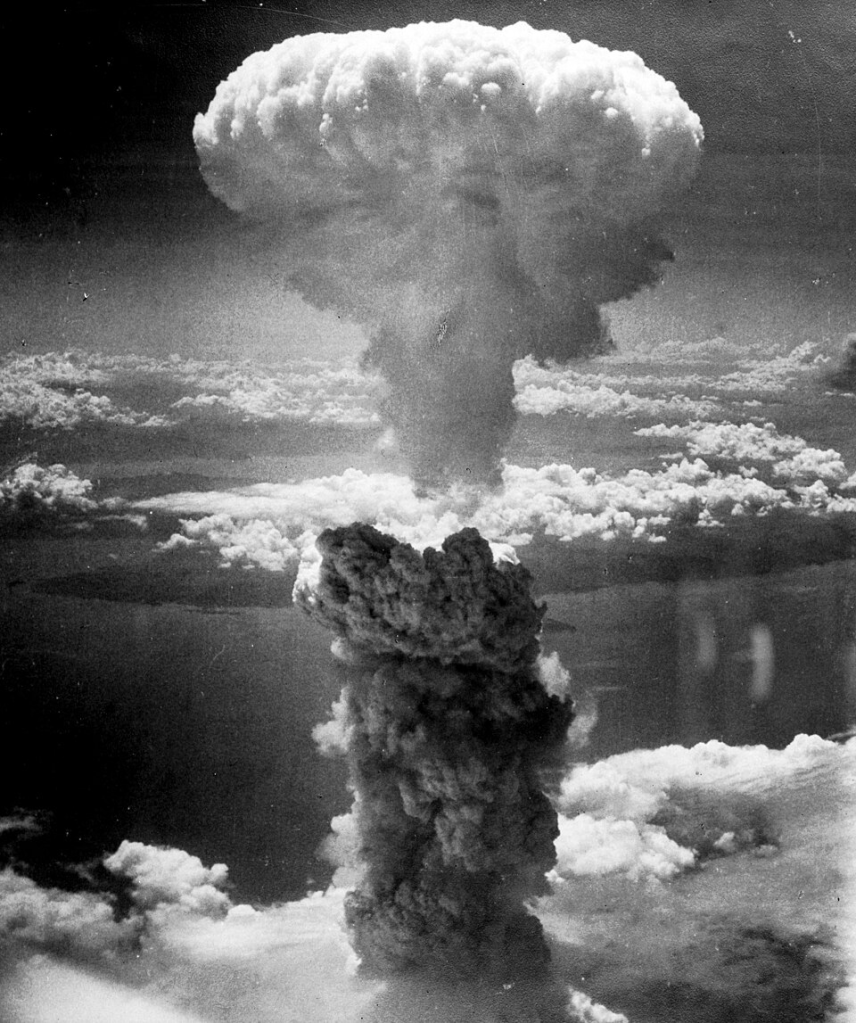
Photo by Charles Levy – U.S. National Archives and Records Administration, Public Domain, https://commons.wikimedia.org/w/index.php?curid=56719
Is it just me, or is Kaja Kallas’s dire warning that coming to a “mutual security agreement” with Russia to resolve the war in Ukraine isn’t an opportunity for peace but a “Russian trap” revelatory of the death wish that leading European politicians are locked into?
Consider what words mean.
- ” A mutual security agreement.” One that deals with the fundamental concerns of both sides and resolves them.
- “A mutual security agreement”. One that resolves any threat that either side might feel from the other.
- ” A mutual security agreement“. One that is agreed by both sides.
How terrible to be “trapped” into that. A future that opens out into better possibilities.
Far better, in her view, to work for a “ceasefire” without resolving any of the underlying problems, to provide a pause, during which both sides would retool at pace with a firm expectation of round 2 – perhaps by 2039, when Germany aims to have the strongest military in Europe, perhaps by 2035, when the 3.5% of GDP target for war spending (plus 1.5% for related infrastructure like hospitals for “mass casualty events” – all those “lost children” who are simply maimed not killed outright)) is supposed to be met, perhaps in 1000 days, if you take Wes Streeting’s pipsqueak Churchill impersonation as seriously as he does himself. That looks much more like a “trap” to me. A future closing in like a narrowing tunnel with death at the end of it.
Peace negotiations would involve de- escalation and trust building measures on both sides. All of which could lead to a healthy transfer of military spending into investment that actually improves people’s lives and deals with the growing impacts of climate breakdown – both in adapting and prevention – on all sides of the conflict.
The Russians proposed such a mutual security pact in late 2021. NATO wouldn’t even talk about it.
But if you start from the presumption that such an agreement is impossible, you are basically saying to the Russian Federation that “this continent ain’t big enough for the both of us”: which comes from and builds in a permanent war posture with an impoverishing escalation of threats and accumulation of war material until we get to a point at which something gives and the build up earths itself in the full scale war that so many military top brass are banging the drum for. This could not help but go nuclear.
That is the path the European NATO leadership is locked into, with the full support of the United States – which benefits hugely from this European civil war. Breaking from it would involve the European ruling class breaking from the US, which it is unprepared to do, because the US is the guarantor of their residual imperial power over the rest of the world. They would rather bluff themselves into a suicidal conflict. The working class in Europe – that’s most of us – have no interest in this; so the stance we take should follow the logic of opposing the war drive to the peace negotiations that will be needed to end it.
On the subject of ending. Here’s a chirpy little film from French TV about how you might survive a nuclear bomb – so long as you live in a huge house, have large enough grounds and an income sufficient to build a steel enclosed bunker over a metre down, don’t suffocate from the firestorm, don’t have to go to the toilet for two weeks, and are not too fussed about what’s going to be left on the surface when you come up. Because you’re not going to be able to pop down to the local boulangerie to restock on baguettes. There’s a striking moment in the BBC nuclear war drama Threads from the 1980s when a government scientist in a bunker with political leaders – as a vast mass of people in the streets of Sheffield demonstrate against the war as a mushroom cloud rises in the distance behind them – explains the calorific content of survival rations – “its the same as a half a pint of bitter, or a slice of treacle tart…” then mutters “the bastards” as it sinks in that everything has been thrown away, blown away leaving an irradiated wasteland… As Robert Wyatt sang in Shipbuilding, “is it worth it?”
We need those mass demonstrations before we get to that point. The student strikes and rallies against the militarisation of Europe all across the continent on 20th November are a good start. Those of us who are getting on a bit should build them and get along to show support. Details of some of the UK events are here.
Protester et survivre!

