The headline in Monday’s Daily Telegraph was Starmer hid costs of Chagos surrender, with the strapline Official figures reveal total cost is ten times higher than the Prime Minister claimed.
Even in the Telegraph, which could have most of its headlines summarised in an emotional digested read as HRUMPH! this is almost poetic. A veritable broadside of misdirected kneekjerk reactions.
Lets start with Chagos surrender. What they mean by this is the return of the Indian Island archipeligo of the Chagos Islands to Mauritius. For Telegraph readers it is a no brainer that an island in the middle of the Indian Ocean is more appropriately administered by the remnants of the Colonial Office in London than another island nearby, let alone, perish the thought, the people who actually live there; because where once a British colonist has stood, the Union Jack should fly forever.
Surrender implies some shame, as the emotional freight of all those retreats from direct imperial control all through the 20th century gets concentrated on this tiny island far, far away; of which their readers know very little.
The notion of the cost of handing back the Chagos Islands to Mauritius is suspicious. Why would it cost anything to relinquish control? It sounds like reparations – the horrifying notion that countries that got rich from exploiting the resources of countries they conquered, keeping them in poverty for the duration, might actually owe them something. Hrumph, indeed! Can’t have THAT!
But as there is no cost to let go of Chagos, what is the cost actually for? Read the article and it admits that the cost is not for giving bup the island, but for leasing back the airbase that Britain expelled the Chagos islanders to build in the 1960s. This base, formally British, is actually used by the United States as a strategic centre for B2 bombers to range across Africa, West, Central and South and South East Asia, China and the Pacific.
Like the agreement to a 5% target for “defence” spending and the meek acceptance of Trump’s tariffs, any contribution to the costs to Britain of keeping this base going – this “terrible deal with huge costs to hard pressed British tax payers”, as Dame Priti Patel put it – is a financial tribute to the United States, so they can bomb half the world with impunity.
Any resentment at this should therefore be directed across the Atlantic, not at Mauritius. But that would involve 1. being honest and 2. punching up.
Their argument that these costs have been misleadingly reported is itself misleading. They argue that methods often used by the Treasury on long term costs to take account of inflation and the “Social Time Preference rate” is an “accountancy trick”. Not an argument they deploy in other contexts.
They then go on to say that the “nominal” cost £34.7 billion over 99 years would be equivalent “half the annual schools budget”. So, a salutory comparison of wasteful military costs with costs of schooling, unusual in the Telegraph, and only made because they have painted the price of subsiding as US air base as an act of reparation, but still comparing an annual cost (in the case of schools) with a cost spread over 99 years – so, not a strictly reasonable comparison.
They are operating more to type when they say that the cost of leaing the base is also equivalent to building “10 Elizabeth class aircraft carriers”; conjuring up a real wet dream of military nostalgia for all those retired Commodores who write them letters; for the days when the Royal Navy had mighty ships of the line and Scapa Flow was full of battleships; instead of being, as it is, a tiny, niche auxiliary force for the US Navy. Oddly enough, playing the same sort of subordinate role as the Air Force does for the Chagos Island base (and other bases here too).
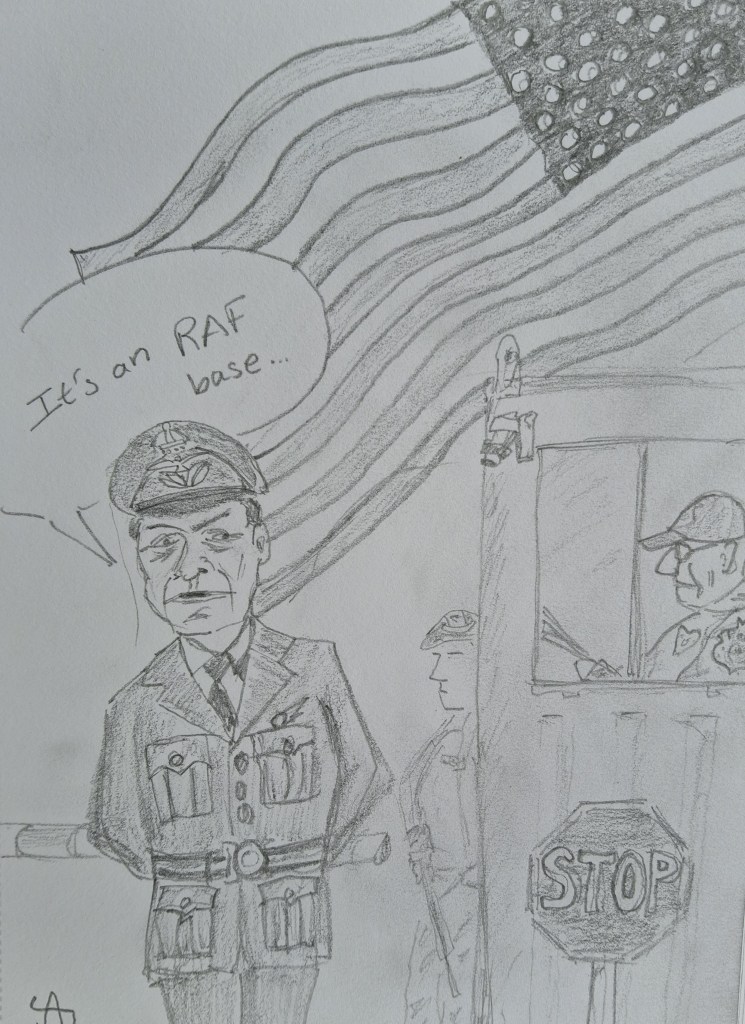
The Wingco at “RAF” Burtonwood.
I had direct experience of the fiction involved in this in the mid 1980s, when a delegation from Greater Manchester CND travelled down to the Burtonwood Air Base to hand in a letter to the base commander pointing out that any nuclear weapons stored there would put the population of Manchester, and the whole North West, at serious risk.
When we asked to see the base commander, a Royal Air Force Wingco came out. He looked a bit like Kenneth Moore, which I don’t suppose damaged his job application any. Everyone else in view was in US uniforms. When we said we wanted to see the actual base commander, he said “I’m the base commander. Its an RAF base”.
So we said, “Really, whats THAT?” pointing to the enormous stars and stripes fluttering on the flag pole behind him.
 Urban ramblings