Remembrance 1: “We’re going to need a bigger moat”.

Its October and, as the clocks go back in more ways than one, scarlet paper poppies begin to bloom on the lapels of MPs and TV presenters. So begins the annual ritual of Remembrance; using the blood of its victims to turn a warning about the human costs of war into a sanctification of preparing for another.

One of the most striking memorials to the outbreak of the First World War in 2014 was the “Blood swept lands and seas of red” installation at the Tower of London; which planted one ceramic poppy for every British and Empire fatality in the war. Estimates for how many of these there were vary. The installation used 888,246 poppies. The figure in Wikipedia is 887, 858. All the same, a lot of deaths. And the installation couldn’t help but numb and sorrow. Such an accumulation of individual losses made collective. Each individual poppy the colour of blood, and an echo of the scarlet of the state, as seen on phone and post boxes, London buses, the Brigade of Guards outside Buckingham Palace, and lost in it. Theirs had not been to reason why. And they had died.

On the Cenotaph in Whitehall, with an “unknown soldier” buried beneath, they are commemorated as “The Glorious Dead”; regardless of how they died or how inglorious it may have been.
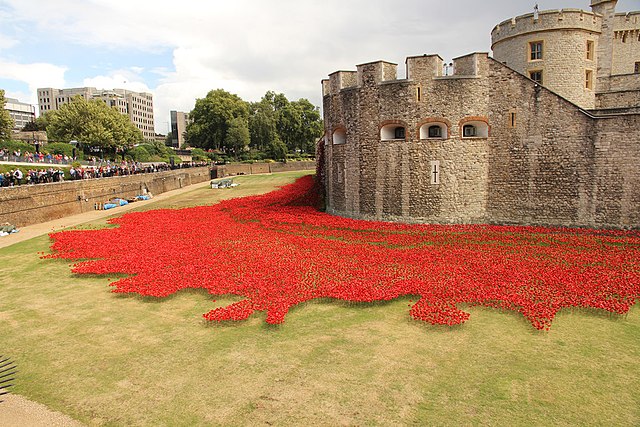
Photo by Richard Croft. Creative Commons.

It is perhaps characteristic of a certain kind of British national narcissism that the only deaths commemorated were “ours”. Which underlines the limits of this sort of “Remembrance”. It becomes acelebration of victory sanctified by “sacrifice”. It tries to make it impossible to think past that sea of poppies to the losses suffered by other countries.

A commemoration of all the service personnel killed in the First World War would require a moat more than twenty times bigger, to register the 20 million or more of them killed. If you were to separate it out into national contingents, the French and Austrian sections would each be one and a half times the size of the British; that of Germany and Russia each more than twice as big. Having them all mixed up, in different colours perhaps, might underline their common humanity and the horrifying waste of it.

Civilian deaths in the First World War were a fraction of the military deaths, unlike the Second World War and most wars since. These are now running at about 67% of the total. Significantly more in Gaza. Commemorations that focus on WW1 tend to obscure that.

Civilian deaths from World War 3 would, of course, be total.

We are now in a period in which people who should know better are agitating for European NATO countries to prepare for a war with Russia by the end of the decade by doubling military expenditure (even though they already outspend them by 3.5 to 1) – a war that could not help but go nuclear – and it is a commonplace of US Foreign Policy thinking to envisage a war with China in the South China Sea – another war that could not help but go nuclear.

And, as Tom Lehrer once remarked, “if there are going to be any songs about World War 3, we’d better start writing them now”.

If we are foolish enough to allow our light headed and light minded leaders to make us collectively “pay undaunted the final sacrifice” in such insane adventures, age shall not weary us, nor the years condemn and at the going down of the sun and in the morning no one will be left to remember us.
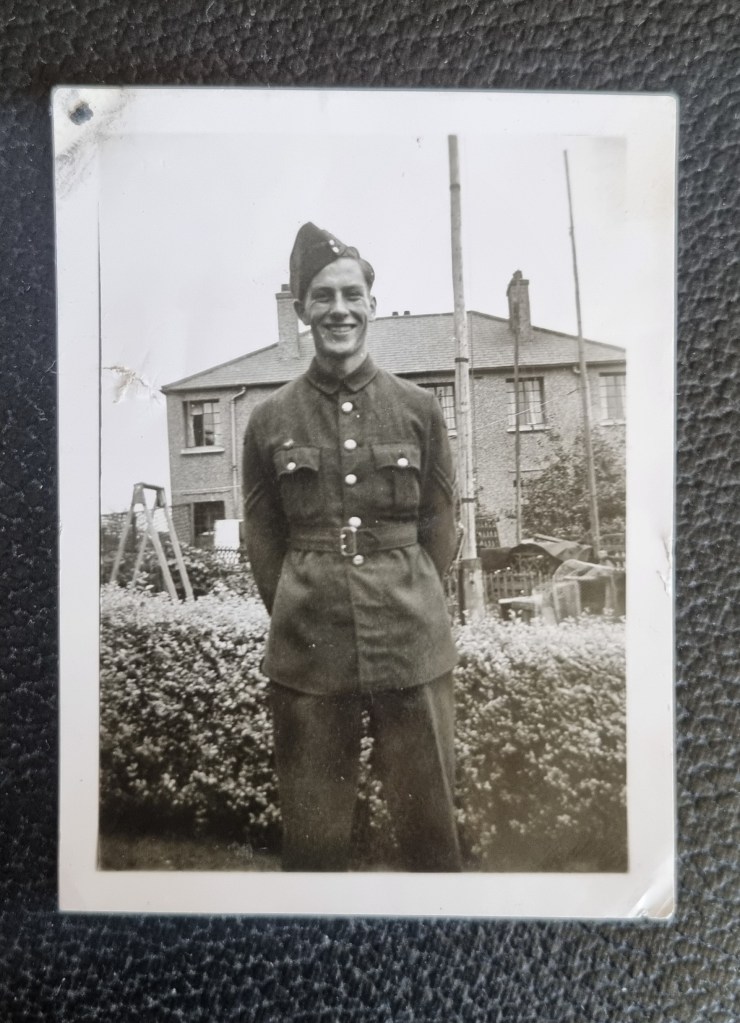
A flying visit to the ruins of the “thousand year Reich” in 1947

My Dad in ATC uniform in 1947.

My Dad was in the Air Training Corps towards the end of WW2 and for several years afterwards. It used to meet in the Main Hall at Grays Tech (now the Hathaway Academy) – where I was to stand through many an Assembly 20 years after.

The high point of being in the ATC, literally, was to get flight experience, usually in a Lancaster (painted white). The best of these was a trip in the ball turrent on the spine of the plane at the top. Some of these flights involved dogfight simulation, where a Spitfire or Mustang fighter would suddenly appear and act out an attack, so the bomber pilot would have to take evasive action, involving yawing, rolling and corkscrewing in a manner guaranteed to give everyone on board acute airsickness. My Dad felt he was very lucky to have avoided one of those.

In 1947, someone higher up in the RAF thought it would be a good idea to send keen cadets from the ATC to have a look at some of the places the RAF was based overseas. A brasshat came down and interviewed my dad and his cousin Len and, a little later sent a message through that they’d decided to send my Dad to Germany and Len to Egypt. Len’s Dad put a veto on that for him, but my Grandad didn’t. So, my Dad got a warrant to go to Northolt for the flight to Germany.

What’s weird about this is that they were sending 17 year old cadets off on their own, with no apparent plan or purpose beyond the trip as an end in itself. The aircrew Dad was flying with in their DC3 didn’t know he was coming, weren’t keen to have him aboard, and had no idea what to do with him. After a bit of discussion they decided to give him the title “Air Quartermaster”; and got him to dish out the sandwiches (dainty things from BOAC on the way out) coffee, and pass on messages – “we’re now over the Hague” etc. Air Safety demonstrations were not part of the job description, and he got to sit in the co-pilot’s seat which had an exellent view of the impenetrable cloud cover they were flying over.

When they arrived at Bucheburg (Bookyburg to them) the cloud cover was still solid and the pilot had to confer with the navigator to make sure they were in the right place – as the airfield was surrounded by hills on three sides; which at that time presented an obvious risk if he couldn’t see where he was. The Navigator being confident enough, they descended through the cloud flying in a spiral until they broke through to clear air beneath and landed.

On landing, no one knew what to do with my Dad, the crew had places to go and Frauleins to see and didn’t want a 17 year old cadet cramping their style, no one from the base was expecting him, nor had he been given any guidance on what he might do. One of the crew grudgingly took him to the bar on the base where the German barman protectively refused to serve Schapps when the crewman ordered it, possibly for the entertainment value – “not for the boy”. After a while the crew member went off leaving Dad to his own devices and to finish his beer. On a visit to the toilet he was approached by a German civilian who asked him for cigarettes – “Zigaretten?” – so he gave him three. In the late 1940s in Germany these were not usually to smoke, but use as currency.

He then walked a little way into the town, which was lively in a “Bachanalian orgy” sort of way. There were “no fraternisation” bans on relations with German civilians, but the RAF crews and the local women did not seem to be paying much attention to them. Leaning on a lampost at the corner of the street, taking some of this in, he was shouted at by a Military Policeman sitting in a jeep on the other side of the road. “Airman! Over here!” Standing in front of him the MP noticed the ATC patch on the shoulder of his uniform and asked what it was. The other MP in the back of the jeep said “He’s just a boy”, so the first one contented himself with telling Dad off for standing with his hands in his pockets. “It creates a bad impression”. Wouldn’t want that with a Bachanalian orgy going on.

The following morning at breakfast, the crew were sitting around regaling each other with tales of exploits and conquests from the previous night, some of which might have been true. Before the trip back Dad went for a walk to the hanger where the DC3 was waiting. The doors to the hold were open, giving off an overpowering smell of coffee – which implied a certain amount of off the books trading.

On the trip back – in which one of the passengers was a former German soldier in handcuffs heading for a war crimes trial – the “Air Quartermaster” had to dish out the sandwiches again – thick RAF doorsteps filled with Corned Beef this time – and, having landed was, as with every other step of this trip, left to his own devices to get home.

Other cadets must have had these trips, but there seems to have been no debriefing beyond the local ATC CO asking if it was a good trip. The expected (opaque) response “Yes Sir!” may not have been universal, because this particular experiment was never repeated. Unless it simply petered out in the same aimless way that it seems to have been set up.

So endeth my Dad’s first trip overseas.