Donald Trump and NATO Secretary General Mark Rutte want NATO members military expenditure increased to “Cold War levels” and for member countries to adopt a “wartime mindset” in order to prepare for a perceived threat from Russia, China, Iran and North Korea.
Neil Kinnock has just stated that 3-4% would be a “realistic” level to reach.
Part of this mindset is a preparedness to sacrfice health, welfare and pensions to fuel the military machine required to fight a war with Russia in Europe that would be suicidal for all involved if it actually broke out.
The UK’s “Defence Review” is framed in a similar “pre war framework”, posing Russia, China, Iran and North Korea as “the deadly quartet”; a good name for a jazz band, but geopolitically infantile.
The threat is posed most sharply in relation to Russia, largely because NATO is now evidently losing its proxy war in Ukraine. This impending defeat is being posed as a lever to militarise European society on the presumption that a Russian win there means that they will then threaten to invade the rest of Europe.
This is simply insane.
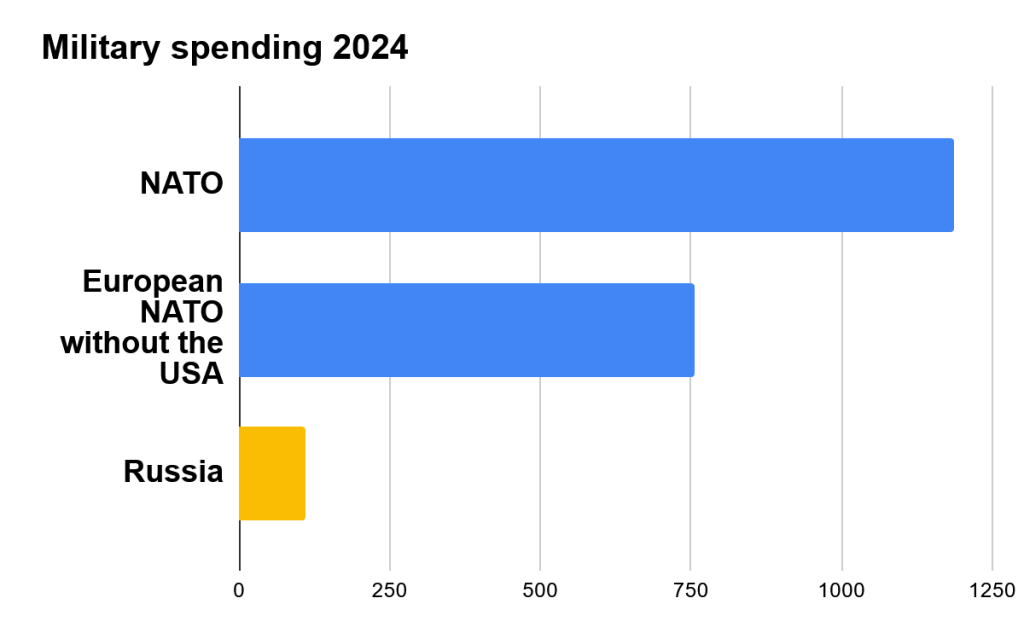
If you look at the balance of military expenditure between NATO and Russia, even after a sharp increase in Russian spending forced by the war to 7-8% of GDP, the imbalance in NATOs favour is overwhelming, because the combined GDPs of the NATO countries are almost incomparably bigger than Russia’s (which is smaller not only than the USA among NATO countries, but also Germany, the UK, France, Italy and Canada and barely larger than Australia).
If the argument from all quarters on high in this country is that “the world is becoming a more dangerous place”, its quite clear from this which countries are making it so in Europe. If the Russian level of expenditure shown in the yellow column is posed as a terrible threat by NATO, how much more threatening is NATOs current expenditure for the Russians?
To underline this with stark figures, with overall NATO spending in 2024 at $1185 billion and Russia’s at $109 billion,
for every dollar the Russians spend, NATO spends just under $11
and the European NATO powers alone spend £755 billion between them, which is just under $7 for every dollar spent by the Russians.
So, the question posed by this is already, who exactly is under threat from whom?
Trump and Rutte, and now Kinnock, propose to raise NATO military spending to “Cold War levels”. That was around 5% of GDP between 1970 and 1987. That would double the imbalance above and set NATO up for an offensive war with a collosal military advantage of 14 to one, even if the US kept out of it, and 22 to 1 if they were involved.
This reality is revealed by the decision of the EU to break its own fiscal rules and raid its levelling up funds to finance war preparations which, among other things, involves strengthening bridges so that “tanks may pass safely”. Were they concerned that columns of Russian tanks would be steamrollering West they would be weakening bridges so they couldn’t pass at all.
This is leaving aside the political feasibility of a Russian offensive, even if it were militarily feasible – which it obviously isn’t.
It beggars belief that a war of this sort is being envisaged with a nuclear power. The same people who argue that the UK’s nuclear weapons “keep us safe” and shouted at Jeremy Corbyn “would you press that red button, Mr Corbyn?” seem to think that a land war in Europe which, given the balance of forces, would be aimed at regime change and the balkanisation of the Russian Federation and have nothing to do with “defence” would not lead to the trip wires for use of these weapons being crossed.
So, the additional cost of meeting this target in full would be around £70 billion. Even getting half the way to it would require a transfer of £35 billion, which would have to come from “other priorities”: and not just “a small amount” as Rutte puts it. Kinnock doesn’t say what he would cut. He should be asked.
Every item cut instead would improve people’s lives. The best that can be hoped for increased military spending is that it doesn’t give our lords and masters the tools to end them.
All this flows from the strategic self subordination of Europe to the United States. As this recent article argues, the new situation for Europe is that the US is leading them into war with the continent’s strongest military power, Russia, at the same time as it deliberately undermining European rivals’ economies. It amounts to a US policy of subordinating Europe through a combination of military and economic warfare.
This is a lethal combination for Europe, the most serious threat to the entire continent since at least the end of the Cold War and in a broader sense since the end of the Second World War.
So, the fight against war, and the fight against austerity, to defend our conditions of life will have to go hand in hand.
Did Andrew Rawnsley seriously write “Senior military officers privately worry that Britain’s Armed Forces would have difficulty fighting a high intensity war in Europe for more than a month or two”? (Britain has never looked more exposed, adrift in the Atlantic in a world pulsing with perils Observer 8/12/24) How long does he think “a high intensity war in Europe” – with an unnamed power which, for the sake of argument we’ll call “Russia” – would last? Never mind a month or two, with nuclear weapons we’d be lucky to get to the end of an afternoon, and no one would be “home in time for tea and medals”, because we’d all be dead.
What is seriously worrying is that our futures are in the hands of people who think that ramped up confrontation on the lines envisaged in the “Defence Review” is in any way survivable. As he says at the start of his article, “I don’t know what effect these men have upon the enemy, but, by God, they frighten me”.
Travelling on the bus up Golders Green Road, the hoardings just opposite Grodzinski’s bakery (now modernised but smaller than it was) are covered with A3 posters of the Israeli hostages. 97 of them are still alive. If you were to stick pictures like this of them up alongside the road in a single line they would stretch for approximately 100 metres. About the length of three semi detached houses side by side.
As of April this year, Israel was holding 3,660 Palestinian prisoners in adminstrative detention, that’s to say without trial. Hostages by any other name. Rarely mentioned on the news. No imperative to release them. Effectively invisible. No pictures of them up on hoardings anywhere. But if you were to stick them up in a single line of A3 posters, it would stretch for about 1,220 metres. On a street of semis that would not stop at number 6, as it would with the Israelis, but at number 73.
If you were to stick up posters of the Israeli victims of the Oct 7th attack on the same street it would not get so far. About 400 metres, just to number 24. You could walk it in a couple of minutes. Doing the same for the 41,534 Palestinians killed so far in Gaza since, and you’d need a road more than ten kilometres long. Walking at an average 3mph it would take you more than two hours to get to the end.
Blairite retread George Robertson is set to lead Labour’s “Defence Review”, with former US Presidential advisor Fiona Hill on hand to keep it in line with US imperatives. The conclusions are flagged up in his premise, which is that the UK has to militarily confront a “deadly quartet” of China, Russia, Iran and North Korea. This is itself a variation on George W Bush’s “axis of evil” and flags up a sharp increase not only in direct military expenditure but also a pro war domestic agenda, trying to ramp up Cold War mentality and reflexes to enable a series of suicidal conflicts and silence dissent.
None of the four countries concerned are in a formal alliance and coordination between them is – needless to say – qualitatively below that which is permanently structured by the dominant US system of alliances, on “sharing arms, components and military intelligence”.
Taking his premise as a given – which we shouldn’t – this is the balance of military spending between the US and its allies (which includes the UK) and the so called “deadly quartet” 2023.
To spell this out. The US and its allies, who Robertson poses as being under threat, outspend the “deadly Quartet” by a factor of 3 to 1. So, who is the more “deadly”? If you were to put teeth on the US slice of this graph, it might reflect how US allies are seen in most of the world.
These figures were taken from NATOs own stats, and the wikipedia list of expenditure by country from SIPRI The NATO figures are worth a look because they show how rapidly NATO is increasing its spending (from $904 billion in 2017 to $1056 in 2021 to $1185 now) and that the number of countries spending 2% or more of GDP has doubled in the last year. The NATO figures, however, are lower than those in the SIPRI list. The US figure from NATO for 2023 is $755 billion, while for Sipri, it is a significantly larger $916 billion. So, the blue, biting pacman shown here probably has its jaws clamping down even more tightly.They also don’t include the exponential increases now being set by US allies, with Japan and Germany doubling their spending.
Robertson’s inclusion of Iran in the list also implicitly underlines the UK’s alignment with Israel. This is also evident in the current government continuing with Sunak’s attempt to exempt Israel from ICC jurisdiction and the fact that it is one of only two countries to be continuing with the defunding of UNWRA after Israel made unsubstantiated allegations about its staff being involved in Oct 7th. The other country (down from the original 16) is the United States – which is one definition of a “special relationship”. This alignment in the face of an ongoing genocidal attack on Palestinians in Gaza and escalating ethnic cleansing in the West Bank, requires the domestic demonisation of the solidarity movement in this country; which we are already beginning to see.
It beggars belief that there are people who are taking bets on a nuclear war taking place by 2025. While gambling addiction has its own dynamic, how does anyone placing one of these bets think they might be in a position to collect their winnings if it does?
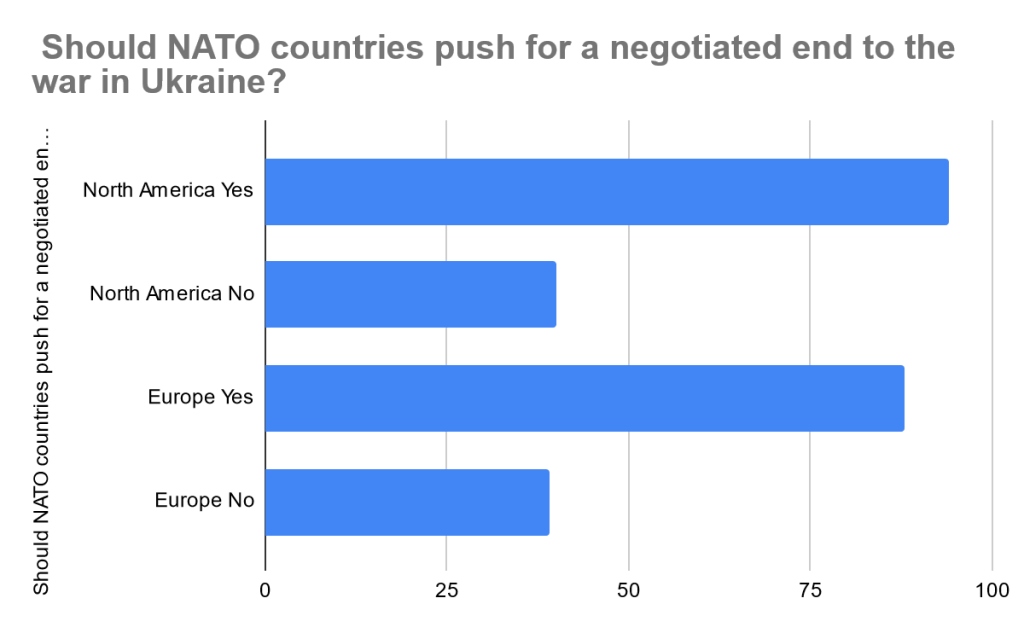
The justified fear that the Ukraine war is heading in that direction is one of the factors in driving majorities in both North America and Europe to favour a ceasefire and negotiated peace over continued escalation.
A recent survey by the Institute for Global Affairs showed that more than twice as many people in Europe and the US supported NATO pushing for a ceasfire as opposed it.
The IGA notes that
In responding to Russia’s invasion, avoiding escalation with Russia is a top priority — especially among Europeans. Results suggest transatlantic support for a cautious response.
More support a negotiated settlement to end the war, with a plurality of Americans and Western Europeans citing the loss of life and casualties as a primary reason.
This is a broadly humane response that is the opposite of the course being taken by the G7 and NATO leaderships. It is perhaps no accident that all of the leaders at the G7 had a negative approval rating; ranging from Georgia Meloni on -10, through Joe Biden on -19 and Justin Tudeau on -33, Olaf Schultz and Rishi Sunak on – 44 to rock bottom Emmanuel Macron on – 52%. Even after just winning the UK General Election, as he arrives at the NATO summit in Washington, Keir Starmer’s rating is -3.
In fact, the same logic on the part of NATO that led to the war in Ukraine in 2022 is the logic that is heading inexorably over nuclear red lines, possibly before the Autumn. The problem with a nuclear balance of terror is that it only works until it doesn’t. And the calculated games of chicken only have to be got wrong once, and its the end for all of us.
It seems clear that the calculation in NATO in the Winter of 2021 that they did not have to take Russia’s attempts to end the smouldering Ukrainian civil war, and defang NATOs eastward expansion, with a
mutual security pact that would have guaranteed autonomy for the Russian speaking Donbass within Ukraine,
made Ukrainian neutrality permanent
and kicked negotiations about the status of Crimea into a possibly interminable negotiation process
seriously because they believed that either
Russian military threats were a bluff that could be called, or
that if Russia did intervene, that would be the opportunity they wanted for sanctions that would rapidly bring the Russian economy to its knees, creating domestic turmoil through which the well oiled processes of a colour revolution could lead to a “regime change” favourable to the US
were a complete miscalculation in both respects.
With the sanctions only supported by direct US allies,and largely blowing back on them, the Russian economy is doing fine, growing 5.4% in the first quarter of 2024 (compared with 0.6% in the UK, 0.4% for the US and 0.2% for Germany). And the military tide is turning slowly, remorselessly Russian, as the Ukrainian government is forced to resort to press ganging increasingly reluctant conscripts, sending them up to the line half trained, and suffering losses in soldiers and material that they can’t replace.
Faced with the prospect of defeat, the G7 and NATO are trying to up the military ante, rather than do what their populations want and seek a negotiated peace.
This is heading into very dangerous territory. Mark Rutte was confirmed as the incoming NATO Secretary General only after he assured Hungary that no Hungarian finance would be used for, or military personnel deployed to, Ukraine. That implies that other NATO forces will be, threatening the direct clash that could be a tipping point beyond the control of its instigators.
The decisions now being made at the NATO summit, with a dedicated NATO HQ being set up, promising an “irreversible path” to membership, cranked up arms spending, a no fly zone on the Western and Southern Ukrainian border, a green light for Ukraine to try to knock out Russian nuclear early warning systems that cover areas well away from Ukraine – a terrifying piece of irresponsible brinkmanship, as this makes a nervous nuclear armed power unable to tell if it is under fire or not in a context in which it is afraid it might be – deployment of NATO “instructors” within the theatre of conflict, and ever widening permissions given to fire NATO produced munitions into Russia are all edging towards catastrophe.
A letter to the FT by a number of academics and former diplomats, including Lord Skidelsky and Anatole Lieven, calling for a negotiated settlement to allow the world to be “pulled back from the very dangerous brink at which it currently stands” is a sign that the consensus at the top in favour of escalation is beginning to crack. This is likely to grow as the situation becomes more intractable and dangerous.
In this context, its important that positions taken in the Labour Movement do not rest too heavily on myths. A recent letter, Time to help Ukraine to win, signed, among others, by John McDonnell, Clive Lewis and Nadia Whittome, argued that failure on the battlefield has been down to inadequate supplies of munitions from the US and its allies, calling for the UK to “take a leading role” in supplying “all the weapons needed to free the entire country” and that, in the short term, this should take the form of obsolete MOD equipment being gifted instead of sold off, for a war crimes tribunal directed solely against the Russians and for Russian assets to be seized (stolen) by Western Banks.
There are four problems with this approach.
Myth 1. To “free the whole country” would actually be a reconquest of the Russian speaking areas that rebelled against the pro Western coup in 2014 and have been fighting it ever since, at a cost of thousands of dead from 2014 onwards; and, far from being a liberation, would constitute an occupation of those areas. This would not be pretty. Kyrill Budanov, head of Ukrainian military intelligence, has stated that this would require the mass reeducation of people “with a completely different mindset” and the “physical elimination” of some of them. Given what has happened in areas that Ukraine took back at the high point of its military efforts in autumn 2021, this does not have to be imagined.
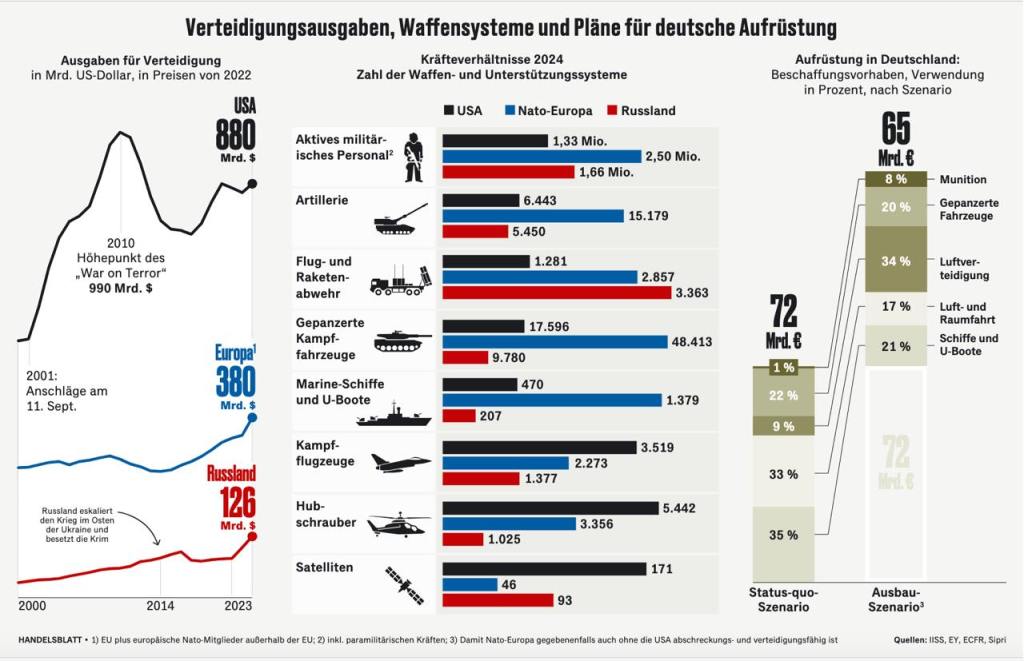
Myth 2. McDonnell et al seem to assume that the taps can just be turned on from an infinite supply of military hardware. It can’t. The paradox of the NATO military Industrial Complex is that although it outspends the Russians 11 to 1, it characteristically produces immensely expensive and complex pieces of kit that require lengthy training, high levels of maintenance and can only be produced in relatively low numbers; and once they are used, at great expense, they are gone. This is highly profitable for the arms companies and is designed for short sharp wars against Global South countries, not long term grinding wars of attrition with near peers. Stocks are now run down, the obsolete equipment, like Leopard I and 2 tanks, Bradley AFVs and so on have been deployed and destroyed in large numbers. F16s – an aircraft first deployed in 1978 – are the next installment and will fare no better. Plans to increase production of, say, Patriot missiles, can only be incremental – from about 500 to 650 a year. That is why this position is a fantasy. The supplies sent to Ukraine have been the maximum that NATO could scrape together. The only way to shift this would be to completely retool arms manufacture, which would require massive investment over several years; and politically set a trajectory for war that would be very hard to stop. No one on the Left should support this.
Myth 3. The barrel has already been scraped for obsolete equipment. The MOD website Army Surplus Store section notes that as of May 2024 “There is currently no MOD surplus inventory for sale.”
Myth 4. McDonnell et al’s argument that “Ukraine deserves a just and socially progressive reconstruction in which trade unions and civil society can democratically participate. International support should help to restore and expand universal healthcare, education, rebuild affordable housing and public infrastructure, ensuring decent jobs and working conditions. No more advisors from the UK Government should be used to assist in retrogressive reforms of trade union and labour rights” is also, sadly, wishful thinking. The “reconstruction” of Ukraine will be a massive asset stripping fire sale, as its Western “backers” come for their loans like a flock of vultures. It has already been agreed between Western creditors and the oligarchs who have run the war, embezzled a good proportion of the “aid” and siphoned quite a bit of arms supplied into the international black market, that the “reconstruction” will be managed by Blackrock; whose priorities are not those of John McDonnell. Blackrock would, no doubt, wish for a succesful UAF offensive into the Donbass that would allow them to get their hands on the $12 Trillion worth or rare earths that are sitting below the surface there. Such an offensive is even less plausible now than when it was tried in 2022 and the UAF suffered terrible casuaklties to make marginal territorial gains of no strategic significance.
Myth 5. In this context, any notion that Ukraine’s debts will be cancelled is similarly wishful thinking. Its as if NATO powers aren’t in this conflict for themselves. As if it is some genuine genuflection to – a partially applied – principle of national self determintion. The West, will want its pound of flesh. One reason for the Ukrainian oligarchy to keep a hopeless war going is to postpone the time that the aid stops flowing and the debts come due. For NATO countries to unilaterally sieze Russian assets would be another nail in the coffin for any pretence at upholding a “rules based international order”, rule out any serious possibility of peace negotiations and be seen in the Global South as on a par with the appropriation of Venezuela’s assets by the same imperial powers.
Sections of the Left often put forward spurious – slightly fantasised – arguments in order to cover an accomodation to their imperatives of their own ruling class. The paradox of this is that the ruling class itself is more hard nosed. The section of the US ruling class that backs Trump wants to cut its losses, try to impose even more financially ruinous military spending on its European subordinate allies, so that, with or without a ceasefire in Ukraine, the US can concentrate on launching and even more ruinous war in the South China Sea.
That is where the US ruling class is heading. It is why a candidate like Trump, convicted felon and epic shyster, keeps afloat on a sea of money; and now looks like he is going to win, with all the “unpredictable violence” that Boris Johnson thinks is just what “the West needs”. This strategic shift is not because Trump is in some way “Putin’s patsy” but its actually a statement of weakness that the US no longer believes itself capable of fighting two and a half wars at once and prevailing in all of them. They have to concentrate on the biggest target, and if that causes problems for its subordinate imperial allies, so be it. To deal with the twists and turns of all this the section of the Left that finds itself cheerleading for NATO escalation will need to burn its delusions.
The core problem for Paul Mason’s* argument – in his piece for Open Democracy entitled The left has a choice: unite behind Starmer or face Farage rising to power – that a Starmer government has the same potential as Attlee’s to set “a new political consensus”, is that Attlee’s reforms in the 1940s were underpinned by Marshall Aid from the United States, as was the restabilisation of other Western European countries like France and Italy. But, we are now in a period in which the United States – faced with the rising economic weight of China and the BRICs – is no longer able to afford to subsidise its junior partners. In fact we are in a period of a reverse Marshall Plan in which capital is being sucked into the US, not only from the Global South but also its allies; which is destablising them politically and economically.
This is bad enough under Biden’s Inflation Reduction Act, attempts to divide the world economy through scanctions and tariffs, drawing the wagons ever tighter around its shrinking zone of economic dominance, while passing the ammunition for the wars they are engaged in in Ukraine and Gaza and preparing for in the South China Sea. Under Trump, if he does indeed have a Second Coming in November, this will be turbo charged, and we will all have to cope with his capacity for “unpredictable violence”, which, according to Boris Johnson, is “what the West needs”.
Mason’s assertion that “in a world where democracy is in peril, and where conservatism is merging with the far right, he (Starmer) stands a chance of making the UK a place of resistance and a model for the rest of Europe” is exposed as the nonsense it is by David Lammy’s attempts to build bridges with the Republicans and explain to us all that Trump has been “misunderstoodabout Europe”. The rule of Blair, that the key objective of British Foriegn Policy is to “get up the arse of the White House and stay there” remains hegemonic in the shadow cabinet.
Mason’s defence of Starmer’s “project” starts from a false premise, because Labour’s 20 point lead is not the result of a cunning plan by the Labour Right, but primarily a result of revulsion at the Tories. That is evident from
polls that shown that only around a third of voters think Labour is fit to govern. Its lead comes from the fact that only a sixth of voters think the Tories are.
a recent poll of who would make the better PM, Keir Starmer or Rishi Sunak in which the leading candidate was “neither of the above” on 49%.
the second TV leaders debate, during which both Sunak and Starmer were laughed at. Sunak more than Starmer, to be fair, as he has pulled one dead rabbit after another out of his hat, but being laughed at before being elected, rather than laughed at on the basis of a dreadful record in office, is not a good sign.
the March YouGov Leaders Standing poll, in which Starmer was viewed favourably by 38% of respondents and unfavourably by 53%.
So, this is not glad confident morning and does not bode well for a “honeymoom period”, let alone a “ten year mission”, whatever the size of the majority. Bubbles can be large, but burst quickly if they are thin.
A warning experience of what this might lead to is what has happened in the United States. In 2020, the vote for Joe Biden was primarily an anti -Trump vote. Biden’s record in office, even before his complicity in fuelling the attack on Gaza, means that Trump – despite everything – is back in contention as potential President. That in itself is evidence of a crisis of leadership in the US. In the UK, Starmer’s similarly cautious approach tees up a far right Faragiste Conservative revival – reeking of booze, fags, exhaust fumes and racism – exactly what Mason says he wants to avoid.
There are deeper currents at work here.
The scale of the economic stagnation, drops in living standards, life expectancy and eroding public services since 2008,
combined with the shifts in global power away from a previously unquestionable Pax Americana – that the UK (and Labour Right) has been an enthusiastic auxiliary of since WW2
and the increasingly evident breakdown in the climactic conditions for human civilisation to survive, means that people can’t live comfortable, complacent lives within a “mainstream consensus” expressed in the “political middle ground” any more.
The strange death of steady as she goes, bank manager Conservatism, as the UKs long managed decline becomes unmanagable, is an expression of that. This isn’t yet expressed in any clear move towards solutions, but the presumption that this can only be expressed in a curmudgeonly negativity is used by the Labour Front bench to make change without hope palatable.
Nevertheless, the 79% of people in John Curtice’s recent poll that said the UK system of government needed to be improved “quite a lot” or “a great deal” shows that there is a preparedness for significant change bubbling under.
Its also quite apparent in this election campaign that, given the scale of the Conservative implosion, not only are forces in the ruling class already angling for a Faragiste/Tory rump realignment, they are also trying to rebuild the Lib Dems as the core of a centre ground regroupment on “Change UK” lines. Now is the time for the breaking of Parties.
The result in the same Curtice poll that 45% would not trust any politicians to put “country before Party” is more ambiguous than its presented. The interests of “the country” is often interpreted as the “common interest”, which a lot of people see as being the interests of the majority of the people. But “the interests of the country” is invariably framed in terms of the interests of those who own the country not that of the majority of us who live in it; in the same way that the interests of “the economy” is framed as the interests of those who own capital, not those who work.
The Conservatives seen no contradiction here. The interests of the “country” is taken to be synomymous with that of private capital, of established institutions (including the Conservative Party) and its symbols. The role of the rest of us is to know our place, doff our caps at the right times, salute the flag when its run up a flagpole, work hard, keep our noses clean and not cause any trouble, lest we get defined as “the enemy within”. So, adopting this slogan (and symbols) as enthusiastically as Keir Starmer has, amounts to a quite explicit tug of the forelock. With this formula, “the many” defer to the interests of “the few”.
Mason argues for a strategy of appealing to “patriotic left” voters by supporting what he calls “mainstream positions on crime, immigration and defence” (my emphasis). This presents right wing positions as if they are a consensus (mainstream) and leaves them unchallenged, helping a punitive approach to criminal justice, xenophobia and war mongering to be accepted as default “common sense”; when they are anything but, and widely agreed, when they are not. This actively alienates a large number of people who normally vote Labour looking for a more progressive alternative. Even if they vote Labour again this time, in desperation to be rid of the Tories, Labour’s grip on them is increasingly tenuous.
As well as digging deep into these toxic trenches, Mason argues that “growth strategies based on borrowing, taxing and spending are precluded by … high bond yields and high inflation”. This is wrong on so many levels.
There is enormous room for higher taxes on the wealthy. In not proposing to raise them, Labour has left room on its left that even the Liberal Democrats and, especially, the Green Party have moved onto. The Green proposals to raise £50 billion a year by these means have been classed as viable by the BBC fact checker; so its not a wild outlier. So, why does Labour refuse to do so, especially with the Tories having set a £19 billion black hole in the public sector budget as a trap? Starmer and Reeves seem to be walking into this with their eyes wide shut. Their line that this gap will be filled by “growth”, that will appear solely by dint of managerial certainty, what Mason calls “creating the conditions for long term private investment”, is already visibly wilting in the election debate. This line won’t even hold in theory; even less so in fact.
Moreover, borrowing only makes any sense if the return on the investment is likely to be lower than the cost of the interest on the additional debt. This is explored in detail here.
This is doubly dangerous because, as Mason points out, “climate change means we need to invest massively in decarbonised energy” (my emphasis). The problem, and Mason knows this, is that Starmer and Reeves are not proposing to do that. They are proposing to invest modestly.
The National Wealth Fund and GB Energy are good steps, but on a very small scale. This has been described by the Guardian as likely to create “tepid” progress towards mitigating climate change. The result of that will be an accelerating drag on “the economy”, as the costs of coping with current impacts – like that of increasing winter rains on sewage systems and farming – get worse and worse. Every 1C increase in temperature hits GDP by 12%. More than the 2008 crash. More than Covid. So a failure to invest, even for people who think getting the books balanced is more important than the survival of human civilisation (and there are a lot of them in the Treasury) is bad for getting the books balanced too.
Voters motivated by “patriotism”, and politicians wanting to pander to them, might note Sir Nicholas Stern’s recent report that for the UK to keep up with the EU and US in infrastructure investment it needs to invest an additonal 1% of GDP. 1% of GDP is £26 billion a year. That figure has a familiar ring to it. Doing less than this is managing decline, no matter how many Union Jacks you surround yourself with. Most of this investment would necessarily be green, to avoid building in carbon emissions that would have to be undone later at greater cost. This is a key point when considering what the proposed Planning reform to build 1.5 million new homes is going to look like.
Putting the constrained resources that will be available in this context into increased arms manufacturing, beating ploughshares into swords, will copper bottom austerity. Mason should recall that the austerity of the Attlee government, that led to its fall in 1951, was driven by the level of military expenditure required to sustain a global Empire under threat from rebellion, to develop nuclear weapons “with the bloody Union Jack on it” (as Ernest Bevin put it) and show its commitment to the US in the Korean war. History in the 2020s could rhyme in this respect, if this course is followed again.
Mason’s argument that this is necessary to counter “Russian aggression” in Ukraine ignores the way the war grew out of NATO’s refusal to even negotiate with the Russians about mutual security guarantees during the Winter of 2021, let alone the national rights of Russian speakers in Eastern Ukraine and Crimea whose rebelion against the NATO coup in 2014 led to them being bombed by the Ukrainian air force and a civil war that lasted for eight years before February 2022.
Had the Labour line quoted with some disdain by Mason, that a Labour government would attempt to “lead efforts to secure strategic arms limitation and multilateral disarmament” been the general view of NATO in 2021, instead of consciously pushing through the well known red lines of a nuclear armed power, there would have been no war. Instead we have “security through strength”. Gaza shows us where that ends up.
Instead of seeking a peace settlement that would enable us all to put resources into stopping climate breakdown – Mason envisages a forever war in a militarised and impoverished Europe, with an entire generation of Ukrainian men fed with understandably increasing reluctance into a horrific meat grinder as dispensible armed henchmen fighting for the retreating US world order, or a possible escalation that is more and more likely to stumble over a final nuclear red line the longer it goes on.
The bottom line here is that we can’t afford a war drive and to invest in stopping climate change at the same time. It is stark how easily the US and its allies find the resources to balloon their military budgets and how difficult they find it to provide the Global South with the climate finance needed to avoid dependence on fossil fuels.
Choosing to play down the chronic certainty of extinction through climate breakdown by building up to a nuclear confrontation that will wipe us all out just as certainly, but quicker, is a bit like President Trump thinking he could stop a hurricane by bombing it.
Mason’s notion that supporting NATO and the Ukrainian oligarchy is “anti fascist” is also a piece of semi conscious self deception, because he knows full well that the European and North American far right have sent some of their most dedicated cadre to fight against the Donbass Republics in Ukraine since 2014; taking Andriyi Biletsky of the Azov battalion at his word when he said that Ukraine’s national purpose was to “lead the white races of the world in a final crusade … against Semite-led Untermenschen”. Funny kind of “anti fascism” to link up with people like that.
Mason says Starmer is “not playing for a five year stint in power” and Reeves talks of “ten years of national renewal” but from an electoral point of view, the problem with their approach is that, because there will be insufficient state investment to generate green growth, especially if they prioritise guns over butter, we will continue to stagnate on our existing unsustainable basis, in conditions of deepening crisis that provide insufficient resources to shore up crumbling public services, leading to a mass rejection of the government presiding over this at the next election – be it in 2029 or earlier – as the current mood gets even angrier.
*Spook warning; Its important to bear in mind that whatever Mason has written is probably run past what he describes as “the official side”. Whether he does or does not have an MI6 handler, as Grayzone allege, is nevertheless, not something he has directly denied.
the UK spends $74.9 billion for a population of 68 million.
Russia spends $109 billion for a population of 144 million.
China spends $296 billion for a population of 1,400 million.
So, the UK spends $1101 per person, almost one and a half times as much as Russia’s spend of $757 per person and more than 5 times as much as China’s $211 per person.
That looks like this.
So, perhaps the UK is on more than enough of a war footing as it is; as its participation in so many wars, overtly and covertly, demonstrates.
If the UK were to go for parity with Russia’s per capita spend, it could save about $20 billion a year (£16 billion). If it were to go for parity with China, it would save $60 billion a year ($48 billion). We could do a lot with that. An additional dividend from these savings might actually be peace.
The United States, of course, is in a league of its own, with a per capita spend of $3,210. If they were to spend what the Russians do, that would free up $687 billion every year. Think what could be done with that.
Is a sentiment increasingly strongly felt in Ukraine. An unwillingness to die for Grant Shapps is also a majority sentiment in the UK, with just 17% being prepared to “fight for their country” in recent polling (and just 14% of 18-24 year olds).
We are now at a very dangerous point in the war in Ukraine. NATO is having to contemplate a defeat. The Ukrainian armed forces are suffering terrible losses and retreating all along the line of contact. There are increasing reports of surrenders, sometimes whole platoons sent to occupy suicidal forlorn hope forward positions (who are asking the Russians not to include them in prisoner swaps so they don’t get sent back to the front). There are also now a lot of videos of men being press ganged by Ukrainian recruitment officers, involving chases down the road and punch ups. Sometimes they get away, sometimes they don’t. The new conscription bill, to draft younger age groups is deeply unpopular and has been a political hot potato for months. The days of eager recruits is long gone. There have been whatsapp groups used by men to warn each other when the press gangs are around, so they can keep their heads down, for quite some time now. The latest visit from US National Security Adviser Jake Sullivan is reported to have offered Zelensky a deal; pass the conscription law as the quid pro quo for the US unblocking its latest tranche of aid. Essentially, this translates as Sullivan saying you provide the men to fight and die, we’ll supply the weapons that keep them in harms way. Zelensky’s own standing is undermined by the expiry of his Presidential term this month. Elections have been cancelled until the war is “won”.
There are two problems with this.
1. “Winning” for Kyiv/NATO means;
reconquering parts of pre 2014 Ukraine that rebelled against the US/EU backed overthrow of a government they had voted for. 30% of the pre-2014 Ukrainian population spoke Russian as their first language. Calling for an end to “the Russian occupation” would actually require most of the population of Crimea and Donbass to become refugees heading for Russia. Calling for “Russian troops out” means driving the locally recruited Donbass militia, which is now integrated into the Russian armed forces – out of their homes and the land they have been fighting to defend since coming under Ukrainian attack in May 2014.
integrating Ukraine fully into NATO – the world’s dominant alliance of imperial predators – as “a big Israel in Eastern Europe” (President Zelensky). A military frontier henchman state for a US dominated bloc that, as we know from long experience, or should, applies the principle recently restated with alarming candour by Anthony Blinken at this year’s Munich Security Conference: “if you’re not at the table in the international system, you’re going to be on the menu.”
Neither of these are outcomes that anyone on the Left should support.
Even if you think that being against “campism” means that you have to defend “principles” like the “right” of a state to join an imperialist military alliance; if you find yourself agitating for that bloc to be moreaggressive in supplying arms, there is no basis on which you can oppose the militarisation of our society, and the war drive that our ruling class is engaging in, because you have become a cheerleader for it. This is revealed by the argument in a recent article on Labour Hub from the Ukraine Solidarity Campaign that the impending defeat in Ukraine “has arisen from the self-limiting approach by the democracies providing aid.” My emphasis. Who does he mean by “the democracies”? The world’s richest, most powerful economies, coralled into a military and political bloc that exploits the rest of the world under the leadership of the USA? Those “democracies”? For the author, the core of world imperialism are “the democracies” engaged in a “key battle for democracy with the new authoritarianism.” This is straight State Department terminology and framing.
This way of thinking possibly explains why USCs contribution to the war drive of the countries that account for 75% of global military spending, launched the “war on terror” that killed 4.5 million worldwide and are currently arming Israel in its genocidal assault on Gaza, is to produce wild and lurid propaganda about Russia’s “barbaric methods” that are the contemporary counterpart of those penned by Horatio Bottomly in John Bull during WW1. They have reduced themselves to a descant chorus to the relentless drone of the ruling class narrative in the dominant media. Karl Leibknecht did not say “The enemy is at home – but for the Russians, Chinese, Syrians, Libyans, Cubans, Venezuelans, Afghans, Haitians (add whoever the next target is) we’ll make an exception”.
2 “Winning”, as described above, is impossible and the attempt to do so will destroy what is left of Ukraine.
The Ukrainian offensive last year was a debacle. The Western supplied equipment, and the tactics they advised, failed appallingly. Incremental gains were won at a terrible cost in men and equipment. There is no chance of a repeat. No one now seriously envisages punching through to the Sea of Azov, let alone a march on Rostov on Don. So, what, or who, is the war for?
For NATO, sustaining the war, at the cost of thousands more dead Ukrainians, is worthwhile to “weaken the Russians”, or at least stave off a very visible defeat. NATO is the core imperial alliance. “Losing” in Ukraine would be a loss of face even more severe than that suffered when its Afghan proxy regime collapsed within weeks of direct withdawal. Can’t have that. However, this requires Ukrainians to be willing to keep fighting, with no chance of winning, no light at the end of the tunnel, the only fuel being the sense of keeping faith with the dead, whose sacrifice cannot be aknolwedged to have been in vain. As noted above, this is beginning to wear out. People need, and deserve, a future that is not an endless war.
There are two possibilities in the current situation.
The Russian armed forces continue to make steady incremental gains on the ground and thousands of Ukrainians die in a futile attempt to stop them; leading, eventually, to political collapse in Western Ukraine leading to partition and neutralisation. No amount of Western weaponry short of nuclear war is going to stop this. The argument in the latest article from Labour Hub – Labour and Ukraine: Oppose the Tory arms sales and demand the weapons to win! endorsing a proposal from John McDonnell and Clive Lewis that the UK Ministry of Defence should stop selling off its old inventory, and donate it to Ukraine instead, peddles the face saving delusion that a bit more second hand equipment would magically do in 2024 what it spectacularly failed to do in 2023. In so doing, it postpones coming to terms with what is staring us all in the face. To try to “win” would involve a level of escalation that would not only militarise society – and require “sacrifices” by the working class to pay for it – it would also threaten a direct confrontation between NATO and Russia; which would be suicidal for all of us. We should all oppose that.
NATO escalates? It is not at all clear what they are going to do. NATO intelligence already provides the UAF with satellite data. There are advisers on the ground, Some of them were killed in a recent Russian missile strike on Odessa. The Black Sea operations are being run by a Royal Navy Admiral. There are also some Special Forces and “volunteers” engaged, like the former French Foreign Legion soldiers who took part in the recent UAF incursion across the Russian border (another costly debacle). “Mission creeep” is always on the agenda. There is currently a massive NATO military exercise going on, that started in January and is scheduled to last until May, largely focussed on the area to the West of Ukraine – part of an annual series of rehearsals for a war with Russia that have been going on for decades. This is in addition to increased permanent deployment since February 2022 into the countries that border Ukraine to the West. As NATO puts it itself, “allies reinforced the existing battlegroups and agreed to establish four more multinational battlegroups in Bulgaria, Hungary, Romania and Slovakia. This has brought the total number of multinational battlegroups to eight, effectively doubled the number of troops on the ground and extended NATO’s forward presence along the Alliance’s eastern flank – from the Baltic Sea in the north to the Black Sea in the south.” So, there are forces poised. Sabre rattling from President Macron, proposing to send NATO troops into Odessa and other parts of Western Ukraine to secure it for “the West” and release Ukrainian reserves to fight and die at the front for many, many more months, kicking a resolution to the war bloodily down the road, has not been endorsed across the bloc, but has led to the deployment of sigificant French forces into Romania in recent days. Doubtless for USC this is another example of “the self-limiting approach by the democracies (sic) providing aid”. It should go without saying that this is incredibly dangerous and I wonder if USC would cheer them in if they marched across the border.
Put very simply, for NATO to attempt to “win” in current circumstances risks nuclear war, which we should all oppose. Sustaining the conflict, even with army surplus goods from the MoD, means many thousands more deaths and the destruction of whats left of Ukraine; with the war as an end in itself that has no end. A peace on the basis of accepting the self determination of both peoples in Ukraine, and securing Ukrainian neutrality could have avoided the war in the first place, and remains the best result now.
Personal post script.
In the early 1960s there was a popular record request programme on the BBC Light Service called Two Way Family Favourites. Well before the internet and mobile phones, this was primarily aimed at allowing service personnel deployed overseas a chance to connect with their family back home by way of requesting a record to be played during Sunday Dinner. A lot of requests came in from BFPO 39 (the Forces Post Office for the British Army on the Rhine) and a regular favourite was the 1812 Overture; Tchaikovsky’s triumphalist celebration of the debacle of Napoleon’s retreat from Moscow. They would always play the last part; depicting the snow swirling down and enveloping the Grande Armee as it limped West, and ending with the old Russian national anthem played as an up tempo riot, punctuated with cannons going off, heavenly choirs singing and church bells ringing. As a child, I thought at the time that the soldiers were requesting it because of the cannons, but (along with the equally frequent requests for the US President’s phone call to the Soviet General Secretary from Dr Strangelove) I think this was a way of sending the message that contemplating a war with Russia was a really bad idea.
Writing on Labour List, Labour Friends of Israel chair, Steve McCabe, argues against a ceasefire because of the scale of the Hamas attack on Israel on Oct 7th and that unless Hamas is utterly destroyed this is a “recipe for endless war”.
He asks us rhetorically We should consider whether we as a country would be willing to accept the continuing existence of a terrorist entity on our borders which had just massacred 10,000 Britons – the equivalent per population figure – after 30 years of ever-increasing attacks? Would we not demand, as the Israeli people are understandably doing, that our government protect us and our children by removing that danger?
“Removing that danger”. What anodyne, surgical framing. McCabe would be more honest, with himself let alone the rest of us, if he were explicit about what this has already meant and will lead to.
He does not make the comparable extrapolation that up to Thursday this week the IDF bombing of Gaza so far killed just over 7,000 people. The equivalent per population figure for the UK is 210,000. If he thinks a desire to retaliate is understandable from Israel, what on earth does he think the desire is going to be in Gaza and beyond with a death rate like that?
You can do the Maths if you like. The UK population is 30 times bigger than that of Gaza, so multiply the latest confirmed casualty figures – an underestimate because so many people are buried under the rubble – which will be bigger than the 7,000 confirmed by last Thursday – by 30 and you get the comparable impact of a bombing campaign on the UK.
To get a perspective on this, the equivalent of 210,000 people killed in just under three weeks is four times the intensity of all the casualties killed by Luftwaffe bombing in the UK between 1939 and 1945 by total in an eightieth of the time.
Nor does he reflect that the overall death rate since 2000 has been twenty Palestinians killed for every Israeli.
If Israeli violence is justified in his view by “acts of terror”, how much more terrorised by the IDF are the Palestinian population?
Even leaving aside the systematic discrimination built into the Israeli state (50 racially discriminatory laws) the casually lethal state backed illegal settlements, evictions and arrests and torture, if death through lethal force is justification for more of it, perhaps he should reflect on the dragons teeth the army he supports is sowing.
He argues that a ceasefire now will not disarm Hamas. Nor will it disarm the IDF, which kills far more people. But it will stop a massacre.
A wholesale ground attack now, under cover of a media blackout – with so many journalists killed and mobile networks cut off – has a genocidal logic that means the war will indeed be endless. The “ever increasing attacks” on Palestinians in Gaza and the West Bank do not lead to peace. On the contrary, a ceasefire now is the essential first step to all children in the region being able to sleep safely in their beds in peace and equality.
This is an expanded version of my complaint to Radio 4. You can’t say everything you need to in 2000 characters.
The way that I feel about your coverage this evening is summarised in a letter I wrote to the Observer last week,
In the last two decades the casualty rate from the conflict in Israel Palestine has been twenty Palestinians killed for every Israeli. Given that the suffering on the Palestinian side is so much higher, it is therefore strange that your editorial finds calls for violence from Israel “understandable”, while considering that violent actions from Palestinians “defy comprehension”.
Perhaps you should write another editorial explaining the asymmetry of your empathy.
They didn’t publish it.
Like them, your bias comes out in two main ways.
The tone in which you say things and the presumption you have about who can be trusted. As if Rishi Sunak, the US administration and MI6 don’t have gigantic axes to grind and have never knowingly misled anyone for political purposes.
What you cover.
This evening you relegated Palestinian suffering to its customary background level of attention and concern – something to be taken for granted, like wallpaper, like all Global South deaths.
You broadcast an item that argued for the Police to suppress people on a small Hizb ut Tahrir demo on Saturday shouting “jihad” on the basis that this could be interpreted as threatening, while managing to falsely imply that this was the character of the main, massive and diverse PSC ceasefire demonstration on the same day – which actually included Jewish people and organisations – and without reflecting for a moment that taking the flag of a country that is imposing collective punishment on 2.3 million people, and has killed over 5,000 of them in the past week, and flying it on public buildings might also be offensive and threatening to many people in this country, and is opposed by most of us.
you followed up with a report on the IDF press conference on Hamas atrocities on October 7th,
then followed that up with an individual story of what happened to one family on Oct 7th.
Then you repeated the Prime Minster’s endorsement of the Israeli claim that the attack on the hospital last week was from a misfired rocket from Islamic Jihad (rockets that have never managed to kill even a handful of people when they have got through to Israel but in this case managed to kill over 400 somehow) without reflecting either the serious debunking the Israeli claims have had, nor noting the other 5 hospitals the IDF have hit, nor the Church that runs the hospital stating that the IDF have warned them twice, nor the Israeli- US rejection of calls for an independent investigation (which is always a bit of a give away).
mentioned that 20 lorries have been allowed into Gaza with humanitarian aid, without noting that this is 480 short of the normal daily total after two weeks of a total siege
then repeated the rocket claim from our ever trustworthy intelligence agencies (who have never been known to be economical with the truth) just in case anyone missed it the first time.
All of this is designed to build up empathy for one side over the other in a way that reflects the agenda of the IDF, which is to generate compliance for its current and future operations in Gaza.
These have already killed three times as many as died on Oct 7th and will kill many many more if there isn’t a ceasefire; something the overwhelming majority of people in this country support (76% according to a YouGov poll last week).
When you cover an individual story it generates an emotional bond with the people being covered. If you primarily cover one side in this way, it indicates that this is deliberate.
Here’s a suggestion. To be properly balanced and properly to match the current ratio of death and suffering, for every individual story you cover from the Israeli side, you should cover three from the Palestinian side, and keep adding to the ratio as the death toll goes up. As it will. A process that coverage like yours is now enabling.