George Monbiot’s comments about the war in Ukraine on BBC Question Time last week are completely disorientated, and disorientating for anyone who swallows them.
His columns in the Guardian are often a haven of well argued, deeply felt sanity in a time when the impasse of capitalism, the decline of US hegemony and the ever mounting climate crisis are driving most columnists in most papers well off the rails and up the wall, but the one entitled A Trump win would change my mind about rearmament (Guardian 5/7/24), was profoundly confused, and underpins the line he took on QT.
He argues that Trump’s Second Coming should “end… our abiding fantasies about a special relationship” without reflecting that, in abusive relationships, abiding fantasies are often clung to harder to avoid having to face facts. There is no doubt that the British ruling class will cling to it as hard as it needs to.
As it is, few, now, have any delusions that this relationship is one of equals. A deferential cringe is built into it, and everyone knows it. The relationship was abjectly summarised by Tony Blair when he told the British Ambassador to Washington to “get up the arse of the White House and stay there”. We have seen what this looks like on film. “Yo! Blair!”
What makes it “special” is being one of the closest US henchmen in their global dominance: one of the “five eyes” countries that share Intelligence gathering (the US and what used to be called the “White Commonwealth”) that is at the core of their system of alliances.
George spells out what this has been about, listing just a few of the brutal and deadly military interventions and coups “we” have been party to since the Second World War – Afghanistan, Iraq, Gaza – with the US as number one and the UK desperate to believe that its number 2.
Although he recognises that these alliances, with NATO as its core, defend a rules based order that “favours capital over the democratic state”, he doesn’t draw the structural conclusion that this also constitutes a Global North military bloc forged to keep the Global South in its place. So, the interventions he mentions were, and are, not random pieces of malevolence that just happened to happen, but systematic attempts to assert global power and dominance. This is posed in these countries as “defence”.
The military forces at their disposal are the tools do do this job, and the stronger and bigger they are, the more they can get away with doing it.
So if, as George argues, our principle is that we are opposed to “imperialism, fascism and wars of aggression”, we have to recognise that not only do we live in a core imperialist state ourselves; one that has committed many wars of aggression in our lifetimes, but that that state is integrated into the system of alliances that guarantees the existing unjust global order.
We therefore have to restrain its capacity to carry out these wars as an act of solidarity with its victims in the rest of the world; in the first instance those in Gaza.
Israeli Foreign Minister Israel Katz was a guest at the NATO summit in July and Israel has had representation at the alliance since Turkiye lifted its veto in 2016, and a cooperation agreement since 2017. The ongoing US, and UK, arms and intelligence supplies during the genocidal IDF operations in Gaza underline what this alliance is for.
George argues that the UK and EU have “leant on the US for security”. What this means is being part of the world’s most aggressive and high spending military alliance. NATO accounts, with its allies in the Pacific, for between 67 and 75% of global military spending (depending on how you measure it). The strongest powers within it – the US, Japan, Germany, France – are boosting their military spending rapidly (Germany and Japan doubling theirs); while simultaneously complaining that it is not “realistic” to expect them to stump up their promised $100 billion annual contribution to help the Global South develop sustainably. In fact, just the increase in NATO military spending since 2015 amounts to $543 billion a year (with a total spend in 2023 of $1341 Billion). So, building up military capacity gets five times as much commitment as the promise to alleviate climate breakdown in the Global South – a promise that has never been fulfilled.
That looks like this.
George, nevertheless, argues that a Trump restoration would be “a threat to our peace, security and wellbeing” not so much because the US would
go full rogue state on climate – with an estimated 4 billion tonnes of additional emissions from pro fossil fuel policies and attempts to break up the Paris process – “drill, drill, drill!”
give Israel carte blanche to double down on the Gaza genocide – “you’ve got to finish the problem”
but because he thinks he would break up NATO, supposedly in cahoots with President Putin; citing his remark that he would be quite happy for Russia to invade any NATO member not spending as much on its military as Trump wants it to and would “end US support for Ukraine” which would “allow Putin to complete his invasion” teeing up “an attack on a NATO country within five years”.
This is where George’s argument aligns with that of other Guardian/Observer columnists and editorials, including the increasingly frenzied Simon Tisdall; one of whose columns last year condemned German Chancellor Olaf Scholz as “overly fearful of nuclear escalation”. Perish the thought that anyone would be worried about that. Tisdall’s critique of last year’s NATO summit was, as ever, that it did too little to escalate the war in Ukraine. No fear of nuclear escalation for him; arguing for no fly zones in the West of the country and missile strikes into Russia, for an alliance that is not “afraid of a fight” in face of the threat that an incoming Trump Presidency would try to force a peace by accepting a partition of pre 2014 Ukrainian territory because he is, as the Observer editorial puts it on the same day, “a keen admirer of Vladimir Putin”.
This profoundly misreads whats going on. Trump is in no kind of bloc with Putin. He’d like to break Russia from its alignment with China, though that ship has long sailed. What Trump is trying to do now is to bully subordinate European allies into taking most of the military weight in Europe off the US. This is so it can concentrate on China; which he sees as the main challenge to the US world order. This will be costly for the countries that do it, but that is of no concern to Trump. Thats the price they have to pay to stay in the kind of “special relationship” with the US that allows them to be at the table and not on the menu, even if it means they will be increasingly relegated farther below the salt.
Trump is not a diplomat. He does not issue quiet threats on secure telephone lines to allow appearances to be kept up, as Joe Biden did for Obama. He is a corrupt wheeler dealer with mob boss characteristics. He doesn’t spare anyone’s feelings. He bullies openly, so everyone is clear who the boss is. Remember his official visit in 2018? That calvalcade of armoured limousines that was longer than the Mall? Those hideous Osprey aircraft repeatedly buzzing London’s airspace?
And it is already working. 23 of NATOs 31 non US members now hit the 2% target, “more than twice as many as two years ago” according to Jens Stoltenburg and the only way is up, with Germany already committed to 3.5%. Job almost done.
So, when George says the “UK and Europe will need to find the means of defending ourselves against a Trump regime and its allies” he misses the point that the UK and EU countries are the allies of the US and, as everyone in the new cabinet is keen to point out, the UK will accomodate to whoever is in the White House because it has to, so they will remain core allies of “the Trump regime” too. David Lammy is quite explicit about that, saying that Trump is “often misunderstood” over NATO, and pledging increased UK spending to stay in the club. Increases in military spending by European countries is exactly what Trump wants. It won’t be used “againsta Trump regime” but to facilitate it, and cover its back in Europe so it can go after China.
The key point for the climate and labour movements therefore is that the policy choice to sink or swim with the US alliance will clash with having to break from it to resist climate breakdown. A very concrete way that this is posed is, when it comes to priorities, will the Starmer government jump to Trump’s tune and increase military spending to 2.5 or 3% or even 5% of GDP, or does it put those resources into its mission for clean energy by 2030? They are unlikely to be able to do both.
Trump wants to pull some US military resources out of Europe to concentrate on China because the US can’t do both any more. Thats why commentators like Tisdall are spinning fantasies. NATO has been unable to supply Ukraine with enough material to “win”, because it can’t.
Some pro EU commentators like Timothy Garton Ash argue that this gives the EU the chance and need to step up and become a serious military power in its own right and George now argues “I now believe we have to enhance our conventional capacities, both to support other European nations against Russia and…perhaps to defend ourselves”.
This presumes that the Russians are at war because they are on some crazed mission of global conquest. In fact, their stance throughout has been to seek mutual security pacts so that they don’t feel under threat from NATO; which, at the moment, they do. This has been the case since Gorbachev proposed a “Common European Home” in 1991. The US and NATO have never accepted that and it has been a US mission to break up any mutually beneficial economic arrangements, partcularly between Russia and Germany, the better to maintain US dominance of the continent.
Seeking such a peaceful arrangement, following a ceasefire in Ukraine, using the war as a terrible example of what everyone in Europe should agree that we need to avoid, is the preferable, alternative course to rearmament and war preparation.
Because George should think about what he’s saying. If there is a war in Europe, even if it stays conventional through some miracle, it will look like Eastern Ukraine or Gaza on a gigantic scale. The attempt to “defend ourselves” militarily will be suicidal, even if nuclear weapons can be kept out of it. War won’t “defend” anyone. Mutually assured destruction can be done conventionally if alliances are not “afraid of a fight”. The danger in proposals to seriously retool the UK, and other, military industrial complexes to be able to fight just such a conventional war of attrition with Russia by the end of the decade, is that this carries its own momentum and will become a self fulfilling prophecy, displacing diplomatic alternatives. If the UK military gets into a position to “fight and win a war in Europe”, the UK ruling class will be tempted to try to do so.
An alternative approach that would avoid economic ruin and a step by step escalation towards war, would be to welcome the US departure and seek mutual security arrangements with Russia in a “common European home”, as Gorbachev put it. A localised version of that was, after all, what the Russians were asking for in the Winter of 2021, which NATO refused even to discuss.
The US uses NATO to maintain its own dominance over Europe – political, military, economic. Which is why Trump’s threats to reorder it, with the US pulling back its commitments to nuclear and air cover and the European powers expected to dramatically increase conventional forces on the ground could end up as an own goal.
A recent poll showed strong majorities in the UK in favour of both NATO and retaining the UK’s nuclear weapons. This is because these are framed as a way of keeping the population safe from overseas threats.
This begins to crack – and you get a mass anti war movement – when that mask slips. In 1980, the incoming Thatcher government, eager to turn the screw in the Cold War and gain compliance with stationing US medium range cruise missiles in the UK, scored a spectacular own goal by issuing a civil defence booklet to every household in the country called “Protect and Survive”, as a guide on how to survive a nuclear war (with no more equipment than you’d find in the average garden shed). After decades in which the “nuclear deterrent” had been motivated as a way to make nuclear war unthinkable, it suddenly became apparent to every household in the country that 1. the government was actively contemplating having one and 2 that the self protection measures outlined in the booklet – like making a do it yourself shelter (for one) by unscrewing your bathroom door and putting it over you as you took shelter in your bathtub – were absurd.
Millions of people realised that it was our government that was putting them at risk and the sense of vulnerability that had always generated a strong anti nuclear and anti war sentiment in Glasgow – as the nearest city to the Holy Loch base of Polaris, and then Trident, submarines – became more widespread – and linked up with the reaction against the monetarist crash that also came in with Thatcher. “A few more years of this government”, as one old campaigner in Bermondsey put it, “and we’ll all be living in tents surrounded by cruise missiles”.
On Air Force 1 overflying the “newly renamed Gulf of America” last week, Donald Trump boasted that his approval ratings were at 49% and “no one has ever seen numbers like this before”. Seemingly so. His numbers are worse than those of any other post war President, apart from himself last time.
My speech at the “Trump Climate Disaster” Rally outside the US Embassy (11/1/25).
The new US Ambassador that Trump is installing in that Vice Regal fortress behind us – and, I’ve got to say that that’s a very wide moat they’d got there, which makes you wonder what they are anticipating – is a guy called Warren Stephens.
Stephens is an investment banker from Arkansas, whose company holds huge oil concessions in the Gulf of Mexico (which Trump wants to rename the Gulf of America). He is also a climate smartarse – someone who likes to use pseudo scientific one liners to deflect from the seriousness of climate change, which are only convincing for those determined to be convinced and unwilling to ask any questions to puncture their own delusions.
He will have two jobs above all.
One will be to push the UK government off its agenda for green transition.
Trump wants “no windmills” in the USA and “no windmills” in the North Sea.
If renewables are abandoned, the limited reserves in the North Sea means that, even if they were maxed out, they would be unable to fill the gap in energy needs; which would have to be made up by very expensive imports of US Liquifid Natural Gas, which we now know has a carbon footprint 33% worse than that of coal.
If the government succumbs to that pressure -which is being pushed “patriotically” by the Conservativbes and Reform now as Trump’s Fifth Column, with the media in a screaming descant in support – it would be a spectacular act of self harm that will impoverish people on a grand scale and make climate damage a lot worse.
His other main priority will be to push the US militarisation drive.
Trump wants NATO allies spending 5% of their GDP on their militaries. Thats more than double the current average.
Neil Kinnock seems to think that 4% is “reasonable”.
This is NOT because they are under any threat militarily. Direct US allies account for 2/3 to 3/4 of global military spending already (depending on what estimates you use).
This collosal concentration of coercive power polices the transfer of $10 Trillion from the Global South to the Global North every year.
This is why countries want to join NATO. It makes them part of the imperial core. As Anthony Blinken put it, “if you are not at the table with us, you’re on the menu”. The problem now though is that being at the table with the US is a bit like having dinner with “the late, great Hannibal Lecter”, as Trump might put it. You can never be sure when the host is going to trun round and take a bite out of you. But you can be sure that he will do so at some point.
Doubling that level of expenditure cannot be seen as a defensive measure. It only makes sense if they are planning wars of aggression.
That is explicitly proclaimed by the UK Defence Review, which talks of being in a “pre war situation”, and there is overt talk of the British Army having to be ready to fight a major land war in Europe within the next ten years. This is completely mad and suicidal.
The impulse for this is partly that the US is losing ground to China very fast economically, but also because, in the context of the climate crisis, US society as it currently stands – and the wealth of the feral billionaires who are running its government – can only be sustained if they can put the Global South in general, and China in particular, back in its box.
They are fully aware that the climate crisis is real. All the denialist stuff is just prolefeed. An example of this is the US Army Report from 2019 that argued that,
left unchecked, the climate crisis would lead to a social collapse in the US itself at some point this century
the US Army had to be ready to intervene to make sure that the new oil and gas reserves revealed by melting polar ice caps would be under the control of the US – annexation of Greenland anyone?.
This would be extreme cognitive dissonance if they did not have a perspective where they could maintain a per capita carbon footprint the size of a Diplodocus, so long as most of the world barely has one at all.
So, the United States can no longer pretend to be anyone’s elses future, not even its own.
The problem they will have with this is that the costs of carrying through this massive shift of resources into militarisation will lead to massive economic and political crises.
To be specific. For the UK to spend 5% of its GDP on its military would cost an additional £60 -70 billion a year. Mark Rutte of NATO has very kindly suggested that this could come from Health and Pensions. Nice. We can be absolutely clear that it would also have to come from green infrastructure investment.
Flood defences? Why would we need those when we can trust to luck?
Ditto investing in fire prevention, because there’s no problem with wild fires is there?
Insulating homes? That would have to go. People can stay patriotically cold.
Electrified railways and affordable public transport? Who needs that when there’s weapons to buy?
So, if the government capitulates to this pressure we will face
extinction from climate breakdown in the long term, because they won’t have invetsed enough to stop it or limit the damage
extinction from nuclear war in the medium term, because they are investing in preparing for that and seem oblivious to the risks
misery and impoverishment in the immediate term to pay for it.
All to defend a “rules based international order” in which – as we’ve seen this week with the US sanctions on the International Criminal Court as punishment for the Gaza indictments – the US makes the rules, and the rest of us are expected to follow the orders. The US is not interested in global leadership, it is interested in global domination.
You can’t build a wall to keep this out.
Millions across the world will resist this – including in Europe and the US itself. Trump’s polices are likely to blow up in his face. His tariffs, if imposed, will be ruinous.
People do not want to be poor. They do not want to be killed in a war. They want more action to keep us safe from climate breakdown. Let’s mobilise that majority, with the trade union year of action from this September as a lever.
I’ll end with an advert. Just down the road from here, on Clapham Manor Street, is the only trade union owned pub in the World, called, perhaps inevitably, Bread and Roses. On 23 January at 7pm it is hosting a showing of the latest Reel News film about the inspirational GKN Firenze factory occupation, and another supporting Vauxhall workers resisting Stellantis closing their plant.
My last blog did not take account of just how slowly votes are counted in US presidential elections. While the result has been obvious from the grey dawn of Nov 6th, and the outlines of the vote equally apparent, a precise accounting has had to wait until now. Even now (Nov 27th) the vote count stands at 99.7%, so there’s roughly another few hundred thousand votes to tot up, but these won’t make much difference to the broad conclusions that were reasonably obvious, and therefore broadly misrepresented in the media, from day 1.
First of all, contrary to my initial blog, Trump did gain votes from 2020. But not many. His total was just over 77 million this year, compared to just over 74 million in 2020; so, a gain of just under 3 million votes.
Similarly, Kamala Harris lost a lot of votes on Joe Biden’s total in 2020, down from just under 81.3 million to just over 74.4 million; so a total loss of 6.9 million votes.
Turnout was down overall by about 3 million votes.
So, the core conclusion that this was more a Democrat slump that a Trump surge still holds. This matters because some of the conclusions coming from Democratic Party reinforce the strategic choices that led them to lose. There are basically three strands to this.
They are in denial about “the economy”, arguing that people under $100,000 a year, whose real wages were lower at the end of the Biden term than the beginning were suffering a delusion because “economic indicators” were going so well. Putting this across as people not “feeling” how well they were doing, when they were actaully doing pretty badly, is a form of gaslighting that, evidently, doesn’t work.
They seem to think that the problem with Kamala, campaigning with the Cheyneys, “I own a Glock”, “border state prosecutor”, “Israel has a right to go after the terrorists” Harris was that she was too “woke”.
They are having a tactical discussion about whether Biden should have withdrawn earlier – obviously he should – and whether they should have had a primary process – neither of which addresses the fundamental problem that any candidate wedded to the same strategy would have faced the same defeat.
This denial is designed to move the Democrats onto the same ground as the Republicans on the spurious argument that there was a significant shift towards them. There wasn’t. It is not a strategy to remobilise their lost voters, let alone an attempt to pose answers that meet the needs of working class voters. Quite the opposite.
It reflects a deeper reality that – their protestations that Trump is a fascist nothwithstanding – they would prefer to lose than contradict the demands of their donors, let alone challenge core US imperial imperatives; which is the fundamental purpose of both parties and the reason why the US political structure is set up the way it is; to squeeze out any genuine challenge that might express the popular progressive majorities that exist for, for example, Medicare for all, Abortion Rights, Serious action on climate, raising the national minumum wage, ending US support for the war in Ukraine and the genocide in Gaza and opposing a wider war involving Iran.
Polling showed, for example, that taking a harder line with Israel would have won Harris significant votes in the swing states.
What we had instead from the Biden adminstration was a performative 30 day ultimatum – due to expire conveniently after the election – for Israel to allow more aid into the Gaza strip on pain of having (some) arms cut off – because even in performative ultimatums, you wouldn’t want to go too far in case the wrong signal gets picked up – in the hope that this gesture would bring back some of the votes that their single minded support for Israel had alienated.
Needless to say, when the 30 days were up, in the middle of Israel’s most ruthless offensive yet – implementing the “General’s Plan” to completely clear the whole of Northern Gaza of its Palestinian population, making it a free fire zone and totally shutting down of any supply of food, water or medicine – the US declared that enough aid was being allowed in for them to keep praising Netanyahu and passing the ammunition.
The psychological shock to a lot of people in the mainstream of politics is that 2020 was supposed to be a “return to normalcy” from the insane aberation of four years of Trumpian excess, after which the Pax Americana could be reasserted on its customary tried and tested basis, with all its familiar landscape intact. The problem is that it can’t, now that the US is no longer the world’s largest and most dynamic economy, the old rules won’t work anymore, so what people thought Biden was now looks like an interegnum in a “new normal” in which the US takes off its masks and stands before the world in all its hideous nakedness as a climate denying rogue state, reduced to having to bully its allies to increase military spending and banking on increasingly overt threats to try to bluff its way out of decline.
This is unlikely to work, but is extremely dangerous and damaging nonetheless.
Beyond the grotesque and demeaning soap opera of his cabinet picks, like putting the former head of the Worldwide Wresting Federation in charge of Education, which could be filmed by Hollywood as the Joker taking control of the Gotham City Mayor’s office.
If Trump imposes 60% tariffs on China and 20% tariffs on everyone else “on the first day” the knock on effect on the world economy will be severe – causing an economic squeeze and political turmoil among allies as well as opponents, sharply rising prices in the US itself and a hard hit to living standards. Those who voted for him under the impression that they would be better off – and many did despite misgivings about his other policies – a response identified as a definite trend by exit pollsters – are in for a shock and are likely to turn.
The same applies to mass deportations, if they are carried out. Removing hundreds of thousands, possibly millions, from the workforce would be seriously disruptive economically, even discounting the immensely divisive and traumatic social and political impacts across communities.
If Trump carries out his promise to reverse major US climate policies passed during Joe Biden’s presidency, this could push $80bn of investment to other countries and cost the country up to $50bn in lost exports, according to a new study by researchers at Johns Hopkins University.
The required ramp up of military spending among allies, in the context of an economic squeeze generated by the tariffs, would also create increasingly febrile and feverish politics even within the US’s core supporters; as we are already seeing in Japan.
The decline of US power has entered a bumpy and perilous period and the election of Trump is a symptom of that. Standing on much thinner ice than the media is suggesting, the harder he tries to grip, the more things will slip through his fingers; the harder he tries to assert US power, the more he will expose how much it has already slipped.
Correction: As of 14/11/24 Trump’s total vote is just under 76 million and Harris’s just under 73 million. That means Trump’s vote has risen by 2 million while the drop in Democrat support is around 8 million.
It is important to base analysis on facts not wishful thinking, so, once the final final count is in, I will rewrite this blog.
Nevertheless, the main argument remains valid.
A small increase in the Trump vote, perhaps 2% or so up on 2020, is not a surge, and remains a very thin mandate for the sweeping changes he intends to bring in. He is standing on thin ice and it is likley that the measures he will take will blow up in his face.
The drop in Democrat support, at around 10% of their 2020 vote, remains very large.
The media chatter about fundamental realignments in US politics has an air of the UK in 2019, but where is Boris Johnson now?
Between the 2020 election and the 2024 election, with nearly all votes now counted, Donald Trump’s vote FELL by a nearly a million, from 74.2 million to 73.4 million*. This is not the surge the media are reporting.
But, the Democrat vote slumped by 12 million, from 81 million to 69 million. So, this was more a Democrat defeat than a Trump victory.
In some ways it is a Republican victory despite Donald Trump.
As this was based on a squeeze on worker’s living standards with real wages lower now than when Biden was elected, and an anger and fear about the slide in US global standing (Biden first lost significant support at the time of the Afghanistan withdrawal) Trump will find that he is standing on thinner ice than the media are projecting because his economic policy of tax cuts for the rich and tariffs on imports will hit living standards even harder, mass deportations will spark mass anger, as will the devastation brought by wholesale environmental deregulation, not to mention the impacts of letting RFK loose on health.
With Republican control of the Senate, the House and the Supreme Court, there will be no checks and balances on this, so the madness will be able to run in full spate until at least the mid term elections in 2 years time. At which point, its likely that the reaction will be severe.
The decision of the Democrats to campaign on what might be called a “Red Wall” strategy,
trying to appeal to conservative leaning voters with conservative leaning policies on immigration,
having campaign sessions with Liz Cheney,
keeping quiet about climate – even after the Florida hurricanes –
remaining muleishly pro-Israel, to the extent that Bill Clinton, campaigning in Michegan, argued that the Palestinians had it coming because they didn’t agree to the bantustan he proposed at Camp David, proved incapable of holding the base they had in 2020.
This parallels the experience of the UK Labour Party, which has relentlessly carried out the same orientation since Keir Starmer was elected leader, with the result that Labour amassed half a million votes fewer in the General Election this year than in 2019 (down from 10.2 million to 9.7 million) only managing to get a huge majority in the House of Commons because the Conservatives had presided over a decline in livings standards even greater than that in the US over the same period, and the right wing vote, for the first time in modern history, was split right down the middle between the Tories and Reform; putting this governmnet too on very thin ice – as local council by elections are showing sharply.
The core lesson for the UK is that an incumbent government that proves incapable of at least maintaining living standards is going to be kicked out. “Its the economy, stupid”.
Blairite retread George Robertson is set to lead Labour’s “Defence Review”, with former US Presidential advisor Fiona Hill on hand to keep it in line with US imperatives. The conclusions are flagged up in his premise, which is that the UK has to militarily confront a “deadly quartet” of China, Russia, Iran and North Korea. This is itself a variation on George W Bush’s “axis of evil” and flags up a sharp increase not only in direct military expenditure but also a pro war domestic agenda, trying to ramp up Cold War mentality and reflexes to enable a series of suicidal conflicts and silence dissent.
None of the four countries concerned are in a formal alliance and coordination between them is – needless to say – qualitatively below that which is permanently structured by the dominant US system of alliances, on “sharing arms, components and military intelligence”.
Taking his premise as a given – which we shouldn’t – this is the balance of military spending between the US and its allies (which includes the UK) and the so called “deadly quartet” 2023.
To spell this out. The US and its allies, who Robertson poses as being under threat, outspend the “deadly Quartet” by a factor of 3 to 1. So, who is the more “deadly”? If you were to put teeth on the US slice of this graph, it might reflect how US allies are seen in most of the world.
These figures were taken from NATOs own stats, and the wikipedia list of expenditure by country from SIPRI The NATO figures are worth a look because they show how rapidly NATO is increasing its spending (from $904 billion in 2017 to $1056 in 2021 to $1185 now) and that the number of countries spending 2% or more of GDP has doubled in the last year. The NATO figures, however, are lower than those in the SIPRI list. The US figure from NATO for 2023 is $755 billion, while for Sipri, it is a significantly larger $916 billion. So, the blue, biting pacman shown here probably has its jaws clamping down even more tightly.They also don’t include the exponential increases now being set by US allies, with Japan and Germany doubling their spending.
Robertson’s inclusion of Iran in the list also implicitly underlines the UK’s alignment with Israel. This is also evident in the current government continuing with Sunak’s attempt to exempt Israel from ICC jurisdiction and the fact that it is one of only two countries to be continuing with the defunding of UNWRA after Israel made unsubstantiated allegations about its staff being involved in Oct 7th. The other country (down from the original 16) is the United States – which is one definition of a “special relationship”. This alignment in the face of an ongoing genocidal attack on Palestinians in Gaza and escalating ethnic cleansing in the West Bank, requires the domestic demonisation of the solidarity movement in this country; which we are already beginning to see.
It beggars belief that there are people who are taking bets on a nuclear war taking place by 2025. While gambling addiction has its own dynamic, how does anyone placing one of these bets think they might be in a position to collect their winnings if it does?
The justified fear that the Ukraine war is heading in that direction is one of the factors in driving majorities in both North America and Europe to favour a ceasefire and negotiated peace over continued escalation.
A recent survey by the Institute for Global Affairs showed that more than twice as many people in Europe and the US supported NATO pushing for a ceasfire as opposed it.
The IGA notes that
In responding to Russia’s invasion, avoiding escalation with Russia is a top priority — especially among Europeans. Results suggest transatlantic support for a cautious response.
More support a negotiated settlement to end the war, with a plurality of Americans and Western Europeans citing the loss of life and casualties as a primary reason.
This is a broadly humane response that is the opposite of the course being taken by the G7 and NATO leaderships. It is perhaps no accident that all of the leaders at the G7 had a negative approval rating; ranging from Georgia Meloni on -10, through Joe Biden on -19 and Justin Tudeau on -33, Olaf Schultz and Rishi Sunak on – 44 to rock bottom Emmanuel Macron on – 52%. Even after just winning the UK General Election, as he arrives at the NATO summit in Washington, Keir Starmer’s rating is -3.
In fact, the same logic on the part of NATO that led to the war in Ukraine in 2022 is the logic that is heading inexorably over nuclear red lines, possibly before the Autumn. The problem with a nuclear balance of terror is that it only works until it doesn’t. And the calculated games of chicken only have to be got wrong once, and its the end for all of us.
It seems clear that the calculation in NATO in the Winter of 2021 that they did not have to take Russia’s attempts to end the smouldering Ukrainian civil war, and defang NATOs eastward expansion, with a
mutual security pact that would have guaranteed autonomy for the Russian speaking Donbass within Ukraine,
made Ukrainian neutrality permanent
and kicked negotiations about the status of Crimea into a possibly interminable negotiation process
seriously because they believed that either
Russian military threats were a bluff that could be called, or
that if Russia did intervene, that would be the opportunity they wanted for sanctions that would rapidly bring the Russian economy to its knees, creating domestic turmoil through which the well oiled processes of a colour revolution could lead to a “regime change” favourable to the US
were a complete miscalculation in both respects.
With the sanctions only supported by direct US allies,and largely blowing back on them, the Russian economy is doing fine, growing 5.4% in the first quarter of 2024 (compared with 0.6% in the UK, 0.4% for the US and 0.2% for Germany). And the military tide is turning slowly, remorselessly Russian, as the Ukrainian government is forced to resort to press ganging increasingly reluctant conscripts, sending them up to the line half trained, and suffering losses in soldiers and material that they can’t replace.
Faced with the prospect of defeat, the G7 and NATO are trying to up the military ante, rather than do what their populations want and seek a negotiated peace.
This is heading into very dangerous territory. Mark Rutte was confirmed as the incoming NATO Secretary General only after he assured Hungary that no Hungarian finance would be used for, or military personnel deployed to, Ukraine. That implies that other NATO forces will be, threatening the direct clash that could be a tipping point beyond the control of its instigators.
The decisions now being made at the NATO summit, with a dedicated NATO HQ being set up, promising an “irreversible path” to membership, cranked up arms spending, a no fly zone on the Western and Southern Ukrainian border, a green light for Ukraine to try to knock out Russian nuclear early warning systems that cover areas well away from Ukraine – a terrifying piece of irresponsible brinkmanship, as this makes a nervous nuclear armed power unable to tell if it is under fire or not in a context in which it is afraid it might be – deployment of NATO “instructors” within the theatre of conflict, and ever widening permissions given to fire NATO produced munitions into Russia are all edging towards catastrophe.
A letter to the FT by a number of academics and former diplomats, including Lord Skidelsky and Anatole Lieven, calling for a negotiated settlement to allow the world to be “pulled back from the very dangerous brink at which it currently stands” is a sign that the consensus at the top in favour of escalation is beginning to crack. This is likely to grow as the situation becomes more intractable and dangerous.
In this context, its important that positions taken in the Labour Movement do not rest too heavily on myths. A recent letter, Time to help Ukraine to win, signed, among others, by John McDonnell, Clive Lewis and Nadia Whittome, argued that failure on the battlefield has been down to inadequate supplies of munitions from the US and its allies, calling for the UK to “take a leading role” in supplying “all the weapons needed to free the entire country” and that, in the short term, this should take the form of obsolete MOD equipment being gifted instead of sold off, for a war crimes tribunal directed solely against the Russians and for Russian assets to be seized (stolen) by Western Banks.
There are four problems with this approach.
Myth 1. To “free the whole country” would actually be a reconquest of the Russian speaking areas that rebelled against the pro Western coup in 2014 and have been fighting it ever since, at a cost of thousands of dead from 2014 onwards; and, far from being a liberation, would constitute an occupation of those areas. This would not be pretty. Kyrill Budanov, head of Ukrainian military intelligence, has stated that this would require the mass reeducation of people “with a completely different mindset” and the “physical elimination” of some of them. Given what has happened in areas that Ukraine took back at the high point of its military efforts in autumn 2021, this does not have to be imagined.
Myth 2. McDonnell et al seem to assume that the taps can just be turned on from an infinite supply of military hardware. It can’t. The paradox of the NATO military Industrial Complex is that although it outspends the Russians 11 to 1, it characteristically produces immensely expensive and complex pieces of kit that require lengthy training, high levels of maintenance and can only be produced in relatively low numbers; and once they are used, at great expense, they are gone. This is highly profitable for the arms companies and is designed for short sharp wars against Global South countries, not long term grinding wars of attrition with near peers. Stocks are now run down, the obsolete equipment, like Leopard I and 2 tanks, Bradley AFVs and so on have been deployed and destroyed in large numbers. F16s – an aircraft first deployed in 1978 – are the next installment and will fare no better. Plans to increase production of, say, Patriot missiles, can only be incremental – from about 500 to 650 a year. That is why this position is a fantasy. The supplies sent to Ukraine have been the maximum that NATO could scrape together. The only way to shift this would be to completely retool arms manufacture, which would require massive investment over several years; and politically set a trajectory for war that would be very hard to stop. No one on the Left should support this.
Myth 3. The barrel has already been scraped for obsolete equipment. The MOD website Army Surplus Store section notes that as of May 2024 “There is currently no MOD surplus inventory for sale.”
Myth 4. McDonnell et al’s argument that “Ukraine deserves a just and socially progressive reconstruction in which trade unions and civil society can democratically participate. International support should help to restore and expand universal healthcare, education, rebuild affordable housing and public infrastructure, ensuring decent jobs and working conditions. No more advisors from the UK Government should be used to assist in retrogressive reforms of trade union and labour rights” is also, sadly, wishful thinking. The “reconstruction” of Ukraine will be a massive asset stripping fire sale, as its Western “backers” come for their loans like a flock of vultures. It has already been agreed between Western creditors and the oligarchs who have run the war, embezzled a good proportion of the “aid” and siphoned quite a bit of arms supplied into the international black market, that the “reconstruction” will be managed by Blackrock; whose priorities are not those of John McDonnell. Blackrock would, no doubt, wish for a succesful UAF offensive into the Donbass that would allow them to get their hands on the $12 Trillion worth or rare earths that are sitting below the surface there. Such an offensive is even less plausible now than when it was tried in 2022 and the UAF suffered terrible casuaklties to make marginal territorial gains of no strategic significance.
Myth 5. In this context, any notion that Ukraine’s debts will be cancelled is similarly wishful thinking. Its as if NATO powers aren’t in this conflict for themselves. As if it is some genuine genuflection to – a partially applied – principle of national self determintion. The West, will want its pound of flesh. One reason for the Ukrainian oligarchy to keep a hopeless war going is to postpone the time that the aid stops flowing and the debts come due. For NATO countries to unilaterally sieze Russian assets would be another nail in the coffin for any pretence at upholding a “rules based international order”, rule out any serious possibility of peace negotiations and be seen in the Global South as on a par with the appropriation of Venezuela’s assets by the same imperial powers.
Sections of the Left often put forward spurious – slightly fantasised – arguments in order to cover an accomodation to their imperatives of their own ruling class. The paradox of this is that the ruling class itself is more hard nosed. The section of the US ruling class that backs Trump wants to cut its losses, try to impose even more financially ruinous military spending on its European subordinate allies, so that, with or without a ceasefire in Ukraine, the US can concentrate on launching and even more ruinous war in the South China Sea.
That is where the US ruling class is heading. It is why a candidate like Trump, convicted felon and epic shyster, keeps afloat on a sea of money; and now looks like he is going to win, with all the “unpredictable violence” that Boris Johnson thinks is just what “the West needs”. This strategic shift is not because Trump is in some way “Putin’s patsy” but its actually a statement of weakness that the US no longer believes itself capable of fighting two and a half wars at once and prevailing in all of them. They have to concentrate on the biggest target, and if that causes problems for its subordinate imperial allies, so be it. To deal with the twists and turns of all this the section of the Left that finds itself cheerleading for NATO escalation will need to burn its delusions.
“I made it clear that if they go into Rafah – they haven’t gone in Rafah yet – if they go into Rafah, I’m not supplying the weapons that have been used historically to deal with Rafah, to deal with the cities – that deal with that problem,”President Biden. May 8th
On the face of it, this is a very strange statement. Israeli troops had already entered Rafah two days before Biden said they hadn’t done it yet. But, although this statement was already out of date at the point that Biden made it, on the other hand, it is “clear”, or seems to be from this statement, that “if they go into Rafah” – no caveats about that – the US would cut off “supplying the weapons that have been used historically to deal with Rafah, with the cities…”
What happened since is that the Israelis have continued sending troops into and occupying Rafah, while shelling and bombing the parts of it that they do not occupy.
The UN puts the impact of that like this.
Ground incursions and heavy fighting also continue to be reported, particularly in Rafah. Intensified hostilities following the issuance of evacuation orders and the Israeli military operation in Rafah have so far forced the displacement of about one million people, amid a decline in the entry of humanitarian aid. Between the afternoons of 29 and 31 May, according to MoH in Gaza, 113 Palestinians were killed and 637 were injured, including 60 killed and 280 injured in the past 24 hours.
In Rafah, only three field hospitals are still operating, one of them partially. The World Food Programme (WFP) calls for the immediate opening of all access points, emphasizing that its ability to support people in need is deteriorating. Health and environmental risks are on the rise due to fuel shortages, limited access to clean water, sewage overflow, accumulation of solid waste, and infrastructural damage, UNRWA and partners warn.
The US, in response, made a tokenistic gesture of blocking one weapons shipment. This had the same performative media feed quality as their aid air drops and the pier they built to deliver aid that has now began to sink.
The International Court of Justice ruled on May 24th that Israel “must halt” its military offensive “immediately”. That was a week ago. The Israelis have ignored the ruling. They are in breach of international law and therefore, as the saying goes, “the rules based international order”.
The film below of National Security Council spokesman and former Rear Admiral John Kirby, a man who definitely has “something of the night about him”, slipping and sliding under pressure from reporters on this question is a study in squirming self righteous evasiveness that becomes embarassingly revealing.
His line can be summarised as …“the Israelis say that they didn’t do the bombing, it “might have been” a Hamas ammo dump spontanously combusting, and anyway they used their smallest bombs, a teeny, tiny bomb, and if they did it was somewhere else, and an accident, and they are investigating it; so I really can’t comment until their investigation is complete. And of course we will not rush to judgement until they have had time to judge their own actions, and there will be nothing self serving about this because they are a “democracy”. We haven’t been able to verify any of the evidence we have seen. We will ask the Israelis about this and accept what they say. Any critical view about this is conjecture that does not fit the facts, even though I’ve just said that we won’t know what the facts are until the Israelis decide what they are. As far as red lines are concerned, there is no mathematical formula, so, trust me, trying to pin me down on this will be like trying to nail blamange to the wall. A great deal of aid has gone into Gaza but I am not going to specify how much because I know damn well how far short it falls. We have a red line against a major incursion, but no matter how major the incursions have been so far, they won’t be major enough for us to actually do anything; and we are in constant talks with the Israelis so we are on the same page on whatever this is going to be. Trust me. Anyway, all this could be avoided if Hamas came out of their tunnels and lined up with big targets on their heads so the IDF could shoot them without having to, sadly, drop 2,000 lb bombs on thousands of people trying to shelter in tents; because its very worrying that the Israelis are having to send troops back into areas that they had already flattened and thought they had “cleared”; so there needs to be a plan for the day after, though for goodness sake don’t ask me what that might be.”
Watch it for yourself. Its an education.
“You cannot make judgements in the midst of a conflict”John Kirby. Exept that the US judgement to cut funding from UNWRA after Israeli accused 7 UNWRA personel of taking part in Oct 7th was immediate, and in the midst of the conflict, even though the Israelis presented no evidence at the time; and the funding remains suspended even though the Israelis have presented no evidence since. This is complicity in using famine as a weapon.
There are times when the veil of delusion, the web of weasel words that weaves our brains into complacent compliance, tears of its own accord and we can see them for what they are.
When the peaceful encampment at UCLA calling for the University to divest its investments in Israel was attacked overnight by masked far right Israeli supporters spraying mace, throwing fireworks and wielding iron bars, aerial footage showed a large concentration of police vans just a few blocks away. It was apparent from the film that the violence and aggression was coming from the pro Israeli side. Resistance from the occupation came in the form of holding up the barricades that the attackers were trying to tear down. The Police did not intervene. Analogies with the West Bank, where far right settlers attack Palestinian villages while the IDF stands by, and sometimes joined in, were hard to avoid.
The attack failed.
So, the following day, the Police themselves in full riot gear, steamed in to smash the occupation and arrest the students taking part. The state having far greater resources than a bunch of vigilantes. Film of students – who had been protesting peacefully – being brutally dragged off, their wrists fastened behind their backs with plastic ties were all over the news.
The similarity in the style of attack juxtaposed together coming so soon after each other was obvious. You could see it.
But the news framed this violent Police action as an attempt to stop violence on campus. You couldn’t make it up. But, in a way, they did just that. And in so doing they reveal what they are. The longer this goes on, the more the masks will slip.
Personal Note: The demand for disinvestment is a crucial one. When I was a student in the 1970s, our Anti-Apartheid society had a campaign for the University I was at to disinvest from investments in South Africa. As the Secretary of the group I had to take in a petition to the University Bursar and try to negotiate with him. Brushing aside my arguments about the sheer immorality and inhumanity of Apartheid and the University’s complicity in it, he commented “Essentially, you want us to opt out of the capitalist system”, before phoning his PA to ask for roast beef, “left a little pink in the middle”, for lunch. I drew the conclusion that if breaking with Apartheid required breaking with capitalism, thats what we’d have to do.
This cartoon is based on a design by the Atelieres Populaires for workers at the Renault Flins factory, who were occupying their plant as part of the General Strike in May – June 1968 and were coming under attack from the CRS riot police as a result.
David Lammy’s recent article, The Case for Progressive Realism. Why Britain Must Chart a New Global Course in Foreign Affairs claims to base itself on a “politics based on respect for facts”, to look for “realist means to pursue progressive ends” and seek “the pursuit of ideals without delusions”. His problem is that the “facts” he uses are filtered by and seen through an ideological lens that distorts them, turns things upside down and inside out; and it rapidly becomes clear that the “new course” he proposes is a reprise of the old one; as the “chart” he is using is marked up with the same old, same old Foreign Policy Shibboleths that have defined UK policy since Suez. Primarily being most favoured auxiliary for the USA during the “American Century”, and a willing supporter of attempts to prolong it for another.
Lammy aims to square a lot of circles, because that course is now increasingly unviable, and the contradictions are starting to creak. In the attempt he skates at speed across a thin ice of delusions about the world that make the ideals he touches on in places unattainable. The “means” that he defines as “realistic” are incompatible with the ends he describes as “progressive”. It is therefore not entirely coherent. Andrew Fisher, possibly kindly, describes his article as a “word salad”.
Before going through this point by point, more or less in his order, I’d like to examine one extraordinarily strange phrase that crops up near the end but, in its way, summarises the fundamental contorted distortions of his world view.
He writes “at times in the Twentieth Century, Western powers undermined the sovreignty of weaker states, especially in the Global South”.
Where do you start with this?
“At times”. As if this were an occasional aberation. An uncharacteristic lapse from an otherwise egalitarian norm of sunny mutual respect. As in, the people of the Congo had their sovreignty “undermined” “at times” by Belgium and “at times” died in their millions. Or, “at times”, Britain presided over famines in India that it took independence to stop. I could go on.
Do I really have to point out that, for the first half of the Twentieth Century, most of the Global South had no sovreignty at all, as they were under the direct territorial control of “Western” Imperial powers.
Nor that this was not abandoned willingly by the “West” in the second half of the century either.
The UK, France and Portugal fought a series of viscious post colonial rearguard actions against independence movements right up to the 1970s; Vietnam, Malaya, Aden (Yemen), Algeria, Kenya, Angola, Mozambique, Guinnea-Bissau.
Settler colonial regimes in Rhodesia and South Africa kept this up to the 1980s and 90s, and Israel is still doing it today.
The United States picked up “the white man’s burden” from France in Vietnam with lethal effect (2 million killed) backed coups and military take overs in Indonesia (600,000 killed) and all over Latin America; Guatemala, Brazil, Bolivia, Argentina, Chile.
The “neo colonial” settlement that allowed formal independence for former colonies left them at the mercy of their former colonial overlords, sometimes embodied in formal structures ensuring financial control and military presence, as in France Afrique until recently; leaving most of the Global South for most of the rest of the twentieth century hog tied by debt and unequal exchange, and sometimes fought over for resources.
Within this, the US gained greater weight over its imperial rivals via economic domination (the US notion of “decolonisation” being the removal of barriers put in the way of their trade by the territorial control of imperial competitors).
This has led to a process of incorporation and subordination of European powers and Japan into a dominant US centred imperial bloc with a parasitic relationship to the rest of the world; which is where we are now.
Western powers “undermine the sovreignty of weaker powers, especially in the Global South”, not just “at times”, butdo so all the time as a structural norm. This is underpinned by an unparallelled capacity to unleash violence on anyone who steps out of line. Recognising this is “realism”. Failing to see it is “delusion”. Accepting or supporting it is siding with the oppressor against the oppressed, the exploiter against the exploited. Always.
Things ain’t what they used to be
Lammy, however, starts his essay by bemoaning how this has began to change; comparing the world at the time of the last Labour landslide in 1997 with the one that will greet the next in 2024.
In the 1990s, after the collapse of the Soviet Union, it was possible to believe in an eternal Pax Americana, in which the entire world would eventually turn into one gigantic American suburb, through US led globalisation and the wonders of the free market. This was a fantasy, even at the time.
What Lammy describes as “the liberal democratic model” – in which all countries would eventually become wealthy clones of the US (just later in the fullness of time, after a little bit of inevitable gradualism) – meant for most of the world to continue living under the crushing weight of the Washington consensus; which policed all development in US interests, guaranteeing that millions were trapped in extreme poverty, forced to live in teeming self built slums, or rural desperation, their resources extracted for little or no benefit by Western multinationals, essential services like water supply privatised; with the threat of military intervention standing permanently behind the IMF and the World Bank.
In 1997, with a slight whiff of “Good Old Days” nostalgia, he notes that the UK had an economy that was larger than those of China and India combined; and it still adminstered Hong Kong as a colony. Not any more. Never again.
Bull in a China shop
Now, as Lammy notes, “China is a superpower”. It has a larger economy than the US, in Purchase Power Partity terms. Lammy does not note, but we should, that it has been mostly in this period from 1997 that China lifted 850 million of its people out of poverty, and eliminated extreme poverty altogether in 2020. A feat described by a Labour Foreign Policy Group report in 2021 as “perhaps the single most significant contribution to human wellbeing in world history”. Something that you’d think someone with “ideals” and “moral purpose” might welcome, or even seek to learn from.
But not a bit of it. Lammy chooses to interpret this as a threat and a “systemic challenge to British interests” (a phrase that begs more than one question).
“Democracies” – a word he uses as a euphemism for the core Imperial powers which are tightly allied to, and coralled, by the United States – are “on the back foot” and losing the “hearts and minds” of the Global South “middle class”; such that “countries described … by CIA Director William Burns as the “hedging middle” are striking bargains and setting their own agendas in Africa, Asia, and Latin America” and, even worse, “they ignore the European Union, the United Kingdom, and the United States ever more frequently”.
They are just not doing what they are told anymore, dammit!
It is the rise of China, and the failure of the US to contain it, that has sent US politics into such a delirious tailspin. Because, if the US truly is the one indispensible nation, with a political and economic system that is the best in the world, then this should not be happening. But, happening it is. And, if everything you believe about the world is being shown to be false, but you can’t bring yourself to break with your beliefs, it becomes possible, even necessary, to believe ten impossible things before breakfast to try to make sense of it. An impulse to seek truth from anything other than the facts is characteristic of the MAGA movement, but not confined to them. “Realism” is too unbearable to be acceptable. So, dangerous fantasies take its place.
We should note at this point that more people in China think that their country is a democracy – a country run in the interests of the people – than people in the US do. In a study published by the Alliance of Democracies Foundation and Latana data tracking firm, when asked whether they believe their country is democratic, those in China topped the list, with 83% saying it is, and 91% also saying that this is important to them. In the US, only 49% of those asked said their country was a democracy and 76%, said it was important.
That looks like this.
Percentage of people in each country that consider it to be a democracy
We should also note that Lammy’s concern with the “middle class” in the Global South is an odd one if his major concern is with development. A striking feature of most of the Global South is the class polarisation, with very extreme Gini coefficients which show a wealthy layer with living standards comparable to those in the “West” sitting on top of a much larger number of impoverished people living in varying degrees of desperate precarity. Rajiv Ghandi’s formula of “France in India” is quite a good way to envisage this; that India contained a nation with roughly the same population and wealth as France – about 65 million – atop over a billion living in desperate straits. This polarity explains the extremity of Rightist Global South politics, producing figures like Bolsonaro or Milei. Wealthy people living in close proximity to teeming masses that they feel threatened by often feel the need to keep in their place with extreme violence. I suspect that when Lammy talks of the “middle class”, he is refering to the wealthier sort, who are in no way middling, economically or politically, but he never clarifies.
Lammy comes back down to Earth to note, appropriately, that “Climate breakdown is no longer a future worry. It is here”. He also notes that China, the US and EU all have green transition plans that require large amounts of state led investment, to a degree that the UK does not, but without digging into the figures that show that only China is doing this on the necessary scale. This is from Adam Tooze. “Measured against the $ 4 trillion per annum benchmark, the only country(my emphasis) that over the last decade has come anywhere close to spending, lending and investing on the required scale is CCP-led China“.
Bloomberg’s tabulation of the $1.1 Trillion investment in energy transition in 2022 shows the following.
China’s investment in energy transition in 2022 was almost double that of the US and EU put together. And this gap is accelerating.
It might be fair to conclude from this that it is just as well that China did not follow the Western economic model, and that its state directed economy is better able to deal with this challenge. Without their investment in renewables, having made them cheaper than fossil fuels, we would already be sunk.
Lammy however regrets that China’s entry into the World Trade Organisation did not lead to the adoption of “liberal democratic values”, putting the private sector in the driving seat of the economy and polity. Had they done so, China could be just as succesful as we are with our neo liberal model that crashed in 2008, is now leading to ever greater concentration of wealth in the hands of a tiny minority; while infrastructure crumbles and standards of living for the majority stagnate or decline. In fact, China is the only large economy in the world in which wage rates have risen consistently for workers in the last decade, such that these are now higher than they are in Portugal and Greece and comparable with Poland.
I think Lammy is being a bit previous in stating that “the rise of China has ended the era of US hegemony”, but it certainly challenges it in trade, technology and scientific innovation – all of which flows from China’s refusal to accept permanent status as a low grade mass manufacturer, most favoured sweat shop providing cheap imports for Western consumers, while stuck in a middle level development trap for its own citizens.
Most countries around the world now trade more with China than the US, and this is a trajectory that is increasing, making attempts to “decouple” an act of self harm. This is true even when defined as “derisking” (a phrase based on the paranoia that its so much worse if a Chinese smart fridge company knows when you need to buy more milk than when Google does). Cutting Chinese tech out of 5G broadband – the most advanced in the world – is an example of voluntarily adopting additional costs for a slower service, which has the additional negative consequence of increasing unnecessary tensions. Partly because of US high technology sanctions, China has increasingly innovated and is now considered to have a lead in 37 out of 44 key technological indicators. This is particularly crucial in green transition, so “derisking” in this area carries with it a lot of serious risks that we can’t afford.
The key area in which the US maintains a crushing dominance is precisely the one that Lammy tries to present as the most threatening; the military. Lammy warns that the Chinese Navy has more ships than any other, but, as World Population Review points out, counting a small patrol vessel as having the same significance as an aircraft carrier “is akin to saying a squirrel is the same as a rhino, or a scooter is the same as an 18-wheel semi-truck”, so, “to better estimate the overall power of a given navy, some analysts turn to tonnage, which is a measure of the amount of water a ship displaces or the amount of cargo it can carry”. By this measure, the US Navy, at 3,415,893 tonnes, is just under five times bigger than the Chinese Navy, at 708,886 tonnes. As Shadow Foreign Secretary, you’d expect Lammy to know that. Perhaps he does, and is just chancing his arm in the hope that no one will check.
We can also look at this in terms of the scale of overall military spending. This year, the US is spending $831,781,000,000 on its front line military. Monthly Review has argued for some years that US military spending figures underestimate the true quantity by about half, but, even if we go with the declared amount, China’s spend of $227,000,000,000 is less than a third of the US total.
This understimates the balance, however, as direct US allies in the region, like Australia (which has a collosal military budget for a country its size), Japan and South Korea add an additional $150 billion; and some proportion of the UK’s $62 billion has to be allocated through its commitments to the AUKUS Treaty. And we should note that all these allies are under intense US pressure to increase and coordinate this spending, and other NATO allies like Italy are entering into joint projects with Japan, which is doubling its expenditure at the present time.
You can look at it in terms of overseas bases too. The US has 750 bases in 80 countries. China has 1 (in 1). The US bases near China encircle it, as we can see here. There are no Chinese bases anywhere near the United States.
The same applies to deployment. US aircraft carrier task forces, sometimes with the Royal Navy’s new carriers (probably the ugliest boats in the world, not an essential point, but they really are hideous looking) as auxiliaries regularly steam up and down the South China Sea. No Chinese Navy forces at all deploy to the Gulf of Mexico or English Channel. Imagine the headlines in the Daily Mail or USA Today if they did. In that light, it is quite amazing how calmly China takes this.
You can also look at it in terms of balance of nuclear power. The United States has 5,244 nuclear weapons. China has 500, a tenth as many. China also has a defensive, no first strike policy – the only nuclear power to have one. A First Strike policy has been US military doctrine since the 1960s, and remains so, even though it has been known since the 1980s that this would be suicidal even if it worked. The explosion of smoke and debris above the cloud layer from the first overwhelming salvo of missiles would blot out sunlight for several years; causing a nuclear winter that would obliterate the “victorious” powers through temperature collapse and starvation, just as surely as the defeated would be incinerated and blasted to death. For a sobering and essential examination of this see John Bellamy Foster’s Notes on Exterminism.
Characteristically, Lammy does not note that no one in China is arguing for a war with the United States. In fact they argue for “win, win cooperation” and “a common home for humanity” as we move towards an “ecological civilisation”; all of which seem both reasonable and essential positions that it would be helpful for humanity if the West were to respond to positively. Nor does he point out that arguing for such a war within the next decade as the only way to stop a peaceful rise by China is now a live debate in mainstream US Foriegn Policy circles; and that maybe this is more than somewhat unhinged.
Arising from all this, the question that has to be realistically asked is, who is threatening whom? Who is posing the “real security threat” and how dangerous is this, realistically? And shouldn’t Labour be seeking to restrain this rather than hype it up and cheer it on? Instead Lammy argues for AUKUS to be “a floor not a ceiling”. This is, realistically, a path to war; the consequence of which cannot be considered to have any “moral purpose” whatsoever.
It is slightly mind boggling that, while he pushes this antagonistic and confrontational military alliance, he thinks positive engagement with China on economic development, climate breakdown and AI (particularly as China is leading on this) can pootle along happily in a sort of paralell universe, not distracted at all by the war drums he is so busily beating, nor thrown off course by the diversion of necessary investment into the suicidal dead end of an arms race. You can make up your own mind about whether this is remotely “realistic” or contains a scintilla of “moral purpose”.
Little Britain blues
More parochially, in an attempt to have “tough minded honesty about the UK”, Lammy goes on to note what he sees as its three key problems.
Its economy is stuck in a low growth, low productivity, low investment slump. Which, given his concern with green transition and positive remarks about state led investment in China, the EU and US, should make him question why Labour has shrunk its green investment plan to little more than is already on the stocks from the Conservatives. He notes that the UK has the lowest level of investment in the G7, but seems to think that Keir Starmer’s “mission” to get the highest growth is possible without this investment, if only the country would have enough self belief. As delusions go, this is a big one.
Its armed forces are too small; which is only the case if you want to prepare for a war that could easily kill us all instead of taking active steps to avert it.
Public Services are crumbling. He could have noted that this also goes for infrastructure, which brings us back to the need for investment which the “realism” of the Shadow Treasury team rules out. So, do not pass Go…
Realism is for him embodied by Ernest Bevin’s actions as Foreign Secretary in the post war Labour government. The flip side of the progressive measures taken by that government, founding the welfare state and NHS, nationalising key industries, was its resolute continuity in Imperial Foriegn Policy; which led it to resist decolonisation, form NATO, aquire atomic bombs, join in the Korean war: and maintain military spending at such a high level that it had to sustain austerity to a degree that got it voted out of office in 1951.
Recognising that “realism alone will not be enough to save the planet” – which essentially means that “realism” defined in this way is anything but realistic – and that the “West” has “to cooperate with its rivals on climate change and AI” leads him to disinter the ghost of Robin Cook as the Push Me to Ernest Bevin’s Pull You. Cook is lauded for his promotion of “human rights” and “soft power”, embodied in the 0.7% of GDP allocated to development aid (a figure that Lammy notes, but does not commit to restoring) and his “realism” in making “hard choices” about “arms exports”, ie letting them go ahead. Lammy’s subsequent assertion that “governments don’t have to choose between values and interests” is belied by this.
Damned if you do, and damned if you don’t
So far so confusing; but Lammy’s attempt to have his bomb and drop it continues. The “West” made mistakes. Its interventions in Iraq, Afghanistan, Libya, the whole war on terror, became “seen as” a “recipe for disorder” because, despite initial military wins, it was unable to stabilise a viable pro Western regime anywhere. Its power lasted just as long as it could sustain boots on the ground, which is not indefinitely. The resulting chaos and impoverishment has not gone unnoticed across the world. The “moral purpose” that Lammy argues for, loses out to “self interest” every time. And because, of the decadent, parasitic stage they are now in, the US and its allies are sucking capital in, not spreading it out, and are therefore incapable of “nation building”.
Four and a half million people were killed in these wars, which I think should be categorised as the first phase of the Wars for the New American Century. Ukraine and Gaza are the start of an even more dangerous second phase, as a more desperate US takes greater risks.
The Rules are for the Little People
Lammy takes the Rules Based International Order as the embodiment of a viable global civilisation, but it is widely understood in the world that the rule that defines the rules is that Washington makes all them, none of them apply to the USA (and select few of its closest allies) and they will be changed on a whim.
A small example of this was the 1984 case at the International Court of Justice in 1984, when Nicaragua won compensation of £17 billion from the US for the damage done by the US-funded Contra war and the mining of its ports. Not a cent was paid. Who was going to make them?
A more recent example is the reaction to the ICJ ruling that Israel has a case to answer that it is commiting genocide in Gaza. The instant reaction from the US and its allies was to defund UNWRA on the back of unsubstantiated accusations from Israel that some of its workers took part in Oct 7th. That is a direct act of collusion in the attempt to starve Palestinians, and two fingers up to the formal structures of international law.
So, the failure of these interventions were a blow to Western hegemony. As Tom Tugendhat put it after the Afghan withdrawal “This feels like defeat”. But, in a quick pivot, Lammy asserts that Western standing was also damaged by the failure to intervene in Syria, or take a harder line in Ukraine in 2014.
What Lammy is describing here, without thinking it through, is that whatever the “West” does, deepens its crisis. It loses ground when it doesn’t intervene, causes chaos when it does.
Pursuing War not Peace in Ukraine
This is demonstrably the case in Ukraine. The West is supporting Ukraine like a rope supports a hanging man. The country is being destroyed. More than 100,000 Ukrainian soldiers have died so far. A great investment according to David Cameron, as “not a single American life has been lost”.
If their concern were genuinely with peace and security in Europe, NATO would at least have been prepared to negotiate with Russia about mutual security arrangements in the Winter of 2021. Instead, we had a hubristic refusal to engage to ease off tensions, which has led to the war which NATO is now visibly losing, amidst appalling casualties and damage.
The sanctions against Russia have failed. Most of the world does not support them, because, as Lammy notes, they see the conflict as between “the West vs the rest”; and have long experience of not being “at the table” with the US, and therefore being “on the menu”, as Antony Blinken put it recently. And they are no longer so securely under the West’s thumb.
Lammy’s support for military “burden sharing” for “as long as it takes to secure victory” is hard to square with any notion of “realism” if “victory” means Ukraine reconquering parts of its pre 2014 territory which actually see themselves as Russian. Even people who consider that to be desirable, have a hard job arguing that its possible. Phrases like “once Ukraine has prevailed” are evidently hollow.
Instead of looking to a peace agreement, as outlined here, that would allow all people in all parts of Ukraine to live in the state they wish to, secure neutrailty and reduce military tensions across the continent, Lammy argues for a “long term generational response” to the “Russian threat”. Again, this is playing on fantasies, as NATO at present already spends more than eleven times as much as the Russians do on its military. That looks like this.
Total military spending 2024
The NATO bloc on this is approprately reminiscent of Pacman, and should probably have teeth drawn on it
What Lammy is proposing is a long term “generational” increase in the military industrial complex and militarisation of society, with some military sources floating the reintroduction of conscription, at a time in which the “realism” of the Treasury team will impose freezes and austerity on everything else.
The (Republican) Elephant in the room
Lammy’s argument for closer links with EU powers, and bilateral pacts to supplement NATO, are the only hint of the nervousness that all the Labour front bench feel that they could be coming into power at the same point that Donald Trump takes back possession of the White House.
Its not surprising that Lammy – with stopping climate change one of his progressive aims – does not explore this possibility; as the US under Trump would go full rogue state on climate change, pull out of the Paris Agreement like they did before and “drill, drill drill” – with an overall impact of an additional 4 billion tonnes of CO2 released by the US the end of his second term. This would make a 1.5C limit completely unachievable, and the damage globally would be horrific.
Lammy, as potential Foreign Secretary would therefore either have to straddle an impossible contradiction in which the main perceived “threat”, China, was investing in the necessary transition, while the “foundation of UK security”, the US, was sabotaging it. As he says, “no country can go green without cooperation”. So, who would he seek to cooperate with? He could only resolve this contradiction by dropping concern with climate change and playing down its significance so as not to upset the “special relationship”, or break with US policy in pursuit of the only realistic understanding of its consequences. It might be argued that Labour’s downgrade of its $28 billion green investment pledge is a pre emptive move to anticipate a Trump Presidency, not just pusillanimity in the face of Neanderthal Tory attacks. This is a concrete choice that has neither “moral purpose” nor “realism”.


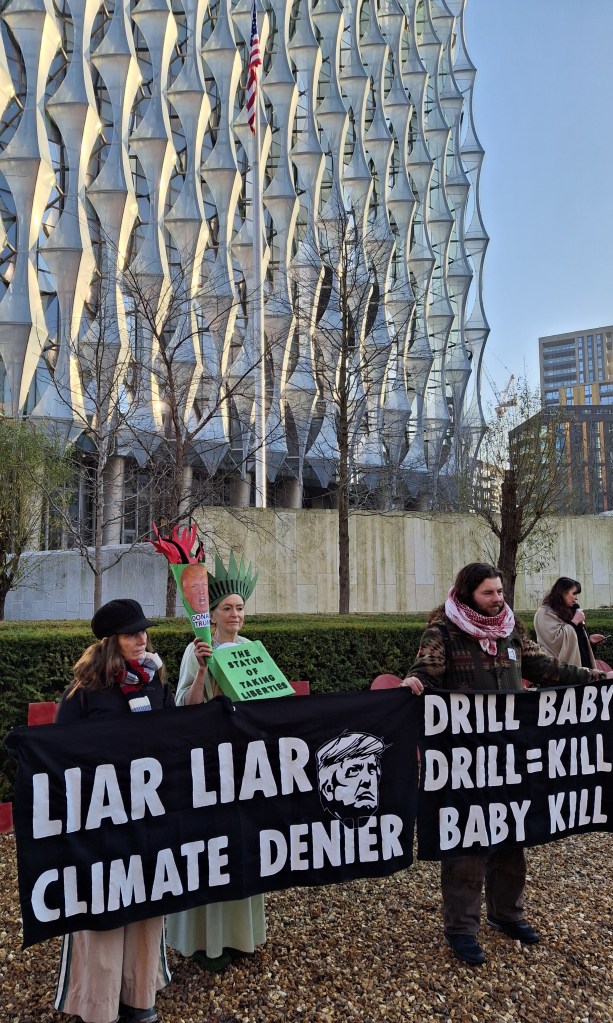


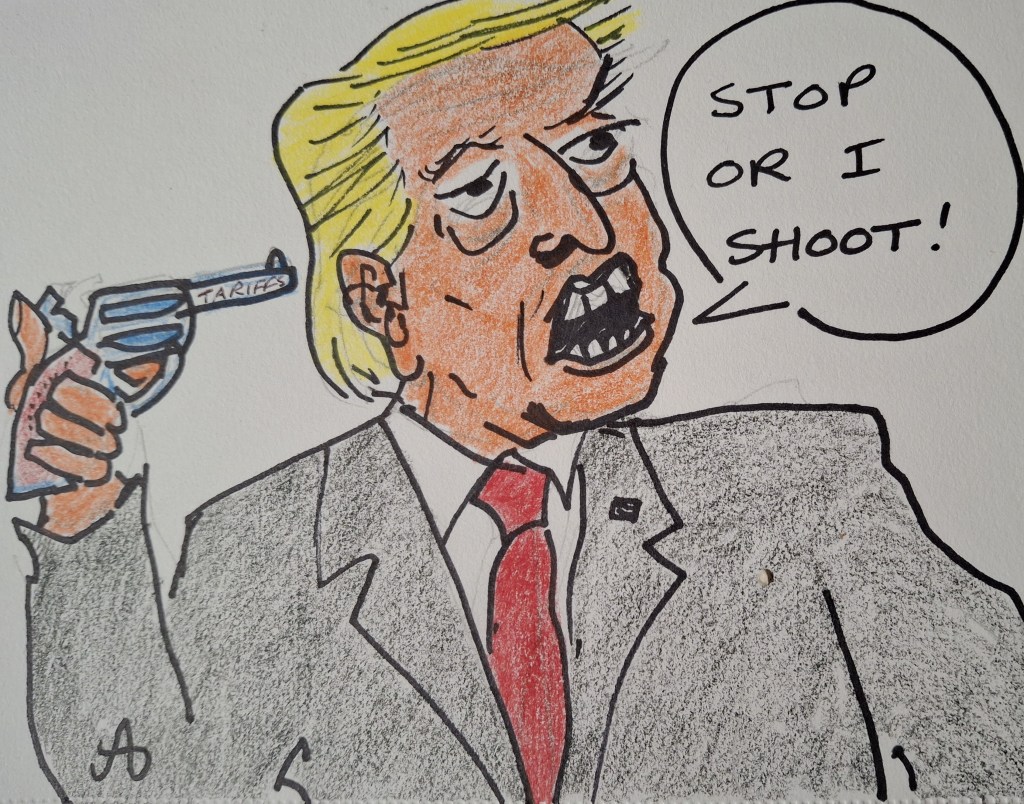
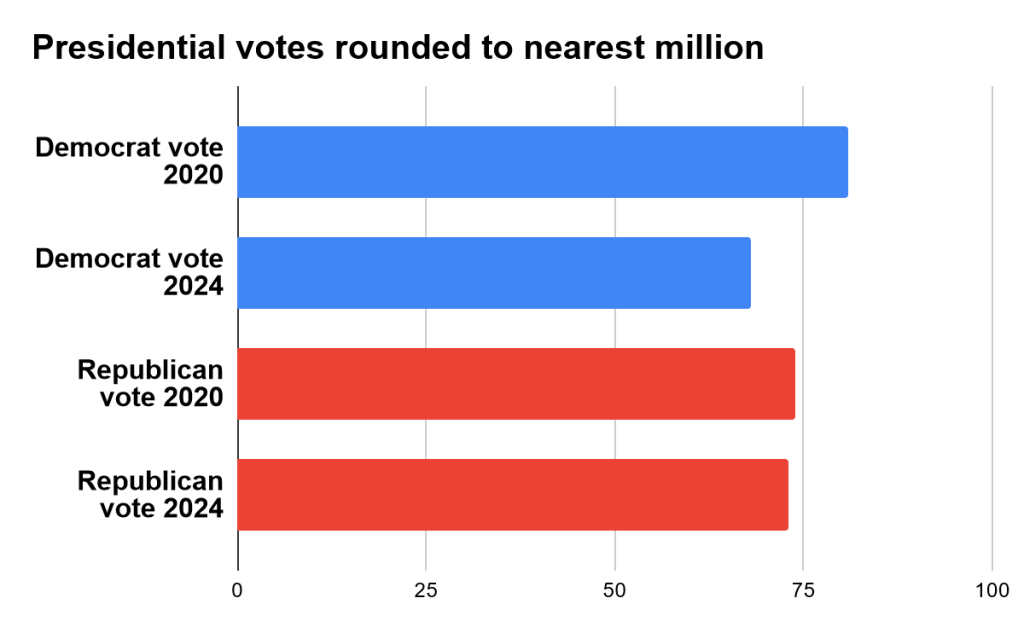

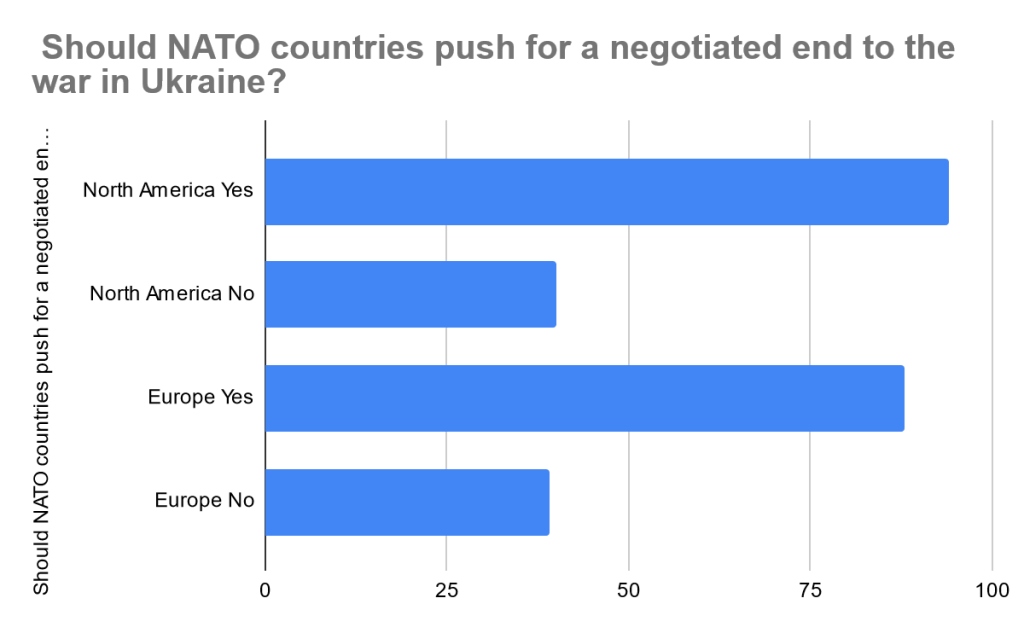
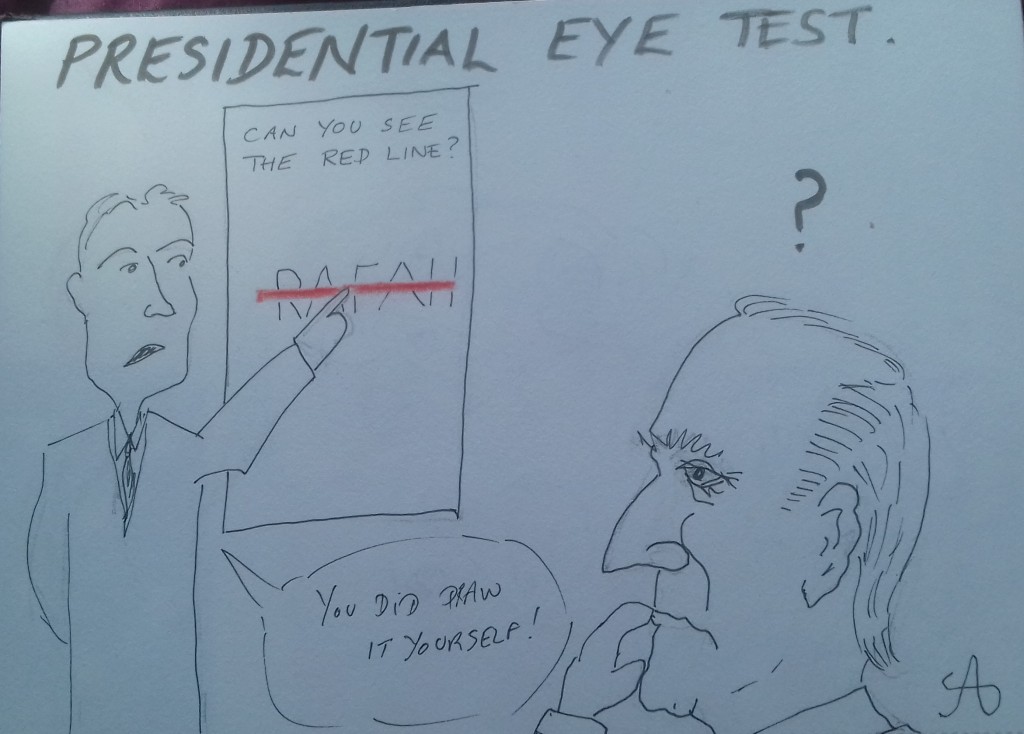


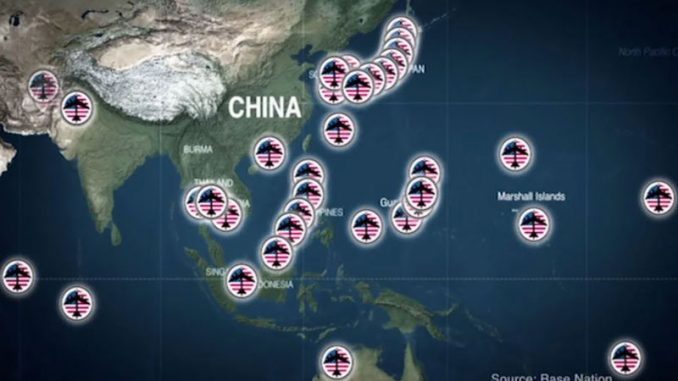

 Urban ramblings