What UK school leavers do – and do not – understand about the climate crisis; and why this is a problem.

The conclusions of the December 2024 research report into climate literacy among school leavers in England makes worrying reading. The survey conclusions are republished below.

  • My comments are in italics.

Through asking a selected sample of Year 11 school leavers in England a broad range of questions, this survey presents a nuanced view of climate literacy amongst school leavers. While there is a general awareness of anthropogenic global warming as a cause of climate change and its global impacts, there are several knowledge gaps and misconceptions demonstrated by the responses collected.


Basic knowledge:
While most school leavers recall having been taught about climate change, only just over half remember having covered it in their last year at school.

  • As Climate change is an existential crisis for humanity, for almost half of students to go sailing through a year of school without being challenged to consider any aspect of it shows an alarming level of baked in complacency that we need to change.


There is a general understanding that the climate has warmed, but many overestimate the extent of warming since 1850. This specifically highlights a poor understanding of messaging related to limiting climate change to within 1.5°C/ 2°C, as many school leavers thought that the climate had already warmed more than this.

  • This fits with a sort of “common sense” approach that uses shifts in temperature in everyday experience of weather as a benchmark. In that, a shift or 1 or 2 degerees doesn’t seem like much, but as an average shift across the whole planet, it has enormous consequences. Students will be seeing an increasing series of news items – on TV or social media – that show these disastrous impacts. The fires in LA and recent storms and floods here will be the latest. Stressing that these impacts are happening at just a 1.2C average increase; so increases above 1.5C or 2C will be so much worse, is essential to challenge this. Some students will have experienced climate impacts, like these: 1. “A primary school in Carlisle had classroom windows blown in during a lesson today, leading to kids diving under their desks. 86mph winds predicted and some HTs “bravely” opened. We’ve got a long way to go on the notion of “adapatation” as well as prevention.” 2. A school in Teeside evacuated due to storm damage after students placed on ‘lockdown’ https://www.gazettelive.co.uk/news/teesside-news/egglescliffe-school-evacuated-stockton-storm-30857248 These are new impacts that will become more common, so staff and students, LAs and Multi Academy Trusts should be aware of them and adapt their risk assessments accordingly.


Most school leavers are ‘fairly concerned’ about climate change but, for those communicating on climate change, it is worth noting that more are ‘not very’ or ‘not at all’ concerned about climate change than are ‘very concerned’.

  • Without wanting students to be overwhelmed by anxiety, being lulled into complacency is doing them a profound disservice. It provides a foundation based on misunderstanding that allows for policies that backslide in a way that puts all our futures at risk.

Unsurprisingly, there is a correlation between those school leavers who think that climate change will affect them directly and those who are concerned about climate change.

  • The obvious question here is, on what basis does anyone think climate change will not affect them? Recognising that this is a threat to all of us is the foundation for the necessary debates, policies and actions.


A substantial proportion do not appreciate that future global warming can still be limited or avoided.

  • Students should not be left with this false impression. It leads to despair, fatalism, or indifference; none of which will help them address the crisis, either as individuals or citizens.

Causes of climate change
Most school leavers can identify carbon dioxide and methane as greenhouse gases and recognise that greenhouse gases affect the temperature of the Earth, but there are misconceptions regarding their respective sources. Similarly, whilst understanding of fossil fuels as a source of carbon dioxide is generally good, in general, the impact of natural causes of changes in the Earth’s climate and, in particular, orbital changes, are overstated. There is a lack of awareness of the contribution of cement to greenhouse gas emissions and uncertainty around wider sustainability issues relating to the production and use of plastics.

  • The confusion around natural causes is understandable, given that in the long term – before humans -they have been more significant. It is important to clarify this because this fact is used to confuse understanding of what is happening now by ignoring the timescale for variations in the Earth’s orbit and tilt, which are over hundreds of thousands of years, and the impacts of solar activity (which on its own has been having a slightly cooling effect for the last few decades) or volcanoes, which tend to have a significant, but short term, cooling effect when they erupt.
  • The misunderstandings about the causes of carbon emissions probably reflects the fact that a lot of cross school interventions on climate change come under an extracurricullar pastoral heading – like walk to school week, or a recycling drive. This reflects the weakness of whole school learning on climate as such, which will have to become a core part of the curriculum if it is to addressed.

As school leavers indicated a good awareness of which countries are currently emitting most greenhouse gas, but less awareness of per capita or historical emissions, this could be linked to a poor understanding of issues related to climate justice.

  • This is likely to reflect awareness filtering in through media coverage, not school learning. It should be clarified so that students have an accurate picture of
  • 1. who has done what since industrialisation since playing this down is a way to minimise the UK’s historic responsibility as the earliest industrial power and
  • 2. what the per head carbon footprint is – which gives a more accurate picture of how sustainable different societies are than raw totals, though this should also be tempered with an understanding of consumption emissions, as contrasted with production emissions as, in an interdependent world, countries with economies that are primarily service based which have outsourced their carbon intensive heavy industry (like cement production) to other countries nevertheless consume the embodied carbon in their imports in a way that does not show up in statistics based on production.
  • When you get bad faith political actors, and we are spoiled for choice for those, these misunderstandings provides wealthy countries with alibis, other countries to point fingers at, often unfairly, and represents the abdication of responsibility that is being pushed aggressively by climate deniers. For example, India has the third largest carbon emissions by volume, but has a per capita (per person) total of 2.7 tonnes – about half the global average – because it has a population greater than Europe, North and South America and Australasia combined. China has big overall emissions and a per capita footprint double the global average, but this is half the per capita footprint of countries like the USA, Canada, Australia and Saudi Arabia.

Evidence for and impacts of climate change:

Many school leavers are aware of some indicators of a warming climate such as melting glaciers and rising sea levels, as well as of the impact of climate change on extreme weather events. However, there is limited understanding of the geographical distribution of future temperature changes and their impacts.

  • Again, this will be as a result of the absence of systematic teaching and learning about the scale, scope and likely development of climate breakdown. Knowing about melting ice caps is more or less ground zero. If you don’t know this, you don’t really know anything. But being aware of patterns and projections is essential to avoid a solely impressionistic understanding based on a montage of news items as they come in, which, in the UK focus primarily on serious impacts 1. locally, 2. in other wealthy countries, especially the USA 3. in the global South. This also downplays the scale and potential social impact of these events as they already occur, which again engenders far more complacency than we can afford.
  • A set of serious discussions about possible tipping points is also essential to overcome the false notion that climate change happens with remorseless gradualism, implying that when it hits harder we will still be able to outrun it; whereas it is more likely that if we let things get away from us, the harder impacts will be of a greater intensity, faster velocity and so widespread that they could sweep us away like an incoming tsunami.

Mitigation and Adaptation:
In general, the survey indicated low awareness of these two aspects of climate action, and in particular of climate mitigation strategies. Furthermore, there is a varied understanding between these two approaches, with school leavers often misinterpreting mitigation strategies as adaptation. The impacts of keeping pets and eating meat are generally underestimated whereas the impact of switching lights off
and recycling (from the point of view of greenhouse gas emissions) is overestimated.

  • The strategies school leavers consider effective are those they have done, or been encouraged to do, at school. Switch the lights off when you leave the classroom. Recycle your stuff. Do schools put what they put in their school dinners up front as part of their climate action plan? They should, and be prepared to have the debate with staff, students and school communities – in the same way that many schools with many Muslim students did when they adopted Halal meat as a default.
  • But, all these examples are in the category of individual actions which, though essential, have too often been used as a distraction to avoid strategic social, political and economic policy choices at society level about use of fossil fuels, industrial farming, construction materials and methods (and who controls those), town planning, transport policy and so on.
  • Whether students can identify whether a given action is mitigation or adaptation, or both, is surely a secondary issue to whether they think they are necessary, for themselves as individuals and/or for everyone as citizens. While its better to be clear, there is a slight echo here of Goveish assumptions that if you can name a part of speech you know how to use language effectively.

Concepts such as the 1.5°C and 2°C targets, and net zero, are very poorly understood. With ‘net zero’ in particular being a phrase which is in widespread use, from the Department for Education’s Climate Change and Sustainability Education Strategy to employers and the media, lack of understanding of it is both surprising and concerning.

  • If it isn’t taught, it won’t be understood. The consequences of average temperature rises of 1.5C and 2C, or worse, are widely published. It should be the core of teaching about what we need to do to limit the incoming damage that students have a firm grasp of these projections and understand the basics of the processes that produce them through the IPCC and that this reflects the firm conviction of 97-99% of the world’s scientists.
  • Given the relentless attacks on “Net Zero madness” and “Net Zero zealots” in the media, having a firm grasp of what the term means is essential to be able to navigate what is becoming an increasingly fraught debate based, primarily, on misleading or factually innaccurate arguments from vested interests with a lot of resources to try to conceptually turn reality upside down. We should not leave our students vulnerable to the suggestion that it is the people who want action for a sustainable future who are “mad” or unreasonably zealous, while those who want to carry on as we are until we hit a series of devastating crises, that we won’t be able to recover from, are somehow the sane ones.
  • Discussions about Net Zero vs Zero carbon emissions raise important issues concerning the limitations of carbon offsets, especially as they are actually used.


If climate education is to raise awareness of green careers and, more generally, to increase hope in our ability to take collective climate action, increased awareness of mitigation and adaptation strategies is vitally important.

  • It is also important for students, who will still be quite young by 2050, to grasp that a failure to decarbonise our society will make us all significantly poorer, even if society avoids collapse altogether. It might help if the Chancellor of the Exchequer had an inkling of this too.


Climate Change in the UK:

In general, there is very poor awareness of the projected impacts of climate change in the UK, the need to adapt, mitigation strategies already in place and of the cost benefits of mitigation rather than adaptation.

  • This, again, reflects the unsystematic and fundamentally unserious character of learning about climate in the UK. These are average results, and some schools do fantastic work, especially if they are signed up to Lets Go Zero, Ministry of Eco Education, Eco Schools, or they have a Local Authority that takes this as seriously as they do in Brighton or Leicester for example, or they have an inspirational Head teacher who is on the mission that, frankly, all Head teachers should be on; but that also means that many schools will be doing far too little in the absence of the thorough commitment to climate education that we need running throigh the entire national curriculum. An example of this is that even an officially supported, and very good, initiative like the National Nature Park has only be signed up to by about 10% of schools. This is absurd.
  • Leaving students with the fundamental misunderstanding that the “costs of Net Zero” are greater than the consequences of failing to meet it – which they will have picked up from deliberately misleading media coverage without a thorough going rebuttal in schools- lays them open to dishonest political manipulation that will put their future at risk.

This will be directly relevant to school leavers’ awareness of the green careers available to them. Whereas school leavers were aware of the contribution of melting ice to sea level rise in the UK, they were less
aware of the contribution of the expansion of sea water as it warms, which has made an approximately equal contribution historically. It could be argued that this reflects a need for science teachers to be able to demonstrate that learning in the sciences has applications and contexts relevant to climate change.

  • The overall conception we should be trying to develop is that every job, every career, will have to be green, because every job will have to be sustainable. There can’t be a “green sector” that maintains peceful coexistence with unsustainable sectors; as the key thing we have to grasp is that we have to make all sectors sustainable and all jobs greener, so the process will be the growth of the former and the shrinking of the latter to ever more residual roles.

Communication:
There is a substantial knowledge gap regarding the level of scientific consensus on climate change, with most thinking agreement amongst scientists is notably lower than it is. This potentially relates to past and present education policy related to presenting a ‘balanced’ argument for global warming. Knowledge of international organisations such as the United Nations Framework Convention on Climate Change (UNFCCC) and Intergovernmental Panel on Climate Change (IPCC) is also limited. Trust in climate information from science teachers and the BBC is high, but lower for politicians and tabloid newspapers.

  • This substantial knowledge gap needs to be closed, and fast. This is not simply down to ludicrous notions that it was necessary to have a “balanced” discussion between an almost universal scientific consensus and a few fossil fuel funded mavericks, as if the two had equal weight, but also the previous government’s successful attempt to freeze debate on the social implications of climate change with its “impartiality guidance”, which put campaigning organisations on a blacklist that should not be invited in. This guidance should be scrapped, and the no holds barred debate on how we are going to construct our own futures unleashed.
  • The understanding that the climate breakdown projections we are working to limit are the product of a thorough and painstaking research and analysis, that the International Panel on Climate Change (IPCC) is a UN body and its findings are subscribed to by 195 governments (out of 198) worldwide; so represents an international government consensus as well as a scientific one is essential. As is the understanding that countries, no matter how weighty they are in the world, that break with the science do not have a valid point of view, but are going rogue.
  • That students trust science teachers most underlines the point that schools have the tresponsibility to present them with the truth, the whole truth, and nothing but the truth. This trust is likely to extend to other teachers in so far as climate is dealt with, as it should be, across the curriculum. There are three levels to our response to this.
  • 1. The current national curriculm review should incorporate climate learning into the national curriculum in all subjects and in an age appropriate way in all key stages. Part of this will have to be turning, appropriate, anxiety into purposeful action, for individuals, schools, communities and in campaigning/debating ways forward to future proof ourselves in a just transition. If it falls short of this, it will not be providing an appropriate curriculum for the Anthropocene.
  • 2. that will require us to campaign for the DFE to create and mandate additional learning to close all of these gaps in understanding.
  • 3. If they fail to do that, we will have to mobilise through our unions and campaigning organisations to produce such material ourselves – from posters, to lesson and assembly plans, to webinars/online learning materials for colleagues to adapt – and push them through during the trade union year of action starting in September, to build such learning into every school’s climate action plan.
  • Trust in “politicians” is low. This isn’t clearly differentiated, because some politicians are more trustworthy than others. But now that we have every Party from the Conservatives rightwards explicitly opposing action to meet “Net Zero”thereby breaking with the scientific imperative to meet it – it becomes even more important for schools to ground our future citizens in the facts of the world they will be dealing with. As there is no need to teach a balance between scientific reality and denial, Parties that break from the scientific reality, and fail to rise to the challenge of meeting it, are putting themselves outside consideration as relevant forces that should be taken seriously.
  • Students, sensibly enough, do not trust the tabloids. But the BBC, which they trust more, often has its news agenda, and the framework they put stories in, set by them. Looking at trust, or distrust, in social media will also be a vital part of developing critical awareness of bias and manipulation in media coverage. Perhaps counting the number of times that the tabloids attach phrases like “madness” to “net zero” or “swivel eyed” to “targets”, might make a revealing set of graphs…

A personal note

This image is a montage of times. The factory in the background is the Wouldham cement works in Thurrock in 1951.

The photo is on the wall in the Grays branch of Morrisons, which has a nice line in sepia industrial nostalgia. The Wouldham was already a ruin by the 1960s, but there were several other huge cement works along the side of the Thames up towards Purfleet.

Growing up back then on the wrong side of the prevailing winds is probably one reason I’m so prone to coughs. All these plants are now gone. Lakeside has taken their place. The carbon, and pollution, footprint of retail is a lot less than that of cement, which has been outsourced to other countries, which suffer the pollution and have to carry the can for the carbon footprint, even when some of the products are exported back here.

The Wouldham is significant for me in another respect. My great grandfather, John Henry Ellis, worked there and was killed in an industrial accident – falling into one of the storage tanks he worked in in 1931.

Nadhim Zahawi loses the plot.

The Open Letter to Schools by Education Minister Nadhim Zahawi for the start of term is based on a presumption that the Omicron variant will cause mass infections and, rather than seek to avoid this, the government wants schools to adapt to it.

This is the logical consequence of putting business first; which requires a defeatist approach to suppressing the virus. If the imperative is not to suppress the virus but simply to have the maximum number of students in school so that their parents can go to work and relieve some of the pressure on businesses, health and educational considerations take a back seat.

Zahawi concedes that the situation is going to be bad. Lots of students and members of staff will contract the virus. “Public sector leaders have been asked to prepare for a worst-case scenario of up to a quarter of staff off work as the virus continues to sweep across the country” TES. This is the “take it on the chin” approach with avengeance. Provision of online or blended learning during the coming half term is not a measure to be taken to avoid mass infection, but a fall back position required by the failure to do so.

His last minute suggestions to deal with large scale staff absence have a whiff of barely thought out panic about them, combined with some attempts not to let a good crisis go to waste.

  • appeals to “former teachers” to return to the classroom; to be organised school by school. There is nothing proposed from the DFE to encourage this, or facilitate it, giving a strong sense of “over to you” about it. If this is to be taken seriously, some thought needs to go into who “former teachers” are – and why they are “former”. Most of them will be found among the third of teachers who quit within five years of qualification; so, addressing the issues which lead to this exodus will be needed if they are to be encouraged back in any numbers. Most of this group will be younger people who will have moved on to other jobs. Relatively few of them will be willing to quit a new career without some sign that the conditions that lead them to leave in the first place are being addressed. A comment often heard from recently departed or retired colleagues is along the lines of, “I don’t know how you can put up with it. Its only after you leave that you realise how much stress you’ve been under”. A serious discussion with the teaching unions about how the unbearable pressures on teachers – at the best of times – could be relieved would be an essential precondition for this to have even a marginal effect. There are also quite a lot of retired teachers. However, most of them are in relatively vulnerable age groups. Probably not wise to put a lot of exhausted rising seventies in Covid crisis classrooms; particularly given some of the other suggestions that Zahawi has sucked out of his thumb; which will determine what those classrooms are like.
  • Flexible delivery of onsite learning – with the priority being to keep the kids on site – covers a multitude of sins. “Flexible delivery involves utilising all your available teaching and non-teaching workforce to maximise on-site education for as many pupils as possible while you flexibly deliver provision either on-site or remotely to some pupils.” Nadhim Zahawi cited in the TES (my emphasis). Using “teaching and non teaching staff” means covering lessons by non teachers. While Higher Level TAs now often cover lessons in some schools in certain conditions, this seems to be a much broader proposal; that anyone who can be propped up in front of a class is fair game to keep the appearance of on site education going. The educational fabric looks set to be stretched very thin.
  • The other suggestion is “merging classes”. This is beyond parody. Instead of having 30 students in a room, you put 60 of them in there. With a Covid variant that is as infectious as measles. Quite brilliant!
  • Exams and OFSTED inspections are expected to go ahead as normal. OFSTED inspections for Secondary schools will be held back for the first week in January, but only to facilitate on site pupil Covid testing. Other than that, OFSTED Inspectors who “who are also school, college and early years leaders” will not be expected to take part in inspections – making the inspectors that do even less in touch with practice and experience on the ground. Schools affected by significant absence can “ask for” Inspections to be “deferred”.
  • Students and staff are “encouraged” to self test twice a week and the DFE “recommend” that face masks should be worn in Secondary classrooms as well as communal areas while students over the age of 12 are “eligible” for vaccination. None of this is a requirement. This lackadaisical libertarianism is described as a “proportionate and targeted” approach. Largely thanks to anti-vaxx influence in the Conservative Party, there is no current proposal to vaccinate 5-12 year olds, even though evidence from South Africa shows that Omicron has a greater impact on younger children that previous developments and vaccinations of this age group are now taking place in the USA and the EU. largely due to anti-vaxx influence in the Conservative Party.
  • 7,000 ventilation units are to be deployed, with no timescale set out. With 24,400 schools in England, that’s one between every three and a half schools. Presumably they are expected to share.

This half term looks set to be as big a mess as any in this pandemic, especially in schools. Zarhawi’s letter describes what “living with the virus” is going to look like. Not just this half term, but forever.

Instead of a determined policy to suppress the virus, with the sort of whole society mobilisation that eliminated domestic infections in China in two months in 2020, we have half hearted safety gestures (described as “proportionate” when “inadequate” would be more accurate) – apologetically introduced and slated to be removed as soon as possible as an affront to personal liberties – used as a cover for a level of social mixing likely to send infections soaring, with massive numbers of staff off sick – and doubled up classes covered by anyone on the payroll who can be got to cover them; giving the infection rate an added top spin.

The Education Unions will in the first instance need some quickly published agreed guidelines to stop this becoming abusive, but we also need to campaign explicitly for an active Covid suppression policy, aiming to eliminate domestic infections as the only way forward that will actually be a way out.

Update 4/1/22:

Joint union safety guidelines have now been published by NEU NASUWT UNISON UNITE and GMB and can be read here.

The NEU press release on the government statement can be read here.

Good News and Bad News. Impact of Schools Reopening Week 4.

There is good news (with a caveat) on the rate of infection in the three areas I am monitoring this week. 
All have declined, with the overall suppressive impact of the wider social lockdown combining with mass vaccination to counteract the upward pressure from schools being open en masse. 

While this is very welcome, the effect in all three places taken together is that infection rates are now only a little below the level they were when schools reopened. This is also true nationally. 


The comparison with an extrapolation of the previous trend shows how this has missed a golden opportunity to bear down on the virus to near extinction point. 


The impact of schools reopening can be seen in the higher rate of infections for school age cohorts than any others – explained very clearly here by the NEU

The next two weeks, with schools on Easter break, will reduce that upward pressure.


These are therefore the last weeks in which the reopening of schools is the main upward driver of infections, before the loosening of restrictions from April 6th begins to have an effect from about April 20th onwards – and the scheduled further loosening on April 12th kicks in from about April 28th. 

The government calculation is that a wide enough vaccination roll out will reduce hospitalisations and death enough to be able to reopen on a far wider scale and get away with “living with the virus.”

The attempt to live with the virus in the absence of a high enough mass vaccination rate can be seen in Brazil; where Bolsonaro’s Bossa Nova is an unambiguous dance of death.

A reliance on mass vaccination as a single line of defence depends on the virus not evolving any variants that resist the vaccines. If it does, all countries that have not carried out a zero covid strategy will be back in the morass.

Impact of School Reopening on Viral Infection Rates. Week 1.

The wholesale reopening of schools on March 8th has already had an impact on the rate of viral transmission.

The National Education Union has a site that measures the rate of infection per 100,000 people in the areas around every school in the country. I have looked at the figures for the areas around three Primary schools with which I have a personal connection – the one I went to, one I taught in, and the one my children went to. I will be updating these on a weekly basis, every Thursday.

The impact of schools reopening can be seen clearly. No other significant measures have been taken to ease lockdown at this point, so this passes the “fair test” criteria for identifying the impact of a single variable (1).

You can check out what is happening in schools near you by going on the NEU covid map site. I would be surprised if the pattern were any different anywhere else.

In Islington, the infection rate is still declining, but the rate of decline is leveling off.

In Brent, the rate of infection has leveled off almost completely, from a previously sharp decline.

In Thurrock, there has been a very small increase, from a rate of decline that was previously similar to Brent’s.

This is quite a disturbing immediate impact. My presumption is that, other things being equal, these trends will continue between now and the Easter break.

The tragedy of this is that keeping schools shut until after the easter break could have got infections down to a point at which and effective Teast and Trace system would have been in a position to eliminate domestic infections.

  1. Level 3 in Key Stage 2 Science.

Holes in the Schools Safety Net. What can we expect from Monday.

Sailors on ships of the line about to be hit by a broadside would quietly intone grace. “For what we are about to receive, may the Lord make us truly grateful.” And so it is with the wholesale reopening of schools on Monday.

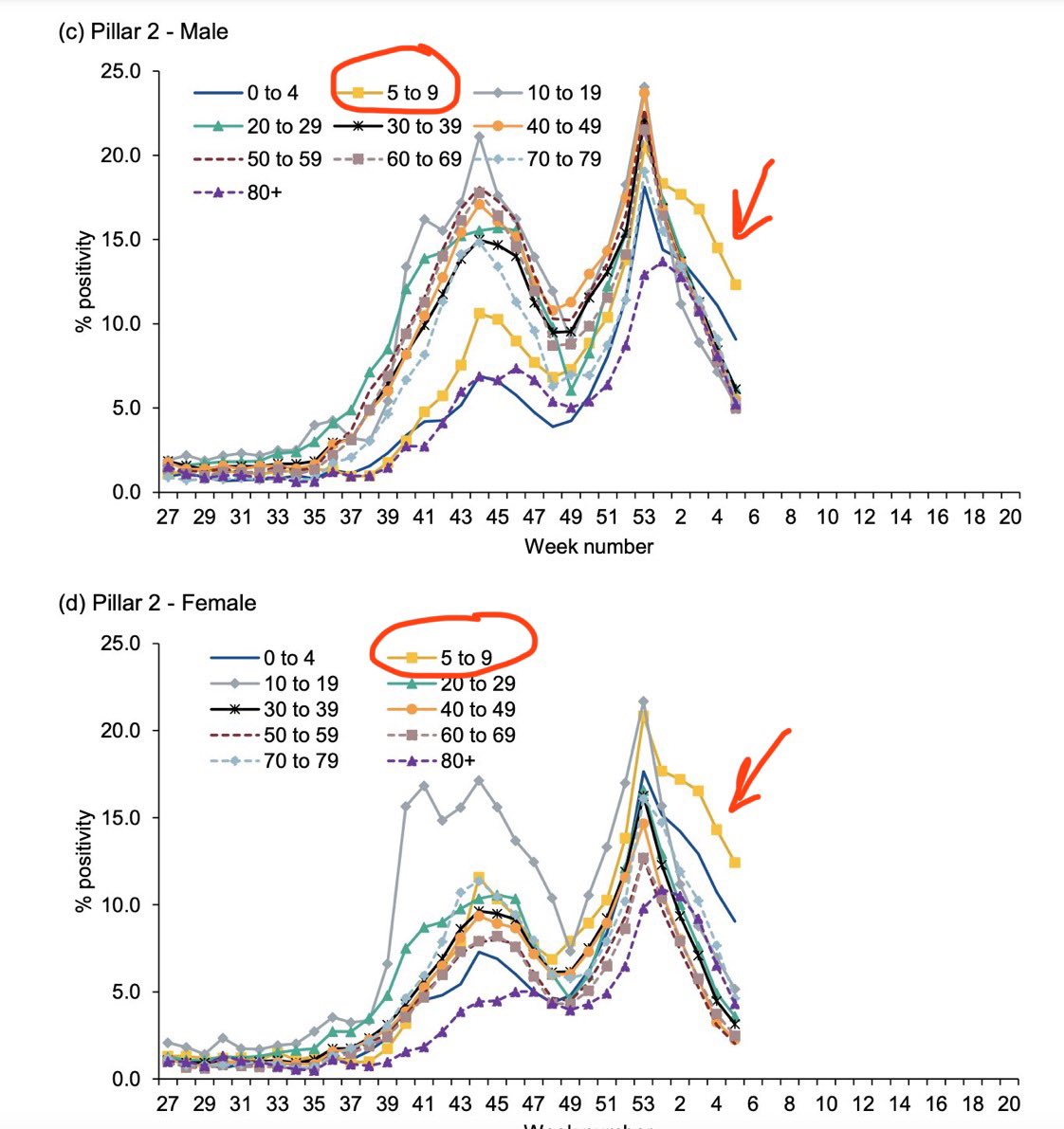
This is particularly the case given that for the last four weeks there has been a significantly larger percentage of positive cases in the 5-9 age group in England, for both boys and girls. (1) A similar trend has been seen in Israel and some sharp localised outbreaks in Italy have been centred on schools.

Image

In this context, looking at what happened in practice the last time that schools were fully open will give us a guide to what is likely to happen.

In the Autumn term the Health And Safety Executive carried out spot checks and inspections on schools to make sure that COVID safety measures were being implemented effectively. As these measures “have not been substantially changed” since then, their findings are instructive. (2)

It should be stressed that none of this addresses the wider safety issues of whole school reopening – particularly the journeys in and out – which are only covered obliquely in the guidance – but will involve a sudden rush of millions of daily interactions; which are bound to boost the overall R rate. Nor does it cover the likely effect of encouraging a sense that “things are getting back to normal” as swarms of kids reappear in the streets in the mornings and afternoons – with a knock on effect of people beginning to relax and drop their guard.

HSE spot checks and inspections in primary and secondary schools from September to December 2020.

“HSE contacted 5000 schools in England and Wales to check they were following the relevant government guidelines. This followed similar spot checks carried out in August on schools in Scotland.”

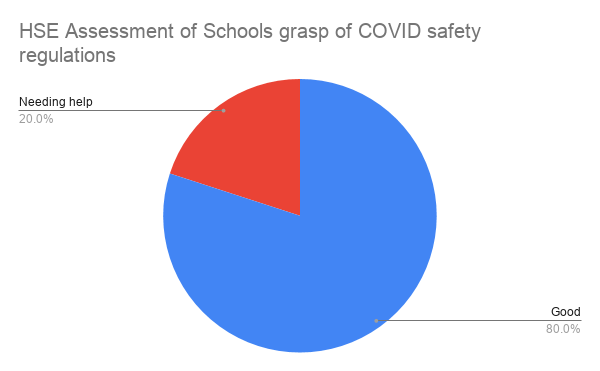
“Following the initial calls, HSE found that around 80% of schools had a good understanding of the guidance and what it means to be COVID-secure.”

The HSE makes no judgement on how much safer schools could have been if the unions 10 point recovery plan had been taken up by the DFE (3) but the 80% figure here is a testament to the hard work and dedication of school managements and the serious input made by the Education unions, whose safety checklist was used by Reps all over the country to make sure that risk assessments and procedures were in place and schools made as safe as it was possible to do within the limitations of the investment the government was prepared to put in. Sometimes school Heads who had previously been institutionally hostile to their union groups found themselves working constructively with Reps because the union guidance was so sound and thorough. However, some did not. 80% is a good figure, but that still leaves one school in five with a poor grasp of safety measures which are a matter of life and death. With 24, 372 schools in England, extrapolating their sample and assuming all other factors remain equal, that would mean that roughly 4, 875 schools had a poor grasp of the guidance. One in five. That would be the sort of place where Heads tried to insist on physical parents evenings or open days taking place, or in person staff meetings, or people of the CEV list coming in to work, or Christmas performances that would presumably be protected by God.

“For those schools, HSE undertook over 1000 follow up site inspections to check the measures they had in place.” While these schools responded positively and “nearly all …had implemented COVID-secure measures in accordance with the relevant government guidelines” by the end of term, obviously, this only covered the schools they had initially contacted; so potentially the remaining 3,875 slipped through the net.

Just under ” 1% identified contraventions of health and safety requiring formal interventions and improvement.” 1% of 24,372 schools is about 240. Not many, but more than enough.

If there is a similar pattern in the next three weeks up to Easter and beyond into the Summer term, the sort of concerns Inspectors had “included social distancing in staff rooms and kitchen/canteens, cleaning regimes, and ventilation in school buildings.”

Ventilation was a particular issue, so the HSE has updated its guidance (4) which will be useful for anyone in a school where this has not been sorted.

Other problems included:

  • Generic risk assessments being used which sometimes lacked specific detail for the school.
  • Lack of effective systems for regular monitoring and review of risk assessments.
  • Fire doors being propped open to aid ventilation.
  • Inappropriate rooms being used for isolating suspected cases.
  • Arrangements for managing external visitors and/or contractors.

good ideas they noted included:

  • Promoting social distancing by issuing pupils with coloured lanyards to identify their bubble and to help avoid mixing between different groups.
  • Using brightly coloured floor markings in school playgrounds to encourage two metre social distancing between parents and pupils during drop-off and collection times.
  • One school used a year seven science project looking at handwashing and UV light as a means of promoting effective hand hygiene.
  • Producing video walkthroughs explaining COVID-secure arrangements for pupils and parents.
  • Use of classroom seating plans to help with self-isolation measures.
  • A click-and-collect app to purchase food from the canteen to reduce queues and avoid crowding.
  • Using video conferencing for staff meetings and phones in classrooms to speak to other staff to reduce face-to-face contact.

The HSE has guidance on being COVID-secure and information on spot checks and inspections is available on their website.

The role of unions in each workplace, making sure that these guidelines are upheld, has been essential in limiting the damage so far, and will be just as urgently needed in the next period, as the government once again skids over thin ice with its eyes shut and fingers crossed.

  1. https://twitter.com/DrEricDing/status/1367448762025672704?s=08

    2. All quotes from HSE Education and schools eBulletin: March 2021

3. https://neu.org.uk/recovery-plan

4.  ventilation and air conditioning 

Schools + Big Bang = Bad Move!

By late Monday afternoon we will know just how lucky Boris Johnson feels.

We will also know whether Chief Medical Officer Chris Whitty – reported to be deeply concerned about a rush to open schools wholesale on March 8th – is going to play the role of a Fauci, by refusing to be window dressing for a move he knows will cost lives, or that of a Birx, grimacing through whatever “form of words” Downing Street comes up with to massage its intent.

The government – not for the first time – is sending contradictory signals. The Education Unions, all of them, are not. They describe the prospect of schools being open to all students from March 8th as “reckless”. (1)

While the government is saying that it will only publish the Scientific advice after the event – an indication that they are not at all sure that it supports a big bang – what we do know appears not to.

As a result of the lockdown, infections are coming down quite fast. Halving every 15 days. With the infections on 18 Feb running at just over 12,000 – other things being equal – they would still be at just under 6,000 a day on March 8th; well above where they were in September last year the last time this was tried (1,295 on September 1st). And we should all recall what happened then. This time round, we are looking at a daily infection rate five times worse than then with a virus that is considered up to 70% more contagious.

Not likely to go better than September is it?

At the current rate of decline, the projection is that infection rates would take until the Easter holidays to be down to 1000 a day. Add the two weeks off for Easter with all other restrictions in place and we could be down to 250 a day by mid April. That is a level at which the virus could be hounded to domestic extinction with a proper test and trade system, run through the Health Service and Local Authorities not SERCO.

The government, instead, wants to rely on vaccines and a lot of hope – and probably some contradictory forms of words as the big bang blows up in our faces. Caution with freedom. Recklessness with responsibility. What more can you expect from us? The buck stops with you. If they do go for this, it will be seen as a green light by the take it on the chin brigade, who want the economy re-opened regardless of the casualties. In the words of Thurrock MP Jackie Doyle Price “The moment you open schools up then there no excuse for not opening up the rest of the economy”.

While there has been a real but marginal impact of vaccinations on infections among the over 80s, this has no bearing at all on schools. No children will be vaccinated. No vaccine has been licensed for the under 16s. Very few teachers or TAs will have had even one injection. At the moment, the age groups which has had the slowest trajectory of decline in infections are young adults (18-24) and primary school age children (5-12). “Researchers say that this may be because a significant proportion of primary pupils have still been in classrooms during lockdown”. (2) The current level of attendance in Primary is around 20-25%. Bump this back up to the pre pandemic norm of 95% and how hard is it to predict whats going to happen?

The impact of a partial reopening – on the lines being tried in Scotland from Monday – is likely to be damaging enough, with primary schools becoming a permanent viral reservoir. Their experience must be watched closely to see what happens, though it must be noted that Scotland has an infection rate that is lower than that in England (1:180 compared to 1:115) and the two weeks between Monday and March 8th is a short period to provide anything definitive about how quickly the virus rebounds. However, opening all schools for all students and all educators is bound to slow down the rate of infection decline significantly and, in the worst case, may even reverse it.

The Education unions, parents, independent SAGE and others are arguing for damage limitation. That if there is to be a partial widening of access to schools from March 8th, this should be on a limited basis and the results studied before considering wholesale reopening. That appears to be the plan in Wales, with Early Years and Infants back next week but a projected fuller opening for the rest of Primary and some Secondary year groups contingent on a continuing improvement in infection reduction. A government concerned with public health would listen to them. Labour should back them – and call for the Zero Covid strategy that is within our grasp, but the Tories fail to sieze

1 https://neu.org.uk/press-releases/joint-statement-wider-opening-schools-england

2 https://www.theguardian.com/education/2021/feb/19/whitty-at-odds-with-johnson-over-big-bang-reopening-of-schools-in-england

March 8th. A “Big Bang” for the Virus.

What a difference a week makes. From March 8th being the earliest possible time to reopen some schools, slowly, slowly, carefully, carefully, it seems to moved through being one of those target dates that become a matter of Ministerial virility to hit, all the way to being a “big bang” day on which all schools open at once. So, eight and a half million students and three quarters of a million educators all going in and out of workplaces every working day with “bubbles” 20 times the size allowed outside, then going home again. Rather a lot of vectors of transmission there. This is like watching a fly trying to get through a window. No matter how many times it bangs its head on the glass, it keeps trying to do the same thing. History repeating itself as tragic farce.

The media – doing their usual job of framing a discussion as though there isn’t one – have gone into overdrive hyping it up in that hopeful way that makes any criticism come across a curmudgeonly, likely to make children unhappy and ruin their lives and – in the case of the Daily Mail – targeting the NEU with a We Reveal Evil Teachers Plotting to Keep Children Safe story; as if demanding safe conditions to teach and learn in were an outrageous abuse by people who don’t know their place. The spirit they would prefer to see being that of the wounded trooper in the 11th Hussars at the end of Tony Richardson’s 1969 film Charge of the Light Brigade, who looks up from the carnage around him as Lord Cardigan rides slowly back up the valley and calls out in a cheery cockney way “Go again Sir?”

The line from the government is that the roll out of the vaccines – a fabulous job by the NHS, thankfully not outsourced to SERCO – will bring the level of infections down to a point that opening up again from March 8th is something they can get away with without overwhelming the Health Service. At the same time they are flying kites with “Great Barrington Declaration” written all over them – arguing that vaccinating the most vulnerable (once) makes it an acceptable risk to go for ” a big wave” of infections among everyone else. Back to “herd immunity”. Here are the problems with this.

If you look at the graph that shows infections in the UK, the pattern is very clear Fig 1.

Fig 1.

During the first lockdown, schools were closed to all but a very few pupils and we were only dealing with the original variant of the virus, which had not yet evolved so that it could spread more quickly. The peak for infections is quite low when you compare it to where we got to over the winter. The point at which infections began to rise again was as soon as the lockdown was lifted in mid summer. This was initially not very apparent because the numbers were low, and its slow growth helped by schools being shut for the summer holidays (despite “Eat out to help out”). Then we had September. Schools reopening evidently had a significant effect on transmission of the virus. Look at the date. Look at the rising curve. The failure to circuit break when absolute numbers were still low enough, then the half hearted lockdown in November followed by the attempt to open up for Xmas shopping can be tracked exactly on this graph. As can the rapid drop resulting from the current lockdown.

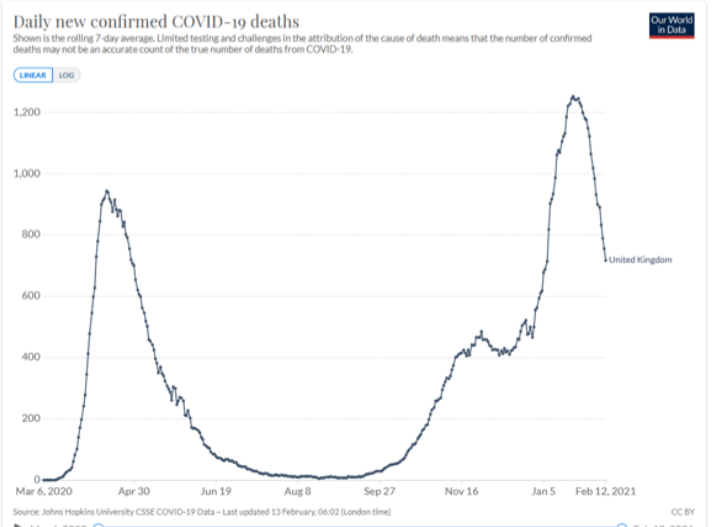
It is possible to argue – so people do it – that the rise in infections is down to an increased level of testing, but this is only true in what might be called a limited and specific way. The pattern of deaths follows the same curves; the slowdowns during lockdowns and the increases when they open up. Fig 2. the minimal downturn in November can partly be attributed to the government’s mulish insistence on keeping schools open. The current, much sharper, downturn is at least partly because schools are currently running with between 20-25% of students in. It would be sharper still if those numbers were down to the 3-10% that was the case in the Spring.

Fig 2

The notion that the sharp fall is attributable to the vaccine roll out is not based on facts. The government and media can be a bit allergic to these if they are inconvenient, but the ONS data on infection by age group shows that the rate of infection has dropped most sharply among the school age cohorts and barely at all among the over 70s; who are the age group that have primarily received their first jab. See the graphs here. https://twitter.com/chrisgiles_/status/1360219174476406788?s=27

So, the contribution of vaccinations to reducing infections has so far been marginal at best. Further, at the current rate of 2.5 million vaccinations a week, it will take until summer to give everyone over 16 one jab – and this will be even slower because everyone who has already had one will have to have their follow up within 12 weeks. So, a wide and rapid reopening on the hope that the vaccines alone will do the job is on a bit of a wing and a prayer.

It should also be stressed that no vaccine is currently liscenced for use on anyone aged under 16. So, children will have no vaccine protection at all. The call from Labour for all teachers to have one jab this week to provide some protection – ignored by the government (who presumably either think that it can be defeated with “British Pluck” or that teachers should be prepared to pay the final sacrifice in an undaunted way) also misses the point that you need TWO jabs to be fully vaccinated. The vaccines also – while offering significant protection against serious illness and death do not in themselves prevent infection and transmission.

Opening schools up wholesale on March 8th – even with all the safety measures that Heads and educators have struggled to put into place – is therefore another attempt at a triumph of the will over scientific reality (of a similar sort to the way they are trying to bluff their way through on climate breakdown) and will have comparable effects. It is likely to become the beginning of a super spreader event across the whole of society.

This continual in and out, stop and start has given the virus time to evolve. As it has evolved the variants that are more infectious are the ones that will survive best. Some of these, like the South African variant, have also become more deadly and resistant to the vaccines. It stands to reason that as the mass vaccinations are carried through, the only variants that survive will be those that resist them.

The decisive question therefore is why, given that this is common knowledge, the government does not adopt a strategy to eliminate the virus – as advocated by the Zero Covid coalition. Using the vaccines as an aid, but not relying solely on them. A key demand is that raised by the education unions throughout – for full disclosure of the scientific advice from SAGE.

Reading the comments made by the 50 strong Tory backbench – and profoundly misnamed – “Covid Recovery Group”, that although wholesale reopening of schools will make it impossible to keep the R rate below 1 that this is “worth it” – it is possible to conclude that this is just bluff and ignorance. The calls for “the scientists” to be taken out of political decision making – so that MPs like them don’t have to be troubled by awkward facts when they have to strike a posture – echoing the long muscular sporty traditions of the Public Schools so many of them went to, with their deep suspicion of intellectuals (dubiously continental and probably effete) and the boys comics they read when they were growing up – full of evil villains with big, sneaky brains and weedy little bodies. This – however – is simply a matter of style. These are not stupid people. But they are remarkably unconcerned about deaths among the sorts of people most likely to die – ethnic minorities, front line workers, the unproductive elderly, those with “underlying conditions” making them not fully work fit, and the worst off in general, who have made the “poor lifestyle choice” of living in overcrowded accommodation – if their lives are an obstacle to letting the economy rip and profits made. “Herd immunity to protect the economy and if that means some pensioners die, too bad” as Dominic Cummings put it. Daily Telegraph business editor Jeremy Warner put it like this last March. “Not to put too fine a point on it, from an entirely disinterested economic perspective, the COVID-19 might be mildly beneficial in the long term by disproportionately culling (sic) elderly dependents”.

Find out more and join the resistance here.

Vaccines are not a magic bullet. Zero Covid coalition zoom meeting. (https://clicks.eventbrite.com/f/a/ZpkyZfNaozDdfG7GeA_Tlg~~/AAQxAQA~/RgRiCMm8P0RKaHR0cHM6Ly9wcm90ZWN0LWV1Lm1pbWVjYXN0LmNvbS9zLzNrRVRDWEw4RWlOQkRadmM5bVpYaT9kb21haW49dGlueXVybC5jb21XA3NwY0IKYCE8lidgZgTiv1IXcGF1bGF0a2luNTRAaG90bWFpbC5jb21YBAAAAAA~)

Not so much a mountain more a roller coaster?

If you look at figure 11 in the government’s latest coronavirus weekly surveillance report (1) which covers the sites for the spread of infectious respiratory disease going back to last autumn, you will notice several things.

1. Schools can be a very serious hub for disease transmission. Weeks 46 to 52 – the end of the autumn term – show schools as the main hub for transmitting last winter’s seasonal flu.

2. Schools were beginning to be a hub for the spread of Coronavirus at the end of March (week 12) until closing them for the overwhelming majority of pupils snuffed that out.

3. Now that more students are going back – even in relatively controlled conditions – schools are again becoming a hub for transmission. This is still quite small thankfully, but in week 23 (the week from June 1st – which was the first week that the government wanted students in Nursery, Reception and Years 1 and 6 to go back) there were 14 outbreaks in school settings. An outbreak is defined as two or more people getting the same illness which “appears to be linked to a particular setting”. Two points should be stressed. This is a real but small increase. It remains to be seen if this is sustained. But this is in the context of relatively few, even of the students the government had targeted for that week, actually going back. More went back in week 24 and yet more from this week (Week 25). The next report will indicate the impact of this.

4. The overall number of acute respiratory infections went UP for the first time since Week 15 in mid April, indicating that passing the peak is not the same as controlling the virus.

1.https://assets.publishing.service.gov.uk/government/uploads/system/uploads/attachment_data/file/891721/Weekly_COVID19_Surveillance_Report_-_week_24.pdf