Palestine, Ukraine and the Wars for the New American Century.

A recent article on Labour Hub tries to link the struggle in Gaza and the war in Ukraine as parallel “struggles for self-determination”; not noticing that one struggle (Gaza) is in resistance to the US centred global imperial system, the other (Ukraine) is a struggle to join it as an auxiliary ally.

People in the Palestine Solidarity movement have strongly felt and taken note of the difference in the response from Western governments to these “struggles for self determination”.

  • The flags of Ukraine and Israel have both been flown on public buildings, head teachers and college principals have been told by the DFE to “stand with Israel”.
  • Palestinian flags – and Keffiyas – have been denounced as “threatening”, or “symbols of terrorism” or “hate” and children drawing flags on their hands or wearing badges in schools have been referred to Prevent. This has become increasingly shrill as the movement has grown and public sympathy for the Palestinians has grown with it.

Like many similar articles, this one has two glaring pieces of disavowell at the heart of it – a selective approach who who is entitled to self determination and a failure to take account of the very active role of the United States and NATO – and a logic that leads those sections of the labour movement who support their line to end up campaigning for the rearmament and militarisation drive that our ruling class is determined to push, even as our societies crumble for want of invetsment and fail to rise to the challenge of climate bteakdown.

All peoples are entitled to self determination, but some are more entited than others.

If a struggle for “self determination” is based on denying that right to another people, it has no leg to stand on. The Palestinian struggle, including the way it is defined in the revised Hamas Charter (2017) is against Israel as a racist state, not against the Jewish population, in the same way that the struggle against Apartheid in South Africa was a struggle against the state, not white people as such.

The dominant, far right, form of Ukrainian nationalism, however, denies the national rights of Russian citizens and heroises historic figures like Stepan Bandera, a recruiting seargent for Nazi concentration camp guards. The US and NATO are quite comfortable with this, but no one on the Left should be.

In this Labour Hub article, like so many others, the Russian population in Eastern Ukraine is ignored. Its as if they don’t exist, didn’t rebel in 2014 against the overthrow of a government they’d voted for, and weren’t bombed and shelled indiscrimately by the Ukrainian armed forces from then onwards. At most they are posed as “Russian proxies” with “no interests of their own”; just as Ansar Allah in Yemen is belittled as “Iranian proxies”. This writes them out of history just as surely as the Israelis would like to do to the Palestinians, who are still described in some quarters there as “not a people”.

As this statement from No Cold War – The War in Ukraine must end – points out; A 2001 census found that nearly 30% of Ukraine’s population considered Russian to be their native language. States with large linguistic and ethnic minority populations can only maintain their unity if the rights of such minorities are respected. The policies of the Ukrainian government after 2014, which included suppressing the official use of the Russian language in numerous spheres, were therefore bound to lead to an explosive crisis within the Ukrainian state. As the Council of Europe’s Venice Commission, which certainly cannot be accused of being pro-Russian, stated: ‘the current Law on National Minorities is far from providing adequate guarantees for the protection of minorities… many other provisions which restrict the use of minority languages have already been in force since 16 July 2019’. There are only two ways to resolve this situation: restoration of the full linguistic and other rights of the Russian-speaking minority within the borders of the old Ukrainian state or the secession of these regions from Ukraine. Which outcome is realised will be a key subject of the negotiations. Nonetheless, it is clear that any attempt to maintain the Russian-speaking minority within the Ukrainian state while continuing to deprive them of their rights will not succeed, nor will any attempt by Russia to impose another state on the Ukrainian-speaking population of western and northern Ukraine.

All efforts to resolve these issues by military means will continue to be futile and will only result in further intense suffering, above all for the Ukrainian people. These realities will become increasingly obvious if the war continues – which is why it must be brought to a halt as rapidly as possible and negotiations must commence.

A “self determination” that denies the national rights of a large minority and denies it equality before the law within the area controlled by an ethnically defined state sounds a lot like Israel – a living expression of Marx’s dictum that “a nation that oppresses another cannot itself be free”. Not something any Socialist should be defending.

The limits of geopolitical Flat Earthism

Its important also to grasp the broader geo political context of these wars in a way that makes sense of both of them. This is because articles like this one reflect a widespread view on the left in the Global North that the world is geopolitically flat. That every country is capitalist. That there is no structure to global imperialism.

This is profoundly disorienting and can lead to the same people challenging the dominant narrative coming from our own ruling class on Gaza, while actively repeating it over Ukraine.

This is inherently distorting for any accurate understanding of whats going on; especially if you fall for, or worse, promote the sort of manichean propaganda that the Russians (or Hamas) are all evil, murdering rapists, while butter wouldn’t melt in the mouths of the Azov battalion or the IDF.

The bottom line on this is…

Who is threatening whom?

In the case of the occupied Palestinian territories and Israel, from 2008 to 2023 there were 319 Israeli deaths and 6,779 Palestinian deaths; thats a ratio of 21 Palestinians to 1 Israeli before Oct 7th and the ensuing IDF offensive.

That looks like this.

With 1,200 Israelis killed on that day and 235 since, and over 29,500 Palestinians killed in the Gaza strip and another 399 in the West Bank thats a ratio of more than 24 to 1.

That looks like this.
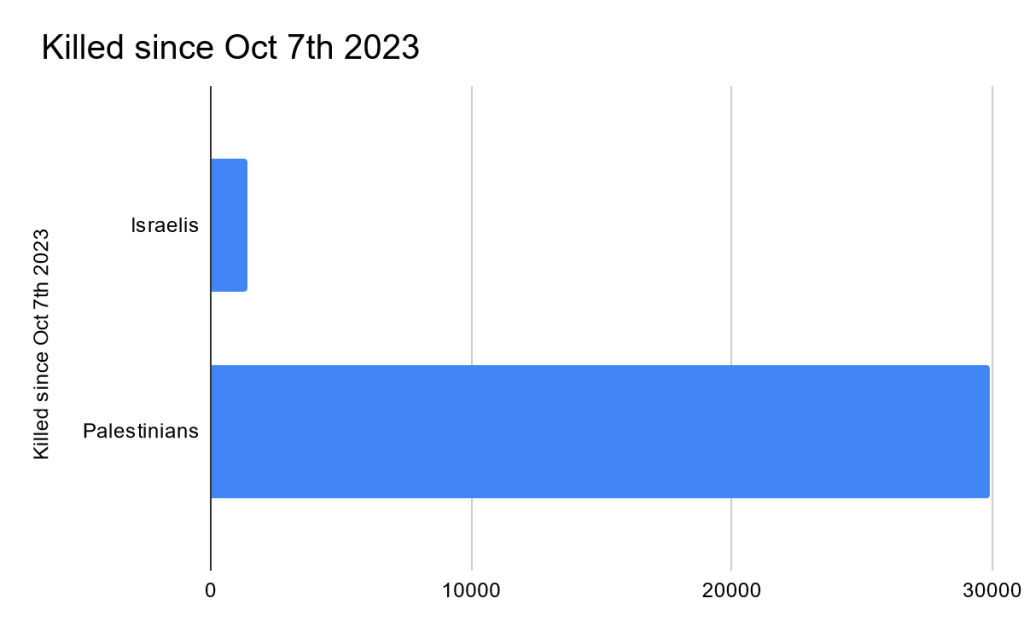
The balance of threat and the balance of death in this conflict is obvious and evident; and needs smoke screens of indignation to try to obscure it.

As there are millions of people in this country who feel a connection with the Palestinians, and have sources of information outside the establishment media, it has been impossible to control this narrative, to allow Israel to get on with what its doing with no scrutiny, and this is rebounding on the government and opposition, both now forced to oppose an IDF attack on Rafah and in some disarray. As there is no such community here with any links in the Donbass, even the existence of Russian speakers in eastern Ukriane is barely known about, let alone understood, and the narrative has been much more tightly controlled.

And, as the war in Ukraine is now being visibly lost by NATO, we are back to the sort of over heated rhetoric that was common two years ago – that NATO is an essentially defensive alliance needed to stop the Russians steamrollering over Europe.

This argument is politically absurd. Taking control of a continent would require a political project that could hold the allegiance of enough of the people who live there for it to be viable. It is not simply a technical military exercise. Russia does not have such a project. It has the military capacity and the political pull to absorb Russian speaking parts of Ukraine into the Russian Federation, and thats it. Even taking over the Western parts of Ukraine has been described as like “swallowing a porcupine”; let alone anywhere else.

Even if it could be reduced to the level of technical military capacity, the threat is actually in the opposite direction.

In 2023, NATO countries spent $1,100 billion on their militaries. Russia spent $100 billion.
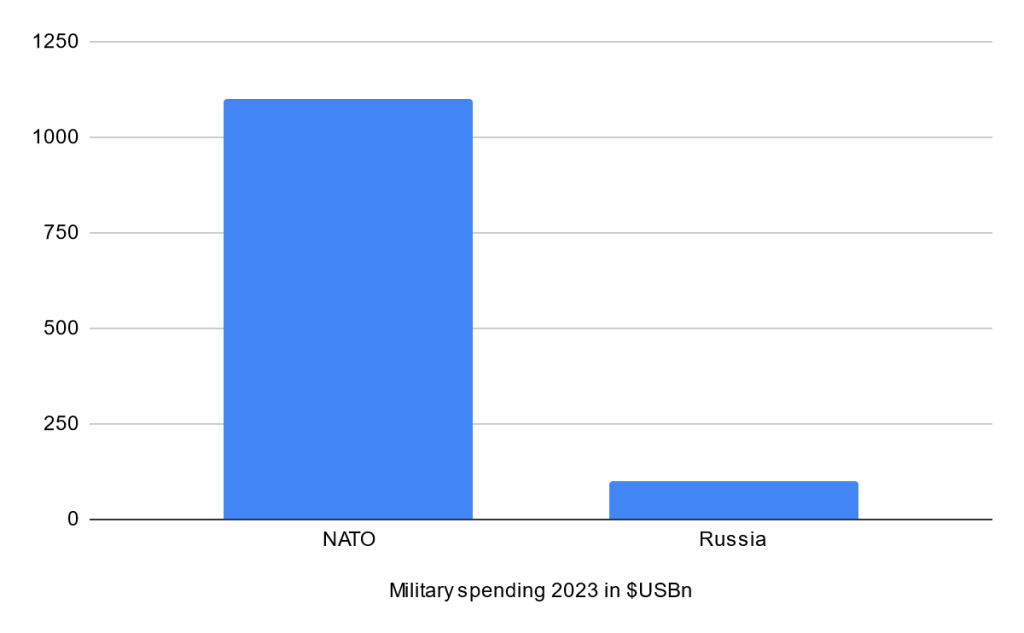
This uses NATOs own figures for its spending. Monthly Review has assessed that US spending is actually about double the amount claimed.

That imbalance looks like the graph above and shows the absurdity of NATOs claim to be both defensive and worried about the potential of being attacked by a power with less than a tenth of its strength. The Russians however, clearly have every reason to be worried about what NATO wants all that expenditure for; especially as it conducts annual “war games” in Eastern Europe practicing for a war with them.

It was fear of that threat, and the failure of NATO to even negotiate about it, which led to the current phase of the war in Ukraine.

Two phases of the wars for the New American Century.

The global context for this is that, for the first time since 1871, we are living in a world in which the United States is no longer the largest economy. China already is in Purchase Power Parity terms; and at current growth rates is likely to overhaul the US in Current Exchange Rate terms before 2030.

The “unipolar moment” and “end of history” is long gone. This analysis of the structure of global imperialism by the Tricontinental Institute goes into this in immense detail and is essential reading. Its core point is that the US has integrated the Global North into a subordinate imperial economic bloc and set of military alliances, but its decline is leading to increasing challenges from a far more diverse set of regimes in the Global South, with China as the core; and China’s highly succesful Socialist economic model at the heart of it. Those who disagree with this definition of China nevertheless have to acknowledge its success, and perhaps concede that that’s how the Chinese themselves define their society. “Socialism with Chinese characteristics”.

In its resistance to its slipping domination, the USA threatens the end of humanity because, with its primacy in capital formation, production and trade gone, financial control and technological lead slipping, the US is trying to push the challenges it faces increasingly onto the military field; which it still believes that it can dominate. That is what makes our current decade the most dangerous in the whole of human history.

The first stage of the wars for the New American Century, the War on Terror after 9/11 2001, was directed at weak powers that the US could overwhelm, killing 4.5 million people according to Browns University, but nevertheless ending in defeat in Iraq, Afghanistan and Syria; and chaos in Libya. This was when they thought they could incorporate China into their world order.

The second phase, now they know that they can’t, threatens to be worse, and could kill all of us, with a nuclear first strike an active part of US war planning.

This is where the tension in the world is coming from. This is who is driving it.

There is an argument within the US ruling class between those who think that it has to take Russia on first before it can get on to the confrontation it wants with China – the position of the Biden administration and more traditional Republicans – and those, like Trump, who think they might be able to get Russia onside against China. Putin’s response of ridiculing questions on these lines from Tucker Carlson in his recent interview, shows that this is wishful thinking on Trump’s part.

The second phase

The US and its allies have now crossed the security red lines of a nuclear armed power (Russia) in Ukraine, and have fuelled the attempted genocide in Gaza; because they have to be seen to be able to impose their will.

  • The US has repeatedly vetoed ceasefire motions for Gaza in the UN Security Council.
  • Russia and China have voted for a ceasefire in Gaza, along with the world majority, in both the Security Council and the General Assembly.
  • In General Assembly votes, Ukraine has been among the tiny minority who have voted with the US against a ceasefire.

Israel and Ukraine are both using weapons supplied by the US. Neither could pursue their war without them.

  • The US signed up to provide $38 billion in military aid to Israel between 2016 and 2026, and additional aid has gone in since October 7th.
  • It has gave Ukraine £113 billion between 2022 and September 2023, with more on the way.

The US is intervening in and arming both in its own interests. The Israelis are already an established US attack dog and the Ukrainian regime aspires to be; and has been playing that role since 2014.

A “Big Israel” in Eastern Europe

The forces the US is supporting – or using – in each war are the same sort of ethno nationalists with far right backing.

Netanyahu has Itamar Ben Gvir and Bezalal Smotrich. Zelensky has the Right Sector and the Azov battalion.

Just to dispell any doubt, speaking in April 2022, President Zelensky was very clear that he wanted Ukraine to be “a big Israel” in Eastern Europe. A country where there were “soldiers in cinemas and supermarkets” and “people with weapons”, not a “liberal European” state at all.

This vision was eagerly and approvingly embraced by US commentators (its possible that they wrote it) because being like Israel is being a military frontier state for the US.

Israel has been the lynch pin of US domination of the Middle East. President Zelensky has volunteered his country to do the same in Eastern Europe.

The Left in NATO countries, marinading as we are in the ideological stomach juices of the belly of the beast, should never forget who our ruling class is.

NATO and other direct US allies – the world’s wealthiest countries – account for 75% of global military spending, are the core of global imperialism, organised as a coordinated bloc, with the US dominating its subordinate rivals.

Russia is not part of this bloc. It is a target for it.

Not recognising that NATO expansion in Eastern Europe has predatory intent takes self delusion a little far. See the map displayed by Kyrillo Budanov, Head of Ukrainian Military Intelligence for the partition of Russia that this aims at if you have any doubts.

Climate Breakdown helps drive US brinkmanship

The accelerating breakdown of the climactic conditions for human civilisation adds urgency to the increasing US brinkmanship that we have seen in Ukraine and Gaza. To try to survive it with the current imbalance of global wealth and power intact requires catastrophic defeats to be imposed on the Global South, and any power not included in the US dominant bloc; in short order.

This can’t be kicked down the road anymore; hence the emergence of apocalyptic maniacs as mainstream political options for the ruling class – from Trump to Bolsonaro to Millais – and the increasingly unhinged quality of mainstream political debate.

Into the vortex of barbarism

We are spiralling into a vortex of barbarism in which light minded fools like Grant Shapps can float the possibility of nuclear war with “Russia, China, Iran, North Korea” and argue that we should arm even more to prepare for it; and this is repeated in a blase way by media talking heads as though this wasn’t suicidal insanity. A mainstream consensus urging us on to Armageddon stretches from the military itself – with former Generals calling for the UK to be put on “a war footing” and floating the idea of conscription – to Boris Johnson arguing in the Dail Mail that a Trump Presidency might be “just what the world needs” because of his “willingness to use force and sheer unpredictability” – to Timothy Garton Ash, arguing in the Guardian that Trump’s America First volatility gives Europe the opportunity to become a more serious military imperialism in its own right – to the Labour front bench, with Rachel Reeves’ fiscal rules mysteriously not applying to the large increases in military spending pencilled in by the Tories (in a country which already has one of the highest military spending burdens in the world).

Supporters of Ukraine Solidarity Campaign like Paul Mason are following the logic of their support for NATOs war aims by arguing, in his case, that the investment needed to combat climate change cannot be afforded because “the cost of borrowing has increased”, but at the same time saying that the UK should follow the US and EU in using debt to finance arms spending. Suicidal logic.

The whole labour movement should be pushing in the opposite direction.

Ukraine Chief of Intelligence drops the mask on forcible reoccupation of Crimea and partition of Russia

The 26th May is the ninth anniversary of the beginning of the shelling of Donetsk by Ukrainian forces in 2014. For the Donbass Ukrainians that opposed the new Maidan regime this event marked the point of no return. It followed the burning alive of the anti-maidan protestors in Odessa on May 2nd 2014 and Ukrainian forces trying to storm Mariupol that same week. The shelling has continued daily ever since, including today, killing several people. Yet, listen to the news here and there is silence about that. The casualties caused by a Russian missile strike in Dnipro were reported however, and President Zelensky’s comment that this showed the Russians to be “fighters against everything humane and honest” was not put in the context of what his own forces are doing. An enemy of the United States would be accused of “shelling his own people”.

Nevertheless, most people who support the Ukraine Solidarity Campaign, or call for a Russian military withdrawal and restoration of the pre 2014 borders, sincerely assume that this would be a liberation for the people who live in the Donbass and Crimea; and that this is where the war would stop.

This interview with Kyrylo Budanov – the head of Ukraine’s military intelligence (the GRU) – by a journalist who has been making a film supporting the Ukrainian war effort released last week, shows that the Ukrainian high command (and journalists) have no such delusions.

Budanov says a number of interesting things in this interview, some of them revealing, some quite far fetched. He is, after all, an intelligence officer, so he has access to a lot of information; but, as an intelligence officer, a large part of his job is to spin false but instrumentally useful narratives. He is also a firm believer in the notion that if you will something hard enough, it will come to pass and that Ukraine will “win”, despite their succession of grinding defeats since the new year and the terrible cost in lives that is the price of carrying on.

At the same time, he is secure enough in the presumed support of his audience to describe what the sort of victory he wants would look like. In the same way that the Guardian is now so sure of the allegiance of its readers to Ukrainian nationalism that they can reveal that, when collaborating with the Nazis in WW2, they killed around 100,000 Poles, a massacre described as “genocide” by the Polish government as recently as 2016.

In the interview’s final section, about what would happen in Crimea if Ukraine’s war aims were achieved (starting 36:57 minutes in) he is quite blunt that “victory” in the sense of military reoccupation would only be the start of a “difficult” “multi year process” of “reintegrating” territories with a population that is actually hostile and does not want to be reoccupied. Three million people with, as he puts it “a completely different view of the world”*. The interviewer uses the euphemism “three million not very devoted people” and Budanov states that those people with an “altered psyche” who can be “re educated” should be – without specifying what should be done with those that can’t, though “physical elimination” is a phrase he uses elsewhere. This will have to be done with a carrot and a stick, as the two only work together; and with a “firm hand”. This will be “hard work” he says.

Many words can be used to describe this scenario. “Liberation” for those 3 million people is not one of them. If you believe in self determination, you can’t support this.

His comments at the end section about “a new security architecture in the world” are put in context by a section “About the Future of Russia” a little before this (at 32.45 minutes in). In this, the interviewer pulls across a map of the Russian Federation – “your famous map” with the partition borders – that Dick Cheney and Zbigniew Brzezinski originally proposed back in 1991 as a way to manage the “Post Soviet space” most amenably for the US – drawn in in thick blue felt tip lines; remarking that “its been shown a lot”. Not in the media here it hasn’t. It might make people wonder a bit.

This isn’t Budanov’s map, but is similar. If you google US aim to partition Russia and click on images, you get a number of variations.

Budanov uses a number of euphemisms about “unanimous transformation” of Russia and the prospective partition being “conceptual”, and speculates that the more defeats the RF suffers the more it will break up, starting with the Caucasus. His confirmation, when discussing the prospect that “new states” will be imposed on the wreck of the RF that, “Russians are well aware of this” gives a tacit recognition that the Russian security concerns raised in the run up to February 24th were real and existential.

His statement “we don’t need Russia in the form that it exists now”, underlines this and, given where the partition plan originated, cannot be defined as defensive.

*If you want an insight into why the people in Donbass might have a “completely different view of the world” – which Budanov suggests is a result of “propaganda” – consider these personal accounts from the day the Ukrainian army started shelling Donetsk city on May 26th 2014. These are from the Donetsk Anti Fascist site.

Marina Kharkova: “May 25 was the last day of peace in Donetsk, as the family celebrated the birthday of my father, a miner. The mood was anxious, restless and tense because of the general situation, but nothing yet seemed to portend tragedy. On the morning of 26, on my way to work, I heard the sounds of flying planes and distant explosions. Everyone had gathered in the largest office and was listening to an employee who lived near the railway station. She cried and told how Ukrainian planes and helicopters had bombed from the air, how their nine-storey building on Privokzalnoye had been shaking, how women killed by shells were lying directly on the pavement bleeding, how the minibus she was travelling in had hurtled away from the danger zone. She sat in silence, clutching her heads, trying to comprehend. Tanya was given water and sedatives – she was so sick. Then, by inertia, they tried to get on with their business. The rumble outside the window increased, though the office was far away from the airport. Ambulances and cars with militia were whizzing down the street. After three in the afternoon everyone decided to stop their pointless attempts to pretend to be busy and drove home. The understanding of what was happening came at once, although the consciousness was still trying to cling to yesterday’s peaceful day. The 26th of May was the point at which “it will never be the same again”.

EIena Hovhannisyan, a biology teacher: “At that time we kept up with the news from Sloviansk and Kramatorsk. We already knew how people had been martyred in Odessa, Mariupol and Krasnoarmeisk. I had forebodings of near disaster. It was already hovering over us, but we did not think how tragic, long, brutal, hopeless the events would be. Sometimes it seemed that it was just a bad dream, that I would wake up and everything would be like before. But no. It is an illusion that the war will not touch you. It will touch everyone, sooner or later. We were simply the first to be in the epicentre. And May 26th I will always remember. The warm, sunny weather and the roar of planes in the sky. From the balcony on the side of the airport black smoke could be seen, you could hear explosions constantly. The first shelling, deaths, destruction, grief and pain. Since that day, there would be no peace in Donetsk for another nine years. But we didn’t know it then. And that day was endless, filled with horror and pain. The phones were literally ringing off the hook – everyone was trying to find out what happened to their loved ones, whether they were alive or not. In the evening my son arrived from work; his office was a couple of blocks from the station. He told about the horror in the city, about the dead woman vendor from the station market, about the very young guy who worked as a valet. He was killed by shrapnel from a missile fired by a Ukrainian helicopter. People were falling, screaming, crying, calling for help. Passers-by tried to save the wounded, car alarms howled. The railway station area in any city is the most crowded place. In Donetsk on Privokzalnoye there are markets, shops, banks, the area was teeming with life. They say helicopters flew so low that you could see the pilots in the cockpit. And these pilots also saw that they hit peaceful people. This was not done by some Hitlerites, but by Ukrainians, with whom we lived in the same country. May 26 was the day that turned everything upside down. There is no and will not be our forgiveness for Ukraine. And there will be no return.

From the diary of a Donetsk woman who wanted to remain anonymous: 26 May 2014, from the balcony, I saw planes firing missiles. My husband, coming home from work, told me about the dead in the station square. At the same time as the airport was being bombed, the fighting moved into the city, on Kievsky Avenue linking the city and the airport. People who had lost their jobs or shelter, relatives or loved ones, went to volunteer for the militia. And every day there were more and more of them, including my acquaintances, as the war gradually touched everyone.

It is difficult to describe the sensations of trying to sleep to the sound of shelling outside your windows. The deafening and resounding explosions are somewhere close by. Your heart sinks each time, because no one knows where the next shell will land. But when you see the dawn, you realize that another night is behind you, all your loved ones are alive today.

In addition to the fighting at the airport and the aerial bombardment with unguided shells, Ukrainian snipers shelled the Putilovsky Bridge. This road was then called the “road of death”: civilian cars with people were burnt and shot, and in the Putilovsky Grove there lay the bodies of both civilians unluckily caught up in the active fighting and the militiamen trying to save people. For several days, the bodies were decomposing in the terrible heat: there was no opportunity to pick them up and bury them.

An ambulance was also shot up on the road to Donetsk airport. Its crew, Artem Kovalevsky, the ambulance driver, paramedic Sergei Kozhukharov and doctor Vladimir Vasilievich, miraculously survived and managed to get out of hell.

They told reporters from the local branch of Komsomolka in Donetsk how they managed to survive when Ukrainian snipers shot even those who had managed to run into the wooded area.

Victoria Sergeyevna, neurologist: I was on duty that day, the hospital was far away from the airport, but we all knew what was going on. In the evening, many people of different ages with strokes or suspected strokes were brought to our department. People’s chronic illnesses were exacerbated by the stress. The statistics of deaths from heart attacks and strokes during the war has increased dramatically compared to the peacetime. And these are also our victims of the war, just as innocent as the victims who died under shelling”.

The causes of the war in Ukraine – a reply to Simon Pirani.

Simon Pirani’s article, “the causes of the war in Ukraine” is posed as a reply to John Bellamy Foster’s brilliant and terrifying Notes on Exterminism” but simply doesn’t address what Bellamy Foster is saying about the connections between US nuclear war posture, its policy towards Russia and the connection with climate breakdown but talks primarily about Gazprom instead. It’s also odd that Simon states that it’s important to understand the background “in order to understand what happens next, and how this relates to the western powers’ historic failure to deal with climate change,” and then completely fails to explore either. There is no vision for what the end of the war might look like if his section of the Left’s backing for Ukraine and NATO leads to a Russian defeat – either for Ukraine or for the world. Nor is there any examination of how the US war drive connects with their failure on climate breakdown. For any insight into this, readers would be better off reading Bellamy Foster, or the companion article from John Ross, which does explain how the war fits into the totality of current geopolitical struggles in a way that makes sense of it.

This is particularly significant because the USA is spending 14 times as much on its armed forces as it plans to invest in climate transition. As Meehan Crist put it in the London Review of Books in March “One of the worst outcomes of the war in Ukraine would be an increasingly militarised response to climate breakdown, in which Western armies, their budgets ballooning in the name of “national security” seek to control not only the outcome of conflicts but the flow of energy, water, food, key minerals and other natural resources. One does not have to work particularly hard to imagine how barbarous that future would be”. Not hard to imagine because that’s pretty much the world we already have under the Pax Americana, but a bit more so.

Simon seems to assume that the “popular resistance” represented by mass conscription in Ukraine hints at a progressive outcome if the Oligarchy in power and its NATO overlords achieve their war aims. To be fair, this is not explicitly stated, just presumed. Leaving aside reports of WhatsApp groups in Ukraine set up to warn people of when the press gangs are in the neighbourhood, and that 7% of the conscripts sent to the West for training have deserted; the proof of the pudding is in the eating. Since the start of the war the Ukrainian government has moved sharp and hard against the rights of the workers they are calling up to fight, and they have drawn up a post war reconstruction plan with western capital that would make Ukraine even more of a dystopian neo liberal laboratory than it already is. Not a land fit for heroes. Before the war, the combination of low wages and corruption with the pending threat of conscription to fight in the Donbass led to one of the lowest birth rates in Europe and 600,000 people a year leaving the country for a better life; some to Russia, more since 2014 to the EU.

Simon asserts that “until 2014, western policy was focused on integrating Russia into the world economy on the west’s terms: even after the Kremlin’s military intervention in Ukraine, the western response remained reactive.” The USA is always reactive, in the sense that it will intervene in any situation anywhere, anytime that it can take advantage of; but it is also invariably pushing things along, actively seeking contradictions and fissures that it can insert itself in to shift things its way. Staying global hegemon takes work, and there are US Embassies full of active agents and 800 US military bases all over the world either doing it or waiting to join in, an inner space full of satellites keeping tabs on things and a cyberspace dominated by US tech companies intimately linked to the security state.

Think about what “integrating Russia into the world economy on the west’s terms” means. “Integrating Russia into the world economy on the west’s terms” means subordinating Russia to the West. Not partnership. Not multipolarity and a deal among equals, but subordination. The US applied the same presumption to China, that participation in the WTO would make it more western, allow the private sector to dominate over the state, ease into a political system that could be bought up by the ruling class; just like ours is. The 2008 crash put paid to any prospect of that. Pro US voices have been marginal since then.

The US is no longer trying to incorporate China, or, now, Russia, on its terms, because it knows it can’t. Its policy now is to break the world economy apart and try to retain domination of as much of it as it still can. In most of the Global South, it is losing ground, quite quickly. That makes continuing to dominate Europe very important. If the European economies suffer as a result, that’s a price to be paid and ridden out politically.

Simon’s core argument is that “the West” was interested in getting cheap Russian energy and therefore had an essentially pacific intent towards it until the invasion on 24th February came out of a clear blue sky and forced them to reassess. This requires almost complete amnesia for anything that actually happened in the run up to 24th Feb – Russia’s continual appeal for negotiations on a “Mutual Security Pact” that NATO could have agreed to and spun out forever to avoid getting to the crunch point had they wanted to instead of spurning with imperial contempt – and a presumption that all of “the West” had the same interests, rather than there being a rift between the US and Germany that was resolved in the former’s favour at the NATO Summit the week before the invasion, with Germany coming to heel and refusing to open up Nordstream 2, putting NATO on an economic war footing. This was almost certainly a tipping factor in Russia’s decision to intervene.

Because, the term “the West” in this context, covers some real contradictions, particularly between the economic interests of the USA and those of the EU, and Germany in particular, which partly explain why Russia was never simply taken into NATO or ever considered a possible EU member even at the point it was considered a “strategic partner”.

Lenin always argued that politics trumps economics. And so we have seen in the case of Germany. It is not in Germany’s economic interests for this war to continue, nor for cheap Russian gas to be cut off from its industries and domestic consumption. This is also true across Europe. The Prime Minister of Belgium has spoken of fears of “deindustrialisation” as a result of this sudden rupture in energy supplies. Political turmoil is rising across Europe, not least in the UK.

The struggle over whether Nordstream 2 would be opened up last winter illuminates the fault lines here. The US was against it, for the same reasons it wouldn’t consider letting Russia into NATO. A close relationship between Germany and Russia undermines US dominance across the whole EU. Russia in NATO would have a similar centrifugal effect on the alliance. Blowing the pipelines up just as demonstrations were starting up in Germany and elsewhere to get them put back on stream to cut energy bills is a completely logical thing for the US to do. Burning the boats. Cutting off the options. Trying to stop a connection being more widely made between the cost of living crisis and ongoing support for the war. The idea that the Russians would blow up their own pipelines, when resupply of gas though them is such a huge diplomatic carrot, is as absurd as the idea that they would shell a nuclear power station occupied by their own troops or convoys of cars full of civilians trying to get out of Ukraine into Russian controlled territory (which they are supposed to have done twice in recent weeks if you believe our objective, reliable media).

The US attempt to subordinate Russia has never been a passive policy, not least in Ukraine and to describe it, either in or after 2014, as “reactive”, as a synonym for defensive, implying that it is a dozy, passive force, only taking action when severely provoked, dulls our understanding of just how proactive they are. NATO Secretary General Jens Stoltenburg has no such delusions and his comment “we have been preparing for this since 2014” should be taken at face value.

And it’s quite clear from this article that preparations for sanctions against Russia were being actively negotiated between the USA and EU from November last year which knocks a big hole in Simon’s main contention that the economic war was a defensive reaction to the Russian intervention. All part of the game plan.

Simon describes the Maidan movement of 2014 as though it was a simply popular uprising against corrupt oligarchs. This is as simplistic as describing Brexit as a popular revolt against “elites”. There is no recognition of the role of the far right, the division in the country leading to civil war is elided, nor is there any acknowledgement of the active intervention of the US and EU to try to mould the outcome in their favour, nor of the tussle for influence between them. The active role of the US in the Maidan movement alongside the far right isn’t mentioned. John McCain addressing a rally in the square is neither a figment of anyone’s imagination nor a “reactive” intervention. The role of Victoria Nuland, one of the architects of neo conservative interventionism and an active participant in many such interventions is almost too well documented, but Simon passes them by without a nod, or a word, or any acknowledgement at all.

The replacement of one corrupt oligarch, Yanukovitch, with another, Poroshenko, who collaborated with the far right throughout his Presidency and oversaw neo liberal reforms, opening up Ukrainian farmland to Western Agribusiness, rather undermines Simon’s assessment. Popular participation in the Maidan in the West of Ukraine did not determine a popular outcome.

Since at least the Orange Revolution (the clue is in the colours, the US can’t help itself when it comes to branding its products) in 2004 there was an open struggle for where Ukraine would align. None of this is unknown. None of it “reactive”.

This is paradoxical because Simon recognises that “in 2013, the Kremlin offered a substantial discount on gas sales as part of a generous trade package, conditional on Ukraine abandoning its talks on an association agreement with the EU; Yanukovych’s support for that package was among the sparks that set off the Maidan revolt.” This package was rather positive for Ukraine, but not at all in the interests of the EU or US. As we know with sparks, the flame has to be fanned.

We are now in a situation in which criticism of NATO is an expulsion offence for Labour MPs. The GMB is campaigning for increases in military spending, when the UK already spends more on its military than every other country in the world apart from the USA, China and India, and, through NATO and AUKUS, is allied to countries responsible for two thirds of global military spending, with the USA at their core. The US is fast losing ground economically and so is trying to reassert itself militarily, even if this leads to war with other nuclear armed powers. Increased arms spending by the UK signs us up for that. Not recognising this drive, or flinching away from the consequences of it, disarms the Labour movement in the face of the greatest short-term threat to human survival.

To invert one of Simon’s sentences; those in the western ‘left’ who don’t recognise that ‘NATO expansion’ is the chief cause of the military conflict and that Ukraine is fighting a ‘proxy war’ for the US with $53 billion worth of US weapons and $12 billion more to come… act in effect as apologists for the USA’s dangerous brinkmanship that could lead to nuclear war and the end of human civilisation. 

The war in Ukraine is indeed a historical turning point. Its result will determine whether we move into a New American Century – with a NATO victory, a US backed colour revolution in Russia, possible partition of the country into at least three parts, as some of the more hawkish neo cons planned in 1991, and the decoupling of Russia from China to facilitate the war US hawks want in the South China Sea before the Chinese economy gets too big for it to deal with – or not.

This prospect makes it a matter of principle that the Left and civil society should resist this war drive.

NATO spends 18 times as much on “defence” as Russia does.

This morning, the newspapers were hyping up the possibility of a Russian attack on NATO territory, and commentators at the weekend arguing for a No Fly Zone were pushing the idea that Ukraine could just be the beginning. This has its counterpart on the Left, where people argue that the Russian invasion is “just imperial expansion”.

People lose their heads in wars – sometimes deliberately – so its worth checking the reality and coming down to earth.

  • We should never lose sight of the fact that a direct clash between NATO and Russia set up by a No Fly Zone would push us over the edge of mutual nuclear annihilation. Hundreds of millions would die. That vast number – too likely to be treated as a statistic that does not engage with our emotions and move us – nevertheless contains an almost infinite multitude of individual tragedies. You would die. So would I. So would everyone you know and love.
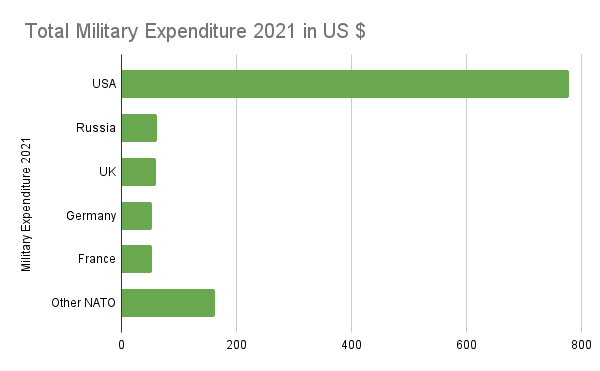
  • NATO spends more than 18 times as much on its military as Russia does. That makes makes a direct Russian attack on NATO absurd. In fact, NATO arms spending is more than half of the global total. Projected increases in “defence” spending will make this proportion even greater. The “defence experts” projecting fantasies of Russian incursions into the Baltic States or Poland know this; but have either lost all grasp of reality, or don’t want their readers to have one.
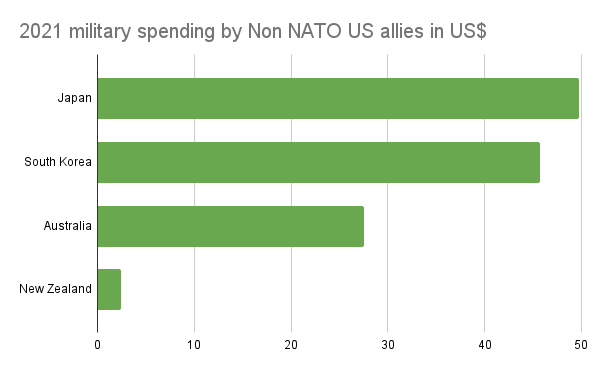
The non NATO countries listed here are the others in the top 20 military spenders table.

Japan, South Korea, Australia and New Zealand are also bound to the US by non NATO military alliances. Add their 6.3% to NATO’s 55.8% and you get 62.1% of global military spending made by countries in US led military alliances. In addition, some of the other countries in the top 20 military spenders also tend to align with the US even without a treaty obligation to do so, like Israel and Saudi Arabia.

Even in Europe, three NATO allies each spend about the same amount on their military as Russia does.

As the Brookings Institute candidly puts it, “America’s alliances in Asia and Europe have formed the backbone of what has become known as the “liberal international order.” Over the past 70 years, this order has helped protect American interests and values.”

That has also involved starting most of the world’s wars in that period.