On Air Force 1 overflying the “newly renamed Gulf of America” last week, Donald Trump boasted that his approval ratings were at 49% and “no one has ever seen numbers like this before”. Seemingly so. His numbers are worse than those of any other post war President, apart from himself last time.
Donald Trump and NATO Secretary General Mark Rutte want NATO members military expenditure increased to “Cold War levels” and for member countries to adopt a “wartime mindset” in order to prepare for a perceived threat from Russia, China, Iran and North Korea.
Neil Kinnock has just stated that 3-4% would be a “realistic” level to reach.
Part of this mindset is a preparedness to sacrfice health, welfare and pensions to fuel the military machine required to fight a war with Russia in Europe that would be suicidal for all involved if it actually broke out.
The UK’s “Defence Review” is framed in a similar “pre war framework”, posing Russia, China, Iran and North Korea as “the deadly quartet”; a good name for a jazz band, but geopolitically infantile.
The threat is posed most sharply in relation to Russia, largely because NATO is now evidently losing its proxy war in Ukraine. This impending defeat is being posed as a lever to militarise European society on the presumption that a Russian win there means that they will then threaten to invade the rest of Europe.
This is simply insane.
If you look at the balance of military expenditure between NATO and Russia, even after a sharp increase in Russian spending forced by the war to 7-8% of GDP, the imbalance in NATOs favour is overwhelming, because the combined GDPs of the NATO countries are almost incomparably bigger than Russia’s (which is smaller not only than the USA among NATO countries, but also Germany, the UK, France, Italy and Canada and barely larger than Australia).
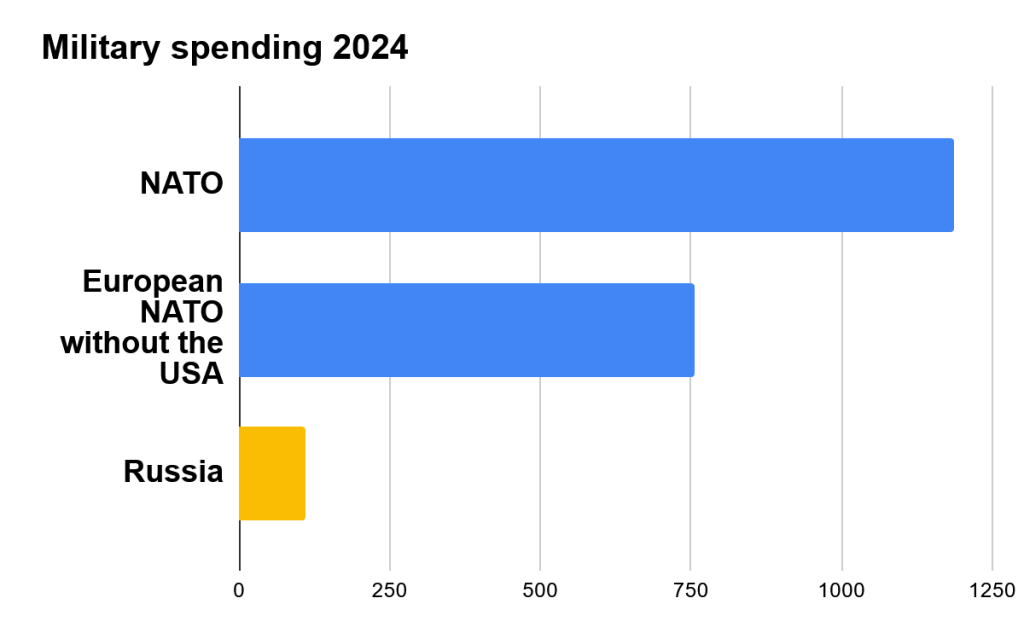
If the argument from all quarters on high in this country is that “the world is becoming a more dangerous place”, its quite clear from this which countries are making it so in Europe. If the Russian level of expenditure shown in the yellow column is posed as a terrible threat by NATO, how much more threatening is NATOs current expenditure for the Russians?
To underline this with stark figures, with overall NATO spending in 2024 at $1185 billion and Russia’s at $109 billion,
for every dollar the Russians spend, NATO spends just under $11
and the European NATO powers alone spend £755 billion between them, which is just under $7 for every dollar spent by the Russians.
So, the question posed by this is already, who exactly is under threat from whom?
Trump and Rutte, and now Kinnock, propose to raise NATO military spending to “Cold War levels”. That was around 5% of GDP between 1970 and 1987. That would double the imbalance above and set NATO up for an offensive war with a collosal military advantage of 14 to one, even if the US kept out of it, and 22 to 1 if they were involved.
This reality is revealed by the decision of the EU to break its own fiscal rules and raid its levelling up funds to finance war preparations which, among other things, involves strengthening bridges so that “tanks may pass safely”. Were they concerned that columns of Russian tanks would be steamrollering West they would be weakening bridges so they couldn’t pass at all.
This is leaving aside the political feasibility of a Russian offensive, even if it were militarily feasible – which it obviously isn’t.
It beggars belief that a war of this sort is being envisaged with a nuclear power. The same people who argue that the UK’s nuclear weapons “keep us safe” and shouted at Jeremy Corbyn “would you press that red button, Mr Corbyn?” seem to think that a land war in Europe which, given the balance of forces, would be aimed at regime change and the balkanisation of the Russian Federation and have nothing to do with “defence” would not lead to the trip wires for use of these weapons being crossed.
So, the additional cost of meeting this target in full would be around £70 billion. Even getting half the way to it would require a transfer of £35 billion, which would have to come from “other priorities”: and not just “a small amount” as Rutte puts it. Kinnock doesn’t say what he would cut. He should be asked.
Every item cut instead would improve people’s lives. The best that can be hoped for increased military spending is that it doesn’t give our lords and masters the tools to end them.
All this flows from the strategic self subordination of Europe to the United States. As this recent article argues, the new situation for Europe is that the US is leading them into war with the continent’s strongest military power, Russia, at the same time as it deliberately undermining European rivals’ economies. It amounts to a US policy of subordinating Europe through a combination of military and economic warfare.
This is a lethal combination for Europe, the most serious threat to the entire continent since at least the end of the Cold War and in a broader sense since the end of the Second World War.
So, the fight against war, and the fight against austerity, to defend our conditions of life will have to go hand in hand.
My last blog did not take account of just how slowly votes are counted in US presidential elections. While the result has been obvious from the grey dawn of Nov 6th, and the outlines of the vote equally apparent, a precise accounting has had to wait until now. Even now (Nov 27th) the vote count stands at 99.7%, so there’s roughly another few hundred thousand votes to tot up, but these won’t make much difference to the broad conclusions that were reasonably obvious, and therefore broadly misrepresented in the media, from day 1.
First of all, contrary to my initial blog, Trump did gain votes from 2020. But not many. His total was just over 77 million this year, compared to just over 74 million in 2020; so, a gain of just under 3 million votes.
Similarly, Kamala Harris lost a lot of votes on Joe Biden’s total in 2020, down from just under 81.3 million to just over 74.4 million; so a total loss of 6.9 million votes.
Turnout was down overall by about 3 million votes.
So, the core conclusion that this was more a Democrat slump that a Trump surge still holds. This matters because some of the conclusions coming from Democratic Party reinforce the strategic choices that led them to lose. There are basically three strands to this.
They are in denial about “the economy”, arguing that people under $100,000 a year, whose real wages were lower at the end of the Biden term than the beginning were suffering a delusion because “economic indicators” were going so well. Putting this across as people not “feeling” how well they were doing, when they were actaully doing pretty badly, is a form of gaslighting that, evidently, doesn’t work.
They seem to think that the problem with Kamala, campaigning with the Cheyneys, “I own a Glock”, “border state prosecutor”, “Israel has a right to go after the terrorists” Harris was that she was too “woke”.
They are having a tactical discussion about whether Biden should have withdrawn earlier – obviously he should – and whether they should have had a primary process – neither of which addresses the fundamental problem that any candidate wedded to the same strategy would have faced the same defeat.
This denial is designed to move the Democrats onto the same ground as the Republicans on the spurious argument that there was a significant shift towards them. There wasn’t. It is not a strategy to remobilise their lost voters, let alone an attempt to pose answers that meet the needs of working class voters. Quite the opposite.
It reflects a deeper reality that – their protestations that Trump is a fascist nothwithstanding – they would prefer to lose than contradict the demands of their donors, let alone challenge core US imperial imperatives; which is the fundamental purpose of both parties and the reason why the US political structure is set up the way it is; to squeeze out any genuine challenge that might express the popular progressive majorities that exist for, for example, Medicare for all, Abortion Rights, Serious action on climate, raising the national minumum wage, ending US support for the war in Ukraine and the genocide in Gaza and opposing a wider war involving Iran.
Polling showed, for example, that taking a harder line with Israel would have won Harris significant votes in the swing states.
What we had instead from the Biden adminstration was a performative 30 day ultimatum – due to expire conveniently after the election – for Israel to allow more aid into the Gaza strip on pain of having (some) arms cut off – because even in performative ultimatums, you wouldn’t want to go too far in case the wrong signal gets picked up – in the hope that this gesture would bring back some of the votes that their single minded support for Israel had alienated.
Needless to say, when the 30 days were up, in the middle of Israel’s most ruthless offensive yet – implementing the “General’s Plan” to completely clear the whole of Northern Gaza of its Palestinian population, making it a free fire zone and totally shutting down of any supply of food, water or medicine – the US declared that enough aid was being allowed in for them to keep praising Netanyahu and passing the ammunition.
The psychological shock to a lot of people in the mainstream of politics is that 2020 was supposed to be a “return to normalcy” from the insane aberation of four years of Trumpian excess, after which the Pax Americana could be reasserted on its customary tried and tested basis, with all its familiar landscape intact. The problem is that it can’t, now that the US is no longer the world’s largest and most dynamic economy, the old rules won’t work anymore, so what people thought Biden was now looks like an interegnum in a “new normal” in which the US takes off its masks and stands before the world in all its hideous nakedness as a climate denying rogue state, reduced to having to bully its allies to increase military spending and banking on increasingly overt threats to try to bluff its way out of decline.
This is unlikely to work, but is extremely dangerous and damaging nonetheless.
Beyond the grotesque and demeaning soap opera of his cabinet picks, like putting the former head of the Worldwide Wresting Federation in charge of Education, which could be filmed by Hollywood as the Joker taking control of the Gotham City Mayor’s office.
If Trump imposes 60% tariffs on China and 20% tariffs on everyone else “on the first day” the knock on effect on the world economy will be severe – causing an economic squeeze and political turmoil among allies as well as opponents, sharply rising prices in the US itself and a hard hit to living standards. Those who voted for him under the impression that they would be better off – and many did despite misgivings about his other policies – a response identified as a definite trend by exit pollsters – are in for a shock and are likely to turn.
The same applies to mass deportations, if they are carried out. Removing hundreds of thousands, possibly millions, from the workforce would be seriously disruptive economically, even discounting the immensely divisive and traumatic social and political impacts across communities.
If Trump carries out his promise to reverse major US climate policies passed during Joe Biden’s presidency, this could push $80bn of investment to other countries and cost the country up to $50bn in lost exports, according to a new study by researchers at Johns Hopkins University.
The required ramp up of military spending among allies, in the context of an economic squeeze generated by the tariffs, would also create increasingly febrile and feverish politics even within the US’s core supporters; as we are already seeing in Japan.
The decline of US power has entered a bumpy and perilous period and the election of Trump is a symptom of that. Standing on much thinner ice than the media is suggesting, the harder he tries to grip, the more things will slip through his fingers; the harder he tries to assert US power, the more he will expose how much it has already slipped.
Correction: As of 14/11/24 Trump’s total vote is just under 76 million and Harris’s just under 73 million. That means Trump’s vote has risen by 2 million while the drop in Democrat support is around 8 million.
It is important to base analysis on facts not wishful thinking, so, once the final final count is in, I will rewrite this blog.
Nevertheless, the main argument remains valid.
A small increase in the Trump vote, perhaps 2% or so up on 2020, is not a surge, and remains a very thin mandate for the sweeping changes he intends to bring in. He is standing on thin ice and it is likley that the measures he will take will blow up in his face.
The drop in Democrat support, at around 10% of their 2020 vote, remains very large.
The media chatter about fundamental realignments in US politics has an air of the UK in 2019, but where is Boris Johnson now?
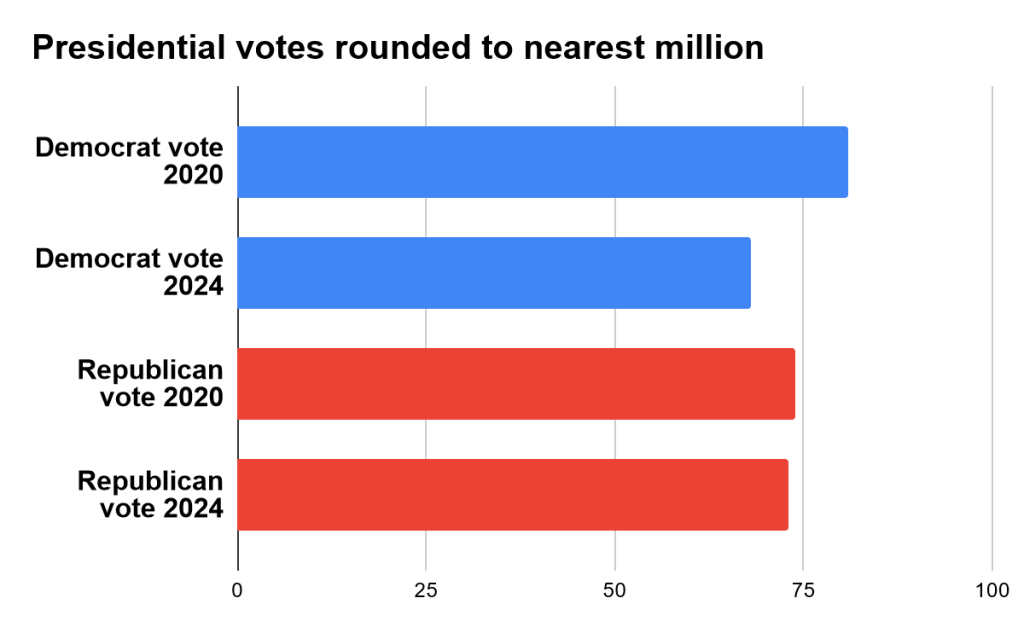
Between the 2020 election and the 2024 election, with nearly all votes now counted, Donald Trump’s vote FELL by a nearly a million, from 74.2 million to 73.4 million*. This is not the surge the media are reporting.
But, the Democrat vote slumped by 12 million, from 81 million to 69 million. So, this was more a Democrat defeat than a Trump victory.
In some ways it is a Republican victory despite Donald Trump.
As this was based on a squeeze on worker’s living standards with real wages lower now than when Biden was elected, and an anger and fear about the slide in US global standing (Biden first lost significant support at the time of the Afghanistan withdrawal) Trump will find that he is standing on thinner ice than the media are projecting because his economic policy of tax cuts for the rich and tariffs on imports will hit living standards even harder, mass deportations will spark mass anger, as will the devastation brought by wholesale environmental deregulation, not to mention the impacts of letting RFK loose on health.
With Republican control of the Senate, the House and the Supreme Court, there will be no checks and balances on this, so the madness will be able to run in full spate until at least the mid term elections in 2 years time. At which point, its likely that the reaction will be severe.
The decision of the Democrats to campaign on what might be called a “Red Wall” strategy,
trying to appeal to conservative leaning voters with conservative leaning policies on immigration,
having campaign sessions with Liz Cheney,
keeping quiet about climate – even after the Florida hurricanes –
remaining muleishly pro-Israel, to the extent that Bill Clinton, campaigning in Michegan, argued that the Palestinians had it coming because they didn’t agree to the bantustan he proposed at Camp David, proved incapable of holding the base they had in 2020.
This parallels the experience of the UK Labour Party, which has relentlessly carried out the same orientation since Keir Starmer was elected leader, with the result that Labour amassed half a million votes fewer in the General Election this year than in 2019 (down from 10.2 million to 9.7 million) only managing to get a huge majority in the House of Commons because the Conservatives had presided over a decline in livings standards even greater than that in the US over the same period, and the right wing vote, for the first time in modern history, was split right down the middle between the Tories and Reform; putting this governmnet too on very thin ice – as local council by elections are showing sharply.
The core lesson for the UK is that an incumbent government that proves incapable of at least maintaining living standards is going to be kicked out. “Its the economy, stupid”.
Its Conservative Party Conference week, so we are spoiled for choice.
Liz Truss announced that she wasn’t going to back any of the 4 candidates for Party leader. The sighs of relief from the candidates could be heard from coast to coast.
Kemi Badenoch – and has no one noticed that her name is an anagram of Bad Enoch (its even in the right order) – said that she was shocked that so many recent immigrants to this country “hate Israel”. Given that Israel has spent the last year killing over 41,000 people and bombing Gaza to rubble, accelerated the ethnic cleansing of the West Bank, been indicted for genocide at the International Criminal Court and, to return its 60,000 internal refugees to their northern border, has just killed another 1,000 people in Lebanon invaded the country and displaced a million people there, what’s not to love?
Her team in the leadership campaign released an odd pamphlet arguing that 21st century politics is different from 20th century politics because – although everything can best be understood in the form of a triangle – in the old days the triangle was divided horizontally and the bottom of society supported the Left while the Right defended the top, today the triangle is divided vertically; to indicate that both Left and Right have support from top to bottom, but without any acknowledgement that the right still defends the interests of the people at the top, while it is the role of the Left to fight for the bottom.
Confused? You will be. Just to make things even clearer, in their diagram the Left is on the Right and the Right is on the Left. This might indicate that the Tory Right approach the world in an inverted way, but it also might simply be a Freudian slip, implying that somewhere deep in their heart of hearts they know that the Left is, ultimately, right.
Another way of looking at it is that they don’t know which way is up. Bottoms up chaps!
Another gem from Badenoch is that her way of dealing with the problem that highly educated people tend to lean Left is to have fewer highly educated people. All those “pointless university degrees” that make people think have got to go.
Meanwhile, Miriam Cates, speaking on Politics Live, unravelled the full insanity of the Right’s line on immigration. On the one hand the country can’t afford to have all these people coming in, but at the same time it needs people coming in to fill job vacancies because, in Cates’ view “we’re not having enough babies”. So, the country isn’t full up after all. Breed damn you! Breed!
Jo Coburn, the anchor of Politics Live, noted that the Tories were obsessively discussing immigration while most of the electorate are concerned about energy bills and the cost of living, the NHS and the state of public services; without reflecting that Politics Live itself obsessively discusses the issue “we can’t talk about” almost every time it comes on. Anyone would think there was an agenda somewhere to push this under everyone’s noses at every opportunity, carpet bombing us with BS.
Robert Jenrick – a small, cheap embodiment of petty minded mean spiritedness, best known for his order as immigration minister to paint over a mural in a child refugee centre to make it less welcoming – dropped an honest bollock when he said that the problem with the European Court of Human Rights is that it meant that UK Special Services were having to shoot terrorists rather than arrest them because the EHRC would order them released. While this is an absurd claim in itself, its notable that none of the people who criticised Jenrick for this statement denied that UK Special Forces do indeed breach the Geneva Convention in this way. There are a number of cases from Afghanistan that the SAS kept locked away for years to maintain the fiction that they didn’t happen. But its now well known that they did. But to everyone from his rivals for the Tory leadership to “a Labour source”, its just terribly bad taste, and awfully insulting to our brave boys to say that they have done what they have done.
Jenrick also criticised the police for dealing with peaceful demonstrators calling for an end to genocide and a ceasefire in Gaza more gently than rioters who were trying to burn refugees alive in hostels, threw bricks at the police, attacked people in the streets and trashed their neighbour’s houses. Quite inexplicable.
And two from last week.
A delegate at the Reform Conference, interviewed on Politics Joe, opined that the rivers are polluted, not because of the water companies failing to invest – “I think they are being scapegoated” – or too much toxic runoff from farmers overfertilising their fields – its because all those immigrants are coming over here and overwhelming our overloaded sewage system with all their poos. Talk about S*$t.
And David Lammy at the UN last week saying “I know Imperialism when I see it”. A question for David. When you go to work as the British Foreign Secretary at the Foreign Office, and you walk past that statue of Robert Clive, and stride along corridors resplendently decorated with paintings of Britannia and all the rest of it (which you can see here), perhaps through the “Durbar Court”, and you look at all that, what exactly do you see?
In Colin Welland’s 1989 adapatation of Andre Brink’s novel A Dry White Season, the barrister played by Marlon Brando comments “Justice and law, Mr. Du Toit, are often just… well they’re, I suppose they can be described as distant cousins. And here in South Africa, well, they’re simply not on speaking terms at all.”
Judge Christopher Hehir, in his conduct of the case against the Just Stop Oil defendants, Roger Hallam, Daniel Shaw, Louise Lancaster, Lucia Whittaker De Abreu, and Cressida Gethin, who he has just sent down for 4 to 5 years in prison for “conspiracy to cause a public nuisance”, has done his best to make people realise just how true that is of the UK too.
His summing up is almost beyond satire in its sophisticated mulishness. Talking of the breakdown of the climactic conditions needed for human civilisation to survive, this bewigged buffoon said, “I acknowledge that at least some of the concerns are shared by many, but the plain fact is that each of you has some time ago crossed the line from concerned campaigner to fanatic”.
Lets break that down. “some of the concerns are shared by many”. The issue is not “concern” at climate breakdown it is the FACT of climate breakdown. This is not in serious dispute. Even the outgoing government’s “Impartiality guidance” for teachers noted that climate denial is not serious science and should not be taught.
Parliament has voted that we are in a “climate emergency”. This does not seem to have got through to Mr Justice Hehir.
So, this is not about opinions. Nor is it about how “many” people share them. It is a matter of UK law that the government has to decarbonise society by 2050. The last government’s plans to meet this target have been ruled inadequate by the UK High Court TWICE in the last two years. The consequences of a failure to meet this target will be considerably more severe than the £750,000 worth of disruption that the M25 protest is estimated to have caused. Would the Judge think it reasonably therefore to bang up Rishi Sunak, Claire Countinho, and the “Net Zero Scrutiny Group” (now happily depleted by the democratic process) for “conspiring” to put the UK well off course for reaching them, as they did in the more salubrious surroundings of the Cabinet Office, and probably on a few zoom calls as well?
It is also a matter of International legal obligation under the Paris Agreement that countries are working together to make this work. Except that the course taken by the last government clearly, in the judgement of the Climate Change Committee – the cross Party body set up to hold government to account for its actions, “signalled a slowing of pace and reversed or delayed key policies” which put the UKs progress below the curve.
In the context of an emergency that has not not been treated as an emergency, in which a lackadaisaical business as usual laziness was passed off as “pragmatism”, any “concerned campaigner” might reasonably conclude that more serious action was needed to make it plain that this is not OK, that the majority opinion, that wants more action on climate not less, should be heard. A “fanatic”, on the other hand, is someone who holds a view unreasonably and in the face of evidence to the contrary. The “plain fact” is that there is no evidence to the contrary in the case of climate breakdown. We can feel and see it happening around us. The consequences of failing to act to limit the damage will be catastrophic. Providing the protection of the law to, for example, banks that finance climate wrecking fossil fuel investments and making an example of people who, for example, take a demonstrative hammer to one of their windows, with punitive multi year sentences for a bit of cracked plate glass shows the same sense of proportion that, 220 years back, hanged Luddites for smashing stocking frames.
A keen advocate of crushing dissent on climate or Palestine by criminalising it has been the last government’s “Security Adviser”, Lord Walney, or plain old John Woodcock MP as he used to be. An acid test for whether the new government will continue down this path will be whether Walney retains his role and continues to be given credence. He should be sacked.
A basic principle of common law is that, for it to retain consent, it has to be seen to be “reasonable” to “the average man (or woman) on the Clapham onmibus”. The lengths to which the judge in this case went to silence the defendents in court, ruling that defendents were not allowed to speak to the jury about why they had done what they did, underlines his fear that the judgement of their 12 peers would be that this was a reasonable and proportionate response to the scale of the crisis and the paucity of action taken to address it. Defendents allowed to put this kind of public interest defence, however unpopular many of the JSO actions have been, have tended to be aquitted by Juries in the last few years. Can’t have that. Where will it all end?
When a judge orders the arrest of people standing outside the court holding placards affirming the rights of juries to hear the whole truth, for contempt of court, it is clear that the legal process as an arbiter of justice is being held in contempt by such a judge; which invites popular scorn for “the rule of law”, “Fundamental British Value” or not.
Mae West put it rather well in 1927.
Judge: “Miss West, are you trying to show contempt for this court?”
Mae West: “On the contrary, your Honor, I was doin’ my best to conceal it.”
Blairite retread George Robertson is set to lead Labour’s “Defence Review”, with former US Presidential advisor Fiona Hill on hand to keep it in line with US imperatives. The conclusions are flagged up in his premise, which is that the UK has to militarily confront a “deadly quartet” of China, Russia, Iran and North Korea. This is itself a variation on George W Bush’s “axis of evil” and flags up a sharp increase not only in direct military expenditure but also a pro war domestic agenda, trying to ramp up Cold War mentality and reflexes to enable a series of suicidal conflicts and silence dissent.
None of the four countries concerned are in a formal alliance and coordination between them is – needless to say – qualitatively below that which is permanently structured by the dominant US system of alliances, on “sharing arms, components and military intelligence”.
Taking his premise as a given – which we shouldn’t – this is the balance of military spending between the US and its allies (which includes the UK) and the so called “deadly quartet” 2023.
To spell this out. The US and its allies, who Robertson poses as being under threat, outspend the “deadly Quartet” by a factor of 3 to 1. So, who is the more “deadly”? If you were to put teeth on the US slice of this graph, it might reflect how US allies are seen in most of the world.
These figures were taken from NATOs own stats, and the wikipedia list of expenditure by country from SIPRI The NATO figures are worth a look because they show how rapidly NATO is increasing its spending (from $904 billion in 2017 to $1056 in 2021 to $1185 now) and that the number of countries spending 2% or more of GDP has doubled in the last year. The NATO figures, however, are lower than those in the SIPRI list. The US figure from NATO for 2023 is $755 billion, while for Sipri, it is a significantly larger $916 billion. So, the blue, biting pacman shown here probably has its jaws clamping down even more tightly.They also don’t include the exponential increases now being set by US allies, with Japan and Germany doubling their spending.
Robertson’s inclusion of Iran in the list also implicitly underlines the UK’s alignment with Israel. This is also evident in the current government continuing with Sunak’s attempt to exempt Israel from ICC jurisdiction and the fact that it is one of only two countries to be continuing with the defunding of UNWRA after Israel made unsubstantiated allegations about its staff being involved in Oct 7th. The other country (down from the original 16) is the United States – which is one definition of a “special relationship”. This alignment in the face of an ongoing genocidal attack on Palestinians in Gaza and escalating ethnic cleansing in the West Bank, requires the domestic demonisation of the solidarity movement in this country; which we are already beginning to see.
It beggars belief that there are people who are taking bets on a nuclear war taking place by 2025. While gambling addiction has its own dynamic, how does anyone placing one of these bets think they might be in a position to collect their winnings if it does?
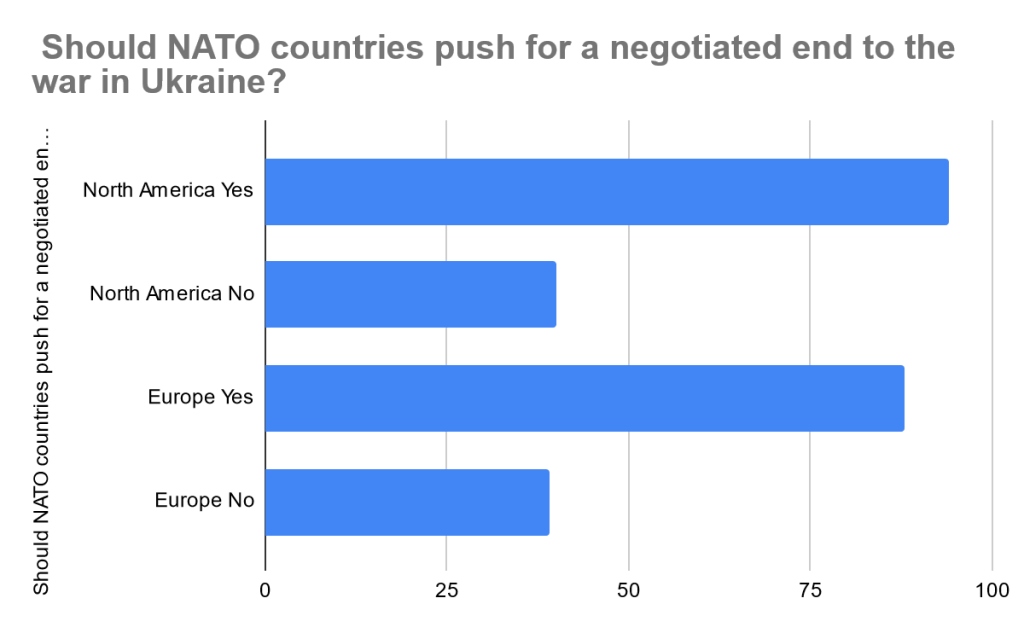
The justified fear that the Ukraine war is heading in that direction is one of the factors in driving majorities in both North America and Europe to favour a ceasefire and negotiated peace over continued escalation.
A recent survey by the Institute for Global Affairs showed that more than twice as many people in Europe and the US supported NATO pushing for a ceasfire as opposed it.
The IGA notes that
In responding to Russia’s invasion, avoiding escalation with Russia is a top priority — especially among Europeans. Results suggest transatlantic support for a cautious response.
More support a negotiated settlement to end the war, with a plurality of Americans and Western Europeans citing the loss of life and casualties as a primary reason.
This is a broadly humane response that is the opposite of the course being taken by the G7 and NATO leaderships. It is perhaps no accident that all of the leaders at the G7 had a negative approval rating; ranging from Georgia Meloni on -10, through Joe Biden on -19 and Justin Tudeau on -33, Olaf Schultz and Rishi Sunak on – 44 to rock bottom Emmanuel Macron on – 52%. Even after just winning the UK General Election, as he arrives at the NATO summit in Washington, Keir Starmer’s rating is -3.
In fact, the same logic on the part of NATO that led to the war in Ukraine in 2022 is the logic that is heading inexorably over nuclear red lines, possibly before the Autumn. The problem with a nuclear balance of terror is that it only works until it doesn’t. And the calculated games of chicken only have to be got wrong once, and its the end for all of us.
It seems clear that the calculation in NATO in the Winter of 2021 that they did not have to take Russia’s attempts to end the smouldering Ukrainian civil war, and defang NATOs eastward expansion, with a
mutual security pact that would have guaranteed autonomy for the Russian speaking Donbass within Ukraine,
made Ukrainian neutrality permanent
and kicked negotiations about the status of Crimea into a possibly interminable negotiation process
seriously because they believed that either
Russian military threats were a bluff that could be called, or
that if Russia did intervene, that would be the opportunity they wanted for sanctions that would rapidly bring the Russian economy to its knees, creating domestic turmoil through which the well oiled processes of a colour revolution could lead to a “regime change” favourable to the US
were a complete miscalculation in both respects.
With the sanctions only supported by direct US allies,and largely blowing back on them, the Russian economy is doing fine, growing 5.4% in the first quarter of 2024 (compared with 0.6% in the UK, 0.4% for the US and 0.2% for Germany). And the military tide is turning slowly, remorselessly Russian, as the Ukrainian government is forced to resort to press ganging increasingly reluctant conscripts, sending them up to the line half trained, and suffering losses in soldiers and material that they can’t replace.
Faced with the prospect of defeat, the G7 and NATO are trying to up the military ante, rather than do what their populations want and seek a negotiated peace.
This is heading into very dangerous territory. Mark Rutte was confirmed as the incoming NATO Secretary General only after he assured Hungary that no Hungarian finance would be used for, or military personnel deployed to, Ukraine. That implies that other NATO forces will be, threatening the direct clash that could be a tipping point beyond the control of its instigators.
The decisions now being made at the NATO summit, with a dedicated NATO HQ being set up, promising an “irreversible path” to membership, cranked up arms spending, a no fly zone on the Western and Southern Ukrainian border, a green light for Ukraine to try to knock out Russian nuclear early warning systems that cover areas well away from Ukraine – a terrifying piece of irresponsible brinkmanship, as this makes a nervous nuclear armed power unable to tell if it is under fire or not in a context in which it is afraid it might be – deployment of NATO “instructors” within the theatre of conflict, and ever widening permissions given to fire NATO produced munitions into Russia are all edging towards catastrophe.
A letter to the FT by a number of academics and former diplomats, including Lord Skidelsky and Anatole Lieven, calling for a negotiated settlement to allow the world to be “pulled back from the very dangerous brink at which it currently stands” is a sign that the consensus at the top in favour of escalation is beginning to crack. This is likely to grow as the situation becomes more intractable and dangerous.
In this context, its important that positions taken in the Labour Movement do not rest too heavily on myths. A recent letter, Time to help Ukraine to win, signed, among others, by John McDonnell, Clive Lewis and Nadia Whittome, argued that failure on the battlefield has been down to inadequate supplies of munitions from the US and its allies, calling for the UK to “take a leading role” in supplying “all the weapons needed to free the entire country” and that, in the short term, this should take the form of obsolete MOD equipment being gifted instead of sold off, for a war crimes tribunal directed solely against the Russians and for Russian assets to be seized (stolen) by Western Banks.
There are four problems with this approach.
Myth 1. To “free the whole country” would actually be a reconquest of the Russian speaking areas that rebelled against the pro Western coup in 2014 and have been fighting it ever since, at a cost of thousands of dead from 2014 onwards; and, far from being a liberation, would constitute an occupation of those areas. This would not be pretty. Kyrill Budanov, head of Ukrainian military intelligence, has stated that this would require the mass reeducation of people “with a completely different mindset” and the “physical elimination” of some of them. Given what has happened in areas that Ukraine took back at the high point of its military efforts in autumn 2021, this does not have to be imagined.
Myth 2. McDonnell et al seem to assume that the taps can just be turned on from an infinite supply of military hardware. It can’t. The paradox of the NATO military Industrial Complex is that although it outspends the Russians 11 to 1, it characteristically produces immensely expensive and complex pieces of kit that require lengthy training, high levels of maintenance and can only be produced in relatively low numbers; and once they are used, at great expense, they are gone. This is highly profitable for the arms companies and is designed for short sharp wars against Global South countries, not long term grinding wars of attrition with near peers. Stocks are now run down, the obsolete equipment, like Leopard I and 2 tanks, Bradley AFVs and so on have been deployed and destroyed in large numbers. F16s – an aircraft first deployed in 1978 – are the next installment and will fare no better. Plans to increase production of, say, Patriot missiles, can only be incremental – from about 500 to 650 a year. That is why this position is a fantasy. The supplies sent to Ukraine have been the maximum that NATO could scrape together. The only way to shift this would be to completely retool arms manufacture, which would require massive investment over several years; and politically set a trajectory for war that would be very hard to stop. No one on the Left should support this.
Myth 3. The barrel has already been scraped for obsolete equipment. The MOD website Army Surplus Store section notes that as of May 2024 “There is currently no MOD surplus inventory for sale.”
Myth 4. McDonnell et al’s argument that “Ukraine deserves a just and socially progressive reconstruction in which trade unions and civil society can democratically participate. International support should help to restore and expand universal healthcare, education, rebuild affordable housing and public infrastructure, ensuring decent jobs and working conditions. No more advisors from the UK Government should be used to assist in retrogressive reforms of trade union and labour rights” is also, sadly, wishful thinking. The “reconstruction” of Ukraine will be a massive asset stripping fire sale, as its Western “backers” come for their loans like a flock of vultures. It has already been agreed between Western creditors and the oligarchs who have run the war, embezzled a good proportion of the “aid” and siphoned quite a bit of arms supplied into the international black market, that the “reconstruction” will be managed by Blackrock; whose priorities are not those of John McDonnell. Blackrock would, no doubt, wish for a succesful UAF offensive into the Donbass that would allow them to get their hands on the $12 Trillion worth or rare earths that are sitting below the surface there. Such an offensive is even less plausible now than when it was tried in 2022 and the UAF suffered terrible casuaklties to make marginal territorial gains of no strategic significance.
Myth 5. In this context, any notion that Ukraine’s debts will be cancelled is similarly wishful thinking. Its as if NATO powers aren’t in this conflict for themselves. As if it is some genuine genuflection to – a partially applied – principle of national self determintion. The West, will want its pound of flesh. One reason for the Ukrainian oligarchy to keep a hopeless war going is to postpone the time that the aid stops flowing and the debts come due. For NATO countries to unilaterally sieze Russian assets would be another nail in the coffin for any pretence at upholding a “rules based international order”, rule out any serious possibility of peace negotiations and be seen in the Global South as on a par with the appropriation of Venezuela’s assets by the same imperial powers.
Sections of the Left often put forward spurious – slightly fantasised – arguments in order to cover an accomodation to their imperatives of their own ruling class. The paradox of this is that the ruling class itself is more hard nosed. The section of the US ruling class that backs Trump wants to cut its losses, try to impose even more financially ruinous military spending on its European subordinate allies, so that, with or without a ceasefire in Ukraine, the US can concentrate on launching and even more ruinous war in the South China Sea.
That is where the US ruling class is heading. It is why a candidate like Trump, convicted felon and epic shyster, keeps afloat on a sea of money; and now looks like he is going to win, with all the “unpredictable violence” that Boris Johnson thinks is just what “the West needs”. This strategic shift is not because Trump is in some way “Putin’s patsy” but its actually a statement of weakness that the US no longer believes itself capable of fighting two and a half wars at once and prevailing in all of them. They have to concentrate on the biggest target, and if that causes problems for its subordinate imperial allies, so be it. To deal with the twists and turns of all this the section of the Left that finds itself cheerleading for NATO escalation will need to burn its delusions.
“In many ways, this looks more like an election the Conservatives have lost than one Labour has won.” John Curtice.
This is evidently the case for the Conservatives. Their support more than halved from 2019.
The splintering of the Tory vote almost down the middle between the Conservatives and “Deform UK” is their most serious split since the Corn Laws in the 1840s. And its a real split. It can’t be overcome by some fantasy of getting “the Conservative Family” back together and arithmetically adding the Conservative vote to the Reform vote (which, at 39% would be 4% larger than Labour’s share).
Farage has a programme to ruthlessly pursue the logic of Brexit, slashing and burning regulation and taxes and the welfare state, cracking down on unions, playing racist dog whistles on trombones in a manner calculated to cause social unrest and violence, and suicidally abandon any attempt to resist climate change; in a way that more traditional Conservatives would consider disruptive and dangerous to social order and profitability.
Add to that the fact that Reform’s economic policy is like that of Liz Truss, but without the restraint, and you get an environment that is too risky for slow and steady profitability. The problem for the wing of the Tories that don’t want to go for this kind of adventurist far right alternative is that the Tory grassroots are largely in that camp; which has meant bending to them in Parliament. So, that’s where the realignment of the Right is heading. This will be put on boosters if Trump regains the White House.
With Tommy Robinson’s thugs planning a street action in London to “take over” central London on July 27th, when Farage promises “something that willstun all of you” its hard not to think that rubber truncheons will be involved.
At the same time, when people say things like, Labour is now “once again in the service of working people”, or how changed Labour has regained popular trust, those statements stack up oddly against the number of people who could be bothered to get out and vote for the Party.
In 2017, under “shh, you know who”, Labour won 12,877,000 votes.
In 2019, under the same man, Labour won 10,300,000 votes.
Yesterday, under Starmer, Labour won 9,600,000 votes, more than half a million fewer than in 2019, still being talked about as “Labour’s worst result since 1935”.
Overall this amounts to 35% on the share of the vote, up less than 2% from 2019.
And this was on a turnout of 60%, down from 67% in 2019.
Most of this small rise is accounted for by a 17% rise in Scotland at the expense of the SNP.
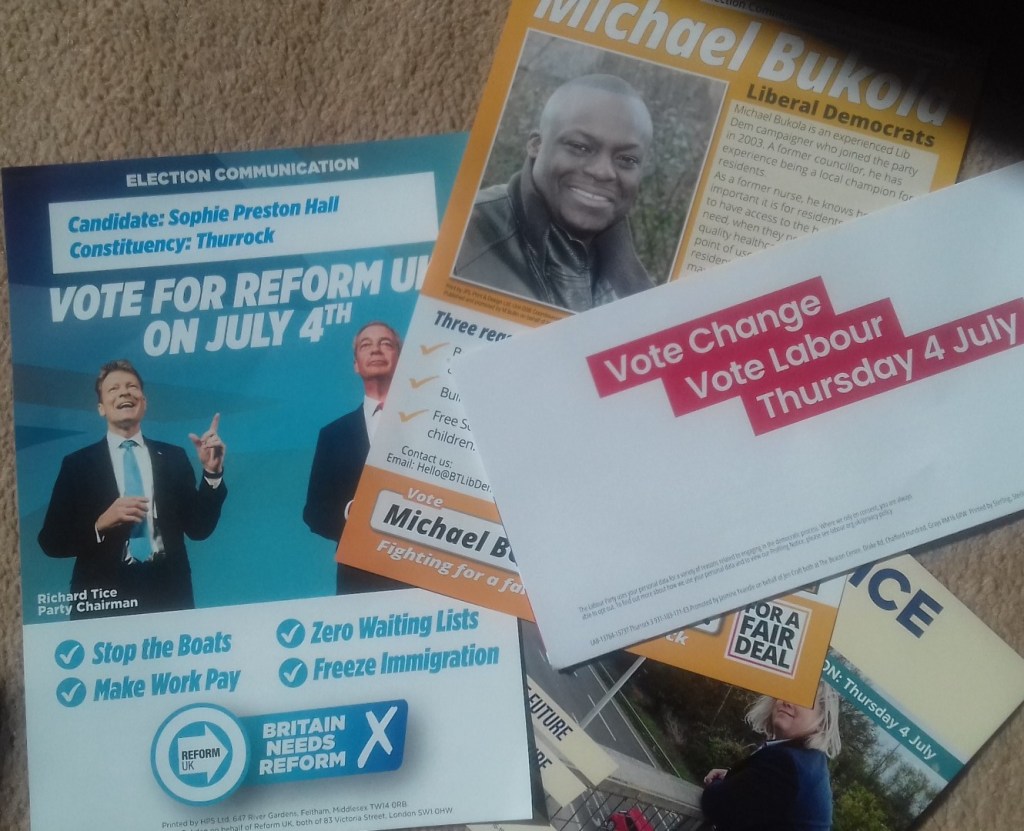
In a constituency somewhere in South Essex, four leaflets plop through the letter box.
The Conservative leaflet is on the bottom. Because I am hoping they will get buried on Thursday.
One is from the sitting MP. She is a Conservative, but seems a bit shy about that. The leaflet leads with her name in large letters. If you look really hard you can see the word “Conservative” in tiny letters tucked into the bottom right corner in an attempt not to draw too much attention to itself, with that squiggly tree logo, from their greenwash phase, tucked alongside. Just so you don’t forget what she looks like, there are eight photos of her in a single folded A4 leaflet. This is not many by her standards. Her previous one had thirteen! An MP since 2010 and only briefly a junior minister, under Liz Truss, so definitely not front rank. The usual phative slogans – A Secure Future – A Brighter Future – are superimposed on a photo of the candidate looking away from the camera into the middle distance with a slightly constipated expression, while standing on a footbridge over a busy road and, hopefully, not breathing in too hard. Roads loom large in her pitch too, the solution to traffic congestion being to build more of them. Her Ayn Randish vision of the constituencyas “the best it can be” is a curiously dated hyperdevelopmentalism, in which hopefully the whole area will be tarmaced over and full of commerce freed from red tape and taxation rushing products in and out and through. Not a “green and pleasant” vision, however you look at it. The only remaining trees will probably be the tiny ones on Conservative leaflets. Her overall pitch of development for “our(sic) local priorities”, which is a bit previous in assuming that everyone else’s local priorities are the same as hers, with the Council – run and bankrupted by her Party until May this year – posed as the enemy and a Labour controlled Westminster, possibly with a “huge majority”, even more so. Its hard to tell who she is referring to when she says “our”. Perhaps she is just giving herself airs and using the majestic pronoun. There is, nevertheless, a whiff of panic about it.
A standard cut and paste job from Reform, in varying shades of blue, uses a template photomontaging images of Nigel Farage looking upwards like a toad in search of heavenly inspiration while holding his hands together in cut price man of destiny pose no.3 and Richard Tice – on a slightly smaller scale, so you get the heirarchy right – pointing up at the slogan “Vote Reform UK on July 4th”, while smiling to indicate this is a happy prospect. The candidate and constituency are slotted in to a small panel at the top. The sort of leaflet that sometimes gets rushed out with “insert name of candidate here” if the Party agent has had a rough night before proof reading it. The front page has two slogans against immigration but tosses in two others – make work pay – zero waiting lists – with no elaboration at all on how this might be done. Given the overall tenor of their politics the former might be achieved by starving the jobless and the latter by weeding the undeserving out of the queue, especailly “immigrants”. The entire reverse side attacks immigration on the argument that freezing it will make life better, in the same way that Brexit made life better presumably. Fool me once… A leaflet aimed at generating knee jerk reactions, not convincing anyone who doesn’t already have them. The Nastier Party.
The Lib Dems have a busy little leaflet that, oddly for them, does not contain a bar chart saying that only the Lib Dems can win here – perhaps because everyone knows they never have, and it wouldn’t wash. Instead, they have a little panel referring to a by election in an unnamed other constituency at an unnamed date, which shows that “Lib Dems can win anywhere”. With a long local record of lost deposits and no local councillors, I wouldn’t bet on that. Beyond that, they have a potted biography of their candidate, which is at least a human touch, but implies that he’s doing this to get elected as a councillor somewhere at some point in the future. The pledges – under the rubric For a Fair Deal – are positive but vague, like ” a fair plan to protect the poor and pensioners, tackle soaring prices and get our economy back on track”. Yes, but, what is it?
Labour, breaking the mould in this case, sends a letter, not from the local candidate but from Keir Starmer. This might be considered an odd choice as Starmer is far less popular than the Party; with a favourability rating of -19. The heading has a smiling Keir, with no tie on to show that he is relaxed and getting on with rolling his shirt sleeves up, staring confidently from right to left, into a future that is just off the page, superimposed on half a Union Jack that doubles up as an arrow pointing towards the word Change, with his name underneath it, in case anyone doesn’t recognise him. At this point, this should not be taken as an injunction on the Party to “change Keir Starmer”, though perhaps the designer has a sense of humour. The pitch is a simple one. There are two possible governments and “versions of Britain” posed as “Conservative chaos” vs “Britain rebuilt by Labour”. “Rebuilt” is an interesting word, as to some people it will mean “transformed” to others it will mean “restored”. On the one hand, the future. On the other, the past. Perfectly pitched for the sort of voters who preferred it in the good old days, when life was harder; and want a future just like it. The pledges are either oddly limited and specific – Recruit 6,500 teachers – or – Set up Great British Energy – too limited and specific to make a serious dent in the problems they purport to address, or magnificently vague – Deliver economic stability – Cut NHS waiting times (a phrase that begs the questions, to how long, by when?) while economicstability can mean solid, reliable, not flaky (like Liz Truss) but it can also mean immobile; not collapsing but not transforming either. Steady as she goes is not full steam ahead. Perhaps Small Change would be a better title.
Every one of these leafets is a parochial and infantilist retail offer. Vote for us and we will do this that or the other on your behalf, or, vote for us and we will take out your frustrations on someone who is worse off than you are. Looking at them, you wouldn’t think that this election is being held under the shadow of two wars in which the UK is complicit, one of them threatening nuclear war and the other a slow moving genocide, and an accelerating pace of climate breakdown that is risking serious global food shortages within a decade. The challenges facing us on a world scale to draw back from confrontation, seek a peaceful modus vivendi in which we can limit the climate damage are titanic. It is a sign of a crisis of leadership that not one of these leaflets seriously addresses these issues, or treats voters as citizens capable of doing so themselves.






 Urban ramblings