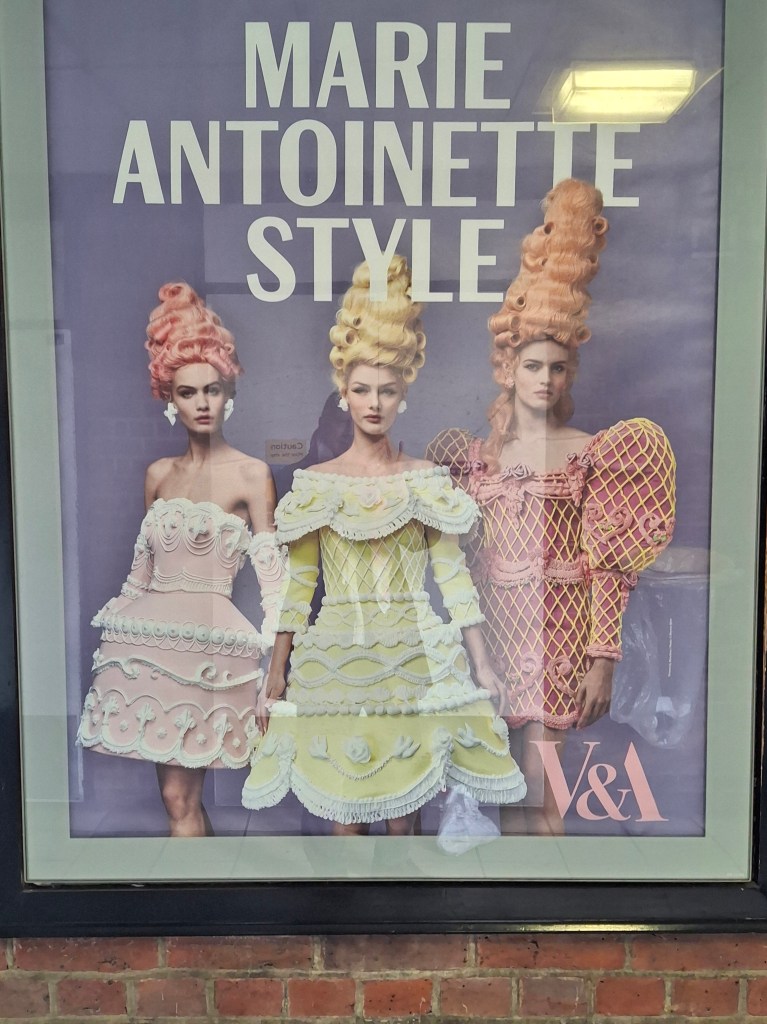
Seen at Kingsbury tube station yesterday. Marie Antoinette, well known for taking the “off the shoulder look” to extremes. If the V&A cafeteria has not booked in extra supplies of cake, they are missing a trick.
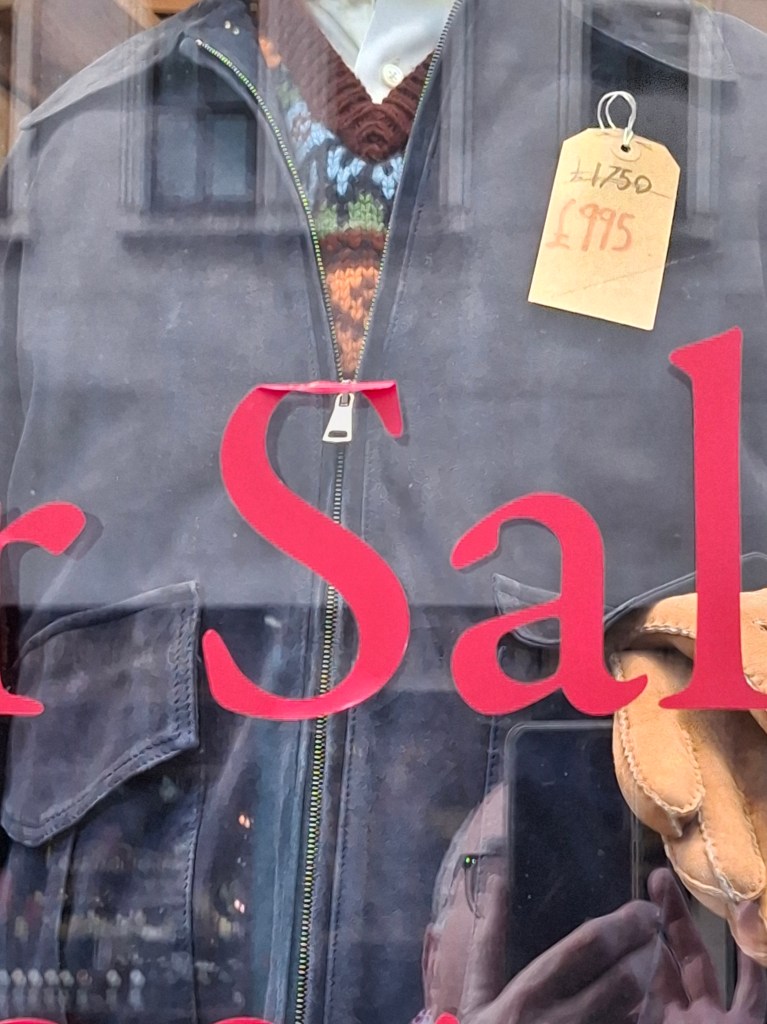
On my search for sandalwood shaving cream from Taylors of Old Bond Street, because it makes having a shave more of a pleasure and less of a chore, I missed the shop because I was so gobsmacked by the prices in this tailor shop on the corner of Piccadilly Arcade. Taylors, although of Old Bond Street is, peculiarly enough, in Jermyn Street. Look at the price tag on the blue jacket.
I mean, its a nice jacket. But initially retailing at £1750, now a snip at £995? People who might think that a bit of a steal have no idea what life is like for most of us – or possibly do and don’t care a great deal. The slogan on the back of Melania Trump’s jacket stating exactly that while touring immigration detention facilities on the US Mexico border was such an in your face message – and so obviously true – that commentators tried to pretend that it was irony. Let them eat wormy food. The popularity of these people is now being shown in the attendance figures for her Biopic. Almost empty cinemas casting a hollow echo to their narcissistic presumption.
I wandered off down the street looking into other shop windows and found a pair of beautiful, highly polished brown shoes retailing at £605 (for the pair, not each). You would be afraid to actually wear a pair of shoes like that. Maybe you’d put them in a cabinet. Possibly at the V&A.
I recall once dispersing from a teachers unions march to defend our pensions, with my school union group banner slung over my shoulder, walking through the usual rush and bustle on the East side of Picadilly circus, all the tatty tourist barking from the Trocadero and that slight sense of sleaze that spills over from being so close to Soho, passing through a sort of portal at the top of Lower Regent Street, which was packed with black bomber jacketed Greek Football fans from one of those continental clubs that still thinks its 1935 (or wishes it was) to emerge into Picadilly proper and a different city, all Royal Academy and Fortnum & Masons; and finding myself being stared at by more than one man wearing a cravatte.
Taylors, however, when I walked back up the street and found it, was delightful. I was expecting a bit of being looked at down at along people’s noses, especially as I was wearing a Keffiyah, but everyone was extremely friendly, polite and helpful. Tiny little shop full of good quality products, attractively arranged, full of people buying them, in a away that felt more cosy than crowded; and an actual barbers shop at the back, smelling like a barbers, so a working shop with products and praxis rooting it in its job, with a couple of plump Turkish looking blokes with their sleeves rolled up ready to do the business wearing welcoming smiles – possibly because I was wearing the Keffiyah. A very polite young man, formally dressed, opened the door for me on the way out. Classy, in a good way.
“We risk becoming an island of strangers” Keir Starmer.*
Now that I am old and full of sleep I find that people are occasionally starting to offer me their seat on the tube. It happened twice on a packed Metropolitan line train yesterday. Both the people offering were young women wearing hijabs.
We live almost at the summit of a very steep hill, so coming home laden with luggage is always a bit of a slog once we’ve got off one of the many buses that stops nearby but doesn’t dare try to ascend it. There are no routes. I suspect the drivers might need oxygen. At any rate, there is always a slight air of base camp about us as we pause at the bottom, look ruefully at each other, up at the slope, take a breath...”ready for this?”
Getting to that point close to midnight on Sunday in the rain, and a young black bloke in a car opposite starts shouting at us. We couldn’t make out what he was saying and initially weren’t sure he was talking to us, or had just stopped to shout at someone down his phone, or whether he was being threatening or not. So many urban myths, so little time. Thinking he might need directions, I wander over to talk to him; and it turns out he’s seen our predicament and was offering us a lift, which we very gratefully accepted. Friendly young man. Helped us in and out of the car with the luggage. Good deed for the day.
And on the way back, we struggled out of the lift at West Ham station just as our train was drawing swiftly in. Being a four carriage train it was sweeping ahead of us down to the far end of the platform, so we ran after it – limped in my case – as fast as we could, lugging backpacks, trundling wheely suitcases with bags balanced on top and pulling a heavily laden shopping trolley. On flopping down in a seat, having heaved all this up into the carriage- “pfff!” the Eastern European woman sitting opposite catches my eye, smiles and offers me a drink of water because “you look out of breath”.
Our neighbours aren’t strangers, and nor, it seems, are strangers.
* I know that Starmer now says that he deeply regrets using that phrase, but doing so was not an accident. All speeches of that sort are worked over many times by many people and every phrase is designed with calculated effect – which button will this push, which strings will that pull, what kneejerk reaction can we get with the other? His regret comes from being caught outas these calculations blew up in his face. He doesn’t, however, seem to have learned from this – that the xenophobes and racists he is trying to impress won’t be impressed and anyone who wants to fight them will be repelled – because he’s still on the same course towards disaster.
This is the story of my Mum’s life written and told by me and my brother at her funeral on 15/10/2025.
CHRIS We would like to welcome you all to this commemoration and celebration of the life of our mother Patricia Joan Atkin. In particular, Shirley and her family who are joining us from New Zealand, Colin and his family in Spain, Brian in Lincolnshire and Penny in Shetland.
It is lovely to see so many of you once again, just 4 months or so since we said goodbye to Dad. We always said they would not want to be parted for long and so it has proved.
In accordance with Mum’s wishes this is a non-religious ceremony, but there will be moments later for reflection, contemplation and prayer if you so wish.
PAUL Mum was born in January 1930, slightly closer to the start of WW2 than the end of WW1, to very young parents, Bill and Mabel Burford, who were both 20 at the time.
She spent her first four years in her maternal grandparent’s very crowded house in Bedford Road, with her parents, grandparents Charlie and Jinny, and their youngest children, Edie, Arthur and Syd; the last two of which were young enough to be playmates as well as uncles, and she was always very close to Edie.
Mum’s first memories were of being terrified by an army pipe and drum band that came skirling out of Grays Park while she was playing in the street, running home and banging on the door to find a place of safety from “that terrible noise”. Mum never liked sudden, loud noises (like me, or her Mum, doing the washing up).
CHRIS She did indeed instil in us a concern about being quiet and thinking of others; If we arrived home late from a trip out with Mum and Dad, she would always insist we didn’t slam the car door, talk loudly or make a noise as ‘there might be babies asleep’. As a pre-school child I remember crawling up the stairs as silent as a ninja on the rare occasions she allowed me to go upstairs for something when Dad was on night shift.
So it must have been an act of adolescent rebellion to some extent when I started to learn the drums in my teenage years. She was surprisingly tolerant of this, but her legacy had an impact as I couldn’t help checking the immediate environment surrounding any gig we might play and think ‘what if a baby is asleep…?’
PAUL An early memory she often mentioned, was of being taken out in her pram by one of the girls down the street and coming home with a dandelion shoved up her nose. Mum never liked bullies, so when she started school she went with a group of kids who were going to look after her. Crossing the road to meet them she was hit by a car which, luckily for her, and us, was going slowly enough just to leave her with bruises and a serious concern about road safety.
When she was 2, her grandmother died and, after a while, her grandfather remarried a woman she did not remember fondly – “old Maud” – and she did not get on with Maud’s daughter, with whom she had to share a room. So, her parents moved into 131 Hathaway Road, one of the new “Homes fit for Heroes” council houses that had been built less than ten years before.
Mum therefore had to change schools and went to Quarry Hill Primary where she came across a boy in the same class – memorable because his was always the first name to be called in the boy’s register, as hers was in the girl’s. She helped him find some lost drumsticks during a school Xmas performance and, as dad said “she’s been helping me ever since”.
As a child Mum played on the playing field (except on Sundays when the council chained up the equipment to preserve the Sabbath) and watched the Council dig trench shelters on it during the Munich crisis in 1938.
On her birthday the next year, she’d wanted a bike. What she got was her baby brother John. I know the family has always inclined to be neat and tidy, but sharing a birthday with a nine year gap might be thought taking this to extremes.
CHRIS Within 9 months of John being born, WW2 broke out and the family was moved to Dumbarton. Mum’s Dad Bill being a docker, was in a reserved occupation essential to war work and the docks just outside Glasgow were thought safer than those in Tilbury.
However, because the family were so homesick, when Bill received call-up cards by an administrative error, he didn’t challenge it and was drafted into the Royal Engineers so called “Dock lot”.
The rest of the family came back to Grays where Nan worked with the Rationalisation Committee at the Coop and Mum spent a lot of nights in an Anderson Shelter with a wireless, lamp and a map she put pins in to follow movements on various fronts. This followed another very brief evacuation to Wales with a friend that lasted several weeks, during which Mum climbed trees by the railway line and made plans to stowaway on a train to London to get back home. Holding on to home was very important to her, and she never moved out of Thurrock her entire life.
The family didn’t get through the war unscathed. Syd, Mum’s youngest uncle and the closest to her, was killed in Tunisia, when his lorry drove over a landmine just days after the Afrika Korps had surrendered. The date of that was burned into Mum’s memory; and his older brother Arthur, who Mum said used to sit by the fireside cracking jokes, died in 1952 of a virus he picked up in Burma with the 14th Army. Syd’s name is on the War Memorial in Grays. Arthur’s isn’t.
PAUL The wartime experience of rationing and “make do and mend” made Mum see food as sacred – there was nothing worse than wasting it – and very careful with resources, keeping things “that might come in handy”. That included an enormous green bottle of calomine lotion that lived under the sink for decades because there was just too much of it to throw out with a good conscience. It took us a long time to persuade her to let it go. Reduce, Reuse Recycle being reflexes for Mum that long predated the environment movement.
On Matriculating from Palmers Girls, Mum got a job as a Secretary with Scottish Widows in the City and enjoyed commuting up there with a friend who worked nearby. She also did evening classes at Grays Tech, where Dad spotted her, ran down the road and asked her out to the pictures. Mum said, “he seemed nice and chatty, so I said yes”. And that was that for the next 80 years.
After Mum and Dad got married in 1952, looking like a pair of film stars (I always thought Mum looked like a prettier version of the Queen and Dad was like Gregory Peck with a stronger jaw) they lived with Dad’s parents in the top two rooms of their house on Ireton Place. That worked out very well and I was born in 1954.
After a short move to a flat in Tilbury we moved back to Hathaway Road – which seems to have a pull like a benevolent black hole – and stayed there ever after. After two years of doing it up in the long lost modernising spirit of Barry Bucknell – remember him? -and John coming to stay with us when his parents moved to Kent; Chris was born there in 1959. During her pregnancy, Mum was offered Thalidomide, but didn’t accept it because she thought she’d manage better without it. A good call. Though, if President Trump is watching, she almost certainly took paracetamol, and made very sure we were vaccinated.
CHRIS Looking back, it feels now like we grew up in a kind of Ladybird book; Mum and Dad took on unchallenged 1950s gender roles, largely because they hadn’t been challenged; with Dad going to work and Mum staying at home to look after us, part cook, part cleaner, part nursery-nurse, teacher, part accountant and manager of home economics.
One of Mum’s roles was passenger in charge of navigation when we took any trips in the car to holiday destinations or other places. A huge OS map across her knees and instructions such as ‘keep on going on this blue road, then we need to turn right onto a red road..’
My very earliest memories are of just me and mum- pre-school years; waving Paul off to school in the deep snow of ‘big freeze’ winter of 1962-1963, always being given a choice of what to play with so she was free to be industrious in the kitchen, being taught to recognise and spell my name, doing a jigsaw of the Beatles together and inadvertently locking ourselves in the cupboard under the stairs. Mum had to call for our neighbour- Mr Barton- through the small window to come to rescue us. She told me some years ago that the incident had terrified her, but she gave absolutely no indication of that at the time. Mind you, she once said that I didn’t actually speak until I was 4 years old and I’m pretty sure that’s untrue.
PAUL Mum being very organised, there was a definite routine to all this. Elevenses, a coffee and a biscuit, was always at 11. Not exactly on the dot, but near enough. We always had a break to “Listen with Mother” at a quarter to 2 on the Home Service because, at the time, this wasn’t just the title of a programme, but an instruction passed down apostolically from Lord Reith. Big jobs had definite days, a bit like the Scaffold song. “Monday’s washing Day, Tuesday’s Soooop”. Washing originally done boiling sheets in a big pan with tongs, a washboard and a mangle.
Mum was a great cook and baker, and made mince pies that would definitely be in line for a Hollywood handshake on Bake Off (an ounce of extra fat in the pastry is the trick – and Jamie always uses that when he bakes, so the tradition lives). At one point in the sixties she went on a World Cookery course, which seemed to focus mostly on chicken, and tried out Coc Au Vin and an extraordinary Mexican dish that involved chicken, chocolate and chilies – they were wonderful; but we never had them again…
CHRIS Mum’s Chocolate Cake was my favourite and I always requested it for birthdays or special occasions. The other thing I loved that mum made was Fish Pie. She complained that it was fiddly and bit complicated to make and when I left home she gave me the recipe. For over 40 years I have made many lovely Fish Pies, but never have I managed to make one like she did, or as taste good as she did. I have never even attempted to make a Chocolate Cake…
PAUL When we all caught chicken pox in 1959 and couldn’t go on holiday. Mum and Dad bought a telly instead. Mum and Dad always watched “the news”; to which Mum’s reactions were often quite fierce. Probably the first time this made a strong impression on me was Mum exploding at a report of the Sharpeville massacre in 1959, when South African police wearing coal scuttle helmets shot down anti apartheid protestors. “JUST LOOK AT THEM! They even LOOK like Nazis!”
Mum had definite views. Always voted Labour, liked Michael Foot and Tony Benn, voted Remain, thought Nigel Farage was a dangerous charlatan; and, during a recent dementia assessment, when asked “who is the President of the United States?” replied, “I don’t know, but I do know that I don’t like him!”
CHRIS She went back to work in the early 1970s when I started secondary school – first with the DHSS, then the local Education Department before settling in to being a librarian – which is very appropriate because, for Mum, if anything was more sacred than food, it was BOOKS. And if there was something more sacred than books, it was LIBRARY books. Because they belong to everyone, and other people would be reading them, they deserved special care. The same personal responsibility for social goods that meant you didn’t drop litter or put your feet up on bus or train seats that other people would have to sit on. And you washed out your milk bottles and recycled tins.
She read constantly and widely. Biographies, novels, crime, Armando Iannucci and Alan Bennett. And she had similarly wide musical taste, from Jack Jones and Charles Aznavour to Glenn Miller, Mozart and many more from what Tom Lehrer called “that crowd“; who she found thrilling.
Retirement in the 1990s coincided with the arrival of grandchildren – which was good timing – first Joe, then Sasha and Jamie; and she was an engaged and loving grandmother who all of the kids felt safe with and nurtured by; while she also helped look after her Mum in her last decade. Retirement also meant walking, Tae Chi, visiting family and friends.
PAUL Ill health in the last ten years or so, came in the form of falling over several times – “I go to walk and my legs don’t move” as she put it, then arthritis in her hip, which made walking even with a stick or frame quite painful; so she didn’t move about much. As she said “its alright when I’m sitting down”. So we watched a lot of Heartbeat and Midsomer murders and Vera.
In the end, Mum went suddenly, pretty much how she’d have wanted it. Quick and relatively easy on her and everyone else. On the Friday, Chris and I took her for a spin around the field in the wheelchair, and she reminisced about playing on it 90 years before. On the Saturday, woken in the morning by a headache that turned out to be a cerebral haemorrhage, she was beyond all pain and sensation by the time we got her to Basildon, quickly though that was, and just drifted away by the evening with us around her during the day.
I think the word that comes to mind most thinking about Mum is “animated”. In just about everything she did, or was involved in, she took enormous delight in what seems to be the smallest of things. “Cup of tea Mum?” “Ooh! LOVELY!” Its heartbreaking not to be able to wake her up in the morning with that question, a kiss and a weather report.
CHRIS I want to leave you with a fanciful thought. We were and are not a spiritual family, but a incident happened that although certainly just serendipity gives me some comfort.
On Mum’s last day in hospital it was obvious that she was no longer with us- just her body in existence and beginning to be at peace when I took Juhi and Sasha back to Hathaway Road. After a short stay I went to get in my car and noticed a plane flying in parallel to Hathaway Road and opposite Ireton Place.
Dad was always fascinated by planes and flight. It was some sort of fighter type and I thought- ‘oh, there goes Dad’. A minute earlier or later and I’d have missed it. Then I thought, ‘of course, he’s gone to pick Mum up’ and I have a very clear image of Dad in the front concentrating on piloting the plane and Mum in the seat behind with her bag and cardigan on and an OS map across her knees saying ‘we follow this red road, then turn left by the river and follow it to the sea’. I’m not sure where they are going, but they are going together.
It was quite disconcerting yesterday to be sitting opposite this poster on the Jubilee Line. Being stared at by Michael Gove in full condescending mode, dressed in a waistcoast and shirt sleeves, which is perhaps to indicate informality and “getting down to business”, but actually just makes him look like a bleached out version of Jarwahalal Nehru (but without the rose) while Madeline Grant (the Daily Telegraph’s Parliamentary Sketch writer) rolls her eyes; its hard to know what at, herself, Gove, or all those silly people out there who don’t think quite like she does.
The new Spectator podcast is getting a lot of advertising, full length posters on the platforms and these little ones staring down from a height in the cars. Its title is a weak pun. Quite right. As in quite RIGHT. So, its right wing, with the presumption that this also makes it “right”, as in “not wrong”; allowing the homynim to do a lot of heavy lifting. But also that its QUITE right. Nothing TOO right. Nothing vulgar. No street thugs, but maybe just a bit of gentle encouragement for them with a lot of plausible deniability. Just “common sense”, nothing that will threaten the presumptions of comfortably off people. And nothing to scare the horses, especially as these are by and for people who ride them more than most and can afford to be Spectators from a position of impunity and financially well padded social safety.
It struck me that it was missing a strapline. Underneath The new podcast for politics, culture and common sense – Quite right! – With Michael Gove and Madeline Grant, the words because at times like this you wouldn’t want to listen to actual experts, would you? wouldmore accurately identify what this thing is for.
And the odd little yellow ribbon with OUT NOW on it should end with an exclamation mark and be in an arrow pointing at the presenters.
When I was an over serious teenager in the early 1970s, making myself very unpopular by putting a CND poster showing a mushroom cloud erupting out of a skull in a 6th Form Common Room full of people who just wanted to listen to Led Zeppelin and have a good time, I developed a philosophy of life that decreed that, in the face of global hunger, the threat of nuclear war and the destruction of the natural world it was immoral to enjoy it.
At the time, this was described as a “denial of life” by some of my closest friends and partners. But it seemed to me that a sense of guilt was a motivator, that the resolution of inhuman acts was a precondition for any happiness that could be justified; without reflecting that moments of joy don’t have to be justified; and a capacity to carry on wouldn’t be possible without them.
I expect I am not alone in getting vicarious imaginary montages, seeing horrific scenes from the news projected onto everyday landscapes. The first time J and I went into central London after the IDF started its mass bombing campaign in Gaza, we talked about how fragile the buildings in Leicester Square now seemed, how easily they could be shattered. Going to Basildon Hospital for my Mum’s most recent appointment we passed the three tower blocks that mark the northern edge of Chadwell and dominate the surrounding countryside, and I couldn’t help thinking that in Ukraine they would be a heavily shelled command post, a fortress in a waste land. While the hospital, so calm, friendly and orderly, humming along so functionally with its shops and cafe and pharmacy, would be a smoking hulk with desperate hungry staff trying to treat patients in the ruins with no anaesthetic, little or no medicine and no beds were it in Gaza. These are virtual, vicarious flash backs, not part of lived experience with no smells, little sound, just images, like a ghostly son et lumiere in the mind, but becoming an everyday part of psychic life.
In this context, when S and I were an hour early to the pots and pans protest for Gaza outside Downing Street last night, we took our sandwiches and sat under the shade of the plane trees in St James Park to catch a breath. We watched the geese and herons, moor hens and ducks like we had when she was little; the children eating ice creams in the sunlight.
On one level, given what we were there for, it seemed almost obscene to be enjoying this, the peace of it; even eating while 2 million people are being deliberately starved, but on another level it was an act of defiance. Finding moments of peace, moments of joy, moments of human kindness or wonder is a reprieve when under unendurable attack. When not under such attack, but aware of it, it becomes almost a duty to experience as much of our humanity as we can in the face of such strenuous efforts to degrade and dehumanise.
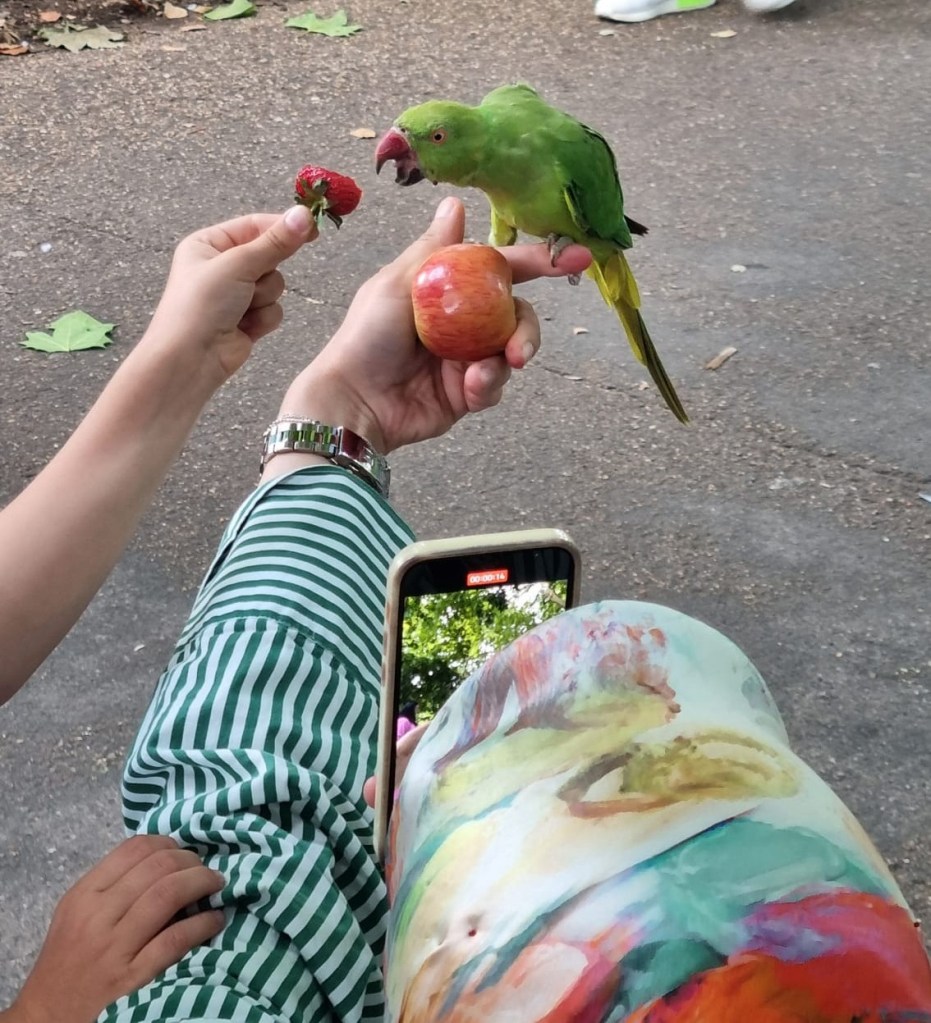
On the way out of the park we came across a Mum in a bright hijab and her daughter feeding a parakeet with an apple and half a strawberry. Parakeets are always exhilarating. This one kept fluttering down from rustling about in the tree above with the rest of its loudly chattering squadron, stretching out its neck and its bright red beak, then flinching back as it got too close. The little girls eyes were wide and bright with wonder.
In Moments of Reprieve, Primo Levi is making an argument for finding any human salvage you can in the most inhumne possible conditions, writing a set of short stories as an elegy to prisoners in Auschwitz, who through tiny affirmations of their humanity – a juggling trick, finding a slice of apple – discover ‘bizarre, marginal moments of reprieve’ amidst the horror.
In a discussion of thefinale of Beethoven’s 7th Symphonyon Radio 3 this morning, Tom Service argued that the ending of the movement is “off the wall”, because Beethoven has the double basses at the bottom of the register accompanied by the rest of the strings in a grinding and remorseless grim cycle of a theme in a lower key than the rest of the orchestra, which is hurtling around in a whirlwind of a joyful dance that ends in a blazing triumph; and the one is the condition for the other.
The conductor Charles Hazelwood, who was abused as a child, has said that “when I conduct Beethoven I feel the abuse in every bar”, because Beethoven’s Dad punched lumps out of him as a child, and as a result “It’s horribly uncomfortable for me to work with, right until the final performance which is always pure ecstasy”. Even when that mournful, somewhat depressive teenager, Beethoven always did that for me too, because his music absorbs the horror and misery and is driven by it to triumph over it.
This is the story of my Dad’s life written and told by me and my brother at his funeral on 27/5/2025.
CHRIS
Welcome everyone and thank you for coming to this commemoration and celebration of the life of Ronald Henry Atkin.
A chance to say goodbye to our Dad.
As you may have worked out, Dad was in many ways an unconventional man and in accordance with his wishes this is a non-religious ceremony, but there will be a moments later for reflection, contemplation and prayer if you so wish.
PAUL
The heavy rain today reminds me a bit of a joke Dad used to have when we went on weekend family outings in the old Morris Minor in the sixties, and the weather refused to cooperate. He would say we were out on “Atkin Sunday”, guaranteed to be the one day in the year in which the rain came down sideways.
To begin at the end… as part of the essence of living a life is that we have to leave it.
A few weeks before he died Dad asked “What am I for now?” It struck me that this was a very characteristic thing to say. Dad always wanted to be useful, helpful, always wanted to make sure that everyone else was alright. Whenever he was in hospital, his first question was always “is Mum alright?” It also struck me how being cared for is a useful role in itself. It enables people to come together in being kind and to find redemptive qualities in each other; solidarity not solitude.
CHRIS
Any brief autobiographical account like this one of Dad’s life may give an impression of a solid-straight line. Born in Grays, lived in Grays, died in Grays. Married for 72 years, 2 boys -us- not quite 2.5 children, but close, a long working life at the same factory and a long retirement. His story however was much richer than this and although his work-ethic was born of a loyalty, love and need to provide and care for his family, he was a man of very wide interests and tastes. With an open curious mind, interested in culture, politics and art and in people.
He was a warm, intelligent man with a wry sense of humour. In many ways self-taught- his education interrupted by war and attending an all-age single class village school for three years. He loved such things as Shakespeare, Ballet concerts and Classical music as well as the Rolling Stones and Jazz, Ian Dury and Paul Simon. He was interested in anything we were interested in; culture, history and politics on the one hand and music, drama and football; Spurs in particular, on the other. The latter being solely down to me I’m afraid.
He liked fine things- single malt whiskey, books, bow ties and cuff links. He also loved owls and had a large collection of ceramic owls. There will be a little more on the significance of owls later.
PAUL
Dad was born in 1930, in “interesting times”– 6 months after the Wall St crash, two and a bit years before Hitler came to power- and when a revolution in aviation -which always fascinated him throughout his life- was developing as fast as things like new chocolate bars were being created.
At a time when the average family size was shrinking, he was the only child of his mother Ruth and father Cecil (known as Tom) and grew up on the Hathaway Road estate, where he lived for almost all of his 94 years – surrounded in childhood by aunties who looked like peas in a pod and cousins who were as close as siblings – particularly Ruth, who’s here today and, at 97, will probably outlast the lot of us. He also had a very tight link to his cousin Len, until Len emigrated to Australia as a ten pound pom in the 1950s.
As the tallest boy in his class at Quarry Hill school he was always being given things to carry and wave, including the banner that kept the children together as they were marched in a crocodile to the station to be evacuated in 1940.
CHRIS
Evacuation was a formative experience for Dad and in many ways a positive one; he was safe, he was surrounded by the countryside, living in a large Georgian farmhouse in Little Somerford in Wiltshire with plentiful food.
He spent three years in Wiltshire at a time when people from Little Somerford often referred to people from Great Somerford as “foreigners”, but he fitted in. He helped with the harvest, pumped the organ in the local church, perfected his ability to mimic accents, developed his love of nature – he made us all birdwatchers in a low key kind of way – But he was homesick and really missed his family. In the three years he was away, he had one visit from his Mum, and one visit from his Dad; and this also gave him his lifelong empathy with people displaced by war and other disasters.
PAUL
When his parents thought it was safe enough, he came home, only to be narrowly missed by a Doodlebug that wiped out the houses at the bottom of Cromwell Road, another that landed next to his Nan’s house on London Road and bombed them out, and an incendiary that hit his parents house in Ireton Place. Luckily this ended up on the concrete floor of the pantry, where it fizzled out. He also looked out of his bedroom window one morning and saw a Junkers 88 dive-bombing somewhere to the West, which turned out to be the railway line at Thames Board Mills. Dad said he was impressed by the skill of the pilot who hit the line smack in the middle, but also by the skill of whoever the slave labour saboteur was in the Nazi munitions factory, as it didn’t go off.
Towards the end of the war, Dad (and Len) joined the Air Training Corps, which used to meet in the hall at Grays Tech; where he also attended evening classes.- which were also attended by Pat Burford- our Mum.
In 1945 the election of the Attlee Labour government introduced the National Health Service, which Dad always felt was the bedrock of a humane post war society. It was also the year that Dad ran down Hathaway Road after evening classes to catch up with Mum, and started a conversation that lasted for the next 80 years, starting with the immortal words “Will you go to the pictures with me on Saturday night?”
CHRIS
He had left school at 14 -although, he sat the 11 plus in Wiltshire, all the Grammar school places were for “local children”, so he never found out if he’d passed or not- and had a variety of jobs – at Thames Board Mills, delivering milk, a painter and decorator with Osborne’s. At 18 he was called up for National Service with the RAF and as he’d always dreamed of being a pilot, they decided to make him a wireless operator, instead…
He told his grandson Joe -now a professional musician- that the secret to Morse Code was not to get too hung up on the individual letters, but to listen to the music of it.
Dad could find the music in most things.
Sadly, Dad also found that he was often airsick and did not pursue any sort of career involving aviation. In any case he had met Mum and was very keen to build a future life with her as soon as he could.
PAUL
Stationed at Gloucester, a long way away from Mum, he had a colleague send him the local weather forecast for wherever she was, so he had a connection with her. There is a blown up photograph from this time on display in the Clarence Road entrance to the Grays Shopping Precinct, that shows Mum and Dad crossing Orsett Road with their arms around each other in about 1949*. Dad home on leave looking impossibly tall in his RAF uniform; and risking a charge for not having his cap on.
CHRIS
After being demobbed, Dad got at job at Proctor and Gamble, and spent the rest of his working life making soap, washing powder, Fairy Liquid. Early on he said that some of the machinery seemed to have been designed to be operated by “a dwarf with three arms”. He worked shifts- Earlies, Lates and his least favourite Nights. As children, I remember Mum kept us very quiet around the house when he was on Nights; then we would help mum bring him tea in bed around 2 in the afternoon.
PAUL
Dad was full of stories garnered from his workmates- giving some names an almost legendary status at home – Charlie Broyd, Bernie Bonass and especially West Thurrock’s answer to Socrates, Joe Cloherty. After being retired for 35 years, in the last few months of his life, Dad started to have dreams about being back at work, having to take readings and start up the machinery – he’d ask us to have a look at what the dials said on that panel on the wall – the sort of workplace anxiety dreams, which you get if you are conscientious and care about what you do and the people you work with.
Some of his friends in the air force had been very much on the political left, and that influenced him – and by extension us. He read the Guardian – thoroughly – every day. Has been known to wear sandals, and sometoimes, eat Muesli. He always voted Labour and leaned towards the Lefter side of the Labour coalition. But this wasn’t unthinking tribalism. During the General Election last year there was a knock on the door. When I answered it there was a brisk and efficient Labour canvas team working its way down the road. I said “My Mum and Dad have voted Labour in every General Election since 1951, and I don’t suppose they atre going to chnage now”, then gave him an earful at the Party leadership’s move to the Right. When I treported this conversation back to Mum and Dad, Dad said “Hmmm. Would you disown me if I voted Green?”
He always took an interest, always listened to people and was prepared to rub along when views differed, usually finding humour in a situation, or a connection to the underlying humanity that he always looked for – and, because he was looking for it, found.
CHRIS
When Dad died I put a post on Facebook to inform family and friends and I was struck by how many of my old friends posted comments using very similar language; about how welcoming Dad was and how he made them feel welcome whenever they visited. It never occurred to me until then how true this was and what it meant- that it meant so much, how Dad made people feel.
He was a man who was comfortable with himself and with others and he enjoyed being with others. He was in touch with his emotions and they were positive and warm. We never knew anger growing up, not even when we nearly burnt the kitchen down, trying to surprise Mum and Dad by making them breakfast in bed one time. Anger was reserved for politics or disrespectful service in shops perhaps.
PAUL
He was not in any way a broad brush, slapdash sort of person; witness the back garden at 112 for the immaculate balance of colours, shapes and timing, or his DIY, or any of his paintings, or the model aircraft he made – where he wouldn’t just produce a generic World War 1 aircraft out of the box. He’d research a particular aircraft and paint the model to match it exactly and rig it with tiny bits of cotton to stand in for the wires that supported the struts on the wings. These were not supplied by Airfix.
This is his painting hat, which he wore for fun to help get in a creative frame of mind; because if you are going to do magic things with paintbrushes, it helps to have a magic hat. It has badges…aircraft museum, World Wildlife Fund and the National Trust, a CND peace badge, Homer Simpson, an Eddie Stobart spotters club – because when you’re driving long distances, games and rituals keep you sane – Tottenham Hotspur – because football, as we know, is about art…and suffering and, just occasionally, joy, and two red nose day badges from the late 90s when the kids were little and selling them; which I initially mistook for blood donor badges – as he gave many an armful over the years.
CHRIS
He built a wonderfully long and great life with Mum that was based on respect and love; from dinner dances with friends (we’ve forgotten to mention what a great dancer he was!) and holidays, concerts, and days out to memorable Christmases and Birthdays. He was at the centre of things. Not in any dominating way, but as the catalyst of good feelings. Effortless and understated.
Dad had no faith but I would describe him as a soulful man. On my Facebook post I described him as a beautiful man in every way. And he was. I could not imagine a better father, or role model; without trying -just by being him-he taught us how to be a respectful, kind and to aspire to be a decent human being in all we did.
He will be greatly missed by all who knew him and loved him.
* The photo at the precinct entrance is wrongly captioned as Orsett Road in 1955. As Dad was demobbed by 1950, this is wrong.
In the market, a bloke is selling gift bags with four top of the range brand perfumes for a tenner. Ask no questions…
Outside the Eastern European Deli by Clarence Road a crowd of people gather round a man playing an accordion and sing the Rumanian version of Felice Navidad. Rumanian being a Latin language, the first word is the same. As is the tune. They seem to be having a good time. People passing by smile, even though they don’t understand the words. They can pick up on the good feeling.
Hurtling on a mobility scooter down George Street towards Morrisons at about 4 mph, a wild haired man with a rubbery twisted face mutters and gurns at passers by like Mick Jagger with Turettes.
Inside a tiny Rumanian owned finance shop on the riverward side of the level crossing by the station, a full scale service is going on. A priest in a cylindrical black hat, wearing an utterly gorgeous scarlet cloak covered with ornate gold embroidery with an icon like picture of the Virgin Mary on the reverse collar at the back of his neck, waves a heavy gold cross in one hand, while crossing himself with the other. Sometimes facing his small congregation of men with nylon suits and short haircuts, sometimes facing the wall behind him. This has an plaque celebrating the company’s Platinum award for HR successes, so it sometimes looks as though they are worshipping that. To his left, and facing the gawpers in the street through the plate glass windows, an attendant in an equally heavily gold embossed crimson robe stands guard with a serious look on his face. The overall effect is positively Byzantine in its mystical magnificence; humanised by the small table of snacks and orange squash along the wall.
At the bottom of Cromwell Road a tiny boy wearing one of those animal head hats that make him look like Max from “Where the Wild Things are”, is being pushed along by his Mum on a little purple plastic three wheel scooter which flashes lights as it trundles onwards. He is standing rigidly erect like a little Emperor, hands firmly on the handlebars, one of them grasping a sharpened pencil that he holds pointedly upwards like a staff of office.
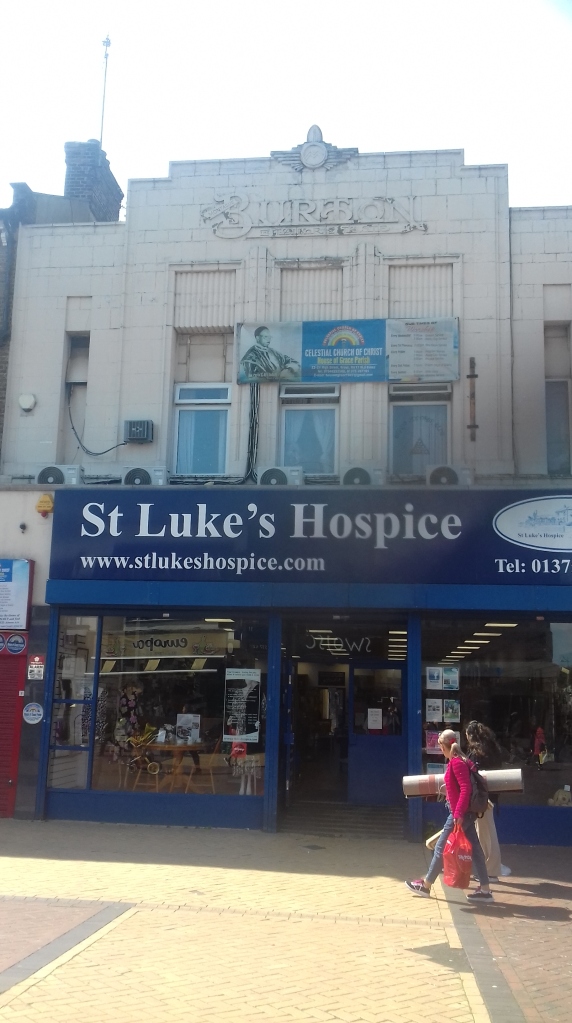
Coming out of the Church of Christ Celestial, a young woman dressed all in white like a cross between a pastry chef and a woman from the Handmaiden’s tale, bustles off down the road on Godly business. The Church is installed above the St Luke’s Hospice shop in what used to be the Burton’s Snooker Hall. Burton’s was a popular off the peg suit emporium that ran a snooker hall above the shop in the middle of the last century. My Dad told me that this was considered something of a den of iniquity among respectable folk – as in The Music Man song:
Oh yes we’ve got trouble
Right here in River City
With a capital T
And that rhymes with P
And that stands for Pool.
The logo for the snooker club – a triangle of racked balls – can still be seen faded but legible on the most southerly window. Hopefully the Church won’t disapprove as much as my grandparents did, and will leave it in place.
Although my Dad was forbidden to go in there, he’d sometimes surreptitiously nip up the stairs, not because he wanted to be Thurrock’s answer to Fast Eddie Felton, but accompanying a mate who’s Mum ran the tea bar as an alternative to the London Road Cafe on a Saturday night; for a heavily stewed tea and slice of “yellow cake” (a late 40s austerity version of Madeira, and nothing to do with Uranium…so they said).
Down Hathaway Road marches a small, slow, stately procession of elderly black matrons, all in their best church hats and sombre business like handbags, led by one of their number carrying a museum piece of a tall vertical banner in dark red with something Biblical in black written on it that could be straight out of the Shankill Road circa 1887. The strong influence of Black Evangelicals on the local Conservative Party indicating that the Saints might not be marching in, but they are definitely marching on; resolutely in the wrong direction.
Outdoor household Xmas decs look a bit sad in daylight, even before the day itself. Lights at night are one thing, but shopworn bows and slightly deflated snowmen and Santas blowing a bit desperately in the wind, are something else. Especially as seen from the top of the 100 bus to Basildon hospital, trundling through Stanford le Hope and Corringham, on a local road for local people, running alongside the huge six lane A roads that slice through and coil around the old towns like Boa Constrictors, with most traffic passing them by, trucking mountains of containers from the docks at Tilbury and Thames Gateway on up to the M25 and across the country. The relatively small and discrete railway line from Southend to London probably carries as much, or could, and makes a far lower impact on the landscape. Blink and you might miss it. You can’t miss the roads, making Stanford and Corringham feel by passed by their by passes. Both have a slightly tired and accidental higgeldy piggeldy feel to them, with no real centre, or heart, just successive layers of improvised development, clustered beyond Stanford’s handsome old church, with matching pub across what might have been a village green once.
Along the river run a row of giant cranes and gantries and the containers pile up 6 storeys high looking like the Martian machines from War of the Worlds. The sort of job done by my grandfather and great uncle consigned by them to rapid oblivion in the early 70s. An old family friend drops in and tells me that her job as a copywriter has gone the same way. At the beginning of last year, she had a waiting list and steady work with regular clients. ChatGPT comes along this year and wipes her out. She hasn’t had work for two months.
My Mum had quite a few cousins. Two of them had rhyming nicknames. Donk and Bronc. “Donk” because he would donk people on the nose if they were getting on his nerves too much. Bronc because, as a child, he was always playing cowboys.
An aspect of US hegemony is the extent to which the films and TV series we have watched all our lives make people think of them as the good guys. This is despite everything we have lived though, from Vietnam to Chile to Central America and the 4.5 million people killed in the war on terror, with Abu Ghraib and the Fallujah Free Fire zone providing a model for the IDF now in Gaza and the West Bank, while the US supplies them with the bombs and bullets to do what they are doing. All played down and deflected in our media of course.
The cavalry charge bugle call that heralded the goodies (white soldiers) arriving at the gallop at the end of so many Westerns to deal with the “savages” (native Americans) to the cheers of the Saturday matinee crowds of children in the 50s and 60s was played in a way intended to be darkly ironic at the end of that decade in the Helicopter gunship scene in Apocalypse Now, where the music shifts to the Apache helicopters playing Ride of the Valkyries through loudspeakers as they swoop in to strafe the Vietnamese village, and their commander comments, “I love the smell of Napalm in the morning”. Only the ironic intent and impact is inappropriate, because, think it back and project it forward, in the “war of civilisation against barbarism” (B. Netanyahu) its a call for the same armed forces to do the same damn thing over and over and over again.




 Urban ramblings