“Island of Strangers” my arse! Labour List’s apologetics for Starmer’s dive into the gutter

On my way back from the shops yesterday, I passed two neighbours chatting in the street outside their houses. A woman in a hijab with her small child was bantering about ice cream with the bloke next door, who was audibly Eastern European. They obviously knew each other well, and got on. Friends, not starngers.

This is in Thurrock, an area that was Brexit central, with a 72.6% leave vote in 2016. I find that, nevertheless, this is an area that is converging with Brent, where I normally live, the most ethnically diverse borough in the country. My neighbours in both places are not simply diverse, they are also ethnically mixed. As is my family.

When I used to analyse the ethnic monitoring stats for the school I used to work at in Islington, the fastest growing group was “mixed”. So, far from immigration making us an “island of strangers” many of us are getting on well enough to be as intimate as you can get.

In this context, and in the wake of Keir Starmer’s pedestrian dog whistling about immigration on Monday, Labour List’s article Local elections: Reform took four times more Labour seats than other parties is disingenuous. It implies, without stating it, that the loss of SEATS to Reform must mean that there is a loss of VOTES to them. And what follows from that is that there is a need – in the framework of the sort of electoral pragmatism that cares not what platform a Party stands on so long as it wins on it – to “address the concerns” of Reform voters in order to win those votes back.

This is a fallacy for three reasons and one principle.

  1. Reform has the momentum on the Right, and cannibalised the Conservative vote. Whether they will eat the whole Party before the next General Election is open to speculation, but it seems likely. These elections were held for the most part in Tory held areas that have been Conservative since the Jurassic and have now voted for a different, even worse, kind of Conservative Party (in the hopes of getting back there).
  2. The Labour vote did not migrate to Reform in a big way. It mostly stayed at home. Feedback from the doorsteps in the Runcorn and Helsby by election was that it was the cuts to winter fuel allowance that was the biggest demobiliser; so people who voted for a change from austerity and “hard decisions” taken at the expense of the poorest last Summer, were now less than enthused by what the Party had to offer.
  3. The government has been trying to cosplay Reform for some time, even to the extent of putting out ads boasting about how many people they have deported in Reform colours (which would be taken by most people as a Reform ad anyway, so self harm in more than one respect). The week of the elections saw announcements on a tougher line on immigration from Yvette Cooper on the presumption that the approach “Reform is right about immigration, we are trying to stop it, vote for us to stop Reform” would do anything other than legitimise them; and demoralise anti racist Labour voters. And, so it came to pass…

Tony Blair remarked after the 2017 General Election that if Corbynism was the way to win, he didn’t want to take it. Given the interests that have made him an extremely wealthy hollowed out husk of a man, this is hardly surprising. But the point applies in the opposite direction. Anyone even pretending to be on the Left who starts trying to exploit – and create – false divisions in our communities is doing the Right’s job for it. For the Labour Party, a lurch onto Reform’s xenophobic turf is a jump into quicksand.

The next lot of local elections will be in the cities. Reform is likely to still make the running on the Right. Labour, if it carries on trying to compete with it on its own terms, while presiding over austerity and an arms drive, instead of making a sharp turn to wealth taxes and investment in infrastructure, public services and green transition, will shed a collosal number of votes, to the Greens, to Independents (especially purged former councillors) even to the Lib Dems in some places, and many will stay at home.

Apologetics of the type that Labour List just published, will help drive that outcome.

Landslides on thin ice?

“In many ways, this looks more like an election the Conservatives have lost than one Labour has won.” John Curtice.

This is evidently the case for the Conservatives. Their support more than halved from 2019.

The splintering of the Tory vote almost down the middle between the Conservatives and “Deform UK” is their most serious split since the Corn Laws in the 1840s. And its a real split. It can’t be overcome by some fantasy of getting “the Conservative Family” back together and arithmetically adding the Conservative vote to the Reform vote (which, at 39% would be 4% larger than Labour’s share).

Farage has a programme to ruthlessly pursue the logic of Brexit, slashing and burning regulation and taxes and the welfare state, cracking down on unions, playing racist dog whistles on trombones in a manner calculated to cause social unrest and violence, and suicidally abandon any attempt to resist climate change; in a way that more traditional Conservatives would consider disruptive and dangerous to social order and profitability.

Add to that the fact that Reform’s economic policy is like that of Liz Truss, but without the restraint, and you get an environment that is too risky for slow and steady profitability. The problem for the wing of the Tories that don’t want to go for this kind of adventurist far right alternative is that the Tory grassroots are largely in that camp; which has meant bending to them in Parliament. So, that’s where the realignment of the Right is heading. This will be put on boosters if Trump regains the White House.

With Tommy Robinson’s thugs planning a street action in London to “take over” central London on July 27th, when Farage promises “something that will stun all of you” its hard not to think that rubber truncheons will be involved.

At the same time, when people say things like, Labour is now “once again in the service of working people”, or how changed Labour has regained popular trust, those statements stack up oddly against the number of people who could be bothered to get out and vote for the Party.

In 2017, under “shh, you know who”, Labour won 12,877,000 votes.

In 2019, under the same man, Labour won 10,300,000 votes.

Yesterday, under Starmer, Labour won 9,600,000 votes, more than half a million fewer than in 2019, still being talked about as “Labour’s worst result since 1935”.

Overall this amounts to 35% on the share of the vote, up less than 2% from 2019.

And this was on a turnout of 60%, down from 67% in 2019.

Most of this small rise is accounted for by a 17% rise in Scotland at the expense of the SNP.

In England overall Party support flatlined.

In London it was down 5% and Wales down by 4%.

This is thin ice.

Worm’s eye view of a curiously parochial election.

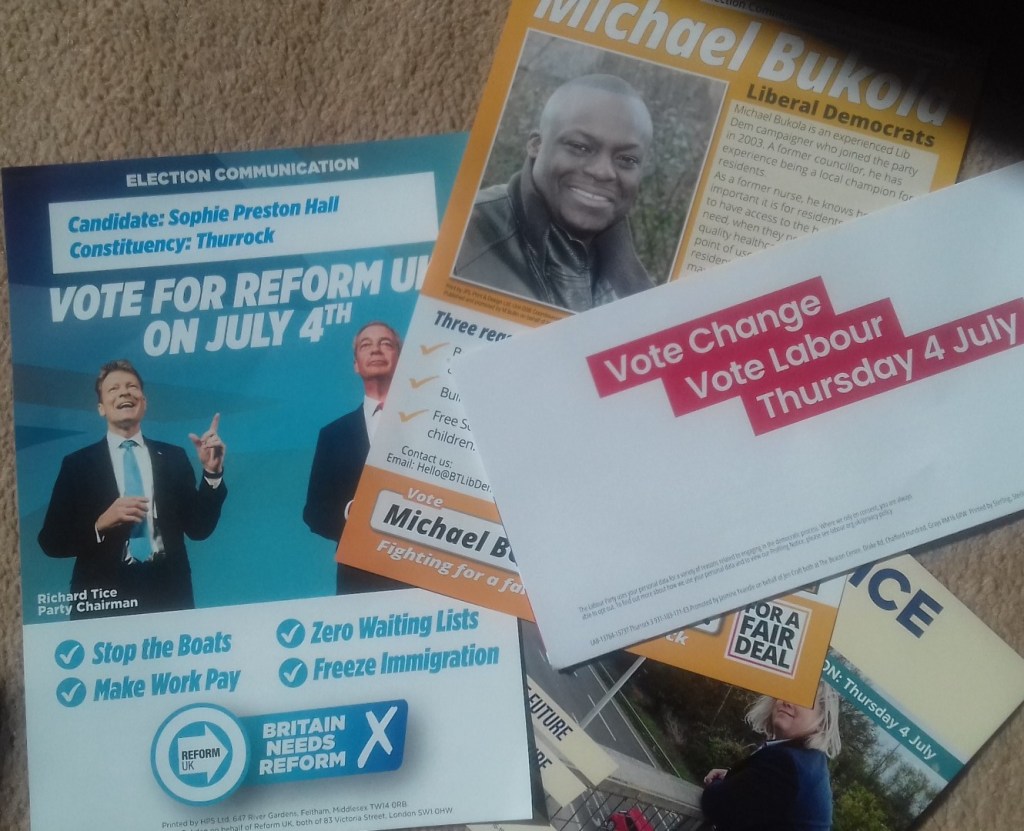
In a constituency somewhere in South Essex, four leaflets plop through the letter box.

The Conservative leaflet is on the bottom. Because I am hoping they will get buried on Thursday.

One is from the sitting MP. She is a Conservative, but seems a bit shy about that. The leaflet leads with her name in large letters. If you look really hard you can see the word “Conservative” in tiny letters tucked into the bottom right corner in an attempt not to draw too much attention to itself, with that squiggly tree logo, from their greenwash phase, tucked alongside. Just so you don’t forget what she looks like, there are eight photos of her in a single folded A4 leaflet. This is not many by her standards. Her previous one had thirteen! An MP since 2010 and only briefly a junior minister, under Liz Truss, so definitely not front rank. The usual phative slogans – A Secure Future – A Brighter Future – are superimposed on a photo of the candidate looking away from the camera into the middle distance with a slightly constipated expression, while standing on a footbridge over a busy road and, hopefully, not breathing in too hard. Roads loom large in her pitch too, the solution to traffic congestion being to build more of them. Her Ayn Randish vision of the constituency as “the best it can be” is a curiously dated hyperdevelopmentalism, in which hopefully the whole area will be tarmaced over and full of commerce freed from red tape and taxation rushing products in and out and through. Not a “green and pleasant” vision, however you look at it. The only remaining trees will probably be the tiny ones on Conservative leaflets. Her overall pitch of development for our (sic) local priorities”, which is a bit previous in assuming that everyone else’s local priorities are the same as hers, with the Council – run and bankrupted by her Party until May this year – posed as the enemy and a Labour controlled Westminster, possibly with a “huge majority”, even more so. Its hard to tell who she is referring to when she says “our”. Perhaps she is just giving herself airs and using the majestic pronoun. There is, nevertheless, a whiff of panic about it.

A standard cut and paste job from Reform, in varying shades of blue, uses a template photomontaging images of Nigel Farage looking upwards like a toad in search of heavenly inspiration while holding his hands together in cut price man of destiny pose no.3 and Richard Tice – on a slightly smaller scale, so you get the heirarchy right – pointing up at the slogan “Vote Reform UK on July 4th”, while smiling to indicate this is a happy prospect. The candidate and constituency are slotted in to a small panel at the top. The sort of leaflet that sometimes gets rushed out with “insert name of candidate here” if the Party agent has had a rough night before proof reading it. The front page has two slogans against immigration but tosses in two others – make work pay – zero waiting lists – with no elaboration at all on how this might be done. Given the overall tenor of their politics the former might be achieved by starving the jobless and the latter by weeding the undeserving out of the queue, especailly “immigrants”. The entire reverse side attacks immigration on the argument that freezing it will make life better, in the same way that Brexit made life better presumably. Fool me once… A leaflet aimed at generating knee jerk reactions, not convincing anyone who doesn’t already have them. The Nastier Party.

The Lib Dems have a busy little leaflet that, oddly for them, does not contain a bar chart saying that only the Lib Dems can win here – perhaps because everyone knows they never have, and it wouldn’t wash. Instead, they have a little panel referring to a by election in an unnamed other constituency at an unnamed date, which shows that “Lib Dems can win anywhere”. With a long local record of lost deposits and no local councillors, I wouldn’t bet on that. Beyond that, they have a potted biography of their candidate, which is at least a human touch, but implies that he’s doing this to get elected as a councillor somewhere at some point in the future. The pledges – under the rubric For a Fair Deal – are positive but vague, like ” a fair plan to protect the poor and pensioners, tackle soaring prices and get our economy back on track”. Yes, but, what is it?

Labour, breaking the mould in this case, sends a letter, not from the local candidate but from Keir Starmer. This might be considered an odd choice as Starmer is far less popular than the Party; with a favourability rating of -19. The heading has a smiling Keir, with no tie on to show that he is relaxed and getting on with rolling his shirt sleeves up, staring confidently from right to left, into a future that is just off the page, superimposed on half a Union Jack that doubles up as an arrow pointing towards the word Change, with his name underneath it, in case anyone doesn’t recognise him. At this point, this should not be taken as an injunction on the Party to “change Keir Starmer”, though perhaps the designer has a sense of humour. The pitch is a simple one. There are two possible governments and “versions of Britain” posed as “Conservative chaos” vs “Britain rebuilt by Labour”. “Rebuilt” is an interesting word, as to some people it will mean “transformed” to others it will mean “restored”. On the one hand, the future. On the other, the past. Perfectly pitched for the sort of voters who preferred it in the good old days, when life was harder; and want a future just like it. The pledges are either oddly limited and specific – Recruit 6,500 teachers – or – Set up Great British Energy – too limited and specific to make a serious dent in the problems they purport to address, or magnificently vague – Deliver economic stabilityCut NHS waiting times (a phrase that begs the questions, to how long, by when?) while economic stability can mean solid, reliable, not flaky (like Liz Truss) but it can also mean immobile; not collapsing but not transforming either. Steady as she goes is not full steam ahead. Perhaps Small Change would be a better title.

Every one of these leafets is a parochial and infantilist retail offer. Vote for us and we will do this that or the other on your behalf, or, vote for us and we will take out your frustrations on someone who is worse off than you are. Looking at them, you wouldn’t think that this election is being held under the shadow of two wars in which the UK is complicit, one of them threatening nuclear war and the other a slow moving genocide, and an accelerating pace of climate breakdown that is risking serious global food shortages within a decade. The challenges facing us on a world scale to draw back from confrontation, seek a peaceful modus vivendi in which we can limit the climate damage are titanic. It is a sign of a crisis of leadership that not one of these leaflets seriously addresses these issues, or treats voters as citizens capable of doing so themselves.

Twelve Questions for Keir Starmer

Outside Parliament calling for a ceasefire. November 14 2023

  1. Nearly three weeks ago you said that you were opposed to a ceasefire in Gaza because it would “freeze the conflict” at that point, leaving Hamas’s military infrastructure intact. That was on October 31st. At that point deaths in Gaza were just under 9,000 according to the UN. Because of the collapse of services and communications in the hospitals in Gaza no totals have been reported in the ten days since Nov 7th, by which time it had reached 11,078. It could now be approaching 20,000, as the Palestinian Red Crescent has reported that it is now no longer able even to pull people out from the rubble of their bombed out homes when they call for help. If you think these extra deaths are a necessary price to make people in Israel safer, why do they matter less?
  2. Given that most of the people killed have been civilians not fighters, how many civilians, how many more children do you think will have to die before the IDF thinks it has, in Ron DeSantis’s phrase, “finished the job”?
  3. If you don’t agree with the comment of Republican member of the Florida State Legislature Michelle Saltzman, who, when asked how many people in Gaza have to die for Israel’s security, replied “all of them” how many do you think should?
  4. Do you disagree with the families of the hostages held by Hamas that the IDFs current military campaign will put the lives of their loved ones at risk ?
  5. If so, why?
  6. Do you accept that the 1200 Palestinians currently detained without charge by Israel are also hostages?
  7. You often say that Israel has the right to defend itself, but do you also accept that, under Additional Article 1 of the Geneva Convention, an occupied people like the Palestinians have the right to resist occupation, including by force of arms?
  8. As your argument is that no country could accept the scale of attack on Oct 7th this year without retaliation, and that the 1400 deaths suffered that day justifies whatever measures are necessary to remove the military threat posed by Hamas; do you think that the Palestinians have the right to retaliate for the Israeli invasions of Gaza in 2008, that killed 1400, or that of 2014, that killed 2100 and keep retaliating until the threat to their lives represented by the IDF is removed?
  9. If not, why not?
  10. Do you recognise that since 2000, eight Palestinians have been killed for every Israeli life lost, and the figures for children are thirty seven Palestinian children killed for every Israeli child?
  11. If you do, what explains your stance that retaliatory attacks from Hamas are terrorism, while retaliatory attacks from the IDF are justified?
  12. Given that you so firmly believe that the UK cannot take an independent line from its closest allies, now that EU High Representative for Foreign Affairs, Josep Borrell, is arguing that “there is no military solution”, will you embrace this recognition; or are you waiting for Washington to say the same thing before you can feel safe to do so?

The Speech that Keir Starmer did not Make.

With Boris Johnson visiting Saudi Arabia, in an attempt to get more oil pumped, just a day after the execution of 81 prisoners by the Bin Salman regime, this is the speech that Keir Starmer could have made but did not.

While he made a general point…“going cap in hand from dictator to dictator is not an energy strategy”, he stopped well short of calling for Johnson’s trip to be called off,and steered well away from any demand for a shift in policy on Yemen remarking instead, “Obviously there’s a real energy crisis in terms of the cost at the moment, so anything that brings the cost down now is a step in the right direction, whatever it is.” (my emphasis).

In this dark hour, our thoughts, our solidarity, and our resolve are with the people of Yemen.

They have been cast into a war, not through fault of their own. But because Mohamed Bin Salman knows that no people will choose to live under his bandit rule unless forced to at the barrel of a gun.

The consequences of Bin Salman’s war have been horrendous and tragic for the Yemeni people but also for the Saudi people, who have been plunged into chaos by a violent elite who have stolen their wealth, stolen their chance of democracy, and stolen their future.

And we must prepare ourselves for difficulties here. We will see economic pain, as we free ourselves from dependence on Saudi Oil, and clean our institutions from money stolen from the Arab peoples.

But the British public have always been willing to make sacrifice to defend democracy on our continent. And we will again.

Saudi Arabia’s neighbours and every other democracy that lives in the shadow of autocratic power are watching their worst nightmare unfold.

All those who believe in democracy over dictatorship, the rule of law over the reign of terror, in freedom over the jackboot of tyranny, must unite and take a stand and ensure Bin Salman fails.

We must make a clean break with the failed approach to handling Bin Salman, which after the intervention into Yemen started in 2015 – has been complicit in more than 20,000 bombing raids on Houthi territory, indiscriminately bombing civilians and hospitals, schools and other infrastructure, killed over 377,000 people, with one child under five dying every nine minutes, displaced millions more, led directly to a cholera epidemic with over a million people infected and much of the country on the brink of famine, with the United Nations describing Yemen as the world’s worst humanitarian crisis, and turned a blind eye to the arrests of anyone who publicly opposes him, symbolised by the murder of Jamal Kashoggi – and has fed his belief that the benefits of aggression outweigh the cost. We must finally show him he is wrong.

That means doing all we can to help Yemen defend herself -urgently withdrawing the military support that we and our NATO allies provide Bin Salman, and the hardest possible sanctions must be taken against his regime. It must be isolated. Its finances frozen. It’s ability to function crippled. We should even withdraw the after sales services provided by BAE systems for the missiles and aircraft they have so lucratively sold.

And there are changes we must make here in the UK. For too long our country has been a safe-haven for the money that Bin Salman and his fellow bandits stole from the people of the Arabian peninsula. It must end now.

And this must be a turning point in our history, we must look back and say what this terrible day was actually when Bin Salman doomed himself to defeat.

He seeks division, so we must stay united. He hopes for inaction, so we must take a stand. He believes that we are too corrupted to do the right thing, so we must prove him wrong.

I believe we can. But only if we stand together.

Very few words have had to be changed from Starmer’s televised speech at the beginning of the Ukraine invasion – mostly personal names and places. If he were genuinely concerned at projecting “a liberal international order in defence of human rights” we should expect to hear a speech like this directed at UK and US allies and calling for an end to UK complicity in their war crimes.

But we don’t.

Could it be the direct involvement of RAF pilots training Saudi Airmen, or the Royal Navy personnel seconded to the Saudi fleet, and all that money made by UK built munitions that have blown up Yemeni civilians in large numbers, that explains the reticence?

Signs of Spring?

I can’t help thinking that if Keir Starmer were a groundhog, he’d be the sort that always saw a shadow. There appear to be no limits to caution. We are living through the beginnings of the breakdown of human civilisation – the pandemic is not an aberration, the environment is unravelling and the old normal is gone, not in temporary abeyance, gone – and- faced with a government that is as venal as it is incompetent – all he can dredge up as a vision of a way forward in his big reset speech on Thursday is Business, Bonds and Britain. The reporting on this is back to the old parliamentary gamesmanship of it being a bad idea for an opposition to come up with a good idea in case the government adopts it. Which is an odd way to think. If you have a good idea, wouldn’t you want the government of the day to adopt it, rather than squirrel it away on the off chance that it will be you that gets to implement it four years too late? Of course, this presupposes that any idea that will be presented is within a range narrow enough to be promoted by either potential governing Party; which is where we are now. And why the venom directed at the previous Labour leadership was so over the top and unrelenting; because its ideas went beyond that narrow range and made it possible to imagine that the way things have been don’t have to be the way things will always be – world without end, forever and ever, Amen. As they say on middle management courses, “Always do what you always did, and you’ll always get what you always got”.

Outside the Chemists – one of the places I go to to socialise these days – there is a sudden, powerful smell of blossom. It is unseasonably warm in the way that is becoming expected. Looking round to see where it is coming from I spot a single daffodil and I become disproportionately happy.

The Eastern European saxophone bloke outside Morrisons is playing his usual variety of disconnected riffs; mixing up echoes of Glen Miller’s American Patrol with a snatch of Klezmer, a bit of bebop from Charlie Parker with the odd standalone note like a mournful car horn. Its like Elena Ferrante’s notion of Frantumaglia – that life and our minds are a whirl of fragments that don’t make sense but echo things that do – and seems the perfect accompaniment to the street scene on the Edgware Road – busy, but fragmented, everyone doing variations on the same things, but now more self consciously socially fragmented and keeping a wary distance from each other; which – now that that alienation is conscious – makes even the most reticent of us talk to each other more at times, at the check out, at the disinfection station.