Of Pies and Doughnuts – 30 theses on Political and Economic issues in Green Transition.

“I wouldn’t start from here if I were you…” Trad.

  1. The first point that we have to be clear about is that we are now in a period of damage limitation. Continued emissions of greenhouse gases are putting humanity well behind the curve of saving ourselves from the breakdown of the climactic conditions needed for the survival of human civilisation. In the current relationship of forces, the question is not whether we can avoid the crisis, but how much damage we can avoid. As we need far more dramatic shifts that current political and economic relations allow, we have to seize and build on any and every change that is immediately possible in order to bank it – limit the damage – and build on it to have any prospect of breaking through the limits of those conditions. It is imperative to do both.
  2. The paradox is that fossil fuel interests are now under such a threat from the transition that is already taking place, even at its current slow pace, that they are putting significant resources into political movements that are either denialist, like Trump, Bolsonaro, Milei, or go slow, like Sunak. The dynamic of this is towards denialism; in practice if not in theory. This dovetails with the impasse of neoliberalism, which requires a dramatic shift in the balance of power against the working class and Global South to restore profitability and capital formation in the US allied countries. This tends towards fascism; because “normal” politics will be incapable of imposing that scale of defeat required. The question here is not whether Trump, for example, is a fascist, but whether the movement he fronts up (and which is an expression of very powerful class forces) is heading in that direction. This tendency is not inevitable, but has to be seen for what it is. As the inequality of wealth, and stratospheric concentration among the wealthiest has increased, political acceptance of democratic constraints among the wealthiest has declined sharply. Resistance to this is one of the motors of transformation.
  3. Fascism is a last resort for ruling classes because it is ultimately suicidal, requires exponential escalation of confrontation to a point of total victory or total defeat: but the prospect of ecological collapse makes this less of an inhibition in a kind of last days of Nazi Berlin recklessness; and generates the sort of exuberantly self indulgent celebration of irrationality that is such a feature of movements like MAGA.
  4. The capitalist class is divided on climate, however. Significant capital is going into renewable energy, electric vehicles, and other key transition sectors. Others are perturbed about the future, and want there to be one. We should note that there was a significant participation from private school students in the climate strikes for example. If you expect the world to be your oyster, then find out it is going to hell in a handcart, you’re going to be upset about it. It is also noticeable that the active cadre of climate denialism in the Global Warming Policy Foundation are not only rich enough to be part of the global 1%, they are also almost entirely over 70 years old. Lord Lawson, of course, is already dead.
  5. This division also plays out not simply in “green sector” businesses, among scientists and academia, but also at different levels in government. Cities are vital laboratories for a green social shift. The C40 movement, the most important legacy of the Livingstone Mayoralty in my view, knits together the Mayors of nearly 100 of the world’s biggest cities from New York to London to Jakarta to Beijing, Paris and Buenos Aires. All of them are working on ways to green construction, transport, urban planning, waste and recycling; and sharing the results in a vast process of mutual experimentation and shared learning. You can read about that here. The need to make such a conscious shift in every aspect of life is a new challenge and no one has all the answers. We are making it up as we go along, and any and every lever we have any access to is vital. Every small step that works is a seed, because it shows what might be done on a bigger scale. These cities cover a multitude of political sins, and at present it could not be otherwise. And they make a big contribution to the Paris process. Actions taken by US cities aligned with C40, and to some extent States, reduced the impact of Trump’s rollback on climate measures during his last Presidency by about half. Whatever the political character, and limitations, of the Mayors of NY and LA and the other cities involved, this is essential work. This could be seen as an application of Gramsci’s notion that we are in a war of position, seeking to gain ground in a myriad of social forms and organisations as part of the process of shifting hegemony towards a point that the old unsustainable order cracks.
  6. Nevertheless, pro Net Zero views among capitalists tends to a kind of techno Micawberism – the view that technological changes alone, leaving existing social and economic structures intact – will be enough. Given the studies by Oxfam and others that show that the carbon emissions of the wealthiest 10% will, at current consumption rates, take us beyond 1.5C on their own, regardless of what the rest of us do, this poses the limits of any bloc with them, and also a rule of thumb guideline for how much income is too much in global terms; roughly anything above £75,000 per person at the moment. For people above this, getting to sustainability will be harder than a camel threading a needle, but there we are. We can travel to sustainability, but not in private jets or yachts.
  7. The climate movement is necessarily broad. We should be prepared for united fronts across wide disagreements on other matters and to have debates within the movement; and also form blocs with different class forces on particular issues without doing so on their terms. Offshore wind companies, for example, are as ruthless to their workers as any others. This is a contradiction that we have to fight out within the imperative to have as many of them built as we can.
  8. The same applies to limited and inadequate political choices which reflect capitalist interests first and human imperatives a long way below. A continued Biden Presidency, for example, would continue to pursue an “America First” green transition, as well as its global war drive against China, arming the IDF assault on Gaza, channeling capital into military spending and sucking green investment away from even its subordinate allies. A Trump Presidency would make the US a complete rogue state on climate, smash up the Paris process, double down on fossil fuels, and spice up the war drive with what Boris Johnson calls “unpredictable violence”. Leon Trotsky’s argument in The Struggle Against Fascism in Germany –that when you are confronted by two people who are going to kill you, but one has a gun and the other some slow poison, you bloc with the poisoner against the gunman, while building up your own forces so you can deal with the poisoner later – is relevant to this.
  9. Either way, the dominant ruling class in the US centred Global North bloc, for all its protestations of global leadership, will not lead humanity into sustainability. The ease with which they have found billions for wars, and now escalating military spending, compares starkly with the difficulty they seem to have providing climate finance for the Global South.
  10. The ideologues of the world’s imperial core have warned us of what they are going to do. In “The Age of Consequences” a projection of potential climate scenarios drawn up by allies of Al Gore in the US Democrat Party in 2008 stated quite clearly that in conditions in which climate driven “massive non linear events” began to unravel societies, “Governments with resources will be forced to engage in long, nightmarish episodes of triage, deciding what and who can be salvaged from engulfment by a disordered environment. The choices will need to be made primarily among the poorest, not just abroad but at home.” When someone tells you who they are, believe them.
  11. This is not simply a question of a confrontation with capitalism, it is a question of confronting imperialism in the first instance. The concentration of the major imperial powers into a US led Global North bloc – described by the Tricontinental Institute as Hyper Imperialism – is the last stand of an order that extracts wealth from the rest of the world, seeks to make its own working classes complicit in doing so, is arming itself to the teeth to confront the consequences of its failure to deal with the climate crisis; and is risking war rather than peacefully come to terms with China becoming economically weightier than the US, thereby accepting multipolarity. This means that we may not live long enough to experience the full consequences of climate breakdown, should the kind of US strategic thinkers advocating a war with China in the next five years manage to provoke one. If we manage to avert this – and it will take efforts on our part – the diversion of investment into military spending will cut essential investment in climate transition and do enormous and unnecessary damage anyway. We won’t get this time back.
  12. John Bellamy Foster’s call for an anti imperialist climate movement to address the twin threats of 21st Century exterminism, the US war drive and climate breakdown, is essential, in that there needs to be clarity on this on the Left, but also insufficient, in that there need to be united fronts with forces that are not on the Left, and forces on the Left that don’t see themselves as anti imperialist in the way that Bellamy Foster (or I) would; and this is a dynamic process.
  13. The role of the countries that see themselves as Socialist is a more positive one than they are usually given credit for in the climate and labour movements in the Global North. Whether this is Cuba being considered a sustainability model by the UN, or China investing twice as much in energy transition as the US and EU put together this year, or high speed rail investments as part of the Belt and Road initiative. This is examined in some detail here.  I use the phrase “countries that see themselves as Socialist” because large parts of the Left in the Global North don’t think that these countries are what they think Socialism is, but its important to take on board the fact that 90 million Chinese Communist Party members disagree with them – and that should pose (at least) a debate, with them, not about them. A good place to start getting a flavour of their views, and that of quite a broad range of the non Party Left is Wenhua Zongheng.
  14. Monthly Review has also made a serious reassessment of the Soviet Union’s ecological record, stressing that the ecological disasters, for which it is well known, generated a significant environmental movement, and big shifts in state policy with real impacts, particularly in the 1980s after Chernobyl; and that its overall environmental impact was no worse than that of the US. Anyone who has seen post industrial wastelands in the US will not find that hard to believe.
  15. The current escalation of extreme weather events is just the overture to impacts that will, on current trajectories, become locally or regionally unmanageable in the coming decades; posing political climate emergencies declared by local ruling classes seeking to survive at everyone else’s expense, confronting working class and popular resistance, forced into revolutionary solutions to seek survival. Developments of this sort can’t help but have a dramatic political ripple effect, transforming debate and actions globally. Columbian President Petro’s insight that Gaza is a dress rehearsal for what the Global North will increasingly impose on the rest of the world as the climate breaks down should also be seen as a promise of the sort of global solidarity it has generated. with the sharp political learning curve, shake up and shake down of allegiances and organisations that goes with it. As Bellamy Foster puts it; “A revolt by the world’s environmental proletariat …, in which hundreds of millions, even billions, of people will inevitably take part, is destined to come about in the coming decades as a result of the struggle for ecological survival.”
  16. We are the majority and should act to mobilise it. When Just Stop Oil in the UK says “We need a revolution”, they are proposing a combination of continued non violent direct actions with assemblies to mobilise local communities around matters of concern. We should not be formulaic about what forms “assemblies” should take; as they will necessarily be multiple and will obviously include workplaces; and in some cases, these will be the core of a wider social mobilisation, as they are at GKN Firenze.
  17. We should also be clear that any NVDA must be directed at appropriate targets and all actions be aimed at mobilising the majority opinion in favour of more urgent climate action, not substituting for that in ways that provide climate deniers with a popular stick to beat us with. JSO has not always been sensitive to that. Nevertheless, initiatives like this are part of the war of position. Revolutions, and counter revolutions, take place when a social order breaks down to a point that it can no longer go on. That is when the war of position becomes a war of manoeuvre and ecological breakdown or economic impasse or military confrontations can all be causes of that. (See point 13 above).
  18. In the UK, the biggest wave of climate activism, and optimism, coincided with the Corbyn leadership of the Labour Party, which held out the prospect of a UK government that would qualitatively up the investment in green transition. This fed off, and fed, a series of mass movements outside Parliament and Parliamentary thinking that nevertheless led to Parliament declaring a climate emergency and embedded concern for climate as a top 4 issue ever since.
  19. A Parliamentary Road to Sustainability now looks too long and winding to get to its destination anything like fast enough; with the level of investment being proposed by Labour quantitatively better than that already in place, but not to the qualitative degree we need. This is a damaging and retrograde choice by the Labour leadership. The failure of economic logic is examined here. Sir Nicholas Stern and others at the Grantham Institute have also demonstrated that the UK needs at least 1% of GDP to be invested in infrastructure every year to keep abreast of other developed countries. 1% of GDP is £26 billion. Which is a familiar sounding figure. Anything short of that allows continued decay.
  20. Rachel Reeves recent Mais lecture got the relationship between climate transition and “growth” completely the wrong way round; with the notion that any investment in green transition will flow from “growth” in the existing economy; within the framework of restrictive fiscal rules and respecting Tory spending plans that have baked in another five years of austerity. Reeves argues that Labour will aim to “grow the pie”, addressing issues of productivity with selective state pump priming. The scale of this is the problem. Cutting planned investment from £28 billion a year to only a little over what the Conservatives have already pencilled in, means that few pumps will be primed. Even with a “growth unit” in the Treasury, there will therefore be little growth, because there won’t be enough investment to generate it; and what growth there will be will primarily reproduce existing patterns of unsustainable production and consumption, not the sharp shift in the economy to a much lower carbon intensity overall that we need. Its not so much that the pie needs to be bigger, but it does need better, more nutritious ingredients, and to be shared qualitatively more equitably. That follows the climate imperative to reduce the overconsumption of the richest 10% outlined above. But Reeves’s approach rejects social redistribution, with all but the most limited taxes on the wealthy ruled out. We should not accept the poverty of low aspirations that passes for “realism” in Labour leadership circles and push for what is realistically necessary.
  21. “Growth” in the sense that Reeves poses it, is a way to generate benefits without confronting unsustainable inequalities of wealth and power; leaving them intact. Without differentiating between what is sustainable and what is not. “A rising tide lifts all boats”, but in current conditions, it also drowns all coastal cities.
  22. However, “degrowth” is not a good description of what we are trying to do; all too easily translated, in current circumstances, as “austerity”, or an unjust transition requiring the 90% to pay the price for the continued indulgence of the wealthiest 10%. Growth is completely legitimate and necessary in the developing world. The importance of a massive shift in investment to it is to enable this to happen without reliance on outmoded fossil fuel technology, in the same way that Africa has leapfrogged landlines to use Satphones. The failure of the Washington Consensus finance structure to make this finance available is structural and condemns the majority world to continued poverty and a pattern of development that is slow and unsustainable. In the Global North our movement has to be about transformation and regeneration, lowering carbon intensity without crashing majority living standards.
  23. The US bloc is trying to unravel globalisation, as it no longer provides it with global dominance. In cutting the world economy into parts, it breaks up shared efficiencies of scale, making all progress towards sustainability more costly. Local production is not always better than working with a global division of labour, and is often less so, even when transport costs are taken into account.
  24. “Extractivism” is also not a useful formulation, as, if we are to make anything at all, we need the raw materials to construct it; and that involves mining, refining and so on. The point here is to have the most economic – sparing – use of these materials, including the most effective possible circular reuse; and the best possible terms and conditions for the workers employed in the global supply chains; which is part of increasing the living standards of workers across the world as we head for sustainability.
  25. The food metaphors used in this discussion are unfortunate as, given the choice, most people would go for a fat pie over a thin doughnut.
  26. It is a statement of the obvious that, if we are to survive, some sectors of the economy have to shrink dramatically and, in some cases disappear, while others have to expand while the overall carbon intensity of everything made or done has to decrease. That requires continued technological innovation. We can’t presume a magic bullet, and can’t afford to wait for one, but at present there is a 2% annual improvement in efficiency and, according to the IEA, that needs to double to get us on track. That needs investment and coordination. So, the transition is necessarily technologically intense. The figures from the study that drew up maximum sustainable per capita energy consumption in Jonathan Essex’s recent article on the Greener Jobs Alliance blog were based on a presumption of everyone having equal access to the most advanced technology available. This is a long way from “Fully Automated Luxury Communism” but the technological dimension of maintaining a decent and sustainable way of life will be huge (and require the commensurate level of skills to sustain it).
  27. At present in the UK, even with stagnant “growth” in the conventional sense, and a transition that is going too slow, the number of jobs being created in “green” sectors is greater than those being lost in carbon heavy sectors.According to the ONS, in 2022, 8,500 jobs were lost in oil and gas, while 40,000 were created in low carbon and renewable energy sectors (almost 5 gained for every one lost). But, they are different jobs in different places. All investment, transition related or not, tends to substitute capital for labour, so transition for workers in threatened sectors must be addressed by any government, or movement, serious about making a shift with public support and avoid devastating local impacts like that at Port Talbot. Our movement should be about anticipating those shifts and for the unions and communities concerned to be ahead of what’s coming to make the appropriate demands for job guarantees, retraining and redeployment. If that does not happen, we end up in the ridiculous position whereby unions representing North Sea Oil and Gas workers campaign against the freeze on new exploration proposed by Labour, even though this is contrary to the interests of the working class as a whole.
  28. If you go to the TUC HQ in London, there is a magnificent painting by Dan Jones of the demonstration outside Pentonville prison in 1972 that was the strongest expression of the General Strike that freed the Pentonville 5. If you look at the banners being carried, most of them are from unions and union organisations that no longer exist. SOGAT. The Port of London Joint Shop Stewards Committee etc. This should stand as a warning to us today. A trade unionism that limits itself to bread and butter issues and the immediate perceived interests of members confines itself to trying to get a better deal in someone else’s world; and leaves strategic decisions about the future in the hands of a ruling class that will make them in a self interested way that will destroy whole sections of our movement. This is trade unionism that Gramsci would have described as “subaltern” and “corporate”. Another way to put it is that it is trade unionism that, however militant, ultimately knows its place.
  29. We need, instead, to push for Just Transition bodies at every level, in every sector and in every community; and push for a government that could, for example, approach the highly skilled workers making private jets and ask them, “with your skills, and this kit, what could you make instead that would benefit everyone?” and coordinates all initiatives through a National Climate Service. There are vast reservoirs of creativity, imagination and preparedness for hard work that could be harnessed in a universally understood human mission to save ourselves.
  30. Article 12 of Paris Agreement states that all signatories have to educate their populations on the nature of the crisis and the measures needed to deal with it. We should not interpret that as a sectoral point, but as a whole society obligation whereby society mobilises itself to deal with the crisis. Our movement has to lead that, or it won’t happen.
How dare you Priti Patel?

The blog below was written before Home Secretary* Priti Patel’s interview on LBC in which she defended the reporting of climate change protesters to the Prevent programme on the grounds that police have to look at “a range of security risks.” This inability to tell the difference between high explosive and superglue reveals Prevent to be a vehicle for criminalising dissent more than safeguarding society from violence. The subsequent revelation that a counter terrorism policing guide from June 2019 included logos from Greenpeace, PETA, Stop the War, CND, the Palestine Solidarity Campaign, Anti Fascist and Anti Racist groups underlines the point.

Given that they are often so keen to tell us that it is the first duty of government to keep its citizens safe, perhaps Patel should heed the warnings of the Ministry of Defence, which is planning for a more unstable world up to 2040 as a result of the impact of climate change, or, the recent US Army report on the security impact of climate change which predicts severe water shortages, increased incidence of “natural” disasters, floods, fires, hurricanes of unprecedented scope and scale, global pandemics, and a break down in vital infrastructure and state functions, including a possible collapse of the army itself – and conclude that the “unco-operative crusties” and, indeed, school students, taking to the streets calling for action to avert this might have a point.

If she can’t do that, and recognise that safeguarding our future is a government responsibility, she should resign or be sacked.

*”Home Secretary” sounds very cosy. Other countries, that don’t do official euphemisms, refer to Patel’s role as the Ministry of the Interior.

Criminalising dissent

The decision by “counter terrorism” police in the South East to include climate change activists who speak in “strong or emotive terms about environmental issues like climate change, ecology, species extinction, fracking, airport expansion or pollution” or “neglect to attend school” or “participate in planned school walkouts” or took part in “writing environmentally themed graffiti” in their list of  “extremists” who should be reported to Prevent by their teachers is very revealing about the way these people think.

There is a very revealing use of the word “or” in this description of what the guide was for. “This document is designed to help you recognise when young people or adults may be vulnerable to extreme or violent ideologies.” The safeguarding concern of Prevent is supposed to be about violence, but the term “extreme” is put in here as an equivalent concern of equal weight.

This is elaborated further, again in a very revealing way in which climate change activism is defined as arising from an “Anti-establishment philosophy that seeks system change…”  Given that the “establishment” and “system” that we have is heading for a global temperature rise of 3-4 C by the end of the century – with everything that flows from that (not least melted ice caps) – that we are in the middle of the 6th mass extinction, that we can see the effects of climate change around us now and the future is closing in like a trap; why is it the “system” and the “establishment” that they instinctively seek to safeguard – not the futures of everyone threatened by it? This is of a piece with the use of public money to pay for under cover police officers to infiltrate non violent environmental campaigns under assumed identities; sometimes forming relationships and fathering children with unsuspecting women activists – in a way that is never held to account by any values at all – let even “fundamental”, “British” ones.

The rapid retreat from this classification shows that they can’t get away with this kind of labeling as a way to inhibit the climate change movement as yet. But it also raises concerns about the Prevent approach in general.

Guilt by association

During a Prevent INSET at a school somewhere in North London a couple of years ago – one of those after school staff meetings at which a course that is supposed to take a whole day is rushed through in a one hour “death by” power point presentation for a room full of teachers who are in that fresh, receptive, alert state of mind always in evidence after a day’s teaching – the trainer, who was quite good as these people go and put a lot of emphasis on the growing threat from the far right, noted that in some parts of the country the biggest terror threat was from “vegans.” What he meant to refer to was the physical force wing of the animal rights movement, but the verbal slip indicates two things.

  1. That the issues involved in generating people prepared to take violent action to force change are only seen as the context for the actions, not as issues of wider concern that mostly DON’T lead to people taking violent actions. Vivisection. Animal rights. Invasions of other countries. Military violence. Discrimination. Unequal rights. Racism. All are issues that demand and deserve open argument. Feeding back from the actions to the ideas, and putting those ideas solely in the context of “safeguarding”, freezes necessary debate and argument, making them a matter for enforcement and suppression ; which is more likely to bottle up people at risk than allow the exploration of worries, concerns and fears in a safe context with trusted people.
  2. That a term that includes a wide set of people – in this case “vegans” – can be used as a short hand term for “terrorists” and thereby implicitly brands the whole lot of them. The trainer was very clear about this in the case of violent Jihadis, often referred to simply as “Muslims”. A nudge on this to a small group of public sector workers is all very well, but this usage is common in the media, which frames the discourse of most people. The far right are usually correctly referred to as fascists or racists. Never as “white people”; which would be the equivalent. In their cases of course, they are often individualised, or seen as individuals with mental health problems not part of a movement: especially by newspapers that have encouraged their fears and hatreds and could be seen to be complicit in their actions.

Fundamental? British? Values?

Napoleon’s Foreign Minister, Tallyrand, once remarked that the chief characteristics of the Holy Roman Empire were that it was neither Holy, nor Roman, nor an Empire.  “Fundamental British Values”  can equally be characterised as neither British, nor Fundamental, nor Values.

These – central to Government’s Prevent Strategy – require a closer examination because there is a statutory duty on public bodies not simply to respect them, but to promote them, and somehow quantify the impact of doing so.

When initially asked to define the sorts of things that might be considered “Fundamental British  Values”, then government Ministers like Eric Pickles came up with things like “the queen and red buses”; which are not values at all; more images from tourist postcards.  The real concern of government – it seems from this -was nothing to do with “values” at all, but just to draw on emotional signifiers of loyalty to a creaking established order.

Nevertheless, the values specifically listed (and for which public servants are accountable by law rather than ministerial prejudice) are

  • democracy,
  • the rule of law,
  • individual liberty,
  • mutual respect
  • and tolerance for those of different faiths or beliefs.

Most sets of values that emerge from genuine historic events come in threes (with only one of them as a phrase) whether its France’s Liberty, Equality, Fraternity, the US constitution’s Life, Liberty and the Pursuit of Happiness, or, indeed, Superman’s Truth, Justice and the American Way. These have the advantage of being memorable and with a historical resonance. They tell a story. There is something rather stodgy, bland and committee like about this list of one word and four phrases; and an ambiguity in the last two points. The need to include “tolerance” as a bottom line indicating that “respect” might be too much to ask for in some cases.

Nevertheless, lukewarm as they are, these five points are presented as timeless, unchanging and unquestionable truths.  Set in stone just like the 10 commandments… or possibly the Asda price promise. So it was, is, and shall be. Permanently, forever.

Historically they are not “fundamental” at all – in the sense of being built into the foundation of the state. They were not truths that were held to be self evident in 1707 when the Act of Union  absorbed the independent Scottish Parliament into Westminster. This was not a foundation on any kind of liberating ideals. It was a deal to set up England and Scotland as a joint colonising enterprise – after the failure of the Darien expedition convinced the Scottish ruling class that they couldn’t build an Empire on their own.

  • Empires are not founded on mutual respect, and tolerance is often is short supply too. The 100 years after the establishment of Britain were the peak of the Slave trade and the colonisation of India. The state brought into being by that Act had religious discrimination against Catholics built into its foundation.
  • Democracy had nothing to do with it. It was an oligarchic monarchy with no popular sovereignty.
  • Individual liberties and the use of the law to defend them had began to be established with the 1679 Habeus Corpus Act, but as a general principle had to be fought for in tumultuous struggles throughout the ensuing century and the laws that ruled hung the poor in great number for crimes born of poverty.

The point here is that none of these are inherent or single edged- “the birthright of free born Englishmen (sic)” as conservatives would have us believe – all are the result of struggles. Nor is the current settlement either perfect or fixed. Nor are these struggles over. As they say in France “La lutte continue!”

Setting up a set of officially sanctioned values  seeks to freeze society in their image. Thus far and no further. The government would like us to treat them as articles of faith; and boxes to be ticked with no further thought; especially given that the “training” is a rushed online exercise carried out by frazzled people with too many other things to think about to properly reflect on what they are skimming.

However, if we are to keep faith with History,  we have to look at them as a living and necessarily malleable partial settlement of unresolved political conflicts.

Its probably best not to ask all of these questions to a trainer if you want to avoid being referred yourself, but obvious questions that can be asked of each of them should be borne in mind by anyone having to be trained.

  • to what extent they are actually characteristic of contemporary British society and do they apply to everyone equally?
  • how fundamental they are to it?
  • to what extent are any of them are qualified, and if so what by?
  • and sometimes to what extent do they contradict each other?

Democracy.

“And it’s through that there Magna Charter,  As were signed by the Barons of old,

That in England to-day we can do what we like,  So long as we do what we’re told.”

Marriott Edgar

Taking it for granted that democracy, rule of the people for the people by the people (Abraham Lincoln, unfortunately an American but no one from Britain has put it better) is a good thing, to what extent can this be considered fundamental to the British state (or the states that currently make up the UK) today, in their domestic history and history of overseas Empire? Those who argue that democracy is essential to its character at least have the obligation to tell us

  • At what point did we become democratic enough for the idea to be considered fundamental? 1215 when the Magna Carta was signed? 1649 when Charles 1 was overthrown and executed? 1688 when James II was overthrown? 1832 when Parliament was reformed? 1867 when the vote was extended to (some) working men? 1928 when the vote was extended to women?
  • Was democracy fundamental to ANY of the Acts of Union that formed the UK?
  • How did this democracy come about?
  • Who was fighting for it?
  • Who was opposing it?
  •  Do we currently have a fully realised democracy (both in constitutional terms and more broadly to what extent are the decisions made reflective of popular will or needs and to what extent to they reflect imbalances of power or wealth)?
  • Can we be more democratic than we are? If so, how?
  • Are the current forms of the British state the last word in democratic participation and to what extent to they embody – and to what extent deny – popular sovereignty?
  • Is not the right to have an argument about both the history and the current reality a hard earned democratic right?

The Rule of Law and individual liberty

“What you’re saying is that there’s one law for the rich…”

“Oh no! There’s FAR more than ONE law for the rich.”

Peter Cook 

These also look smooth on the surface, but when you examine them there are a lot of interesting questions which make them more problematic and therefore more alive.

  • To what extent does the rule of law conflict with the notion of individual liberty?
  • What are the constraints on individual liberty, and are these primarily codified by law?
  • To what extent is there are shared set of social mores and accepted ways of getting along without recourse to law; and if so what are they and where do they come from?
  • Who makes the laws, and who enforces them?
  • Is our current legal system equally accessible to all individuals and if not why not?
  • Is there a right of conscience to act “criminally” for the greater good? What might the parameters of that be? Anti-war protesters have been known to break into BAE factories to smash up fighter bombers about to be sold to dictatorships. Their defence was that they were committing criminal damage to save lives. They were acquitted by a jury. On the other hand, a recent City of London Police anti-terrorist exercise bracketed terrorists with Occupy and Environmental protesters; which is another way to look at it and could be where this legislation is leading us.
  • Isn’t part of living in a democracy that people argue about what laws are right or just?
  • Isn’t part of the rule of law the recognition that people will sometimes feel oppressed by specific laws, or the people who enforce them, and have a right to argue and organise to change them?
  • Are all liberties individual, or do some apply to collective groups (Companies, unions, protected groups in equalities legislation etc)?
  • Is it compatible with individual liberty for the state to define ideas as criminal or pre-criminal, or would it not be better simply to apply John Stuart Mill’s principle that people are free to think, speak or do as they wish, so long as by so doing they are causing no harm to someone else?

Mutual respect and tolerance for those of different faiths or beliefs.

This is a very desirable value – that we can see implemented in practice every day on the front pages of tabloid newspapers and for thirty years in the journalistic scribblings of our current Prime Minister – which have never been less than respectful to women, gays, ethnic or religious minorities. Although this has been promoted in UK public sector since the Race Relations Amendment Act of 2002; after 2010 the coalition government removed virtually all equalities guidance from the DFE website within months of coming into office,  which shows what they thought of it.

Indeed, David Cameron argued in 2014 that “multi-culturalism has failed”, then in the 2015 general election, the Conservative Party attracted the votes of high caste, well to do Hindus with a promise to take caste discrimination out of equalities legislation, so it seems that some discriminatory practices are more tolerable than others; even those that do not “unite us”.

This value is presented as though it is the norm. Looking at statistics for discriminatory patterns in housing, unemployment, employment prospects, employment by sector, school exclusions, stop and search, deaths in police custody, rates of imprisonment and poverty it’s clear that “mutual respect and tolerance” is little more than a self regarding denial of yawning cracks of inequality and injustice; which creates “a sense of grievance” and a “desire to change things”, that is entirely reasonable and justified; and therefore the Prevent guidance warns against it.

The giveaway here, which is itself an expression of the reality described in the last paragraph, is that the allocation of funding  for the Prevent strategy is based on the proportion of Muslims in a given area. This puts a paradox at the heart of this value. Although there is mention of “far right extremism” as also an area of concern, funding is not based on proportion of votes for far right parties in any given area. Now that Tommy Robinson has joined the Conservative Party, along with the entire membership of “Britain First”, and Priti Patel is in the Home Office, we should not hold our breath that this might change any time soon.

British Values? When will Britain live up to them?

There is a further purpose in describing these as British values even though – as described above – they are not actually applied in Britain in any consistent way as lived realities.

A desire for democratic rights, mutual respect, individual liberty and the rule of law (in the sense of putting limitations on arbitrary power) is widespread across the world, and they are embodied (to a greater or lesser extent) in many countries. They are not specifically British as values. Posing them as if they were is to take them out of a  human rights framework – which has to be struggled for – and to put them instead as a privilege of citizenship and a reward for loyalty. They take what we have fought for and they resisted, and shamelessly present them as though they were gifts from them to us.

How dare they?

Climate Change. The Conservative Manifesto is playing chicken with Physics.

Reading the section of the Conservative Manifesto on climate change- one page tucked away as a sort of afterthought – one item among so many – on page 55 (out of 64) to show just how important they think it is – I can’t help but be reminded of a 1971 meeting between Thurrock Friends of the Earth and the local Young Tories. We were from different planets of course. Thurrock FOE – like a foretaste of the UKSCN -was made up entirely of school students. Mostly working class high flyers from Grays and Aveley Tech and the Convent Girls School living on estates in Grays, Stifford Clays and Tilbury. In the Conservative Party it was possible at that time to be considered “young” at the age of 35, but the two brittly over confident chaps who came to talk with us weren’t much older than we were. They were also from Orsett, a well to do rural enclave that could double for Ambridge on a good day.

Our concerns were global, systemic. Even before climate change was recognised as the threat that it is, there was a sense that we were using resources in a way that was reckless for our own survival. We picketed Tescos because of overpackaging and worried about the built in obsolescence of so much of the tat that was being produced – the philosophy at the time being neatly skewered in Tom Stoppard’s play “Jumpers” as “no problem is insoluble; given a large enough plastic bag.” We picketed the motor show over safety and pollution. We worried about the air we were breathing. With the huge cement works by the Dartford Tunnel, where Lakeside is now, and the predominantly westerly winds, everyone between there and the Estuary was breathing solid lungfuls of cement dust on a daily basis. That then blew across the North Sea and contributed to the acid rain that was killing European forests at the time. We worried about Dutch elm disease as the local variant of deforestation – all the magnificent elms in Dell Woods, Alfred Russel Wallis’s* abandoned arboretum, were dying- and we were beginning to see all this as a manifestation of a system driven by profit.

The Young Conservatives saw the fundamental issue with “the environment” as being litter. More to the point, litter and fly tipping being brought in by people from Basildon – at that time a relatively new New Town full of decanted Londoners and therefore deeply suspect. It struck me at the time that this missed the point on every level that it was possible to miss it on.

Today’s Conservative Manifesto – written as it is by a consultant for a fracking company – does much the same. It starts with a self soothing pat on the back for achievements they have not made.

“Our Government’s stewardship of the natural environment, its focus on protecting the countryside and reducing plastic waste, is a source of immense pride.”  Really? Walk down any urban street and check out how successful they have been at “reducing plastic waste”. Take a deep breath and savour the air that has led them to being taken to court – twice – by the European Union for failing to clear up dangerous levels of air pollution. Bear in mind that this was the government that wanted to sell off National Parks and – for a while – was prepared to contemplate fracking within them.

“But today, the climate emergency means that the challenges we face stretch far beyond our borders.”

This would be the climate emergency that was introduced into parliament by Jeremy Corbyn and the Labour Party and on which most Conservative MPs abstained. Note that the challenge that stretches beyond our borders is one that “we” face. Not a global problem that has to be faced together, but one that has to be seen through the distorting lens of nation. The challenges being faced now under the impact of climate change in the developing world are seen in the framework of a possibly threatened cosy domesticity.

“Thanks to the efforts of successive Governments, the UK has cut carbon emissions by more than any similar developed country. We are now the world’s leader in offshore wind – a fantastic success story of Government and the private sector working hand in hand to cut costs and deliver ever more electricity at plummeting costs.” 

This sentence stands boldly and four square on the thinnest of thin ice.

  • The UK has cut its carbon emissions by a sharp shift away from coal for energy generation and by offshoring significant parts of manufacturing industry to China and other developing countries. The cement dust in the air I grew up with is no longer in Thurrock, but in Chongking. The goods that are consumed in the UK are not counted towards its carbon emissions. If they were, UK carbon emissions from consumption would almost double.
  • There is no mention here of onshore wind – which the Conservatives have hobbled. Onshore wind installation – now the cheapest form of energy generation – fell by 80% in 2018 because of planning restrictions brought in by the Conservative government.
  • Nor is there a reference to solar. The removal of the solar subsidy – on the grounds that a “mature industry” should stand on its own two feet in an open market – led to new solar installation falling by half in 2016 and again in 2017.
  • Fossil fuel subsidy in UK in 2018 was running at £12 billion – the highest level in the EU. So much for mature industries competing on a level playing field.

These decisions are perverse and suicidal – not something anyone could be proud of. We should also note that without the colossal Chinese investment in wind technology which have reduced its costs to below those of fossil fuel equivalents, there would be no expansion even of offshore wind. Freeloading of the efforts of others while taking credit for them is ever the Conservative way.

“Unlike Jeremy Corbyn, we believe that free markets, innovation and prosperity can protect the planet.”

This translates as, leave it to the good old boys in charge- when have they ever let you down? Such complacency in the face of all the evidence to the contrary. How far have “free markets, innovation and prosperity” reduced carbon emissions so far? Innovation requires a level of investment that the private sector is proving remarkably resistant to making. Prosperity is an odd word to lay claim to after ten years of austerity. More urgently, business as usual free market investment decisions, already taken and in the pipeline, threaten the world with a 4C temperature rise. That is not according to Jeremy Corbyn. That is according to the Governor of the Bank of England. The fossil fuel companies spend millions on subverting any decisions that might affect their profits in the short term – in the same way that the tobacco companies and the asbestos companies did. Left to itself the “free market” is knowingly pushing us to hell in a handcart.

Lets look at what the Conservatives propose to do if re-elected.

“We will lead the global fight against climate change by delivering on our world-leading target of Net Zero greenhouse gas emissions by 2050, as advised by the independent
Committee on Climate Change.”

2050 is better than many but not world leading. Sweden is aiming for 2045, Finland 2035 and Norway by 2030. But more significant than the date is the action taken to meet it. The Parliamentary Science and Technology Committee pointed out in August that “Fundamental change is required, but government keeps papering the cracks instead of fixing the foundations.” Current plans, none of them revised by this Manifesto, mean the UK will miss its existing targets and increasingly fall behind in the next ten crucial years – which, as Labour rightly points out – have to be front loaded with initiatives if we are to have a chance of keeping temperature rises below 2C, let alone 1.5C. The Conservatives seem content to keep playing chicken with physics. We really can’t afford to let them keep doing that.

“We have doubled International Climate Finance. And we will use our position hosting the UN Climate Change Summit in Glasgow in 2020 to ask our global partners to match
our ambition.”

“Doubled” sounds impressive, but the actual quantity of International climate Finance coming from the UK is £5.8 billion over 5 years (2016-21); about a billion a year. Developed countries – acting under the Paris Agreement – are supposed to be transferring £100 billion a year to developing countries to allow development without carbon emissions, but the actual transfer is running at between a tenth and a fifth of that. Meanwhile the UK continues to use development funding through UK Export Finance to finance fossil fuel developments (amounting to 96% of UKEF funding over five years of £2.4 billion to developing countries). The ambition we need from Glasgow is an awful long way beyond the compromised, hesitant half steps taken by the UK so far.

We will set up new international partnerships to tackle deforestation and protect vital landscapes and wildlife corridors. We will establish a new £500 million Blue Planet Fund to
help protect our oceans from plastic pollution, warming sea temperatures and overfishing, and extend the Blue Belt programme to preserve the maritime environment. We will continue to lead diplomatic efforts to protect 30 per cent of the world’s oceans by 2030.

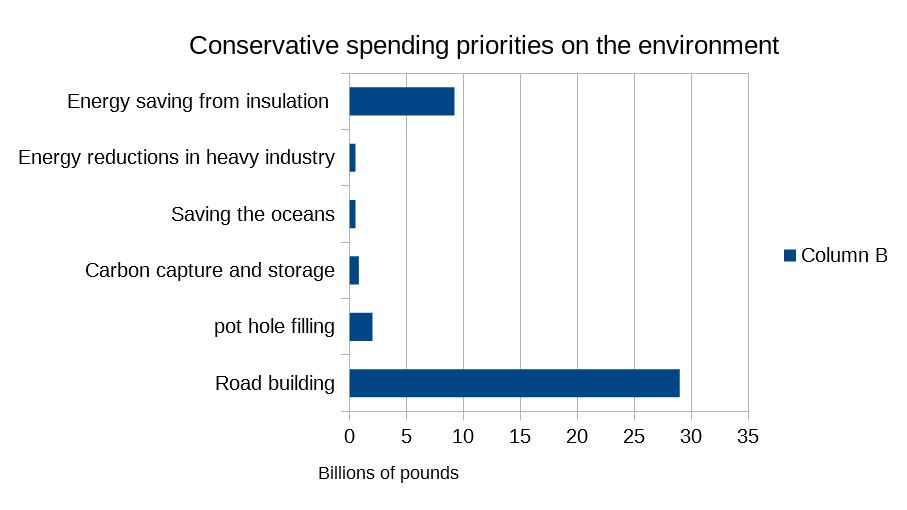
Half a billion pounds – to “protect our oceans from plastic pollution, warming sea temperatures and overfishing”.  Very grandiose ambitions for such a tiny amount of money. This is a quarter of what they propose to spend on filling in potholes in roads. The phrase “drop in the ocean” comes to mind. No budget for the “international partnerships to tackle deforestation.” It should be noted that planting lots of trees has recently been adopted by sections of the right internationally as an alternative to taking any other action on climate change.

Our first Budget will prioritise the environment: investing in R&D ; decarbonisation schemes ; new flood defences, which will receive £4 billion in new funding over the coming
years; electric vehicle infrastructure including a national plug-in network , and gigafactory; and clean energy. In the next decade, we will work with the market to deliver two million new high quality jobs in clean growth. We have ambitious targets:

All this is what might be called feelgood broad brush. There are no budgets or timescales.  “We will invest” an unspecified amount in all sorts of things that sound terribly good but we’re not going to say what they are or how much or what results we expect nor by when. “I shall do such things. what they are I know not.” *The key phrase is “we will work with the market”. Working with the market means that the interests of private sector profit trumps everything else and the state will help it along. This has not worked out well so far and there is little reason to suppose there will be any change in the immediate future. And we don’t have long.

Their record on this is not good. Once David Cameron decided to “clear out the green crap” Conservative policies in the renewable energy sector led to a third of the jobs being lost between 2014 and 2017. There is no sign in this manifesto of the either the policies required to reverse this nor the scale of investment that would be needed to get anywhere near the figure of two million jobs; which they seem to have sucked out of their thumbs by taking Labour’s promise and doubling it but with neither the required level of investment nor the sector by sector analysis of where these jobs would come from (or be). Labour’s plan has more precise and credible projections – 98,000 jobs building an additional 7,000 offshore and 2,000 onshore wind turbines. 450,000 jobs by upgrading every home in Britain by 2030 to cut emissions. 26,500 jobs in Hydrogen production in Yorkshire, the Humber and the north-east. 195,000 jobs in electric car production. 25,000 in nine new recycling sites.

Nor is there any reason to suppose that – if re-elected “the green crap” would sit around very long before being cleared out again. This is quite evident in their section on fracking – which they completely reversed before the manifesto even went out.

We placed a moratorium on fracking in England with immediate effect.
Having listened to local communities, we have ruled out changes to the planning system. We will not support fracking unless the science shows categorically that it can be done safely.

This is quite outrageous. Just two days after announcing their “ban”, not only did they re-designate it a “moratorium”, but government documents were released that foreshadowed proposals to allow fracking “at will” with no planning permission, making fracking “as easy as building a conservatory.” The shape of things to come if we allow them back in.

It is also indicated by their approach to transport.

We will support clean transport to ensure clean air, as well as setting strict new laws on air quality. We will consult on the earliest date by which we can phase out the sale of new conventional petrol and diesel cars.

Its tempting to say that this is “breathtaking”. They have been taken to court TWICE by the EU on air quality. They have been in government for TEN YEARS. Where have the “strict new laws” been all that time? More to the point – what will they say? Given that Conservative candidates often make opposition to clean air zones one of the points in their campaigns “strict” should not be taken at face value. “Support” for clean transport can mean anything from being pleased that there is a bit of it coming on stream to actually taking steps to ensure that there is. There is a definite big budget for building roads. Building new roads tends to increase motor traffic; the opposite of what we need. No budget for bus services, reopening or electrifying rail lines nor for making sure that the vehicles running on these roads are actually “clean”. The consultation on the earliest date to phase out sale of new petrol/diesel vehicles gives the game away. If you consider whose interests have been prioritised every time the Conservatives launch a consultation its clear that they will dance to the tune of the motor manufacturers, not set them the tough targets we need to actually make the transition.

This graphic summary of the financial projections for these “ambitious targets” listed here, alongside what they plan to spend on building roads and filling in potholes illustrates just how lacking in ambition they are. This is a deeply perverse set of priorities.

Conservative investment in Environment priorities

Their one relatively substantial commitment is this.

We will help lower energy bills by investing £9.2 billion in the energy efficiency of homes, schools and hospitals.

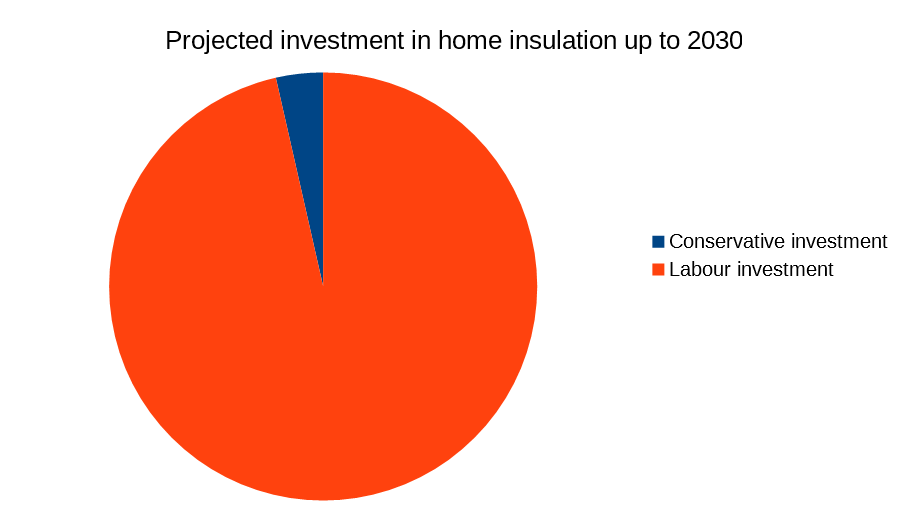
This is one twenty fifth of what Labour would do and would barely scratch the surface; so, by 2030 we’d still have the overwhelming majority of our homes leaking carbon at a ludicrous rate with people paying the energy companies through the nose for the privilege. Labour would fix that problem in both respects.

Home insulation investment

This graphic is a suitable illustration of the different scale of Party ambition. What we have with the Conservative manifesto is muddling on with business as usual, kicking the can further down a road that we are about to run out of, a little tweak here, a little tweak there, but nothing that recognises either the scale of the crisis nor the level of urgency with which it has to be tackled because of its deep seated aversion to the necessary state action.

*Alfred Russel Wallace came up with the theory of evolution at the same time as Darwin. In fact, it was a letter from Russel Wallace that persuaded Darwin to publish, out of fear that Russel Wallace would do it first. He lived for a while in Grays in the early 1870s building one of the world’s first concrete houses, later used as a convent (!) and now converted into flats. The grounds of the house included a 16 acre walled arboretum along a steep hill which has been disused and run wild for over a hundred years – a place of mystery and darkness for generations of local children.

*Shakespeare. King Lear.

Conservative Environment Policy – a Manifesto for Mr Toad.

This graph speaks for itself. The spending commitments are all taken from the Conservative Manifesto. Conservative investment in Environment priorities

So road building is 58 times more important than saving the oceans and filling pot holes in roads is four times more important than carbon capture and storage. The commitment to homes and public building insulation is roughly 1:25th of Labour’s.

As Mr Toad might say “Poop poop!”