“The Adventures of Odysseus” was the first book that I got out from the local library at least five times in succession – being nudged that way by a sixties sword and sandals film called “The Wooden Horse of Troy” which was the first story to obsess me as much as dinosaurs already did.
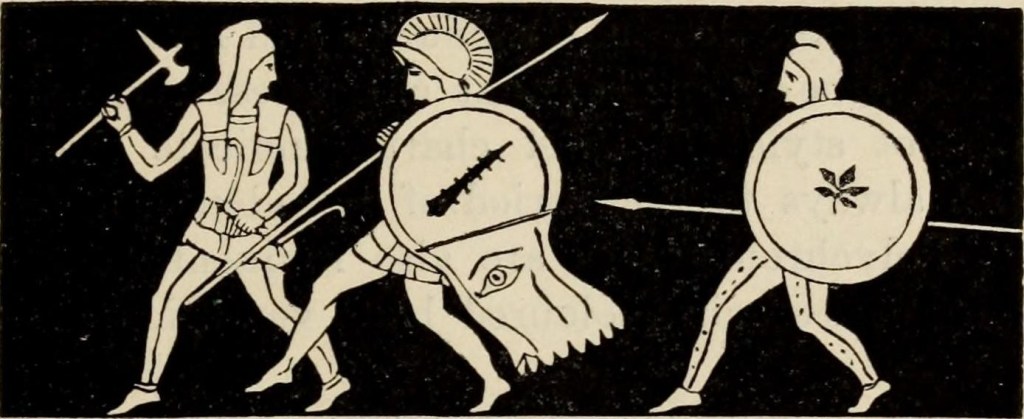
Image from M Hodder Handbook of Archeology 1867 Wikicommons
I got them out so often, not because I was finding much new in it, but because I didn’t want to read about anything else. I also got out “The Adventures of Ulysses”, which I’d hoped would be a similar set of different stories about another hero of the same type, but turned out to be exactly the same book but with Roman names instead of Greek. But I got it out several times anyway. Some of the attraction was the illustrations, which were stark, black and white, based on Greek vases and felt like a different world. The power of this sense of immersion in something recognisable but more vivid than actual life is something I’ve only ever felt since with Lord of the Rings – another totally absorbed five in succession repeated reads when I was a teenager – and another, more richly, lately – and Gormenghast – which I’ve enjoyed three times so far, and I’m sure I’ll read it again.
A lot of people die in the Odyssey. Probably not as many as in the Iliad, where whole passages list who was slain by whom in as relentless a poetic metre as the list of who beget whom in the Old Testament.
One of the mysteries of Christopher Nolan’s film is how it is that no matter how many of Odysseus’s crew get munched to death by the Cyclops, slaughtered by armoured giants, snatched into the air by Scylla, somehow there’s always a more or less full crew until the final shipwreck.
This is a very loud and violent film. A lot of the messages are carried by the images, and some of them are spectacular.
- The shot of the Trojan patrol riding along the beach towards the wooden horse, sunk in the sand at an angle comparable to the Statue of Liberty in Planet of the Apes, on horses so white that they look other worldly; like a posse of doomed angels.
- Agamemnon standing in front of the fatally opened city gate with his army massed behind him like a black armoured personification of death.
- The Trojans all in immaculate white, slightly overdressed, with faceless helmets, not very numerous, pampered, well equipped but mown down by the greasy, grimy, black clad Greeks pouring through the gates like an enraged uprising. The sort of Eloi consumed by the Molochs nightmare that must haunt every billionaire on the planet.
- The looming, glum misery of the Cyclops, even before he has his eye put out.
- Calypso’s bleached out, hazed out, druggy dreamy beach, scattered with the driftwood of lost memories.
As with a lot of US war films post Vietnam, the notion that a home coming is impossible because the things that the veterans have seen and done means that it is changed, changed utterly to them, even if it is much the same as it was when they left, runs through this one and provides what moral arc it has.
Leaving Troy, having been the author of its destruction through trickery, Odysseus, “the man of twists and turns”, as Homer puts it, heads away from the main fleet to chart his own course through unknown waters telling the crew, and himself, that with a bit of luck and a following wind they’ll be home in no time, but actually because he can’t live with himself for what he’s seen and done. This is posed in the film as breaking Zeus’s law – that demands straight and decent treatment of strangers; essentially “do as you would be done by”. Not a commandment much respected by Zeus Himself of course. But perhaps its too much to expect consistency from gods, any more than it is from mortals with too much power.
In Odysseus’s case this is partly a revulsion at the scale of the destruction of Troy, partly at his cynical sacrifice of a boy soldier in his care, left to tell the Trojans the Horse was a gift with no knowledge of who was in it. This makes no difference to his first landfall to seek provisions, during which his troops steal what they need and burn down the homes of the islanders who have fled before them. There is a weird conversation in which one of his officers asks an old man they have captured “why did everyone run away?” The burning houses behind him might have given a clue to that.
From then on, its a series of ordeals.
- Outwitting the Cyclops, but inviting disaster by vengefully firing an arrow into its injured eye, goading it to crash in blind pursuit, throwing rocks by sense of smell, crushing men and ships in its rage.
- Not being led into temptation by Circe’s enchanted, but admittedly not enchanting looking, pig swill of a stew; so rescuing his hungry landing party from a short future as prospective bacon and getting an “I wouldn’t start from here if I was you” steer from Circe that the only way back to Ithaca (as a state of mind as much as a place) would be to sail West to Hades to learn what he can learn there.
- Subjecting himself to the hard truths of the Sirens song, who put him through the wringer by laying his soul bare for him about everything he wants and can’t have, as he’s lashed to the mast with his crew rowing flat out with wax in their ears.
- Sailing to Hades and back, a twilight zone of the miserable shades of the dead, where Sinon reproaches him for having left him to die on the beach, which Odysseus tries to deflect by saying that he was just a plank away so was “with him” – not much consolation for Sinon but an aspect of Odysseus’s PTSD. Agamemnon warns him of the perils of hubris, of going home thinking everyone is going to welcome you as a conquering hero when, in his case, his enraged wife Clytemnestra had had the ten years of the war to nurse her grief and fury at his sacrifice of their daughter to get the gods to provide a wind to Troy for his ships, and sharpen her plans to stab him to death in his homecoming bath. The blind prophet Tiresias warns him that the route back has to pass between the whirlpool of Charybdis and the monster Scylla and past the isle of Thrinacia, where it would be certain death to kill and eat Apollo’s cattle of the Sun and from which he is chased by all the dead members of his crew that he’d left behind unburied which, to be fair, would have been rather difficult in the circumstances.
- Avoiding a suicidal decision to take his ship down with him into the vortex of Charybdis, when his crew revolt and make the inadvertent trolley problem decision to steer closer to Scylla, who, surprise, surprise, they don’t know is lurking in the rocks above and seizes six men in her tentacles.
- Blown by one of those god willed winds onto Thrinacia, the stranded crew decides it would rather drown than starve, leaving Odysseus as the only one who doesn’t eat some of Apollo’s butchered beef, and therefore the only survivor when they put back to sea and the ship is wrecked by a vengeful divine storm.
- Seven years of lonely amnesia as a drugged out beach bum with a rather bemused Calypso, eased by the mind numbing Lotus flower, but without the intense sexual relationship that would have undermined his uxorious fixation on his wife Penelope. As Emily Wilson notes in her acidic review in LRB, Calypso in this film is not an embodiment of desire so much as a therapist. At the end of this he is eventually mended enough to try to confront his demons, which surface as nightmares.
The end of the film includes a number of classic US cinema tropes – all the bad guys are righteously killed, just like in the Magnificent Seven – but starts with a rather new agey conceit that the way to get to where you want to is to stop trying to control things and submit to the will of a higher power (which carries with it the presumption common in the US, especially among the wealthy, that if you have got where you want it must be the result of deserving to in the cosmic order and possibly the result of divine favour). Putting out to sea in an open raft, he drifts at the will of the gods, before the raft breaks up, he sinks and is born again brothers and sisters; before washing up on the beach at Ithaca, where no one recognises him, even though he looks exactly the same as he did when he left, albeit a bit greyer.
In the meantime his son, Telemachos, has gone in search of him, or news of him, to try to put off the evil hour when his mother is forced to choose among the 105 brawling abusive lowlifes that have occupied his palace and demanding she accept that he’s dead and marry one of them and make them King – at which point Telemachos’s life expectancy would be short. He goes to Sparta to witness the unhappy reunion of King Menelaus with Helen, who’s flight to Troy with Prince Paris was the pretext for a war on the Trojans that earlier dialogue had made clear was more about control of the sea routes for trade with points further East. Menelaus bears a striking resemblance to Andrew Tate and is played as a mysogenist thug, forcing Helen to show Telemachus the scars he’d slashed into the left side of her face as punishment for leaving him. Paris makes no appearance in the film, but given what Menelaus is like, its understandable why Helen might have seen him as a better bet. Helen herself, like most of the women in the film apart from Penelope, has few lines, but she whispers in Telemachus’s ear in genuine anguish before he leaves that if he sees his father again to apologise to him for her part in all the pain and suffering caused by the war; which shows more self awareness and responsibility than any of the male characters.
And, in the end, the suitors are massacred by Odysseus, starting with the immortal line from one of the nastier of them “You’re Odyssieeeergh!” Unlike in the original poem, the slave women who served and consorted with them were not. Even when Penelope’s handmaiden, having betrayed Telemachus’s journey to Sparta to lead suitor Antoninus, is locked out of the safety of the women’s quarters by Penelope with a hard stare and the words “you belong in there” – if she comes to a sticky end, it isn’t shown. Murderous patriarchal slaughter being guaranteed to turn a twenty first century audience right off Odysseus if he did it in the film. Having violated the laws of hospitality by killing all of his unwelcome guests, apart from those who bent the knee as the slaughter went on around them, the final scene leaves a rather callow Telemachus as King. This doesn’t feel secure, as he’s a lamb among wolves: the phrase “Oh sweet child of Summer” comes to mind. Odysseus and Penelope embrace exile, as punishment in form and escape in content, by sailing into the sunset like characters do in so many Westerns, except on a boat not a horse, “chasing the setting sun”. Go West old man. Possibly forgetting that, in their world, and in this legend, where you get to when you go far enough West is Hades. There is also some echo of the other great US cinematic tradition of redemption by road trip in this.
So, full of sound and fury, but signifying what? Any treatment of an old story is a dialogue determined, or at least strongly influenced, by the concerns of the present. A theme running through the film is awareness that “our Age of Bronze is collapsing”. As is America’s unipolar moment. Leaving aside the quibble that no one in the Bronze Age would have called it “the Age of Bronze” the Homeric epics were set at a time, around 1200 BC, that the interlocking civilisations of Mycenaean Greece, Crete, Egypt, the Hittites in Anatolia and Mesopotamia collapsed and regressed, primarily under the impact of a series of earthquakes, a shift in weather patterns that led to drought and failed harvests, then hunger, social dislocation, strife and mass migrations. The film uses the notion of “the People from the Sea” as the external threat that everyone is worried about, that turns out to be a description of the Greeks themselves, arriving at Troy, as they did, on their 1,000 ships. So the civilisational collapse is attributed to a breakdown of internal moral order, symbolised when the Greek soldiers sacking Troy behead the priestess of the temple of Athene, and the head of the goddess’s statue falls off with hers. From then on, whenever Athene manifests herself to Odysseus, it is always in the form of the executed priestess, who looks rather reproachfully at him, as well she might. When Odysseus complains to her that the gods don’t talk to humans in a way we can understand, she says “who doesn’t understand thunder, and fire and floods?”
In the Gotterdamerung of Fossil Fuel Imperialism that we are currently living in, very obviously Donald Trump, Nigel Farage, Kemi Badenoch…I could go on.

