The current TV advert for the Citroen e-C3 – which looks as though it was directed by the same team as set up the synchronised singing decapitated Marie Antoinette heads at the Olympic opening ceremony this summer- is a funny, elegant French finger gesture to Tesla and Elon Musk.
With David Bowie’s “Suffragette City” pounding in the background, a pair of “artisan” looking young men drive a column of four e-C3s (in a possibly conscious genuflection to the Italian Job) over and through a banquet being held in a chateau by caricatured ancien regime types – all giant bouffant wigs, beauty spots, silk frock coats and enormous dresses – disrupting it and causing operatic shock horror to the assembled aristos. Big, blunt letters announce THE REVOLUTION HAS BEGUN…ELECTRIC IS NO LONGER FOR THE ELITE before the two drivers go racing away looking perplexed at each other as one of the aristo women appears in the back seat, while other artisan styled “revolutionaries” run aongside with a red flares, red flags and – just to be politically broad church and incorporate that little bit of French bourgeois revolutionary tradition -a tricolour.
This is one in the eye not only for Tesla’s model of high cost, high end, high profit EVs that can only be afforded by the wealthy – which explains why Elon Musk can be so comfortable with Donald Trump, as EVs for him are not for everyone, the poor can be left to drive old bangers, so the Chinese are guilty of “overcapacity” in wanting electric people’s cars – but also neatly skewers his political posture of being the richest man in the world and also “anti elite”.
The e -C3 is one of several cheaper EVs put on the market this year by European car manufacturers, in an attempt not to be overwhelmed by the competition from China. It is notable that the EUs negotiating position on tariffs against potential Chinese imports demands technology transfer as part of the price not to impose them. This concedes that the Chinese companies have more advanced technology and the Europeans are playing catch up. Whether this succeeds in rescuing these companies in the short term, which it may not because it is still a struggle for them to produce EVs profitably, this is projected to reverse the downward tick in EV purchases peculiar to Europe last year, which in turn will have a knock on effect on oil demand in the way that the EV boom in China already has.
Blairite retread George Robertson is set to lead Labour’s “Defence Review”, with former US Presidential advisor Fiona Hill on hand to keep it in line with US imperatives. The conclusions are flagged up in his premise, which is that the UK has to militarily confront a “deadly quartet” of China, Russia, Iran and North Korea. This is itself a variation on George W Bush’s “axis of evil” and flags up a sharp increase not only in direct military expenditure but also a pro war domestic agenda, trying to ramp up Cold War mentality and reflexes to enable a series of suicidal conflicts and silence dissent.
None of the four countries concerned are in a formal alliance and coordination between them is – needless to say – qualitatively below that which is permanently structured by the dominant US system of alliances, on “sharing arms, components and military intelligence”.
Taking his premise as a given – which we shouldn’t – this is the balance of military spending between the US and its allies (which includes the UK) and the so called “deadly quartet” 2023.
To spell this out. The US and its allies, who Robertson poses as being under threat, outspend the “deadly Quartet” by a factor of 3 to 1. So, who is the more “deadly”? If you were to put teeth on the US slice of this graph, it might reflect how US allies are seen in most of the world.
These figures were taken from NATOs own stats, and the wikipedia list of expenditure by country from SIPRI The NATO figures are worth a look because they show how rapidly NATO is increasing its spending (from $904 billion in 2017 to $1056 in 2021 to $1185 now) and that the number of countries spending 2% or more of GDP has doubled in the last year. The NATO figures, however, are lower than those in the SIPRI list. The US figure from NATO for 2023 is $755 billion, while for Sipri, it is a significantly larger $916 billion. So, the blue, biting pacman shown here probably has its jaws clamping down even more tightly.They also don’t include the exponential increases now being set by US allies, with Japan and Germany doubling their spending.
Robertson’s inclusion of Iran in the list also implicitly underlines the UK’s alignment with Israel. This is also evident in the current government continuing with Sunak’s attempt to exempt Israel from ICC jurisdiction and the fact that it is one of only two countries to be continuing with the defunding of UNWRA after Israel made unsubstantiated allegations about its staff being involved in Oct 7th. The other country (down from the original 16) is the United States – which is one definition of a “special relationship”. This alignment in the face of an ongoing genocidal attack on Palestinians in Gaza and escalating ethnic cleansing in the West Bank, requires the domestic demonisation of the solidarity movement in this country; which we are already beginning to see.
The news that MI5 has told Universities to restrict cooperation with Chinese Universities on “national security” grounds looks like self harm when you consider that China leads the “West” in 37 out of 44 key and emerging technologies.
According to a report from the Australian Strategic Policy Institute funded by the US State Department, Over the past five years, China
hosts seven of the world’s top 10 research institutions.
generated 48.49% of the world’s high-impact research papers into advanced aircraft engines, including hypersonics
is likely to emerge with a monopoly in 10 fields including synthetic biology, where it produces one-third of all research, as well as electric batteries, 5G, and nano manufacturing
is strong enough in the fields of photonic sensors and quantum communication, to “go dark” to the surveillance of western intelligence.
Overall, the Chinese Academy of Sciences ranked first or second in most of the 44 technologies tracked, which included defence, space, robotics, energy, the environment, biotechnology, artificial intelligence (AI), advanced materials and quantum technology.
The Report attributes this to government support and funding but, instead of supporting greater collaboration and sharing, or emulating the model of state led investment in technological development – which clearly works – or recognising that science and technology in the “West” can benefit from learning from the cutting edge work being done in China, we have proposals based on Cold War paranoia that are as much an act of self harm as cutting Huewai out of the 5G Network to use slower, more expensive Western alternatives.
the UK spends $74.9 billion for a population of 68 million.
Russia spends $109 billion for a population of 144 million.
China spends $296 billion for a population of 1,400 million.
So, the UK spends $1101 per person, almost one and a half times as much as Russia’s spend of $757 per person and more than 5 times as much as China’s $211 per person.
That looks like this.
So, perhaps the UK is on more than enough of a war footing as it is; as its participation in so many wars, overtly and covertly, demonstrates.
If the UK were to go for parity with Russia’s per capita spend, it could save about $20 billion a year (£16 billion). If it were to go for parity with China, it would save $60 billion a year ($48 billion). We could do a lot with that. An additional dividend from these savings might actually be peace.
The United States, of course, is in a league of its own, with a per capita spend of $3,210. If they were to spend what the Russians do, that would free up $687 billion every year. Think what could be done with that.
David Lammy’s recent article, The Case for Progressive Realism. Why Britain Must Chart a New Global Course in Foreign Affairs claims to base itself on a “politics based on respect for facts”, to look for “realist means to pursue progressive ends” and seek “the pursuit of ideals without delusions”. His problem is that the “facts” he uses are filtered by and seen through an ideological lens that distorts them, turns things upside down and inside out; and it rapidly becomes clear that the “new course” he proposes is a reprise of the old one; as the “chart” he is using is marked up with the same old, same old Foreign Policy Shibboleths that have defined UK policy since Suez. Primarily being most favoured auxiliary for the USA during the “American Century”, and a willing supporter of attempts to prolong it for another.
Lammy aims to square a lot of circles, because that course is now increasingly unviable, and the contradictions are starting to creak. In the attempt he skates at speed across a thin ice of delusions about the world that make the ideals he touches on in places unattainable. The “means” that he defines as “realistic” are incompatible with the ends he describes as “progressive”. It is therefore not entirely coherent. Andrew Fisher, possibly kindly, describes his article as a “word salad”.
Before going through this point by point, more or less in his order, I’d like to examine one extraordinarily strange phrase that crops up near the end but, in its way, summarises the fundamental contorted distortions of his world view.
He writes “at times in the Twentieth Century, Western powers undermined the sovreignty of weaker states, especially in the Global South”.
Where do you start with this?
“At times”. As if this were an occasional aberation. An uncharacteristic lapse from an otherwise egalitarian norm of sunny mutual respect. As in, the people of the Congo had their sovreignty “undermined” “at times” by Belgium and “at times” died in their millions. Or, “at times”, Britain presided over famines in India that it took independence to stop. I could go on.
Do I really have to point out that, for the first half of the Twentieth Century, most of the Global South had no sovreignty at all, as they were under the direct territorial control of “Western” Imperial powers.
Nor that this was not abandoned willingly by the “West” in the second half of the century either.
The UK, France and Portugal fought a series of viscious post colonial rearguard actions against independence movements right up to the 1970s; Vietnam, Malaya, Aden (Yemen), Algeria, Kenya, Angola, Mozambique, Guinnea-Bissau.
Settler colonial regimes in Rhodesia and South Africa kept this up to the 1980s and 90s, and Israel is still doing it today.
The United States picked up “the white man’s burden” from France in Vietnam with lethal effect (2 million killed) backed coups and military take overs in Indonesia (600,000 killed) and all over Latin America; Guatemala, Brazil, Bolivia, Argentina, Chile.
The “neo colonial” settlement that allowed formal independence for former colonies left them at the mercy of their former colonial overlords, sometimes embodied in formal structures ensuring financial control and military presence, as in France Afrique until recently; leaving most of the Global South for most of the rest of the twentieth century hog tied by debt and unequal exchange, and sometimes fought over for resources.
Within this, the US gained greater weight over its imperial rivals via economic domination (the US notion of “decolonisation” being the removal of barriers put in the way of their trade by the territorial control of imperial competitors).
This has led to a process of incorporation and subordination of European powers and Japan into a dominant US centred imperial bloc with a parasitic relationship to the rest of the world; which is where we are now.
Western powers “undermine the sovreignty of weaker powers, especially in the Global South”, not just “at times”, butdo so all the time as a structural norm. This is underpinned by an unparallelled capacity to unleash violence on anyone who steps out of line. Recognising this is “realism”. Failing to see it is “delusion”. Accepting or supporting it is siding with the oppressor against the oppressed, the exploiter against the exploited. Always.
Things ain’t what they used to be
Lammy, however, starts his essay by bemoaning how this has began to change; comparing the world at the time of the last Labour landslide in 1997 with the one that will greet the next in 2024.
In the 1990s, after the collapse of the Soviet Union, it was possible to believe in an eternal Pax Americana, in which the entire world would eventually turn into one gigantic American suburb, through US led globalisation and the wonders of the free market. This was a fantasy, even at the time.
What Lammy describes as “the liberal democratic model” – in which all countries would eventually become wealthy clones of the US (just later in the fullness of time, after a little bit of inevitable gradualism) – meant for most of the world to continue living under the crushing weight of the Washington consensus; which policed all development in US interests, guaranteeing that millions were trapped in extreme poverty, forced to live in teeming self built slums, or rural desperation, their resources extracted for little or no benefit by Western multinationals, essential services like water supply privatised; with the threat of military intervention standing permanently behind the IMF and the World Bank.
In 1997, with a slight whiff of “Good Old Days” nostalgia, he notes that the UK had an economy that was larger than those of China and India combined; and it still adminstered Hong Kong as a colony. Not any more. Never again.
Bull in a China shop
Now, as Lammy notes, “China is a superpower”. It has a larger economy than the US, in Purchase Power Partity terms. Lammy does not note, but we should, that it has been mostly in this period from 1997 that China lifted 850 million of its people out of poverty, and eliminated extreme poverty altogether in 2020. A feat described by a Labour Foreign Policy Group report in 2021 as “perhaps the single most significant contribution to human wellbeing in world history”. Something that you’d think someone with “ideals” and “moral purpose” might welcome, or even seek to learn from.
But not a bit of it. Lammy chooses to interpret this as a threat and a “systemic challenge to British interests” (a phrase that begs more than one question).
“Democracies” – a word he uses as a euphemism for the core Imperial powers which are tightly allied to, and coralled, by the United States – are “on the back foot” and losing the “hearts and minds” of the Global South “middle class”; such that “countries described … by CIA Director William Burns as the “hedging middle” are striking bargains and setting their own agendas in Africa, Asia, and Latin America” and, even worse, “they ignore the European Union, the United Kingdom, and the United States ever more frequently”.
They are just not doing what they are told anymore, dammit!
It is the rise of China, and the failure of the US to contain it, that has sent US politics into such a delirious tailspin. Because, if the US truly is the one indispensible nation, with a political and economic system that is the best in the world, then this should not be happening. But, happening it is. And, if everything you believe about the world is being shown to be false, but you can’t bring yourself to break with your beliefs, it becomes possible, even necessary, to believe ten impossible things before breakfast to try to make sense of it. An impulse to seek truth from anything other than the facts is characteristic of the MAGA movement, but not confined to them. “Realism” is too unbearable to be acceptable. So, dangerous fantasies take its place.
We should note at this point that more people in China think that their country is a democracy – a country run in the interests of the people – than people in the US do. In a study published by the Alliance of Democracies Foundation and Latana data tracking firm, when asked whether they believe their country is democratic, those in China topped the list, with 83% saying it is, and 91% also saying that this is important to them. In the US, only 49% of those asked said their country was a democracy and 76%, said it was important.
That looks like this.
Percentage of people in each country that consider it to be a democracy
We should also note that Lammy’s concern with the “middle class” in the Global South is an odd one if his major concern is with development. A striking feature of most of the Global South is the class polarisation, with very extreme Gini coefficients which show a wealthy layer with living standards comparable to those in the “West” sitting on top of a much larger number of impoverished people living in varying degrees of desperate precarity. Rajiv Ghandi’s formula of “France in India” is quite a good way to envisage this; that India contained a nation with roughly the same population and wealth as France – about 65 million – atop over a billion living in desperate straits. This polarity explains the extremity of Rightist Global South politics, producing figures like Bolsonaro or Milei. Wealthy people living in close proximity to teeming masses that they feel threatened by often feel the need to keep in their place with extreme violence. I suspect that when Lammy talks of the “middle class”, he is refering to the wealthier sort, who are in no way middling, economically or politically, but he never clarifies.
Lammy comes back down to Earth to note, appropriately, that “Climate breakdown is no longer a future worry. It is here”. He also notes that China, the US and EU all have green transition plans that require large amounts of state led investment, to a degree that the UK does not, but without digging into the figures that show that only China is doing this on the necessary scale. This is from Adam Tooze. “Measured against the $ 4 trillion per annum benchmark, the only country(my emphasis) that over the last decade has come anywhere close to spending, lending and investing on the required scale is CCP-led China“.
Bloomberg’s tabulation of the $1.1 Trillion investment in energy transition in 2022 shows the following.
China’s investment in energy transition in 2022 was almost double that of the US and EU put together. And this gap is accelerating.
It might be fair to conclude from this that it is just as well that China did not follow the Western economic model, and that its state directed economy is better able to deal with this challenge. Without their investment in renewables, having made them cheaper than fossil fuels, we would already be sunk.
Lammy however regrets that China’s entry into the World Trade Organisation did not lead to the adoption of “liberal democratic values”, putting the private sector in the driving seat of the economy and polity. Had they done so, China could be just as succesful as we are with our neo liberal model that crashed in 2008, is now leading to ever greater concentration of wealth in the hands of a tiny minority; while infrastructure crumbles and standards of living for the majority stagnate or decline. In fact, China is the only large economy in the world in which wage rates have risen consistently for workers in the last decade, such that these are now higher than they are in Portugal and Greece and comparable with Poland.
I think Lammy is being a bit previous in stating that “the rise of China has ended the era of US hegemony”, but it certainly challenges it in trade, technology and scientific innovation – all of which flows from China’s refusal to accept permanent status as a low grade mass manufacturer, most favoured sweat shop providing cheap imports for Western consumers, while stuck in a middle level development trap for its own citizens.
Most countries around the world now trade more with China than the US, and this is a trajectory that is increasing, making attempts to “decouple” an act of self harm. This is true even when defined as “derisking” (a phrase based on the paranoia that its so much worse if a Chinese smart fridge company knows when you need to buy more milk than when Google does). Cutting Chinese tech out of 5G broadband – the most advanced in the world – is an example of voluntarily adopting additional costs for a slower service, which has the additional negative consequence of increasing unnecessary tensions. Partly because of US high technology sanctions, China has increasingly innovated and is now considered to have a lead in 37 out of 44 key technological indicators. This is particularly crucial in green transition, so “derisking” in this area carries with it a lot of serious risks that we can’t afford.
The key area in which the US maintains a crushing dominance is precisely the one that Lammy tries to present as the most threatening; the military. Lammy warns that the Chinese Navy has more ships than any other, but, as World Population Review points out, counting a small patrol vessel as having the same significance as an aircraft carrier “is akin to saying a squirrel is the same as a rhino, or a scooter is the same as an 18-wheel semi-truck”, so, “to better estimate the overall power of a given navy, some analysts turn to tonnage, which is a measure of the amount of water a ship displaces or the amount of cargo it can carry”. By this measure, the US Navy, at 3,415,893 tonnes, is just under five times bigger than the Chinese Navy, at 708,886 tonnes. As Shadow Foreign Secretary, you’d expect Lammy to know that. Perhaps he does, and is just chancing his arm in the hope that no one will check.
We can also look at this in terms of the scale of overall military spending. This year, the US is spending $831,781,000,000 on its front line military. Monthly Review has argued for some years that US military spending figures underestimate the true quantity by about half, but, even if we go with the declared amount, China’s spend of $227,000,000,000 is less than a third of the US total.
This understimates the balance, however, as direct US allies in the region, like Australia (which has a collosal military budget for a country its size), Japan and South Korea add an additional $150 billion; and some proportion of the UK’s $62 billion has to be allocated through its commitments to the AUKUS Treaty. And we should note that all these allies are under intense US pressure to increase and coordinate this spending, and other NATO allies like Italy are entering into joint projects with Japan, which is doubling its expenditure at the present time.
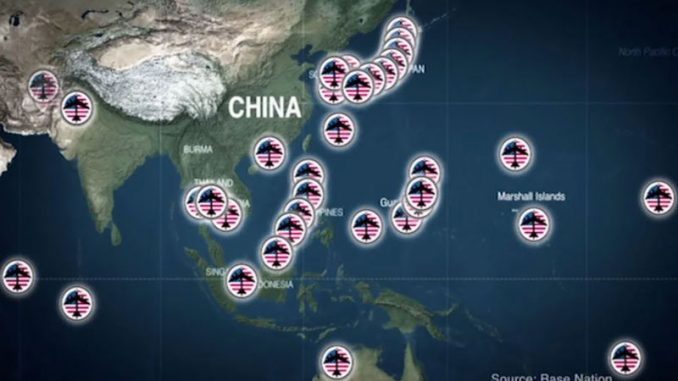
You can look at it in terms of overseas bases too. The US has 750 bases in 80 countries. China has 1 (in 1). The US bases near China encircle it, as we can see here. There are no Chinese bases anywhere near the United States.
The same applies to deployment. US aircraft carrier task forces, sometimes with the Royal Navy’s new carriers (probably the ugliest boats in the world, not an essential point, but they really are hideous looking) as auxiliaries regularly steam up and down the South China Sea. No Chinese Navy forces at all deploy to the Gulf of Mexico or English Channel. Imagine the headlines in the Daily Mail or USA Today if they did. In that light, it is quite amazing how calmly China takes this.
You can also look at it in terms of balance of nuclear power. The United States has 5,244 nuclear weapons. China has 500, a tenth as many. China also has a defensive, no first strike policy – the only nuclear power to have one. A First Strike policy has been US military doctrine since the 1960s, and remains so, even though it has been known since the 1980s that this would be suicidal even if it worked. The explosion of smoke and debris above the cloud layer from the first overwhelming salvo of missiles would blot out sunlight for several years; causing a nuclear winter that would obliterate the “victorious” powers through temperature collapse and starvation, just as surely as the defeated would be incinerated and blasted to death. For a sobering and essential examination of this see John Bellamy Foster’s Notes on Exterminism.
Characteristically, Lammy does not note that no one in China is arguing for a war with the United States. In fact they argue for “win, win cooperation” and “a common home for humanity” as we move towards an “ecological civilisation”; all of which seem both reasonable and essential positions that it would be helpful for humanity if the West were to respond to positively. Nor does he point out that arguing for such a war within the next decade as the only way to stop a peaceful rise by China is now a live debate in mainstream US Foriegn Policy circles; and that maybe this is more than somewhat unhinged.
Arising from all this, the question that has to be realistically asked is, who is threatening whom? Who is posing the “real security threat” and how dangerous is this, realistically? And shouldn’t Labour be seeking to restrain this rather than hype it up and cheer it on? Instead Lammy argues for AUKUS to be “a floor not a ceiling”. This is, realistically, a path to war; the consequence of which cannot be considered to have any “moral purpose” whatsoever.
It is slightly mind boggling that, while he pushes this antagonistic and confrontational military alliance, he thinks positive engagement with China on economic development, climate breakdown and AI (particularly as China is leading on this) can pootle along happily in a sort of paralell universe, not distracted at all by the war drums he is so busily beating, nor thrown off course by the diversion of necessary investment into the suicidal dead end of an arms race. You can make up your own mind about whether this is remotely “realistic” or contains a scintilla of “moral purpose”.
Little Britain blues
More parochially, in an attempt to have “tough minded honesty about the UK”, Lammy goes on to note what he sees as its three key problems.
Its economy is stuck in a low growth, low productivity, low investment slump. Which, given his concern with green transition and positive remarks about state led investment in China, the EU and US, should make him question why Labour has shrunk its green investment plan to little more than is already on the stocks from the Conservatives. He notes that the UK has the lowest level of investment in the G7, but seems to think that Keir Starmer’s “mission” to get the highest growth is possible without this investment, if only the country would have enough self belief. As delusions go, this is a big one.
Its armed forces are too small; which is only the case if you want to prepare for a war that could easily kill us all instead of taking active steps to avert it.
Public Services are crumbling. He could have noted that this also goes for infrastructure, which brings us back to the need for investment which the “realism” of the Shadow Treasury team rules out. So, do not pass Go…
Realism is for him embodied by Ernest Bevin’s actions as Foreign Secretary in the post war Labour government. The flip side of the progressive measures taken by that government, founding the welfare state and NHS, nationalising key industries, was its resolute continuity in Imperial Foriegn Policy; which led it to resist decolonisation, form NATO, aquire atomic bombs, join in the Korean war: and maintain military spending at such a high level that it had to sustain austerity to a degree that got it voted out of office in 1951.
Recognising that “realism alone will not be enough to save the planet” – which essentially means that “realism” defined in this way is anything but realistic – and that the “West” has “to cooperate with its rivals on climate change and AI” leads him to disinter the ghost of Robin Cook as the Push Me to Ernest Bevin’s Pull You. Cook is lauded for his promotion of “human rights” and “soft power”, embodied in the 0.7% of GDP allocated to development aid (a figure that Lammy notes, but does not commit to restoring) and his “realism” in making “hard choices” about “arms exports”, ie letting them go ahead. Lammy’s subsequent assertion that “governments don’t have to choose between values and interests” is belied by this.
Damned if you do, and damned if you don’t
So far so confusing; but Lammy’s attempt to have his bomb and drop it continues. The “West” made mistakes. Its interventions in Iraq, Afghanistan, Libya, the whole war on terror, became “seen as” a “recipe for disorder” because, despite initial military wins, it was unable to stabilise a viable pro Western regime anywhere. Its power lasted just as long as it could sustain boots on the ground, which is not indefinitely. The resulting chaos and impoverishment has not gone unnoticed across the world. The “moral purpose” that Lammy argues for, loses out to “self interest” every time. And because, of the decadent, parasitic stage they are now in, the US and its allies are sucking capital in, not spreading it out, and are therefore incapable of “nation building”.
Four and a half million people were killed in these wars, which I think should be categorised as the first phase of the Wars for the New American Century. Ukraine and Gaza are the start of an even more dangerous second phase, as a more desperate US takes greater risks.
The Rules are for the Little People
Lammy takes the Rules Based International Order as the embodiment of a viable global civilisation, but it is widely understood in the world that the rule that defines the rules is that Washington makes all them, none of them apply to the USA (and select few of its closest allies) and they will be changed on a whim.
A small example of this was the 1984 case at the International Court of Justice in 1984, when Nicaragua won compensation of £17 billion from the US for the damage done by the US-funded Contra war and the mining of its ports. Not a cent was paid. Who was going to make them?
A more recent example is the reaction to the ICJ ruling that Israel has a case to answer that it is commiting genocide in Gaza. The instant reaction from the US and its allies was to defund UNWRA on the back of unsubstantiated accusations from Israel that some of its workers took part in Oct 7th. That is a direct act of collusion in the attempt to starve Palestinians, and two fingers up to the formal structures of international law.
So, the failure of these interventions were a blow to Western hegemony. As Tom Tugendhat put it after the Afghan withdrawal “This feels like defeat”. But, in a quick pivot, Lammy asserts that Western standing was also damaged by the failure to intervene in Syria, or take a harder line in Ukraine in 2014.
What Lammy is describing here, without thinking it through, is that whatever the “West” does, deepens its crisis. It loses ground when it doesn’t intervene, causes chaos when it does.
Pursuing War not Peace in Ukraine
This is demonstrably the case in Ukraine. The West is supporting Ukraine like a rope supports a hanging man. The country is being destroyed. More than 100,000 Ukrainian soldiers have died so far. A great investment according to David Cameron, as “not a single American life has been lost”.
If their concern were genuinely with peace and security in Europe, NATO would at least have been prepared to negotiate with Russia about mutual security arrangements in the Winter of 2021. Instead, we had a hubristic refusal to engage to ease off tensions, which has led to the war which NATO is now visibly losing, amidst appalling casualties and damage.
The sanctions against Russia have failed. Most of the world does not support them, because, as Lammy notes, they see the conflict as between “the West vs the rest”; and have long experience of not being “at the table” with the US, and therefore being “on the menu”, as Antony Blinken put it recently. And they are no longer so securely under the West’s thumb.
Lammy’s support for military “burden sharing” for “as long as it takes to secure victory” is hard to square with any notion of “realism” if “victory” means Ukraine reconquering parts of its pre 2014 territory which actually see themselves as Russian. Even people who consider that to be desirable, have a hard job arguing that its possible. Phrases like “once Ukraine has prevailed” are evidently hollow.
Instead of looking to a peace agreement, as outlined here, that would allow all people in all parts of Ukraine to live in the state they wish to, secure neutrailty and reduce military tensions across the continent, Lammy argues for a “long term generational response” to the “Russian threat”. Again, this is playing on fantasies, as NATO at present already spends more than eleven times as much as the Russians do on its military. That looks like this.
Total military spending 2024
The NATO bloc on this is approprately reminiscent of Pacman, and should probably have teeth drawn on it
What Lammy is proposing is a long term “generational” increase in the military industrial complex and militarisation of society, with some military sources floating the reintroduction of conscription, at a time in which the “realism” of the Treasury team will impose freezes and austerity on everything else.
The (Republican) Elephant in the room
Lammy’s argument for closer links with EU powers, and bilateral pacts to supplement NATO, are the only hint of the nervousness that all the Labour front bench feel that they could be coming into power at the same point that Donald Trump takes back possession of the White House.
Its not surprising that Lammy – with stopping climate change one of his progressive aims – does not explore this possibility; as the US under Trump would go full rogue state on climate change, pull out of the Paris Agreement like they did before and “drill, drill drill” – with an overall impact of an additional 4 billion tonnes of CO2 released by the US the end of his second term. This would make a 1.5C limit completely unachievable, and the damage globally would be horrific.
Lammy, as potential Foreign Secretary would therefore either have to straddle an impossible contradiction in which the main perceived “threat”, China, was investing in the necessary transition, while the “foundation of UK security”, the US, was sabotaging it. As he says, “no country can go green without cooperation”. So, who would he seek to cooperate with? He could only resolve this contradiction by dropping concern with climate change and playing down its significance so as not to upset the “special relationship”, or break with US policy in pursuit of the only realistic understanding of its consequences. It might be argued that Labour’s downgrade of its $28 billion green investment pledge is a pre emptive move to anticipate a Trump Presidency, not just pusillanimity in the face of Neanderthal Tory attacks. This is a concrete choice that has neither “moral purpose” nor “realism”.
These are the notes for a recent speech at my local Constituency Labour Party. The title and the quote at the beginning is from Jason Hickel, who is the Energy editor at the Financial Times; so has something of a horses mouth quality to it.
“There’s too much to do and, given the urgency and the need to get the solutions right, this isn’t a task for your favourite ESG focussed portfolio manager, or the tech bros. The sheer scale of the physical infrastructure that must be revamped, demolished or replaced is almost beyond comprehension. Governments, not Blackrock, will have to lead this new Marshall Plan. And keep doing it. The Western nations that did so much of the damage will have to finance the transition in the developing world – it is astonishing that this is still debated. Massive deficit funding will be necessary.(my emphasis)
For all the clean tech advances and renewable deployment in recent decades, fossil fuels share of global energy use was 86% in 2000, and 82% last year.”
The scale of the challenge
According to Adam Tooze we need to be investing $4 Trillion per year in energy transition.
Others have argued as much as $6.5 Trillion per year
As the world economy is roughly $100 Trillion a year, between 4 and 6% of it needs to be invested in the transition.
A large sum, but to put it in context, last year (2022) subsidies for fossil fuels amounted to $7 Trillion and Fossil fuel profits were $4Trillion.
This is an opportunity – because there’s your magic money tree…but also a problem, because fossil fuels are so entrenched in everyday life and political power.
Fossil fuel companies have known about the effect of greenhouse gases for 60 years, and have reacted in the same way as the tobacco and asbestos companies did over the links between their products and cancer.
Even now, Shell is arguing that – to be compatible with their interests – Net Zero will only be achievable some time in the 22nd century (so between 50 and 100 years too late).
This entrenchment in political power is seen in Sunak’s latest announcements and more structurally in the high level of climate denial in the US Congress – where Senators and Congresspeople are bought up by FF companies. Showing once again that the USA is the best democracy money can buy.
This leads to a mind boggling level of cognitive dissonance. In 2019 the US military produced a report which stated that the impact of climate breakdown would lead not only to states collapsing around the world, but also that extreme weather events in the US itself would lead to infrastructure and civil society collapsing to a degree that they would expect to be called in to fulfil para state roles, before collapsing themselves from the overstretch that would impose. At the same time, they projected a need to be ready to intervene as the Arctic ice melts, to make sure that the US gets its customary lion’s share of the fossil fuel resources revealed under the ice; thereby helping fuel the collapse that they predict.
Which brings us to a related problem. The ratio of military to green transition spending. In the US, for every $1 allocated to green transition via the Inflation Reduction Act, they are currently spending $18 on their military. And this will get worse as the US and its allies, already responsible for two thirds of global military spending, are sharply increasing it.
The figures on this for China might surprise you. For every $1 they spend on their military, they spend $2 on green transition.
This means two things
A shift from military to green transition spending is an urgent task for the climate and labour movement globally – and therefore the Atlanticist foreign policy framework of the current Labour leadership is as wrong as it can be – and will be thrown into complete crisis should Donald Trump be re-elected next year (which is highly possible).
Countries that see themselves as Socialist are more part of the solution than they are given credit for. The one relatively developed country that the UN considers operates on sustainable lines is… Cuba.
Going back to Tooze to underline this point.
$4Trillion per year needed for energy transition.
Last year, $1.7 Trillion invested in renewable energy, but $1 Trillion was invested in fossil fuels. So, the net gain of 700 billion amounts to about 20% of what we need to be doing. Another way of looking at this is that we need to be doing five times as much as we are at the moment.
According to Tooze, China is the only country investing at anything like the scale and pace we need.
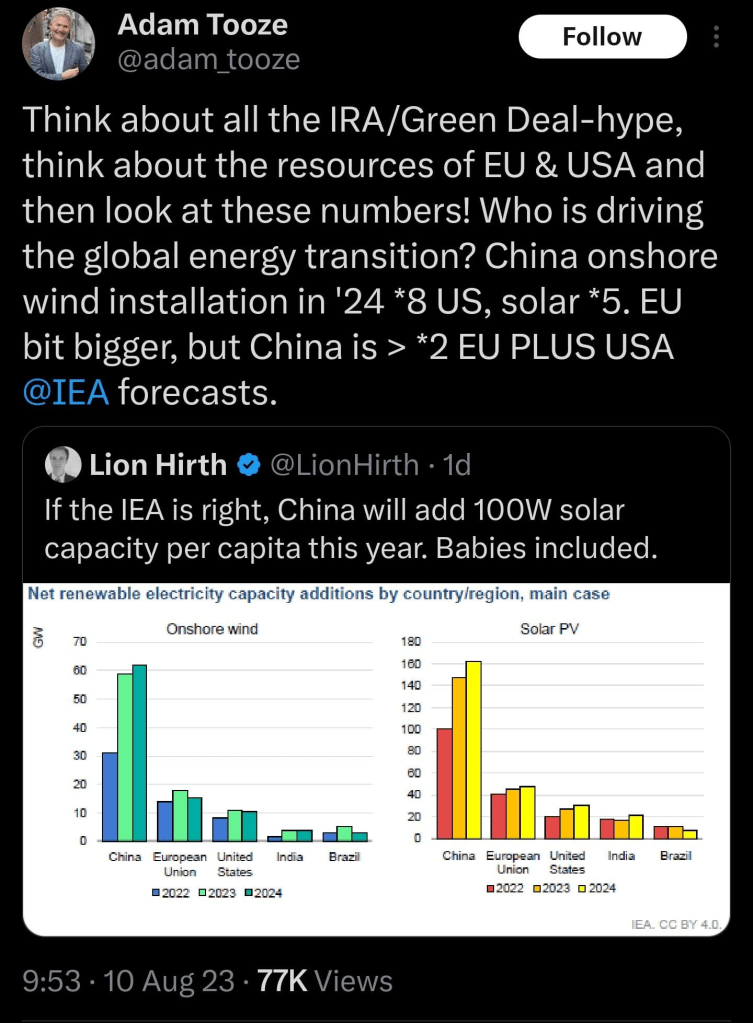
This is underlined by the International Energy Agency that reports that last year China invested 70% more in the transition than the USA and EU put together. And next year the projections are that their investment will be double that of the US and EU combined.
Specifically, in 2024, China is projected to account for
50% of global solar installations
60% of new onshore wind
70% of new offshore wind.
Labour’s projected £28 billion a year would get us up to US or EU levels; so about half of where we need to be.
This week the IEA put out an updated road map to Net Zero and keeping under a 1.%C increase.
Their essential point is that this is still possible, but only if advance (rich) countries in particular up their targets and ambitions – the opposite of what Sunak has done this week – with an enhanced target of 2045 for Net Zero. No new oil and gas is a bottom line.
To have any chance of getting to that £28 billion, what we need is Just transition bodies with union and community involvement at every level in every sector – so plans for investment – and community mobilisation around them – can be made. This transition can’t happen as a “trickle down” process. It has to be forced up, and the unions in particular will need to take the lead on this, not react defensively.
William I Robinson’s conclusion to his essay The Unbearable Manicheanism of the “anti imperialist” Left implicitly contradicts the rest of his argument.
He writes The U.S. may be the top dog and the most dangerous criminal among competing cartels of criminal states. We must condemn Washington for instigating a New Cold War and for prodding Russia through aggressive NATO expansion into invading Ukraine.
Quite so. This point makes it an odd post to be recommended by the editor of Labour Hub, which in lockstep with the hegemonic ruling class narrative in the UK, has spent the last 18 months arguing doggedly that NATO expansion had nothing to do with causing the war. No prods or provocations acknowledged.
But the wider point, that the US “may be the top dog and the most dangerous criminal among competing cartels of criminal states” means that the Tricontinental Institute, Code Pink, The International Manifesto Group and No Cold War among others critiqued in his article, have got it right; that the US is the core of the imperial systemthat needs to be opposed in the global struggle for socialism; because that “may be” is a way of saying “is” without quite saying “is”.
The way Robinson poses it in the rest of his article however is that we are almost in a multipolar world already, and the USA is just first among equals. This is far from the case. Its capacity to subordinate the rest of the developed world to its economic, political and military needs makes it the lynch pin of the global imperial system. The EU, Japan, UK, and even smaller wealthy countries like Australia and New Zealand, are tied to it as auxiliaries prepared to sacrifice their own economies for its needs, and integrate their militaries into US global leadership. This integration of all the major developed imperial powers, subordinates the weaker to the US, but allows them together to dominate the rest of the world. Between them, direct US allies account for 67% of global military spending; and the US alone accounts for more than half of that. “Top dog” indeed.
And the US has almost 800 overseas military bases in over 80 countries, as we can see here. China, by contrast, has one (8 fewer than Turkey).
What a Global Empire looks like
This is not a matter of show. The war on terror, from 2001 to the debacle of the flight from Afghanistan, killed 4.5 million people; and did so without establishing a single viable, functioning, let alone democratic, state anywhere they intervened. It has been argued that the creation of chaos in countries like Syria and Libya has been seen in Washington as preferable to allowing regimes they disapprove of to function effectively.
This is underpinned by the Death Star level planet destroying weight of the US nuclear arsenal, the biggest of big sticks, which has hitherto allowed them to speak as softly or loudly as they like. And this is not simply for “deterrence”, or to threaten non nuclear states. The US nuclear “first strike” doctrine envisages an exterminist attack on China or Russia. This would be suicidal, as the scale of such an attack would generate a nuclear winter, but the top brass are as deeply into denial about this as they are about their equally fatal failure to rise to the level of the challenge of climate breakdown, and their planning is regularly updated.
Direct military intervention, by their own forces or using proxies, as they are trying to do with ECOWAS in the current crisis of Mali, Burkina Faso and Niger trying to get out from under France Afrique in the Sahel, are only the sharpest form of intervention. Sanctions are also devastating and are imposed “against countries that violate the interests of the United States” as Wikipedia puts it with disarming frankness. At any one point, this is a significant slice of, primarily, the Global South, as we can see here.
These sanctions are designed to cripple economies but also kill people in large numbers. Half a million children in Iraq in the 1990s, over 40,000 in Venezuela in the last decade, to pick just two examples.
This is sustains the (“rules based”) world economic order, which keeps the Global South underdeveloped through the normal functioning of the international trade system, US dominance of finance, low prices for Global South commodities and high prices for loan capital, including from international institutions like the IMF and World Bank, that have imposed the “Washington consensus” privatising development agenda that is anything but developmental. The utter failure of the US allied countries in the Global North to provide the – completely token – $100 billion a year contribution to the Global South to enable fossil fuel free development, at the same time as the US alone has stumped up more than $120 billion to fuel the Ukraine war, is emblematic of how this rotten system works. As Vijay Prasad has pointed out“one in three lightbulbs in France are powered by uranium from Niger, at the same time as 42 percent of the African country’s population lived below the poverty line” and fewer than 20% have access to electricity.
At the outset of World War 1, Karl Leibknecht argued rather bravely in the Reichstag that “the main enemy is at home”. In the light of the above assessment of the structure of global imperialism, we have to recognise that the main enemy, while the Pax Americana exists and the struggle for full spectrum dominance and a “New American Century” is driven onwards, is always in Washington.
Footnotes. Short points on the rest of Robinson’s article
“Manicheanism” is a Persian theology from 300 BC that poses the world as the site of a cosmic struggle between good and evil; which are posed as moral absolutes.
Cold War thinking is Manichean. “Win, win” global cooperation is not. Demonisation of rivals, or just people who think differently, as “evil” is a characteristic of Manichean thinking.
It makes a rational assessment of the motives of opposing forces very difficult, because all analysis is shrouded in a red mist of moral repugnance; which is itself all too often a form of projection. This is evident in most establishment media coverage of the Ukraine war, in which all atrocities are attributed to the Russians, while butter wouldn’t melt in the mouths of the Azov battalion.
This is often given added vehemence by sections of the Left who back this line, partly because they they need to stoke a lot of moral outrage to drown out the awareness in the backs of their minds that doing so is becoming an auxiliary of “the top dog”.
Its the same the whole world over?
The core of Robinson’s argument is that, while “the 2022 Russian invasion of Ukraine and the West’s radical political, military and economic response to it may signal the coup de grace of a decadent post-WWII inter-state order” and “the emerging global capitalist pluralism may offer greater maneuvering room for popular struggles around the world “ nevertheless, “the crisis of hegemony in the international order takes place within this single, integrated global economy.” Essentially all states are capitalist and much of a muchness. No state is any different from any other. All are converging on nationalist revivalism and this is the primary context for the “escalating economic turbulence and political chaos” we are heading for.
The paradox of this argument is that the Manichean zero sum calculations made by the US Foreign Policy establishment, that confrontation, decoupling and, in extremis, war with China is necessary to stop its rise, is not reflected in a Manichean mirror image in China’s stance. Their approach is to maintain globalisation, for global cooperation to find “win win” solutions and “a common home for humanity”. The former is leading us towards Armageddon and sections of the Left are being swept up with it. The latter is the basis of a way out.
Because China, and other states that see themselves as Socialist, dance to a different drum. Robinson acknowledges China’s “rapid industrialization, technological progress, and advanced infrastructure” and that “China has not followed the neo-liberal route to transnational capitalist integration. The state plays a key role in the financial system, in regulating private capital, in massive public expenditure, especially in infrastructure, and in planning“. And that’s the point. “The state plays a key role” The key role in fact. And it is a state run by a Communist Party with 90 million members. It is not run by the private sector. It hasn’t been since China “stood up” in 1949. That’s the difference.
Four ways this shows.
Poverty Reduction Robinson acknowledges that China “has lifted millions out of extreme poverty” then moves swiftly on. Let’s be more precise about this. 850 million people lifted out of poverty in the last 40 years. To make that relatable, because statistics don’t have an emotional impact, think of one friend and what it would mean for their life to be lifted out of extreme poverty. Then imagine a city the size of London full of friends like that. Then imagine 100 of those cities full of friends like that. That’s the scale of China’s achievement. Another way of looking at it is to imagine the whole population of Europe (740 million people) living in extreme poverty in 1993, and being lifted out of it by now. Plus an additional 100 million people. This is not normal for developing countries subject to imperialist domination. It has been a state driven mission.
Wages As you can see from this graph, wages in China have consistently grown faster than in the rest of the world. This is one reason that the rule of the CPC is popular and most people in China see their country as a democracy, in the sense of it being run in the interests of the mass of the population. Fewer than half of respondents in the United States thought the same about their country, because they know full well it isn’t.
3. Belt and Road Initiative The overall impact of this is genuinely developmental and far more “greening” than Robinson makes out. As argued here, “Research indicates that the BRI has significantly promoted the carbon intensity reduction of countries along the route”, and, though this is uneven, a recent study by CGS analysing “17 environmental, economic, and social indicators” in Africa found “consistent improvements across 12 indicators through 2050 across 1.5°C scenarios” thanks to to BRI impacts. Even the World Bank projects that “BRI transport projects could reduce travel times along economic corridors by 12%, increase trade between 2.7% and 9.7%, increase income by up to 3.4% and lift 7.6 million people from extreme poverty.“
4. Climate Breakdown The investment that China is putting into the energy transition is projected by the IEA to be double that of the US and EU put together next year, as you can see here.
They are also spending twice as much on energy transition as they are on their military. The US is spending 18 times as much on its military as on the energy transition. Which sums up their relative priorities.
The Left in the Global North – which has never overthrown its own ruling class and lives in a relatively comfortable niche of permanent opposition made bearable by the higher standards of living made possible by global exploitation- tends to be dismissive of the struggles of people in developing countries who have. This niche has been tolerated hitherto here, but, with US dominance increasingly under challenge, both economic concessions and democratic spaces are being inexorably squeezed, and dissent increasingly categorised at treasonous.
Currents on the Left who, to prove their independence of mind, find themselves habitually parroting the same attack lines on the same targets as the State Department (and at the same time) should reflect that perhaps their opposition to “campism” has led them to pitch their tents in the wrong camp.
An info graphic tucked away on the back page of Tuesday’s Financial Times shows why articles have started appearing across the press in recent weeks, rowing back on previous optimism, to project that the forthcoming Ukrainian military offensive is a last throw of the dice.
Confirming the analyses of commentators like Brian Berletic, who has argued from the beginning that this is a war of attrition, the info graphic compared the munitions so far supplied to Ukraine by the US and its allies, with the annual production of those munitions that they can manage if working their factories at full stretch (“surge” production) and the number of years it would take to replenish stocks already expended.
When read in conjunction with comments from Ukrainian military figures that Ukraine is fast running out of the Soviet era S300 air defence missiles that it has hitherto relied on to contest the air space above its cities and the battlefront, this makes a harsh reality check for anyone arguing that the NATO military input into Ukraine should be increased; because, even if you think that’s the right thing to do, its not actually possible.
For 155mm shells, over a million have already been supplied. They can be produced – when really pushing it – at 240,000 a year. It would take 7 years to replenish stocks to previous levels at that rate* and, its quite evident that even if every shell produced went to Ukraine, that would supply around a quarter of the supply for the first year from here on.
155mm precision shells would take 4 years to replenish, Javelin missiles 6 years, Stinger missiles 7 years and Himars systems 3 years.
To significantly increase military production capacity would require
significant investment, that would have to come from elsewhere in the economies, at a time when all the Western countries are undergoing a sharp squeeze on living standards and increasing political turbulence.
time, to make the machine tools, build the factories, put in the infrastructure, train the workers; a matter of years not months.
a rethink about how the Western military industrial complex functions; as it has hitherto been set up to produce very expensive and sophisticated kit that requires a lot of training to use and, because it is so sophisticated, very lucrative for the manufacturers. This is a viable approach when the wars the West was fighting were either relatively short, or low key against opponents with limited capacity who could be technologically overawed, though is not so effective in protracted attempts to occupy hostile countries, hence the debacles in Iraq and Afghanistan. It does not hack it at all when what’s needed is the sustained mass production of simple munitions like shells for a prolonged war of attrition; which the Russians are set up to do very effectively, even though they spend a lot less on their military than NATO countries do on average, and far less in total ($1 to every $19 spent by NATO in fact).**
That is a material constraint on the US and NATO because they want sufficient of a stockpile to be able to credibly threaten or fight wars elsewhere. So the longer they have to supply more munitions than they can produce to Ukraine, the weaker their global position becomes.
Hence the increasingly open anger of right wingers in the US who think that engaging in this war is a strategic error; because they want to keep as much powder dry (and missiles in stock) as possible for the war with China they see as the priority to fight before the end of the decade.
This is causing a reframing of the narrative for the forthcoming Ukrainian offensive.
Into the Valley of Death?
Whatever view you take on the rights and wrongs of this conflict, it is hard to contemplate this forthcoming, and much advertised, offensive without a sense of horror for the appalling loss of life that it will require. Like knowing that the battle of the Somme is about to start.
Posed initially as a big push with new Western weapons – primarily Leopard tanks – that would break through Russian lines and lead to a political crisis in Russia leading to a victory and reconquest of all territory up to the 2014 borders, the expectations for this offensive are now being downgraded.
Commentators from Admiral Chris Parry to Daily Telegraph columnists to arch hawk Simon Tisdall in the Observer, are now arguing that, in the words of Admiral Parry, the Russians are “too well dug in” to be shifted much. The logic of this is to try to ward off too much disappointment and war fatigue, such that pressure for a ceasefire and negotiated settlement grows significantly. Reports, from Russian sources, so take them with a pinch of salt if you like – of an increasing tendency for Ukrainian soldiers to surrender and, in some cases, offer to turn change sides, indicates what could happen on a wider scale as the prospect for “victory” is no longer posed as just over the horizon, but as an uncertain and remote possibility in an and unending slog with horrific and remorseless casualties.
So, in some quarters there is now an explicit argument that the aim of the offensive is to gain ground to put Ukraine into a more advantageous position when these negotiations come. The overt call, coming from the Ukrainian military and these same writers, is that the supply of munitions from NATO is insufficient and should be, or should have been, even greater than it has been. The problem with this position is that, in reality, as outlined above, there is insufficient capacity in the Western military industrial complex to provide the level that is demanded. So, it is a demand that cannot be fulfilled. In the event of a debacle these commentators can nevertheless cry betrayal, as reality rarely stands in the way of a politically useful myth.
The scale of the shift in investment required to make it so would require a shift in resources on a scale that could not help but hit domestic living standards very hard indeed; and the militarisation of society that would follow would require dissent to be repressed as treason. The legal case already being taken out in the US against four members of the anti war African People’s Socialist Party for “conspiring to covertly sow discord in U.S. society, spread Russian propaganda and interfere illegally in U.S. elections” is the beginning of what threatens to be a much wider and deeper process across the NATO countries.
Its possible that this offensive will make no ground at all. That the 50,000 or so troops assembled for it will make little or no headway against heavily fortified Russian positions and be hammered by superior Russian artillery and air power and, ultimately, a concentration of reservists that will outnumber them. It is, however, also possible that a heavy enough concentration of forces could break through and reoccupy territory. The Russians have been evacuating civilians in preparation of such a possibility. This is posed by our press as “abductions”, though, what they’d have them do to keep these civilians safe I don’t know. Given the way the Ukrainian army has tried to use the continued presence of civilians as human shields, the chutzpah here is quite extraordinary.
Whatever the impact, the question of what happens when it runs out of steam – as casualties mount, munitions are used up, soldiers succumb to exhaustion – is rarely addressed. There seems to be a presumption that the Russians will be equally exhausted, will not have military reserves in place, or the political will, to push back; which seems unlikely.
Any assessment of what happens then is necessarily speculative. A successful Russian push back with limited territorial aims but aiming for regime change in Kyiv – as spelled out in tub thumping terms by Dmitri Medvedev – would involve a loss of face for NATO that it would find unbearable. So, a partial occupation of Western Ukraine by some NATO forces as a face saving territory holding operation is being rumoured; with the Polish Army being set up to do this. If this is clearly understood and expected by both sides through back channel diplomacy it could lead to a ceasefire and frozen conflict on pre determined territorial lines and avert the very real risk of direct engagement leading potentially to nuclear catastrophe. If not, we could all be in very serious trouble indeed.
In that situation, the cries of betrayal from the right – and some sections of the NATO supporting left – would be very loud; and there would be every prospect of a lower intensity continuing conflict with Azov type forces trying to conduct raids across whatever DMZ might be set up. Alongside this there would be continuing campaigns to increase military spending in the NATO countries and attempts to line everyone up behind it; and demonise and criminalise those that don’t.
At the same time, the price for the aid to Ukraine, which is in the form of loans, will be called in by the NATO powers and Ukraine’s mineral and agricultural resources will be asset stripped on a grand and ruthless scale from the part of the country it occupies. So much for sovereignty and the rights of nations to self determination. The war time legislation stripping workers of what rights they still had will be reaffirmed in the name of national survival and the oligarchy in Kyiv will make a comfortable living on brokering the deals.
Chinese solutions
There have also been articles arguing that China could put pressure on Russia in order to pull NATOs nuts out of the fire; which is more wishful thinking. Why China should do this when the US is actively trying to mobilise the reluctant population of Taiwan to play the same role viz a viz China as it has managed to get the Ukrainian oligarchy to do viz a viz Russia, is unclear. China’s capacity to broker a peace should not be underestimated. They have managed to get Saudi Arabia and Iran to restore diplomatic relations, which has led to a real prospect for peace in Yemen. The recent call between President Zelensky and President Xi opens the door to an end to the conflict that is not primarily framed by NATOs interests; which will therefore be resisted by it. The comment of a US major about the Vietnamese village of Ben Tre in 1968 “in order to save the village, it was necessary to destroy it” could end up as the preferred US position on Ukraine, if the alternative involves a Chinese brokered peace.
*These are the FTs figures. Although 1,074,000 divided by 240,000 gets you just under four and a half years, presumably they are taking other factors into account lime depreciation, use on live fire exercises etc.
**A World War 2 analogy might be in comparing the T34/85 and the PZKWV (Panther) tanks. Panthers were designed as an answer to the T34. They were heavier, better armoured, faster, more sophisticated and overall more effective tank to tank, but they were far more prone to breakdown (with only 35% of vehicles considered “combat ready” in 1944) and were more expensive and time consuming to build; so that from 1943 to 45 the Nazis built around 6,500 of them, while in the same period the USSR built29,400 T34/85s.
Anyone who thinks that “respect” and “tolerance” are “Fundamental British Values” hasn’t spent a lot of time online. The review of Prevent by William Shawcross published on February 7th reflects the government’s alarm that referrals for right wing and racist views were beginning to outnumber referrals for Islamism by 2021. As well they might. Jihadist attacks have dropped off sharply. There have been none in the UK since 2019 and the ISIS Caliphate no longer casts any kind of bogus attraction to a community that has overwhelmingly grasped how malign it was, whereas there was a far right/Incel mass shooting of five people in Plymouth in 2021. Nevertheless, the Review has ruled out the growing concerns about the increasingly aggressive misogyny in Secondary schools, directed by boys influenced by the Incel movement against girls students and women teachers alike; even though it has increasingly gone beyond verbal abuse to violent attacks, killing 53 people across the world and injuring many more. By this definition, racism and misogyny are not worthy or referral, even though they are currently leading to the largest number of violent incidents and Prevent is supposed to be about stopping people being “radicalised” so that they commit such acts.
What’s quite overt about this is that racist views – by definition contrary to “tolerance” and “respect” – are considered by Shawcross and the government to be “mainstream right wing views” that are acceptable. Given that racist paranoia about “small boats” is one of the main knee jerk reactions the government is trying to hammer on to divert attention from its deplorable record in sustaining our living standards, not least by cutting the immigration of necessary workers, unless racism is taken out of the list of Prevent concerns, the government itself would have to be referred for grooming it.
Its hardly surprising that they should want to define themselves out of a situation in which, if Suella Braverman were in a classroom, she might find herself referred for the incendiary language that fuelled the people who firebombed refugee hostels in Knowsley and Dover. Braverman herself, who always comes across as someone living on the edge of nervous anger from having to control so many explosive contradictions in her own head with a rigid framework of far right paranoia, doesn’t seem to have twigged that the next step on from “Stop them coming” is “Send them back”. And, however much she tries to save herself by channeling pure gammon, the people she is winding up to violence won’t exempt her from the flights to Rwanda she says she dreams about.
The paradox of the government’s move is that it exposes Prevent as a divisive and “partisan” tool employed for limited political purposes, with some views demonised and others given official sanction, whether they contradict the FBVs or not. They are dropping the curtain and stand revealed. Here be monsters indeed.
Its a right of passage towards old age when someone young offers you a seat on the tube or a bus, which started happening a few years ago. When someone visibly middle aged does the same thing, as happened yesterday, you know you’re getting past it in a big way. What must I look like? And today, someone stopped their car to allow me across the road. OK, I was pulling a shopping trolley and wearing a mask, but I must be exuding a new level of decrepitude to bring forth such gratuitous courtesy.
This is the bust of late Rolling Stones drummer Charlie Watts that’s been on display in Kingsbury Library for the last couple of months. Watts, who definitely got old before he died in 2021, grew up locally in a now demolished row of houses off Fryent Way and went to Tyler’s Croft, the Secondary Modern School off Roe Green Park that became part of Kingsbury High School when Comprehensivisation went through well after he’d left; and my kids went to well after that. He is one of two famous alumni. The other being James Hanratty; the last man in England ever to be hanged. I see that the new Deputy Chair of the Conservative Party, Lee Anderson, would like to hang more people in the future on the invincible grounds that “nobody has ever committed a crime after being executed”. As an extra bonus, that includes all those innocent of the crime they were executed for.
The 183 bus route, run between Pinner and Golders Green in a striking display of cross border state ownership by the RATP (Régie Autonome des Transports Parisiens) has now been electrified. It feels like riding inside the future. The buses arrive swiftly, swoosh to a halt, then accelerate off again smoothly; without picking up any of the bad vibrations, rumbling, juddering, boggler, boggling you get with a diesel engine. Smells better too. At present it will take TFL, which is very good by UK standards and at least publicly owned, about another ten years to electrify all 8,000 of its buses. Shenzen, in Southern China, did all 16,000 of theirs in 2016.
Which makes the current wave of Sinophobia doubly sad and dangerous. We have things to learn from each other but, instead, we get stories designed to make us fear. A feature of the recent past is how quickly stories that first show up on really whacked out far right sites – the sort of places that combine racism and imperial nostalgia with adverts for hemorrhoid cream, and feature Nigel Farage as an embodiment of all of them – find themselves on the front pages of our mainstream press within a week or two. This one, complete with weird capitalisation, “China finds SHOCKING WAY to spy on you – and they’re already in your KITCHEN!” was replicated in the slew of headlines this week implying that use, in anything, of technology made by Chinese companies would allow surveillance by the CPC. This is weird. If Xi Jinping wants to know what’s in my fridge – and this is terribly important information for the 15th Five Year Plan – he will have to nudge Eric Schmidt, Mark Zuckerberg and Jeff Bezos out of the way, because they already know (and are using it to try to sell me stuff that I don’t realise I “need”). US based tech companies are also, of course, completely tied in the the National Security Agency, so, if Joe Biden wanted to know what’s in my fridge he could probably find out without too much trouble. If you want to be really paranoid about tech surveillance, read Surveillance Capitalism by Shoshana Zuboff. This is a bit repetitious, but reveals some quite alarming stuff, like the way interactive toys are sending messages about what a child says, and how they say it, back to the manufacturer and that devices like Alexa don’t just tabulate requests, but tones of voice…
Although I retired from teaching three and a half years ago, I still get classroom anxiety dreams. This morning’s was a classic. I was being driven in to school by a friend and everything was really relaxed until I got there – even though it was during morning break, so seriously late – and realised I was due into class in a minute and not only had no plan, but no idea what we were supposed to be teaching that week. Feeling far less panicked than I would have been if that had actually been the case I wandered into the classroom, getting a reproachful look from a younger version of BB, my old head teacher, who’d been covering, and asked what we were supposed to be doing. “Stories”. That’s ok. Everything is a story. Best to start with a question. As the kids drifted in chatting and sitting on the mat, I asked them “Where do you find a monster?” while thinking that wherever we find them, they are already in our heads…
Amid all the fuss about the Chinese balloon floating over Montana – we should not forget that the US has 339 military surveillance satellites operating around the world; watching everyone and everything all the time.
They launched four of them in 2020 and, as Space Magazine reported at the time “It’s unclear exactly what the spacecraft will be doing up there.” Though I think we can work it out.
If every other country reacted to that like the US has to this balloon, no future summit would ever be able to take place.
Paranoia about Chinese technology is becoming another theme being pushed hard in the Western Press and on right wing sites. Here’s a headline from one of them. China finds SHOCKING WAY to spy on you – and they’re already in your KITCHEN!(their caps) Of course, if there’s someone from Chinese intelligence who wants to sit in your fridge to note the contents, he or she would have to nudge Jeff Bezos, Mark Zuckerberg and Eric Schmidt out of the way first. “Alexa! note down everything I’m saying”.
The US has also been developing balloon surveillance capacity of its own. Last May Politico reported that
Over the past two years, the Pentagon has spent about $3.8 million on balloon projects, and plans to spend $27.1 million in fiscal year 2023 to continue work on multiple efforts, according to budget documents.
And that
For years, DoD has conducted tests using high-altitude balloons and solar-powered drones to collect data, provide ground forces with communication and mitigate satellite problems. The Pentagon is quietly transitioning the balloon projects to the military services to collect data and transmit information to aircraft, POLITICO discovered in DoD budget justification documents.





 Urban ramblings