US Presidential Election Final Score: what comes next?

My last blog did not take account of just how slowly votes are counted in US presidential elections. While the result has been obvious from the grey dawn of Nov 6th, and the outlines of the vote equally apparent, a precise accounting has had to wait until now. Even now (Nov 27th) the vote count stands at 99.7%, so there’s roughly another few hundred thousand votes to tot up, but these won’t make much difference to the broad conclusions that were reasonably obvious, and therefore broadly misrepresented in the media, from day 1.

First of all, contrary to my initial blog, Trump did gain votes from 2020. But not many. His total was just over 77 million this year, compared to just over 74 million in 2020; so, a gain of just under 3 million votes.

Similarly, Kamala Harris lost a lot of votes on Joe Biden’s total in 2020, down from just under 81.3 million to just over 74.4 million; so a total loss of 6.9 million votes.

Turnout was down overall by about 3 million votes.

So, the core conclusion that this was more a Democrat slump that a Trump surge still holds. This matters because some of the conclusions coming from Democratic Party reinforce the strategic choices that led them to lose. There are basically three strands to this.

  1. They are in denial about “the economy”, arguing that people under $100,000 a year, whose real wages were lower at the end of the Biden term than the beginning were suffering a delusion because “economic indicators” were going so well. Putting this across as people not “feeling” how well they were doing, when they were actaully doing pretty badly, is a form of gaslighting that, evidently, doesn’t work.
  2. They seem to think that the problem with Kamala, campaigning with the Cheyneys, “I own a Glock”, “border state prosecutor”, “Israel has a right to go after the terrorists” Harris was that she was too “woke”.
  3. They are having a tactical discussion about whether Biden should have withdrawn earlier – obviously he should – and whether they should have had a primary process – neither of which addresses the fundamental problem that any candidate wedded to the same strategy would have faced the same defeat.

This denial is designed to move the Democrats onto the same ground as the Republicans on the spurious argument that there was a significant shift towards them. There wasn’t. It is not a strategy to remobilise their lost voters, let alone an attempt to pose answers that meet the needs of working class voters. Quite the opposite.

It reflects a deeper reality that – their protestations that Trump is a fascist nothwithstanding – they would prefer to lose than contradict the demands of their donors, let alone challenge core US imperial imperatives; which is the fundamental purpose of both parties and the reason why the US political structure is set up the way it is; to squeeze out any genuine challenge that might express the popular progressive majorities that exist for, for example, Medicare for all, Abortion Rights, Serious action on climate, raising the national minumum wage, ending US support for the war in Ukraine and the genocide in Gaza and opposing a wider war involving Iran.

Polling showed, for example, that taking a harder line with Israel would have won Harris significant votes in the swing states.

What we had instead from the Biden adminstration was a performative 30 day ultimatum – due to expire conveniently after the election – for Israel to allow more aid into the Gaza strip on pain of having (some) arms cut off – because even in performative ultimatums, you wouldn’t want to go too far in case the wrong signal gets picked up – in the hope that this gesture would bring back some of the votes that their single minded support for Israel had alienated.

Needless to say, when the 30 days were up, in the middle of Israel’s most ruthless offensive yet – implementing the “General’s Plan” to completely clear the whole of Northern Gaza of its Palestinian population, making it a free fire zone and totally shutting down of any supply of food, water or medicine – the US declared that enough aid was being allowed in for them to keep praising Netanyahu and passing the ammunition.

The psychological shock to a lot of people in the mainstream of politics is that 2020 was supposed to be a “return to normalcy” from the insane aberation of four years of Trumpian excess, after which the Pax Americana could be reasserted on its customary tried and tested basis, with all its familiar landscape intact. The problem is that it can’t, now that the US is no longer the world’s largest and most dynamic economy, the old rules won’t work anymore, so what people thought Biden was now looks like an interegnum in a “new normal” in which the US takes off its masks and stands before the world in all its hideous nakedness as a climate denying rogue state, reduced to having to bully its allies to increase military spending and banking on increasingly overt threats to try to bluff its way out of decline.

This is unlikely to work, but is extremely dangerous and damaging nonetheless.

Beyond the grotesque and demeaning soap opera of his cabinet picks, like putting the former head of the Worldwide Wresting Federation in charge of Education, which could be filmed by Hollywood as the Joker taking control of the Gotham City Mayor’s office.

  • If Trump imposes 60% tariffs on China and 20% tariffs on everyone else “on the first day” the knock on effect on the world economy will be severe – causing an economic squeeze and political turmoil among allies as well as opponents, sharply rising prices in the US itself and a hard hit to living standards. Those who voted for him under the impression that they would be better off – and many did despite misgivings about his other policies – a response identified as a definite trend by exit pollsters – are in for a shock and are likely to turn.
  • The same applies to mass deportations, if they are carried out. Removing hundreds of thousands, possibly millions, from the workforce would be seriously disruptive economically, even discounting the immensely divisive and traumatic social and political impacts across communities.
  • If Trump carries out his promise to reverse major US climate policies passed during Joe Biden’s presidency, this could push $80bn of investment to other countries and cost the country up to $50bn in lost exports, according to a new study by researchers at Johns Hopkins University.
  • The required ramp up of military spending among allies, in the context of an economic squeeze generated by the tariffs, would also create increasingly febrile and feverish politics even within the US’s core supporters; as we are already seeing in Japan.

The decline of US power has entered a bumpy and perilous period and the election of Trump is a symptom of that. Standing on much thinner ice than the media is suggesting, the harder he tries to grip, the more things will slip through his fingers; the harder he tries to assert US power, the more he will expose how much it has already slipped.

That Time of Year#3. How are the Mighty Fallen?

Seen in Foyles Bookshop on Saturday. Someone with a sense of humour has placed the parody of Boris Johnson’s memoir alongside the original; which many reviewers thought was surreal enough.

This may be a desperate attempt to boost sales for that, as the red sticker showing that its on sale for half the recomended retail price does not indicate that it is exactly flying off the shelves.

Yesterday’s man.

That Time of Year #2. A Carnival for Carnivores!

Grays High Street was not its usual quiet self on Saturday morning. A blue tent with a sound stage flanked by huge loudspeakers was deployed at the strategic centre between Clarence Road and George Street. Manned by a tiny, grey complexioned DJ in his fifties, it was belting out Romanian techno beats, while he rapped along with it, hopping about with an enthusiasm appropriate to someone a third of his age like a gleeful goblin.

We have the meats….

In front of the shops on either side were lines of Eastern European market stalls, most selling meat. Steaming meat, cured meat, barbecued meat, meat to take away, meat to eat. Tables were laid out in between so people could sit and munch in their anoraks while the vibrations from the sound stage thundered through their chests.

Giblets steaming on gibbets…

There is something almost medieval about it. All you’d need is some jugglers and fire breathers.

In case the last stall didn’t have enough meat, here’s some more…and a bit of cheese.

In case you were in any doubt where the meat comes from, this makes it pretty apparent. Not Kosher, pretty Haraam and no place for a vegetarian.

It was quite sparsely attended when I passed it in the morning, but it was rammed in the afternoon. A mix of local people enjoying being swamped by an alien culture. The Disco King on the stage was playing a Techno verison of the Lambada as I walked past; proof positive that multiculturalism is dead.

One of the regular young black evangelists a little further down offers me a leaflet. I politely decline and he says “Jesus loves you”; which is quite a pitch when you think about it, particularly to anyone who feels otherwise unloved.

That time of Year #1. The Nativity with no baby.

In the midst of the great Temple of Mammon that is Brent Cross Shopping Centre, a not quite life size Nativity scene is installed on the first floor. It looks normal enough until you notice that, in the midst of the manger, where the Christ baby should be, there is a void.

As a result the hand and face gestures that should express awe and wonder are more akin to shock and bewilderment, puzzlement or even irritation. Where’s that baby gone? He was here a minute ago?

The Gold and Frankincense seems to have arrived with two of the Three Magi, but there’s no Myrrh for the third. Its obviously a result of something prosaic – some of the parts haven’t been delivered perhaps.

Nevertheless, it comes across almost as a statement of doubt. The absence at the heart of doctrine. Faith without object. Or perhaps as a practical joke, or a Shopping Mall Treasure Hunt – find the missing Son of God and win a Waitrose voucher (bonus points for the missing Myrrh).

A small dog strains on his lead to sniff through the barrier at one of the plastic sheep, trying to work it out.

Labour’s Climate Strategy – strengths and weaknesses.

This was an introduction given at the Campaign Against Climate Change Trade Union Group’s energy strategy day. Afterthoughts and updates, like the next few paragraphs, have been added in bold.

This introduction was delivered before Keir Starmer’s speech at COP 29, which made the very welcome pledge of an 81% cut in carbon emissions by 2035, but also included the promise that the government would not “tell people how to live their lives”.

This makes the way we live now somehow sacrosanct- and assumes that “people” are incapable of rising to the challenge of changing it if thats whats needed to secure a livable world for their children and grandchildren. It also ducks the government’s responsibility to implement Article 12 of the Paris Agreement which is a call for mass popular information, education and mobilisation campaigns, to enable society to act collectively to save itself.

Parties shall cooperate in taking measures, as appropriate, to enhance climate change
education, training, public awareness, public participation and public access to information,
recognizing the importance of these steps with respect to enhancing actions under this
Agreement.

As 66% of the public want more action to combat climate change, we should be mobilised to do so. We will have to get to sustainability by marching forward on both the technological transformation leg and the social transformation leg. We won’t get there if we have to hop hopefully on just one of them.

Labour’s strengths and weaknesses

I’d like to stress that there are a range of views in the Greener Jobs Alliance, and these are mine.

To start with a statement of the obvious, it doesn’t look as though the government sees itself as an instrument to mobilise society to transform itself to sustainability.

They treat the climate crisis as an item on a list – limited to a mission to make the UK a “Green Energy Superpower” – not the framework in which everything else has to be posed.

That leaves huge gaps. Some examples.

1.The current curriculum review for schools does not explicitly have addressing the climate crisis at the heart of it, although the current Ministerial team are open to a discussion about it in a way that the last was not.

2.A climate conscious budget would, as a minimum,

i) have raised fuel duty and hypothecated the revenue to keep the £2 bus fare cap and invested the rest in enhanced public transport.

ii) raised a wealth tax on incomes above £10 million per annum, as suggested by Greenpeace – to raise £130 billion over 5 years (1% of GDP) which, they argue, would raise the revenue to cover insulating 19 million homes, cap bus fares outside London at £1.65, and free for under 25s, fund an unlimited rail ticket for £49, provide retraining for the 3.2 million workers at risk in high carbon industries and shift agriculture onto an agro- ecological basis.

That might be optimistic, but its that scale of ambition thats needed, along with a relentless explanation of why its necessary as a national and international mission.

And to play fantasy Chancellor a little longer, a recommitment to the £28 billion a year future proofing investment with a plan for every sector that works with the relevant unions to develop it and identify the skills gaps that have to be filled. This applies to expanding sectors as well as high carbon sectors that will have to shrink.

Reeves and Starmer’s overall strategy is for “growth” – any growth – conceived in completely traditional terms, not framed as transformation. This can sometimes even be framed in a way that undermines the government’s own targets -as expressed in the recent Sun article under Starmer’s name headlined – “I will never sacrifice Great British Industry to the drum beating, finger wagging Net Zero Zealots”.

I guess that’s us. Perhaps we should all get badges.

Also, I don’t know if its just me, but does all this “Great British this, Great British that” have a really early Victorian feel to it?

3. This can also be seen in housing. The challenge is to build 1.5 million new homes a year. The GJA wrote to Angela Rayner in October last year whether all new homes would be

i) built to a zero carbon standard, with a sound level of insulation, heat pumps, electric cookers and hubs, solar panels as standard and no connection to the gas grid (as this would be a wasted investment).

ii) with all essential facilities within walking distance, integrated green spaces and trees, good public transport links and car clubs to reduce the burden of individual car ownership.

iii) zero impact assessments on water tables and sewage and other questions including who will build them? Arguing that there needs to be a plan to expand Local Authority Direct Labour Organisations with a link to local FE colleges to skill up the new workers we will need to do it

iv) And, crucially, the last question. If the aim is to use existing developers, how will you prevent them from blackmailing the government to water down standards to enable them to squeeze in more units, cut the proportion of social housing, sit on land banks and refuse to develop them, or claim that necessary environmental standards impact on their profits too much?

We didn’t get a reply, but there are indications that they could let developers rip through reducing planning restrictions even on the water table and sewage – which is quite extraordinary, given the massive concern about sewage in our rivers – and there are signs of a retreat on a solar panel default after push back from the industry which shows where the battle is. New rules ensuring that no new homes are connected to the gas grid are, however, scheduled to come into force by 2027 and implemented from 2028. The key question now is how stringent the environmental standards for new builds will be and not allowing the developers to kick the costs of meeting them onto households.

All this poses a question for the trade union approach to Just Transition. At the moment, the new TUC Worker Led Transition Team is focussed on enabling a transition in threatened high carbon sectors – cars, cement, steel etc – which is vital and important work, but we also need campaigns for employment that doesn’t currently exist. Construction and retrofit are probably the most promising sector for this.

The TUC WLT have been working since May and you can read about them and find their contact details in the latest Greener Jobs Alliance Newsletter.

Just Transition doesn’t have to mean like for like jobs. I saw in Edie this week that there’s a skills gap for 50% of the jobs projected as “green” by 2030 – which indicates a huge demand and potential, but also a risk if that gap isn’t filled.

4. This also applies to Foreign Policy. David Lammy made a speech in September stating that the government would put climate change at the heart of UK foriegn policy.

Wouldn’t it be lovely if it did?

For him this had three components.

i) A “clean power alliance” to scale up finance for “clean power” in the Global South.

ii) Measures to unlock global finance to “leapfrog fossil fuels” there.

iii) Implementation of the 30 by 30 agreement (safeguarding 30% of land and oceans by 2030).

The problems with this are that the UK went to the recent Nature COP without a plan for 30/30. “Clean power” is sometimes used as a synonym for “green power” but it is also often used, especially in the US, as a specific description for the cluster of technologies being posed as an alternative to renewables; nuclear, hydrogen, carbon capture and storage.

Most crucially, unlocking finance does not mean increasing aid levels – which are still at 0.5% of GDP, with no plans even to get back up to 0.7%.

What Lammy means is trying to find investment opportunities for the City of London/UK finance sector. For this to work it would have to be profitable for them, as banks follow the money; which is why they have invested twenty times as much in carbon bombs as the Global South has received in climate finance since the Paris Agreement was signed in 2015.

So this is a bit greenwashy, especially as the actual heart of UK Foreign policy is not prioritising fighting the climate crisis, but its strategic subordination to the United States; expressed this week by Starmer “looking forward” to working with Trump “in defence of our shared values” – even as Trump is poised to exit the Paris Agreement and trash all domestic environment protection measures and even the bodies that monitor them.

The question posed by this is the extent to which the government will adapt to US pressure; particularly as this is finding expression here in the alignment of every political force from the Tories rightwards on opposition to “the madness of Net Zero” or the “costs of Net Zero” as they put it. The use of these phrases is now ubiquitous and serves to associate “Net Zero” with “madness in people’s minds – pushed as it is by “eco zealots” and therefore by definition unreasonable without the inconvenience of having to make an argument to justify the association; which they have to do because both are the opposite of the truth. The only thing mad about Net Zero is not reaching it in time, the costs of not getting there are enormous and, indeed, fatal.

As will be the end result of the increased military spending that they falsely pose as keeping us “safe”.

One aspect of US pressure is to sharply increase and prioritise military spending. Starmer is due to announce a schedule for the UK to increase its military spending to 2.5% of GDP straight after Trump’s inauguration, which will do little to appease him when he’s pushing for an eye watering 4%. This is dangerous in itself, but also sucks resources away from investing in transition and/or improving people’s lives; thereby deepening the cost of living crisis and the risk of war.

This is in the context of some EU leaders going to Trump, according to the FT, and suggesting “lets avoid a tariff war and team up against China”; thereby proposing to form a bloc with a climate rogue state against the world’s largest investor in renewable energy.

At the same time they are relaxing their formerly sacred fiscal rules to allow stepped up investment in military production and military focussed infrastructure investment, like strengthening bridges “so tanks can pass in safety”to prepare for a continental war with Russia which, were it to happen, would kill us all. It is an explicit presumption of the current UK Defence Review that we are in ” a pre war period” with Russia, Iran, China, North Korea, or all four. This is suicidal lunacy and we don’t have to accept it.

In the context of Trump expecting these ruinous increases in military spending from all US subordinate allies, a better course for all of them is to seek peace and mutual security with the targetted countries. In Europe, that means finding a modus vivendi with the Russians that would allow a lasting peace in Ukraine – not just a pause while both sides feel they have to tool up for Armageddon – and a reduction in tensions and barriers across the whole of Eurasia.

5) Lastly, on the “Green Energy Superpower” project, there is good news and bad news.

The good news is

i) the unblocking of onshore wind and solar farms,

ii) the 2.5 times increase in offshore wind in this years Contracts for Difference auction – though this needs to double again next year and stay at that level to meet the 2030 target

iii) getting a fast feasibility study done from NEOS that its possible to get the grid in shape to take on all the new renewable energy sources – and finding that this would cut people’s bills

iv) moving zombie projects out of the planning system so those most ready can go first

…all this is positive and means there will be a substantial increase in renewable energy by 2030.

But,

i) The investment in CCUS and blue hydrogen announced last month is a misallocation of funds that could have more of a climate impact and create more jobs elsewhere.

ii) The failure to maintain the original plan for retrofit means that demand and emissions will be higher than they need to be.

iii) As does the insufficient focus on sustainable transport and the continued low funding for local authorities that makes most local climate action plans well intentioned and doing some good things – from bee corridors to LTNs and cycle paths, public EV charging points, officially approved guerilla gardening, school streets programmes and so on, but not resourced enough to qualitatively impact neighbourhoods.

Above all, and overarching, this is the lack of just transition bodies with mass participation at national. regional and local levels because, if I can misquote Lenin, Sustainability = electrification plus Just Transition Commissions.

Its not a Trump surge. Its a Democrat slump.

Correction: As of 14/11/24 Trump’s total vote is just under 76 million and Harris’s just under 73 million. That means Trump’s vote has risen by 2 million while the drop in Democrat support is around 8 million.

It is important to base analysis on facts not wishful thinking, so, once the final final count is in, I will rewrite this blog.

Nevertheless, the main argument remains valid.

A small increase in the Trump vote, perhaps 2% or so up on 2020, is not a surge, and remains a very thin mandate for the sweeping changes he intends to bring in. He is standing on thin ice and it is likley that the measures he will take will blow up in his face.

The drop in Democrat support, at around 10% of their 2020 vote, remains very large.

The media chatter about fundamental realignments in US politics has an air of the UK in 2019, but where is Boris Johnson now?

Between the 2020 election and the 2024 election, with nearly all votes now counted, Donald Trump’s vote FELL by a nearly a million, from 74.2 million to 73.4 million*. This is not the surge the media are reporting.

But, the Democrat vote slumped by 12 million, from 81 million to 69 million. So, this was more a Democrat defeat than a Trump victory.

In some ways it is a Republican victory despite Donald Trump.

As this was based on a squeeze on worker’s living standards with real wages lower now than when Biden was elected, and an anger and fear about the slide in US global standing (Biden first lost significant support at the time of the Afghanistan withdrawal) Trump will find that he is standing on thinner ice than the media are projecting because his economic policy of tax cuts for the rich and tariffs on imports will hit living standards even harder, mass deportations will spark mass anger, as will the devastation brought by wholesale environmental deregulation, not to mention the impacts of letting RFK loose on health.

With Republican control of the Senate, the House and the Supreme Court, there will be no checks and balances on this, so the madness will be able to run in full spate until at least the mid term elections in 2 years time. At which point, its likely that the reaction will be severe.

The decision of the Democrats to campaign on what might be called a “Red Wall” strategy,

  • trying to appeal to conservative leaning voters with conservative leaning policies on immigration,
  • having campaign sessions with Liz Cheney,
  • keeping quiet about climate – even after the Florida hurricanes –
  • remaining muleishly pro-Israel, to the extent that Bill Clinton, campaigning in Michegan, argued that the Palestinians had it coming because they didn’t agree to the bantustan he proposed at Camp David, proved incapable of holding the base they had in 2020.

This parallels the experience of the UK Labour Party, which has relentlessly carried out the same orientation since Keir Starmer was elected leader, with the result that Labour amassed half a million votes fewer in the General Election this year than in 2019 (down from 10.2 million to 9.7 million) only managing to get a huge majority in the House of Commons because the Conservatives had presided over a decline in livings standards even greater than that in the US over the same period, and the right wing vote, for the first time in modern history, was split right down the middle between the Tories and Reform; putting this governmnet too on very thin ice – as local council by elections are showing sharply.

The core lesson for the UK is that an incumbent government that proves incapable of at least maintaining living standards is going to be kicked out. “Its the economy, stupid”.

What’s wrong with the Ukraine Solidarity Campaign model motion for NEU Conference.

If this Motion were to be marked as a History essay, it would be unlikely to get high marks for balanced or objective judgement.

More important, it is a motion to pursue the war not to end it. 

All of the horrific consequences of the war, which it simplistically, ascribes to one side in the same way that our self serving media do, are arguments to end it as rapidly as possible, not cheer it on, particularly given the dangers of nuclear escalation. 

Whatever views members have about the causes of the war, we can surely unite in wanting it to end.

Most people do.

1 A Majority of people in Ukraine now support negotiations to end the war. “More than half of Ukrainians polled by Gallup (52%) agree that: “Ukraine should seek to negotiate an ending to the war as soon as possible”, while only 38% want the country to “continue fighting until it wins the war”. This is a remarkable shift compared to a year ago, when 63% wanted to continue fighting and 27% were in favour of negotiations.” From The Conversation. The motion supports the minority view in Ukraine.

2 Majorities in Poland and Italy (both 55%) support a negotiated settlement over supporting Ukraine for as long as it takes to restore the 1991 borders. Almost twice as many also support negotiations over those who argue for fighting on in Germany (45% -28%) and France (43% – 23%) twice as many in Spain (46% -23%) even more than that in Italy (55% – 15%). Even in the UK, with its stifling pro-war consensus in Parliament and media, support for negotiations is now almost level pegging with support for fighting on (32% -36%). The trend in all countries is towards negotiation not endless war. By the time of NEU conference at Easter, on current trends, there will be a majority for negotiations here too. This is partly because only one in ten Europeans now believe that Ukraine can “win”; or that to do so would require an economically, militarily and humanly unsustainable level of military escalation; including crossing nuclear red lines.

3 Supporters of the motion should be asked if they support the £3 billion a year from the UK, “as long as it takes”, and the sharp increases in military spending now being posed as needed to counter the Russians, if not now, then in a suicidal land war in Europe within the decade. Trump is demanding 5%. Neil Kinnock says 4% would be “reasonable”. Kim Darroch says “more than 3%” would be needed. 5% of GDP on “defence” in the UK would require an additional £60 -70 billion a year. This cannot be done without cuts in every other area. Mark Rutte, of NATO, suggests this could come from “health and pensions”, but we can be sure that everything else, including schools – with 76% of primary schools and 94% of secondary schools already being threatened with cuts this year, even before this starts – and investment in climate transition, would be in the firing line too.

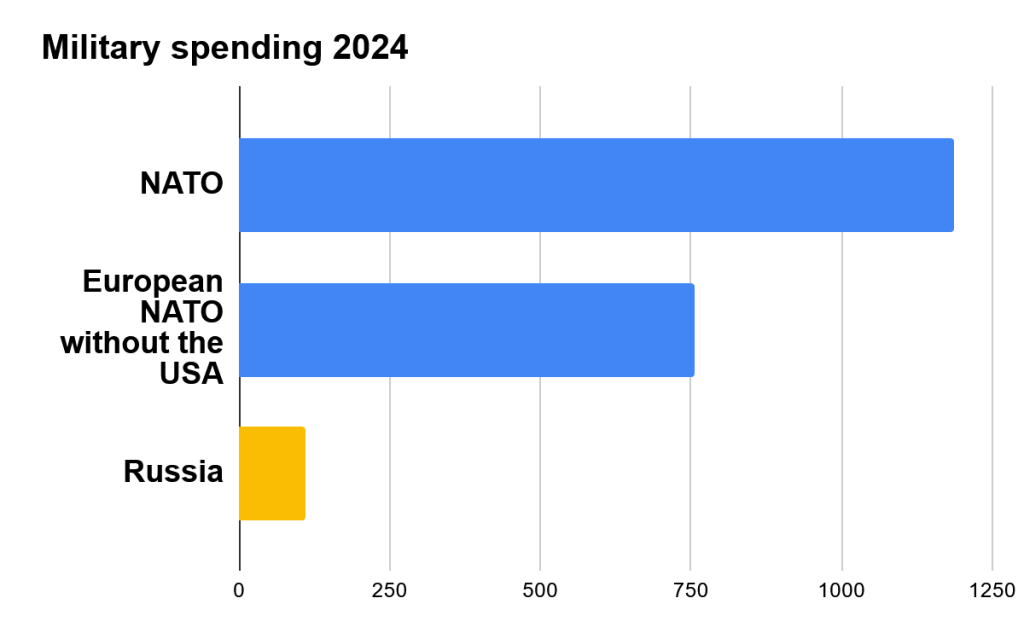
This infographic shows the comparative existing balance of military spending between NATO and the Russian Federation. For every £1 spent by the Russians, NATO spends £11. Even the European NATO powers outspend them by a ratio of £7 for every £1. Proposals to double that can’t realistically be described as “defensive”. We should not support it.

The USC Motion point by point.

  1. Self determination has to apply to all peoples in Ukraine, including the large Russian speaking minority in the East of the country and Crimea. The USC position is based on the delusion that there is one united Ukrainian people, which writes the Russians in the East of the country out of history as if they don’t exist and never have. They did, do, and have been asserting their independence since 2014. Any position on the war that does not recognise this is a denial of reality and principle.
  2. and 3. All children deserve a peaceful education on both sides of the front line. Hopefully we can all agree on that. The USC does not acknowledge that the Donbass has been shelled daily since 2014. Schools and colleges have been hit. Children have been killed. Their lives matter as much as those in the West.

Faina Savenkova in the ruins of school №7 in Lugansk. It was not a warehouse or a military facility. Ordinary children studied in this school. But Ukraine destroyed it during its shelling of the city in 2014.

4. Calling for “Russia” to withdraw from “Ukrainian territory” does not recognise the unresolved national question in Ukraine and, as a result, is a call for the Russian speaking population of the Donbass and Crimea to become refugees en masse. Ukrainian military intelligence is quite clear that the people in these areas have “a completely different mindset” (Kyrillo Budanov, head of Ukranian Military Intelligence) requiring wholesale reeducation and anyone “with blood on their hands” would have to be “physically eliminated” (Budanov again). This could well mean all 55,000 members of the Donbass Militia. Hopefully, we can all oppose that.

5. This point is a cover for NATO to step up the war. When funding, munitions, weaponry, special forces and special advisers, “volunteers”, military technicians and satellite data are core to the war effort this makes it clear that this is not support for Ukraine from NATO, it is the Ukrainian government sacrificing its people on behalf of NATO. A neat formula expressing this relationship is President Zelensky’s comment that his aim is to build “a big Israel in Eastern Europe” – that’s to say, a powerful, technically proficient, military frontier state for the US, guaranteeing its interests in “a bad neighbourhood”. The price being paid by the Ukrainian working class for this ambition is appalling.  The fulfillment of this ambition would not be a good development for the working class in Ukraine, or anywhere else.

6. At the moment the Russians are still able to grow their army with volunteers. By contrast, the early surge of volunteers in Ukraine has long subsided and there is now forced conscription with press gangs roaming the streets widespread draft resistance – with films of men being dragged off the streets into military minibuses and putting up a hell of a fight to stay free. In the Autumn there were demonstrations of relatives demanding to know the whereabouts of their sons, brothers, husbands who have disappeared at the front. UAF losses have been horrific, particularly since the start of the Kursk offensive. As a result, Western “supporters” of Ukraine like Senator Lindsay Graham, have been calling for conscription to be extended down from 27 to 18 years old to supply more bodies to feed into the war. President Zelensky has been resisting this so far, for the same reason that the call up age was so high in the first place. With a steep demographic decline since the break up of the USSR, resulting from a low birth rate combined with high emigration, the number of men in their twenties is about half that of men in their forties; so national survival depends to a large degree on not letting them get killed in large numbers. Hopefully we can all oppose that.

7. In the event of peace, the “Western backers” will call their loans in and asset strip the country and no one should have any delusions about that. Having sacrificed their sons for the West, the Ukrainian people will have their resources annexed by it for the privilege.

i) Opposing the Russian intervention without considering what came before is like opposing October 7th without considering 70 years of Israeli occupation. There had been a civil war in Ukraine since 2014, when the overthrow of an elected Russian leaning President by a mass movement in the West of the country, – supported organisationally and politically by the US and EU – led to a rebellion by people in Crimea, the South and the East of the country by Russian speakers who objected to the overthrow of a government they had voted for. This was crushed in Odessa, led to direct Russian intervention and annexation in Crimea and to a war in the Donbass, after the new government in Kyiv sent in the army and strafed Donetsk city with helicopter gunships. This war cost 14,000 lives up to 2022, mostly on the Donbass side of the front line.

Attempts to resolve this war through an agreement (at Minsk) to allow autonomy within Ukraine for the Donbass Republics were conceded by Angela Merkel to be an attempt to “buy time” while NATO trained up the Ukrainian Armed Forces so they’d be strong enough to retake the Donbass by force. At this point, the Russian stance was for the Minsk agreement to be implemented. They didn’t even recognise the Donbass Republics. This came to a head in the Winter of 2021 -22 when the formal process of starting Ukraine’s application to join NATO began.

The Russians had made it clear at least since the US backed Orange Revolution of 2004 -5 (hard to deny that this was a colour revolution, since the name is on the tin) that Ukraine being in NATO was as much of an existential threat to them as the US had seen Soviet missiles in Cuba in 1962. At that point the US had been prepared to risk nuclear war to get them out. The Russians were saying consistently that this was a similar red line for them. So, in the winter of 2021 -2 they put forward a mutual security treaty as a way to avoid the clash that, without it, they conceived was inevitable, if not now, then later when Ukraine was fully integrated and NATO felt able to chance its arm. NATOs refused even to negotiate on this, either because they thought the Russians were bluffing, or that if they weren’t the sanctions they had up their sleeve would be enough to bring them to their knees in short order. They were wrong about both. But, either way, an alliance interested in peace would have negotiated.

Deliberately pushing across the red lines of a nuclear armed state warning of an existential crisis for it is a level of reckless brinkmanship that puts us all at risk and our movement should be challenging that not supporting it.

ii) See point 2 above.

iii) and iv) All civilian deaths on both sides of the line are to be deplored, as are war crimes committed by soldiers of either side. Trying to present only one side as culpable of this, as this motion does, is reminiscent of editions of John Bull in 1915 banging the drum for recruitment in WW1 on stories of “German beastliness”, and it is dangerously similar to the far-right framing of the Azov battalion (or Benjamin Netanyahu) who see themselves in a struggle for Western civilisation against hordes of eastern Untermensch. In Vietnam, the US forces referred to the Vietnamese as “Gooks”. In Ukraine they refer to the Russians as “Orcs”. There is a continuity in this with the Ukrainian nationalists from WW2 led by Stepan Bandera, who are now celebrated in Kyiv, who fought with and for the Nazis, recruited guards for the concentration camps and massacred Polish villagers.  The longer the war goes on, the more atrocities there will be.

v) The environmental damage is done by the war itself, not just by one side in it. Some of the most productive agricultural fields in the world are mined by both sides. The Nordstream gas pipeline was blown up by the US . The Zaporozhe nuclear power station was shelled by the Ukrainians for months, as was the Kakhovka dam. All these are good reasons for the war to end, not be pursued.

vi) It is the war and resulting sanctions that is disrupting the supply of food and fertilizer from Russia and Ukraine to the rest of the world. Another reason to end it.

vii) What the USC describe as “Russian occupied areas” are Russian speaking areas that rebelled against Ukrainian nationalism in 2014 and are now part of the Russian Federation; so it is entirely logical that schools there follow the Russian curriculum, not that of the state they rebelled agsinst.

viii)  Evacuating children in orphanages and children’s homes from war zones is a necessary precaution to keep them safe. Perhaps the USC thinks it would have been better had the Russians left them in the firing line?

  1. Supporting the trade unions that support the oligarchy that support the war is in contradiction to
  2. supporting campaigns for working class interests, which requires the workers movement not to subordinate itself to its own oligarchy.
  3. 1.2 million of the refugees from the war fled to Russia – which is more than any other single country.
  4. Dissidents are also arrested in Ukraine, some have been murdered.
  5. All refugees should be treated with respect and care wherever they come from and whatever the reason.

The instructions for the Executive do not support a campaign to end the war and the suffering attendant on it. 

All the links they propose are with organisations in the West of Ukraine that support the continuation of the war, and therefore the sacrifice and suppression of the working class. We should reach out to teachers in the Donbass too and should campaign for a ceasefire and peace talks without preconditions.

The NEU already has guidance for supporting refugee children that we should be pressing employers to use for all refugee children.

Photos of children killed in the Donbass by Ukrainian shelling from 2014 onwards on display on the Arbat in Moscow. There are more than 300 of them. Photo Dan Kovalic

A finger of hot schrapnel

One afternoon in 1940, before he was evacuated, my dad, his parents and their neighbours were drawn outside their house in Ireton Place in Grays by the shattering percussion of the Hogg Lane Anti Aircraft battery opening up at Luftwaffe bombers heading upriver towards London. Everyone stood in their front gardens and looked anxiously upwards.

The aircraft could not been seen because of low cloud. Bursts of flak puffed amidst it.

The anti-aircraft battery was loud. It was barely a quarter of a mile away at the crown of the Hogg Lane hill, just beyond Wallace Road, the other side of the thin end of the Titan pit and the allotment. Being on the top of the hill, it had a command over the Thames flood plain below. Navigating by eye, Luftwaffe pilots found the Thames a useful routemap up to London, but had to run the gauntlet of dozens of Ak Ak batteries on the way. This map just shows the heavy batteries. Regular batteries like the Hogg Lane one are not marked.

These are Vickers 3.7 inch anti aircraft guns – the main calibre used in the UK during WW2 – about the same as the more well known German 88 mm gun. It could fire a 13 Kg shell up to 9 kilometres high at a velocity of 800 -1000 metres per second at a rate of 10 – 20 rounds per minute (one every 3 to 6 seconds). This is not a photo of the Hogg Lane site but looks similar, with, from memory, four concrete bases in a kind of four petal shape to make a firm platform for each gun, with a concrete bunker in the middle to store ammunition. This was abandoned at the end of the war and was used to play on by successive generations of children – “let’s play over the army barracks” – until the landscape was obliterated by the Chafford Hundred development in the late eighties. Photo Wikipedia

These guns didn’t often hit anything, but it was devastating when they did. At around this time a Junkers 88 was hit flying at 30,000 feet over Purfleet, disintegrating the plane and killing the whole crew of seven. The youngest member of it was 19, the oldest 26.

Standing outside during an air raid is never a good idea. A friend who grew up in Mumbai told me that during the 1967 Indo Pakistan war – the second one over Kashmir – people would initially go up on their roofs to look at the show when the Pakistan Air Force made raids – and many were killed or injured from falling schrapnel – so that was a short lived diversion.

It surprises me that my grandad’s curiosity got the better of the ingrained caution built into surviving almost three years as a teenage soldier on the Western Front. At one point his regiment was redeployed to Ireland, so perhaps I owe his survival, and my existence, to the IRA, whose insurgency got him out of the trenches for a while.

My family and their neighbours were luckier than the people hit by schrapnel in Mumbai.

There was a “ping” as something hit the roof and a piece of metal bounced off onto the garden. A warning in a way. It was about the size of a fat finger, smooth on one side but visciously jagged on the other. Hot too. As no aircraft were hit by the bombardment, the shell fragment must have been “one of ours”. My granddad picked it up and kept it as a memorial for about twenty years, wired down to a piece of hardboard to keep it safe in the glass fronted bookcase with the tiny ivory elephants and three wise monkeys he had brought back from India when deployed there in the 1920s.

The transition to renewables is not a threat to jobs in the North Sea, its the only lifeline that workers there have.

My speech at the Rally for a Just Transition outside the Treasury last week

When people say “We have to make the transition to sustainable energy BUT we need to save jobs” we need to change one word in that sentence. “We have to make the transition to sustainable energy AND we need to save jobs”.

At the 2017 COP in Katowice – held in the middle of the Silesian coalfield, where the delegates said that they could smell the sulphur on the air – sensing a threat to their jobs, the local mineworkers branch of the Solidarnosc mineworkers union voted that climate change is not happening.

While that’s an understandable defensive reaction, it actually disarms these workers two times over.

  1. It makes it impossible for them to campaign to save their families and communities from the consequences of climate breakdown.
  2. It makes it impossible for them to defend their jobs, because that defence would be based on a fantasy.

That underlines the point that, whether we are a trade union seeking a future for our members – or a government seeking a sustainable future for society – we have to base our policies on reality.

Which brings us to the North Sea.

Oil and gas production in the North Sea is caught in a pincer that has nothing to do with government policy.

  1. The oil and gas fields are becoming exhausted – and even investment in new fields would make an insignificant difference to the speed of the decline in production, and therefore jobs.
  2. Oil demand has either peaked already, or will soon. That sets up a scenario in which the major oil companies are fighting like rats in a sack over the remaining profitable years. As oil demand declines, the only viable companies will be those able to extract oil from the easiest, therefore cheapest, places. That means OPEC, essentially. The Western oil majors will start to go to the wall in order of size and the extent to which their reserves are difficult/expensive to extract. The writing is on the wall for all of them, but BP and Shell will go down long before Exxon Mobil.

But these companies aren’t going down without a fight. They are pushing back hard against the shrinking of their markets, against taxes on their profits.

Part of this is the abandonment of transition plans from fossil fuels to renewables on the part of these comapnies because, in the short term, the former are more profitable. This dooms them and everyone working for them.

The bottom line is that the transition to renewables in the North Sea is not a threat to jobs in the North Sea, its the only lifeline that workers there have.

This is a video of the rally outside the Treasury.

📣 Please like & share the video to amplify our demands ahead of the budget!

Twitter: https://x.com/PlatformLondon/status/1844347237142262256
Instagram: https://www.instagram.com/p/DA8XoAQoD4c/
Facebook: https://www.facebook.com/share/r/X9zuPQXheN92Qebx/
TikTok: https://www.tiktok.com/@stopcambo/video/7424117445268393249

John Wesley’s Twinned Toilets, and other scenes from Central London

On the Metropolitan Line on the way to the joint unions and climate movement rally for a just transition outside the Treasury building, a bloke gets on the tube wearing a blank expression and a black jacket with the legend “Find your own way” on the breast pocket. Its hard to tell if thats a personal philosophy, or advice.

Rising up through Westminster tube station, built at a time of intense de-industrialisation and therefore designed to look like the inside of a power station, a crocodile of kids on a school trip walk across on a higher level. They are wearing scarlet peaked hats, which are a bit MAGA, but, small as they are, they seem calmer, more mature than the people you get at Trump rallies. Odd moment at one of those recently. He complained that the teleprompter had cut out. You mean that stuff is scripted?

At the Portals of Power. Outside the Treasury building (author with Greener Jobs Alliance banner in evil looking black hat).

A lively rally outside the Treasury. A mix of Scottish trade unionists and other UNITE members, the Stop Rosebank campaign, Campaign Against Climate Change, Greener Jobs Alliance, Greenpeace and Scottish FOE. More women than men, including among the speakers. Lots of speeches and chants, people passing sometimes bemused, but a lot of honked car horns and fist pumps from drivers. A letter signed by 60 organisations calling for the government to fund a transition for North Sea Oil and Gas workers so their skills can be redeployed, handed in at the end. It would cost about a billion a year – small change given the totality of government spending and a sixth of what they are spending on maintenance on the Trident missiles they occasionally misfire into the Carribean on tests. Hopefully, when it was handed in by a delegation that included UNITE and Greenpeace representatives, someone from the Treasury was engaged in a discusion about it and was given some food for thought.

In the basement of Central Hall Westminster, the enormous HQ of the Methodist Church, they have a cafe that is a bit hidden away, named after John Wesley, founder of the Church, which a little group of us from the Greener Jobs Alliance repaired after the rally for a bit of caffeine fuelled repair and bounce ideas off each other. Its a light and airy cafe. A bit of a discovery. Good coffee. One of my comrades in Green arms was very complimentary about their bacon rolls. Its a little odd because Wesley himself was not especially fond of coffee. In his Primitive Physick, his rather austere guide to diet and exercise he notes that “Coffee and tea are extremely hurtful to persons who have weak nerves.” However, while he was not especially fond of coffee, he definitely didn’t like tea, blaming it for “Symptoms of a Paralytick Disorder” in himself and, watching people on the street, concluded that there was a lot of that about. He gave it up altogether in 1746, arguing with a friend that “You have need to abhor it as deadly Poison, and to renounce it from this very Hour.” Now they sell mugs with his face on it, but without the quote.

Although, equally oddly, he didn’t note that coffee and tea can be exteremely hurtful to persons who have weak bladders, one of the best things about the place is that they have twinned their toilets with facilities their church has built all over Africa. Every urinal has a little photo above it of a thatched shack in Zambia, or the DRC explaining where it is. They are all unique. The urinals are all the same. None of them is by Duchamp. The shacks are like the Ventilated Improved Pit toilets at Vanghani school in Limpopo, South Africa that I visited in 2005. A gigantic pit with a long drop from a basic toilet seat. The idea being that whatever goes down will be absorbed and the hole will never fill. Works very well. No need for flushing. The pictures felt like humanity and hope.

On the corner outside Westminster Hall, a bloke in his sixties is standing with a home made contraption with a message about the overuse of plastics that looks like a full size crucifix for plastic bottles, which hang from the cross bar like shot game birds. Its so large that its hard to miss. I go over and offer some encouragement and find out that he is doing it off his own bat, not attached to any campaign, just personally motivated to get a worthwhile message out there. Beats sitting at home watching Homes under the hammer I guess. I suggest it might be an idea to have a map showing nearby water fountains and he says that there aren’t any nearby, and those that do exist are often hidden away in odd corners, perhaps so they don’t get worn out by anyone using them.

Opposite him, a big blue banner and EU flag with the slogan “We’re still here because Brexit is still crap”. I think this might have been the bloke who played “Things can only get better” as an accompanyment to Rishi Sunak’s ill judged General Election announcement; one of the things contributing to Sunak’s increasingly frustrated demeanor as he talked on through the wind, talked on through the rain, and walked back into Downing Street very much alone. Perhaps “Singing in the rain” might have been better.

By the statues in Parliament Square, a tour guide rattles through his spiel to a group of teenagers with 1,000 yard stares. General Smuts is turning green behind them.

On my way back down the tube, a family of French tourists walks up the steps towards the exit. As they get half way up, the two toddlers with them, who look like illustrations by Shirley Hughes, look up and out and catch an eyefull of Big Ben at a sharp angle, framed by the humdrum surroundings of the exit and backlit by a bright blue sky, all tall, gothic, gold and glittering in the sunlight, and their eyes widen and jaws drop – “OOOOH! Wah!”

Love a bit of awe and wonder.