This is a tin of beans that slipped through quality control somehow. Aiming to make some beans on toast, as you do, J noticed that the lid on this can seemed a bit swollen, checked the sell by date to find that it was ok until 2027, and pulled on the ring, much as you would a hand grenade.
The resulting eruption splatted all over her glasses, clothes and across the room. The kitchen units, ceiling, floor and windows had an orange explosion pattern reminiscent of the Chemistry Lab ceiling at Grays Tech- a montage of multicoloured stains accumulated over many years of over enthusiastic experiments – with one particularly far flung splat making it as far as the washing machine four yards away.
And that, as you can see form the picture, was just from the top half a centimetre of beany effervescence; a different kind of bang from the one you normally get from Heinz.
There was an item on the World at One on 5th June that talked about the two Israeli hostages whose dead bodies were recovered by an IDF operation in Gaza the previous night.
They were named and some of their story, and that of another hostage from the same Kibbutz were told.
This introduced and framed a following item on the chaotic and lethal Gaza Humanitarian Foundation aid distribution sites, in the same way that Israel’s attack on Gaza is invariably framed with October 7th, as an innoculation against the full horror of it; in an illustration of the way that Stalin’s remark that ” a single death is a tragedy, a million deaths is a statistic” is routinely applied by the news media.
Altogether, the item lasted about 3 minutes.
So, one minute for each hostage.
Were the World at One to give the same respect and time to each of the 62, 614 Palestinian dead in Gaza – name them, tell a little of their story, round them out as human beings in the way they do for the Israelis – that would be 62,614 minutes.
Thats 1,043 hours.
Or 43 and a half days.
If they were to clear the airwaves of Radio 4 to run this continuously, 24 hours a day, starting with their broadcast at lunchtime in June 5th, it would take them until July 18th to get to the end of it.
Speaking today, the Prime Minster stated that the UK has to get into a position to fight a war with Russia. It is a premise of the “Defence” Review that such a threat exists.
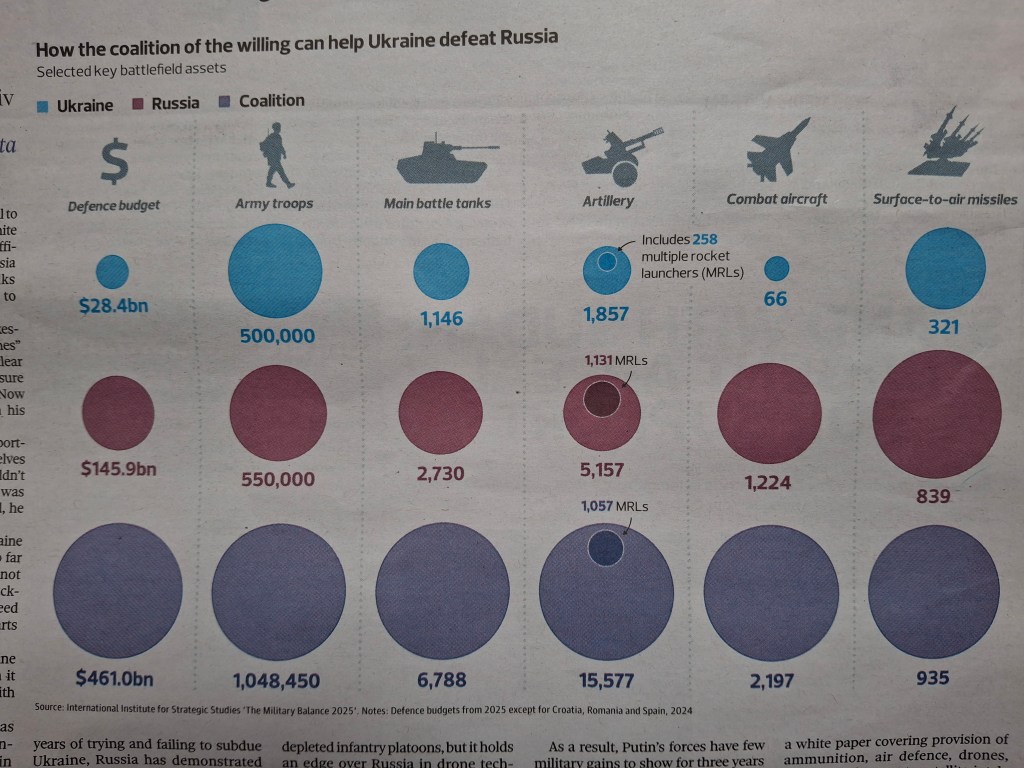
However, last week’s Observer published a graphic that shows the actual balance of forces now in Europe, between the European NATO powers and Russia. This reflects a level of spending that is three and half times the Russian level.
This is it. Have a look at this and ask yourself, who is threatening who here?
Then consider that the proposed 10 fold increase in lethality of the UK armed forces is part of a Europe wide drive to get the imbalance of spending between Euro NATO and Russia up to 10 or 11 to 1. So, this is not about “defence”. It is about being in a position to launch a war. Our current crop of lightweight leaders don’t seem to have studied much History. Invasions of Russia do not go well. As Charles XII, or Napoleon Bonaparte, and Adolf Hitler found out.
Given that Russia is a nuclear power with a nuclear war doctrine that would use nuclear weapons in the face of an existential threat to the country, the suicidal futlity of this drive boggles the mind. Needless to say, NONE of the interveiwers on the Radio or TV today have posed any questions of this sort. In fact, the Veterans Minister told the BBC Interviewer on PM this evening that it would be part of his job to “tell the truth”, which he interpreted as telling a story that projects “the national interest”. So, don’t ask the awkward questions. Close them down. Like we have now, but more so.
Four short points.
The Review states that “you can’t defend on the goal line”. What they mean by this is that the UK armed forces would be fighting wars in other countries – as they have done regularly and consistently since WW2. Nothing new there. But there is a particular emphasis on Russia. How they envisage fighting even a conventional war with Russia without utter devastation for any country unfortunate enough to be on the front line, or within reach of even conventional missiles, isn’t elaborated on. We just get the old chestnut that to defend peace we have to be able to fight and win a war. That’s what everyone said in the run up to 1914, and look how well that turned out.
The Review envisages mobilising the whole population for war readiness. That means a huge propaganda effort directed at civil society and through the school curriculum, presumably boosting cadets corps as part of the process, and weeding out dissent, either through Prevent or something more bespoke. A robust resistance to this from educators in defence of peace and sanity will be essential. As the Minister on PM said, this will be what we did “in the Cold War”. Similar conscientious objection will be needed, as it was then, to attempts to impose a stifling conformity, and any of the rituals deployed to shore that up.
Complaints have been made in the press that the Armed Forces are losing people faster than they can recruit them, “even though the government has pledged to provide peacekeepers for Ukraine”. Has it not occured to them that this might be one of the reasons why more peopple are leaving than joining?
The government is keen to talk about “military Keynesianism” rebuilding the economy, and some unions will go along with that on a “British Bombs for British Workers” line. This is nonsense. Military investment is, hopefully, wasted. The weaponry produced doesn’t build anything. Quite the reverse if used. This is unlike investment in, say, Health or Green transition, both of which produce much greater returns in value added and job creation. Explored in depth here. So, this is a dead end, in both respects.
The bottom line is that this is a political and military posture of choice. Impoverishing our society to ramp up arms spending, some of which will be exported to allies like Israel or Saudi Arabia to pursue genocidal attacks on Gaza or Yemen, in pursuit of a confrontation with Russia that will kill all of us if it follows its own impetus to full scale war, is not inevitable, not an imperative. Seeking a peaceful resolution to the Ukraine war and an ongoing modus vivendi with Russia that cools off military confrontation across the whole of Eurasia is an alternative that the whole Left should fight for. Some of the framework for this is explored in the Alternative Defence Review produced by CND and the RMT.
Please note. My Blogs are banned of Facebook because they say they “look like spam”. This has somewhat reduced their reach. If you think the arguments are worth passing on, and want to help break the ideological blockade embodied in this sort of action, please pass it on to anyone who you think might find it interesting or useful.
This is the story of my Dad’s life written and told by me and my brother at his funeral on 27/5/2025.
CHRIS
Welcome everyone and thank you for coming to this commemoration and celebration of the life of Ronald Henry Atkin.
A chance to say goodbye to our Dad.
As you may have worked out, Dad was in many ways an unconventional man and in accordance with his wishes this is a non-religious ceremony, but there will be a moments later for reflection, contemplation and prayer if you so wish.
PAUL
The heavy rain today reminds me a bit of a joke Dad used to have when we went on weekend family outings in the old Morris Minor in the sixties, and the weather refused to cooperate. He would say we were out on “Atkin Sunday”, guaranteed to be the one day in the year in which the rain came down sideways.
To begin at the end… as part of the essence of living a life is that we have to leave it.
A few weeks before he died Dad asked “What am I for now?” It struck me that this was a very characteristic thing to say. Dad always wanted to be useful, helpful, always wanted to make sure that everyone else was alright. Whenever he was in hospital, his first question was always “is Mum alright?” It also struck me how being cared for is a useful role in itself. It enables people to come together in being kind and to find redemptive qualities in each other; solidarity not solitude.
CHRIS
Any brief autobiographical account like this one of Dad’s life may give an impression of a solid-straight line. Born in Grays, lived in Grays, died in Grays. Married for 72 years, 2 boys -us- not quite 2.5 children, but close, a long working life at the same factory and a long retirement. His story however was much richer than this and although his work-ethic was born of a loyalty, love and need to provide and care for his family, he was a man of very wide interests and tastes. With an open curious mind, interested in culture, politics and art and in people.
He was a warm, intelligent man with a wry sense of humour. In many ways self-taught- his education interrupted by war and attending an all-age single class village school for three years. He loved such things as Shakespeare, Ballet concerts and Classical music as well as the Rolling Stones and Jazz, Ian Dury and Paul Simon. He was interested in anything we were interested in; culture, history and politics on the one hand and music, drama and football; Spurs in particular, on the other. The latter being solely down to me I’m afraid.
He liked fine things- single malt whiskey, books, bow ties and cuff links. He also loved owls and had a large collection of ceramic owls. There will be a little more on the significance of owls later.
PAUL
Dad was born in 1930, in “interesting times”– 6 months after the Wall St crash, two and a bit years before Hitler came to power- and when a revolution in aviation -which always fascinated him throughout his life- was developing as fast as things like new chocolate bars were being created.
At a time when the average family size was shrinking, he was the only child of his mother Ruth and father Cecil (known as Tom) and grew up on the Hathaway Road estate, where he lived for almost all of his 94 years – surrounded in childhood by aunties who looked like peas in a pod and cousins who were as close as siblings – particularly Ruth, who’s here today and, at 97, will probably outlast the lot of us. He also had a very tight link to his cousin Len, until Len emigrated to Australia as a ten pound pom in the 1950s.
As the tallest boy in his class at Quarry Hill school he was always being given things to carry and wave, including the banner that kept the children together as they were marched in a crocodile to the station to be evacuated in 1940.
CHRIS
Evacuation was a formative experience for Dad and in many ways a positive one; he was safe, he was surrounded by the countryside, living in a large Georgian farmhouse in Little Somerford in Wiltshire with plentiful food.
He spent three years in Wiltshire at a time when people from Little Somerford often referred to people from Great Somerford as “foreigners”, but he fitted in. He helped with the harvest, pumped the organ in the local church, perfected his ability to mimic accents, developed his love of nature – he made us all birdwatchers in a low key kind of way – But he was homesick and really missed his family. In the three years he was away, he had one visit from his Mum, and one visit from his Dad; and this also gave him his lifelong empathy with people displaced by war and other disasters.
PAUL
When his parents thought it was safe enough, he came home, only to be narrowly missed by a Doodlebug that wiped out the houses at the bottom of Cromwell Road, another that landed next to his Nan’s house on London Road and bombed them out, and an incendiary that hit his parents house in Ireton Place. Luckily this ended up on the concrete floor of the pantry, where it fizzled out. He also looked out of his bedroom window one morning and saw a Junkers 88 dive-bombing somewhere to the West, which turned out to be the railway line at Thames Board Mills. Dad said he was impressed by the skill of the pilot who hit the line smack in the middle, but also by the skill of whoever the slave labour saboteur was in the Nazi munitions factory, as it didn’t go off.
Towards the end of the war, Dad (and Len) joined the Air Training Corps, which used to meet in the hall at Grays Tech; where he also attended evening classes.- which were also attended by Pat Burford- our Mum.
In 1945 the election of the Attlee Labour government introduced the National Health Service, which Dad always felt was the bedrock of a humane post war society. It was also the year that Dad ran down Hathaway Road after evening classes to catch up with Mum, and started a conversation that lasted for the next 80 years, starting with the immortal words “Will you go to the pictures with me on Saturday night?”
CHRIS
He had left school at 14 -although, he sat the 11 plus in Wiltshire, all the Grammar school places were for “local children”, so he never found out if he’d passed or not- and had a variety of jobs – at Thames Board Mills, delivering milk, a painter and decorator with Osborne’s. At 18 he was called up for National Service with the RAF and as he’d always dreamed of being a pilot, they decided to make him a wireless operator, instead…
He told his grandson Joe -now a professional musician- that the secret to Morse Code was not to get too hung up on the individual letters, but to listen to the music of it.
Dad could find the music in most things.
Sadly, Dad also found that he was often airsick and did not pursue any sort of career involving aviation. In any case he had met Mum and was very keen to build a future life with her as soon as he could.
PAUL
Stationed at Gloucester, a long way away from Mum, he had a colleague send him the local weather forecast for wherever she was, so he had a connection with her. There is a blown up photograph from this time on display in the Clarence Road entrance to the Grays Shopping Precinct, that shows Mum and Dad crossing Orsett Road with their arms around each other in about 1949*. Dad home on leave looking impossibly tall in his RAF uniform; and risking a charge for not having his cap on.
CHRIS
After being demobbed, Dad got at job at Proctor and Gamble, and spent the rest of his working life making soap, washing powder, Fairy Liquid. Early on he said that some of the machinery seemed to have been designed to be operated by “a dwarf with three arms”. He worked shifts- Earlies, Lates and his least favourite Nights. As children, I remember Mum kept us very quiet around the house when he was on Nights; then we would help mum bring him tea in bed around 2 in the afternoon.
PAUL
Dad was full of stories garnered from his workmates- giving some names an almost legendary status at home – Charlie Broyd, Bernie Bonass and especially West Thurrock’s answer to Socrates, Joe Cloherty. After being retired for 35 years, in the last few months of his life, Dad started to have dreams about being back at work, having to take readings and start up the machinery – he’d ask us to have a look at what the dials said on that panel on the wall – the sort of workplace anxiety dreams, which you get if you are conscientious and care about what you do and the people you work with.
Some of his friends in the air force had been very much on the political left, and that influenced him – and by extension us. He read the Guardian – thoroughly – every day. Has been known to wear sandals, and sometoimes, eat Muesli. He always voted Labour and leaned towards the Lefter side of the Labour coalition. But this wasn’t unthinking tribalism. During the General Election last year there was a knock on the door. When I answered it there was a brisk and efficient Labour canvas team working its way down the road. I said “My Mum and Dad have voted Labour in every General Election since 1951, and I don’t suppose they atre going to chnage now”, then gave him an earful at the Party leadership’s move to the Right. When I treported this conversation back to Mum and Dad, Dad said “Hmmm. Would you disown me if I voted Green?”
He always took an interest, always listened to people and was prepared to rub along when views differed, usually finding humour in a situation, or a connection to the underlying humanity that he always looked for – and, because he was looking for it, found.
CHRIS
When Dad died I put a post on Facebook to inform family and friends and I was struck by how many of my old friends posted comments using very similar language; about how welcoming Dad was and how he made them feel welcome whenever they visited. It never occurred to me until then how true this was and what it meant- that it meant so much, how Dad made people feel.
He was a man who was comfortable with himself and with others and he enjoyed being with others. He was in touch with his emotions and they were positive and warm. We never knew anger growing up, not even when we nearly burnt the kitchen down, trying to surprise Mum and Dad by making them breakfast in bed one time. Anger was reserved for politics or disrespectful service in shops perhaps.
PAUL
He was not in any way a broad brush, slapdash sort of person; witness the back garden at 112 for the immaculate balance of colours, shapes and timing, or his DIY, or any of his paintings, or the model aircraft he made – where he wouldn’t just produce a generic World War 1 aircraft out of the box. He’d research a particular aircraft and paint the model to match it exactly and rig it with tiny bits of cotton to stand in for the wires that supported the struts on the wings. These were not supplied by Airfix.
This is his painting hat, which he wore for fun to help get in a creative frame of mind; because if you are going to do magic things with paintbrushes, it helps to have a magic hat. It has badges…aircraft museum, World Wildlife Fund and the National Trust, a CND peace badge, Homer Simpson, an Eddie Stobart spotters club – because when you’re driving long distances, games and rituals keep you sane – Tottenham Hotspur – because football, as we know, is about art…and suffering and, just occasionally, joy, and two red nose day badges from the late 90s when the kids were little and selling them; which I initially mistook for blood donor badges – as he gave many an armful over the years.
CHRIS
He built a wonderfully long and great life with Mum that was based on respect and love; from dinner dances with friends (we’ve forgotten to mention what a great dancer he was!) and holidays, concerts, and days out to memorable Christmases and Birthdays. He was at the centre of things. Not in any dominating way, but as the catalyst of good feelings. Effortless and understated.
Dad had no faith but I would describe him as a soulful man. On my Facebook post I described him as a beautiful man in every way. And he was. I could not imagine a better father, or role model; without trying -just by being him-he taught us how to be a respectful, kind and to aspire to be a decent human being in all we did.
He will be greatly missed by all who knew him and loved him.
* The photo at the precinct entrance is wrongly captioned as Orsett Road in 1955. As Dad was demobbed by 1950, this is wrong.
Like a chess player in time trouble, moments of crisis can produce moves that undermine a whole position. So it is in this week’s Observer, arguing that Euro-NATO can go it alone in pursuing the Ukraine war without the US, and printing a graph that shows what the real balance of military forces already is, they can’t help but undermine the core case for increases in military spending instead of a peace settlement, that without it the Russians will invade Europe.
This is the graphic they published. Hence this letter to the editor.
Now that you have published a graphic (As Trump steps back, Ukraine looks to Europe for a way of defeating Putin) that shows that NATO in Europe, without the USA and without Ukraine, outspends the Russians on defence by three to one – which shows up in twice as many troops and aircraft, three times as many tanks and artillery pieces, and even an advantage in Surface to Air Missiles – can we please have an end to articles arguing that if there is a peace in Ukraine that respects the rights of Russian speakers in the South and East of the country, this will be a cue for a Russian invasion of the rest of Europe? And, indeed, pretending that the proposed increases in Euro NATO military spending up to 2030 – aimed at increasing that ratio to a staggering 10:1 – are a necessary defensive measure, rather than a preparation for a war of aggression – impoverishing us in the immediate term and threatening nuclear annihilation should it be launched?
Please note. My Blogs are banned of Facebook because they say they “look like spam”. This has somewhat reduced their reach. If you think the arguments are worth passing on, and want to help break the ideological blockade embodied in this sort of action, please pass it on to anyone who you think might find it interesting or useful.
Because of a brief break in the drought, that left the roofs and pavements dark and shiny, and everything green breathing more freshly, I had to borrow my dad’s old raincoat to get up to London without becoming a sodden mess. It was hanging up in the hall, from whenever it was that he wore it last. Some years ago now. Old styling, but high quality polyester and clean and unrumpled. It didn’t go with my peaked sky blue hat and I briefly considered borrowing Dad’s flat cap, which would have matched it very well; but thought better of it because it would have felt as though I were cosplaying my dad.
Wearing an unaccustomed outer garment, in a style that you normally wouldn’t, makes you feel as though you are someone else anyway; because you have shucked off your normal outer appearance to some extent. Dressing differently confers a sort of anonymity, or an opening up of other possibilities. I suppose that the essence of acting is to inhabit these alternative selves. In the case of spies, to inhabit the anonymity, to fade into the background while making mental notes, the acute observer going unobserved – or so he hopes. Or being a plausible enough facsimilie of the role being played, that an equally astute observer will be taken in. One of John Le Carre’s themes is that a personality type that can make an effective spy – especially a double agent – is not so much someone burning with conviction, but a shape shifter, a con man who has enough empathy to at least temporarily be able to become a person with completely different values and convictions and be believable. One or two of his characters find the tension of this unbearable. The coat itself, an ambiguous shade veering between grey, green and a particularly hideous brown seemed to be an embodiment of this idea.
Walking up to the station, I am passed by a fast walking lean man with darty snake like eyes, a killer jaw, sandpapery, grizzled, set, but trembling slightly, a tan suit and shiny black shoes…a hit man in beige. But if he was, you’d notice him. He’d need a raincoat.
Just before Limehouse station (when did that stop being Stepney?) there is an athletics track. The main stand was half full, but in a concentrated sort of way, people all bunched up in a companionable triangular clump. But nothing seemed to be going on. Spectators with no spectacle.
Just after Limehouse, there is a repurposed cinema, the Roxy, with its name painted in huge vertical letters on the end facing the railway tracks. A bit of decoration at the top that looks like the letter “t” gives the impression that it has been transplanted from Yorkshire. “Let’s go to t’Roxy”*. In the middle of the O, they have painted King Kong’s face, as though he is staring out of a huge porthole at you. On the way up to London, in a burst of sunlight, he looked quite benign; a bit like Hugh Jape in Willy the Wimp. On the way back, in the dark, he looked moody and menacing; as well he might.
The ceramic poppies set in a V shape on the White Tower seem to me to have lost some of their poignancy. The horror of all those lives lost, buried twice over in a celebration of winning. Its the V that you notice. An embodiment of the despair that all that sacrifice is being exploited to try to make people prepared to do it again. The real flush of actual poppies, delicate scarlet life bursting through the waste space by railway tracks and in back alleys, is like a burst of hope that we can do better.
On my way back from the shops yesterday, I passed two neighbours chatting in the street outside their houses. A woman in a hijab with her small child was bantering about ice cream with the bloke next door, who was audibly Eastern European. They obviously knew each other well, and got on. Friends, not starngers.
This is in Thurrock, an area that was Brexit central, with a 72.6% leave vote in 2016. I find that, nevertheless, this is an area that is converging with Brent, where I normally live, the most ethnically diverse borough in the country. My neighbours in both places are not simply diverse, they are also ethnically mixed. As is my family.
When I used to analyse the ethnic monitoring stats for the school I used to work at in Islington, the fastest growing group was “mixed”. So, far from immigration making us an “island of strangers” many of us are getting on well enough to be as intimate as you can get.
In this context, and in the wake of Keir Starmer’s pedestrian dog whistling about immigration on Monday, Labour List’s article Local elections: Reform took four times more Labour seats than other parties is disingenuous. It implies, without stating it, that the loss of SEATS to Reform must mean that there is a loss of VOTES to them. And what follows from that is that there is a need – in the framework of the sort of electoral pragmatism that cares not what platform a Party stands on so long as it wins on it – to “address the concerns” of Reform voters in order to win those votes back.
This is a fallacy for three reasons and one principle.
Reform has the momentum on the Right, and cannibalised the Conservative vote. Whether they will eat the whole Party before the next General Election is open to speculation, but it seems likely. These elections were held for the most part in Tory held areas that have been Conservative since the Jurassic and have now voted for a different, even worse, kind of Conservative Party (in the hopes of getting back there).
The Labour vote did not migrate to Reform in a big way. It mostly stayed at home. Feedback from the doorsteps in the Runcorn and Helsby by election was that it was the cuts to winter fuel allowance that was the biggest demobiliser; so people who voted for a change from austerity and “hard decisions” taken at the expense of the poorest last Summer, were now less than enthused by what the Party had to offer.
The government has been trying to cosplay Reform for some time, even to the extent of putting out ads boasting about how many people they have deported in Reform colours (which would be taken by most people as a Reform ad anyway, so self harm in more than one respect). The week of the elections saw announcements on a tougher line on immigration from Yvette Cooper on the presumption that the approach “Reform is right about immigration, we are trying to stop it, vote for us to stop Reform” would do anything other than legitimise them; and demoralise anti racist Labour voters. And, so it came to pass…
Tony Blair remarked after the 2017 General Election that if Corbynism was the way to win, he didn’t want to take it. Given the interests that have made him an extremely wealthy hollowed out husk of a man, this is hardly surprising. But the point applies in the opposite direction. Anyone even pretending to be on the Left who starts trying to exploit – and create – false divisions in our communities is doing the Right’s job for it. For the Labour Party, a lurch onto Reform’s xenophobic turf is a jump into quicksand.
The next lot of local elections will be in the cities. Reform is likely to still make the running on the Right. Labour, if it carries on trying to compete with it on its own terms, while presiding over austerity and an arms drive, instead of making a sharp turn to wealth taxes and investment in infrastructure, public services and green transition, will shed a collosal number of votes, to the Greens, to Independents (especially purged former councillors) even to the Lib Dems in some places, and many will stay at home.
Apologetics of the type that Labour List just published, will help drive that outcome.
Since my Dad died, one of the few things that has uplifted me is an unexpected brush with nature, especially in the air.
A glimpse of a Red Kite circling effortlessly in the far sky.
Seeing bats flitting across my Mum’s back garden in the dark, acrobatic in the twilight.
Which is why the news that the government is considering rowing back on a pledge to require new built homes to have a nest brick built into them came as a such a puzzling shock.
Nest bricks aim to make up for the absence of nesting spaces under the eaves of modern homes, which has helped cut our swallow and sparrow population by half in the last few decades.
They cost £35 per house, so not an onerous burden on developers.
The apparent reasoning is that encouraging the recovery of bird life will be “unpopular with voters”. I really don’t know who they might have been talking to. Perhaps they are the sort of people who hear the word “green” and reach for their chain saw.
It makes me wonder whether the Ministers who are pondering this have ever seen a swallow. They will have the opportunity in the next few weeks. I’d urge them to get their noses out of their red boxes and look up. They’ll feel so much better for it if they do; then make the decision to give more of us a chance to keep doing it.
Wordsworth once wrote “my heart leaps up when I behold a rainbow in the sky”. If you don’t feel the same about swallows, your soul is dead.
Please sign the petition to show that people actually like to live with and in inspirational nature and pass it on.
Every year during the Autumnal years in the early sixties, when I was in my last years of Primary school, as the nights drew in and visibility declined on the playing field at the heart of the estate I grew up on, some of my friends claimed that it was haunted by bodyless heads that they had seen floating across it in the middle distance. There was much heated debate about this, with most of us quite sceptical, but the sheer vehemence of those that had “seen” was enough to bring on a wary shudder in our lizard brains – of the same sort that made us nervous of walking up the alleyway behind Cromwell Road in the dark, because the bush half way up, which we knew perfectly well was a bush, looked like a gigantic bear reaching across to grab and eat us. Some Winter evenings we got a bit of the way up, saw the bear bush, hesitated and turned back. An irrational fear that we knew was irrational, but potent nonetheless.
The bodyless heads turned out in the end to be some older kids who’d started the story as a lark, and backed it up by running across the field shining torches up into their faces, giving the impression of eery ghost lit heads floating at speed and sparking shouts of “ITS THE BODYLESS HEADS!” from the gangs of younger kids still mooching about after it was too dark to play football but too early to go home to bed and hasten the next day…and school. Even though we could see the bodies running along, dimly, somehow it was more fun to believe than not.
I was reminded of all that by these bodyless heads in the local precinct. Decapitated dummies, oddly cloned, modelling hijabs and other stylish headgear, balanced on the top of rollable purple luggage; in some ways even more eery than the original fantasy in the field. Somehere, there are complementary headless bodies…
This one looks a bit resentful that someone has taken a lump out of her nose.
Talking to my brother about this revealed an alternative origin story for the bodyless heads. Long before Halloween was a thing in England – we used to do “penny for the Guy” for Guy Fawkes night and no one had heard of Trick or Treating (or “trickle treating”, as the kids in my class used to say) – one of our more creative Primary school teachers got us to carve a Jack o Lantern. Being England in the 1960s, we didn’t have pumpkins, so I think we used Swedes. They smelt really bad anyway. They were quite small and a bit pallid looking, but we put candles in them, and I think some of my classmates might have put them on top of the fence posts at the ends of their back gardens facing onto the Field; so, from a distance in the twilight, the legend of the bodyless heads would have been born. The kids with torches would have been playing into it for a laugh.
“I don’t want anyone else to die,” Natalya says, crying. “Our little trooper is the youngest of all those who lie here.” “Here” is the military cemetary in Lviv. Her son was 18.
What follows are a series of quotes from an article in Meduza based on interviews with people across Ukraine. Meduza is a Latvian based English and Russian language news blog with an unofficial motto “make the Kremlin sad”.
Despite that. what is striking about this selection is how the views expressed differ from the limited range of Ukrainian voices we get to hear in the official media here; which is why I have highlighted them in concentrated form in this blog.
I want to stress that for each of these views in the full article – which is worth reading – there is another arguing for carrying on fighting until the 1991 borders are restored, “otherwise what have we been fighting for?”
In these arguments, the deaths of the future are sanctified in advance and made imperative by the deaths of the past. None of the people who put this view, however, argue that it is possible. It is posed more as as a moral imperative, a revulsion against sacrifice in a lost cause; thereby carrying within it the prospect of a backlash not only against any peace terms that Ukraine accepts, but also those who have conducted an ultimately futile war. So the question “WHAT have we been fighting for?” is inextricably entwined with,“WHO have we been fighting for?” especially as the Kyiv oligarchy’s US puppet masters measure up the country’s natural resources as compensation for defeat.
“This is a separatist city; there are many zhduny here,” he ( a young soldier in the Ukrainian army) says of Sloviansk (a city in Northern Donetsk, close to the front line now) using a Ukrainian term for people who are “waiting for Russia.”“Even the local grandmas look at me like they want me to drop dead.”
According to Oleksandr, Sloviansk residents with pro-Russian views no longer speak openly “because they understand it will cause them grief.” But Lera says that in some local Telegram groups, they refer to the Russians as “ours,” and local taxi drivers and shopkeepers often use the word “ruble” instead of “hryvnia.”
This confirms that pro-Russian views in eastern Ukraine are a reality, not a “Putin talking point”.In other parts of the country, sentiments like these are expressed.
“If I were [in the politicians’ place], I’d have come to an agreement already, to be honest. I just want the war to end.”
“Yes, we’d like the 1991 borders to be ours, but not [if we have to fight] to the last Ukrainian. If so, let everything remain as it is. Not at this price.”
Borys says he wishes “Zelensky would stop this.” He thinks that Ukraine’s occupied territories should receive neutral status or become part of Russia, so long as the majority of Ukrainians are left alive; joining NATO isn’t worth such losses, he says.
“I think we should start negotiations [with Russia] and then decide the fate of [the Donetsk and Luhansk] regions through an honest poll. So people can decide for themselves which country they want to be in,” chimes in his friend Ihor, 18.
“Are we going to sacrifice a million [people] for Crimea? And then what will we get?” Valetov continues. “I’m going to say something [that sounds] bad, but the people in Donetsk and Luhansk are no longer ours — with the help of television and Telegram, you can flush everything [Ukrainian] out of people’s minds in 11 years.”
She worries that politicians have gradually turned the war “into a business,” and she doesn’t understand how the money sent to help Ukraine is spent. “I have a lot of friends at the front whose [relatives] equipped them,” she says. “[It’s like,] You want normal body armor and a good helmet? Get it yourself.”
“I don’t understand why our boys are at the front, but guys from Donetsk come here in their big flashy cars and live it up,” she cries (Maryanivka is about 500 kilometers, or 310 miles, from the front line in Donbas). “Why don’t they go there and defend their territory?!”
Ukrainians are tired of the war for many reasons, including because many of them donate money to support the army only to hear about constant shortages of weapons and equipment. She’d like the war to end with Ukraine getting back its occupied territories, but “if it were going to happen, it would have happened long ago,”
“Do you know what a Pyrrhic victory is? I don’t want such a victory,” he says. “But if our territories are given to Russia, this would be a capitulation, which isn’t right either. Therefore, just freeze the conflict. But on one condition: our country introduces the death penalty for embezzlement today. I’m no supporter of the death penalty, but I think it’s time.”
“They’re stealing our boys!” cries Yevhenia (name changed). Her draft-age son “was taken right from the bus stop” to basic training, even though he should have received an exemption as his grandmother’s caregiver. Yevhenia says her son failed to submit his documents to the military enlistment office in time. “If I’d known that would happen I never would’ve let him go out!” she says, practically in tears.
“It feels like they just want to destroy us,” he explains. “Not just the Russians, but our command, as well. We’ve been sitting at the front endlessly. It’s as if they’re saying, ‘There’s no one to replace you, [so] you have to die here.’”
According to Stanislav, morale is low and soldiers are just trying to survive. “Anyone who talks about peremoha should grab a Kalashnikov and go for it,” he says, using the Ukrainian word for “victory.” “On the Zaporizhzhia front, the Russians are making concrete and fortifying their positions with it. How are we going to break through? I’m horrified at the thought of going on the attack there. We’ll just drown in blood.”
Asked what to do about the so-called Donetsk and Luhansk “people’s republics,” Stanislav argues that the easiest solution is to “amputate” the Donbas region. Mentioning the fact that Ukrainians live there makes him roll his eyes. “Oh, for fuck’s sake,” he says with a sigh.



 Urban ramblings