Odd scenes in North West London and South East Essex
Walking past the Thameside Theatre and a woman is furtively picking what looks like lettuce leaves from the flower beds at the front. I assume that she is wild scavenging, and now that I look like a harmless old geezer, complete with arthritic limp and shopping trolley, I feel emboldened to talk to strangers, so I ask. “Are those edible?” Waving them to underline her point, she says, “They are for my tortoises”. In Todmorden this is what everyone does. For over ten years they have encouraged people to plant food on any vacant and unused land, and for anyone who needs it to pick it. This brightens and greens up the streetscape, creates community – as loads of people plant things in all sorts of places – and provides extra fresh food, in season, for anyone who needs it. This has been picked up in lots of other small towns, but Hull is about to try it out on a city wide scale. We should all do it. Why can’t our High Streets be orchards too?
Three shops in Rainham. Vape shop. Fried Chicken shop, Undertakers. In that order.
As the C2C train arrives at Dagenham Dock, the small girl wearing a blue jacket with white angel wings designed onto the back – who has hitherto been exploring the physical space around her Mum, who sits a bit careworn in her mac and hijab, and elder sister, who is glued to her phone – lifts her head and listens. Perhaps its because the recorded announcement is done in posh. Emphasising all three syllables – “Dag-en-ham”, not the local version that makes the middle one redundant – “Dag – nem”; thereby bringing out its full rhythm and range of sounds. The drum beat of the syllables too; Dagenham Dock, boo, ba, bum – BOM! The percusive consonants at the start of Dagenham, the extended hum at the end Dagenhmmmm– the sharp crack of “Dock!” She seems enchanted by it and, all the way to West Ham, she keeps repeating it in various forms – stretching it out, making it jerky and jumpy- making it an impromptu nursery rhyme with no meaning but a definite music.
Of course, the part of my brain that still thinks in Lesson Plans started working out how to canal this spontaneous exploration into a rhythm game: sit in a circle and clap and chant the the names of stations; always ending at Mornington Crescent obviously…
Outside the Magistrates Court on the Edgware Road, a couple of pararazzi snipers with huge photolens cameras lurk in ambush, presumably waiting for a celebrity wrong ‘un to emerge at the top of the steps; the name of the Court photogenically framing them in more ways than one. One scopes out a shot from behind a tree, perhaps nervous of being seen by his mark.
A recent article on Labour Hub tries to link the struggle in Gaza and the war in Ukraine as parallel “struggles for self-determination”; not noticing that one struggle (Gaza) is in resistance to the US centred global imperial system, the other (Ukraine) is a struggle to join it as an auxiliary ally.
People in the Palestine Solidarity movement have strongly felt and taken note of the difference in the response from Western governments to these “struggles for self determination”.
The flags of Ukraine and Israel have both been flown on public buildings, head teachers and college principals have been told by the DFE to “stand with Israel”.
Palestinian flags – and Keffiyas – have been denounced as “threatening”, or “symbols of terrorism” or “hate” and children drawing flags on their hands or wearing badges in schools have been referred to Prevent. This has become increasingly shrill as the movement has grown and public sympathy for the Palestinians has grown with it.
Like many similar articles, this one has two glaring pieces of disavowell at the heart of it – a selective approach who who is entitled to self determination and a failure to take account of the very active role of the United States and NATO – and a logic that leads those sections of the labour movement who support their line to end up campaigning for the rearmament and militarisation drive that our ruling class is determined to push, even as our societies crumble for want of invetsment and fail to rise to the challenge of climate bteakdown.
All peoples are entitled to self determination, but some are more entited than others.
If a struggle for “self determination” is based on denying that right to another people, it has no leg to stand on. The Palestinian struggle, including the way it is defined in the revised Hamas Charter (2017) is against Israel as a racist state, not against the Jewish population, in the same way that the struggle against Apartheid in South Africa was a struggle against the state, not white people as such.
The dominant, far right, form of Ukrainian nationalism, however, denies the national rights of Russian citizens and heroises historic figures like Stepan Bandera, a recruiting seargent for Nazi concentration camp guards. The US and NATO are quite comfortable with this, but no one on the Left should be.
In this Labour Hub article, like so many others, the Russian population in Eastern Ukraine is ignored. Its as if they don’t exist, didn’t rebel in 2014 against the overthrow of a government they’d voted for, and weren’t bombed and shelled indiscrimately by the Ukrainian armed forces from then onwards. At most they are posed as “Russian proxies” with “no interests of their own”; just as Ansar Allah in Yemen is belittled as “Iranian proxies”. This writes them out of history just as surely as the Israelis would like to do to the Palestinians, who are still described in some quarters there as “not a people”.
As this statement from No Cold War – The War in Ukraine must end – points out; A 2001 census found that nearly 30% of Ukraine’s population considered Russian to be their native language. States with large linguistic and ethnic minority populations can only maintain their unity if the rights of such minorities are respected. The policies of the Ukrainian government after 2014, which included suppressing the official use of the Russian language in numerous spheres, were therefore bound to lead to an explosive crisis within the Ukrainian state. As the Council of Europe’s Venice Commission, which certainly cannot be accused of being pro-Russian, stated: ‘the current Law on National Minorities is far from providing adequate guarantees for the protection of minorities… many other provisions which restrict the use of minority languages have already been in force since 16 July 2019’. There are only two ways to resolve this situation: restoration of the full linguistic and other rights of the Russian-speaking minority within the borders of the old Ukrainian state or the secession of these regions from Ukraine. Which outcome is realised will be a key subject of the negotiations. Nonetheless, it is clear that any attempt to maintain the Russian-speaking minority within the Ukrainian state while continuing to deprive them of their rights will not succeed, nor will any attempt by Russia to impose another state on the Ukrainian-speaking population of western and northern Ukraine.
All efforts to resolve these issues by military means will continue to be futile and will only result in further intense suffering, above all for the Ukrainian people. These realities will become increasingly obvious if the war continues – which is why it must be brought to a halt as rapidly as possible and negotiations must commence.
A “self determination” that denies the national rights of a large minority and denies it equality before the law within the area controlled by an ethnically defined state sounds a lot like Israel – a living expression of Marx’s dictum that “a nation that oppresses another cannot itself be free”. Not something any Socialist should be defending.
The limits of geopolitical Flat Earthism
Its important also to grasp the broader geo political context of these wars in a way that makes sense of both of them. This is because articles like this one reflect a widespread view on the left in the Global North that the world is geopolitically flat. That every country is capitalist. That there is no structure to global imperialism.
This is profoundly disorienting and can lead to the same people challenging the dominant narrative coming from our own ruling class on Gaza, while actively repeating it over Ukraine.
This is inherently distorting for any accurate understanding of whats going on; especially if you fall for, or worse, promote the sort of manichean propaganda that the Russians (or Hamas) are all evil, murdering rapists, while butter wouldn’t melt in the mouths of the Azov battalion or the IDF.
The bottom line on this is…
Who is threatening whom?
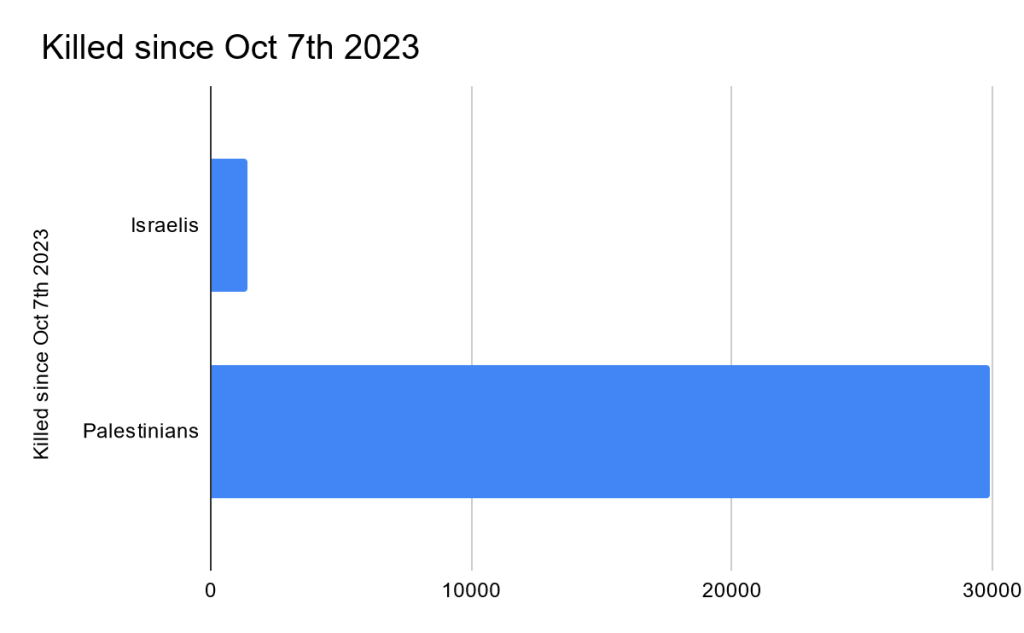
In the case of the occupied Palestinian territories and Israel, from 2008 to 2023 there were 319 Israeli deaths and 6,779 Palestinian deaths; thats a ratio of 21 Palestinians to 1 Israeli before Oct 7th and the ensuing IDF offensive.
That looks like this.
With 1,200 Israelis killed on that day and 235 since, and over 29,500 Palestinians killed in the Gaza strip and another 399 in the West Bank thats a ratio of more than 24 to 1.
That looks like this.
The balance of threat and the balance of death in this conflict is obvious and evident; and needs smoke screens of indignation to try to obscure it.
As there are millions of people in this country who feel a connection with the Palestinians, and have sources of information outside the establishment media, it has been impossible to control this narrative, to allow Israel to get on with what its doing with no scrutiny, and this is rebounding on the government and opposition, both now forced to oppose an IDF attack on Rafah and in some disarray. As there is no such community here with any links in the Donbass, even the existence of Russian speakers in eastern Ukriane is barely known about, let alone understood, and the narrative has been much more tightly controlled.
And, as the war in Ukraine is now being visibly lost by NATO, we are back to the sort of over heated rhetoric that was common two years ago – that NATO is an essentially defensive alliance needed to stop the Russians steamrollering over Europe.
This argument is politically absurd. Taking control of a continent would require a political project that could hold the allegiance of enough of the people who live there for it to be viable. It is not simply a technical military exercise. Russia does not have such a project. It has the military capacity and the political pull to absorb Russian speaking parts of Ukraine into the Russian Federation, and thats it. Even taking over the Western parts of Ukraine has been described as like “swallowing a porcupine”; let alone anywhere else.
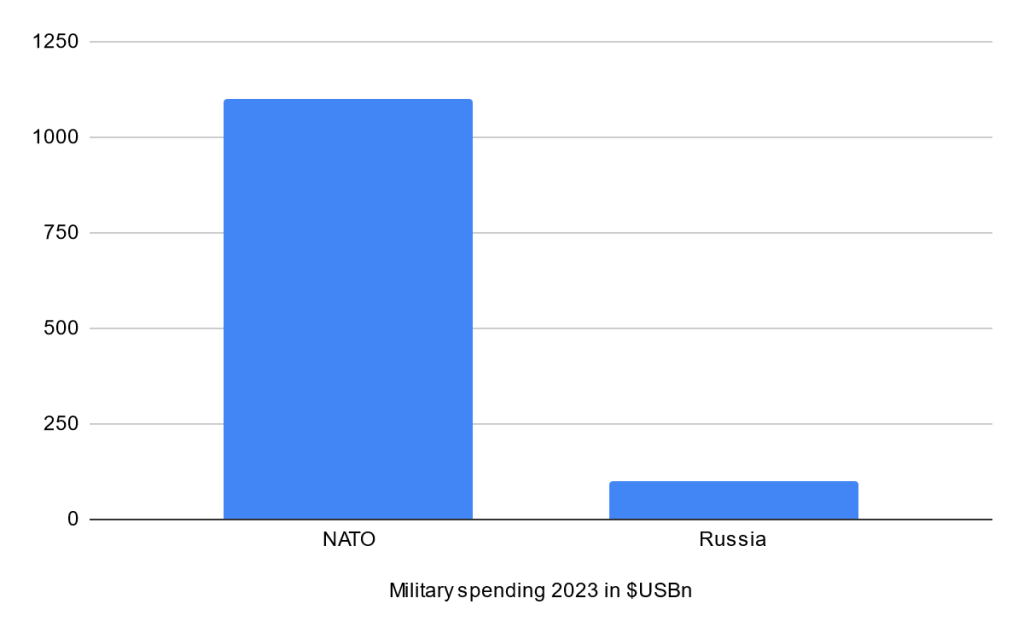
Even if it could be reduced to the level of technical military capacity, the threat is actually in the opposite direction.
This uses NATOs own figures for its spending. Monthly Review has assessed that US spending is actually about double the amount claimed.
That imbalance looks like the graph above and shows the absurdity of NATOs claim to be both defensive and worried about the potential of being attacked by a power with less than a tenth of its strength. The Russians however, clearly have every reason to be worried about what NATO wants all that expenditure for; especially as it conducts annual “war games” in Eastern Europe practicing for a war with them.
It was fear of that threat, and the failure of NATO to even negotiate about it, which led to the current phase of the war in Ukraine.
Two phases of the wars for the New American Century.
The global context for this is that, for the first time since 1871, we are living in a world in which the United States is no longer the largest economy. China already is in Purchase Power Parity terms; and at current growth rates is likely to overhaul the US in Current Exchange Rate terms before 2030.
The “unipolar moment” and “end of history” is long gone. This analysis of the structure of global imperialism by the Tricontinental Institute goes into this in immense detail and is essential reading. Its core point is that the US has integrated the Global North into a subordinate imperial economic bloc and set of military alliances, but its decline is leading to increasing challenges from a far more diverse set of regimes in the Global South, with China as the core; and China’s highly succesful Socialist economic model at the heart of it. Those who disagree with this definition of China nevertheless have to acknowledge its success, and perhaps concede that that’s how the Chinese themselves define their society. “Socialism with Chinese characteristics”.
In its resistance to its slipping domination, the USA threatens the end of humanity because, with its primacy in capital formation, production and trade gone, financial control and technological lead slipping, the US is trying to push the challenges it faces increasingly onto the military field; which it still believes that it can dominate. That is what makes our current decade the most dangerous in the whole of human history.
The first stage of the wars for the New American Century, the War on Terror after 9/11 2001, was directed at weak powers that the US could overwhelm, killing 4.5 million people according to Browns University, but nevertheless ending in defeat in Iraq, Afghanistan and Syria; and chaos in Libya. This was when they thought they could incorporate China into their world order.
The second phase, now they know that they can’t, threatens to be worse, and could kill all of us, with a nuclear first strike an active part of US war planning.
This is where the tension in the world is coming from. This is who is driving it.
There is an argument within the US ruling class between those who think that it has to take Russia on first before it can get on to the confrontation it wants with China – the position of the Biden administration and more traditional Republicans – and those, like Trump, who think they might be able to get Russia onside against China. Putin’s response of ridiculing questions on these lines from Tucker Carlson in his recent interview, shows that this is wishful thinking on Trump’s part.
The second phase
The US and its allies have now crossed the security red lines of a nuclear armed power (Russia) in Ukraine, and have fuelled the attempted genocide in Gaza; because they have to be seen to be able to impose their will.
The US has repeatedly vetoed ceasefire motions for Gaza in the UN Security Council.
Russia and China have voted for a ceasefire in Gaza, along with the world majority, in both the Security Council and the General Assembly.
In General Assembly votes, Ukraine has been among the tiny minority who have voted with the US against a ceasefire.
Israel and Ukraine are both using weapons supplied by the US. Neither could pursue their war without them.
The US signed up to provide $38 billion in military aid to Israel between 2016 and 2026, and additional aid has gone in since October 7th.
It has gave Ukraine £113 billion between 2022 and September 2023, with more on the way.
The US is intervening in and arming both in its own interests. The Israelis are already an established US attack dog and the Ukrainian regime aspires to be; and has been playing that role since 2014.
A “Big Israel”in Eastern Europe
The forces the US is supporting – or using – in each war are the same sort of ethno nationalists with far right backing.
Netanyahu has Itamar Ben Gvir and Bezalal Smotrich. Zelensky has the Right Sector and the Azov battalion.
Just to dispell any doubt, speaking in April 2022, President Zelensky was very clear that he wanted Ukraine to be “a big Israel” in Eastern Europe. A country where there were “soldiers in cinemas and supermarkets” and “people with weapons”, not a “liberal European” state at all.
This vision was eagerly and approvingly embraced by US commentators (its possible that they wrote it) because being like Israel is being a military frontier state for the US.
Israel has been the lynch pin of US domination of the Middle East. President Zelensky has volunteered his country to do the same in Eastern Europe.
The Left in NATO countries, marinading as we are in the ideological stomach juices of the belly of the beast, should never forget who our ruling class is.
NATO and other direct US allies – the world’s wealthiest countries – account for 75% of global military spending, are the core of global imperialism, organised as a coordinated bloc, with the US dominating its subordinate rivals.
Russia is not part of this bloc. It is a target for it.
Not recognising that NATO expansion in Eastern Europe has predatory intent takes self delusion a little far. See the map displayed by Kyrillo Budanov, Head of Ukrainian Military Intelligence for the partition of Russia that this aims at if you have any doubts.
Climate Breakdown helps drive US brinkmanship
The accelerating breakdown of the climactic conditions for human civilisation adds urgency to the increasing US brinkmanship that we have seen in Ukraine and Gaza. To try to survive it with the current imbalance of global wealth and power intact requires catastrophic defeats to be imposed on the Global South, and any power not included in the US dominant bloc; in short order.
This can’t be kicked down the road anymore; hence the emergence of apocalyptic maniacs as mainstream political options for the ruling class – from Trump to Bolsonaro to Millais – and the increasingly unhinged quality of mainstream political debate.
Into the vortex of barbarism
We are spiralling into a vortex of barbarism in which light minded fools like Grant Shapps can float the possibility of nuclear war with “Russia, China, Iran, North Korea” and argue that we should arm even more to prepare for it; and this is repeated in a blase way by media talking heads as though this wasn’t suicidal insanity. A mainstream consensus urging us on to Armageddon stretches from the military itself – with former Generals calling for the UK to be put on “a war footing” and floating the idea of conscription – to Boris Johnson arguing in the Dail Mail that a Trump Presidency might be “just what the world needs” because of his “willingness to use force and sheer unpredictability” – to Timothy Garton Ash, arguing in the Guardian that Trump’s America First volatility gives Europe the opportunity to become a more serious military imperialism in its own right – to the Labour front bench, with Rachel Reeves’ fiscal rules mysteriously not applying to the large increases in military spending pencilled in by the Tories (in a country which already has one of the highest military spending burdens in the world).
Supporters of Ukraine Solidarity Campaign like Paul Mason are following the logic of their support for NATOs war aims by arguing, in his case, that the investment needed to combat climate change cannot be afforded because “the cost of borrowing has increased”, but at the same time saying that the UK should follow the US and EU in using debt to finance arms spending. Suicidal logic.
The whole labour movement should be pushing in the opposite direction.
The wording of the Labour curates egg amendment to the SNP ceasefire now motion has all the signs of being written in haste in an attempt to build loopholes into it that would allow wiggle room for the “catastrophic humanitairian consequences” of Israel’s ongoing assault to go ahead. My additional wording to tease out its imbalances are in bold.
That this House believes that an Israeli ground offensive in Rafah risks catastrophic humanitarian consequences and therefore must not take place;
notes the intolerable loss of Palestinian life as a result of the Israeli offensive so far and the prospect of famine if it continues, the majority being women and children;
condemns the terrorism of Hamas who continue to hold hostages and the actions of Israel in holding many more prisoners without charge;
supports Australia, Canada and New Zealand’s calls for Hamas to release and return all hostages and adds that Israel should release Palestinian prisoners and not rearrest them and for an immediate humanitarian ceasefire, which means an immediate stop to the fighting and a ceasefire that lasts and is observed by all sides, noting that Israel cannot be expected to cease fighting if Hamas continues with violence nor that Palestinians can be expected to cease resisting if Israel continues its attacks and that Israelis have the right to the assurance that the horror of 7th October cannot happen again and that Palestinians have the right to the assurance that there will be no more IDF assaults on Gaza, and ethnic cleansing in the West Bankwill end;
therefore supports an immediate ceasfirefollowed by diplomatic mediation efforts to achieve a lasting ceasefire;
demands that rapid and unimpeded humanitarian relief is provided in Gaza an the UK immediately restores and increases its funding for UNWRA;
demands an end to settlement expansion and violence;
urges Israel to comply with the International Court of Justice’s provisional measures and for the UK to withdraw all diplomatic, military or other aid until it does;
calls for the UN Security Council to be meet (?) urgently and pledges that the UK will vote for a ceasefirewhen it does with no equivocation;
and urges all international partners to work together to establish a diplomatic process to deliver the peace of a two-state solution on the lines of China’s proposed international peace conference, with a safe and secure Israel alongside a viable Palestinian state, including working with international partners to recognise a Palestinian state as a contribution to rather than outcome of that process, because statehood is the inalienable right of the Palestinian people and not in the gift of any neighbour and further recognising that leadership of that state must be the choice of the Palestinian peoplethemselvesnot imposed on them.
A recent reevaluation of Trotsky and Trotskyism in the Morning Star from the Marx Memorial Library contained one key misconception, based on a misunderstanding of a phrase. The notion of “Permanent Revolution” gains a lot in translation. A clearer synonym would be “uninterrupted”.
What it applies to specifically is not as the article argues the relationship between revolutions across the globe and the consolidation or otherwise of socialist states (of which more later) but the specific argument among Bolsheviks and Mensheviks as the Russian Revolution was fought out as to what was possible and necessary; essentially what kind of revolution did it have to be?
The dominant view in both currents before it broke out had been that, because Russia was an politically primitive absolutist monarchy with an underdeveloped capitalism and a primarily peasant population, it had to go through a “bourgeois democratic” revolution, like England in the 1640s or France in the 1790s to sweep away feudalism, allow broader capitalist development and set the stage for a longer term struggle for socialism, which would require a further revolution at a later date, when conditions were “ripe”. The position of the working class and its parties in such a revolution was to support it but, ultimately, to know its place and not try to lead it. This has been described as stageism.
Trotsky’s argument was that this did not take account of economic and political development being not only uneven but combined. The conditions for less developed countries were (and are) significantly affected, and often determined, by the power of the more developed. This is true on all sorts of levels, including cultural. It means that less developed countries are not destined to simply follow in the footsteps of the more developed and become comfortable, well off bourgeois democracies, just a bit later. Bodies like the Tony Blair Institute that still maintain this point of view are at pains not to notice that already developed Imperial powers act consciously to maintain an exploitative relationship that keeps the majority of humanity indebted, overpowered and poor. The phrase “developing world” is a delusionary euphemism that disguises the imbalance of wealth and power with the Fabian notion of the inevitability of gradual incremental positive change. But capitalism outside the metropolitan centres is a sour fruit that rarely ripens.
Aspects of unevenness in the case of Imperial Russia is that where industry had developed, it was often relatively advanced, often owned by overseas capital and concentrated in some of the biggest factories in the world in the core cities, creating a large new industrial working class in the centres of political power, including a highly skilled layer who formed the backbone of the Worker’s Parties in Russia, just as their counterparts did of the Shop Stewards Movement in Britain but, because the contradictions were so much more severe in Russia, they were politically far more sophisticated and a lot tougher.
Revolutions are necessarily chaotic, shattering events. They can be conceived as an attempt to find a new stable order when a social and political order is collapsing. On some levels they are liberatory – “the festival of the oppressed” – as people previously denied a voice or power at any level find it and express it – at another it is a violent struggle for power in its most naked form – “the most authoritarian thing there is” (both quotes from Lenin). Who and what do people look to and organise around as a source of possible stability when the old gods have visibly failed? In Russia, the working class looked to its own organisations.
What became quite evident in Russia in 1917 is that there was no way that any sort of bourgeois democracy was on the agenda. The Provisional Government that tried to make the transition from Tsarism, had an insufficiently strong class base inside the country and, through its reliance on support from the Entente powers, was locked into continuing Russian participation in the First World War, even as that drove on the disintegration of its armed forces and hardship on the home front, fueling radicalisation in the factories, barracks and villages.
Even though the Provisional Government was led by a self-described Socialist, Kerensky, and leaned for its support on the Menshevik leaders of the Petrograd Soviet, they were balanced between two forms of class power, that of the Soviets – or Worker’s Councils – and that of the army High Command, itching to intervene at home and “restore order”. One or other of these fundamental forces had to win out. This would also determine the result in the countryside, where the collapse of Tsarist order left the landlords at the mercy of a restive peasantry becoming emboldened to take their land and shrug off their overlordship.
Lenin’s view was that the most determined leaders of the working class either had to seize state power or be destroyed. The revolution had to become a Socialist revolution, as the class that it represented determined the order it attempted to construct. The “Bourgeois democratic phase” was leapfrogged, or collapsed into the socialist phase, or was carried forward in an uninterrupted way. It had to be so because the Russian capitalist class was not strong enough to consolidate a new social order on its own terms as leaders of the people against the old regime, instead they were aligning with the military war lords, from Kornilov to Kolchak and Deniken, to crush the terrifying underclasses that had erupted out of their place. Fascism with Russian characteristics. The revolution had to push beyond those limits and establish a socialist state as the only possible way to avoid that. The revolution had to become “permanent” in the sense that Trotsky had meant it.
This was extremely difficult, took place in very grim circumstances and was rapidly isolated. The collapse of social order and centuries long habits of deference to suddenly collapsed dynasties in central Europe, Hohenzollerns and Habsburgs, did not lead on to successful socialist revolutions that could have broken the Russians out of their isolation, but instead to the reassertion of capitalist power in potentially revolutionary circumstances through Fascist movements, as in Italy and Germany, or the consolidation of the state around military strongmen, like Pilsudski in Poland or Mannerheim in Finland, or a mix of the two as in Spain. A broad movement across the continent described locally by Rumanian playwright Ionescu as “rhinocerisation”.
Crushing worker’s movements at home had the inevitable implication that the Soviet Union would also have to be a target internationally. The defeat of isolated revolutions in Hungary and Bavaria, and the failure of mass occupation of factories by workers in northern Italy underlines the point that sustaining a socialist revolutionary state at that point was only possible in a large country with immense resources that was simultaneously somewhat removed from the centres of imperial power.
This poses a key question. Given that revolutions take place in the weakest imperialist link, what is the relationship between consolidating power in one state and class struggles internationally?
All successful revolutions from 1917 onwards have taken place in the imperial periphery. Think China, Vietnam, Cuba. There have been no successful revolutions in the imperial heartlands. The closest to this was probably Portugal in the mid 1970s; the dynamics of which would repay a closer look.
To express this as a paradox. Socialism cannot be fully realised “in one country”, but it has to start in one; and that means state power in a state. Socialism, properly understood, is a state of struggle in which the Working Class or a Party embodying it, has state power – which includes control of the armed forces, police and so on, but a capitalist class still exists, can even prosper, but does not dominate the state, and in which that state exists in a world still dominated by imperialism and imperialist states. This is necessarily a process of political struggle that takes place over decades, both internally and externally and there is a dialectical link between the two. It is not a fully developed state of being in which all contradictions are, or could be, resolved in one fell swoop in the revolutionary moment. A revolution starts the process, it does not resolve it.
There is no blueprint for this. There is a tendency for currents on the Left in the wealthiest countries to have an essentially theological view of what socialism is. That a quick and painless big strike will lead to a quick consolidation of a complete worker’s democracy. This sometimes goes along with treating the thoughts of our illustrious forebears not so much as guides and prompts but as Holy Writ, historical experiences not so much as unique combinations of common elements that should be understood in their specificity, but as models to follow in abstraction from actual circumstances; and sometimes taking the form of self aggrandising analogies (I once heard a small poll tax demonstration in Chelmsford that was met with police horses as being “just like 1905”).This often goes along with a dismissive and hostile attitude towards the revolutions that have actually taken place, essentially because they are in places that are much poorer than the imperial centres. As one member of the AWL put it to me once, “nothing less than a complete workers’ democracy will do.”
International waves of turmoil, from the 1848 revolutions through to ’68 in Europe or the Arab Spring in 2011, hold out a promise of a simultaneous great leap forward but have always, so far, fallen short and see the restoration of the old order in an adjusted and often fiercer form afterwards. Nevertheless, the spread of socialist states is an essential defence for those that already exist, and the existence of those that exist is a condition for others to make a breakthrough. This is not counterposed to domestic consolidation and in fact are an essential aid to ensuring that the pressures on it are not simply coming from Imperialism. “Create two, three, many Vietnams”, as Che Guevara put it. There is no “national road” in isolation. All struggles affect each other.
The question for established socialist states is whether they make a virtue of necessity or not. Having carried out a revolution in conditions of siege and relative underdevelopment and under constant imperial pressure means that mistakes, sometimes serious ones, will be made. Sometimes these are from excessive voluntarism, like the Soviet “Third Period” or China’s Great Leap Forward and Cultural Revolution. Sometimes from the sort of stodgy complacency and demoralisation characteristic of the late Soviet period, leading at the end to the counter revolutionary embrace of capitalism among the nomenkaltura. The question for the leading political forces in these revolutions is whether they learn from these, adapt and move on in the unrelenting struggle with the immensely powerful and resourceful opposition of world imperialism, centred in the United States, or succumb to it.
A boy of about seven carrying a large backpack walks along Orsett Road chatting with his Dad. Where might they be going? Church? Seems unlikely. Serious though they look, the dress code for the new wave of Black Evangelical Churches in Grays ranges from the Handmaiden’s Tale look (white robes and squashed chef’s hats) to the distinctly snazzy. The Dad was wearing camouflage cargo shorts, which probably wouldn’t make it past the divine bouncers on the doors. On the same stretch of street a couple of weeks ago I saw a sharp looking young Pastor who was offsetting his stark black shirt and gleaming white dog collar with a spotless, figure caressing, bright mustard camel coat. He had a confident, world conquering walk. Hot priest, indeed.
Just past the Magistrates Court onto London road, the Dad stops and checks his phone, letting his son walk ahead to his destination. The Grays Tuition Centre – “Your Child … Our Priority” (next door to Divine Styles and Cosmetics and Tahmina & Co Criminal Solicitors – not a place to hang out, you never know who you might meet) and offering courses to get you through the tests for Maths, English, 11 plus.
As the boy gets closer to the door and further from his Dad, his pace slows and his mood deadens. He slowly mounts the steps and quietly enters the building, seemingly in the hope that if no one sees him, he won’t really be there.
On Friday the International Court of Justice threw out Israel’s objection to proceeding with South Africa’s case that it is committing genocide in Gaza, on the grounds that it is plausible that it is, gave it specific instructions on what it had to do, and ordered it to report back to the court by February 26th on what it has done to comply.
Simply put, it has to cease attacking civilians and allow in aid. There was a brief moment of hope that this might provide some pressure towards a change of course. But, hope, above all else, must be crushed.
Over the weekend there was no let up in the Israeli assault. This is from the latest UN daily report:
“Intense Israeli bombardment from air, land, and sea continued across much of the Gaza Strip on 27 and 28 January, resulting in further civilian casualties, displacement, and destruction.”
Between the afternoonsof 26 and 28 January, according to the Ministry of Health (MoH) in Gaza, 339 Palestinians were reportedly killed (165 people on 28 January, 174 people on 27 January), and 600 Palestinians were injured (290 on 28 January and 310 on 27 January).
Incoming truckloads of aid, averaging 156 a day in the preceding week, are now being held up at Kerem Shalom by Israeli demonstrators.
On Saturday Israel’s leaders responded to the ICJ ruling by demanding that countries cease to fund UNWRA – the backbone of what aid structure there is in Gaza – on the grounds of “allegations” that 12 of its employess “participated” in some undefined way in the attacks on Oct 7th. These allegations have not been published. UNWRA has sacked the named individuals while an investigation takes place.
The UN Reports that UNRWA is the main humanitarian agency in Gaza, with over two million people now dependent on its services and some 3,000 out of its 13,000 staff in Gaza continuing to report to work, despite the ongoing hostilities.
So, far from seeking to comply with the Court, and recognise what a deep hole they are digging themselves into with their armoured bulldozers, Israeli leaders have sought to bluster, calling the South African case “outrageous”, carried on as though no ruling had been issued, and to hit back by undermining what limited aid has been getting in.
This is in a situation in which the UN reports that
2.2 million people are at imminent risk of famine.
378,000 of these are at “catastrophic” level (extreme lack of food, starvation, exhaustion of coping capacities)
939,000 are at emergency level.
The ICJ will take a long time to come up with a definitive judgement. Without a ceasefire, the scale of this famine could well have made the case de facto for them by the time they decide de jure.
The response of “the West” has been instructive. A rush further down the rabbit hole towards confrontation with the rest of the world.
Faced with “plausible” accusations of genocide from the ICJ – the World Court on these questions – they issued diplomatic versions of Itamar Ben Gvir’s dismissive tweet “The Hague schmague. The UK with characteristic patronising condecension snarked that the South African case was “not helpful”. Its “plausibility” in the eyes of the court was not acknowledged. Instead we had the worn out mantra that Israel is “entitled to defend itself”; while the Palestinians, presumably, must suffer what they must with no right to resist. The same mind set that led the Observer to write that Israeli violnece is “understandable” while Palestinian violence “defies comprehension” (Editorial Oct 15th).
Faced with unpublished allegations of a tiny number of UNWRA employees being involved in Oct 7th, the US and nine of its core subordinates have leapt to broadcast Israel’s case from their bully pulpits and to cut UNWRA’s funds.
The ICJ ordered Israel “to take immediate and effective measures to enable the provision of urgently needed basic services and humanitarian assistance”. UNWRA is the body that organises that. In striking at UNWRA, Israel is signalling that, in doing the exact opposite of what it has been ordered to do, far from respecting international law, it is doubling down on defying it.
This was an opportunity for “the West” to de escalate, if that were their intention. Perfect legal cover. In backing Israel up, and actively imposing its own collective punishment on the people of Gaza, “the West” is tearing off its moral mask.
So, even after the ICJ ruling, the UK and US continue to supply Israel with weapons and argue that the condition for a viable ceasefire is for Israel to have achieved its military objectives before one happens. Given the way that Israel is doing that, that makes them overtly complicit in the ongoing slaughter.
They are, perhaps, hoping that by doubling down they can make what the ICJ says to Israel in a month’s time irrelevant, drowned in a brute display of unaccountable force.
This is what the West’s “rules based international order” looks like with the pretences stripped away. Not naked in the conference chamber, or courtroom, but strutting across the world with their big swinging dicks horribly on display.
Even if we avoid the wider war that is now looming, and which this stance has made more likely, this will neither be forgotten nor forgiven. Now we see you.
Both have argued this week that a ceasefire is not a route to a durable peace because Israel’s declared war aim of eliminating Hamas will not be achieved; therefore further October 7th attacks could take place.
The core moral flaw in this argument is that there is an October 7th attack on Gaza every four days. Another way of looking at it is that the price for stopping a further October 7th is twenty of them inflicted on the Palestinians so far, and an incalculable number of them henceforth.
The only logic of this is that Palestinian lives are worth less than a twentieth of Israeli lives.
There’s a word for that.
Doing the Maths
Total Israeli casualties on Oct 7th: 1,200
Total Palestinian casulaties in Gaza so far: 23,000. This is an underestimate, as it does not include any of the people buried under the rubble and not yet accounted for. Attempts by Israeli spokepeople to cast doubt on this figure by quibbling that this estimate is made by Hamas ignores the fact that previous Hamas estimate of casualties caused by IDF attacks on Gaza have been found to be accurate, that these figures are used as a working assumption by the UN. In any case, they present no figures of their own, other than the absurd claim that just about every male Palestinian they have killed is a “Hamas terrorist”. This follows the sort of practice carried out by some NATO units in Afghanistan, which counted all Afghan males killed as “Taliban”.
While claiming no entitlement to have letters published, I think its indicative of the ideological limits of the challenges The Observer is prepared to publish that neither of these, or anything like it, made it into print.The only response they put in to the Karen Pollock article, which was a way to package Suella Braverman’s accusation that demonstrations calling for a ceasefire are actually “hate marches” in a way that might be acceptable for readers who think of themselves as liberals, was a letter that followed her framing of the conflict as religious intolerance, nothing to do with occupation and oppression (and was pessimistic that anything could be done about it).Narrowing the range of challenge, and excluding challenge to ideological frameworks, is a sign of waning political self confidence. As the old order fades, it has no option but to shut people up.
Eyeless in Gaza
Karen Pollock uses some odd constructions in her article (Anti Semitism and Holocaust denial are rife, just look at Stephen Fry’s Twitter Feed Observer 24/12/23) stepping across the thin ice of distortion on the snow shoes of euphemism.
Conceding that you “can“ be “appalled by the scenes we are witnessing in Gaza and critical of the choices made by the Israeli government and not be an antisemite” is just as well. If you read the daily UN updates there is such utter horror there, expressed in the most dispassionate prose, that it becomes numbing to read it. That’s why a majority of people in this country want a ceasefire, almost every country in the world has voted for one at the UN, and why there have been such huge demonstrations, here and everywhere else.
Implying that is driven by “hatred” rooted in “antisemitism”, not by the reality of a genocide unfolding in front of our eyes, inverts reality; and would even if there weren’t such large and vibrant Jewish contingents and speakers on all of the marches.
Her use of the word “scenes”, for the utter carnage we are all seeing, possibly indicates a shying away in her own mind from the consequences of seeing it for what it is, as the logic of racism leads to genocide, and no people are immune from following it.
In that spirit, I hope that the Holocaust Education Trust would agree that Israeli politicians have learned the wrong lessons from the Holocaust when they
build their state on racially discriminatory laws,
say “the Gaza Strip should be flattened, and there should be one sentence for everyone there—death”,
or back settlers who terrorise villagers in the West Bank and chant “Death to Arabs” and “May your villages burn”?
This one was written in the middle of October and calls out the fundamental imbalance in their editorial response to October 7th. The figure quoted in this letter understates the asymmetry in casualties since 2000, which is almost 7 Palestinians for every Israeli killed.And this has got far worse since then, with the casualty rate since October 7th being “at least” (in the UN’s words) 18 Palestinians killed for every Israeli.
In the last decade the casualty rate from the conflict in Israel Palestine has been five Palestinians killed for every Israeli. Given that the suffering on the Palestinian side is so much higher, just on that level and leaving aside everything else, it is therefore strange that your editorial finds calls for violence from Israel “understandable”, while considering that violent actions from Palestinians “defy comprehension”.
Perhaps you should write another editorial explaining the asymmetry of your empathy.
In the market, a bloke is selling gift bags with four top of the range brand perfumes for a tenner. Ask no questions…
Outside the Eastern European Deli by Clarence Road a crowd of people gather round a man playing an accordion and sing the Rumanian version of Felice Navidad. Rumanian being a Latin language, the first word is the same. As is the tune. They seem to be having a good time. People passing by smile, even though they don’t understand the words. They can pick up on the good feeling.
Hurtling on a mobility scooter down George Street towards Morrisons at about 4 mph, a wild haired man with a rubbery twisted face mutters and gurns at passers by like Mick Jagger with Turettes.
Inside a tiny Rumanian owned finance shop on the riverward side of the level crossing by the station, a full scale service is going on. A priest in a cylindrical black hat, wearing an utterly gorgeous scarlet cloak covered with ornate gold embroidery with an icon like picture of the Virgin Mary on the reverse collar at the back of his neck, waves a heavy gold cross in one hand, while crossing himself with the other. Sometimes facing his small congregation of men with nylon suits and short haircuts, sometimes facing the wall behind him. This has an plaque celebrating the company’s Platinum award for HR successes, so it sometimes looks as though they are worshipping that. To his left, and facing the gawpers in the street through the plate glass windows, an attendant in an equally heavily gold embossed crimson robe stands guard with a serious look on his face. The overall effect is positively Byzantine in its mystical magnificence; humanised by the small table of snacks and orange squash along the wall.
At the bottom of Cromwell Road a tiny boy wearing one of those animal head hats that make him look like Max from “Where the Wild Things are”, is being pushed along by his Mum on a little purple plastic three wheel scooter which flashes lights as it trundles onwards. He is standing rigidly erect like a little Emperor, hands firmly on the handlebars, one of them grasping a sharpened pencil that he holds pointedly upwards like a staff of office.
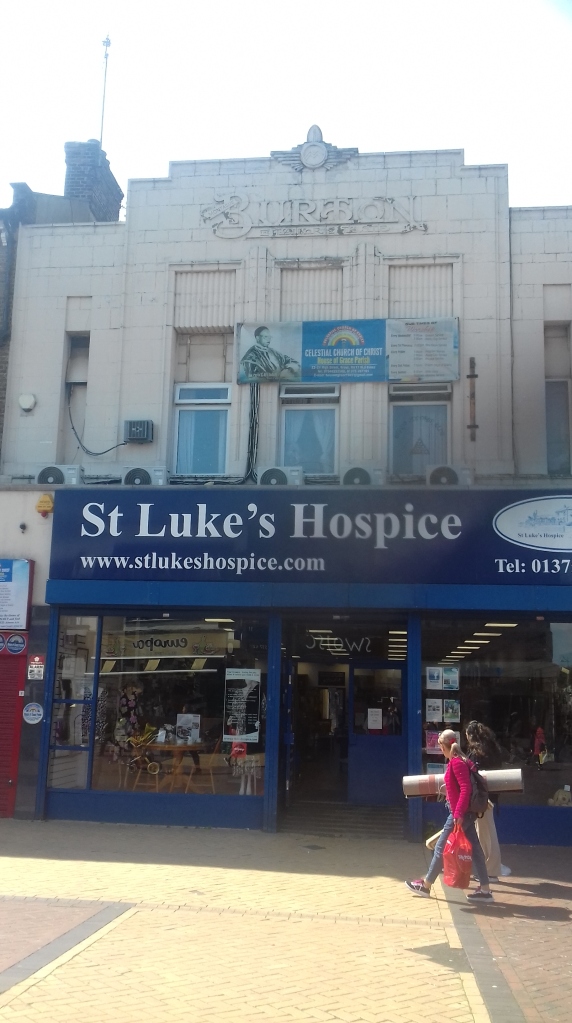
Coming out of the Church of Christ Celestial, a young woman dressed all in white like a cross between a pastry chef and a woman from the Handmaiden’s tale, bustles off down the road on Godly business. The Church is installed above the St Luke’s Hospice shop in what used to be the Burton’s Snooker Hall. Burton’s was a popular off the peg suit emporium that ran a snooker hall above the shop in the middle of the last century. My Dad told me that this was considered something of a den of iniquity among respectable folk – as in The Music Man song:
Oh yes we’ve got trouble
Right here in River City
With a capital T
And that rhymes with P
And that stands for Pool.
The logo for the snooker club – a triangle of racked balls – can still be seen faded but legible on the most southerly window. Hopefully the Church won’t disapprove as much as my grandparents did, and will leave it in place.
Although my Dad was forbidden to go in there, he’d sometimes surreptitiously nip up the stairs, not because he wanted to be Thurrock’s answer to Fast Eddie Felton, but accompanying a mate who’s Mum ran the tea bar as an alternative to the London Road Cafe on a Saturday night; for a heavily stewed tea and slice of “yellow cake” (a late 40s austerity version of Madeira, and nothing to do with Uranium…so they said).
Down Hathaway Road marches a small, slow, stately procession of elderly black matrons, all in their best church hats and sombre business like handbags, led by one of their number carrying a museum piece of a tall vertical banner in dark red with something Biblical in black written on it that could be straight out of the Shankill Road circa 1887. The strong influence of Black Evangelicals on the local Conservative Party indicating that the Saints might not be marching in, but they are definitely marching on; resolutely in the wrong direction.
Outdoor household Xmas decs look a bit sad in daylight, even before the day itself. Lights at night are one thing, but shopworn bows and slightly deflated snowmen and Santas blowing a bit desperately in the wind, are something else. Especially as seen from the top of the 100 bus to Basildon hospital, trundling through Stanford le Hope and Corringham, on a local road for local people, running alongside the huge six lane A roads that slice through and coil around the old towns like Boa Constrictors, with most traffic passing them by, trucking mountains of containers from the docks at Tilbury and Thames Gateway on up to the M25 and across the country. The relatively small and discrete railway line from Southend to London probably carries as much, or could, and makes a far lower impact on the landscape. Blink and you might miss it. You can’t miss the roads, making Stanford and Corringham feel by passed by their by passes. Both have a slightly tired and accidental higgeldy piggeldy feel to them, with no real centre, or heart, just successive layers of improvised development, clustered beyond Stanford’s handsome old church, with matching pub across what might have been a village green once.
Along the river run a row of giant cranes and gantries and the containers pile up 6 storeys high looking like the Martian machines from War of the Worlds. The sort of job done by my grandfather and great uncle consigned by them to rapid oblivion in the early 70s. An old family friend drops in and tells me that her job as a copywriter has gone the same way. At the beginning of last year, she had a waiting list and steady work with regular clients. ChatGPT comes along this year and wipes her out. She hasn’t had work for two months.
My Mum had quite a few cousins. Two of them had rhyming nicknames. Donk and Bronc. “Donk” because he would donk people on the nose if they were getting on his nerves too much. Bronc because, as a child, he was always playing cowboys.
An aspect of US hegemony is the extent to which the films and TV series we have watched all our lives make people think of them as the good guys. This is despite everything we have lived though, from Vietnam to Chile to Central America and the 4.5 million people killed in the war on terror, with Abu Ghraib and the Fallujah Free Fire zone providing a model for the IDF now in Gaza and the West Bank, while the US supplies them with the bombs and bullets to do what they are doing. All played down and deflected in our media of course.
The cavalry charge bugle call that heralded the goodies (white soldiers) arriving at the gallop at the end of so many Westerns to deal with the “savages” (native Americans) to the cheers of the Saturday matinee crowds of children in the 50s and 60s was played in a way intended to be darkly ironic at the end of that decade in the Helicopter gunship scene in Apocalypse Now, where the music shifts to the Apache helicopters playing Ride of the Valkyries through loudspeakers as they swoop in to strafe the Vietnamese village, and their commander comments, “I love the smell of Napalm in the morning”. Only the ironic intent and impact is inappropriate, because, think it back and project it forward, in the “war of civilisation against barbarism” (B. Netanyahu) its a call for the same armed forces to do the same damn thing over and over and over again.



 Urban ramblings