Ozymandias in Gaza

I think Shelley got Trump in one…

I met a traveller from an antique land
Who said: “Two vast and trunkless legs of stone
Stand in the desert . . . Near them, on the sand,
Half sunk, a shattered visage lies, whose frown,
And wrinkled lip, and sneer of cold command,
Tell that its sculptor well those passions read
Which yet survive, stamped on these lifeless things,
The hand that mocked them, and the heart that fed:
And on the pedestal these words appear:
‘My name is Ozymandias, king of kings:
Look on my works, ye Mighty, and despair!’
Nothing beside remains. Round the decay
Of that colossal wreck, boundless and bare
The lone and level sands stretch far away.”

Thus do I exist, between my ears…

Sleepwalking to war?

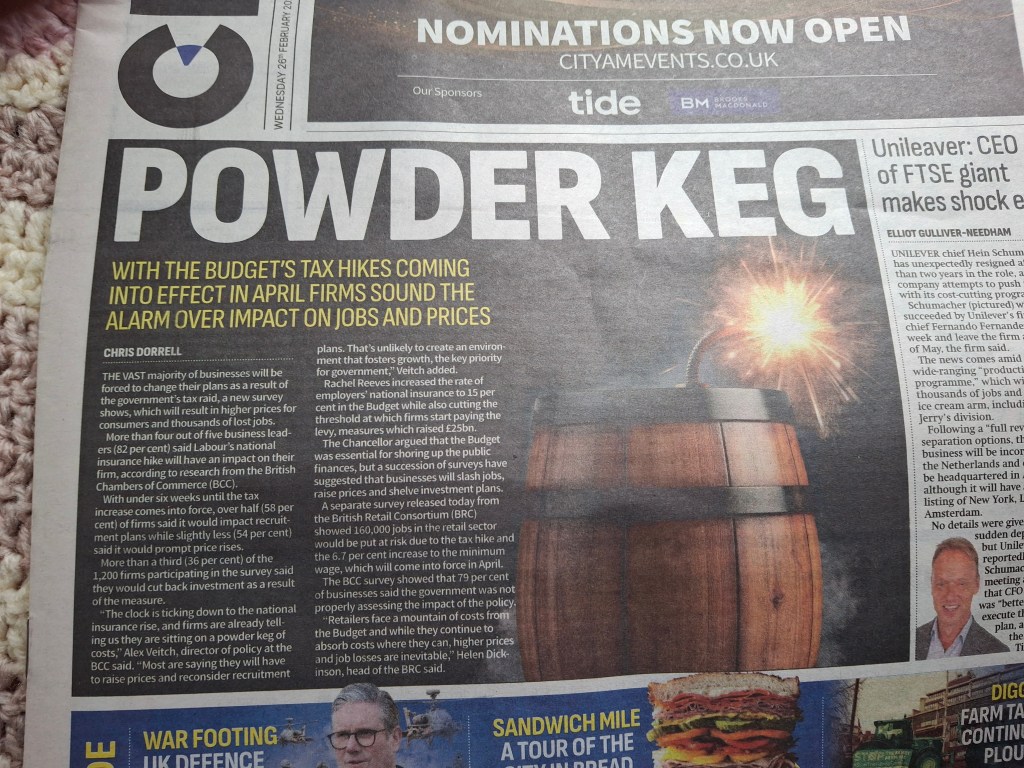
The juxtaposition of the headlines from the Guardian and City AM, as they flopped onto the mat this morning, was unintentionally instructive. “Fight for peace” is in inverted commas perhaps because the Guardian has a vague historical memory that “Peace through Strength” was what all the great powers were relying on in the run up to World War 1, and it worked really well; until it didn’t.

Richard Tice can’t face the truth.

And his comments on climate change are “absolute garbage”. I suppose being an active fifth column for Trump means that he has to say “garbage” instead of “rubbish”.

Richard Tice can’t do History. The global heating we are currently experiencing is beyond anything that human civilisation has ever had to contend with. The longer term cyclical swings in global climate arising from variations in Earth’s orbit that have been the fundamental drivers of Ice Ages and periods that have been far hotter than today take place over tens of thousands of years are not an explanation for our current period of rapidly increasing temperatures. That can be explored here.

Explore further here. Myth busters 2. Was it really hotter in the Medieval Warm Period?

Richard Tice can’t do Maths. He says that the scientists who agree with him are “not a minority”. The scientific consensus that human activity is generating climate change has the support of 97 – 99% of scientists across the world. However you look at it, 1 – 3% can’t be described as anything other than a minority.

He also says that the costs of dealing with climate change are an insupportable burden. In fact, the costs of not addressing it will be far higher, even if we manage to avoid social collapse.

That can be explored here. Mythbusters #3 “It’s gonna cost you?”  

Richard Tice can’t do science. The basis of science is to pay attention to what you can see going on. His claim that “there is no evidence” for human generated climate change is like a toddler closing his eyes, sticking his fingers in his ears and chanting “la,la,la, I’m not listening”. He and his party are not only out of step with science, but also with popular opinion; not because the rest of us have been brainwashed but because we notice the wildfires and the floods and the increasingly extreme weather, are worried about our childrens futures, and because we are not members of a Party being bankrolled by fossil fuel interests.

He says that the actions of the sun and volcanoes have more effect on climate than greenhouse gas emissions. He does not note that volcanic activity cools the planet*, sometimes severely for short periods, but cannot explain the way that it is heating, nor that current levels of solar activity would also be cooling the planet if left to itself. While natural cycles and events of this sort have heated and cooled the planet even more dramatically than current human activity, these are events that are outside our control, and are not an immediate cause of the global heating we are seeing now, which is down to the burning of vast quantities of fossil fuels. Nor should the impact and velocity of this be minimised. The rate of global heating in the coming decades is projected to be in the order of 65 times the rate during the last deglaciation. We are driving ourselves fast off the map. Whether we drive ourselves off a cliff or not is a matter of choice.

In the immediate period ahead, we are looking to try to save human society from the worst consequences of this, and no political force that abdicates its responsibility to do so should be given the time of day.

Explore further here. Mythbuster 1. “Phew! What a scorcher!” Overheating is good for you?  

There are indeed “experts”, who are telling us we are in serious trouble and need to take urgent action, “vested interests”, like Tice and the Carnival or reactionary grotesques and “swivel eyed anti net zero zealots” at the ARC Convention this week, seeking to “rebuild the foundations of our civilisation” on lies, fantasies and racist paranoia, and “then people who tell the truth” like the IPCC and the climate movement.

Tice and all of those who can’t face the truth are dinosaurs having a last hurrah.

*There is a caveat on this that some extremely large eruptions unleash large quantities of greenhouse gases which can have a significant heating effect.

Why George Monbiot is wrong about the war

George Monbiot’s comments about the war in Ukraine on BBC Question Time last week are completely disorientated, and disorientating for anyone who swallows them.

His columns in the Guardian are often a haven of well argued, deeply felt sanity in a time when the impasse of capitalism, the decline of US hegemony and the ever mounting climate crisis are driving most columnists in most papers well off the rails and up the wall, but the one entitled A Trump win would change my mind about rearmament (Guardian 5/7/24), was profoundly confused, and underpins the line he took on QT.

He argues that Trump’s Second Coming should “end… our abiding fantasies about a special relationship” without reflecting that, in abusive relationships, abiding fantasies are often clung to harder to avoid having to face facts. There is no doubt that the British ruling class will cling to it as hard as it needs to.

As it is, few, now, have any delusions that this relationship is one of equals. A deferential cringe is built into it, and everyone knows it. The relationship was abjectly summarised by Tony Blair when he told the British Ambassador to Washington to “get up the arse of the White House and stay there”. We have seen what this looks like on film. “Yo! Blair!”

What makes it “special” is being one of the closest US henchmen in their global dominance: one of the “five eyes” countries that share Intelligence gathering (the US and what used to be called the “White Commonwealth”) that is at the core of their system of alliances.

George spells out what this has been about, listing just a few of the brutal and deadly military interventions and coups “we” have been party to since the Second World War – Afghanistan, Iraq, Gaza – with the US as number one and the UK desperate to believe that its number 2.

Although he recognises that these alliances, with NATO as its core, defend a rules based order that “favours capital over the democratic state”, he doesn’t draw the structural conclusion that this also constitutes a Global North military bloc forged to keep the Global South in its place. So, the interventions he mentions were, and are, not random pieces of malevolence that just happened to happen, but systematic attempts to assert global power and dominance. This is posed in these countries as “defence”.

The military forces at their disposal are the tools do do this job, and the stronger and bigger they are, the more they can get away with doing it.

So if, as George argues, our principle is that we are opposed to “imperialism, fascism and wars of aggression”, we have to recognise that not only do we live in a core imperialist state ourselves; one that has committed many wars of aggression in our lifetimes, but that that state is integrated into the system of alliances that guarantees the existing unjust global order.

We therefore have to restrain its capacity to carry out these wars as an act of solidarity with its victims in the rest of the world; in the first instance those in Gaza.

Israeli Foreign Minister Israel Katz was a guest at the NATO summit in July and Israel has had representation at the alliance since Turkiye lifted its veto in 2016, and a cooperation agreement since 2017. The ongoing US, and UK, arms and intelligence supplies during the genocidal IDF operations in Gaza underline what this alliance is for.

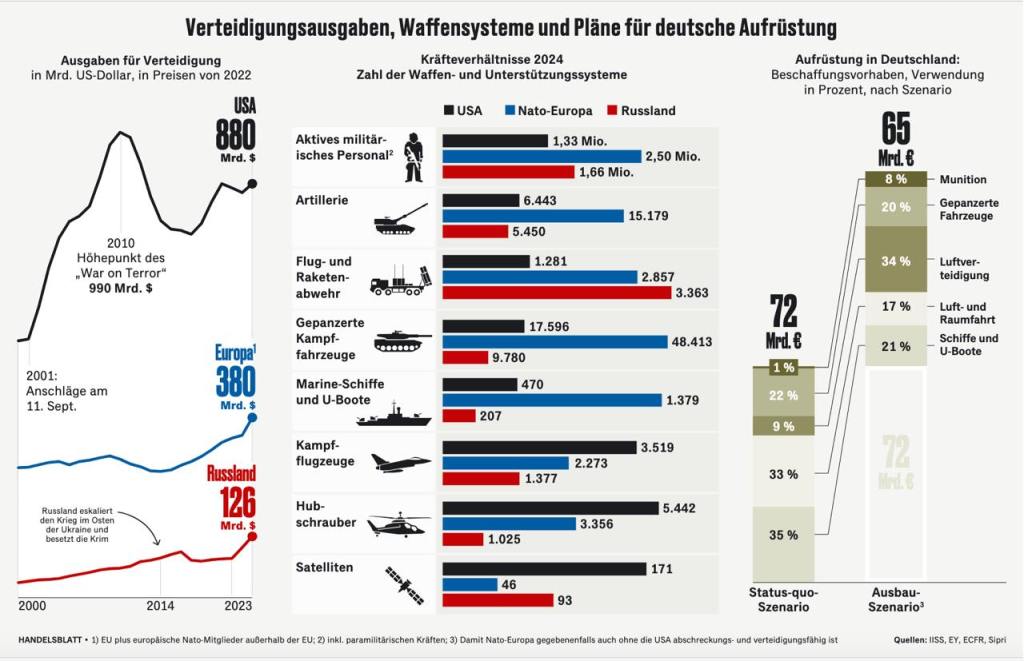
George argues that the UK and EU have “leant on the US for security”. What this means is being part of the world’s most aggressive and high spending military alliance. NATO accounts, with its allies in the Pacific, for between 67 and 75% of global military spending (depending on how you measure it). The strongest powers within it – the US, Japan, Germany, France – are boosting their military spending rapidly (Germany and Japan doubling theirs); while simultaneously complaining that it is not “realistic” to expect them to stump up their promised $100 billion annual contribution to help the Global South develop sustainably. In fact, just the increase in NATO military spending since 2015 amounts to $543 billion a year (with a total spend in 2023 of $1341 Billion). So, building up military capacity gets five times as much commitment as the promise to alleviate climate breakdown in the Global South – a promise that has never been fulfilled.

That looks like this.

George, nevertheless, argues that a Trump restoration would be “a threat to our peace, security and wellbeing” not so much because the US would

  • go full rogue state on climate – with an estimated 4 billion tonnes of additional emissions from pro fossil fuel policies and attempts to break up the Paris process – “drill, drill, drill!”
  • give Israel carte blanche to double down on the Gaza genocide – “you’ve got to finish the problem”
  • or seek to provoke a war with China,

but because he thinks he would break up NATO, supposedly in cahoots with President Putin; citing his remark that he would be quite happy for Russia to invade any NATO member not spending as much on its military as Trump wants it to and would “end US support for Ukraine” which would “allow Putin to complete his invasion” teeing up “an attack on a NATO country within five years”.

This is where George’s argument aligns with that of other Guardian/Observer columnists and editorials, including the increasingly frenzied Simon Tisdall; one of whose columns last year condemned German Chancellor Olaf Scholz as “overly fearful of nuclear escalation”. Perish the thought that anyone would be worried about that. Tisdall’s critique of last year’s NATO summit was, as ever, that it did too little to escalate the war in Ukraine. No fear of nuclear escalation for him; arguing for no fly zones in the West of the country and missile strikes into Russia, for an alliance that is not “afraid of a fight” in face of the threat that an incoming Trump Presidency would try to force a peace by accepting a partition of pre 2014 Ukrainian territory because he is, as the Observer editorial puts it on the same day, “a keen admirer of Vladimir Putin”.

This profoundly misreads whats going on. Trump is in no kind of bloc with Putin. He’d like to break Russia from its alignment with China, though that ship has long sailed. What Trump is trying to do now is to bully subordinate European allies into taking most of the military weight in Europe off the US. This is so it can concentrate on China; which he sees as the main challenge to the US world order. This will be costly for the countries that do it, but that is of no concern to Trump. Thats the price they have to pay to stay in the kind of “special relationship” with the US that allows them to be at the table and not on the menu, even if it means they will be increasingly relegated farther below the salt.

Trump is not a diplomat. He does not issue quiet threats on secure telephone lines to allow appearances to be kept up, as Joe Biden did for Obama. He is a corrupt wheeler dealer with mob boss characteristics. He doesn’t spare anyone’s feelings. He bullies openly, so everyone is clear who the boss is. Remember his official visit in 2018? That calvalcade of armoured limousines that was longer than the Mall? Those hideous Osprey aircraft repeatedly buzzing London’s airspace?

And it is already working. 23 of NATOs 31 non US members now hit the 2% target, “more than twice as many as two years ago” according to Jens Stoltenburg and the only way is up, with Germany already committed to 3.5%. Job almost done.

So, when George says the “UK and Europe will need to find the means of defending ourselves against a Trump regime and its allies” he misses the point that the UK and EU countries are the allies of the US and, as everyone in the new cabinet is keen to point out, the UK will accomodate to whoever is in the White House because it has to, so they will remain core allies of “the Trump regime” too. David Lammy is quite explicit about that, saying that Trump is “often misunderstood” over NATO, and pledging increased UK spending to stay in the club. Increases in military spending by European countries is exactly what Trump wants. It won’t be used “against a Trump regime” but to facilitate it, and cover its back in Europe so it can go after China.

The key point for the climate and labour movements therefore is that the policy choice to sink or swim with the US alliance will clash with having to break from it to resist climate breakdown. A very concrete way that this is posed is, when it comes to priorities, will the Starmer government jump to Trump’s tune and increase military spending to 2.5 or 3% or even 5% of GDP, or does it put those resources into its mission for clean energy by 2030? They are unlikely to be able to do both.

Trump wants to pull some US military resources out of Europe to concentrate on China because the US can’t do both any more. Thats why commentators like Tisdall are spinning fantasies. NATO has been unable to supply Ukraine with enough material to “win”, because it can’t.

Some pro EU commentators like Timothy Garton Ash argue that this gives the EU the chance and need to step up and become a serious military power in its own right and George now argues “I now believe we have to enhance our conventional capacities, both to support other European nations against Russia and…perhaps to defend ourselves”.

This presumes that the Russians are at war because they are on some crazed mission of global conquest. In fact, their stance throughout has been to seek mutual security pacts so that they don’t feel under threat from NATO; which, at the moment, they do. This has been the case since Gorbachev proposed a “Common European Home” in 1991. The US and NATO have never accepted that and it has been a US mission to break up any mutually beneficial economic arrangements, partcularly between Russia and Germany, the better to maintain US dominance of the continent.

Seeking such a peaceful arrangement, following a ceasefire in Ukraine, using the war as a terrible example of what everyone in Europe should agree that we need to avoid, is the preferable, alternative course to rearmament and war preparation.

Because George should think about what he’s saying. If there is a war in Europe, even if it stays conventional through some miracle, it will look like Eastern Ukraine or Gaza on a gigantic scale. The attempt to “defend ourselves” militarily will be suicidal, even if nuclear weapons can be kept out of it. War won’t “defend” anyone. Mutually assured destruction can be done conventionally if alliances are not “afraid of a fight”. The danger in proposals to seriously retool the UK, and other, military industrial complexes to be able to fight just such a conventional war of attrition with Russia by the end of the decade, is that this carries its own momentum and will become a self fulfilling prophecy, displacing diplomatic alternatives. If the UK military gets into a position to “fight and win a war in Europe”, the UK ruling class will be tempted to try to do so.

An alternative approach that would avoid economic ruin and a step by step escalation towards war, would be to welcome the US departure and seek mutual security arrangements with Russia in a “common European home”, as Gorbachev put it. A localised version of that was, after all, what the Russians were asking for in the Winter of 2021, which NATO refused even to discuss.

The US uses NATO to maintain its own dominance over Europe – political, military, economic. Which is why Trump’s threats to reorder it, with the US pulling back its commitments to nuclear and air cover and the European powers expected to dramatically increase conventional forces on the ground could end up as an own goal.

A recent poll showed strong majorities in the UK in favour of both NATO and retaining the UK’s nuclear weapons. This is because these are framed as a way of keeping the population safe from overseas threats.

This begins to crack – and you get a mass anti war movement – when that mask slips. In 1980, the incoming Thatcher government, eager to turn the screw in the Cold War and gain compliance with stationing US medium range cruise missiles in the UK, scored a spectacular own goal by issuing a civil defence booklet to every household in the country called “Protect and Survive”, as a guide on how to survive a nuclear war (with no more equipment than you’d find in the average garden shed). After decades in which the “nuclear deterrent” had been motivated as a way to make nuclear war unthinkable, it suddenly became apparent to every household in the country that 1. the government was actively contemplating having one and 2 that the self protection measures outlined in the booklet – like making a do it yourself shelter (for one) by unscrewing your bathroom door and putting it over you as you took shelter in your bathtub – were absurd.

Millions of people realised that it was our government that was putting them at risk and the sense of vulnerability that had always generated a strong anti nuclear and anti war sentiment in Glasgow – as the nearest city to the Holy Loch base of Polaris, and then Trident, submarines – became more widespread – and linked up with the reaction against the monetarist crash that also came in with Thatcher. “A few more years of this government”, as one old campaigner in Bermondsey put it, “and we’ll all be living in tents surrounded by cruise missiles”.

See also, https://urbanramblings19687496.city/2023/07/02/ukraine-ecocide-and-complicity-or-why-the-climate-movement-should-not-allow-itself-to-become-a-fig-leaf-for-nato/

Trump’s approval ratings are lower than for any other President at this stage – apart from himself

On Air Force 1 overflying the “newly renamed Gulf of America” last week, Donald Trump boasted that his approval ratings were at 49% and “no one has ever seen numbers like this before”. Seemingly so. His numbers are worse than those of any other post war President, apart from himself last time.

What UK school leavers do – and do not – understand about the climate crisis; and why this is a problem.

The conclusions of the December 2024 research report into climate literacy among school leavers in England makes worrying reading. The survey conclusions are republished below.

  • My comments are in italics.

Through asking a selected sample of Year 11 school leavers in England a broad range of questions, this survey presents a nuanced view of climate literacy amongst school leavers. While there is a general awareness of anthropogenic global warming as a cause of climate change and its global impacts, there are several knowledge gaps and misconceptions demonstrated by the responses collected.


Basic knowledge:
While most school leavers recall having been taught about climate change, only just over half remember having covered it in their last year at school.

  • As Climate change is an existential crisis for humanity, for almost half of students to go sailing through a year of school without being challenged to consider any aspect of it shows an alarming level of baked in complacency that we need to change.


There is a general understanding that the climate has warmed, but many overestimate the extent of warming since 1850. This specifically highlights a poor understanding of messaging related to limiting climate change to within 1.5°C/ 2°C, as many school leavers thought that the climate had already warmed more than this.

  • This fits with a sort of “common sense” approach that uses shifts in temperature in everyday experience of weather as a benchmark. In that, a shift or 1 or 2 degerees doesn’t seem like much, but as an average shift across the whole planet, it has enormous consequences. Students will be seeing an increasing series of news items – on TV or social media – that show these disastrous impacts. The fires in LA and recent storms and floods here will be the latest. Stressing that these impacts are happening at just a 1.2C average increase; so increases above 1.5C or 2C will be so much worse, is essential to challenge this. Some students will have experienced climate impacts, like these: 1. “A primary school in Carlisle had classroom windows blown in during a lesson today, leading to kids diving under their desks. 86mph winds predicted and some HTs “bravely” opened. We’ve got a long way to go on the notion of “adapatation” as well as prevention.” 2. A school in Teeside evacuated due to storm damage after students placed on ‘lockdown’ https://www.gazettelive.co.uk/news/teesside-news/egglescliffe-school-evacuated-stockton-storm-30857248 These are new impacts that will become more common, so staff and students, LAs and Multi Academy Trusts should be aware of them and adapt their risk assessments accordingly.


Most school leavers are ‘fairly concerned’ about climate change but, for those communicating on climate change, it is worth noting that more are ‘not very’ or ‘not at all’ concerned about climate change than are ‘very concerned’.

  • Without wanting students to be overwhelmed by anxiety, being lulled into complacency is doing them a profound disservice. It provides a foundation based on misunderstanding that allows for policies that backslide in a way that puts all our futures at risk.

Unsurprisingly, there is a correlation between those school leavers who think that climate change will affect them directly and those who are concerned about climate change.

  • The obvious question here is, on what basis does anyone think climate change will not affect them? Recognising that this is a threat to all of us is the foundation for the necessary debates, policies and actions.


A substantial proportion do not appreciate that future global warming can still be limited or avoided.

  • Students should not be left with this false impression. It leads to despair, fatalism, or indifference; none of which will help them address the crisis, either as individuals or citizens.

Causes of climate change
Most school leavers can identify carbon dioxide and methane as greenhouse gases and recognise that greenhouse gases affect the temperature of the Earth, but there are misconceptions regarding their respective sources. Similarly, whilst understanding of fossil fuels as a source of carbon dioxide is generally good, in general, the impact of natural causes of changes in the Earth’s climate and, in particular, orbital changes, are overstated. There is a lack of awareness of the contribution of cement to greenhouse gas emissions and uncertainty around wider sustainability issues relating to the production and use of plastics.

  • The confusion around natural causes is understandable, given that in the long term – before humans -they have been more significant. It is important to clarify this because this fact is used to confuse understanding of what is happening now by ignoring the timescale for variations in the Earth’s orbit and tilt, which are over hundreds of thousands of years, and the impacts of solar activity (which on its own has been having a slightly cooling effect for the last few decades) or volcanoes, which tend to have a significant, but short term, cooling effect when they erupt.
  • The misunderstandings about the causes of carbon emissions probably reflects the fact that a lot of cross school interventions on climate change come under an extracurricullar pastoral heading – like walk to school week, or a recycling drive. This reflects the weakness of whole school learning on climate as such, which will have to become a core part of the curriculum if it is to addressed.

As school leavers indicated a good awareness of which countries are currently emitting most greenhouse gas, but less awareness of per capita or historical emissions, this could be linked to a poor understanding of issues related to climate justice.

  • This is likely to reflect awareness filtering in through media coverage, not school learning. It should be clarified so that students have an accurate picture of
  • 1. who has done what since industrialisation since playing this down is a way to minimise the UK’s historic responsibility as the earliest industrial power and
  • 2. what the per head carbon footprint is – which gives a more accurate picture of how sustainable different societies are than raw totals, though this should also be tempered with an understanding of consumption emissions, as contrasted with production emissions as, in an interdependent world, countries with economies that are primarily service based which have outsourced their carbon intensive heavy industry (like cement production) to other countries nevertheless consume the embodied carbon in their imports in a way that does not show up in statistics based on production.
  • When you get bad faith political actors, and we are spoiled for choice for those, these misunderstandings provides wealthy countries with alibis, other countries to point fingers at, often unfairly, and represents the abdication of responsibility that is being pushed aggressively by climate deniers. For example, India has the third largest carbon emissions by volume, but has a per capita (per person) total of 2.7 tonnes – about half the global average – because it has a population greater than Europe, North and South America and Australasia combined. China has big overall emissions and a per capita footprint double the global average, but this is half the per capita footprint of countries like the USA, Canada, Australia and Saudi Arabia.

Evidence for and impacts of climate change:

Many school leavers are aware of some indicators of a warming climate such as melting glaciers and rising sea levels, as well as of the impact of climate change on extreme weather events. However, there is limited understanding of the geographical distribution of future temperature changes and their impacts.

  • Again, this will be as a result of the absence of systematic teaching and learning about the scale, scope and likely development of climate breakdown. Knowing about melting ice caps is more or less ground zero. If you don’t know this, you don’t really know anything. But being aware of patterns and projections is essential to avoid a solely impressionistic understanding based on a montage of news items as they come in, which, in the UK focus primarily on serious impacts 1. locally, 2. in other wealthy countries, especially the USA 3. in the global South. This also downplays the scale and potential social impact of these events as they already occur, which again engenders far more complacency than we can afford.
  • A set of serious discussions about possible tipping points is also essential to overcome the false notion that climate change happens with remorseless gradualism, implying that when it hits harder we will still be able to outrun it; whereas it is more likely that if we let things get away from us, the harder impacts will be of a greater intensity, faster velocity and so widespread that they could sweep us away like an incoming tsunami.

Mitigation and Adaptation:
In general, the survey indicated low awareness of these two aspects of climate action, and in particular of climate mitigation strategies. Furthermore, there is a varied understanding between these two approaches, with school leavers often misinterpreting mitigation strategies as adaptation. The impacts of keeping pets and eating meat are generally underestimated whereas the impact of switching lights off
and recycling (from the point of view of greenhouse gas emissions) is overestimated.

  • The strategies school leavers consider effective are those they have done, or been encouraged to do, at school. Switch the lights off when you leave the classroom. Recycle your stuff. Do schools put what they put in their school dinners up front as part of their climate action plan? They should, and be prepared to have the debate with staff, students and school communities – in the same way that many schools with many Muslim students did when they adopted Halal meat as a default.
  • But, all these examples are in the category of individual actions which, though essential, have too often been used as a distraction to avoid strategic social, political and economic policy choices at society level about use of fossil fuels, industrial farming, construction materials and methods (and who controls those), town planning, transport policy and so on.
  • Whether students can identify whether a given action is mitigation or adaptation, or both, is surely a secondary issue to whether they think they are necessary, for themselves as individuals and/or for everyone as citizens. While its better to be clear, there is a slight echo here of Goveish assumptions that if you can name a part of speech you know how to use language effectively.

Concepts such as the 1.5°C and 2°C targets, and net zero, are very poorly understood. With ‘net zero’ in particular being a phrase which is in widespread use, from the Department for Education’s Climate Change and Sustainability Education Strategy to employers and the media, lack of understanding of it is both surprising and concerning.

  • If it isn’t taught, it won’t be understood. The consequences of average temperature rises of 1.5C and 2C, or worse, are widely published. It should be the core of teaching about what we need to do to limit the incoming damage that students have a firm grasp of these projections and understand the basics of the processes that produce them through the IPCC and that this reflects the firm conviction of 97-99% of the world’s scientists.
  • Given the relentless attacks on “Net Zero madness” and “Net Zero zealots” in the media, having a firm grasp of what the term means is essential to be able to navigate what is becoming an increasingly fraught debate based, primarily, on misleading or factually innaccurate arguments from vested interests with a lot of resources to try to conceptually turn reality upside down. We should not leave our students vulnerable to the suggestion that it is the people who want action for a sustainable future who are “mad” or unreasonably zealous, while those who want to carry on as we are until we hit a series of devastating crises, that we won’t be able to recover from, are somehow the sane ones.
  • Discussions about Net Zero vs Zero carbon emissions raise important issues concerning the limitations of carbon offsets, especially as they are actually used.


If climate education is to raise awareness of green careers and, more generally, to increase hope in our ability to take collective climate action, increased awareness of mitigation and adaptation strategies is vitally important.

  • It is also important for students, who will still be quite young by 2050, to grasp that a failure to decarbonise our society will make us all significantly poorer, even if society avoids collapse altogether. It might help if the Chancellor of the Exchequer had an inkling of this too.


Climate Change in the UK:

In general, there is very poor awareness of the projected impacts of climate change in the UK, the need to adapt, mitigation strategies already in place and of the cost benefits of mitigation rather than adaptation.

  • This, again, reflects the unsystematic and fundamentally unserious character of learning about climate in the UK. These are average results, and some schools do fantastic work, especially if they are signed up to Lets Go Zero, Ministry of Eco Education, Eco Schools, or they have a Local Authority that takes this as seriously as they do in Brighton or Leicester for example, or they have an inspirational Head teacher who is on the mission that, frankly, all Head teachers should be on; but that also means that many schools will be doing far too little in the absence of the thorough commitment to climate education that we need running throigh the entire national curriculum. An example of this is that even an officially supported, and very good, initiative like the National Nature Park has only be signed up to by about 10% of schools. This is absurd.
  • Leaving students with the fundamental misunderstanding that the “costs of Net Zero” are greater than the consequences of failing to meet it – which they will have picked up from deliberately misleading media coverage without a thorough going rebuttal in schools- lays them open to dishonest political manipulation that will put their future at risk.

This will be directly relevant to school leavers’ awareness of the green careers available to them. Whereas school leavers were aware of the contribution of melting ice to sea level rise in the UK, they were less
aware of the contribution of the expansion of sea water as it warms, which has made an approximately equal contribution historically. It could be argued that this reflects a need for science teachers to be able to demonstrate that learning in the sciences has applications and contexts relevant to climate change.

  • The overall conception we should be trying to develop is that every job, every career, will have to be green, because every job will have to be sustainable. There can’t be a “green sector” that maintains peceful coexistence with unsustainable sectors; as the key thing we have to grasp is that we have to make all sectors sustainable and all jobs greener, so the process will be the growth of the former and the shrinking of the latter to ever more residual roles.

Communication:
There is a substantial knowledge gap regarding the level of scientific consensus on climate change, with most thinking agreement amongst scientists is notably lower than it is. This potentially relates to past and present education policy related to presenting a ‘balanced’ argument for global warming. Knowledge of international organisations such as the United Nations Framework Convention on Climate Change (UNFCCC) and Intergovernmental Panel on Climate Change (IPCC) is also limited. Trust in climate information from science teachers and the BBC is high, but lower for politicians and tabloid newspapers.

  • This substantial knowledge gap needs to be closed, and fast. This is not simply down to ludicrous notions that it was necessary to have a “balanced” discussion between an almost universal scientific consensus and a few fossil fuel funded mavericks, as if the two had equal weight, but also the previous government’s successful attempt to freeze debate on the social implications of climate change with its “impartiality guidance”, which put campaigning organisations on a blacklist that should not be invited in. This guidance should be scrapped, and the no holds barred debate on how we are going to construct our own futures unleashed.
  • The understanding that the climate breakdown projections we are working to limit are the product of a thorough and painstaking research and analysis, that the International Panel on Climate Change (IPCC) is a UN body and its findings are subscribed to by 195 governments (out of 198) worldwide; so represents an international government consensus as well as a scientific one is essential. As is the understanding that countries, no matter how weighty they are in the world, that break with the science do not have a valid point of view, but are going rogue.
  • That students trust science teachers most underlines the point that schools have the tresponsibility to present them with the truth, the whole truth, and nothing but the truth. This trust is likely to extend to other teachers in so far as climate is dealt with, as it should be, across the curriculum. There are three levels to our response to this.
  • 1. The current national curriculm review should incorporate climate learning into the national curriculum in all subjects and in an age appropriate way in all key stages. Part of this will have to be turning, appropriate, anxiety into purposeful action, for individuals, schools, communities and in campaigning/debating ways forward to future proof ourselves in a just transition. If it falls short of this, it will not be providing an appropriate curriculum for the Anthropocene.
  • 2. that will require us to campaign for the DFE to create and mandate additional learning to close all of these gaps in understanding.
  • 3. If they fail to do that, we will have to mobilise through our unions and campaigning organisations to produce such material ourselves – from posters, to lesson and assembly plans, to webinars/online learning materials for colleagues to adapt – and push them through during the trade union year of action starting in September, to build such learning into every school’s climate action plan.
  • Trust in “politicians” is low. This isn’t clearly differentiated, because some politicians are more trustworthy than others. But now that we have every Party from the Conservatives rightwards explicitly opposing action to meet “Net Zero”thereby breaking with the scientific imperative to meet it – it becomes even more important for schools to ground our future citizens in the facts of the world they will be dealing with. As there is no need to teach a balance between scientific reality and denial, Parties that break from the scientific reality, and fail to rise to the challenge of meeting it, are putting themselves outside consideration as relevant forces that should be taken seriously.
  • Students, sensibly enough, do not trust the tabloids. But the BBC, which they trust more, often has its news agenda, and the framework they put stories in, set by them. Looking at trust, or distrust, in social media will also be a vital part of developing critical awareness of bias and manipulation in media coverage. Perhaps counting the number of times that the tabloids attach phrases like “madness” to “net zero” or “swivel eyed” to “targets”, might make a revealing set of graphs…

A personal note

This image is a montage of times. The factory in the background is the Wouldham cement works in Thurrock in 1951.

The photo is on the wall in the Grays branch of Morrisons, which has a nice line in sepia industrial nostalgia. The Wouldham was already a ruin by the 1960s, but there were several other huge cement works along the side of the Thames up towards Purfleet.

Growing up back then on the wrong side of the prevailing winds is probably one reason I’m so prone to coughs. All these plants are now gone. Lakeside has taken their place. The carbon, and pollution, footprint of retail is a lot less than that of cement, which has been outsourced to other countries, which suffer the pollution and have to carry the can for the carbon footprint, even when some of the products are exported back here.

The Wouldham is significant for me in another respect. My great grandfather, John Henry Ellis, worked there and was killed in an industrial accident – falling into one of the storage tanks he worked in in 1931.

Up Yours Elon Musk!

The current TV advert for the Citroen e-C3 – which looks as though it was directed by the same team as set up the synchronised singing decapitated Marie Antoinette heads at the Olympic opening ceremony this summer- is a funny, elegant French finger gesture to Tesla and Elon Musk.

With David Bowie’s “Suffragette City” pounding in the background, a pair of “artisan” looking young men drive a column of four e-C3s (in a possibly conscious genuflection to the Italian Job) over and through a banquet being held in a chateau by caricatured ancien regime types – all giant bouffant wigs, beauty spots, silk frock coats and enormous dresses – disrupting it and causing operatic shock horror to the assembled aristos. Big, blunt letters announce THE REVOLUTION HAS BEGUN…ELECTRIC IS NO LONGER FOR THE ELITE before the two drivers go racing away looking perplexed at each other as one of the aristo women appears in the back seat, while other artisan styled “revolutionaries” run aongside with a red flares, red flags and – just to be politically broad church and incorporate that little bit of French bourgeois revolutionary tradition -a tricolour.

This is one in the eye not only for Tesla’s model of high cost, high end, high profit EVs that can only be afforded by the wealthy – which explains why Elon Musk can be so comfortable with Donald Trump, as EVs for him are not for everyone, the poor can be left to drive old bangers, so the Chinese are guilty of “overcapacity” in wanting electric people’s cars – but also neatly skewers his political posture of being the richest man in the world and also “anti elite”.

The e -C3 is one of several cheaper EVs put on the market this year by European car manufacturers, in an attempt not to be overwhelmed by the competition from China. It is notable that the EUs negotiating position on tariffs against potential Chinese imports demands technology transfer as part of the price not to impose them. This concedes that the Chinese companies have more advanced technology and the Europeans are playing catch up. Whether this succeeds in rescuing these companies in the short term, which it may not because it is still a struggle for them to produce EVs profitably, this is projected to reverse the downward tick in EV purchases peculiar to Europe last year, which in turn will have a knock on effect on oil demand in the way that the EV boom in China already has.

The Words of the Prophets…

…are written on the subways walls, and tenement halls” or, very often, the walls of pub toilets. In the toilet at the Chandos pub, wedged between St Martin in the Fields and the Colosseum, and reached up a narrow twisting staircase lined with black and white photos of opera singers, you’d expect something classy.

Above a startlingly black and white diamond floor, someone has written gnomic messages in the tiny capitalised writing of the obsessive along the grout between the wall tiles. “The World is flat”. “The World is grey”. “Trump is a bump in the road” The last of which can’t help but make you wonder “Where to?” Rather than clean up these rather faint assertions, the pub management has drawn over them in coloured marker; which paradoxically draws attention to them and makes decoding what you can and can’t see underneath a bit of a mission.

Behind the cistern, someone has written, bolder, larger, in green, red and black, “Free, Free Palestine!” then poignantly added “please!” drawing an angry retort in scrawled biro, most of which has been equally angrily scribbled over so only the sentiment “Let us finish the job” can be read. A third person, presumably the one who scribbled it out, has drawn an arrow to the sentiment and added “You did that in 1948”. So, at the pub toilet in the Chandos, as in the Oxford Union, its evident that Israel’s exercise of its “right to defend itself” has blown away any pretence it had at moral standing with every bomb it has dropped, every tactical success lays the ground for strategic failure; and the writing is now on the wall.

Graffiti in pub toilets varies with the clientelle. Back in the seventies in York, when I was more inclined to be a regular than the very occasional visitor I am now, the Spread Eagle in Walmgate seemed to specialise in satire at the expence of John Smiths brewery. Just above the urinal, someone had written, “You don’t buy the beer here, you rent it”. Somone else had added “Don’t take the piss out of John Smiths bitter – you might remove its entire liquid content”. In the more sophisticated refuge of the York Arms, a cosy mostly gay pub tucked snugly in behind Bootham Bar, there was a line in arch and witty comments about anything and everything. Most were a fleeting laugh, but, for a reason that is mysterious to me, this one has stuck. “To be is to do” Rousseau. “To do is to be” Sartre. “Oo be do be do” Sinatra.

A similar mixture of the cod profound and the down to earth was written on the whiteboard on the concourse of Piccadilly Circus tube station that was crowded with people rushing hither and thither in an even busier than usual pre Xmas crush, giving a Hallmark sentiment a practical punch line. “Life is about the journey, not the station – SO KEEP MOVING”.

A sticker in the tube car read “My girlfriend said it was her or Reading – I still miss her sometimes”. My initial thought was that Reading is a nice place, definitely deserves to be a city, but not so nice as to break up over living there, and that this was a strange way to promote its charms; until I tumbled that it was about the football club. The same thought applied though…

Another tube advert illustrated the limitations of synthetic phonics as a method of teaching reading. It read “Whne yuo cna’t dceipher thier priicng bnudles”. I expect that most people reading this will have had no trouble working out what that said, because you’d have been using your sense of meaning and syntax to work with your knowledge of possible letter/sound correspondences (which can vary in English, vowels being especially slippery, as in “I like reading in Reading” or “Gove loves to move”). If the sentence had had a jumbled word order as well as a jumbled letter order, it would have been much harder to work out.

The problem with an over dogmatic phonic approach to reading is the insistence that meaning follows decoding, when it is necessarily very often the other way round. Even when learning the phonemes themselves, its a lot more effective to do so from a word that has meaning for the learner (like their name, or words like “Mum”) than a random list.

The brain works like a very sophisticated version of the spellcheck/predictive text systems that are now on phones. As you type, the system will give you possible options for words that might make sense if they come next. As you type more letters, the words change as the possibilities narrow.

This perception is important from the off, as without making sense being built into the process, there is a danger of what used to be called “barking at print”, where a child might learn to decode the sounds and pronounce the words, but be reading them as a random list. This might get good marks in the phonic screening children in Year 1 have to do, which is set up exactly as a random list, many of them as “non words” to eliminate any input from meaning contaminating the purity of the letter,sound correspondences; but it doesn’t allow lift off into self sustaining reading for pleasure or information – because the activity is abstracted from all that.

More creative mishears. In a discussion on the antecedents of the HTS in the Al Nousra Front and Jolani’s split from ISIS, I misheard the name of the ISIS caliph Abu Bakr Al Bagdhadi as Big Daddy, which conjured a different image altogether.

That Time of Year #5: A train called Barry – Pants Panto and Creative Mishears.

One of the good things about having ears blocked enough to not quite hear things straight, is that some of the mishears are quite evocative. Getting out of a train the other day, the following, rather poignant message came over the speaker – “We have now reached our destination. When you leave the train, please take all of your longings with you…”

The C2C train that I got out of in Grays station had a name plate. Barry Flaxman. Not quite Thomas the Tank Engine, but quirky in its own way. C2C being owned by TrenItalia, you’d expect something zappier and well travelled, the Marco Polo perhaps, or the Amerigo Vespucci. But those would work better for high speed rail over continental distances. If the Belt and Road Initiative was a European enterprise heading East to Samarkand, Ulan Bator and Beijing, instead of vice versa, the locomotives might have names like that. For a short haul commute between Southend and Fenchurch Street, Barry it is.

An appropriate honour for a man from Southend who spent his life from 1949 onwards campaigning for passenger improvements, died of a heart attack on his way to view a new train in 1998 and whose “timetabling knowledge was the driving force behind the electrification scheme benefits of the early 1960s that brought such a step change in journey time and frequency.” The world is full of barely acknowledged contributions to life being a tiny bit better, made by people unknown outside their own field and tiny circle. Its a pity that the train just has the name, with no further information, leaving it to stand alone in almost anonymous obscurity.

All the same, perhaps Barry himself might have been a bit cross that the train with his name on it was having a problem with its connecting doors on the day I went down; making the carriage with the toilet in it innaccesible from the rear coach. Having indulged in a coffee from Fenchurch Street, which seemed like a good idea at the time, this was becoming more and more of a problem as the stations counted down.

Dagenham Dock,

Rainham,

Purfleet,

Grays.

The train glided into its final destination in what felt like mocking sloth and was in no hurry to let the doors bleep their escape signal. Limping at speed to the toilets in the Precinct and just about making it, or so I thought; there being an “Out of Order” sign improvised in cardboard across the Mens. Knowing that I would never make it back to the toilets in Morrisons before suffering leaks on a grand scale, I expressed my frustration at slightly “Broken Britain” with a satisfying fricative explosion

“F*$*£!!!!”

“No need to swear”, says a concerned woman passing by.

“There’s a disabled toilet. You can use that. Are you disabled?”

“I will be in a minute if I can’t use it”.

My nephew, who is a very talented musician, is now in the band for this year’s Aladdin Panto, with Gok Wan, a Loose Woman and the surviving Chuckle Brother. Most of the music in Panto is what they call “stings”; musical sound effects that punctuate the story and draw attention to jokes. Ba -boom – tisshhh – Ta – daaah! – Wa, Wa Waaaaa! That sort of thing. Not massively taxing, and not a lot of room for solo improvisation, but quite fun.

Meanwhile, at the Thameside Theatre, this year’s version of Snow White has just one named actor – Luke Coldham (who may, or may not, be a cold ham) – playing “Nurse Kelly” – a character I don’t recall either from Grimm or Disney – who looms very large and central in the poster. None of the other actors merits a mention, but they are all smiling happily, if anonymously, enough. Its possible that this is Panto’s answer to Tom Stoppard’s Rosencrantz and Guildenstern are dead, where he takes two minor but essential characters out of Hamlet and makes their offstage existential angst the centre of the play, posing the fundamental question of what Non Playable Characters think of when they are not being played, but probably not.

And SMILE! A broadside of dentistry to brighten the bleak midwinter – and not a dwarf in sight. What have they DONE with them? The other acts being advertised at the Thameside, and Civic Centre, have a definite nostaglic quality: The Upbeat Beatles, The Jersey Boys, The Roy Orbison story: appealing to people who remember 1963 and think the world has gone to pot since; partly because the Beatles did themselves and got a lot less upbeat and a lot more quirky as a result. I’m not knocking the concerts, I expect they are good fun, albeit in a safe retread sort of way, but its the sheer uniformity of the cultural offer – nothing for anyone under 60, no cultural influences other than an aging transatlantic mainstream: like Radio 2 forty years ago. And the only other piece of Theatre on offer is a stage version of “Allo! Allo!”, the 1980s situation comedy in which the situation is the Nazi occupation of France reimagined as farce. Always good for a laugh, if you don’t have much grasp of what that was actually like.

Luke probably gets a mention, not because he might have been on Eastenders once in 2013, but because he’s a Thameside Panto regular – having played Sarah the Cook in Dick Whittington (who?) Widow Twanky in a former Aladdin production, Dame Dolly Doughnut in Peter Pan, Stanley in One Man Two Guv’nors and must do it well enough to be a bit of a draw. He’s also played Maximilian Robespierre at the Royal Opera House, so he’s not a one trick pony (unless he’s playing him in drag). Like everyone in the Arts, you get the work where you can.

Meanwhile, the Guardian quotes Keira Knightly as saying that her latest Xmas set thriller will “ruin Christmas”. Many of us think that she and Richard Curtis did that already with Love Actually, which will probably be running on a loop on most channels for most of the holiday.

That Time of Year #4. Deck the Halls with plastic holly…

In the precinct – not a tree, but a simulation of a tree. A geometric shape in plastic. A prefab structure with built in baubles. Tall, pretty in its way, but by definition lifeless and sterile. None of the tension of a real dying live tree, no reflection of the mid Winter dramas of light in the darkness, evergreen boughs, blood berries and spiky leaves. And no aroma; no fresh gusts of pine leaf and sap to quiver the nostrils and refresh the mind.

When the school that I worked in for many years fell seriously foul of OFSTED and we were forcibly academised – which tipped a difficult situation into one that became almost irretrievable – on the first Christmas after the takeover, I walked into the reception area between the Scylla of the Head’s Office and the Charybdis of the Office office, and there, standing in the corner, was a silver, plastic tree (with attached baubles). Frank the Premises Manager had just put it up and was appraising it with his head on one side. Under the old regime we had had TWO real trees. Big ones. One in the reception, one in the Middle Hall, where most Assemblies took place. These were lovingly decorated with great craft and skill by the TAs and the whole school was treated to great wafts of aromatherapy for the whole of December. This was not a box being ticked. There was a heart to it. I looked at the plastic replica of a tree, looked at Frank. We both looked back at it, then at each other. We had the same expression. “Sums it up in a way, doesn’t it?” “Yeah, it does”.

Customers are fairly sparse. The independent cafe in the centre is closed, but the Costa on the corner facing onto the High Street is full of people drinking vast bowls of coffee at the bladder bursting end of the spectrum.

Meanwhile, at the War Memorial, an equal opportunities Remembrance Parade, in crochet, lines up on the bollards.