Sketches from Pakistan 3. Calls to Prayer

When the Imams call to prayer from the loudspeakers in their minarets, it is so loud and all embracing that it is as though the whole country is steaming with spirituality.

It is almost possible to believe that a divine order reigns, a different reality, brought about by sufficient belief.  A life defined by Allah overlays and defines the problems of everyday life.

Sermons broadcast in Arabic through the loudspeakers – part words, part music of words –  create an ambient aural background that is all pervasive.

But, because this is so normal, life goes on.

The loudspeakers blare as wedding guests sit chatting impassively, building workers pull down scaffolding and pile up bricks, traffic buzzes and honks by, the fruit sellers keep selling fruit… and the last prayer sinks into a muzak hum, like a radio stuck between channels.


building worker
Building worker on a break 25/12/92


Kingsbury off cuts

In the park, two men sat on the ground under a tree necking lager, stand up unsteadily near the wreck of the horse chestnut tree blown down in last night’s gales.

A group of Romanian youth in their non church going casual Sunday best – brighter, lighter shirts than their more devout elder siblings, no big black bible under their arm – stand outside The Lodge wondering where to go after the secular delights of coffee and ice cream.

On the bus, an invisible child in the back seat is holding a fox faced metallic helium balloon – the face stares like a policeman carrying out surveillance.

A young woman in the distance is carrying a huge armful of flowers – as though she is driving a tractor in a 1975 copy of Soviet Weekly – which she has picked rather thoughtlessly from the wildflower trenches that the council has planted to attract and support bees.


Arguing with MI6. Cyber warfare

This is partly based on the MI6 official history and partly the experience of walking past it’s HQ in Vauxhall.

The Secret Intelligence Service HQ, built by the river where the Prince Regent’s beloved Vauxhall pleasure gardens used to be, is known to those in the trade as “Ceausescu Towers”; a grim and forbidding sort of place.

Until 1994, SIS HQ was a naff looking tower block, built on top of a petrol station near Lambeth North tube station. It was meant to be completely secret and, of course, everyone who needed to knew where it was. Mentioning it in the press would lead to a charge under the Official Secrets Act, but every cabby knew where to go to get to the place that was not supposed to exist. There was something oddly reassuring about this; like the opening sequence of “Carry on Spying” (1964) in which a secret base is effortlessly penetrated by a whistling milkman casually walking through doors marked “top secret”. Replacing this monument to muddle with a large, publicly proclaimed, specially built Byzantine ziggurat on a prominent river bank site is to replace a joke with a threatening form of disavowal. The “secret” service is right there in front of you; so watch the wall my darling…

It is a peculiarly ugly building: like a cathedral to a religion with no soul, a mock art- deco power station sucking the life out of its surroundings: half 1930’s cinema, half mausoleum; a monument to the grandiose hollowness of the 1980s in yellow stone.

It exudes sterility. It can’t be missed; but there is a disinclination to look. No people can be seen inside. No one seems to come in or out. Its windows, made with three layers of toughened glass, are opaque. Its rear end, on Albert Embankment, is an edifice that Albert Speer would have appreciated, with no character, barricaded off from the roads around by a high wall topped with green spikes and restless cameras following anyone who passes by. The urge to cross the road or walk more briskly to get away from its force field is overwhelming.

There is – so far – no tradition in this country of people disappearing into the Intelligence service’s HQ and not coming out again – as in the old Czech joke, “The Minister of the Interior collects jokes made against him, and he also collects the people who make them” – because, as with manufacturing industry, the UK tends to outsource and offshore its dirtiest work; though brutal methods of interrogation, torture and extrajudicial killings had made it as close to home as the North of Ireland in the 1970s. However, it looks as though it was built in anticipation of a time in which the state would feel sufficiently under threat to bring these methods home to roost. So, the effect on the surrounding streets is a deadening one. People hurry by with eyes averted.

Large parts of the building are underground and there is rumoured to be a tunnel connecting it to Whitehall. It is now slightly closer to the new US embassy than it is to the Palace of Westminster, possibly in more ways than one.

The function of SIS from when it was initially set up in 1909 was to be able to carry out operations in the interests of the state which the government of the day could deny any knowledge of; carried out by an organisation which it was illegal to admit actually existed. The way this was done relied rather heavily on having “the right kind of chap” who could be trusted to do the right kind of thing, without explicit instruction from anyone whose political career might be put in jeopardy if found out. These would usually be current or former military personnel; though there was a continuous and fierce turf war with the military intelligence departments of the armed forces. Agents were also often moneyed individuals doing espionage on an amateur basis to provide themselves with an adventurous existence, while providing service for the society that had made them moneyed individuals and kept them in the manner to which they were accustomed. Patriotism and class interest merging here in an organic unity that Oakshott* would have been proud of. This kept recruitment within a very restricted class of people and came with a set of values and beliefs rooted in defence of Empire internationally – and not exactly neutral when it came to domestic politics either. Enemies without – movements for colonial freedom – were linked to “enemies within” – anyone who supported the movements for colonial freedom or favoured significant redistribution of wealth away from moneyed individuals who could afford to be amateur spies. Labour was inherently suspect – let alone anything to its left. The Cold War co-operation with and subordination to the United States that followed World War 2, and then the collapse of independent British imperial pretensions at Suez in 1956, copper bottomed this.

And so to today. The report in the Daily Telegraph on August 1st that the UK armed forces would now be carrying out cyber warfare on a permanent basis begs a number of questions both about how far the Intelligence Services have been doing this as a matter of course hitherto and – as this kind of warfare is partly about the manipulation of narrative on social media – the extent to which the world view they are defending is a politically partisan one.

Jeremy Corbyn’s election as Labour leader means that the largest opposition party – and therefore prospective government – is in the process of breaking with a prior consensus about international alliances and the inviolability of private sector economic dominance that the SIS exists to defend. The instant response to Corbyn’s election from an anonymous serving general that the army would “mutiny” in the event of him becoming Prime Minster, and even more disturbing reports recently of the Parachute Regiment in Afghanistan using the face of the Leader of the Opposition for target practice in a firing range are reminiscent of the febrile and shaky political crisis in the 1970s.

In the 1970s, the last time the constitutional and economic order in the UK was being shaken by a strategic reorientation; during the edgy readjustment between the collapse of Empire and trying to settle into the EEC, we had, among other things…

  • elements of SIS – who may have been “rogue” or may simply have been operating with a nod and a wink on a long leash -were actively working against the elected Labour government of Harold Wilson (see Peter Wright Spycatcher for an inside account by one of the agents doing it)
  • at the same time former army officers like David Stirling  – a founding member of the SAS – were trying to set up a shadow alternative government in case of an “undemocratic event”. Stirling “created an organisation called Great Britain 75 and recruited members from the aristocratic clubs in Mayfair; mainly ex-military men (often former SAS members). The plan was simple. Should civil unrest result in the breakdown of normal Government operations, they would take over its running.” See Wikipedia. He also “created a secret organisation designed to undermine trade unionism from within. He recruited like-minded individuals from within the trade union movement, with the express intention that they should cause as much trouble during conferences as permissible. Funding for this “operation” came primarily from his friend Sir James Goldsmith.” Wikipedia. Small world.

It is worth considering the extent to which such forces would go in conditions in which there was no hegemonic consensus on the future of the country. The 1975 EEC referendum had a sufficiently decisive result to give the country an apparent way forward for the forseeable future and took us back to a more routine time of

  • surveillance and infiltration of unions and the left in which pious evocations of British democracy were combined with blacklisting activists on behalf of employers,
  • undercover policemen infiltrating completely harmless environmental organisations as agents provocateurs and going so far as to form relationships on false pretences with women in the movement, father children with them, then disappear on them when the job demanded it,
  • lying about overseas threats to justify military interventions that led to the deaths of hundreds of thousands of people (in the name of human rights) as with the Iraqi dodgy dossier in 2003.

So far, so routine. But today we are back in a time like the early seventies and the political debate is becoming delirious.

Reports in December 2018 that a government funded agency – the Integrity Initiative – run by exactly the nexus of good old boys who have always run SIS – had funded online attacks on Labour in general and Corbyn in particular (1) reveal that the line between the security of citizens and politically partisan intervention is being more blurred than usual. It is important not to be cynical about this – they would do that wouldn’t they – because they are not supposed to and should be held to account for it.

The revelation that someone somewhere had set up at least ten fake twitter profiles of supposed Corbyn supporters which were spewing out antisemitic bile until unmasked (2) begs the question of who would be likely to do that and what their interest is in creating this impression and association. Reports on troll farms indicate that one agent can operate up to ten separate identities at any one time. Some of these people might be politically motivated freelancers, others will be employees of think tanks, some will work for intelligence agencies (at home or abroad).

These are likely to be the tip of the iceburg. Reports in Al Jazeera on the mechanisation of trolling adds another dimension to how this works (3).

Analysis by outfits like Cambridge Analytica, to enable personally targeted posts during campaigns , make the whole field wide open to surreal manipulation. The most effective post for the leave campaign during the EU referendum was apparently one about animal rights and the cruelties of bull fighting – which might be fair comment if so many of the people behind it weren’t so keen on fox hunting.

The bottom line therefore, is never to assume in an online discussion that the “people” who are posting are actually people. When a thought out post is countered by a short negation from someone you don’t know, especially when it has no other content, and is immediately backed up by several likes and one word affirmations – you are probably being trolled by a bot. Whether coming from a human or a bot, if the comment is designed to generate more heat than light, the key thing is to try to cool it down, get to the facts and don’t get riled up. Part of the aim of all this is to drive us all a bit mad and make discourse more and more vituperative and unity based on truth impossible to achieve.

1 https://www.thecanary.co/trending/2018/12/11/by-posting-anti-corbyn-tweets-this-black-ops-organisation-has-just-shot-itself-in-the-foot/

2 https://www.thecanary.co/uk/news/2019/01/18/report-exposes-fake-twitter-accounts-set-up-to-help-smear-jeremy-corbyn/

3 https://www.aljazeera.com/blogs/americas/2018/02/troll-factories-bots-fake-news-wild-west-social-media-180207061815575.html

  • Michael not Isobel.

Sketches of Pakistan 2 – Karachi

Karachi airport was all cool, swish, green plants, white paint, shiny floor. Security guards with black berets, military sweaters, neat black machine pistols and seriously psycho stares patrol the immaculate corridors.  Green tailed PIA Jumbos slumber on the tarmac in the shimmering heat.

All of us pile into a tiny car. Seven people in a car designed to fit four at a squash. The luggage is jammed into between us in a masterpiece of spatial improvisation worthy of a Timelord. There are no seat belts of course. R relaxes in the open boot space in the rear like a Khan on a cushion.”Welcome to Pakistan” says J.

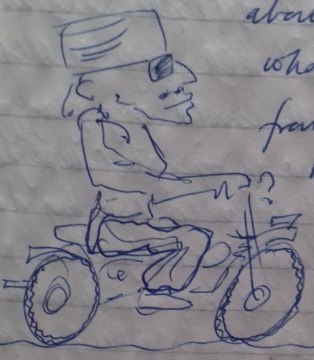
Karachi cool dude
“Cool Dude” with wheels, shades and astrakhan hat.

On the road, buses and auto-rickshaws, tingling with dangling mirrors, brightly reflective with polished chrome, fluttering and flaunting with plumes, flags and tassels, honk and shriek. Mopeds weave wildly carrying stick backed men trying to look like film stars, pop popping along at about ten miles an hour, or whole families, father in front, son in the middle, mother and baby on the back horns honking with a wildness that is at the same time completely routine. Pedestrians walking blithely into lines of oncoming traffic with complete faith in divine protection. They will get to the far side, inshallah.

The sides of the road look quite desperate but full of life. Crowds of people exuding an electric energy, half wrecked buildings in a state of constant make do and mend piled full of dusty merchandise, street stalls, a children’s playground with a manually operated wooden big dipper that wasn’t so big but was heavy enough and full of laughing children, piles of junk, piles of goods, adverts high over shops on dizzying piles of scaffolding.

Karachi family bike
All aboard – En famille en route a des aventures nouvelles.

Karachi is under martial law, so at junctions and in the middle of roundabouts we zip past pill boxes with light machine guns poking out, oiled, manned and ready to be used; the soldiers in WW2 era steel helmets and light khaki uniforms. Big houses belonging to society’s higher ups are barricaded off and guarded by more soldiers, standing with a relaxed aggression and casual arrogance; confident in their control of superior weaponry to any potential challengers.

We pass a grimy industrial waste land with no industry full of shanties – all wriggly tin and flapping canvas.

Journey’s end – a cool oasis – R’s family house – huge white building with three generations of the family living in it; both elderly grandparents, two married sons with their wives and children, three unmarried daughters and two more unmarried sons: over ten adults and several children under five. Nevertheless, it is calm and peaceful. The noise outside is somehow in a different dimension, as though its an echo from somewhere else that is far, far away that you can choose to heed or not – the calls of fruit sellers, the honking of horns.


ARGUING IN CAPITALS – encounters with Trolls.

In online debates there are always trolls and the victims of trolls.

A troll can be said to be someone who – with or without a personal investment in the issue under discussion – seeks to divert it from a reasoned exploration of whatever the issue is – in which both sides might learn something – by way of emotive statements to a series of escalating knee jerk reactions designed to reinforce existing prejudices and emnities.

The persona Donald Trump – as a front man for the team who write his tweets – is an archetypal troll. Nothing he writes leads to reflection or insight, everything leads to outrage, as he might say, “on both sides.” There is no commitment to any search for anything that might be objectively provable; the point is to construct a politically expedient narrative; “alternative facts” using “words as bullets”.

This might be seen as an expression of a ruling class in decline. The leadership of the United States, the most powerful country in the world, faced with the challenge of climate breakdown, simply denies that it is happening. This makes political debate increasingly delirious – because no reasoned discussion can take place when reality is denied.

While some trolls are true believers, some are operatives working for commercial interests, or agents for state intelligence services, or mercenary hacks hired by people like the Koch brothers to propagate their views.

This is the high tech equivalent of the way that the Labour Party relies on its members to get its leaflets out and the Conservative Party hires leaflet distribution companies. One reflects the power of conviction and voluntary commitment, the other the power of money.

There is a distinction in the most effective way to respond to these. The argument that “you should never wrestle with a pig because you both get dirty and the pig likes it” often applies, but sometimes you don’t have to get dirty. Three examples.

  1. Tory boy. Some mercenaries – or political operatives – tend to write short, emotive mantras, rather like a verbal drive by shooting. They really dislike being asked to explain their premises or taken up on a paradox in their own argument and simply go quiet or tend to repeat their statement; as though they are far less sophisticated than they are making out. One, who commented that he loved his country and hated socialists, couldn’t really cope with the point that the country he supposedly loves contains quite a lot of socialists – and we are as legitimate a part of it as he is. The denial of national legitimacy to political opponents has a whiff of civil war about it. One liner shock statements that seem a bit off the wall can be effectively challenged with a question like “Could you explain this please?” They very rarely can or do.
  2. Fossil Fule. The upsurge of justified concern about climate breakdown has led to a rash of sites targeted at for example, motorists – full of profiles – some of which might be people but some may be bots – all spinning variations on – climate change is natural, its just a money making scam etc etc – and commentators who pop up on campaigning sites with remarkably similar misleading claims about – for example -the lifespan of batteries for electric vehicles or the carbon footprint of manufacturing them. These claims are almost plausible and usually backed up with a battery of internet links to long scholarly looking articles to give them weight and are designed to intimidate people who are new to a movement and might be easily put off. The people posting these are often PR people for fossil fuel companies or foundations operating on their behalf. The best way to counter them is to research their claims and present them with the information that debunks them. There is always information that debunks them.
  3. Angry victim. Last year a group of far right Alex Jones supporters – fresh from picketing the BBC in defence of their hero’s online rants -decided to round off their afternoon by trashing Bookmarks, the TUC bookshop in Bloomsbury. As raids go this was more F troop than A team, and – although threatening at the time -gave the shop a huge publicity and sales boost so, along with their online film – which among other things showed a guy with a Donald Trump mask explaining to camera that he was going to wear it so no one would recognise him before he put it on – made the whole thing a huge own goal for them. People who had never heard of the shop before made special trips afterwards to check it out. One education trade union leader put up a post in the immediate aftermath of the raid pointing out that trashing bookshops is a step on the path to burning books – and received an avalanche of abuse from supporters of the English Defence League, and similar organisations. These were all emotional and abusive. Given that anger is a secondary emotion deriving from fear, I asked one of them why he thought what he thought. This was a response to the man’s conviction. there was no question that he personally believed in what he was saying. No one was paying him to do it. This required some research, ignoring some personal abuse, working out that the issue underlying everything else for him was that of of sexual abuse in Rotherham. From his point of view, this issue was as it has been presented by Tommy Robinson and a lot of the mainstream tabloids. The sexual abuse of vulnerable young women – all white – by grooming gangs – all Muslim. When you dig into this, the reality is not so simple. The men at the heart of this were Rotherham’s leading gangsters. They ran prostitution, drugs and taxis. While most of the firm were Pakistani Muslims, one of the taxi drivers – convicted of multiple child abuse in the case – was white. The key role in grooming the girls was carried out by the taxi company’s radio operators – both middle aged white women. The argument that “they never go after their own” was blown away by figures from the helpline for abused young women that was operating in Rotherham while this was going on – which reported that 10% of the girls coming forward were from a Muslim background – exactly the proportion of the local community that is. 90% of the victims in Rotherham were white because Rotherham is 90% white. This was on top of the overall figures, which didn’t cut so much ice with him, that the overwhelming majority of people on the sex offenders register at national level are white men – but no more overwhelming than their proportion of the population as a whole. Putting these points to him led to silence at his end.

There is an additional element to this, when false narratives are deliberately created on an industrial scale by state or commercial or political actors. Part 2 to follow…


An open letter to Alastair Campbell

Dear Alastair,

As an intelligent man and seasoned journalist, as well as one who was as close to the centre of political power in the UK as anyone ever gets – and indeed as a specialist in the management of news – you will have weighed every word of your open letter to Jeremy Corbyn very carefully.

You end it with a plea for him to consider the message rather than dismiss it because of the identity of the messenger. This is a common theme of late, but you will know that the identity of messengers is a relevant aspect of responding to the message. Who are they, what is their overall view, and what axes do they tend to grind, whose interests are they representing, why are they choosing to send this particular message at this time and what effect is it likely to have, are just six questions that come to mind. So, the message and the messenger tend to be inextricably linked; as I’m sure you would concede, if you reflect on your own practice as a spin doctor for Tony Blair.

But, for the sake of utmost clarity, lets look at the message you sent. I will take your points in order.

“Britain is in a moment of peril” facing the prospect of a no deal Brexit, with Boris Johnson as Prime Minister, but “I see no sign that you…have grasped the seriousness of what is happening, let alone devised a strategy to respond and defeat it.” This is very odd. Labour has always opposed no deal. It has voted against it in Parliament consistently. Jeremy Corbyn is currently on the stump around the country holding rallies opposing it. He says he opposes it in every TV interview. Labour stands for a people’s vote on no deal or any deal Johnson can get – though – with his current provocations on the Irish backstop – its obvious he isn’t trying to get one. Labour, uniquely, seeks to unite all those who oppose no deal, both those who favour remaining in the EU and those who favour leaving the political structures but retaining membership of the customs union and single market. The reason for this is that Labour’s position is based on defending the living standards of the majority of the UK population – not limited and polarising notions of “identity” . Labour is not just about the 48% versus the 50%, it is about the 99% vs the 1%. If the country is facing an “existential crisis” it is clearly in the interests of the 1% to try to define all politics in relation to the 48:52, however paralysing that turns out to be.*

Labour’s stance has the advantage of not lumping people who favour a soft Brexit in with the no dealers as an undifferentiated mass of “leavers”; which allows the latter to increasingly hoover them up as a tribal hinterland who just haven’t become full true believers yet. You seem to disregard this risk, which is helping the no dealers towards a majority. Most people in this country want to get on with their lives, do not live in a political bubble, do not write or read letters like this, and could live with any number of political variations as long as their lives are not thrown into chaos by adventurist politicians.

This position is quite clear to me. I can only conclude that you can’t see it because you either haven’t looked, or don’t want to see. It also strikes me as very odd indeed that your response to an existential crisis for the country caused because its government has been captured by a dangerous faction, is to launch an attack on the only political party that could possibly form an alternative government. It is, of course, par for the course for every institution that supports the status quo to drown out any policies that appeal to people on the basis of their class interest; thereby making the identity discourse the only show in town. Although I take you at your word that you have only discussed this issue with close family and friends, it is consistent with articles in the Guardian at the weekend by Jonathan Freedland and Jonathan Powell, arguing for Corbyn to go and Labour to join some sort of “centre” regroupment with no political definition other than remaining in the EU. This is essentially pickling the politics and economics of the 2010 – 15 coalition in aspic and presenting it as a solution; when it helped set up the “left behind” component of the leave vote in the first place.

You argue that if Johnson were to hold a recall referendum between No deal and Remain, Remain would win. Labour agrees and would campaign for Remain were that to happen – as you know. Remaining concerned about Labour’s position on this must take a real act of will.

You then say that Johnson is likely to opt for an early general election because he thinks he can win. If that is indeed your view, isn’t the logical thing to do to support and back up the only Party able to form an alternative government rather than attack it? Taking a fatalistic attitude that current opinion polls are the last word on possible results did not work out too well for Theresa May in 2017 did it?

As a journalist who learned his trade in the pre-digital era, you will be familiar with the phrase “today’s news is tomorrow’s chip paper.” The same applies to conventional political wisdoms. Given how quickly the bad news is already piling up – bad receptions for Johnson in his tours of Wales and Scotland – described by the BBC as “bumpy” – a sharp drop, already, in the value of the pound, the CBI warning against no deal and commenting that preparations for it are as desperate as filling sandbags in a flood – you might save the bedroom but you’ll lose the kitchen – and even that Johnson’s poll bounce is entirely at the expense of the Brexit Party – its quite possible that one of the only things that might save the government and their hard Brexit project are these gratuitous attacks on the opposition from people who should be concentrating all their fire on the government.

It as if the existential crisis of the country takes a back seat to overthrowing the Labour leadership. Fatalistic phrases (“the country may have decided…” on any current analysis..”) – especially when used to obscure a preference – could be fatal here; not so much for Labour but for the prospect of actually stopping no deal.

You say that you have spent “several weeks trying without success to have explained to me the process under which I was expelled for voting Liberal Democrat in the European elections.” I think most of the readers of that sentence will be able to work that one out; and it wouldn’t take them several weeks to do so.

LBJ once remarked that he kept J Edgar Hoover on as Director of the FBI because he preferred to have him “in the tent pissing out, rather than outside the tent pissing in.” Labour is a big tent, but I’m sure you recognise that being inside it pissing in is not a reasonable or acceptable position.

You say that the Party no longer represents your “values”. Quite a number of people will read that with a sigh of relief. The sort of values that allowed you to distort reality to sell participation the war in Iraq, in which hundreds of thousands of people were killed, is not something that sits comfortably with Party members today. Praise be for that.  But you say you want a Party and leadership that stands up for the many not the few and for that to be clearly spelled out. These are Labour’s campaigning pledges. Which of these can you not accept? Which do not represent your “hopes for Britain”?

  1. Increased funding for the NHS with more nurses and doctors to give patients the care they need.
  2. A Real Living Wage of £10 an hour and no increase in Income Tax or National Insurance for 95% of people.
  3. A Green Industrial Revolution creating 400,000 jobs.
  4. Free school meals for all primary school children and reduced class sizes for all 5, 6 and 7 year olds.
  5. Keep the Winter Fuel Allowance, free TV licences and bus passes for pensioners.
  6. A public vote on any Brexit deal. Labour will campaign to Remain against No Deal or a bad Tory deal. 

We will be fighting Boris Johnson – and Nigel Farage – tooth and nail – in Parliament and out. We will put a motion of no confidence when we can win it, not play games with it like the Liberal Democrats. You say that you are unsure who you are going to vote for in the next General Election, but you know that the only practical governmental alternative to Boris Johnson is Labour. Choosing this moment to try to engender a split must be music to his ears.

*For a fuller exploration of this argument see Mike Wongsam – Brexit and the progress of Jeremy Corbyn in Transform 6.


Freeports – giving up control .

Fresh in his job as Conservative Party Chairman in the the new kamikazi Brexit government, James Cleverly announced on Radio 4 that they have plans for 6 “free ports” to get up and running once the UK is “freed” from the obligations of EU membership. By the end of the week Liz Truss had upped this to ten.

This makes clear what their intentions are and undermines any claims by Johnson that it will be possible to maintain good relations with “our friends in Europe” once these are in place.

Despite their rhetoric about “Brussels red tape”, they know that if they want to sell goods into the EU they have to meet EU standards. There’s no getting around that even if they wanted to go on a path of cutting costs and corners on quality to go for a cheap and nasty strategy; at least so far as selling into Europe is concerned. Companies that concentrate on the rest of the world could, however, find a niche for shoddy goods if their costs were low enough.  How far they have to go to make the workers of this country poor enough so their costs are low enough to compete with qualitatively poorer countries is an experiment they will no doubt be keen to try out.

Cleverly argued that setting up free ports would “bring money into the exchequer.” This is odd; because the whole point of them is that companies using them do not have to pay domestic taxes or customs duties; leading to a direct loss of revenue compared with now. The only logic would be that, faced with a UK outside the EU market, international capital will need some serious incentives to even consider investing here.

A “free port” is a classic third world development strategy for countries desperate to attract footloose capital, any capital, by slashing taxes and regulations to zero (or near as dammit) within them. They have also been adopted in the United States, as US capital seeks to withdraw itself from any financial obligations to the society that sustains it. A Free Port is a place in which the writ of the investor runs more than that of the elected government. They will have taken back control from the people. “Democracy” will kneel before them with its begging bowl out. It is a direct abdication of sovereignty. Far from “controlling our own laws” we would be giving them up to footloose multi nationals – who take from everywhere and have obligations nowhere.

The big claims being made for them should be taken with a shovel full of salt. The Centre for Cities Report* on Enterprise Zones – on which Freeports are modeled, points out the following issues.

  1. Over optimistic job creation predictions Estimates cited alongside Johnson’s announcement claim that Freeports will add £12 billion to the economy and create 150,000 jobs. Just as, in 2011, the Treasury claimed that enterprise zones would create 54,000 private jobs by 2015. They didn’t. In fact between 2012 and 2017 the zones had created just 13,500 sustainable private sector jobs.
  2. Hype about the type of jobs.  95 per cent of these 13,500 jobs were lower skilled, so the zones have not provided the answer for areas wanting to shift their economy from lower-skilled to higher-skilled economies.
  3. Displacement Of all the jobs in enterprise zones in 2017 that were not there in 2012, at least one third moved from elsewhere.

Full report here.  https://www.centreforcities.org/blog/why-free-ports-do-not-hold-the-answer-to-job-creation-in-a-post-brexit-world/

This displacement means that places without this special status are being set up to shrink and shrivel from a lack of investment, further reducing revenue to the exchequer. The consequence would be a creeping expansion of zero taxation regimes to as many manufacturing or trading areas trying to compete by offering further incentives.

EU regulations forbid Free Ports, so, as this is aimed at attracting investment from countries in the EU that expect companies to pay their fair share of tax, this would aggravate relations with them.

The domestic “benefits” of such ports accrue mostly to landowners within them. It remains to be seen how far regulations safeguarding workers rights will also be slashed in this desperate race to the bottom.

How low can we go? Quite a bit further if we let them get away with it.


There and back again. Pakistan 1992 – Part 1. Getting there by Aeroflot.

In Pakistan it is said that PIA – the initials of the national airline – stand either for “Perhaps I’ll arrive” or “Please Inform Allah.” We went one better than that and traveled by Aeroflot. This was in the first flush of post Soviet gangster capitalism in which life expectancy in Russia was falling to 57 (for men) and Aeroflot’s aircraft were falling out of the sky almost as rapidly.

“Vy did you come so late?” huffed a squat, fierce eyed Aeroflot official, who looked like she was taking a break from putting shots for the Red Army; her eyes arched and nose quivering. “Traffic” we lied smoothly, so as not to slow ourselves down even more and satisfy a giant ego in a tiny uniform.

Russian pilots wear enormous hats to show how important they are.

The inside of the airport looked like a 1930s cinema with no screen. The plane itself was comfortingly big and looked sturdy and no nonsense. Decorated throughout in brown formica. Style by committee. Worn, carpet backed seats had seat numbers on the backs. That meant that most of the first time Aeroflot travelers used to western airlines sat in the seat behind the one they were meant to be in; leading to a lot of confusion and flustered hostesses; exasperated beyond measure because this happened so often and they didn’t seem to have worked out why.

In 1992 Aeroflot found it hard to cope with vegetarians. The iron trolleys clunked down the aisles like a convoy of T72s, pushed by a hostess who looked like Meryl Streep with a sneer. We asked for vegetarian meals and she looked startled and disgruntled – as though this was the final straw. She pulled out a napkin with a list of seat numbers, waved it under our noses and muttered – “I only haf TEN meals – you are not HERE” and that – as far as she was concerned – was that. We explained that we had definitely booked them and her colleague – a plump baby faced guy with a gentle demeanor under a pile of curly blond hair leaned over coaxingly – “Vould you like Feesh?” – presumably on the basis that meat is murder but fish is justifiable homicide. Puzzled that we wouldn’t, he wandered away promising to try to sort something out in the fullness of time, with a Micawber like faith that something would turn up. Wandering back later in his amiable way – possibly having put this problem into the “leave them long enough and they’ll put up with it” box – we asked him again. He frowned, remembered vaguely, waved a finger to denote that all things come to those who wait and drifted off to the galley – where one unclaimed veggie meal sat resplendent in green eco tinfoil. He presented it to us with the graceful apology of one of nature’s gentlemen and we shared it.

It turned out quite tasty, despite the rather grey appearance of the baby sweetcorn. Everything was enhanced – potentially- by Aeroflot mustard. This stuff was a real nose blaster – a coarse oral dynamite that exploded its way from the taste buds to tingling nasal extremities with a terrifyingly rapid inevitability; making each mouthful an exciting and dangerous challenge. Very good for colds. Highly recommended.

Moscow Airport

Midnight. Minus 8 degrees. Misty. A few pale lights. Heavy snow. An articulated truck with a bus on the back drove emptily by. A hyper modern terminal needing a good clean. Tall brown columns holding up the roof looked like giant toilet roll tubes. Hard face guards in furry hats.

A shuttered enclave of feverish capitalism in a cold climate; a toehold of speculative trading – a levis shop, duty free booze and perfumes, and the heart of the place, a brightly signposted “Irish Bar”, a replica Dublin pub complete with Guinness and Shamrocks, shiny wooden bar and beer pumps but neither soul nor craic and, of course, closed.

A seed of the reborn Russian spiv imperialism that was the best that Yeltsin and Gaidar could offer was embodied in the flinty faced woman at the all night hard currency cafe who asked for £1.70 for a (disgustingly watery) cup of instant coffee (6 times what you’d have paid for it in London at the time) then offered to pour it into two glasses so we wouldn’t steal the cup in revenge.

People were sleeping in doorways all round the terminal. An island of souls in transit from here to there or back again, never making contact with the Russia outside this oddly dispiriting bubble of a place.

The toilets had neither seats nor paper.  Graffitti in English read – “This toilet is made of total crap”.

Outside, in a flurry of light winter snowdrifts and eddies and shifting air currents, snow was softly, gently burying newly arrived aircraft and the runway in thick drifts like icing on a wedding cake.

Inside, a leading member of the SWP and his partner drifted past with incongruous familiarity amid fierce denunciation of someone’s deviations – “and that article he wrote was disgusting!”

On to Karachi

Before we could get into the air again they had to blast the snow off the wings, and they did. This had settled several inches thick and they had to use a hose on a mobile gantry. Completely routine. Going on all over the airport with a calm efficiency. In a climate like that, all engineering had to be seriously heavy duty and watching it work was a wonder.

On the plane, the hostesses had their own solution to the usual seat confusion. “Sit where you like – its free seats.”

Opposite us, a thick set blond youth was fidgety with exhaustion. He kept putting his feet up onto the seat in front – forcing it sharply forwards so the bloke sitting in it got upset, turned round a swore at him. So, he tried plan B and laid down in the aisle, forcing people to step over him. After enough of them had stepped on him instead, he tried Plan C, leaning his head awkwardly onto his food tray; causing the bloke in front to recline his seat and squash him. So, he sat up and pushed back and the bloke in front turned round and hit him. We wondered whether he was on something.

We dozed fitfully though the early hours until woken by a flood of white light through all the windows. It was like light from another dimension. Not the soft, washed out water colour light back home, it was a light so bright it was almost an assault; so many stages higher on the path to heaven.

Down below, the pock marked desert; a baked and crumbling moon landscape, brown and khaki, utterly arid, breaking into the jumbled sprawl of Karachi – shanty town shoved against shanty town, punctuated by clusters of higher flats and offices, all bleached white in the light and crushed up together with more shanties squeezed into every available space.


Why is Labour accused of antisemitism and the Conservatives not?

In any political conflict there is a tendency for heat to obscure light. Statistics quoted in a body of text are often not absorbed. So what follows is an attempt to set out the facts graphically and provide some interpretation which shows how they differ from misleading popular perceptions.

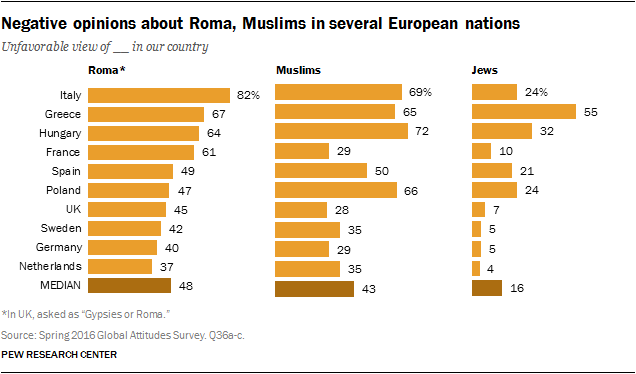
  1. According to Pew Research antisemitism in the UK is very low; both as compared with the median level in Europe and as compared with the national level of Islamophobia and anti Roma sentiment. This does not mean that it is not happening nor that it is not deep rooted in some quarters.
Negative opinions about Roma, Muslims in several European nations

2. Research carried out by MORI on behalf of Jewish Policy Research indicates that strong antisemitic sentiments were very low from the far left right across the political spectrum until you get to the far right; at which point it almost quadruples.

JPR’s central argument – that there is a direct correlation between antisemitic attitudes and hostility to Israel – is undermined by their own survey. This shows that there is indeed a direct correlation between antisemitism and hostility to Israel on the far right – where the figure overlap almost exactly – and almost complete disjunct on the far left – where there is significant hostility to Israel but almost no corresponding level of antisemitism. It would be hard to argue from these figures that the direct correlation between antisemitism on the right and hostility to Israel is not indeed a reflection of overall racism on the right; nor that the lack of such an overlap on the left can reflect anything another than  an anti racist position – which defends Jewish and other ethnic minority communities domestically – and extends this to the human rights of Palestinians in Israel.

antisemitism.PNG

3. Surveys carried out by the Campaign Against Antisemitism have shown that there is more of a problem with antisemitic attitudes among supporters of the Conservative Party than the Labour Party (Figures as original).

4. This is born out by research from The National Centre for Social Research which shows a very welcome overall decline in racist attitudes overall, that these are less commonplace among Labour supporters than those of other parties and, crucially, that these have declined very sharply since Jeremy Corbyn was elected leader of the Labour Party. It is worth noting that racism rose across the board after 2001, reflecting the “war on terror” and everything that went with it, and that racist attitudes are almost TWICE as prevalent among supporters of the Conservative Party than they are among Labour supporters.

5. It is also the case that it is the Conservative Party that has links at a European level with dubious Parties and movements that either deny or belittle the holocaust or celebrate the participation of their citizens in the Waffen SS. This was detailed in an article by Jonathan Freedland in 2009 in which he asked “where is the outrage?” An appropriate question.

https://www.theguardian.com/commentisfree/2009/oct/20/conservatives-european-allies-holocaust-deniers

It is reported on Wikipedia that Jewish organisations quite rightly complained about these links to the Conservative Party in 2018. There have been, however, no marches on Conservative central office, no “enough is enough” placards, no weekly headlines in the Jewish Chronicle targeting them, no declarations of an existential threat. Instead, the greater incidence of antisemitism within the Conservative Party and right generally has been ignored in a single minded focus on making out that Labour has much more of a problem that it does – to the extent that the popular perception is now the inverse of reality.

The figures for Labour are quite revealing when you look at them graphically.

Figure 6. Number of Labour Party members accused of antisemitism as a proportion of the membership.

The ratio of 1:817 (1106 cases out of 550 000) is so small that the number of accused (the thin blue line) barely shows up on the graph.

accusationsgraph

Moreover,  4 in 10 of those accused turned out not to be Party members in the first place. Of the cases referred by Margaret Hodge, only 20 out of 200 were actually Party members.

Further, of the remainder, more than half had their cases dismissed for lack of evidence. Only 1 in 10 of those accused have either been expelled or resigned. Some of those who have been accused or expelled are Jewish.

Three dissonant shirts

A woman walks past in a mass produced T-shirt that reads “Dare to be Different.”

Another – with a red and angry face – is decked out in a purple shirt with the word LOVE in enormous letters.

A third on the bus, whose “Choose Cheerful” shirt does not make her smile.

This is not to denigrate the women wearing these, but simply to point out that the constant pressure to “be positive”, “keep calm and carry on”, “keep smiling” is a way of normalising the unbearable in a way that can make it worse. the impact of what might be called “compulsory happiness” regimes in workplaces creates a tension between outward appearance and inward feeling that destroys people’s souls.