“West” marches Ukraine towards the abyss.

“I think it is absolutely in the interest of US security. It is extremely good value for money for the United States and others, for perhaps about 5 or 10% of your (US) defence budget, almost half of Russia’s pre war military equipment has been destroyed without the loss of a single American life.” Lord Cameron speaking in Washington this week.

An admission that this is a proxy war, in which the “West” supplies the munitions and the Ukrainians do the dying, if ever there was one.

The review on Labour Hub of Volodymyr Ishchenko’s Towards the AbyssUkraine from Maidan to War is a bit sniffy at how “even handed” he is; but in examining who he is being “even handed” between allows a chink of reality into a discourse on that site that has refused to acknowledge any fissures in Ukrainian identity at all up to now.

All the previous articles self referentially quoted in this review were consistent in dismissing the people in Crimea and Donbass who rebelled against the consequences of the Maidan movement and the incorporation of Ukraine into the Western Bloc either as non existent or, at most, a minority of Russian proxies.

But in this review we do have a recognition that Ukraine did indeed “polarise” towards, in and beyond the Maidan movement; in a way self servingly summarised by pro “western” commentators as between ‘new’ Ukraine – “young, metropolitan, cosmopolitan, fluent in English, stylish, mobile, liberal, well-educated, successful” to the old ‘Soviet’ or ‘Russian’ outlook – “old, conservative, provincial, rigid, clinging to dying industries, poorly or inadequately educated, in bad taste, losers.” “Sovoks” as the dismissive term goes in Kyiv.

This is worth noting as the first time that this reality has been acknowledged in a Labour Hub article. Its possible that this is simply for purposes of this review, and normal service will be resumed shortly, but taking it on board is essential for any serious search for a peaceful solution that does not go by way of a massive Western escalation, with a possible nuclear component, and a (now implausible) march on Rostov on Don.

However, though the summary of the polarity in this review does not minimise the scale of it, unlike previous articles on Hub, it continues to ignore a different, more disturbing, dimension. That the largely Russian speaking, and oriented, East, was, and is, for the most part industrial working class. The Donbass, in which the war is being fought, is heavily built up, with densely packed strings of urban settlements built around mines, or strung out like heavy, gritty beads along the main roads.

The EU – and now US – oriented Ukrainian speaking West, is more agricultural; with wide open spaces with sparse villages. Look at an aeriel view. The Ukrainian nationalism nurtured there draws from deep wells of peasant suspicion of urban elites, with poisonous roots reaching back through Banderist collaboration with the Nazis (all those concentration camp guards) and beyond, to Pyet Lyura’s short lived nationalist regime at the end of World War 1; notorious for pogroms even more severe than those carried out by the White Guards during the Russian Civil War.

This has its modern day expression in influential organisations now incorporated into the Ukrianian armed forces, like the Azov battalion or the Right Sector – whose leader has been filmed saying “certain people have too much influence in Ukraine… you know, like Russians…and Jews” . Not so “metropolitan”, “cosmopolitan” or “liberal” then.

A nationalism generated in service to a greater Empire runs in the tradition of this sort of Ukrainian nationalism. First for the Habsburgs, then the Nazis, now the USA. A self image as a frontier people, “a large Israel in eastern Europe”, as President Zelensky put it. In its full fat far right form, full of suicidal self romanticism: seeing themselves as the 300 Spartans against the Asiatic hordes. A view also actively promoted within the Left by the John Bull like Ukraine Solidarity Campaign weekly bulletins that paint a picture of Russian soldiers as the sort of sub human orcs that Georgia Melloni imagines them to be. Which is why the transatlantic far right has sent so many volunteers to fight in the Donbass since 2014, a practice now getting a nod and a wink from NATO governments, with “off duty” French Foreign Legionnaires beginning to appear in casualty lists.

But perhaps not quite so self sacrificial. Units of the Ukrainian Armed Forces that are effectively insourced far right militias, like the 67th Mechanised Brigade for the Right Sector and the 3rd Assault Brigade for Azov, tend to be used behind the lines to deter retreats and deserters. When put in the front lines they are developing a reputation for self preservation; with the 3rd refusing to take up what they considered to be suicidal positions in Avdiivka last month and, just this week, Chassiv Yar, while the 67th abandoned their positions there to avoid encirclement rather than seek the heroic martyrdom they advocate for others.

These are nevertheless the shock troops and guarantors of “the Ukrainian government’s decision to stick to neoliberal dogmas of privatization, lowering taxes and extreme labour deregulation, despite the objective imperatives of the war economy” as Ishchenko puts it.

But still, a polarisation. Two sides, in Ukraine. In which the tradition described by Ishchenko which celebrates the hostory that “Ukraine was crucial to the greatest social revolution and modernization breakthrough in human history. Ukraine was where some of the most significant battles of World War II took place” and in which “Millions of Ukrainian civilians and soldiers in the Red Army contributed huge sacrifices to defeat Nazi Germany” is actively celebrated in Donbass and Crimea; while people are arrested for expressing it in Western Ukraine. “Western” here being a term that is both geographical and political.

So, a civil war, in which the Russians are engaged with what they see as their people, and NATO is engaged with what have become their proxies. It is, indeed, innappropriate for anyone on the left to be “even handed” in a polarisation like this.

It takes a heroic act of disavowell on Labour Hub’s part to consider the economic polices outlined above to be a sovereign act by Kyiv, with the US and EU having no influence whatsoever; even though the “reconstruction plan” due to be administered by Blackrock after “victory” will take this to frenzied levels; initially conceived as a way for Western capital to carve up Ukrainian resources, with the oligarchy getting a cut, but, in the context of defeat, so the “West” can salvage what it can from the wreck of its military ambitions.

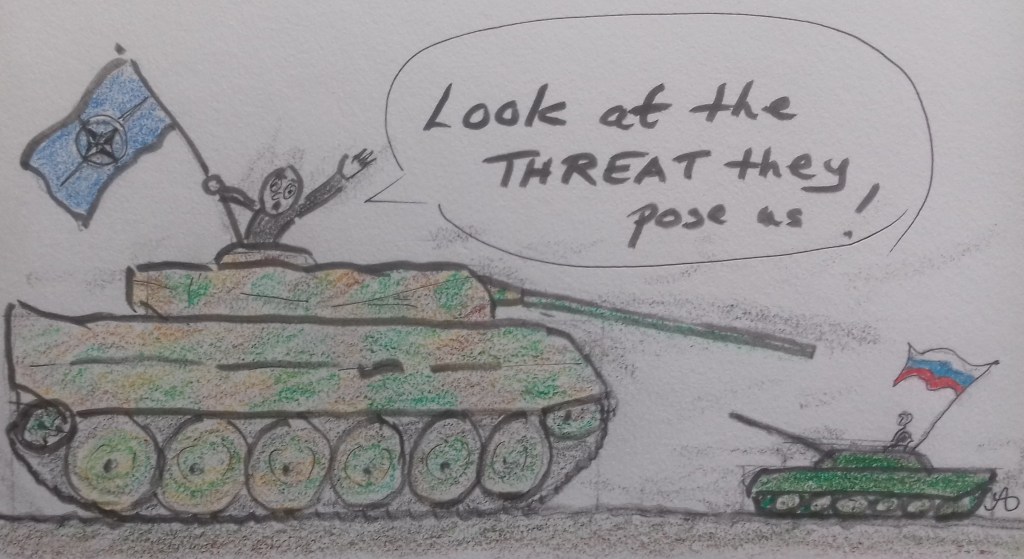
There is similar disavowell in the breezy assertion – contrary to everything the Russians said about their motivation since at least 2008 – that “Russia’s war on Ukraine had very little to do with a supposed ‘NATO threat’”. “Supposed ‘NATO threat'”? Its amazing how dismissive you can be just by using an adjective and a pair of inverted commas. Perish the thought that NATO outspending the Russians on arms by more than eleven to one, expanding right up to their border and carrying out annual war games practicing to fight them could be considered a threat in Moscow.

A way to picture that is this infographic, which has the NATO tank 11 times the size of the Russian tank and therefore has the respective threats in proportion. Not something that is ever evident in the media here, nor, sadly, on Labour Hub.

The US alone spends seven and a half times as much as the Russians do. Add together all the direct US allies and they account for 67% of global military spending. They are the core of Global imperialism. The military expenditure is to secure their ongoing exploitative relationship to the rest of the world. We know that they are willing to use this, and have done. Four and a half million people have died in the “war on terror” since 2001. And President Biden is busily pushing Congress to authroise an additional $18 billion in militray aid to Israel, even as it commits its genocide in Gaza, while at the same time as cutting off aid to UNWRA to further facilitate it. so, they are not intervening in Ukraine now, and did not intervene in Ukraine during the Orange Revolution or in the Maidan movement, out of any romantic belief in the self determination of nations; quite the reverse. As Anthony Blinken put it recently, “if you’re not at the table, you’ll probably be on the menu”.

This was a war of choice by NATO. A deal guaranteeing Ukrainian neutrality, autonomy for the Donbass within Ukraine, and open ended, possibly eternal, negotiations about the status of Crimea and mutual security guarantees for the whole of Europe were on the table in the Winter of 2021. That would have been a good result for everyone in Ukraine and eased tensions across Europe. NATO wouldn’t even discuss it. It is still the best outcome for the working class in Ukraine, and in the rest of Europe, and the world.

Without an even more catastrophic escalation, possibly through the Samson option foreshadowed by the UAFs recent drone attacks on the Zaporizhye nuclear power station, NATO is now heading, slowly, inexorably, towards defeat.

Continuing cheerleading for pursuit of this war pulls us all towards the “abyss” of Ishchenko’s title, but the people of Ukraine most of all.

We won’t die for Zelensky

Is a sentiment increasingly strongly felt in Ukraine. An unwillingness to die for Grant Shapps is also a majority sentiment in the UK, with just 17% being prepared to “fight for their country” in recent polling (and just 14% of 18-24 year olds).

We are now at a very dangerous point in the war in Ukraine. NATO is having to contemplate a defeat. The Ukrainian armed forces are suffering terrible losses and retreating all along the line of contact. There are increasing reports of surrenders, sometimes whole platoons sent to occupy suicidal forlorn hope forward positions (who are asking the Russians not to include them in prisoner swaps so they don’t get sent back to the front). There are also now a lot of videos of men being press ganged by Ukrainian recruitment officers, involving chases down the road and punch ups. Sometimes they get away, sometimes they don’t. The new conscription bill, to draft younger age groups is deeply unpopular and has been a political hot potato for months. The days of eager recruits is long gone. There have been whatsapp groups used by men to warn each other when the press gangs are around, so they can keep their heads down, for quite some time now. The latest visit from US National Security Adviser Jake Sullivan is reported to have offered Zelensky a deal; pass the conscription law as the quid pro quo for the US unblocking its latest tranche of aid. Essentially, this translates as Sullivan saying you provide the men to fight and die, we’ll supply the weapons that keep them in harms way. Zelensky’s own standing is undermined by the expiry of his Presidential term this month. Elections have been cancelled until the war is “won”.

There are two problems with this.

1. “Winning” for Kyiv/NATO means;

  • reconquering parts of pre 2014 Ukraine that rebelled against the US/EU backed overthrow of a government they had voted for. 30% of the pre-2014 Ukrainian population spoke Russian as their first language. Calling for an end to “the Russian occupation” would actually require most of the population of Crimea and Donbass to become refugees heading for Russia. Calling for “Russian troops out” means driving the locally recruited Donbass militia, which is now integrated into the Russian armed forces – out of their homes and the land they have been fighting to defend since coming under Ukrainian attack in May 2014.
  • integrating Ukraine fully into NATO – the world’s dominant alliance of imperial predators – as “a big Israel in Eastern Europe” (President Zelensky). A military frontier henchman state for a US dominated bloc that, as we know from long experience, or should, applies the principle recently restated with alarming candour by Anthony Blinken at this year’s Munich Security Conference: “if you’re not at the table in the international system, you’re going to be on the menu.”

Neither of these are outcomes that anyone on the Left should support.

Even if you think that being against “campism” means that you have to defend “principles” like the “right” of a state to join an imperialist military alliance; if you find yourself agitating for that bloc to be more aggressive in supplying arms, there is no basis on which you can oppose the militarisation of our society, and the war drive that our ruling class is engaging in, because you have become a cheerleader for it. This is revealed by the argument in a recent article on Labour Hub from the Ukraine Solidarity Campaign that the impending defeat in Ukraine “has arisen from the self-limiting approach by the democracies providing aid.” My emphasis. Who does he mean by “the democracies”? The world’s richest, most powerful economies, coralled into a military and political bloc that exploits the rest of the world under the leadership of the USA? Those “democracies”? For the author, the core of world imperialism are “the democracies” engaged in a “key battle for democracy with the new authoritarianism.” This is straight State Department terminology and framing.

This way of thinking possibly explains why USCs contribution to the war drive of the countries that account for 75% of global military spending, launched the “war on terror” that killed 4.5 million worldwide and are currently arming Israel in its genocidal assault on Gaza, is to produce wild and lurid propaganda about Russia’s “barbaric methods” that are the contemporary counterpart of those penned by Horatio Bottomly in John Bull during WW1. They have reduced themselves to a descant chorus to the relentless drone of the ruling class narrative in the dominant media. Karl Leibknecht did not say “The enemy is at home – but for the Russians, Chinese, Syrians, Libyans, Cubans, Venezuelans, Afghans, Haitians (add whoever the next target is) we’ll make an exception”.

2 “Winning”, as described above, is impossible and the attempt to do so will destroy what is left of Ukraine.

The Ukrainian offensive last year was a debacle. The Western supplied equipment, and the tactics they advised, failed appallingly. Incremental gains were won at a terrible cost in men and equipment. There is no chance of a repeat. No one now seriously envisages punching through to the Sea of Azov, let alone a march on Rostov on Don. So, what, or who, is the war for?

For NATO, sustaining the war, at the cost of thousands more dead Ukrainians, is worthwhile to “weaken the Russians”, or at least stave off a very visible defeat. NATO is the core imperial alliance. “Losing” in Ukraine would be a loss of face even more severe than that suffered when its Afghan proxy regime collapsed within weeks of direct withdawal. Can’t have that. However, this requires Ukrainians to be willing to keep fighting, with no chance of winning, no light at the end of the tunnel, the only fuel being the sense of keeping faith with the dead, whose sacrifice cannot be aknolwedged to have been in vain. As noted above, this is beginning to wear out. People need, and deserve, a future that is not an endless war.

There are two possibilities in the current situation.

  1. The Russian armed forces continue to make steady incremental gains on the ground and thousands of Ukrainians die in a futile attempt to stop them; leading, eventually, to political collapse in Western Ukraine leading to partition and neutralisation. No amount of Western weaponry short of nuclear war is going to stop this. The argument in the latest article from Labour Hub – Labour and Ukraine: Oppose the Tory arms sales and demand the weapons to win! endorsing a proposal from John McDonnell and Clive Lewis that the UK Ministry of Defence should stop selling off its old inventory, and donate it to Ukraine instead, peddles the face saving delusion that a bit more second hand equipment would magically do in 2024 what it spectacularly failed to do in 2023. In so doing, it postpones coming to terms with what is staring us all in the face. To try to “win” would involve a level of escalation that would not only militarise society – and require “sacrifices” by the working class to pay for it – it would also threaten a direct confrontation between NATO and Russia; which would be suicidal for all of us. We should all oppose that.
  2. NATO escalates? It is not at all clear what they are going to do. NATO intelligence already provides the UAF with satellite data. There are advisers on the ground, Some of them were killed in a recent Russian missile strike on Odessa. The Black Sea operations are being run by a Royal Navy Admiral. There are also some Special Forces and “volunteers” engaged, like the former French Foreign Legion soldiers who took part in the recent UAF incursion across the Russian border (another costly debacle). “Mission creeep” is always on the agenda. There is currently a massive NATO military exercise going on, that started in January and is scheduled to last until May, largely focussed on the area to the West of Ukraine – part of an annual series of rehearsals for a war with Russia that have been going on for decades. This is in addition to increased permanent deployment since February 2022 into the countries that border Ukraine to the West. As NATO puts it itself, “allies reinforced the existing battlegroups and agreed to establish four more multinational battlegroups in Bulgaria, Hungary, Romania and Slovakia. This has brought the total number of multinational battlegroups to eight, effectively doubled the number of troops on the ground and extended NATO’s forward presence along the Alliance’s eastern flank – from the Baltic Sea in the north to the Black Sea in the south.” So, there are forces poised. Sabre rattling from President Macron, proposing to send NATO troops into Odessa and other parts of Western Ukraine to secure it for “the West” and release Ukrainian reserves to fight and die at the front for many, many more months, kicking a resolution to the war bloodily down the road, has not been endorsed across the bloc, but has led to the deployment of sigificant French forces into Romania in recent days. Doubtless for USC this is another example of “the self-limiting approach by the democracies (sic) providing aid”. It should go without saying that this is incredibly dangerous and I wonder if USC would cheer them in if they marched across the border.

Put very simply, for NATO to attempt to “win” in current circumstances risks nuclear war, which we should all oppose. Sustaining the conflict, even with army surplus goods from the MoD, means many thousands more deaths and the destruction of whats left of Ukraine; with the war as an end in itself that has no end. A peace on the basis of accepting the self determination of both peoples in Ukraine, and securing Ukrainian neutrality could have avoided the war in the first place, and remains the best result now.

Personal post script.

In the early 1960s there was a popular record request programme on the BBC Light Service called Two Way Family Favourites. Well before the internet and mobile phones, this was primarily aimed at allowing service personnel deployed overseas a chance to connect with their family back home by way of requesting a record to be played during Sunday Dinner. A lot of requests came in from BFPO 39 (the Forces Post Office for the British Army on the Rhine) and a regular favourite was the 1812 Overture; Tchaikovsky’s triumphalist celebration of the debacle of Napoleon’s retreat from Moscow. They would always play the last part; depicting the snow swirling down and enveloping the Grande Armee as it limped West, and ending with the old Russian national anthem played as an up tempo riot, punctuated with cannons going off, heavenly choirs singing and church bells ringing. As a child, I thought at the time that the soldiers were requesting it because of the cannons, but (along with the equally frequent requests for the US President’s phone call to the Soviet General Secretary from Dr Strangelove) I think this was a way of sending the message that contemplating a war with Russia was a really bad idea.

No ifs, no buts…why the trade union movement should stand for peace in Ukraine – a reply to Gary Smith

However one views Russia’s invasion, to support pursuit of the war by Kyiv until victory, until all lost territory has been regained, and to call for Russia’s strategic defeat—the current position of that regime, supported by the US and NATO—is to support a profoundly criminal policy, since the goal is unrealisable. Its pursuit will not change the outcome of the war but will continue to destroy Ukraine. David Mandel

Gary Smith’s argument on Labour List, written under the pressure of a critique from Stop the War’s Andrew Murray, starts with the resounding phrase “Solidarity should know no borders”.

One border that he doesn’t acknowledge is the one that has run in blood across the Donbass since the Ukrainian Air Force bombed Donetsk City in May 2014. This followed a popular insurrection in the East of the country against the Maidan coup, because it overthrew a President they had voted for, with the help of the US and EU with an increasingly influential role being played by the local far right.

Gary Smith simplistically sees this as a “Russian occupation”. His attempt to explain away local support undermines his entire stance, however. He is AGAINST a local referendum in Crimea and Donbass, to determine whether the people who live there wish to revert to Ukraine or remain in the Russian Federation, on the grounds that there has been an exchange of population since 2014. What he doesn’t acknowledge is that some of the people who have moved into the Russian zone since the start of the war have been refugees from Western Ukraine. Russian speaking people who felt under threat or out of sympathy with the Ukrainian nationalist form of the oligarchic regime in Kyiv. Early in the war, there were convoys of cars trying to get out of Western Ukraine to get to the Russian zone. Some of them were shelled. He also doesn’t note that a third of the refugees from the war overall have fled to Russia itself, which is the largest single destination country.

He uncritically repeats lurid propaganda that a policy of evacuating civilians from war zones -as the Russians have done – amounts to “abduction”. It seems odd to argue that children in an orphanage, for instance, should be left in a zone that is being shelled and fought over by both sides. Better to get them out, surely? He does not note that when Russia evacuated Kherson last Autumn, a majority of people chose to leave, but those hostile to them stayed; and were allowed to do so; which would not be the case if they were being “abducted”. Hopefully he does not agree that keeping them in situ to act as human shields for military installations – as Amnesty International noted the Ukrainians were doing – is somehow acceptable because its them doing it.

Overall however, opposing a referendum – giving the people a choice – shows that he knows that the reversion to Ukraine would lose in these areas. There are good reasons for that. Even if you think the referenda held by the Russians last Autumn in Donbass, and in Crimea in 2014 had no significance, people in Donbass have been fighting the Ukrainian army since 2014. 50,000 of them are in the Donbass militia. Dontesk city has been shelled almost every day for nearly ten years. There is no love lost on either side of this border. It is also stated in terms by the head of Ukraine’s Military Intelligence, Kyrillo Budanov, that the people in Donbass and Crimea have a “completely different view of the world” and will have to be “re educated” or “physically eliminated”. This is not, in his view, a liberation of a population oppressed by a Russian occupation, but a reconquest against the resistance of people who support it. Budanov is a serious man. We should take him at his word.

So Gary Smith’s view, and that of the GMB Motion, is that the determination of Ukraine’s future should be left in the hands of some of the pre 2014 population, but definitely not all of it. Self determination for the West. Forcible occupation and ethnic cleansing for the East. Not a position the TUC should support if we think that “solidarity has no borders”.

Gary Smith’s case relies on two gigantic false premises.

1 That it is a Russian war aim to conquer the whole of Ukraine and eliminate the Ukrainian nation. It isn’t. Occupation of the whole of Ukraine would be like “swallowing a porcupine” for Russia, as John Mearsheimer put it. Why would they want to do that?

Russian war aims have been quite clear from before the war started, and negotiating about them seriously in the Winter of 2021-2 could have averted the conflict.

  • They were initially to remove the military threat to the Donbass and allow it autonomy within Ukraine. 14,000 people had died in the conflict since 2014, most of them on the Donbass side of the line. Initially Russia didn’t even recognise the Donbass Republics, despite local pressure and pressure in the Duma from The Communist Party of the Russian Federation – the main opposition Party – to do so. The demands from Donbass itself to be absorbed into the Russian Federation were only accepted and implemented after 6 months of fighting and the failure of initial peace negotiations in May 2022 that are widely acknowledged to have been torpedoed by the US and UK.
  • Recognition of Crimea as part of the Russian Federation. This is overwhelmingly supported by the people who live in Crimea. For background see here.
  • A commitment from Ukraine not to join NATO. NATO is presented in the West/Global North as a defensive alliance, because NATO is the military expression of the Global North. Being a member if NATO is being part of a bloc of wealthy imperialist countries responsible between them for 62% of global military spending and whose core members, including the UK, are responsible for 4.5 million deaths in the war on terror over the last twenty years. It does not defend “democracy” it is an organisation to defend the Pax Americana, which is anything but peaceful for anyone on the receiving end of it. Every year, NATO conducts “war games” in Eastern Europe practising for a war with Russia. Locking in Ukraine, with a large army, swollen by Western finance and honed by Western training, spiced up by far right volunteers who see the Donbass as the front line of the war between (white) Europe and (untermensch) Asia would make such a war inevitable. The refusal of NATO to even negotiate on the Russian proposals for mutual security guarantees in the winter of 2021 -2, convinced them that this was the case.
  • A removal of far right (Banderite) influence on the Ukrainian state. This influence has been played down in the West for the last eighteen months, but it is pervasive. This goes a lot deeper than Azov battalion insignia. The wholesale glorification of Stepan Bandera, a man whose organisation provided a strong contingent of concentration camp guards, fought with the Nazis and killed 100,000 Polish villagers, as well as countless numbers of Jews, and the embedding of far right organisations and their mode of thought across the entire state is no trivial matter and reflects a wider rehabilitation of the far right increasingly pervasive in the Global North.

Supporters of the GMB motion should reflect on what, if anything, is wrong with any of these positions.

Is it desirable to glorify a Fascist movement as part of an attempt to build up national consciousness?

Is it desirable to be part of the world’s premier predatory imperialist alliance?

Should the people who live in Donbass and Crimea be forced to live in a state that is hostile to them and wants to ethnically cleanse them?

If your answer to any of these questions is “no”, then the GMB Motion can’t be supported.

2. Gary Smith does not acknowledge the role of NATO in general and the United States in particular in fomenting this conflict. The geo-political aim of the US since the fall of the Soviet Union in 1991 has been to “dominate the post Soviet space”. That means Eastern Europe, former Soviet Republics and, ultimately, Russia too. This goes along with breaking any relationship between countries in the EU and Russia that might threaten US dominance in Europe as a whole. That’s why they never agreed to any notion that Russia could join NATO – because the centre of military and economic gravity on the continent would be between Russia and Germany, and that would be hard for them to control. Blowing up the Nordstream pipeline is symbolic of this.

The United States is funding this war, and supplying the military equipment, satellite intelligence and propaganda mobilisation needed to keep it going. You’d have to have to have been paying no attention at all to the US record across the world in the last 150 years to have any delusion that this has anything to do with the rights or otherwise of Ukrainians. Senator Mitt Romney put it as cynically as you might expect “Supporting Ukraine weakens an adversary, enhances our national security advantage, and requires no shedding of American blood”.

On the principle that “he who pays the piper calls the tune” it would also be naive to assume that Kyiv has any weight at all in strategic decisions. A concern with “imperialism” that ignores the role and influence of the world’s dominant imperialism – and its local dominance inside Ukraine itself -is an attempt to blow smoke in our eyes.

The best traditions of international solidarity in the trade union movement are to stand up against the wars and exploitation visited upon the world by our own ruling class. The worst tradition is that of knowing our place, tugging our forelock, and going along with the foreign policy objectives of our own imperialism and its senior partner in Washington, in the hope that, loyalty will be rewarded with some crumbs from their table, like well paid manufacturing jobs in BAE systems perhaps.

The current course of the Kyiv government is to subject their people to self immolation at the behest of the US. This summary of how grim things are getting is from Dimitriy Kovalevich.

In Western media, the current conflict in Ukraine is often presented as a war between Western-style ‘freedom and democracy’ and Russian-style ‘authoritarianism and dictatorship’. We are told, furthermore, that such ‘freedom and democracy’ are represented by the governing regime in Kiev.

But this is a regime that has banned all men between the ages of 18 and 60 as well as women in certain professions from leaving the country. There is no free internal movement of citizens. The main exceptions to the prohibition on leaving the country are those unfit for military service, those fathers who have three or more minor children (all below the age of 16), and persons caring for people with disabilities. (The latter exemption only applies if there is no other family member to provide care.)

The regime, which came to power in a violent coup in February 2014, has long ago banned all left-wing political parties in the country, and since last year it has banned street protests and strikes. Also last year, it passed a law severely restricting the rights of trade unions. Ukraine was supposed to hold a legislative election this fall, but this has been postponed. (Elections are to take place in the Russian-controlled territories of Ukraine on September 8-10). For neoliberal capitalism, there can never be too many restrictions against freedom, nor can there ever be too much exploitation.

In early August, deputies of the Ukraine president’s ‘Servant of the People’ party in the national legislature (‘Rada’) introduced a bill that provides for the conscription of forced labor of all those who have not been conscripted to the armed forces. Formally free citizens who already cannot legally leave the country due to wartime restrictions will now also be subjected to forced labor.

There is also already a serious shortage of trained personnel in Ukraine. Hundreds of thousands of factory workers, skilled tradespeople, railway workers, drivers, and other equipment operators in agricultural industries, and on and on have been conscripted into the army. Many of them have died or been seriously injured in the futile attempts of Ukraine’s leaders and their Western patrons to storm the well fortified defensive lines of the Russian armed forces.

In addition, some eight million people have simply left the country during the past year and a half. Most of those have no wish or plans to return in any foreseeable future. Every day, Ukrainian border guards catch dozens of ‘conscription refugees’ at Ukraine’s borders. Sometimes, border officials use tracking drones generously provided by the governments of the European Union and the United States. The unfortunates who are caught quickly find themselves in the trenches along the hundreds of kilometers of front lines separating Ukrainian and Russian armies.

‘Help wanted’ signs can be seen in Ukraine on many delivery trucks, at bus stops, and in front of supermarkets. Orderlies and drivers, construction workers and packers read the signs, are “urgently needed for work”.

Although Ukraine is the poorest country on the European continent, many people are not eager to rush into a job. Since the beginning of the year, company managers are obliged to hire employees only after receiving formal approval from the local military conscription office. Thus, a man who applies for an advertised job as a driver may well instead find himself in the trenches, facing minefields and deadly Russian defensive positions. Meanwhile, his former employer will be back on the hustings looking for a replacement driver.

Another factor weighing on the labor market in Ukraine is wage reductions of up to 50 per cent. Teachers are facing salary cuts as the 2023 national budget for public education in Ukraine has been downgraded from an initial 154 billion hryvnias to 131 billion  hryvnias (US$3.5 billion). That is less than the 2022 expenditure. In addition, most school districts rely on supplementary funding from local governments, and these funds, too, are being squeezed. As the Ukrainian news outlet Apostrophe explained in a report in late 2022, citing a teacher in Kiev named Oksana: “In Kyiv, the situation is more or less the same, although the allowances have been partially removed. But the situation elsewhere in Ukraine is really worse. In many cities and villages, teachers are receiving ‘survival’ salaries only, losing from 15 per cent all the way to 50 per cent of their income, depending on the state of local budgets.”

The report explains, “Educators receive money not only from the Ministry of Education and Culture but also from local budgets. But local budgets during the war have also shrunk significantly. According to a study by the Kyiv School of Economics, every fourth community under [Russian] occupation [control] has collected 50 percent less revenue compared to pre-war plans. Another two-thirds of communities outside the combat zone reported a decrease in income. It is clear that in such a situation when it is necessary to urgently address humanitarian issues, local authorities cannot pay pre-war salaries to teachers.”

This takes place as inflation is around 30 percent annually. Wages in Ukraine today barely cover the cost of basic food. For these reasons and more, many workers retreat into the shadows and choose to work illegally, many in multiple jobs if possible.

Last year, Ukrainian authorities tried to solve their labor shortage problems by tapping into the large pool of the unemployed. The unemployed who were officially registered were sent into military zones to clear rubble, cut down trees, build shelters, etc. This is hard physical work, often located near the front lines. This initiative was labeled an ‘Army of Reconstruction’, but many people responded by simply stopping to register as unemployed. After all, unemployment benefits have also been cut in Ukraine. Today, the average benefit hovers around the equivalent of US$27 per month. The maximum benefit rate is $180 per month, but this is only good for three months.

Food prices in Ukraine are already higher than in Russia and EU countries, from where most food supplies in Ukraine come.

Simply put, Ukraine is gradually introducing a system of slave labor – people must work to meet basic food needs, but they work for steadily shrinking salaries and benefits. Western media is silent about all this ...

The new draft law on the mobilization of workers is intended to “ensure the functioning of the national economy under martial law”, in the words of those drafting the law. It is noteworthy that in early August, Ukraine began to talk about a likely ban against military conscripts leaving the country for three years following an eventual end to military hostilities and martial law. Just such a proposal was recently made by Vadym Denysenko (and here), head of the Ukrainian Institute for the Future and a former advisor to the head of the Ukrainian Ministry of Internal Affairs. Denysenko said, “I am sure that even after the war it will be necessary to extend the ban on men traveling abroad for at least another three years. Otherwise, we simply will not survive as a nation.”

Earlier, Denysenko’s Ukrainian Institute for the Future published data on population numbers in Ukraine. Since the start of the Russian special military operation in Ukraine 18 months ago, some 8.6 million citizens have left the country and not returned. Of the 29 million citizens remaining in the country, no more than 9.5 million are working. State-financed jobs excluded, there are some six to seven million workers earning salaries. Ukraine began its path to post-Soviet ‘independence’ in 1991, with a population of 52 million. The population numbers have been steadily declining ever since due to mass emigration.

At the same time, the fertility rate of the country has fallen below one. To ensure stabilisation and a small increase of the population, the fertility rate should be more than 2. But the Institute says the average fertility rate is 0.7 children per couple. It also cites analysts who project that the number of pensioners in Ukraine in the coming years will be double the number of working-age citizens.

Vadym Denysenko is partly right in the sense that millions of Ukrainian men would no doubt rush abroad were borders to be opened. The wives and children of many of them have already been living abroad for year and a half. Many would leave in search of better wages and in order to escape the mousetrap that Ukraine has become.

Denysenko’s proposal is not at all appreciated in Ukraine. It is viewed as a return to slavery and serfdom. Of particular note is that his Ukrainian Institute for the Future is a neoliberal think tank funded by right-wing think tanks in the West, including the Atlantic Council and the National Endowment for Democracy in the United States.

This idea of prohibiting Ukrainian citizens from leaving the country even after the end of hostilities stems, in part, from the fact that Ukraine is now heavily indebted to Western governments and financial institutions. Repayment with interest can only be guaranteed through the merciless exploitation of the Ukrainian population. To achieve that, it is necessary that the population be denied the option of running away from something rightly perceived as something resembling slavery or medieval serfdom.

In July 2023, the foreign exchange reserves of the National Bank of Ukraine grew by 6.9% to $41.7 billion, the highest monthly increase since 1991. However, the largest share of the increase came not from economic growth and increased export revenues but from international assistance to the tune of $4.7 billion. Most of that comes in the form of loans from the European Union, the United States, Japan, the IMF, and the World Bank, to be repaid in the future.

Bloomberg News reported on July 24 that Ukraine needs to bring back 2.8 million of its women citizens from abroad in order to have a chance at economic recovery following the end of military hostilities. According to one expert Bloomberg interviewed, if only half of the women return, this would cost Ukraine 10% of its GDP by 2032, on the order of $20 billion per year. Such losses will far outweigh the EU’s proposed four-year aid package to Ukraine in the amount of $14 billion per year.

According to a recent estimate by the Ukrainian Ministry of Economy, Ukraine will need to attract an additional 4.5 million workers to the labor market over the next ten years. But at current wage levels, people are more likely to leave the country than to stay and work.

Ukrainian journalist Diana Panchenko wrote on her blog earlier this month, “At the end of the war, a huge number of people will still leave. Ukrainians will be scattered all over the world, like the Roma people, for example.” She has been forced to flee Ukraine due to her writings critical of the government. She also noted in her blog post that, according to UN statistics, most Ukrainians who have left the country have settled in Russia. “It is not customary to talk about this in Kyiv, and the reason for that is clear.”

Answering a reader asking when the refugees could return to Ukraine, the journalist replied that, in her opinion, it would not be soon, the war could last a long time. Clearly, this will not help boost population growth. And how will it all end? Few in Ukraine can openly say this, but, according to Panchenko, “Ukraine has already lost – we have no economy and, even worse, we have no sovereignty. Today, we simply depend on what the West says. We have lost our identity.”

At the end of July, Ukrainians were also apprised of a stunning proposal that the working week may be increased to 60 hours, consisting of six days of work at ten hours per day or five days at 12 hours. At least, that is the idea published by the Eastern interregional office of the State Service of Ukraine on Labor Issues. The duration of weekly, uninterrupted rest would be reduced to 24 hours, that is, Ukrainians will have only Sunday as a day of rest from work. This idea would first be implemented in enterprises working in critical infrastructure or “defense”. The increase in the work week is said to be required by the shortage of workers and the need to constantly repair energy infrastructure.

As it stands presently, employers often exploit Ukrainian workers beyond the norms that would be established by this law. Recently, this same State Service of Ukraine on Labor Issues was approached by an employee whose employer set the rest period for the preceding month as only one day every three weeks and the duration of the shift as 12 hours. The employer claims that such a schedule will be in effect until the end of the year because, during martial law, the number of overtime hours required to work can be unlimited.

Thus, for the average Ukrainian, the Western values of freedom and democracy are turning into an unprecedented neoliberal experiment to abolish all labor rights and implement something resembling slavery. Measures to force Ukrainians to ‘fight or work’ are presented as a triumph of oft-spoken “European values”.

In the future that Ukrainian politicians and their Western advisors and think tanks are preparing, many Ukrainians will work up to 12 hours a day with few days off, earning less than a minimum subsistence salary. They won’t dare flee their country because the consequences of being caught could easily become deadly.

A prolonged war will make all of this worse. A fig leaf conscience clearing clause in a TUC Motion claiming to oppose this will have no weight at all in the situation. The only thing that could make a difference is for the war to end. And the path to that is not through a military victory for NATO with Ukrainians doing the fighting and dying, Even if you think this might be desirable, it isn’t possible so the attempt to pursue it becomes an act of futile cruelty.

As David Mandel puts it

the most condemnable policy is surely to keep the war going when there is no hope that continued fighting will improve the outcome for Ukrainian workers and related popular groups. That is precisely the policy of the US, NATO and Kyiv. Biden stated clearly that he would not pressure the Ukrainian government—in private or public—to make any territorial concessions.

One need not be a military expert to see that there is not the slightest prospect that Ukraine can regain its lost territory, or possibly even avoid losing more, through continued military action, unless, of course, NATO forces directly enter the war—a move that would threaten the world with nuclear Armageddon. This was evident to objective observers from the very first moment of the war, even to the New York Times, which a month into the war admitted that the US goal was to pull Russia into a quagmire.

Continued pursuit of war will bring only more death and destruction to the people of Ukraine. At one point, that was admitted even by the US Chairman of the Joint Chiefs of Staff Mark Milley, who called for a negotiated settlement and was duly instructed to shut up. And if anyone still nurtured illusions, the current Ukrainian “counteroffensive,” whose inevitable failure was obvious to any objective observer, should have finally dispelled them.

However one views Russia’s invasion, to support pursuit of the war by Kyiv until victory, until all lost territory has been regained, and to call for Russia’s strategic defeat—the current position of that regime, supported by the US and NATO—is to support a profoundly criminal policy, since the goal is unrealisable. Its pursuit will not change the outcome of the war but will continue to destroy Ukraine. Territorial compromise is inevitable, if the war is not to go on forever, a prospect that some elements in Washington and Kyiv, in particular the latter’s neo-Nazi elements, who have gained much influence thanks to the war, are apparently prepared to contemplate.
War and Peace: Points of Information for TUC delegates on the GMB Motion on Ukraine.

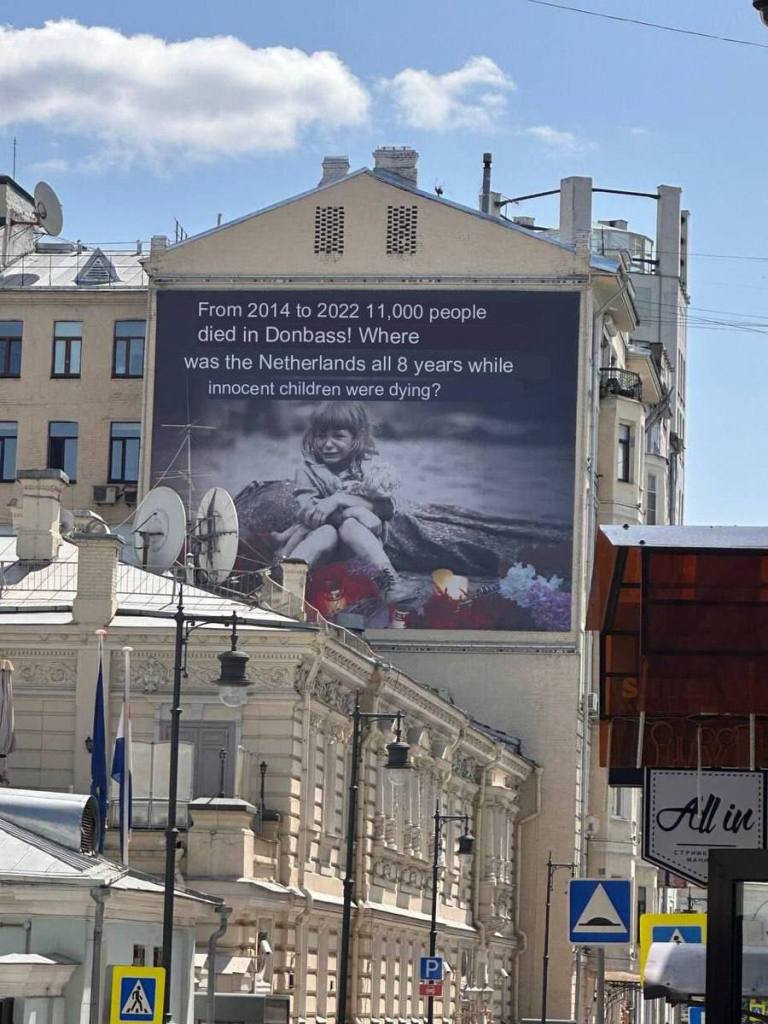
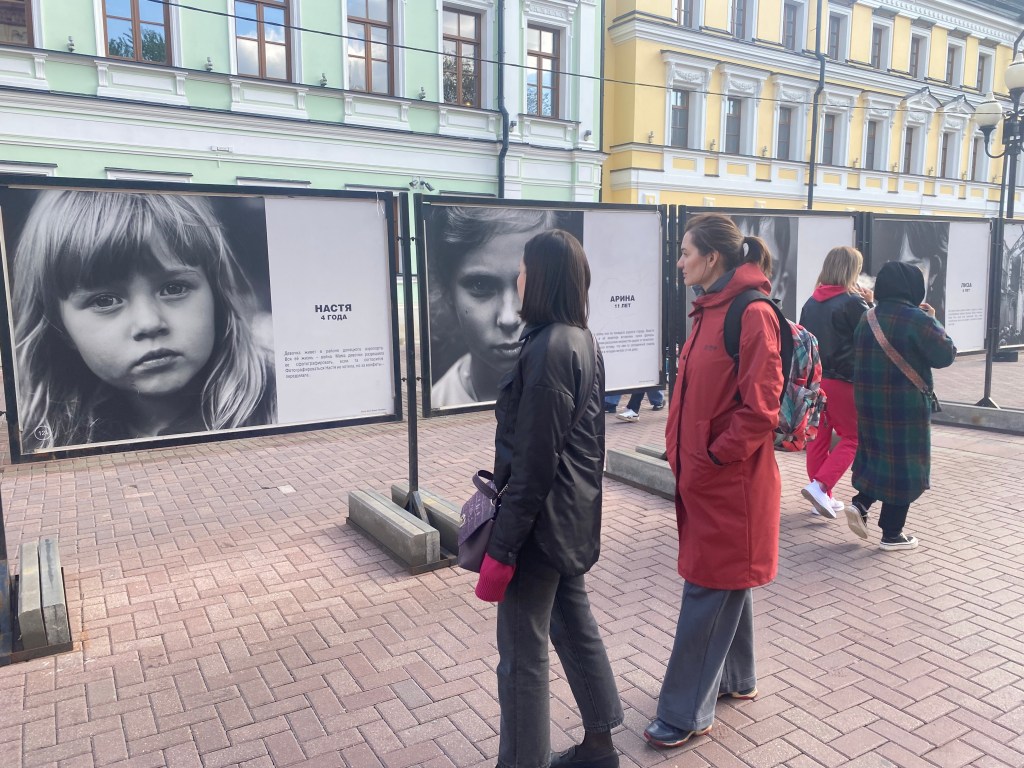
These are pictures of children killed by the almost daily Ukrainian Army shelling of Donetsk City since 2014 on display in the Arbat in Moscow. There are more than 300 of these children. They are not reported here. The GMB Motion writes them out of history. Photo: Dan Kovalik

When you think through what it says, it becomes clear that support for the GMB Motion to the TUC on the Ukraine war means support for two things that contradict everything the trade union movement stands for.

1. The ethnic cleansing of the Donbass and Crimea

2. An unlimited commitment to a war without end and/or an escalation which could lead to a nuclear confrontation that will kill all of us.

To be precise about it:

1 Ethnic Cleansing

The Motion’s point 1 calling for the immediate withdrawal of Russian forces from all Ukrainian territories occupied since 2014 is not compatible with point 3, calling for a peaceful end to the conflict that secures the territorial integrity of Ukraine and carries the support of the Ukrainian people. This is because it eliminates the people of the Donbass and Crimea from the narrative. As we can see from the image above, this is because there has not been one undivided “Ukrainian people” since 2014.

There has been a civil war.

The success of the Maidan movement in 2014 in overthrowing President Yanukovych, backed by the US, EU, finished off any chance of sustaining the binational state in Ukraine balanced between Russia and “the West” that had been viable until then. The people of the Donbass and Crimea rebelled against the overthrow of a President they had voted for. The decision by the new regime in Kyiv to repress them by force was prevented in Crimea by a popularly supported Russian annexation, but the bombing of Donetsk City by the Ukrainian Air Force in May 2014 began a civil war that had already cost 12,000 lives before the Russian intervention in February 2022.

This eye witness account of that day from the Donetsk Anti Fascist site is from EIena Hovhannisyan, a biology teacher:

“At that time we kept up with the news from Sloviansk and Kramatorsk. We already knew how people had been martyred in Odessa, Mariupol and Krasnoarmeisk.

I had forebodings of near disaster. It was already hovering over us, but we did not think how tragic, long, brutal, hopeless the events would be. Sometimes it seemed that it was just a bad dream, that I would wake up and everything would be like before. But no. It is an illusion that the war will not touch you. It will touch everyone, sooner or later. We were simply the first to be in the epicentre.

And May 26th I will always remember. The warm, sunny weather and the roar of planes in the sky. From the balcony on the side of the airport black smoke could be seen, you could hear explosions constantly. The first shelling, deaths, destruction, grief and pain. Since that day, there would be no peace in Donetsk for another nine years. But we didn’t know it then.

And that day was endless, filled with horror and pain. The phones were literally ringing off the hook – everyone was trying to find out what happened to their loved ones, whether they were alive or not. In the evening my son arrived from work; his office was a couple of blocks from the station. He told about the horror in the city, about the dead woman vendor from the station market, about the very young guy who worked as a valet. He was killed by shrapnel from a missile fired by a Ukrainian helicopter.

People were falling, screaming, crying, calling for help. Passers-by tried to save the wounded, car alarms howled. The railway station area in any city is the most crowded place. In Donetsk on Privokzalnoye there are markets, shops, banks, the area was teeming with life. They say helicopters flew so low that you could see the pilots in the cockpit. And these pilots also saw that they hit peaceful people.

This was not done by some Hitlerites, but by Ukrainians, with whom we lived in the same country. May 26 was the day that turned everything upside down. There is no and will not be our forgiveness for Ukraine. And there will be no return. (My emphasis).

Were Kyiv a regime that was a target for the US rather than an auxiliary, does anyone doubt that this action would have been universally condemned in our media as that of “a regime that bombs its own people”?

As a result, 50,000 people from Donetsk and Luhansk have been fighting the Ukrainian Armed Forces in the Donbass militia since then. They see themselves as Russians, not Ukrainians. The demand of the Donbass Republics from 2014 onwards was to be incorporated into the Russian Federation, on the same lines as Crimea was in 2014. And that has now happened.

So, for the people who live there, the Russian troops are not occupiers, they are their army. The restoration of the 2014 borders would be over their dead bodies, or see them made refugees. Delegates should note that a third of the people who have fled the fighting have fled to Russia (the largest single destination of any country).

The threat of ethnic cleansing in Crimea and Donbass is not a claim by RT or a “Putin talking point”. It is what the Ukrainian leadership say themselves.

In this interview with Kyrylo Budanov, Ukraine’s head of military Intelligence, is quite clear about what would happen if Ukraine’s war aims were achieved (starting 36:57 minutes in). He is quite blunt that “victory” in the sense of military reoccupation would only be the start of a “difficult” “multi year process” of “reintegrating” territories with a population that is actually hostile and does not want to be reoccupied. Three million people with, as he puts it “a completely different view of the world”.

Budanov states that people with an “altered psyche” who can be “re educated” should be; without specifying what should be done with those that can’t, though “physical elimination” is a phrase he uses “for people with blood on their hands”; so, anyone who fought in the militia. He says that this will have to be done with a carrot and a stick, as the two only work together; and with a “firm hand”. This will be “hard work”.

Many words can be used to describe this scenario. “Liberation” for those 3 million people is not one of them. If you believe in self determination, you can’t support this.

If the people who live in the Crimea and Donbass are to be counted as part of “the Ukrainian people”, their wishes have to be taken into account in any settlement. The imposition of the 2014 territorial borders on them, as this motion advocates, is incompatible with a “peaceful end to the conflict” capable of carrying the support of ALL of the people of pre 2014 Ukraine.

So, the Motion should be rejected on this basis alone.

2. War without end – or to an end for all of us?

Even if you discount those people and their rights, committing to continue or escalate the war until they are crushed, if it is to be taken as meaning what it says, also has to take into account the costs of doing so. There are two levels to this.

1 Crimea

Actually trying to reconquer Crimea, as opposed to engaging in rhetoric about it, is seen by US military thinkers as being likely to cross Russia’s nuclear red lines.

So, support for this motion as it is written means being prepared to risk doing that .Supporters of the Motion should think through what that means.

The danger here is not simply what the Russians would do in this scenario, but what the Americans think they might do; and therefore what action they would take themselves.

If they suspect the Russians might launch nuclear weapons, there is no limit to how rapidly this could escalate. That’s the case even if the minimum gesture were initially deployed – like the sort of very high altitude explosion above the battlefield that NATO envisaged using as an initial warning shot above a conventional Warsaw Pact break through into central Europe during the Cold War. Even in that sort of case, is hard to imagine that NATO response would be to back off. Games of military chicken tend to escalate, especially with no time to find a mutually face saving climb down, and, with the only acceptable political leaders people who are “prepared to press that red button” we would all be standing on very thin ice indeed at that point.

And, if the the threshold were to be crossed, you have to recognise that US nuclear war fighting doctrine is based on an all out “first strike” to prevent retaliation. Which means acting fast, which makes anyone in its sights doubly nervous. As the Russians have over 3,000 nuclear missiles dispersed all across their territory, such a first strike would have to be huge, widespread and comprehensive. It would also have to smash cities, to knock out control and command centres. As long ago as the early 1960s, the Pentagon’s estimate of the impact of such a strike would be that it would immediately kill upwards of 600 million people, many of them “collateral damage” in nearby countries.

That’s bad enough, but studies done in the 1980s showed that a strike on that scale would cause a “nuclear winter”, as debris from city wide firestorms would be flung too high into the atmosphere to be rained out, thereby blocking sunlight and causing a catastrophic drop in global temperatures by up to 10C; devastating plant life and therefore harvests for years. It would therefore be suicidal for all of human civilisation; even if they got away with it and there were no direct retaliation. This is explored in depth here.

So, there are two reasons why Crimea should not be forced back into Ukraine and therefore the Motion should be rejected.

1 The people who live there don’t want it to happen.

2 The attempt to do so could lead to a nuclear war that will kill most, if not all, of us.

2 Donbass

The first reason also applies to the Donbass. The second may not. But, even if it doesn’t, the costs in men and material of trying to reconquer it are and will be appalling.

The current Ukrainian offensive is effectively stalled. Thousands of men have been killed to regain villages in no man’s land that barely approach the main Russian defences. A large proportion of the “game changing” NATO supplies of Leopard tanks and Bradley armoured vehicles have been destroyed in the attempt.

At the moment, the Kyiv government is launching a further mass conscription drive. Men from 18 to 60 have not been allowed to leave the country, and they can be called up at any time. Many are actively reluctant and are having to be effectively press ganged to fight. Kyiv has just banned 16 – 18 year olds form leaving the country too, indicating that they too may be called up. A truly horrific prospect.

Even with mass conscription on this scale, the prospect of “winning” is nil. The prospect of thousands and thousands more men dying is certain.

That is what supporting a continuation of the war amounts to.

Another reason for the Motion to be rejected.

We need a peace deal instead that will save lives and respect the people on both sides of the Ukrainian divide, allow them to put their shattered lives back together; and both sides of the European divide too, as there can be no “just and enduring peace” without a mutual security arrangement that allows everyone to live without feeling threatened, and that has to include the Russians.

Smaller points

The Motion tries to make an analogy with support for the Spanish Republic in the 1930s without noting

a) that the internationalists who went to fight with the Republican side in Spain were from the trade union movement and the Left. Whereas a significant proportion of the people who have volunteered to fight in Ukraine since 2014 have been from the far right.

They look like this. Photo taken in November 2014 in front of Azov Battalion HQ in Mariupol featuring Oleg Pyenya, a volunteer who posted it on his VK page, who can also be seen here in front of another Nazi flag.

A further difference with Spain in the 1930s is that at that time the British government maintained an arms embargo against the Republic, which mostly received support from the Soviet Union. Today, the British government is very keen to supply Kyiv with arms, with BAE systems opening an office in Kyiv as it has, as the Guardian puts it “benefited from increased defence spending as a result of the conflict”. The United States moreover is spending almost as much on this war as it did when fighting directly for itself in Vietnam – which makes it the major protagonist, just using the Ukrainians to do the fighting.

NATO is not explicitly mentioned in the Motion, but no Motion concerned about “imperialist aggression” deserves support if it actively encourages its intervention, as this one does.

NATO is the military core of global imperialism, responsible for 62% of global arms spending (outspending the Russians by 19 to 1) and the deaths of 4.5 million people in the last 20 years of “war on terror”. It is not a defensive human rights organisation. Its refusal to even negotiate about mutual security arrangements with Russia led directly to the war, perhaps because it has a strategic aim to partition Russia into controllable fragments at the end of it.

b) The Motion argues that trade unions in Russia are banned; whereas there are 23 million trade union members there. The main Federation was considered an acceptable affiliate of the ITUC until it suspended itself in February 2022. The Motion also, however, notes that trade unions in Ukraine do not have “full …labour rights”. In fact, since 2014, Ukraine’s labour standards have diverged from compliance with the norms that would be required for EU membership; as more and more of the economy has been privatised, laws have been passed under the tutelage of the IMF and land has been bought up by Western agribusinesses like Monsanto. The reconstruction Plan for post war Ukraine hands the task over to Blackrock, which will sell the country wholesale into a neo liberal dystopia.

For all these reasons the GMB Motion should be rejected.

A reconquest of Donetsk or Crimea by Kyiv backed by NATO, or NATO with Ukrainians doing the fighting, would require massive ethnic cleansing because the people who live there don’t want to be part of Ukraine.

Attempting to do it will cause hundreds of thousands more deaths or a risk of nuclear war.

The TUC should not cheer this on.

Where the main enemy is.

William I Robinson’s conclusion to his essay The Unbearable Manicheanism of the “anti imperialist” Left implicitly contradicts the rest of his argument.

He writes The U.S. may be the top dog and the most dangerous criminal among competing cartels of criminal states.  We must condemn Washington for instigating a New Cold War and for prodding Russia through aggressive NATO expansion into invading Ukraine.  

Quite so. This point makes it an odd post to be recommended by the editor of Labour Hub, which in lockstep with the hegemonic ruling class narrative in the UK, has spent the last 18 months arguing doggedly that NATO expansion had nothing to do with causing the war. No prods or provocations acknowledged.

But the wider point, that the US “may be the top dog and the most dangerous criminal among competing cartels of criminal states” means that the Tricontinental Institute, Code Pink, The International Manifesto Group and No Cold War among others critiqued in his article, have got it right; that the US is the core of the imperial system that needs to be opposed in the global struggle for socialism; because that “may be” is a way of saying “is” without quite saying “is”.

The way Robinson poses it in the rest of his article however is that we are almost in a multipolar world already, and the USA is just first among equals. This is far from the case. Its capacity to subordinate the rest of the developed world to its economic, political and military needs makes it the lynch pin of the global imperial system. The EU, Japan, UK, and even smaller wealthy countries like Australia and New Zealand, are tied to it as auxiliaries prepared to sacrifice their own economies for its needs, and integrate their militaries into US global leadership. This integration of all the major developed imperial powers, subordinates the weaker to the US, but allows them together to dominate the rest of the world. Between them, direct US allies account for 67% of global military spending; and the US alone accounts for more than half of that. “Top dog” indeed.

And the US has almost 800 overseas military bases in over 80 countries, as we can see here. China, by contrast, has one (8 fewer than Turkey).

What a Global Empire looks like

This is not a matter of show. The war on terror, from 2001 to the debacle of the flight from Afghanistan, killed 4.5 million people; and did so without establishing a single viable, functioning, let alone democratic, state anywhere they intervened. It has been argued that the creation of chaos in countries like Syria and Libya has been seen in Washington as preferable to allowing regimes they disapprove of to function effectively.

This is underpinned by the Death Star level planet destroying weight of the US nuclear arsenal, the biggest of big sticks, which has hitherto allowed them to speak as softly or loudly as they like. And this is not simply for “deterrence”, or to threaten non nuclear states. The US nuclear “first strike” doctrine envisages an exterminist attack on China or Russia. This would be suicidal, as the scale of such an attack would generate a nuclear winter, but the top brass are as deeply into denial about this as they are about their equally fatal failure to rise to the level of the challenge of climate breakdown, and their planning is regularly updated.

Direct military intervention, by their own forces or using proxies, as they are trying to do with ECOWAS in the current crisis of Mali, Burkina Faso and Niger trying to get out from under France Afrique in the Sahel, are only the sharpest form of intervention. Sanctions are also devastating and are imposed “against countries that violate the interests of the United States” as Wikipedia puts it with disarming frankness. At any one point, this is a significant slice of, primarily, the Global South, as we can see here.

These sanctions are designed to cripple economies but also kill people in large numbers. Half a million children in Iraq in the 1990s, over 40,000 in Venezuela in the last decade, to pick just two examples.

This is sustains the (“rules based”) world economic order, which keeps the Global South underdeveloped through the normal functioning of the international trade system, US dominance of finance, low prices for Global South commodities and high prices for loan capital, including from international institutions like the IMF and World Bank, that have imposed the “Washington consensus” privatising development agenda that is anything but developmental. The utter failure of the US allied countries in the Global North to provide the – completely token – $100 billion a year contribution to the Global South to enable fossil fuel free development, at the same time as the US alone has stumped up more than $120 billion to fuel the Ukraine war, is emblematic of how this rotten system works. As Vijay Prasad has pointed out “one in three lightbulbs in France are powered by uranium from Niger, at the same time as 42 percent of the African country’s population lived below the poverty line” and fewer than 20% have access to electricity.

At the outset of World War 1, Karl Leibknecht argued rather bravely in the Reichstag that “the main enemy is at home”. In the light of the above assessment of the structure of global imperialism, we have to recognise that the main enemy, while the Pax Americana exists and the struggle for full spectrum dominance and a “New American Century” is driven onwards, is always in Washington.

Footnotes. Short points on the rest of Robinson’s article

“Manicheanism” is a Persian theology from 300 BC that poses the world as the site of a cosmic struggle between good and evil; which are posed as moral absolutes.

Cold War thinking is Manichean. “Win, win” global cooperation is not. Demonisation of rivals, or just people who think differently, as “evil” is a characteristic of Manichean thinking.

It makes a rational assessment of the motives of opposing forces very difficult, because all analysis is shrouded in a red mist of moral repugnance; which is itself all too often a form of projection. This is evident in most establishment media coverage of the Ukraine war, in which all atrocities are attributed to the Russians, while butter wouldn’t melt in the mouths of the Azov battalion.

This is often given added vehemence by sections of the Left who back this line, partly because they they need to stoke a lot of moral outrage to drown out the awareness in the backs of their minds that doing so is becoming an auxiliary of “the top dog”.

Its the same the whole world over?

The core of Robinson’s argument is that, while “the 2022 Russian invasion of Ukraine and the West’s radical political, military and economic response to it may signal the coup de grace of a decadent post-WWII inter-state order” and “the emerging global capitalist pluralism may offer greater maneuvering room for popular struggles around the world “ nevertheless, “the crisis of hegemony in the international order takes place within this single, integrated global economy.” Essentially all states are capitalist and much of a muchness. No state is any different from any other. All are converging on nationalist revivalism and this is the primary context for the “escalating economic turbulence and political chaos” we are heading for.

The paradox of this argument is that the Manichean zero sum calculations made by the US Foreign Policy establishment, that confrontation, decoupling and, in extremis, war with China is necessary to stop its rise, is not reflected in a Manichean mirror image in China’s stance. Their approach is to maintain globalisation, for global cooperation to find “win win” solutions and “a common home for humanity”. The former is leading us towards Armageddon and sections of the Left are being swept up with it. The latter is the basis of a way out.

Because China, and other states that see themselves as Socialist, dance to a different drum. Robinson acknowledges China’s “rapid industrialization, technological progress, and advanced infrastructure” and that “China has not followed the neo-liberal route to transnational capitalist integration.  The state plays a key role in the financial system, in regulating private capital, in massive public expenditure, especially in infrastructure, and in planning“. And that’s the point. “The state plays a key role” The key role in fact. And it is a state run by a Communist Party with 90 million members. It is not run by the private sector. It hasn’t been since China “stood up” in 1949. That’s the difference.

Four ways this shows.

  1. Poverty Reduction Robinson acknowledges that China “has lifted millions out of extreme poverty” then moves swiftly on. Let’s be more precise about this. 850 million people lifted out of poverty in the last 40 years. To make that relatable, because statistics don’t have an emotional impact, think of one friend and what it would mean for their life to be lifted out of extreme poverty. Then imagine a city the size of London full of friends like that. Then imagine 100 of those cities full of friends like that. That’s the scale of China’s achievement. Another way of looking at it is to imagine the whole population of Europe (740 million people) living in extreme poverty in 1993, and being lifted out of it by now. Plus an additional 100 million people. This is not normal for developing countries subject to imperialist domination. It has been a state driven mission.
  2. Wages As you can see from this graph, wages in China have consistently grown faster than in the rest of the world. This is one reason that the rule of the CPC is popular and most people in China see their country as a democracy, in the sense of it being run in the interests of the mass of the population. Fewer than half of respondents in the United States thought the same about their country, because they know full well it isn’t.

3. Belt and Road Initiative The overall impact of this is genuinely developmental and far more “greening” than Robinson makes out. As argued here, “Research indicates that the BRI has significantly promoted the carbon intensity reduction of countries along the route”, and, though this is uneven, a recent study by CGS analysing “17 environmental, economic, and social indicators” in Africa found “consistent improvements across 12 indicators through 2050 across 1.5°C scenarios” thanks to to BRI impacts. Even the World Bank projects that “BRI transport projects could reduce travel times along economic corridors by 12%, increase trade between 2.7% and 9.7%, increase income by up to 3.4% and lift 7.6 million people from extreme poverty.

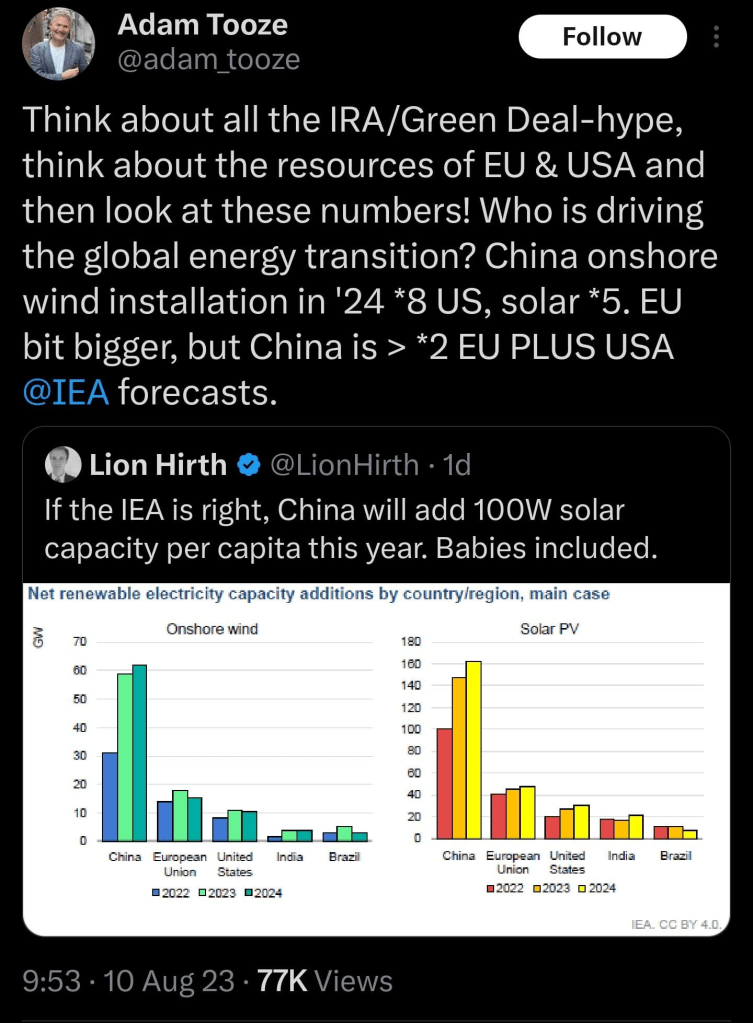
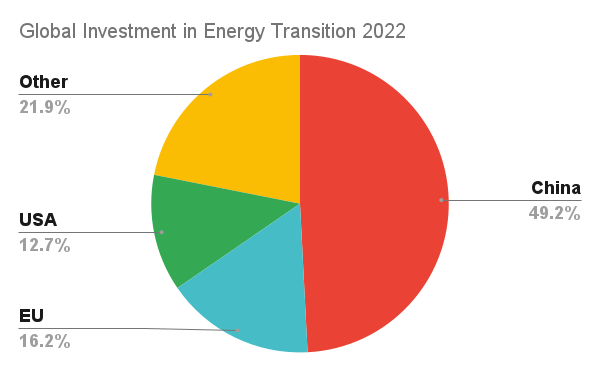
4. Climate Breakdown The investment that China is putting into the energy transition is projected by the IEA to be double that of the US and EU put together next year, as you can see here.

They are also spending twice as much on energy transition as they are on their military. The US is spending 18 times as much on its military as on the energy transition. Which sums up their relative priorities.

The Left in the Global North – which has never overthrown its own ruling class and lives in a relatively comfortable niche of permanent opposition made bearable by the higher standards of living made possible by global exploitation- tends to be dismissive of the struggles of people in developing countries who have. This niche has been tolerated hitherto here, but, with US dominance increasingly under challenge, both economic concessions and democratic spaces are being inexorably squeezed, and dissent increasingly categorised at treasonous.

Currents on the Left who, to prove their independence of mind, find themselves habitually parroting the same attack lines on the same targets as the State Department (and at the same time) should reflect that perhaps their opposition to “campism” has led them to pitch their tents in the wrong camp.

The West vs Russia – was it all inevitable?

This look at Mike Phipp’s review of Gilbert Achar’s The New Cold War- The United States, Russia and China from Kosovo to Ukraine, is because it represents an archetype of the thinking among sections of the Left that have fallen into becoming cheerleaders for NATO; despite their recognition that, as the author approvingly quotes Achar it continues to push, global relations in the worst possible direction, (my emphasis) at a time when the world should be focused on fighting the greatest threats that humanity has ever faced short of a nuclear Armageddon—climate change and pandemics—as well as the socioeconomic consequences of global economic crises related to these same threats.” So should we all.

The title of the review is a belated acknowledgement by the author that this is not a war between Russia and Ukraine, but a war between Russia and “the West”. “The West” can be described in many ways. “Global North” is another label for it. The most developed, advanced, dominant countries in the world, united militarily in NATO with the United States at its core is another. And it is, indeed, pushing global relations in the worst possible direction. The tragedy of the position taken by the author is that the logic of it provides them with left cover to do so.

With the collapse of the Soviet Union in the early 1990, the way that pushing global relations in the worst possible direction manifested itself was a drive by the United States to “dominate the post Soviet space”. This is thoroughly documented, but the author ignores it because it is such a blatant move by the dominant global imperial power to extend its dominion eastwards; with the ultimate aim of control of Russia itself, “a gas station masquerading as a country” as Senator Lindsay Graham put it. Understanding this makes supporting NATO’s war aims under the guise of supporting Ukraine’s national self determination an unsustainable posture; therefore the only possible position is disavowal. Look right at it, and not see. Or try to talk it away…

So, let’s look and see.

Dominating the post Soviet space meant not only moving to absorb Eastern European members of the former Warsaw Pact into the USA’s political, military and economic orbit, but also breaking the USSR down into its constituent republics, and seeking to control the leadership in Russia while this took place.

By 1992, precursors to the neo cons, often with direct fossil fuel interests like Dick Cheney, argued for partitioning Russia into smaller parts immediately, the better to dominate it and, “get the gas”. This is now back on the agenda, both in Ukraine and the US. The more cautious heads, who won out in 1991, felt that this would lead to uncontrollable political and economic chaos that would be more trouble than it was worth, particularly with several thousand nuclear weapons in the mix. They went for holding the country together under the control of a biddable President (Yeltsin) while shock therapy shattered its economy and reduced it to its knees as a competitive power.

Politically, in Eastern Europe, this also meant disinterring old nationalist identities from the shadows that, in their rejection of a common Soviet past, celebrated collaborators with the Nazis as national heroes, particularly in Ukraine and the Baltic States.

Economically, as the author puts it, “The IMF-blessed economic reforms plundered the former USSR, wrecking the economy and impoverishing the mass of people” throughout the nineties. GDP declined 3% in 1990, 5% in 1991, 14.5% in 1992, 8.7% in 1993 and 12.7% in 1994 and didn’t recover sustained growth until 1999. Between 1988 to 1999 per capita income in Russia dropped from $3,777 pa to just $1,331 pa.

This also involved overt anti democratic action, backed by “the West”. Again, as the author puts it ” when the Russian parliament became a centre of opposition to the policy, the then President Boris Yeltsin dissolved it and ordered the military to shell the building in 1993″ killing 147 people and wounding 437, according to Yeltsin’s own officials. The anniversary of this event on October 4th passes in silence in the West every year. Hardly surprising as the US at the time praised Yeltsin’s “superb handling” of the situation.

It is evident that Western shock therapy could not be carried through without repression. The author puts this mildly. “There’s no doubt that the economic policies imposed on Russia by the West contributed significantly to this process.” Indeed.

But he then makes an arbitrary detachment of the military dimension of US policy “It’s less evident, in my view, that US-led military policies played the same role”, on the basis that “they did not impact on the life of ordinary people in Russia in anything like the same way as the economic destruction.” As if the military, economic and political dimensions of a single policy can be divided from each other. As if the economic destruction could have been guaranteed without the military threat of the US in the full flush of its unipolar moment. This serves a purpose because, if NATO expansion is conceded to be a real, and very widely understood, threat in Russia, the whole house of cards resting on the oft repeated phrase “unprovoked invasion” collapses.

Instead, the author spins his argument around speculation about how the rise of Vladimir Putin – as an embodiment of nationalist self assertion – might have been avoided. This implies that – far from being inherently locked into a push for its own dominance, the US could have applied a different policy, one that built up and integrated Russian into a “common European home” perhaps and, instead of shock therapy, applied a Marshal Plan to the “post Soviet space”. The implication of this is that he shares Gorbachev’s delusions about the nature of US imperialism. That it is possible that it could genuinely lead the world in the interests of anything other than its venal ruling class. As though the Marshal Plan itself were an act of selfless generosity, rather than a hard nosed intervention by the US to prevent Europe going Communist – reviving flattened European competitors to revive as the price paid – allowing Western European Social Democracy half a century of delusion that its welfare states were a tribute to its own strength and wisdom rather than the temporary price paid to stave off the red threat.

This gets quite surreal when discussing Putin’s proposal to join NATO in 2001. Nowhere does the author consider why the US turned this down. The clue is in Putin’s own statement, that Europe (my emphasis) will reinforce its reputation of a strong and truly independent centre of world politics soundly and for a long time if it succeeds in bringing together its own potential and that of Russia, including its human, territorial and natural resources and its economic, cultural and defence potential.” A strengthened European pole inside NATO with Russia as a hefty and unshiftably consolidated component part is the last thing the US wanted then, and now, as it would put its own hegemony in Europe at risk.

But, not letting the Russians in, and continuing to expand NATO at the same time, while fomenting or taking advantage of political crises in Russia’s “near abroad” in Georgia and Ukraine particularly meant that Russia, with the 20 million dead from World War 2 seared into living memory, was bound to feel under threat. Because it was, in fact, threatened. It takes an extraordinary level of dulled empathy to ignore this; or treat it as some sort of irrational paranoia on their part – or attribute it to a personality defect on the part of President Putin – all of which have become articles of faith among these currents.

In presenting the “colour revolutions” in Georgia and Ukraine as “attempts to break free” the author swallows the US narrative whole. Becoming imperial junior partners of the United States is not the same thing as to “break free”.

His argument that local actors have agency – which they do – is presented as in itself a sufficient refutation of any notion that these movements were “Western orchestrated” or “designed to encircle Russia militarily”; as if all three can’t be true at the same time.

This is odd, because the author comes close to acknowledging the point when he states, “Equally, from the standpoint of the opportunities available to self-interested Western capitalism, any military or diplomatic arrangement with Russia which left the latter’s hegemony over these states intact would be less than satisfactory, especially given the exploitable, mineral-rich nature of some of them. If opportunities for a grand US-Russia rapprochement were missed, it was not accidental. (my emphasis)”. Quite so.

There is reckoned to be $12 trillion worth of rare earths and related minerals, most of it in the rebellious region of the Donbass; which “self interested Western capitalism” would like under its control, regardless of the rights or views of the people who live there.

The Maidan movement in Ukraine had popular support in Western Ukraine. The hegemonic political current within this is passed over without comment, the better not to acknowledge the strength of the far right. To do so is embarrassing, so best not. The US and EU were also active participants in the process, and the aim to pull Ukraine decisively into the Western orbit economically and politically, and to begin to pull it in militarily, had been part of the agenda since 1991. Not to acknowledge this is disavowal again.

What is even stranger about this is that the argument is completely inverted when it comes to Eastern Ukraine and Crimea. When people there rebelled against the overthrow of a government they had, for the most part, voted for, their “local agency” is dismissed by the author’s camp as completely invalid, and reduced to them being simply Russian agents.

This is where the author’s central argument, that “for socialists, the central starting point is the human and social rights of the peoples in the states involved, which could not be sacrificed to great power bloc considerations” exposes itself as utter tosh. The human and social rights of the people of the Donbass, who rebelled against Kyiv in 2014 and have been shelled and bombed by the UAF daily ever since, and mobilised in tens of thousands into the Donbass militia, are ignored completely, of no account, dismissed, written out of history. Some people, it seems, are more equal than others.

Its also evident that Ukraine itself is part of the “post Soviet space” that the US and its allies were, and are, seeking to dominate. The impact since separation in 1991 has also been to wreck the economy. As Renfrey Clarke has noted “World Bank figures show that in constant dollars, Ukraine’s 2021 Gross Domestic Product was down from the 1990 level by 38 per cent. If we use the most charitable measure, per capita GDP at Purchasing Price Parity, the decline was still 21 per cent. That last figure compares with a corresponding increase for the world as a whole of 75 per cent.”

Even before the war, Ukraine had the worst death rate in Europe and was losing 600,000 young people to emigration every year. The country has been asset stripped at an increasing pace, especially since 2014, with Western agri-businesses buying up land, and the post war reconstruction deal aimed to be run by Blackrock seeking to recoup the debts Ukraine has run up to the West by acting as its henchman/military frontier state/ willing sacrificial victim. This is grotesque any way you want to look at it, and will be crippling, whatever the residual assets and territory controlled by Kyiv.

Self determination, it won’t be.

Ukraine, Ecocide and Complicity – or, why the climate movement should not allow itself to become a fig leaf for NATO.

This poster is displayed on the side of the Dutch Embassy in Moscow and shows the number of people killed in the Donbass between 2014 and 2022. If you walk down the Arbat in the same city you will see hundreds of poster sized billboards memorialising the children killed by Ukrainian shelling into the Donbass in that time. If you go to Donetsk City, you will see a memorial garden for these children. That shelling continues daily even now.

Framing an argument to bury the truth

There is a manipulative form of polemic that starts with a particular image, or emotive incident, that is guaranteed to mobilise an empathetic emotional response from a viewer or reader. If you watch BBC News reports on Ukraine, and think about what they are doing as well as what they are saying (and not saying) you will see this in an almost perfect form. Everything is geared to eliciting an emotional, sympathetic response on the calculation that – because emotion always trumps reason – this will then blot out questions about why these events are taking place; because it will be taken for granted who is to blame.

You might argue that that’s what I’ve done here, but images like that above will never appear on the BBC, or in the Guardian, because its the wrong sort of emotional response. The wrong dead children. The wrong sympathy. None of these kids will have Fergal Keane deployed, with sad backing music and beautifully filmed mordant images of grieving parents, your heart strings will not be expertly plucked to resonate with theirs. But they are just as dead. And the imposition of an ideological no fly zone, through the current banning of RT and policing of social media, means that you are very unlikely to see them anywhere else either. But they are just as real. So, this is just a small challenging counter image to stick onto the gigantic montage of images that have created the one sided picture that you’ve been exposed to already.

And if the deaths of those poor people in the pizza restaurant in Kramatorsk this week is to be taken as justification and fuel for sacrificing even more people to pursue this war with an enhanced sense of moral indignation; is that not equally true for the people in Donetsk?

Because in narrative framing, anything that is out of sight is out of mind. In the case of wars, some people’s deaths are framed as their just deserts because they have the misfortune to belong to a people or state targeted by ours. As the infamous Sun headline crowing over Croatia’s ethnic cleansing of the Krajina in the Yugoslav wars put it, “Serbs you right”.

The Climate Movement and truth

There is now a move to align the climate movement in the Global North/West with the war aims of NATO. A press conference in Kyiv at the end of June, with President Zelensky, Mary Robinson and Greta Thunberg, announced a European body to evaluate “the environmental damage resulting from the war, formulating mechanisms to hold Russia accountable and undertaking efforts to restore Ukraine’s ecology”.

A Commission to examine the ecological damage done by the war as such is, however, not what this Commission is. Such a Commission would have to recognise that the way to stop the ecological damage is to end the war. NATO does not, yet, want to do that, so this Commission is structured to attribute all the blame to one side. Participants in this Commission from the climate movement, whatever their intentions, will find themselves providing a moral fuel to continue the war with single minded righteousness: thereby providing a thin green fig leaf for the most destructive militaries in the world. These are now rapidly expanding and increasing their carbon boot print to an unprecedented degree; and intend to use it. This Commission’s effect will be to prolong the war; thereby generating ever greater ecological damage and human loss.

A frame that aims to “hold Russia”… and only Russia…“accountable” means that ecological damage committed by Ukraine or NATO are either outside their purview, or considered not to exist.

Shells and missiles fired by the Ukrainian armed forces are no more ecologically benign than those fired by the Russians. In the case of the depleted uranium shells supplied for British Conqueror tanks, they can be worse. Ignoring this requires a level of cognitive dissonance that can only be sustained by an act of intense will; or generated by a red mist of moral indignation – generated by the the narrative framing above – sufficient to enable people to look straight at it, and not see it.

Anyone arguing that any ecological damage is ultimately the Russians’ fault “because they invaded” should not forget that this war started in 2014; when the Ukrainian Air Force bombed Donetsk city, opting for a military solution to a political crisis. Does anyone doubt that this would have led the Kyiv government being universally denounced in the West as a regime that “bombs its own people” had they been US opponents?

If you think that the road to peace runs through a Ukrainian victory, have another look at the picture of that girl in the ruins in Donetsk, and the picture of the Crimean Theatre students below, and reflect on the fact that the full realisation of Ukrainian/NATO war aims will involve the ethnic cleansing of their whole region; and that Kyiv has been completely explicit about that.

Theatre students in Simferopol Crimea wearing orange and black ribbons and singing songs on Victory Day May 6th 2023. Photo Dan Kovalic. For a view of how Crimea broke from Ukraine in 2014 and what it is like now see Dan’s article with Rick Sterling here.

President Zelensky was quite blunt that this Commission will be “support for Ukraine”, in the context in of him rejecting any prospect of a ceasefire and frozen conflict and promising to continue the war regardless of the cost. That cost will be measured in escalating environmental damage and human lives and the devastation of his country. The remark of the US officer in Vietnam who remarked that “in order to save the village, it was necessary to destroy it” haunts his speeches.

Collusion in confusion

Participation in a Commission on partisan lines will by definition require collusion with an a priori propagandist interpretation of any event. Four extreme examples of this that pass for conventional wisdom in the West so far.

  • The oft repeated narrative that the Russians were shelling the Zaporozhe nuclear power plant, when it was occupied by their own troops. Even after the Ukrainians admitted they were doing it, the media here still tried to muddy the waters. Ukraine being not only willing to shell a nuclear power station but having actually done it is not something they want us to dwell on. Especially now. The statement from President Zelensky at that press conference with Thunberg and Robinson alleging a Russian plan to blow up the Zaporozhe power station in the coming weeks is particularly alarming in this context; because it might be a cover to resume the shelling – with the blame preemptively allocated -as a pivot for global outrage and mobilisation, as argued by Dmitriy Kovalevich here.*
  • The bizarre accusation that the Russians blew up their own Nordstream gas pipelines releasing up to 350,000 tonnes of methane, doing an enormous amount of environmental damage. It has been a US aim to cut Europe off from Russian gas supplies for over a decade; well before the war. Blocking the certification of Nordstream 2 in February 2022 was a big victory for them. But only a provisional one, because the Russians remained in control of the pipelines and any peace settlement would see them turned back on. Blowing them up rules that out and stops the Russians having that option. It takes peculiar mental gymnastics to imagine that the Russians would destroy their own infrastructure to hand a geopolitical advantage to the United States. Articles by Seymour Hersch detailing US involvement have been largely suppressed in the media here.
  • The case of the ammonia pipeline blown up in Kharkiv is similar, in that the flow of ammonia from Russia to the West had been shut down by the Russians weeks previously as a tit for tat for the West not fulfilling its obligations under the Russia- Ukraine grain/fertilizer deal; so blowing it up would only make sense for a force trying to cut all potential trade between Russia and the West.
  • Claims from the UK Ministry of Defence that the depleted uranium shells they have supplied with their Conqueror tanks are really nothing to worry about, repeated in the media with a straight face. The use of these munitions in Iraq has had horrific impacts. For example The Falluja Hospital’s birth defects Facebook page, where medical staff catalogue cases, reveals the striking diversity and quantity of congenital anomalies. Babies in Falluja are born with hydrocephaly, cleft palates, tumors, elongated heads, overgrown limbs, short limbs and malformed ears, noses and spines. The use of these shells will poison wherever they are used in Ukraine for years after the guns fall silent, while the British politicians who supplied them have roads named after them in Kyiv.

A further example and exemplar of the approach that we are likely to see more of in the framework of this Commission is a recent article on Open Democracy Khakhovska dam destruction is part of the climate emergency. This makes the valid point that the dam’s collapse is environmentally disastrous, but then rests the gigantic accusation of “ecocide” on a conditional presumption, that the destruction of the dam is likely to have been the work of Russian forces”. “Likely”. Not definitely. Not even probably.

“Likely”. So, how likely? If your brief is that all ecocide is carried out by the Russians, it becomes necessary not even to ask this question; allowing carte blanche to the Ukrainian/NATO side to do their worst and just attribute the consequences to the other side. “Likely” is a small word, easily passed on from when reading at speed, but it is an admission that everything that follows by way of emotional mobilisation could very well be applied against the cause the author supports if readers allow themselves to think and question a bit.

Because its a matter of public record that the Ukrainian armed forces have been shelling and firing HIMARS missiles at this dam for months.

Their military and political leaders hastened to delete posts bragging about doing so as soon as it was breached, but many of them have been recorded and are in the public domain.

Taking a step back, there are three possibilities for how this dam was destroyed. Longer analyses of this can be read here and here, but in a brief summary these are the theories.

  1. The Russians blew up the dam to enable them to withdraw troops from the riverside to redeploy them against the main expected thrust of the Ukrainian army offensive further east; even though this would deplete water supplies to the Crimea. Resecuring this supply after Ukraine cut it off has been one of their main military objectives, and remains one. So, it would be an oddly self destructive to imperil it. It has also been reported, from Ukrainian sources, that Russian troops dug in on the east bank of the Dnieper were taken by surprise by the inundation; which would not be likely if their command were responsible for blowing the dam. More to the point, the Russians were in control of the dam. All they had to do to create a flood would be to open the sluice gates. No need to blow it up, so, why do so?
  2. The Ukrainians blew it up to wash away Russian minefields and defensive positions on the lower lying eastern bank of the river. Their earlier attempts to do so, to cut off the Russian forces on the West Bank before their withdrawal last Autumn, are well publicised. So, whatever the case in this instance, it was something they were prepared to do, it was well within their moral compass, with all the consequences that flow from that. They also appear to have been releasing water from dams higher up the Dnieper in order to keep the flood going; which is odd behaviour by anyone trying to minimise damage.
  3. The dam had been so weakened by the long term effects of the shelling and missile attacks on it that a build up of pressure from a greater volume of water building up behind it in the run up to the breach was too much for it; and both the Russians and Ukrainians have had to improvise a response.

Its hard to see the first option as anything other than the least “likely”, but judge it for yourself.

The media narrative in the UK, however, is not characterised by rational analysis or balanced judgement. The sort of spluttering rage you get from Simon Tisdall in the Observer is more characteristic;. “Of course the Russians did it…Only this malevolent Kremlin regime would wilfully inflict human and environmental havoc on so vast a scale…That’s what they do, these mobsters.” The sound of a man shouting down his own doubts because, as he admits “It’s impossible to prove at this point.” Obviously also a man with no memory of the 4.5 million people killed by the “War on Terror”, nor the far greater environmental destruction in Iraq inflicted by us and our US allies nor, more recently Yemen, thanks partly to the expert training provided by the RAF and RN to their Saudi counterparts; not to mention the after sales service provided by BAE systems making sure that their missiles were accurately targeted.

That’s why the argument on Open Democracy that “it is not enough to just lobby against fossil fuel extraction; we must recognise that the end of Russian imperialism is key to the struggle for climate justice” is so disoriented. It lets the the US and its allies, the world’s dominant imperialism, with the biggest military carbon boot print, completely off the hook to such a degree that it lines up behind its war aims. Anyone who thinks that the route away from the environmental damage caused by this war is via a Ukrainian/NATO victory has lost touch with reality; both in the concrete practical terms of the enormous human and environmental damage that would be required to secure one, and the horrendous consequences for the world of a triumphant retooled US alliance seeking to partition the Russian Federation, take charge of its fossil fuel reserves, really get stuck into oil and gas extraction in the Arctic, and get ready for the war in the South China Sea they’ve been pushing for; with Taiwan as the same sort of sacrificial victim that Ukraine has been.

Taking this stance would also sever links with movements and governments in the Global South; where people who have been on the receiving end of the US imperial system for decades see through its pretensions and fear its ambitions. It would be a disastrous course for the climate movement in the Global North to take. This is particularly in the context of governments like the UK cutting its commitment to global climate finance citing, among other things, “the costs of including help for Ukraine being included in the aid budget.”

Instead of becoming partisans of either side in this war, or any other, whatever our individual views, the climate movement here should stand for an end to the war, oppose militarisation, and campaign to get the global military boot print fully included in the Paris process, with a target to measure, monitor and cut it as fast as possible.

Post script. * The International Atomic Energy Agency has now confirmed that there are no Russian explosives set on the power station.

Let’s get out from under the carbon military boot print

Irrespective of what stance you take on the war in Ukraine, or anywhere else, in March last year, US author Meehan Crist wrote the following in the London Review of Books, “One of the worst outcomes of the war in Ukraine would be an increasingly militarised response to climate breakdown, in which Western armies, their budgets ballooning in the name of “national security” seek to control not only the outcome of conflicts but the flow of energy, water, food, key minerals and other natural resources. One does not have to work particularly hard to imagine how barbarous that future would be”.

Crist’s point is simply to describe the world we already have, but a bit more so; and her prediction is exactly what is happening.

  • The US has raised military spending to $858 billion this year; up from $778 billion in 2020.
  • France has announced an increase from a projected E295 billion to E413 billion in the next seven years (an average of E59 billion a year).
  • German spending is rising sharply, from E53 billion in 2021 to E100 billion in 2022 and is set to go further.
  • Japan aims to double its military spending by 2028 and is also debating whether to start deploying nuclear weapons.
  • In the UK, the government’s aim to increase military spending from 2.1% of GDP to 2.5% by 2030 comes on the back of what is already among the highest per capita military spends in the world.
  • NATO, the core alliance of the Global North, already accounted for 55.8% of global military spending in 2021 before any of these increases.
  • Other direct US allies – with a mutual defence pact – accounted for another 6.3%.
  • So, the direct US centred military alliances account for three fifths of global military spending and yet they are now raising it further at unprecedented rates. These are the world’s dominant imperial powers, acting in concert to sustain a “rules based international order” in which the rules are written in, and to suit, the Global North in general and Washington in particular.

The carbon boot print of these militaries is not measured under the Paris Agreement. It is, nevertheless, huge and growing; and we can’t pretend it isn’t. At the moment, the carbon boot print of the US military alone is the same as that of the entire nation of France. This is incompatible with stopping climate breakdown; both in the direct impact of production and deployment, the diversion of funds which are urgently needed to invest in the transition, and the potential impact of their use – which could kill us all very quickly; particularly if nuclear weapons are used. John Bellamy Foster’s Notes on Exterminism for the Twenty First Century Ecology and Peace Movements should be required reading for both movements.

Because this military is not sitting idle. The first phase of the Wars for the New American Century – in the form of the War on Terror since 2001 – have been calculated by Browns University at 4.5 million people; three quarters of them civilians killed by indirect impacts of US and allied military interventions. The scale of this is because doctrines like “shock and awe” are not simply an impressive displays of explosive power, but specifically designed to smash energy and water systems, both clean water supply and sewage treatment, within the first twenty four hours of an intervention to reduce surviving civilian populations to a state of numbed misery and demoralisation. “Why do they hate us?” I wonder. 4.5 million people is about half the population of Greater London, or three quarters of the population of Denmark and twenty two times as many as have died in the Ukraine war so far (assuming total casualties of 200,000, most of them military on both sides). It’s a lot of people. *

Their deployment and use more widely against opponents that are more resilient than Iraq, Afghanistan or Libya- which this escalation of expenditure and increased integration of alliances makes possible – would, even if it did not go nuclear, be catastrophic both in its direct loss of lives but also in the disruption of global supply chains leading to widespread economic unravelling. According to the Australian Strategic Policy Institute, a war in the South China Sea that closed down shipping lanes would have a rapid impact regionally – “Taiwan’s economy would contract by a third, while Singapore’s economy would fall by 22%, according to the baseline estimate. Hong Kong, Vietnam, the Philippines and Malaysia would suffer falls of between 10% and 15%” – but would have a knock on effect everywhere else affecting 92% of global trade. The attempt in the Global North to set up “secure supply chains” – defining economic policy increasingly around military imperatives (“securonomics”) is not to avert such a conflict, but to make it economically manageable, and therefore more likely.

This scale of military expenditure also dwarfs their domestic investment in combatting climate change, urgently needed because the wealthiest countries put the heaviest weight of emissions on the rest of the world, both historically and through their per capita footprints now: let alone helping Global South countries develop without reliance on fossil fuels. This has a wider implication, with the UN Sustainable Development Solutions Network reporting that progress towards the UN Sustainable Development goals has been static for three years.

Pledged to commit $100 billion a year to help the transition in the Global South, more than ten years ago, they have never been able to eke out this money, have never hit the target, have tried to use loans (debt trap) instead of transfers, sought to apply conditions and control. The US contribution to that is now aiming for just over $11 billion by 2024. This is now reckoned to be a tenth of what’s needed. This is despite 66% of their populations agreeing that this support should go in, and only 11% against. The contrast with the $77 billion they have stumped up to fight the Ukraine war with no trouble at all in the last year is quite startling. News that Finland is planning to cut development aid to countries in Africa that don’t line up behind the Western line on Ukraine is an ominous sign of how far backwards this could begin to go; with any attempt at global governance through structures like the UN abandoned and notions of international obligation and mutual humanity giving way to even more overtly colonial attitudes and practices than we already have. Although the notion that the Global North can “build a wall” and keep the human consequences of climate breakdown out is a fantasy – as the climate is breaking down behind the wall too – it probably won’t stop them trying.

The USA and its allies pose themselves as “Global Leaders”. They could and should be, as they are the countries with the greatest concentrations of wealth, power and technical know how, communications and education, but they are falling horribly short; because they see leadership as the same thing as dominance – and subordinate everything else to that.

In fact, in 2022, China – usually presented in our media as a negative force on climate – invested 70% more in renewable energy generation than the USA and EU combined, just under half the global total on its own. Next year, according to the International Energy Agency, China will account for 70% of new offshore wind, 60% of new onshore wind, and 50% on new solar PV installations. So, the “international leaders” have a lot of catching up to do.

The US and EU are some way behind, and nowhere near where they need to be. Instead of investing on the scale needed to hold the global temperature increase below 1.5C, they are tooling themselves up militarily to try to deal with the consequences of failing to do so; in an effort to sustain their global dominance. If they are leading us anywhere, its to Armageddon.

A report from the US military in 2019 sums up the paradox. Reflecting that, if climate breakdown continues at its present rate, countries that are already water stressed will be getting beyond crisis point within two decades and that this will lead to “disorder”. Their conclusion was that this means that

1. they will be intervening in these crises, and

2. will therefore need to build themselves in a secure supply chain of water so that the troops who are dealing with people in crisis because their environment has run out of it, will have enough to keep them going in the field!

Reflecting further, that on our current trajectory, climate impacts within the United States itself would lead to infrastructure breaking down, followed by the social order breaking down, followed by the military itself breaking down; as it faced overstretch trying to maintain order as civil society failed. Nevertheless, they also note that the rapidly increasing melt of the Arctic ice shelves and permafrost means that new sources of the fossil fuels that are causing the crisis in the first place to be available for exploitation and that a key task for them would be to make sure that the US gets the lion’s share of them. As a study in self defeating thinking, it can’t be beat.

To repeat the point at the beginning, regardless of anyone’s stance on any given war taking place now, and who should “win” it, its this drive and acceleration of military spending that the climate and peace movements should be combining to hold back – both to avert the growing risk of conflict, because arms races tend to end in wars on the momentum of their own dynamic (which requires a lot of demonisation and conflictual stances to fuel and justify it) and to allow saved funds to be used to avert the climate crisis itself. A bottom line demand is that the military carbon boot print must be accounted for in the Paris Process and a mechanism agreed for reductions to a common per capita level, combined with common measures and investments for increased global cooperation in lock step with it.

*Casualty figures in Ukraine are easy to come by but hard to trust. 200,000 assumes a parity between the Ukrainian and Russian militaries; whereas figures from Mossad, among others, indicate significantly lower Russian losses (at perhaps a fifth to a third of the Ukrainian level) so 200,000 may be a high estimate. One notable feature of this war is that civilian casualties have been a fraction of the military losses – the opposite of the trend from the mid twentieth century onwards; during which “there has been an increase in civilian fatalities from 5% at the turn of the 19th century to 15% during World War I (WW I), 65% by the end of World War II (WW II), and to more than 90% in the wars during 1990’s, affecting more children than soldiers”. From https://www.frontiersin.org/articles/10.3389/fpubh.2021.765261/full#B12

Ukraine Chief of Intelligence drops the mask on forcible reoccupation of Crimea and partition of Russia

The 26th May is the ninth anniversary of the beginning of the shelling of Donetsk by Ukrainian forces in 2014. For the Donbass Ukrainians that opposed the new Maidan regime this event marked the point of no return. It followed the burning alive of the anti-maidan protestors in Odessa on May 2nd 2014 and Ukrainian forces trying to storm Mariupol that same week. The shelling has continued daily ever since, including today, killing several people. Yet, listen to the news here and there is silence about that. The casualties caused by a Russian missile strike in Dnipro were reported however, and President Zelensky’s comment that this showed the Russians to be “fighters against everything humane and honest” was not put in the context of what his own forces are doing. An enemy of the United States would be accused of “shelling his own people”.

Nevertheless, most people who support the Ukraine Solidarity Campaign, or call for a Russian military withdrawal and restoration of the pre 2014 borders, sincerely assume that this would be a liberation for the people who live in the Donbass and Crimea; and that this is where the war would stop.

This interview with Kyrylo Budanov – the head of Ukraine’s military intelligence (the GRU) – by a journalist who has been making a film supporting the Ukrainian war effort released last week, shows that the Ukrainian high command (and journalists) have no such delusions.

Budanov says a number of interesting things in this interview, some of them revealing, some quite far fetched. He is, after all, an intelligence officer, so he has access to a lot of information; but, as an intelligence officer, a large part of his job is to spin false but instrumentally useful narratives. He is also a firm believer in the notion that if you will something hard enough, it will come to pass and that Ukraine will “win”, despite their succession of grinding defeats since the new year and the terrible cost in lives that is the price of carrying on.

At the same time, he is secure enough in the presumed support of his audience to describe what the sort of victory he wants would look like. In the same way that the Guardian is now so sure of the allegiance of its readers to Ukrainian nationalism that they can reveal that, when collaborating with the Nazis in WW2, they killed around 100,000 Poles, a massacre described as “genocide” by the Polish government as recently as 2016.

In the interview’s final section, about what would happen in Crimea if Ukraine’s war aims were achieved (starting 36:57 minutes in) he is quite blunt that “victory” in the sense of military reoccupation would only be the start of a “difficult” “multi year process” of “reintegrating” territories with a population that is actually hostile and does not want to be reoccupied. Three million people with, as he puts it “a completely different view of the world”*. The interviewer uses the euphemism “three million not very devoted people” and Budanov states that those people with an “altered psyche” who can be “re educated” should be – without specifying what should be done with those that can’t, though “physical elimination” is a phrase he uses elsewhere. This will have to be done with a carrot and a stick, as the two only work together; and with a “firm hand”. This will be “hard work” he says.

Many words can be used to describe this scenario. “Liberation” for those 3 million people is not one of them. If you believe in self determination, you can’t support this.

His comments at the end section about “a new security architecture in the world” are put in context by a section “About the Future of Russia” a little before this (at 32.45 minutes in). In this, the interviewer pulls across a map of the Russian Federation – “your famous map” with the partition borders – that Dick Cheney and Zbigniew Brzezinski originally proposed back in 1991 as a way to manage the “Post Soviet space” most amenably for the US – drawn in in thick blue felt tip lines; remarking that “its been shown a lot”. Not in the media here it hasn’t. It might make people wonder a bit.

This isn’t Budanov’s map, but is similar. If you google US aim to partition Russia and click on images, you get a number of variations.

Budanov uses a number of euphemisms about “unanimous transformation” of Russia and the prospective partition being “conceptual”, and speculates that the more defeats the RF suffers the more it will break up, starting with the Caucasus. His confirmation, when discussing the prospect that “new states” will be imposed on the wreck of the RF that, “Russians are well aware of this” gives a tacit recognition that the Russian security concerns raised in the run up to February 24th were real and existential.

His statement “we don’t need Russia in the form that it exists now”, underlines this and, given where the partition plan originated, cannot be defined as defensive.

*If you want an insight into why the people in Donbass might have a “completely different view of the world” – which Budanov suggests is a result of “propaganda” – consider these personal accounts from the day the Ukrainian army started shelling Donetsk city on May 26th 2014. These are from the Donetsk Anti Fascist site.

Marina Kharkova: “May 25 was the last day of peace in Donetsk, as the family celebrated the birthday of my father, a miner. The mood was anxious, restless and tense because of the general situation, but nothing yet seemed to portend tragedy. On the morning of 26, on my way to work, I heard the sounds of flying planes and distant explosions. Everyone had gathered in the largest office and was listening to an employee who lived near the railway station. She cried and told how Ukrainian planes and helicopters had bombed from the air, how their nine-storey building on Privokzalnoye had been shaking, how women killed by shells were lying directly on the pavement bleeding, how the minibus she was travelling in had hurtled away from the danger zone. She sat in silence, clutching her heads, trying to comprehend. Tanya was given water and sedatives – she was so sick. Then, by inertia, they tried to get on with their business. The rumble outside the window increased, though the office was far away from the airport. Ambulances and cars with militia were whizzing down the street. After three in the afternoon everyone decided to stop their pointless attempts to pretend to be busy and drove home. The understanding of what was happening came at once, although the consciousness was still trying to cling to yesterday’s peaceful day. The 26th of May was the point at which “it will never be the same again”.

EIena Hovhannisyan, a biology teacher: “At that time we kept up with the news from Sloviansk and Kramatorsk. We already knew how people had been martyred in Odessa, Mariupol and Krasnoarmeisk. I had forebodings of near disaster. It was already hovering over us, but we did not think how tragic, long, brutal, hopeless the events would be. Sometimes it seemed that it was just a bad dream, that I would wake up and everything would be like before. But no. It is an illusion that the war will not touch you. It will touch everyone, sooner or later. We were simply the first to be in the epicentre. And May 26th I will always remember. The warm, sunny weather and the roar of planes in the sky. From the balcony on the side of the airport black smoke could be seen, you could hear explosions constantly. The first shelling, deaths, destruction, grief and pain. Since that day, there would be no peace in Donetsk for another nine years. But we didn’t know it then. And that day was endless, filled with horror and pain. The phones were literally ringing off the hook – everyone was trying to find out what happened to their loved ones, whether they were alive or not. In the evening my son arrived from work; his office was a couple of blocks from the station. He told about the horror in the city, about the dead woman vendor from the station market, about the very young guy who worked as a valet. He was killed by shrapnel from a missile fired by a Ukrainian helicopter. People were falling, screaming, crying, calling for help. Passers-by tried to save the wounded, car alarms howled. The railway station area in any city is the most crowded place. In Donetsk on Privokzalnoye there are markets, shops, banks, the area was teeming with life. They say helicopters flew so low that you could see the pilots in the cockpit. And these pilots also saw that they hit peaceful people. This was not done by some Hitlerites, but by Ukrainians, with whom we lived in the same country. May 26 was the day that turned everything upside down. There is no and will not be our forgiveness for Ukraine. And there will be no return.

From the diary of a Donetsk woman who wanted to remain anonymous: 26 May 2014, from the balcony, I saw planes firing missiles. My husband, coming home from work, told me about the dead in the station square. At the same time as the airport was being bombed, the fighting moved into the city, on Kievsky Avenue linking the city and the airport. People who had lost their jobs or shelter, relatives or loved ones, went to volunteer for the militia. And every day there were more and more of them, including my acquaintances, as the war gradually touched everyone.

It is difficult to describe the sensations of trying to sleep to the sound of shelling outside your windows. The deafening and resounding explosions are somewhere close by. Your heart sinks each time, because no one knows where the next shell will land. But when you see the dawn, you realize that another night is behind you, all your loved ones are alive today.

In addition to the fighting at the airport and the aerial bombardment with unguided shells, Ukrainian snipers shelled the Putilovsky Bridge. This road was then called the “road of death”: civilian cars with people were burnt and shot, and in the Putilovsky Grove there lay the bodies of both civilians unluckily caught up in the active fighting and the militiamen trying to save people. For several days, the bodies were decomposing in the terrible heat: there was no opportunity to pick them up and bury them.

An ambulance was also shot up on the road to Donetsk airport. Its crew, Artem Kovalevsky, the ambulance driver, paramedic Sergei Kozhukharov and doctor Vladimir Vasilievich, miraculously survived and managed to get out of hell.

They told reporters from the local branch of Komsomolka in Donetsk how they managed to survive when Ukrainian snipers shot even those who had managed to run into the wooded area.

Victoria Sergeyevna, neurologist: I was on duty that day, the hospital was far away from the airport, but we all knew what was going on. In the evening, many people of different ages with strokes or suspected strokes were brought to our department. People’s chronic illnesses were exacerbated by the stress. The statistics of deaths from heart attacks and strokes during the war has increased dramatically compared to the peacetime. And these are also our victims of the war, just as innocent as the victims who died under shelling”.

Writing on the Wall in Ukraine.

An info graphic tucked away on the back page of Tuesday’s Financial Times shows why articles have started appearing across the press in recent weeks, rowing back on previous optimism, to project that the forthcoming Ukrainian military offensive is a last throw of the dice.

Confirming the analyses of commentators like Brian Berletic, who has argued from the beginning that this is a war of attrition, the info graphic compared the munitions so far supplied to Ukraine by the US and its allies, with the annual production of those munitions that they can manage if working their factories at full stretch (“surge” production) and the number of years it would take to replenish stocks already expended.

When read in conjunction with comments from Ukrainian military figures that Ukraine is fast running out of the Soviet era S300 air defence missiles that it has hitherto relied on to contest the air space above its cities and the battlefront, this makes a harsh reality check for anyone arguing that the NATO military input into Ukraine should be increased; because, even if you think that’s the right thing to do, its not actually possible.

For 155mm shells, over a million have already been supplied. They can be produced – when really pushing it – at 240,000 a year. It would take 7 years to replenish stocks to previous levels at that rate* and, its quite evident that even if every shell produced went to Ukraine, that would supply around a quarter of the supply for the first year from here on.

155mm precision shells would take 4 years to replenish, Javelin missiles 6 years, Stinger missiles 7 years and Himars systems 3 years.

To significantly increase military production capacity would require

  • significant investment, that would have to come from elsewhere in the economies, at a time when all the Western countries are undergoing a sharp squeeze on living standards and increasing political turbulence.
  • time, to make the machine tools, build the factories, put in the infrastructure, train the workers; a matter of years not months.
  • a rethink about how the Western military industrial complex functions; as it has hitherto been set up to produce very expensive and sophisticated kit that requires a lot of training to use and, because it is so sophisticated, very lucrative for the manufacturers. This is a viable approach when the wars the West was fighting were either relatively short, or low key against opponents with limited capacity who could be technologically overawed, though is not so effective in protracted attempts to occupy hostile countries, hence the debacles in Iraq and Afghanistan. It does not hack it at all when what’s needed is the sustained mass production of simple munitions like shells for a prolonged war of attrition; which the Russians are set up to do very effectively, even though they spend a lot less on their military than NATO countries do on average, and far less in total ($1 to every $19 spent by NATO in fact).**

That is a material constraint on the US and NATO because they want sufficient of a stockpile to be able to credibly threaten or fight wars elsewhere. So the longer they have to supply more munitions than they can produce to Ukraine, the weaker their global position becomes.

Hence the increasingly open anger of right wingers in the US who think that engaging in this war is a strategic error; because they want to keep as much powder dry (and missiles in stock) as possible for the war with China they see as the priority to fight before the end of the decade.

This is causing a reframing of the narrative for the forthcoming Ukrainian offensive.

Into the Valley of Death?

Whatever view you take on the rights and wrongs of this conflict, it is hard to contemplate this forthcoming, and much advertised, offensive without a sense of horror for the appalling loss of life that it will require. Like knowing that the battle of the Somme is about to start.

Posed initially as a big push with new Western weapons – primarily Leopard tanks – that would break through Russian lines and lead to a political crisis in Russia leading to a victory and reconquest of all territory up to the 2014 borders, the expectations for this offensive are now being downgraded.

Commentators from Admiral Chris Parry to Daily Telegraph columnists to arch hawk Simon Tisdall in the Observer, are now arguing that, in the words of Admiral Parry, the Russians are “too well dug in” to be shifted much. The logic of this is to try to ward off too much disappointment and war fatigue, such that pressure for a ceasefire and negotiated settlement grows significantly. Reports, from Russian sources, so take them with a pinch of salt if you like – of an increasing tendency for Ukrainian soldiers to surrender and, in some cases, offer to turn change sides, indicates what could happen on a wider scale as the prospect for “victory” is no longer posed as just over the horizon, but as an uncertain and remote possibility in an and unending slog with horrific and remorseless casualties.

So, in some quarters there is now an explicit argument that the aim of the offensive is to gain ground to put Ukraine into a more advantageous position when these negotiations come. The overt call, coming from the Ukrainian military and these same writers, is that the supply of munitions from NATO is insufficient and should be, or should have been, even greater than it has been. The problem with this position is that, in reality, as outlined above, there is insufficient capacity in the Western military industrial complex to provide the level that is demanded. So, it is a demand that cannot be fulfilled. In the event of a debacle these commentators can nevertheless cry betrayal, as reality rarely stands in the way of a politically useful myth.

The scale of the shift in investment required to make it so would require a shift in resources on a scale that could not help but hit domestic living standards very hard indeed; and the militarisation of society that would follow would require dissent to be repressed as treason. The legal case already being taken out in the US against four members of the anti war African People’s Socialist Party for “conspiring to covertly sow discord in U.S. society, spread Russian propaganda and interfere illegally in U.S. elections” is the beginning of what threatens to be a much wider and deeper process across the NATO countries.

Its possible that this offensive will make no ground at all. That the 50,000 or so troops assembled for it will make little or no headway against heavily fortified Russian positions and be hammered by superior Russian artillery and air power and, ultimately, a concentration of reservists that will outnumber them. It is, however, also possible that a heavy enough concentration of forces could break through and reoccupy territory. The Russians have been evacuating civilians in preparation of such a possibility. This is posed by our press as “abductions”, though, what they’d have them do to keep these civilians safe I don’t know. Given the way the Ukrainian army has tried to use the continued presence of civilians as human shields, the chutzpah here is quite extraordinary.

Whatever the impact, the question of what happens when it runs out of steam – as casualties mount, munitions are used up, soldiers succumb to exhaustion – is rarely addressed. There seems to be a presumption that the Russians will be equally exhausted, will not have military reserves in place, or the political will, to push back; which seems unlikely.

Any assessment of what happens then is necessarily speculative. A successful Russian push back with limited territorial aims but aiming for regime change in Kyiv – as spelled out in tub thumping terms by Dmitri Medvedev – would involve a loss of face for NATO that it would find unbearable. So, a partial occupation of Western Ukraine by some NATO forces as a face saving territory holding operation is being rumoured; with the Polish Army being set up to do this. If this is clearly understood and expected by both sides through back channel diplomacy it could lead to a ceasefire and frozen conflict on pre determined territorial lines and avert the very real risk of direct engagement leading potentially to nuclear catastrophe. If not, we could all be in very serious trouble indeed.

In that situation, the cries of betrayal from the right – and some sections of the NATO supporting left – would be very loud; and there would be every prospect of a lower intensity continuing conflict with Azov type forces trying to conduct raids across whatever DMZ might be set up. Alongside this there would be continuing campaigns to increase military spending in the NATO countries and attempts to line everyone up behind it; and demonise and criminalise those that don’t.

At the same time, the price for the aid to Ukraine, which is in the form of loans, will be called in by the NATO powers and Ukraine’s mineral and agricultural resources will be asset stripped on a grand and ruthless scale from the part of the country it occupies. So much for sovereignty and the rights of nations to self determination. The war time legislation stripping workers of what rights they still had will be reaffirmed in the name of national survival and the oligarchy in Kyiv will make a comfortable living on brokering the deals.

Chinese solutions

There have also been articles arguing that China could put pressure on Russia in order to pull NATOs nuts out of the fire; which is more wishful thinking. Why China should do this when the US is actively trying to mobilise the reluctant population of Taiwan to play the same role viz a viz China as it has managed to get the Ukrainian oligarchy to do viz a viz Russia, is unclear. China’s capacity to broker a peace should not be underestimated. They have managed to get Saudi Arabia and Iran to restore diplomatic relations, which has led to a real prospect for peace in Yemen. The recent call between President Zelensky and President Xi opens the door to an end to the conflict that is not primarily framed by NATOs interests; which will therefore be resisted by it. The comment of a US major about the Vietnamese village of Ben Tre in 1968 “in order to save the village, it was necessary to destroy it” could end up as the preferred US position on Ukraine, if the alternative involves a Chinese brokered peace.

*These are the FTs figures. Although 1,074,000 divided by 240,000 gets you just under four and a half years, presumably they are taking other factors into account lime depreciation, use on live fire exercises etc.

**A World War 2 analogy might be in comparing the T34/85 and the PZKWV (Panther) tanks. Panthers were designed as an answer to the T34. They were heavier, better armoured, faster, more sophisticated and overall more effective tank to tank, but they were far more prone to breakdown (with only 35% of vehicles considered “combat ready” in 1944) and were more expensive and time consuming to build; so that from 1943 to 45 the Nazis built around 6,500 of them, while in the same period the USSR built 29,400 T34/85s.