Why George Monbiot is wrong about the war

George Monbiot’s comments about the war in Ukraine on BBC Question Time last week are completely disorientated, and disorientating for anyone who swallows them.

His columns in the Guardian are often a haven of well argued, deeply felt sanity in a time when the impasse of capitalism, the decline of US hegemony and the ever mounting climate crisis are driving most columnists in most papers well off the rails and up the wall, but the one entitled A Trump win would change my mind about rearmament (Guardian 5/7/24), was profoundly confused, and underpins the line he took on QT.

He argues that Trump’s Second Coming should “end… our abiding fantasies about a special relationship” without reflecting that, in abusive relationships, abiding fantasies are often clung to harder to avoid having to face facts. There is no doubt that the British ruling class will cling to it as hard as it needs to.

As it is, few, now, have any delusions that this relationship is one of equals. A deferential cringe is built into it, and everyone knows it. The relationship was abjectly summarised by Tony Blair when he told the British Ambassador to Washington to “get up the arse of the White House and stay there”. We have seen what this looks like on film. “Yo! Blair!”

What makes it “special” is being one of the closest US henchmen in their global dominance: one of the “five eyes” countries that share Intelligence gathering (the US and what used to be called the “White Commonwealth”) that is at the core of their system of alliances.

George spells out what this has been about, listing just a few of the brutal and deadly military interventions and coups “we” have been party to since the Second World War – Afghanistan, Iraq, Gaza – with the US as number one and the UK desperate to believe that its number 2.

Although he recognises that these alliances, with NATO as its core, defend a rules based order that “favours capital over the democratic state”, he doesn’t draw the structural conclusion that this also constitutes a Global North military bloc forged to keep the Global South in its place. So, the interventions he mentions were, and are, not random pieces of malevolence that just happened to happen, but systematic attempts to assert global power and dominance. This is posed in these countries as “defence”.

The military forces at their disposal are the tools do do this job, and the stronger and bigger they are, the more they can get away with doing it.

So if, as George argues, our principle is that we are opposed to “imperialism, fascism and wars of aggression”, we have to recognise that not only do we live in a core imperialist state ourselves; one that has committed many wars of aggression in our lifetimes, but that that state is integrated into the system of alliances that guarantees the existing unjust global order.

We therefore have to restrain its capacity to carry out these wars as an act of solidarity with its victims in the rest of the world; in the first instance those in Gaza.

Israeli Foreign Minister Israel Katz was a guest at the NATO summit in July and Israel has had representation at the alliance since Turkiye lifted its veto in 2016, and a cooperation agreement since 2017. The ongoing US, and UK, arms and intelligence supplies during the genocidal IDF operations in Gaza underline what this alliance is for.

George argues that the UK and EU have “leant on the US for security”. What this means is being part of the world’s most aggressive and high spending military alliance. NATO accounts, with its allies in the Pacific, for between 67 and 75% of global military spending (depending on how you measure it). The strongest powers within it – the US, Japan, Germany, France – are boosting their military spending rapidly (Germany and Japan doubling theirs); while simultaneously complaining that it is not “realistic” to expect them to stump up their promised $100 billion annual contribution to help the Global South develop sustainably. In fact, just the increase in NATO military spending since 2015 amounts to $543 billion a year (with a total spend in 2023 of $1341 Billion). So, building up military capacity gets five times as much commitment as the promise to alleviate climate breakdown in the Global South – a promise that has never been fulfilled.

That looks like this.

George, nevertheless, argues that a Trump restoration would be “a threat to our peace, security and wellbeing” not so much because the US would

  • go full rogue state on climate – with an estimated 4 billion tonnes of additional emissions from pro fossil fuel policies and attempts to break up the Paris process – “drill, drill, drill!”
  • give Israel carte blanche to double down on the Gaza genocide – “you’ve got to finish the problem”
  • or seek to provoke a war with China,

but because he thinks he would break up NATO, supposedly in cahoots with President Putin; citing his remark that he would be quite happy for Russia to invade any NATO member not spending as much on its military as Trump wants it to and would “end US support for Ukraine” which would “allow Putin to complete his invasion” teeing up “an attack on a NATO country within five years”.

This is where George’s argument aligns with that of other Guardian/Observer columnists and editorials, including the increasingly frenzied Simon Tisdall; one of whose columns last year condemned German Chancellor Olaf Scholz as “overly fearful of nuclear escalation”. Perish the thought that anyone would be worried about that. Tisdall’s critique of last year’s NATO summit was, as ever, that it did too little to escalate the war in Ukraine. No fear of nuclear escalation for him; arguing for no fly zones in the West of the country and missile strikes into Russia, for an alliance that is not “afraid of a fight” in face of the threat that an incoming Trump Presidency would try to force a peace by accepting a partition of pre 2014 Ukrainian territory because he is, as the Observer editorial puts it on the same day, “a keen admirer of Vladimir Putin”.

This profoundly misreads whats going on. Trump is in no kind of bloc with Putin. He’d like to break Russia from its alignment with China, though that ship has long sailed. What Trump is trying to do now is to bully subordinate European allies into taking most of the military weight in Europe off the US. This is so it can concentrate on China; which he sees as the main challenge to the US world order. This will be costly for the countries that do it, but that is of no concern to Trump. Thats the price they have to pay to stay in the kind of “special relationship” with the US that allows them to be at the table and not on the menu, even if it means they will be increasingly relegated farther below the salt.

Trump is not a diplomat. He does not issue quiet threats on secure telephone lines to allow appearances to be kept up, as Joe Biden did for Obama. He is a corrupt wheeler dealer with mob boss characteristics. He doesn’t spare anyone’s feelings. He bullies openly, so everyone is clear who the boss is. Remember his official visit in 2018? That calvalcade of armoured limousines that was longer than the Mall? Those hideous Osprey aircraft repeatedly buzzing London’s airspace?

And it is already working. 23 of NATOs 31 non US members now hit the 2% target, “more than twice as many as two years ago” according to Jens Stoltenburg and the only way is up, with Germany already committed to 3.5%. Job almost done.

So, when George says the “UK and Europe will need to find the means of defending ourselves against a Trump regime and its allies” he misses the point that the UK and EU countries are the allies of the US and, as everyone in the new cabinet is keen to point out, the UK will accomodate to whoever is in the White House because it has to, so they will remain core allies of “the Trump regime” too. David Lammy is quite explicit about that, saying that Trump is “often misunderstood” over NATO, and pledging increased UK spending to stay in the club. Increases in military spending by European countries is exactly what Trump wants. It won’t be used “against a Trump regime” but to facilitate it, and cover its back in Europe so it can go after China.

The key point for the climate and labour movements therefore is that the policy choice to sink or swim with the US alliance will clash with having to break from it to resist climate breakdown. A very concrete way that this is posed is, when it comes to priorities, will the Starmer government jump to Trump’s tune and increase military spending to 2.5 or 3% or even 5% of GDP, or does it put those resources into its mission for clean energy by 2030? They are unlikely to be able to do both.

Trump wants to pull some US military resources out of Europe to concentrate on China because the US can’t do both any more. Thats why commentators like Tisdall are spinning fantasies. NATO has been unable to supply Ukraine with enough material to “win”, because it can’t.

Some pro EU commentators like Timothy Garton Ash argue that this gives the EU the chance and need to step up and become a serious military power in its own right and George now argues “I now believe we have to enhance our conventional capacities, both to support other European nations against Russia and…perhaps to defend ourselves”.

This presumes that the Russians are at war because they are on some crazed mission of global conquest. In fact, their stance throughout has been to seek mutual security pacts so that they don’t feel under threat from NATO; which, at the moment, they do. This has been the case since Gorbachev proposed a “Common European Home” in 1991. The US and NATO have never accepted that and it has been a US mission to break up any mutually beneficial economic arrangements, partcularly between Russia and Germany, the better to maintain US dominance of the continent.

Seeking such a peaceful arrangement, following a ceasefire in Ukraine, using the war as a terrible example of what everyone in Europe should agree that we need to avoid, is the preferable, alternative course to rearmament and war preparation.

Because George should think about what he’s saying. If there is a war in Europe, even if it stays conventional through some miracle, it will look like Eastern Ukraine or Gaza on a gigantic scale. The attempt to “defend ourselves” militarily will be suicidal, even if nuclear weapons can be kept out of it. War won’t “defend” anyone. Mutually assured destruction can be done conventionally if alliances are not “afraid of a fight”. The danger in proposals to seriously retool the UK, and other, military industrial complexes to be able to fight just such a conventional war of attrition with Russia by the end of the decade, is that this carries its own momentum and will become a self fulfilling prophecy, displacing diplomatic alternatives. If the UK military gets into a position to “fight and win a war in Europe”, the UK ruling class will be tempted to try to do so.

An alternative approach that would avoid economic ruin and a step by step escalation towards war, would be to welcome the US departure and seek mutual security arrangements with Russia in a “common European home”, as Gorbachev put it. A localised version of that was, after all, what the Russians were asking for in the Winter of 2021, which NATO refused even to discuss.

The US uses NATO to maintain its own dominance over Europe – political, military, economic. Which is why Trump’s threats to reorder it, with the US pulling back its commitments to nuclear and air cover and the European powers expected to dramatically increase conventional forces on the ground could end up as an own goal.

A recent poll showed strong majorities in the UK in favour of both NATO and retaining the UK’s nuclear weapons. This is because these are framed as a way of keeping the population safe from overseas threats.

This begins to crack – and you get a mass anti war movement – when that mask slips. In 1980, the incoming Thatcher government, eager to turn the screw in the Cold War and gain compliance with stationing US medium range cruise missiles in the UK, scored a spectacular own goal by issuing a civil defence booklet to every household in the country called “Protect and Survive”, as a guide on how to survive a nuclear war (with no more equipment than you’d find in the average garden shed). After decades in which the “nuclear deterrent” had been motivated as a way to make nuclear war unthinkable, it suddenly became apparent to every household in the country that 1. the government was actively contemplating having one and 2 that the self protection measures outlined in the booklet – like making a do it yourself shelter (for one) by unscrewing your bathroom door and putting it over you as you took shelter in your bathtub – were absurd.

Millions of people realised that it was our government that was putting them at risk and the sense of vulnerability that had always generated a strong anti nuclear and anti war sentiment in Glasgow – as the nearest city to the Holy Loch base of Polaris, and then Trident, submarines – became more widespread – and linked up with the reaction against the monetarist crash that also came in with Thatcher. “A few more years of this government”, as one old campaigner in Bermondsey put it, “and we’ll all be living in tents surrounded by cruise missiles”.

See also, https://urbanramblings19687496.city/2023/07/02/ukraine-ecocide-and-complicity-or-why-the-climate-movement-should-not-allow-itself-to-become-a-fig-leaf-for-nato/

The Norbot solution?

In the exit corridor in the local Morrisons, between the toilets and the foodbank donation box, there’s a display for a firm that does patios and front garden paving. Blown up Before and After photos provide a visual focus. The before pictures show unkempt and bedraggled front lawns. Next to them are “neat and tidy” areas of paving.

I look at them a bit depressed, and the salesman takes this to be a sign of interest and asks if I want to find out about what they do, how they do it etc etc.

I point out, in a friendly sort of way, that what they do looks like a desert. Its lifeless.

He says that unfortunately that’s how they make a living.

I reply that there are a lot of people in that sort of situation, but what they are doing is helping create a problem with flash flooding, because there is no exposed ground to absorb any of the extra rain that we are now going to be getting every winter.

He points out the “soakaway” – a small drain in the middle of the paving (an absolute bottom line for this kind of total paving approach, which at least drains excess water run off into the soil below, without which the sort of storm we are now getting will just overwhelm the drainage system and add to flash flooding lower down as the water gushes back up through the drains) and says that there can be a lot of ground in back gardens.

My response is that thats fine as far as it goes, but removing all the greenery from the fronts of houses makes streets souless and sterile, citing the way that grass verges have been paved over and trees rooted up to make way for cars to park, and hedges have been replaced by fences or open paved areas making streets feel bare, mean, lacking in rest. Parting shot, with a smile, “we need more greenery”.

He shrugs and smiles back, and waits for the next prospective customer.

I think any trees strategy for Local Authorities should incorporate a hedges campaign, to offer whole streets financial aid to replace fences with hedges, opening up a small amount of extra ground, but also greening our streets, providing habitat for birds and insects to complement the bee corridors and wildflower sewing in the local parks and surviving grass verges.

What UK school leavers do – and do not – understand about the climate crisis; and why this is a problem.

The conclusions of the December 2024 research report into climate literacy among school leavers in England makes worrying reading. The survey conclusions are republished below.

  • My comments are in italics.

Through asking a selected sample of Year 11 school leavers in England a broad range of questions, this survey presents a nuanced view of climate literacy amongst school leavers. While there is a general awareness of anthropogenic global warming as a cause of climate change and its global impacts, there are several knowledge gaps and misconceptions demonstrated by the responses collected.


Basic knowledge:
While most school leavers recall having been taught about climate change, only just over half remember having covered it in their last year at school.

  • As Climate change is an existential crisis for humanity, for almost half of students to go sailing through a year of school without being challenged to consider any aspect of it shows an alarming level of baked in complacency that we need to change.


There is a general understanding that the climate has warmed, but many overestimate the extent of warming since 1850. This specifically highlights a poor understanding of messaging related to limiting climate change to within 1.5°C/ 2°C, as many school leavers thought that the climate had already warmed more than this.

  • This fits with a sort of “common sense” approach that uses shifts in temperature in everyday experience of weather as a benchmark. In that, a shift or 1 or 2 degerees doesn’t seem like much, but as an average shift across the whole planet, it has enormous consequences. Students will be seeing an increasing series of news items – on TV or social media – that show these disastrous impacts. The fires in LA and recent storms and floods here will be the latest. Stressing that these impacts are happening at just a 1.2C average increase; so increases above 1.5C or 2C will be so much worse, is essential to challenge this. Some students will have experienced climate impacts, like these: 1. “A primary school in Carlisle had classroom windows blown in during a lesson today, leading to kids diving under their desks. 86mph winds predicted and some HTs “bravely” opened. We’ve got a long way to go on the notion of “adapatation” as well as prevention.” 2. A school in Teeside evacuated due to storm damage after students placed on ‘lockdown’ https://www.gazettelive.co.uk/news/teesside-news/egglescliffe-school-evacuated-stockton-storm-30857248 These are new impacts that will become more common, so staff and students, LAs and Multi Academy Trusts should be aware of them and adapt their risk assessments accordingly.


Most school leavers are ‘fairly concerned’ about climate change but, for those communicating on climate change, it is worth noting that more are ‘not very’ or ‘not at all’ concerned about climate change than are ‘very concerned’.

  • Without wanting students to be overwhelmed by anxiety, being lulled into complacency is doing them a profound disservice. It provides a foundation based on misunderstanding that allows for policies that backslide in a way that puts all our futures at risk.

Unsurprisingly, there is a correlation between those school leavers who think that climate change will affect them directly and those who are concerned about climate change.

  • The obvious question here is, on what basis does anyone think climate change will not affect them? Recognising that this is a threat to all of us is the foundation for the necessary debates, policies and actions.


A substantial proportion do not appreciate that future global warming can still be limited or avoided.

  • Students should not be left with this false impression. It leads to despair, fatalism, or indifference; none of which will help them address the crisis, either as individuals or citizens.

Causes of climate change
Most school leavers can identify carbon dioxide and methane as greenhouse gases and recognise that greenhouse gases affect the temperature of the Earth, but there are misconceptions regarding their respective sources. Similarly, whilst understanding of fossil fuels as a source of carbon dioxide is generally good, in general, the impact of natural causes of changes in the Earth’s climate and, in particular, orbital changes, are overstated. There is a lack of awareness of the contribution of cement to greenhouse gas emissions and uncertainty around wider sustainability issues relating to the production and use of plastics.

  • The confusion around natural causes is understandable, given that in the long term – before humans -they have been more significant. It is important to clarify this because this fact is used to confuse understanding of what is happening now by ignoring the timescale for variations in the Earth’s orbit and tilt, which are over hundreds of thousands of years, and the impacts of solar activity (which on its own has been having a slightly cooling effect for the last few decades) or volcanoes, which tend to have a significant, but short term, cooling effect when they erupt.
  • The misunderstandings about the causes of carbon emissions probably reflects the fact that a lot of cross school interventions on climate change come under an extracurricullar pastoral heading – like walk to school week, or a recycling drive. This reflects the weakness of whole school learning on climate as such, which will have to become a core part of the curriculum if it is to addressed.

As school leavers indicated a good awareness of which countries are currently emitting most greenhouse gas, but less awareness of per capita or historical emissions, this could be linked to a poor understanding of issues related to climate justice.

  • This is likely to reflect awareness filtering in through media coverage, not school learning. It should be clarified so that students have an accurate picture of
  • 1. who has done what since industrialisation since playing this down is a way to minimise the UK’s historic responsibility as the earliest industrial power and
  • 2. what the per head carbon footprint is – which gives a more accurate picture of how sustainable different societies are than raw totals, though this should also be tempered with an understanding of consumption emissions, as contrasted with production emissions as, in an interdependent world, countries with economies that are primarily service based which have outsourced their carbon intensive heavy industry (like cement production) to other countries nevertheless consume the embodied carbon in their imports in a way that does not show up in statistics based on production.
  • When you get bad faith political actors, and we are spoiled for choice for those, these misunderstandings provides wealthy countries with alibis, other countries to point fingers at, often unfairly, and represents the abdication of responsibility that is being pushed aggressively by climate deniers. For example, India has the third largest carbon emissions by volume, but has a per capita (per person) total of 2.7 tonnes – about half the global average – because it has a population greater than Europe, North and South America and Australasia combined. China has big overall emissions and a per capita footprint double the global average, but this is half the per capita footprint of countries like the USA, Canada, Australia and Saudi Arabia.

Evidence for and impacts of climate change:

Many school leavers are aware of some indicators of a warming climate such as melting glaciers and rising sea levels, as well as of the impact of climate change on extreme weather events. However, there is limited understanding of the geographical distribution of future temperature changes and their impacts.

  • Again, this will be as a result of the absence of systematic teaching and learning about the scale, scope and likely development of climate breakdown. Knowing about melting ice caps is more or less ground zero. If you don’t know this, you don’t really know anything. But being aware of patterns and projections is essential to avoid a solely impressionistic understanding based on a montage of news items as they come in, which, in the UK focus primarily on serious impacts 1. locally, 2. in other wealthy countries, especially the USA 3. in the global South. This also downplays the scale and potential social impact of these events as they already occur, which again engenders far more complacency than we can afford.
  • A set of serious discussions about possible tipping points is also essential to overcome the false notion that climate change happens with remorseless gradualism, implying that when it hits harder we will still be able to outrun it; whereas it is more likely that if we let things get away from us, the harder impacts will be of a greater intensity, faster velocity and so widespread that they could sweep us away like an incoming tsunami.

Mitigation and Adaptation:
In general, the survey indicated low awareness of these two aspects of climate action, and in particular of climate mitigation strategies. Furthermore, there is a varied understanding between these two approaches, with school leavers often misinterpreting mitigation strategies as adaptation. The impacts of keeping pets and eating meat are generally underestimated whereas the impact of switching lights off
and recycling (from the point of view of greenhouse gas emissions) is overestimated.

  • The strategies school leavers consider effective are those they have done, or been encouraged to do, at school. Switch the lights off when you leave the classroom. Recycle your stuff. Do schools put what they put in their school dinners up front as part of their climate action plan? They should, and be prepared to have the debate with staff, students and school communities – in the same way that many schools with many Muslim students did when they adopted Halal meat as a default.
  • But, all these examples are in the category of individual actions which, though essential, have too often been used as a distraction to avoid strategic social, political and economic policy choices at society level about use of fossil fuels, industrial farming, construction materials and methods (and who controls those), town planning, transport policy and so on.
  • Whether students can identify whether a given action is mitigation or adaptation, or both, is surely a secondary issue to whether they think they are necessary, for themselves as individuals and/or for everyone as citizens. While its better to be clear, there is a slight echo here of Goveish assumptions that if you can name a part of speech you know how to use language effectively.

Concepts such as the 1.5°C and 2°C targets, and net zero, are very poorly understood. With ‘net zero’ in particular being a phrase which is in widespread use, from the Department for Education’s Climate Change and Sustainability Education Strategy to employers and the media, lack of understanding of it is both surprising and concerning.

  • If it isn’t taught, it won’t be understood. The consequences of average temperature rises of 1.5C and 2C, or worse, are widely published. It should be the core of teaching about what we need to do to limit the incoming damage that students have a firm grasp of these projections and understand the basics of the processes that produce them through the IPCC and that this reflects the firm conviction of 97-99% of the world’s scientists.
  • Given the relentless attacks on “Net Zero madness” and “Net Zero zealots” in the media, having a firm grasp of what the term means is essential to be able to navigate what is becoming an increasingly fraught debate based, primarily, on misleading or factually innaccurate arguments from vested interests with a lot of resources to try to conceptually turn reality upside down. We should not leave our students vulnerable to the suggestion that it is the people who want action for a sustainable future who are “mad” or unreasonably zealous, while those who want to carry on as we are until we hit a series of devastating crises, that we won’t be able to recover from, are somehow the sane ones.
  • Discussions about Net Zero vs Zero carbon emissions raise important issues concerning the limitations of carbon offsets, especially as they are actually used.


If climate education is to raise awareness of green careers and, more generally, to increase hope in our ability to take collective climate action, increased awareness of mitigation and adaptation strategies is vitally important.

  • It is also important for students, who will still be quite young by 2050, to grasp that a failure to decarbonise our society will make us all significantly poorer, even if society avoids collapse altogether. It might help if the Chancellor of the Exchequer had an inkling of this too.


Climate Change in the UK:

In general, there is very poor awareness of the projected impacts of climate change in the UK, the need to adapt, mitigation strategies already in place and of the cost benefits of mitigation rather than adaptation.

  • This, again, reflects the unsystematic and fundamentally unserious character of learning about climate in the UK. These are average results, and some schools do fantastic work, especially if they are signed up to Lets Go Zero, Ministry of Eco Education, Eco Schools, or they have a Local Authority that takes this as seriously as they do in Brighton or Leicester for example, or they have an inspirational Head teacher who is on the mission that, frankly, all Head teachers should be on; but that also means that many schools will be doing far too little in the absence of the thorough commitment to climate education that we need running throigh the entire national curriculum. An example of this is that even an officially supported, and very good, initiative like the National Nature Park has only be signed up to by about 10% of schools. This is absurd.
  • Leaving students with the fundamental misunderstanding that the “costs of Net Zero” are greater than the consequences of failing to meet it – which they will have picked up from deliberately misleading media coverage without a thorough going rebuttal in schools- lays them open to dishonest political manipulation that will put their future at risk.

This will be directly relevant to school leavers’ awareness of the green careers available to them. Whereas school leavers were aware of the contribution of melting ice to sea level rise in the UK, they were less
aware of the contribution of the expansion of sea water as it warms, which has made an approximately equal contribution historically. It could be argued that this reflects a need for science teachers to be able to demonstrate that learning in the sciences has applications and contexts relevant to climate change.

  • The overall conception we should be trying to develop is that every job, every career, will have to be green, because every job will have to be sustainable. There can’t be a “green sector” that maintains peceful coexistence with unsustainable sectors; as the key thing we have to grasp is that we have to make all sectors sustainable and all jobs greener, so the process will be the growth of the former and the shrinking of the latter to ever more residual roles.

Communication:
There is a substantial knowledge gap regarding the level of scientific consensus on climate change, with most thinking agreement amongst scientists is notably lower than it is. This potentially relates to past and present education policy related to presenting a ‘balanced’ argument for global warming. Knowledge of international organisations such as the United Nations Framework Convention on Climate Change (UNFCCC) and Intergovernmental Panel on Climate Change (IPCC) is also limited. Trust in climate information from science teachers and the BBC is high, but lower for politicians and tabloid newspapers.

  • This substantial knowledge gap needs to be closed, and fast. This is not simply down to ludicrous notions that it was necessary to have a “balanced” discussion between an almost universal scientific consensus and a few fossil fuel funded mavericks, as if the two had equal weight, but also the previous government’s successful attempt to freeze debate on the social implications of climate change with its “impartiality guidance”, which put campaigning organisations on a blacklist that should not be invited in. This guidance should be scrapped, and the no holds barred debate on how we are going to construct our own futures unleashed.
  • The understanding that the climate breakdown projections we are working to limit are the product of a thorough and painstaking research and analysis, that the International Panel on Climate Change (IPCC) is a UN body and its findings are subscribed to by 195 governments (out of 198) worldwide; so represents an international government consensus as well as a scientific one is essential. As is the understanding that countries, no matter how weighty they are in the world, that break with the science do not have a valid point of view, but are going rogue.
  • That students trust science teachers most underlines the point that schools have the tresponsibility to present them with the truth, the whole truth, and nothing but the truth. This trust is likely to extend to other teachers in so far as climate is dealt with, as it should be, across the curriculum. There are three levels to our response to this.
  • 1. The current national curriculm review should incorporate climate learning into the national curriculum in all subjects and in an age appropriate way in all key stages. Part of this will have to be turning, appropriate, anxiety into purposeful action, for individuals, schools, communities and in campaigning/debating ways forward to future proof ourselves in a just transition. If it falls short of this, it will not be providing an appropriate curriculum for the Anthropocene.
  • 2. that will require us to campaign for the DFE to create and mandate additional learning to close all of these gaps in understanding.
  • 3. If they fail to do that, we will have to mobilise through our unions and campaigning organisations to produce such material ourselves – from posters, to lesson and assembly plans, to webinars/online learning materials for colleagues to adapt – and push them through during the trade union year of action starting in September, to build such learning into every school’s climate action plan.
  • Trust in “politicians” is low. This isn’t clearly differentiated, because some politicians are more trustworthy than others. But now that we have every Party from the Conservatives rightwards explicitly opposing action to meet “Net Zero”thereby breaking with the scientific imperative to meet it – it becomes even more important for schools to ground our future citizens in the facts of the world they will be dealing with. As there is no need to teach a balance between scientific reality and denial, Parties that break from the scientific reality, and fail to rise to the challenge of meeting it, are putting themselves outside consideration as relevant forces that should be taken seriously.
  • Students, sensibly enough, do not trust the tabloids. But the BBC, which they trust more, often has its news agenda, and the framework they put stories in, set by them. Looking at trust, or distrust, in social media will also be a vital part of developing critical awareness of bias and manipulation in media coverage. Perhaps counting the number of times that the tabloids attach phrases like “madness” to “net zero” or “swivel eyed” to “targets”, might make a revealing set of graphs…

A personal note

This image is a montage of times. The factory in the background is the Wouldham cement works in Thurrock in 1951.

The photo is on the wall in the Grays branch of Morrisons, which has a nice line in sepia industrial nostalgia. The Wouldham was already a ruin by the 1960s, but there were several other huge cement works along the side of the Thames up towards Purfleet.

Growing up back then on the wrong side of the prevailing winds is probably one reason I’m so prone to coughs. All these plants are now gone. Lakeside has taken their place. The carbon, and pollution, footprint of retail is a lot less than that of cement, which has been outsourced to other countries, which suffer the pollution and have to carry the can for the carbon footprint, even when some of the products are exported back here.

The Wouldham is significant for me in another respect. My great grandfather, John Henry Ellis, worked there and was killed in an industrial accident – falling into one of the storage tanks he worked in in 1931.

Trump is proof that the World can’t survive another “New American Century”

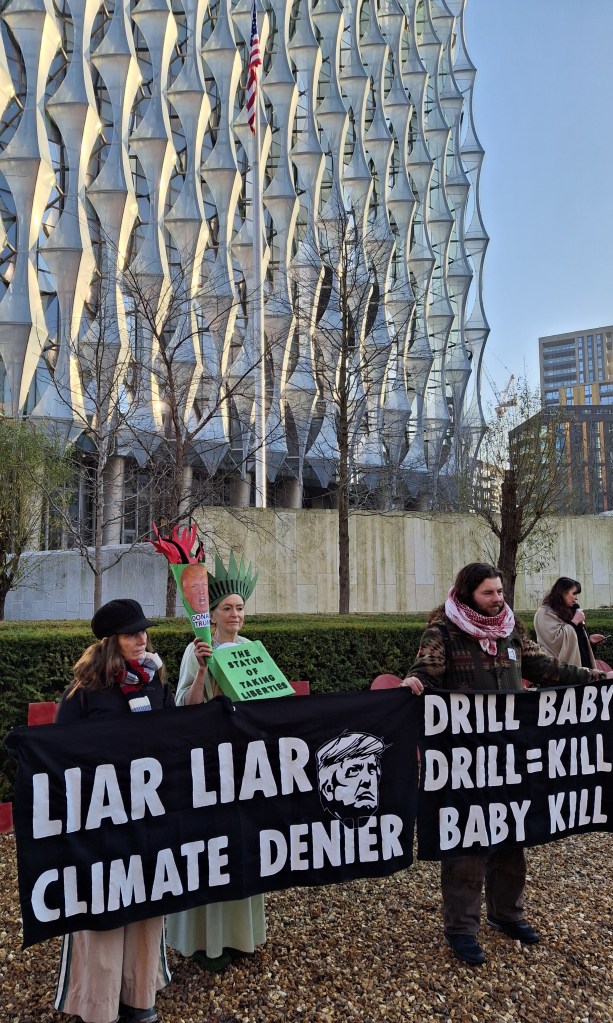
My speech at the “Trump Climate Disaster” Rally outside the US Embassy (11/1/25).

The new US Ambassador that Trump is installing in that Vice Regal fortress behind us – and, I’ve got to say that that’s a very wide moat they’d got there, which makes you wonder what they are anticipating – is a guy called Warren Stephens.

Stephens is an investment banker from Arkansas, whose company holds huge oil concessions in the Gulf of Mexico (which Trump wants to rename the Gulf of America). He is also a climate smartarse – someone who likes to use pseudo scientific one liners to deflect from the seriousness of climate change, which are only convincing for those determined to be convinced and unwilling to ask any questions to puncture their own delusions.

He will have two jobs above all.

One will be to push the UK government off its agenda for green transition.

Trump wants “no windmills” in the USA and “no windmills” in the North Sea.

If renewables are abandoned, the limited reserves in the North Sea means that, even if they were maxed out, they would be unable to fill the gap in energy needs; which would have to be made up by very expensive imports of US Liquifid Natural Gas, which we now know has a carbon footprint 33% worse than that of coal.

If the government succumbs to that pressure -which is being pushed “patriotically” by the Conservativbes and Reform now as Trump’s Fifth Column, with the media in a screaming descant in support – it would be a spectacular act of self harm that will impoverish people on a grand scale and make climate damage a lot worse.

His other main priority will be to push the US militarisation drive.

Trump wants NATO allies spending 5% of their GDP on their militaries. Thats more than double the current average.

Neil Kinnock seems to think that 4% is “reasonable”.

This is NOT because they are under any threat militarily. Direct US allies account for 2/3 to 3/4 of global military spending already (depending on what estimates you use).

This collosal concentration of coercive power polices the transfer of $10 Trillion from the Global South to the Global North every year.

This is why countries want to join NATO. It makes them part of the imperial core. As Anthony Blinken put it, “if you are not at the table with us, you’re on the menu”. The problem now though is that being at the table with the US is a bit like having dinner with “the late, great Hannibal Lecter”, as Trump might put it. You can never be sure when the host is going to trun round and take a bite out of you. But you can be sure that he will do so at some point.

Doubling that level of expenditure cannot be seen as a defensive measure. It only makes sense if they are planning wars of aggression.

That is explicitly proclaimed by the UK Defence Review, which talks of being in a “pre war situation”, and there is overt talk of the British Army having to be ready to fight a major land war in Europe within the next ten years. This is completely mad and suicidal.

The impulse for this is partly that the US is losing ground to China very fast economically, but also because, in the context of the climate crisis, US society as it currently stands – and the wealth of the feral billionaires who are running its government – can only be sustained if they can put the Global South in general, and China in particular, back in its box.

They are fully aware that the climate crisis is real. All the denialist stuff is just prolefeed. An example of this is the US Army Report from 2019 that argued that,

  • left unchecked, the climate crisis would lead to a social collapse in the US itself at some point this century
  • the US Army had to be ready to intervene to make sure that the new oil and gas reserves revealed by melting polar ice caps would be under the control of the US – annexation of Greenland anyone?.

This would be extreme cognitive dissonance if they did not have a perspective where they could maintain a per capita carbon footprint the size of a Diplodocus, so long as most of the world barely has one at all.

So, the United States can no longer pretend to be anyone’s elses future, not even its own.

The problem they will have with this is that the costs of carrying through this massive shift of resources into militarisation will lead to massive economic and political crises.

To be specific. For the UK to spend 5% of its GDP on its military would cost an additional £60 -70 billion a year. Mark Rutte of NATO has very kindly suggested that this could come from Health and Pensions. Nice. We can be absolutely clear that it would also have to come from green infrastructure investment.

Flood defences? Why would we need those when we can trust to luck?

Ditto investing in fire prevention, because there’s no problem with wild fires is there?

Insulating homes? That would have to go. People can stay patriotically cold.

Electrified railways and affordable public transport? Who needs that when there’s weapons to buy?

So, if the government capitulates to this pressure we will face

  • extinction from climate breakdown in the long term, because they won’t have invetsed enough to stop it or limit the damage
  • extinction from nuclear war in the medium term, because they are investing in preparing for that and seem oblivious to the risks
  • misery and impoverishment in the immediate term to pay for it.

All to defend a “rules based international order” in which – as we’ve seen this week with the US sanctions on the International Criminal Court as punishment for the Gaza indictments – the US makes the rules, and the rest of us are expected to follow the orders. The US is not interested in global leadership, it is interested in global domination.

You can’t build a wall to keep this out.

Millions across the world will resist this – including in Europe and the US itself. Trump’s polices are likely to blow up in his face. His tariffs, if imposed, will be ruinous.

People do not want to be poor. They do not want to be killed in a war. They want more action to keep us safe from climate breakdown. Let’s mobilise that majority, with the trade union year of action from this September as a lever.

I’ll end with an advert. Just down the road from here, on Clapham Manor Street, is the only trade union owned pub in the World, called, perhaps inevitably, Bread and Roses. On 23 January at 7pm it is hosting a showing of the latest Reel News film about the inspirational GKN Firenze factory occupation, and another supporting Vauxhall workers resisting Stellantis closing their plant.

Everyone is welcome.

Up Yours Elon Musk!

The current TV advert for the Citroen e-C3 – which looks as though it was directed by the same team as set up the synchronised singing decapitated Marie Antoinette heads at the Olympic opening ceremony this summer- is a funny, elegant French finger gesture to Tesla and Elon Musk.

With David Bowie’s “Suffragette City” pounding in the background, a pair of “artisan” looking young men drive a column of four e-C3s (in a possibly conscious genuflection to the Italian Job) over and through a banquet being held in a chateau by caricatured ancien regime types – all giant bouffant wigs, beauty spots, silk frock coats and enormous dresses – disrupting it and causing operatic shock horror to the assembled aristos. Big, blunt letters announce THE REVOLUTION HAS BEGUN…ELECTRIC IS NO LONGER FOR THE ELITE before the two drivers go racing away looking perplexed at each other as one of the aristo women appears in the back seat, while other artisan styled “revolutionaries” run aongside with a red flares, red flags and – just to be politically broad church and incorporate that little bit of French bourgeois revolutionary tradition -a tricolour.

This is one in the eye not only for Tesla’s model of high cost, high end, high profit EVs that can only be afforded by the wealthy – which explains why Elon Musk can be so comfortable with Donald Trump, as EVs for him are not for everyone, the poor can be left to drive old bangers, so the Chinese are guilty of “overcapacity” in wanting electric people’s cars – but also neatly skewers his political posture of being the richest man in the world and also “anti elite”.

The e -C3 is one of several cheaper EVs put on the market this year by European car manufacturers, in an attempt not to be overwhelmed by the competition from China. It is notable that the EUs negotiating position on tariffs against potential Chinese imports demands technology transfer as part of the price not to impose them. This concedes that the Chinese companies have more advanced technology and the Europeans are playing catch up. Whether this succeeds in rescuing these companies in the short term, which it may not because it is still a struggle for them to produce EVs profitably, this is projected to reverse the downward tick in EV purchases peculiar to Europe last year, which in turn will have a knock on effect on oil demand in the way that the EV boom in China already has.

Labour’s Climate Strategy – strengths and weaknesses.

This was an introduction given at the Campaign Against Climate Change Trade Union Group’s energy strategy day. Afterthoughts and updates, like the next few paragraphs, have been added in bold.

This introduction was delivered before Keir Starmer’s speech at COP 29, which made the very welcome pledge of an 81% cut in carbon emissions by 2035, but also included the promise that the government would not “tell people how to live their lives”.

This makes the way we live now somehow sacrosanct- and assumes that “people” are incapable of rising to the challenge of changing it if thats whats needed to secure a livable world for their children and grandchildren. It also ducks the government’s responsibility to implement Article 12 of the Paris Agreement which is a call for mass popular information, education and mobilisation campaigns, to enable society to act collectively to save itself.

Parties shall cooperate in taking measures, as appropriate, to enhance climate change
education, training, public awareness, public participation and public access to information,
recognizing the importance of these steps with respect to enhancing actions under this
Agreement.

As 66% of the public want more action to combat climate change, we should be mobilised to do so. We will have to get to sustainability by marching forward on both the technological transformation leg and the social transformation leg. We won’t get there if we have to hop hopefully on just one of them.

Labour’s strengths and weaknesses

I’d like to stress that there are a range of views in the Greener Jobs Alliance, and these are mine.

To start with a statement of the obvious, it doesn’t look as though the government sees itself as an instrument to mobilise society to transform itself to sustainability.

They treat the climate crisis as an item on a list – limited to a mission to make the UK a “Green Energy Superpower” – not the framework in which everything else has to be posed.

That leaves huge gaps. Some examples.

1.The current curriculum review for schools does not explicitly have addressing the climate crisis at the heart of it, although the current Ministerial team are open to a discussion about it in a way that the last was not.

2.A climate conscious budget would, as a minimum,

i) have raised fuel duty and hypothecated the revenue to keep the £2 bus fare cap and invested the rest in enhanced public transport.

ii) raised a wealth tax on incomes above £10 million per annum, as suggested by Greenpeace – to raise £130 billion over 5 years (1% of GDP) which, they argue, would raise the revenue to cover insulating 19 million homes, cap bus fares outside London at £1.65, and free for under 25s, fund an unlimited rail ticket for £49, provide retraining for the 3.2 million workers at risk in high carbon industries and shift agriculture onto an agro- ecological basis.

That might be optimistic, but its that scale of ambition thats needed, along with a relentless explanation of why its necessary as a national and international mission.

And to play fantasy Chancellor a little longer, a recommitment to the £28 billion a year future proofing investment with a plan for every sector that works with the relevant unions to develop it and identify the skills gaps that have to be filled. This applies to expanding sectors as well as high carbon sectors that will have to shrink.

Reeves and Starmer’s overall strategy is for “growth” – any growth – conceived in completely traditional terms, not framed as transformation. This can sometimes even be framed in a way that undermines the government’s own targets -as expressed in the recent Sun article under Starmer’s name headlined – “I will never sacrifice Great British Industry to the drum beating, finger wagging Net Zero Zealots”.

I guess that’s us. Perhaps we should all get badges.

Also, I don’t know if its just me, but does all this “Great British this, Great British that” have a really early Victorian feel to it?

3. This can also be seen in housing. The challenge is to build 1.5 million new homes a year. The GJA wrote to Angela Rayner in October last year whether all new homes would be

i) built to a zero carbon standard, with a sound level of insulation, heat pumps, electric cookers and hubs, solar panels as standard and no connection to the gas grid (as this would be a wasted investment).

ii) with all essential facilities within walking distance, integrated green spaces and trees, good public transport links and car clubs to reduce the burden of individual car ownership.

iii) zero impact assessments on water tables and sewage and other questions including who will build them? Arguing that there needs to be a plan to expand Local Authority Direct Labour Organisations with a link to local FE colleges to skill up the new workers we will need to do it

iv) And, crucially, the last question. If the aim is to use existing developers, how will you prevent them from blackmailing the government to water down standards to enable them to squeeze in more units, cut the proportion of social housing, sit on land banks and refuse to develop them, or claim that necessary environmental standards impact on their profits too much?

We didn’t get a reply, but there are indications that they could let developers rip through reducing planning restrictions even on the water table and sewage – which is quite extraordinary, given the massive concern about sewage in our rivers – and there are signs of a retreat on a solar panel default after push back from the industry which shows where the battle is. New rules ensuring that no new homes are connected to the gas grid are, however, scheduled to come into force by 2027 and implemented from 2028. The key question now is how stringent the environmental standards for new builds will be and not allowing the developers to kick the costs of meeting them onto households.

All this poses a question for the trade union approach to Just Transition. At the moment, the new TUC Worker Led Transition Team is focussed on enabling a transition in threatened high carbon sectors – cars, cement, steel etc – which is vital and important work, but we also need campaigns for employment that doesn’t currently exist. Construction and retrofit are probably the most promising sector for this.

The TUC WLT have been working since May and you can read about them and find their contact details in the latest Greener Jobs Alliance Newsletter.

Just Transition doesn’t have to mean like for like jobs. I saw in Edie this week that there’s a skills gap for 50% of the jobs projected as “green” by 2030 – which indicates a huge demand and potential, but also a risk if that gap isn’t filled.

4. This also applies to Foreign Policy. David Lammy made a speech in September stating that the government would put climate change at the heart of UK foriegn policy.

Wouldn’t it be lovely if it did?

For him this had three components.

i) A “clean power alliance” to scale up finance for “clean power” in the Global South.

ii) Measures to unlock global finance to “leapfrog fossil fuels” there.

iii) Implementation of the 30 by 30 agreement (safeguarding 30% of land and oceans by 2030).

The problems with this are that the UK went to the recent Nature COP without a plan for 30/30. “Clean power” is sometimes used as a synonym for “green power” but it is also often used, especially in the US, as a specific description for the cluster of technologies being posed as an alternative to renewables; nuclear, hydrogen, carbon capture and storage.

Most crucially, unlocking finance does not mean increasing aid levels – which are still at 0.5% of GDP, with no plans even to get back up to 0.7%.

What Lammy means is trying to find investment opportunities for the City of London/UK finance sector. For this to work it would have to be profitable for them, as banks follow the money; which is why they have invested twenty times as much in carbon bombs as the Global South has received in climate finance since the Paris Agreement was signed in 2015.

So this is a bit greenwashy, especially as the actual heart of UK Foreign policy is not prioritising fighting the climate crisis, but its strategic subordination to the United States; expressed this week by Starmer “looking forward” to working with Trump “in defence of our shared values” – even as Trump is poised to exit the Paris Agreement and trash all domestic environment protection measures and even the bodies that monitor them.

The question posed by this is the extent to which the government will adapt to US pressure; particularly as this is finding expression here in the alignment of every political force from the Tories rightwards on opposition to “the madness of Net Zero” or the “costs of Net Zero” as they put it. The use of these phrases is now ubiquitous and serves to associate “Net Zero” with “madness in people’s minds – pushed as it is by “eco zealots” and therefore by definition unreasonable without the inconvenience of having to make an argument to justify the association; which they have to do because both are the opposite of the truth. The only thing mad about Net Zero is not reaching it in time, the costs of not getting there are enormous and, indeed, fatal.

As will be the end result of the increased military spending that they falsely pose as keeping us “safe”.

One aspect of US pressure is to sharply increase and prioritise military spending. Starmer is due to announce a schedule for the UK to increase its military spending to 2.5% of GDP straight after Trump’s inauguration, which will do little to appease him when he’s pushing for an eye watering 4%. This is dangerous in itself, but also sucks resources away from investing in transition and/or improving people’s lives; thereby deepening the cost of living crisis and the risk of war.

This is in the context of some EU leaders going to Trump, according to the FT, and suggesting “lets avoid a tariff war and team up against China”; thereby proposing to form a bloc with a climate rogue state against the world’s largest investor in renewable energy.

At the same time they are relaxing their formerly sacred fiscal rules to allow stepped up investment in military production and military focussed infrastructure investment, like strengthening bridges “so tanks can pass in safety”to prepare for a continental war with Russia which, were it to happen, would kill us all. It is an explicit presumption of the current UK Defence Review that we are in ” a pre war period” with Russia, Iran, China, North Korea, or all four. This is suicidal lunacy and we don’t have to accept it.

In the context of Trump expecting these ruinous increases in military spending from all US subordinate allies, a better course for all of them is to seek peace and mutual security with the targetted countries. In Europe, that means finding a modus vivendi with the Russians that would allow a lasting peace in Ukraine – not just a pause while both sides feel they have to tool up for Armageddon – and a reduction in tensions and barriers across the whole of Eurasia.

5) Lastly, on the “Green Energy Superpower” project, there is good news and bad news.

The good news is

i) the unblocking of onshore wind and solar farms,

ii) the 2.5 times increase in offshore wind in this years Contracts for Difference auction – though this needs to double again next year and stay at that level to meet the 2030 target

iii) getting a fast feasibility study done from NEOS that its possible to get the grid in shape to take on all the new renewable energy sources – and finding that this would cut people’s bills

iv) moving zombie projects out of the planning system so those most ready can go first

…all this is positive and means there will be a substantial increase in renewable energy by 2030.

But,

i) The investment in CCUS and blue hydrogen announced last month is a misallocation of funds that could have more of a climate impact and create more jobs elsewhere.

ii) The failure to maintain the original plan for retrofit means that demand and emissions will be higher than they need to be.

iii) As does the insufficient focus on sustainable transport and the continued low funding for local authorities that makes most local climate action plans well intentioned and doing some good things – from bee corridors to LTNs and cycle paths, public EV charging points, officially approved guerilla gardening, school streets programmes and so on, but not resourced enough to qualitatively impact neighbourhoods.

Above all, and overarching, this is the lack of just transition bodies with mass participation at national. regional and local levels because, if I can misquote Lenin, Sustainability = electrification plus Just Transition Commissions.

The transition to renewables is not a threat to jobs in the North Sea, its the only lifeline that workers there have.

My speech at the Rally for a Just Transition outside the Treasury last week

When people say “We have to make the transition to sustainable energy BUT we need to save jobs” we need to change one word in that sentence. “We have to make the transition to sustainable energy AND we need to save jobs”.

At the 2017 COP in Katowice – held in the middle of the Silesian coalfield, where the delegates said that they could smell the sulphur on the air – sensing a threat to their jobs, the local mineworkers branch of the Solidarnosc mineworkers union voted that climate change is not happening.

While that’s an understandable defensive reaction, it actually disarms these workers two times over.

  1. It makes it impossible for them to campaign to save their families and communities from the consequences of climate breakdown.
  2. It makes it impossible for them to defend their jobs, because that defence would be based on a fantasy.

That underlines the point that, whether we are a trade union seeking a future for our members – or a government seeking a sustainable future for society – we have to base our policies on reality.

Which brings us to the North Sea.

Oil and gas production in the North Sea is caught in a pincer that has nothing to do with government policy.

  1. The oil and gas fields are becoming exhausted – and even investment in new fields would make an insignificant difference to the speed of the decline in production, and therefore jobs.
  2. Oil demand has either peaked already, or will soon. That sets up a scenario in which the major oil companies are fighting like rats in a sack over the remaining profitable years. As oil demand declines, the only viable companies will be those able to extract oil from the easiest, therefore cheapest, places. That means OPEC, essentially. The Western oil majors will start to go to the wall in order of size and the extent to which their reserves are difficult/expensive to extract. The writing is on the wall for all of them, but BP and Shell will go down long before Exxon Mobil.

But these companies aren’t going down without a fight. They are pushing back hard against the shrinking of their markets, against taxes on their profits.

Part of this is the abandonment of transition plans from fossil fuels to renewables on the part of these comapnies because, in the short term, the former are more profitable. This dooms them and everyone working for them.

The bottom line is that the transition to renewables in the North Sea is not a threat to jobs in the North Sea, its the only lifeline that workers there have.

This is a video of the rally outside the Treasury.

📣 Please like & share the video to amplify our demands ahead of the budget!

Twitter: https://x.com/PlatformLondon/status/1844347237142262256
Instagram: https://www.instagram.com/p/DA8XoAQoD4c/
Facebook: https://www.facebook.com/share/r/X9zuPQXheN92Qebx/
TikTok: https://www.tiktok.com/@stopcambo/video/7424117445268393249

Judge not, lest ye be judged.

In Colin Welland’s 1989 adapatation of Andre Brink’s novel A Dry White Season, the barrister played by Marlon Brando comments “Justice and law, Mr. Du Toit, are often just… well they’re, I suppose they can be described as distant cousins. And here in South Africa, well, they’re simply not on speaking terms at all.”

Judge Christopher Hehir, in his conduct of the case against the Just Stop Oil defendants, Roger Hallam, Daniel Shaw, Louise Lancaster, Lucia Whittaker De Abreu, and Cressida Gethin, who he has just sent down for 4 to 5 years in prison for “conspiracy to cause a public nuisance”, has done his best to make people realise just how true that is of the UK too.

His summing up is almost beyond satire in its sophisticated mulishness. Talking of the breakdown of the climactic conditions needed for human civilisation to survive, this bewigged buffoon said, “I acknowledge that at least some of the concerns are shared by many, but the plain fact is that each of you has some time ago crossed the line from concerned campaigner to fanatic”.

Lets break that down. “some of the concerns are shared by many”. The issue is not “concern” at climate breakdown it is the FACT of climate breakdown. This is not in serious dispute. Even the outgoing government’s “Impartiality guidance” for teachers noted that climate denial is not serious science and should not be taught.

Parliament has voted that we are in a “climate emergency”. This does not seem to have got through to Mr Justice Hehir.

So, this is not about opinions. Nor is it about how “many” people share them. It is a matter of UK law that the government has to decarbonise society by 2050. The last government’s plans to meet this target have been ruled inadequate by the UK High Court TWICE in the last two years. The consequences of a failure to meet this target will be considerably more severe than the £750,000 worth of disruption that the M25 protest is estimated to have caused. Would the Judge think it reasonably therefore to bang up Rishi Sunak, Claire Countinho, and the “Net Zero Scrutiny Group” (now happily depleted by the democratic process) for “conspiring” to put the UK well off course for reaching them, as they did in the more salubrious surroundings of the Cabinet Office, and probably on a few zoom calls as well?

It is also a matter of International legal obligation under the Paris Agreement that countries are working together to make this work. Except that the course taken by the last government clearly, in the judgement of the Climate Change Committee – the cross Party body set up to hold government to account for its actions, “signalled a slowing of pace and reversed or delayed key policies” which put the UKs progress below the curve.

In the context of an emergency that has not not been treated as an emergency, in which a lackadaisaical business as usual laziness was passed off as “pragmatism”, any “concerned campaigner” might reasonably conclude that more serious action was needed to make it plain that this is not OK, that the majority opinion, that wants more action on climate not less, should be heard. A “fanatic”, on the other hand, is someone who holds a view unreasonably and in the face of evidence to the contrary. The “plain fact” is that there is no evidence to the contrary in the case of climate breakdown. We can feel and see it happening around us. The consequences of failing to act to limit the damage will be catastrophic. Providing the protection of the law to, for example, banks that finance climate wrecking fossil fuel investments and making an example of people who, for example, take a demonstrative hammer to one of their windows, with punitive multi year sentences for a bit of cracked plate glass shows the same sense of proportion that, 220 years back, hanged Luddites for smashing stocking frames.

A keen advocate of crushing dissent on climate or Palestine by criminalising it has been the last government’s “Security Adviser”, Lord Walney, or plain old John Woodcock MP as he used to be. An acid test for whether the new government will continue down this path will be whether Walney retains his role and continues to be given credence. He should be sacked.

A basic principle of common law is that, for it to retain consent, it has to be seen to be “reasonable” to “the average man (or woman) on the Clapham onmibus”. The lengths to which the judge in this case went to silence the defendents in court, ruling that defendents were not allowed to speak to the jury about why they had done what they did, underlines his fear that the judgement of their 12 peers would be that this was a reasonable and proportionate response to the scale of the crisis and the paucity of action taken to address it. Defendents allowed to put this kind of public interest defence, however unpopular many of the JSO actions have been, have tended to be aquitted by Juries in the last few years. Can’t have that. Where will it all end?

When a judge orders the arrest of people standing outside the court holding placards affirming the rights of juries to hear the whole truth, for contempt of court, it is clear that the legal process as an arbiter of justice is being held in contempt by such a judge; which invites popular scorn for “the rule of law”, “Fundamental British Value” or not.

Mae West put it rather well in 1927.

Judge: “Miss West, are you trying to show contempt for this court?”

Mae West: “On the contrary, your Honor, I was doin’ my best to conceal it.”

Mythbuster 1. Over heating is good for you?

As we move into a period in which the powers that be will be retreating and retrenching on climate policy, we can expect discredited arguments and factoids to be churned out with dreary regularity; so that anyone who does not want to confront the realities we face has a set of one liners to trot out to deflect thought and effort.

This series of blogs is aimed at giving workers and activists the information we need to debunk these claims if a workmate, friend or relative comes out with one of them.

A recently distributed leaflet, very glossy but with no publisher acknowledged, makes the claim that Humans thrive in warm climates straight after arguing that the world is not heating up; stating Humans have always thrived in warm climates. Even if the world were warming, warmth is by no means a threat, ice ages ARE. Every year many more people die in the colder winter months, even in the UK, see ONS data”.

The key word here is “warm”. We are already getting well beyond that. Here’s some examples, with thanks to Simon Erskine for compiling them. These arguments will be useful in the context of “Phew! What a scorcher!” and “Hotter than Morroco!” headlines in the tabloids. For those who can absorb anecdotes more easily than statitsics, a useful question is, “Have you noticed how, until a few years ago, every time we had a heatwave people used to go out and sunbathe, but now, have you noticed how people go out and sit in the shade under the tres because the heat is becoming uncomfortable?”

  • Zimbabwe’s president Emmerson Mnangagwa has declared a national disaster amid a prolonged drought that has destroyed about half the country’s maize crop, BBC News reports. He joins neighbouring nations in southern Africa, Zambia and Malawi, both of which have recently declared similar states of emergency, the article adds.
  • “Unprecedented” temperatures are being reached across south-east Asia, including in parts of Vietnam, Thailand and Myanmar, according to the Guardian. It points to lengthy spells of dry weather in Indonesia driving up rice prices and fears that coral is under threat in Thailand due to high water temperatures. The newspaper says the World Meteorological Organisation (WMO) has “attributed the scorching weather to human-induced climate change, as well as the El Niño event, which brings hotter, drier conditions to the region”.
  • In Santiago, Chile, an 11-day heatwave has ended, becoming “the longest in history,” according to Raúl Cordero, a climatologist at the University of Santiago, La Tercera reports.
  • The UK may face water shortages and hosepipe bans this summer, despite recording record-breaking rainfall over the past 18 months, the Times reports. The i newspaper notes that the UK population has increased by 10 million over the past three decades, while “climate change has put pressure on existing reserves”. The Guardian reports that the Environment Agency released a report last week, which “predicts a growing shortfall of water in coming years, leading to a deficit of almost 5bn litres of water a day by 2050”. The National Farmers Union has warned that flooding and other extreme weather linked to climate change will undermine UK food production, BBC News reports. The article says this comes after “record-breaking rain over the past few months”, which “has left fields of crops under water and livestock’s health at risk”.
  • Russia and Kazakhstan have ordered more than 100,000 people to evacuate after melting snow swelled rivers beyond bursting point, leading to the worst flooding in the area for at least 70 years, reports Reuters.
  • The United Arab Emirates has been hit by an intense storm, with the country experiencing its heaviest rains in 75 years, according to meteorological authorities, reports the Financial Times. Almost 6 inches (152mm) of rain fell on the capital Dubai on Tuesday, a year and a half’s worth of rain in a single day, causing travel disruptions, reports the Independent. In related news, the death toll from flooding in Pakistan has risen to 63, the Associated Press reports.
  • The deadly heatwave that hit West Africa and the Sahel over recent weeks would have been “impossible” without human-induced climate change, scientists have said, reports BBC News. Temperatures in Mali soared to above 48C, with one hospital linking hundreds of deaths to the extreme heat, it continues. Researchers found that human activities such as burning fossil fuels made temperatures up to 1.4C hotter than normal, the article adds. On 3 April, temperatures hit 48.5C in the south-western city of Kayes in Mali, with intense heat continuing for more than five days and nights, giving no time for vulnerable people to recover, reports the Guardian.
  • The “unprecedented” warming of the oceans over the past year has had widespread repercussions on marine life, an EU environment chief has warned, reports the Financial Times. This includes impacting already dwindling native fish species such as Baltic Sea Cod, the European commissioner for the environment, oceans and fisheries Virginijus Sinkevičius said, citing the migration of the cod towards colder waters near Russia and Norway as an example of the impact on biodiversity of rising temperatures, it adds.
  • The past 10 months have all set new all-time monthly global temperature records, with April 2024 on track to extend this streak to 11, wrote Dr Zeke Hausfather in his latest quarterly “state of the climate” report for Carbon Brief. The graph at the end of this email shows monthly temperatures over 1940-2024, plotted with respect to a 1850-1900 baseline. Based on the year so far and the current El Niño forecast, Carbon Brief estimates that global temperatures in 2024 are likely to average out at around 1.5C above pre-industrial levels.
  • The Independent reports that a “punishing heatwave” has forced the government in Bangladesh to shut schools for 33 million children “as the country battles the hottest April in three decades”. The Guardian has an article with the headline, “Wave of exceptionally hot weather scorches south and south-east Asia”. It says millions of people across the Philippines, Thailand, Bangladesh and India are facing dangerous temperatures as the hottest months of the year are made worse by El Niño.
  • Mexico: Drought spreads to almost 80% of the country; there are 10 states with 100% of municipalities affected.
  • As India heads to polls amid 45C heat, fears mount over voters’ safety. Bloomberg columnist David Fickling asks: “How can India hold elections when it’s too hot to vote?”
  • The Washington Post carries a feature headlined: Earth’s record hot streak might be a sign of a new climate era.” It says Nasa’s Dr Gavin Schmidt indicates that what happens in the next few months…could indicate whether Earth’s climate has undergone a fundamental shift – a quantum leap in warming that is confounding climate models and stoking ever more dangerous weather extremes”.

Now that this is the trend, unions are developing stronger guidelines for working in extreme heat. This is a serious matter as some right wing

TUC guidelines are here. Individual unions will also have their own polices. Joint guidelines for the education sector are here.

Of Pies and Doughnuts – 30 theses on Political and Economic issues in Green Transition.

“I wouldn’t start from here if I were you…” Trad.

  1. The first point that we have to be clear about is that we are now in a period of damage limitation. Continued emissions of greenhouse gases are putting humanity well behind the curve of saving ourselves from the breakdown of the climactic conditions needed for the survival of human civilisation. In the current relationship of forces, the question is not whether we can avoid the crisis, but how much damage we can avoid. As we need far more dramatic shifts that current political and economic relations allow, we have to seize and build on any and every change that is immediately possible in order to bank it – limit the damage – and build on it to have any prospect of breaking through the limits of those conditions. It is imperative to do both.
  2. The paradox is that fossil fuel interests are now under such a threat from the transition that is already taking place, even at its current slow pace, that they are putting significant resources into political movements that are either denialist, like Trump, Bolsonaro, Milei, or go slow, like Sunak. The dynamic of this is towards denialism; in practice if not in theory. This dovetails with the impasse of neoliberalism, which requires a dramatic shift in the balance of power against the working class and Global South to restore profitability and capital formation in the US allied countries. This tends towards fascism; because “normal” politics will be incapable of imposing that scale of defeat required. The question here is not whether Trump, for example, is a fascist, but whether the movement he fronts up (and which is an expression of very powerful class forces) is heading in that direction. This tendency is not inevitable, but has to be seen for what it is. As the inequality of wealth, and stratospheric concentration among the wealthiest has increased, political acceptance of democratic constraints among the wealthiest has declined sharply. Resistance to this is one of the motors of transformation.
  3. Fascism is a last resort for ruling classes because it is ultimately suicidal, requires exponential escalation of confrontation to a point of total victory or total defeat: but the prospect of ecological collapse makes this less of an inhibition in a kind of last days of Nazi Berlin recklessness; and generates the sort of exuberantly self indulgent celebration of irrationality that is such a feature of movements like MAGA.
  4. The capitalist class is divided on climate, however. Significant capital is going into renewable energy, electric vehicles, and other key transition sectors. Others are perturbed about the future, and want there to be one. We should note that there was a significant participation from private school students in the climate strikes for example. If you expect the world to be your oyster, then find out it is going to hell in a handcart, you’re going to be upset about it. It is also noticeable that the active cadre of climate denialism in the Global Warming Policy Foundation are not only rich enough to be part of the global 1%, they are also almost entirely over 70 years old. Lord Lawson, of course, is already dead.
  5. This division also plays out not simply in “green sector” businesses, among scientists and academia, but also at different levels in government. Cities are vital laboratories for a green social shift. The C40 movement, the most important legacy of the Livingstone Mayoralty in my view, knits together the Mayors of nearly 100 of the world’s biggest cities from New York to London to Jakarta to Beijing, Paris and Buenos Aires. All of them are working on ways to green construction, transport, urban planning, waste and recycling; and sharing the results in a vast process of mutual experimentation and shared learning. You can read about that here. The need to make such a conscious shift in every aspect of life is a new challenge and no one has all the answers. We are making it up as we go along, and any and every lever we have any access to is vital. Every small step that works is a seed, because it shows what might be done on a bigger scale. These cities cover a multitude of political sins, and at present it could not be otherwise. And they make a big contribution to the Paris process. Actions taken by US cities aligned with C40, and to some extent States, reduced the impact of Trump’s rollback on climate measures during his last Presidency by about half. Whatever the political character, and limitations, of the Mayors of NY and LA and the other cities involved, this is essential work. This could be seen as an application of Gramsci’s notion that we are in a war of position, seeking to gain ground in a myriad of social forms and organisations as part of the process of shifting hegemony towards a point that the old unsustainable order cracks.
  6. Nevertheless, pro Net Zero views among capitalists tends to a kind of techno Micawberism – the view that technological changes alone, leaving existing social and economic structures intact – will be enough. Given the studies by Oxfam and others that show that the carbon emissions of the wealthiest 10% will, at current consumption rates, take us beyond 1.5C on their own, regardless of what the rest of us do, this poses the limits of any bloc with them, and also a rule of thumb guideline for how much income is too much in global terms; roughly anything above £75,000 per person at the moment. For people above this, getting to sustainability will be harder than a camel threading a needle, but there we are. We can travel to sustainability, but not in private jets or yachts.
  7. The climate movement is necessarily broad. We should be prepared for united fronts across wide disagreements on other matters and to have debates within the movement; and also form blocs with different class forces on particular issues without doing so on their terms. Offshore wind companies, for example, are as ruthless to their workers as any others. This is a contradiction that we have to fight out within the imperative to have as many of them built as we can.
  8. The same applies to limited and inadequate political choices which reflect capitalist interests first and human imperatives a long way below. A continued Biden Presidency, for example, would continue to pursue an “America First” green transition, as well as its global war drive against China, arming the IDF assault on Gaza, channeling capital into military spending and sucking green investment away from even its subordinate allies. A Trump Presidency would make the US a complete rogue state on climate, smash up the Paris process, double down on fossil fuels, and spice up the war drive with what Boris Johnson calls “unpredictable violence”. Leon Trotsky’s argument in The Struggle Against Fascism in Germany –that when you are confronted by two people who are going to kill you, but one has a gun and the other some slow poison, you bloc with the poisoner against the gunman, while building up your own forces so you can deal with the poisoner later – is relevant to this.
  9. Either way, the dominant ruling class in the US centred Global North bloc, for all its protestations of global leadership, will not lead humanity into sustainability. The ease with which they have found billions for wars, and now escalating military spending, compares starkly with the difficulty they seem to have providing climate finance for the Global South.
  10. The ideologues of the world’s imperial core have warned us of what they are going to do. In “The Age of Consequences” a projection of potential climate scenarios drawn up by allies of Al Gore in the US Democrat Party in 2008 stated quite clearly that in conditions in which climate driven “massive non linear events” began to unravel societies, “Governments with resources will be forced to engage in long, nightmarish episodes of triage, deciding what and who can be salvaged from engulfment by a disordered environment. The choices will need to be made primarily among the poorest, not just abroad but at home.” When someone tells you who they are, believe them.
  11. This is not simply a question of a confrontation with capitalism, it is a question of confronting imperialism in the first instance. The concentration of the major imperial powers into a US led Global North bloc – described by the Tricontinental Institute as Hyper Imperialism – is the last stand of an order that extracts wealth from the rest of the world, seeks to make its own working classes complicit in doing so, is arming itself to the teeth to confront the consequences of its failure to deal with the climate crisis; and is risking war rather than peacefully come to terms with China becoming economically weightier than the US, thereby accepting multipolarity. This means that we may not live long enough to experience the full consequences of climate breakdown, should the kind of US strategic thinkers advocating a war with China in the next five years manage to provoke one. If we manage to avert this – and it will take efforts on our part – the diversion of investment into military spending will cut essential investment in climate transition and do enormous and unnecessary damage anyway. We won’t get this time back.
  12. John Bellamy Foster’s call for an anti imperialist climate movement to address the twin threats of 21st Century exterminism, the US war drive and climate breakdown, is essential, in that there needs to be clarity on this on the Left, but also insufficient, in that there need to be united fronts with forces that are not on the Left, and forces on the Left that don’t see themselves as anti imperialist in the way that Bellamy Foster (or I) would; and this is a dynamic process.
  13. The role of the countries that see themselves as Socialist is a more positive one than they are usually given credit for in the climate and labour movements in the Global North. Whether this is Cuba being considered a sustainability model by the UN, or China investing twice as much in energy transition as the US and EU put together this year, or high speed rail investments as part of the Belt and Road initiative. This is examined in some detail here.  I use the phrase “countries that see themselves as Socialist” because large parts of the Left in the Global North don’t think that these countries are what they think Socialism is, but its important to take on board the fact that 90 million Chinese Communist Party members disagree with them – and that should pose (at least) a debate, with them, not about them. A good place to start getting a flavour of their views, and that of quite a broad range of the non Party Left is Wenhua Zongheng.
  14. Monthly Review has also made a serious reassessment of the Soviet Union’s ecological record, stressing that the ecological disasters, for which it is well known, generated a significant environmental movement, and big shifts in state policy with real impacts, particularly in the 1980s after Chernobyl; and that its overall environmental impact was no worse than that of the US. Anyone who has seen post industrial wastelands in the US will not find that hard to believe.
  15. The current escalation of extreme weather events is just the overture to impacts that will, on current trajectories, become locally or regionally unmanageable in the coming decades; posing political climate emergencies declared by local ruling classes seeking to survive at everyone else’s expense, confronting working class and popular resistance, forced into revolutionary solutions to seek survival. Developments of this sort can’t help but have a dramatic political ripple effect, transforming debate and actions globally. Columbian President Petro’s insight that Gaza is a dress rehearsal for what the Global North will increasingly impose on the rest of the world as the climate breaks down should also be seen as a promise of the sort of global solidarity it has generated. with the sharp political learning curve, shake up and shake down of allegiances and organisations that goes with it. As Bellamy Foster puts it; “A revolt by the world’s environmental proletariat …, in which hundreds of millions, even billions, of people will inevitably take part, is destined to come about in the coming decades as a result of the struggle for ecological survival.”
  16. We are the majority and should act to mobilise it. When Just Stop Oil in the UK says “We need a revolution”, they are proposing a combination of continued non violent direct actions with assemblies to mobilise local communities around matters of concern. We should not be formulaic about what forms “assemblies” should take; as they will necessarily be multiple and will obviously include workplaces; and in some cases, these will be the core of a wider social mobilisation, as they are at GKN Firenze.
  17. We should also be clear that any NVDA must be directed at appropriate targets and all actions be aimed at mobilising the majority opinion in favour of more urgent climate action, not substituting for that in ways that provide climate deniers with a popular stick to beat us with. JSO has not always been sensitive to that. Nevertheless, initiatives like this are part of the war of position. Revolutions, and counter revolutions, take place when a social order breaks down to a point that it can no longer go on. That is when the war of position becomes a war of manoeuvre and ecological breakdown or economic impasse or military confrontations can all be causes of that. (See point 13 above).
  18. In the UK, the biggest wave of climate activism, and optimism, coincided with the Corbyn leadership of the Labour Party, which held out the prospect of a UK government that would qualitatively up the investment in green transition. This fed off, and fed, a series of mass movements outside Parliament and Parliamentary thinking that nevertheless led to Parliament declaring a climate emergency and embedded concern for climate as a top 4 issue ever since.
  19. A Parliamentary Road to Sustainability now looks too long and winding to get to its destination anything like fast enough; with the level of investment being proposed by Labour quantitatively better than that already in place, but not to the qualitative degree we need. This is a damaging and retrograde choice by the Labour leadership. The failure of economic logic is examined here. Sir Nicholas Stern and others at the Grantham Institute have also demonstrated that the UK needs at least 1% of GDP to be invested in infrastructure every year to keep abreast of other developed countries. 1% of GDP is £26 billion. Which is a familiar sounding figure. Anything short of that allows continued decay.
  20. Rachel Reeves recent Mais lecture got the relationship between climate transition and “growth” completely the wrong way round; with the notion that any investment in green transition will flow from “growth” in the existing economy; within the framework of restrictive fiscal rules and respecting Tory spending plans that have baked in another five years of austerity. Reeves argues that Labour will aim to “grow the pie”, addressing issues of productivity with selective state pump priming. The scale of this is the problem. Cutting planned investment from £28 billion a year to only a little over what the Conservatives have already pencilled in, means that few pumps will be primed. Even with a “growth unit” in the Treasury, there will therefore be little growth, because there won’t be enough investment to generate it; and what growth there will be will primarily reproduce existing patterns of unsustainable production and consumption, not the sharp shift in the economy to a much lower carbon intensity overall that we need. Its not so much that the pie needs to be bigger, but it does need better, more nutritious ingredients, and to be shared qualitatively more equitably. That follows the climate imperative to reduce the overconsumption of the richest 10% outlined above. But Reeves’s approach rejects social redistribution, with all but the most limited taxes on the wealthy ruled out. We should not accept the poverty of low aspirations that passes for “realism” in Labour leadership circles and push for what is realistically necessary.
  21. “Growth” in the sense that Reeves poses it, is a way to generate benefits without confronting unsustainable inequalities of wealth and power; leaving them intact. Without differentiating between what is sustainable and what is not. “A rising tide lifts all boats”, but in current conditions, it also drowns all coastal cities.
  22. However, “degrowth” is not a good description of what we are trying to do; all too easily translated, in current circumstances, as “austerity”, or an unjust transition requiring the 90% to pay the price for the continued indulgence of the wealthiest 10%. Growth is completely legitimate and necessary in the developing world. The importance of a massive shift in investment to it is to enable this to happen without reliance on outmoded fossil fuel technology, in the same way that Africa has leapfrogged landlines to use Satphones. The failure of the Washington Consensus finance structure to make this finance available is structural and condemns the majority world to continued poverty and a pattern of development that is slow and unsustainable. In the Global North our movement has to be about transformation and regeneration, lowering carbon intensity without crashing majority living standards.
  23. The US bloc is trying to unravel globalisation, as it no longer provides it with global dominance. In cutting the world economy into parts, it breaks up shared efficiencies of scale, making all progress towards sustainability more costly. Local production is not always better than working with a global division of labour, and is often less so, even when transport costs are taken into account.
  24. “Extractivism” is also not a useful formulation, as, if we are to make anything at all, we need the raw materials to construct it; and that involves mining, refining and so on. The point here is to have the most economic – sparing – use of these materials, including the most effective possible circular reuse; and the best possible terms and conditions for the workers employed in the global supply chains; which is part of increasing the living standards of workers across the world as we head for sustainability.
  25. The food metaphors used in this discussion are unfortunate as, given the choice, most people would go for a fat pie over a thin doughnut.
  26. It is a statement of the obvious that, if we are to survive, some sectors of the economy have to shrink dramatically and, in some cases disappear, while others have to expand while the overall carbon intensity of everything made or done has to decrease. That requires continued technological innovation. We can’t presume a magic bullet, and can’t afford to wait for one, but at present there is a 2% annual improvement in efficiency and, according to the IEA, that needs to double to get us on track. That needs investment and coordination. So, the transition is necessarily technologically intense. The figures from the study that drew up maximum sustainable per capita energy consumption in Jonathan Essex’s recent article on the Greener Jobs Alliance blog were based on a presumption of everyone having equal access to the most advanced technology available. This is a long way from “Fully Automated Luxury Communism” but the technological dimension of maintaining a decent and sustainable way of life will be huge (and require the commensurate level of skills to sustain it).
  27. At present in the UK, even with stagnant “growth” in the conventional sense, and a transition that is going too slow, the number of jobs being created in “green” sectors is greater than those being lost in carbon heavy sectors.According to the ONS, in 2022, 8,500 jobs were lost in oil and gas, while 40,000 were created in low carbon and renewable energy sectors (almost 5 gained for every one lost). But, they are different jobs in different places. All investment, transition related or not, tends to substitute capital for labour, so transition for workers in threatened sectors must be addressed by any government, or movement, serious about making a shift with public support and avoid devastating local impacts like that at Port Talbot. Our movement should be about anticipating those shifts and for the unions and communities concerned to be ahead of what’s coming to make the appropriate demands for job guarantees, retraining and redeployment. If that does not happen, we end up in the ridiculous position whereby unions representing North Sea Oil and Gas workers campaign against the freeze on new exploration proposed by Labour, even though this is contrary to the interests of the working class as a whole.
  28. If you go to the TUC HQ in London, there is a magnificent painting by Dan Jones of the demonstration outside Pentonville prison in 1972 that was the strongest expression of the General Strike that freed the Pentonville 5. If you look at the banners being carried, most of them are from unions and union organisations that no longer exist. SOGAT. The Port of London Joint Shop Stewards Committee etc. This should stand as a warning to us today. A trade unionism that limits itself to bread and butter issues and the immediate perceived interests of members confines itself to trying to get a better deal in someone else’s world; and leaves strategic decisions about the future in the hands of a ruling class that will make them in a self interested way that will destroy whole sections of our movement. This is trade unionism that Gramsci would have described as “subaltern” and “corporate”. Another way to put it is that it is trade unionism that, however militant, ultimately knows its place.
  29. We need, instead, to push for Just Transition bodies at every level, in every sector and in every community; and push for a government that could, for example, approach the highly skilled workers making private jets and ask them, “with your skills, and this kit, what could you make instead that would benefit everyone?” and coordinates all initiatives through a National Climate Service. There are vast reservoirs of creativity, imagination and preparedness for hard work that could be harnessed in a universally understood human mission to save ourselves.
  30. Article 12 of Paris Agreement states that all signatories have to educate their populations on the nature of the crisis and the measures needed to deal with it. We should not interpret that as a sectoral point, but as a whole society obligation whereby society mobilises itself to deal with the crisis. Our movement has to lead that, or it won’t happen.