Retired teacher. Lives in North West London. Grew up in Thurrock in the 1950's and 60's and consequently spent the first 18 years of his life breathing air that was 60% cement. Active member of the National Education Union (formerly NUT) and Labour Party.
“Isn’t it lovely?” And so it is. Soft winds. A hint of blossom. Sticky buds starting to uncurl. Everything that little bit lighter and fresher. And you can respond on that level. Yes. Its lovely. There are crocuses of hope. Spring has more than one meaning. This early though…Our light. bright days are the accompaniment to the wild gyrations of the jet stream, the blazing forests of Australia, the melting ice packs of Greenland and Antarctica, the freezing of Texas* and the floods here in Storm Cristophe just last month, which Sir James Bevan, the Chief Executive of the Environment Agency, reports came within one centimeter of the tops of flood defences – constructed to Reasonable Worst Case Scenario Standards – that protect 49,000 homes from inundation. (1) Crocuses of hope could well give way to daffodils of despair if we don’t get our act together. Of course, in a conversation with a neighbour, being the Cassandra who is always pointing out the dark cloud that is the condition for the silver lining makes you a prophet of doom that no one wants to listen to, lest it ruin their good mood.
At the supermarket, a young woman pushes her baby buggy steadily down the aisle with one hand, looking sideways at her mobile phone completely absorbed, legs on cruise, navigating by muscle memory; her toddler is a small mirror image, looking to the left at his phone with the same frown of concentration.
Around the end of the Park, the first school crocodile of spring. Teacher striding out briskly at the head without a backward look. Neat little rows in the papal scarlet of the local Catholic primary going in two by two, with barely a need to be shepherded by the TAs at the back. Eighteen of them. And they look liked one class. Quite a lot even before the reckless reopening next week. The “normality” of it coming as a shock.
*“I’ll believe in climate change when Texas freezes over” Senator Ted Cruz.
In his friendly review of Bill Gates’s How to Avoid a Climate Disaster, former UK Prime Minister Gordon Brown argues that the 2010 Copenhagen summit failed to lead to the breakthrough we needed because of both “the reluctance of the US to make legally binding commitments, and the deep suspicion of China, India and the emerging economies of any obligations that they believed might threaten their development”. (1) He then anecdotally glosses over the former and emphasises the latter by recounting the rather startling image of “Australian Prime Minister, Kevin Rudd” having to be “physically restrained from punching the Chinese negotiator.” What an unreconstructed colonial incident that would have been. (2)
It might seem odd that the man who, as Chancellor in 2005, campaigned to “Make Poverty History” should put an equals sign between the refusal of the US – the worlds heaviest emitter per capita and the country with the biggest global legacy of carbon emissions – to see world leadership as anything other than getting away with the most it could, at the expense of those less powerful than itself – and the desire of the developing world not to stay poor; let alone foreground the latter. The way that he does this – possibly unconsciously – could stand as a warning that this attitude – that seeks a global division of labour in which the worse off and worst hit parts of the world do the heavy lifting, and restrain their development in the common interest, while the wealthiest countries try to make only those moves that maintain existing patterns of wealth, power and ways of life – is likely to find expression again and again in the run up to, at, and beyond the COP in November. There is already a significant effort going in to paint the more industrialised parts of the developing world in general – and China in particular – as the flies in the global ointment.
A recent report from US Researchers shows how much more work every country has to do if we are to hit the Paris target of keeping the global temperature rise within 1.5C – beyond which we are likely to be in danger of feedback loops that will make it incredibly difficult for us to control. (1) The additional effort needed for a selection of key countries looks like this.
Please note that this is what is required to have a 50:50 chance of staying within a 1.5C rise.
So, China has to do 41% more, just under half as much again as its already doing, while the UK has to almost double its efforts (97%) and the USA, India and Japan roughly quadruple theirs (203%, 190%, 229% respectively) and South Korea almost nine times as much. So, while John Kerry’s argument that China “isn’t doing enough” is true, nobody is, and the Washington has far more to do than Beijing; so a little humility might be in order. Closer to home, the frequent trope from UK Ministers that we “lead the world” on this are neither true – we are well behind the Chinese – nor relevant. It doesn’t matter if you are leading a pack of slower runners, if you are not going to get to the finish line before nature calls time on the race.
This blog is the first in a short series.
1. https://www.nature.com/articles/s43247-021-00097-8#Tab1 The worrying thing about this Report is that it puts a lot of emphasis that only an 80% increase in global effort would be needed to stay within 2C, as if it would not be extremely damaging and dangerous for us to end up there and it is just too much to expect that we could do what we need to if it was remotely inconvenient in the short term.
By late Monday afternoon we will know just how lucky Boris Johnson feels.
We will also know whether Chief Medical Officer Chris Whitty – reported to be deeply concerned about a rush to open schools wholesale on March 8th – is going to play the role of a Fauci, by refusing to be window dressing for a move he knows will cost lives, or that of a Birx, grimacing through whatever “form of words” Downing Street comes up with to massage its intent.
The government – not for the first time – is sending contradictory signals. The Education Unions, all of them, are not. They describe the prospect of schools being open to all students from March 8th as “reckless”. (1)
While the government is saying that it will only publish the Scientific advice after the event – an indication that they are not at all sure that it supports a big bang – what we do know appears not to.
As a result of the lockdown, infections are coming down quite fast. Halving every 15 days. With the infections on 18 Feb running at just over 12,000 – other things being equal – they would still be at just under 6,000 a day on March 8th; well above where they were in September last year the last time this was tried (1,295 on September 1st). And we should all recall what happened then. This time round, we are looking at a daily infection rate five times worse than then with a virus that is considered up to 70% more contagious.
Not likely to go better than September is it?
At the current rate of decline, the projection is that infection rates would take until the Easter holidays to be down to 1000 a day. Add the two weeks off for Easter with all other restrictions in place and we could be down to 250 a day by mid April. That is a level at which the virus could be hounded to domestic extinction with a proper test and trade system, run through the Health Service and Local Authorities not SERCO.
The government, instead, wants to rely on vaccines and a lot of hope – and probably some contradictory forms of words as the big bang blows up in our faces. Caution with freedom. Recklessness with responsibility. What more can you expect from us? The buck stops with you. If they do go for this, it will be seen as a green light by the take it on the chin brigade, who want the economy re-opened regardless of the casualties. In the words of Thurrock MP Jackie Doyle Price “The moment you open schools up then there no excuse for not opening up the rest of the economy”.
While there has been a real but marginal impact of vaccinations on infections among the over 80s, this has no bearing at all on schools. No children will be vaccinated. No vaccine has been licensed for the under 16s. Very few teachers or TAs will have had even one injection. At the moment, the age groups which has had the slowest trajectory of decline in infections are young adults (18-24) and primary school age children (5-12). “Researchers say that this may be because a significant proportion of primary pupils have still been in classrooms during lockdown”. (2) The current level of attendance in Primary is around 20-25%. Bump this back up to the pre pandemic norm of 95% and how hard is it to predict whats going to happen?
The impact of a partial reopening – on the lines being tried in Scotland from Monday – is likely to be damaging enough, with primary schools becoming a permanent viral reservoir. Their experience must be watched closely to see what happens, though it must be noted that Scotland has an infection rate that is lower than that in England (1:180 compared to 1:115) and the two weeks between Monday and March 8th is a short period to provide anything definitive about how quickly the virus rebounds. However, opening all schools for all students and all educators is bound to slow down the rate of infection decline significantly and, in the worst case, may even reverse it.
The Education unions, parents, independent SAGE and others are arguing for damage limitation. That if there is to be a partial widening of access to schools from March 8th, this should be on a limited basis and the results studied before considering wholesale reopening. That appears to be the plan in Wales, with Early Years and Infants back next week but a projected fuller opening for the rest of Primary and some Secondary year groups contingent on a continuing improvement in infection reduction. A government concerned with public health would listen to them. Labour should back them – and call for the Zero Covid strategy that is within our grasp, but the Tories fail to sieze
I can’t help thinking that if Keir Starmer were a groundhog, he’d be the sort that always saw a shadow. There appear to be no limits to caution. We are living through the beginnings of the breakdown of human civilisation – the pandemic is not an aberration, the environment is unravelling and the old normal is gone, not in temporary abeyance, gone – and- faced with a government that is as venal as it is incompetent – all he can dredge up as a vision of a way forward in his big reset speech on Thursday is Business, Bonds and Britain. The reporting on this is back to the old parliamentary gamesmanship of it being a bad idea for an opposition to come up with a good idea in case the government adopts it. Which is an odd way to think. If you have a good idea, wouldn’t you want the government of the day to adopt it, rather than squirrel it away on the off chance that it will be you that gets to implement it four years too late? Of course, this presupposes that any idea that will be presented is within a range narrow enough to be promoted by either potential governing Party; which is where we are now. And why the venom directed at the previous Labour leadership was so over the top and unrelenting; because its ideas went beyond that narrow range and made it possible to imagine that the way things have been don’t have to be the way things will always be – world without end, forever and ever, Amen. As they say on middle management courses, “Always do what you always did, and you’ll always get what you always got”.
Outside the Chemists – one of the places I go to to socialise these days – there is a sudden, powerful smell of blossom. It is unseasonably warm in the way that is becoming expected. Looking round to see where it is coming from I spot a single daffodil and I become disproportionately happy.
The Eastern European saxophone bloke outside Morrisons is playing his usual variety of disconnected riffs; mixing up echoes of Glen Miller’s American Patrol with a snatch of Klezmer, a bit of bebop from Charlie Parker with the odd standalone note like a mournful car horn. Its like Elena Ferrante’s notion of Frantumaglia – that life and our minds are a whirl of fragments that don’t make sense but echo things that do – and seems the perfect accompaniment to the street scene on the Edgware Road – busy, but fragmented, everyone doing variations on the same things, but now more self consciously socially fragmented and keeping a wary distance from each other; which – now that that alienation is conscious – makes even the most reticent of us talk to each other more at times, at the check out, at the disinfection station.
As Boris Johnson loves his World War 2 references, those who argue that the coronavirus crisis is not a big deal – an argument quite painful to those of us who have lost friends or relatives to it – or that the UK government has done a good job in containing it, so we should all rally round them – should consider the following.
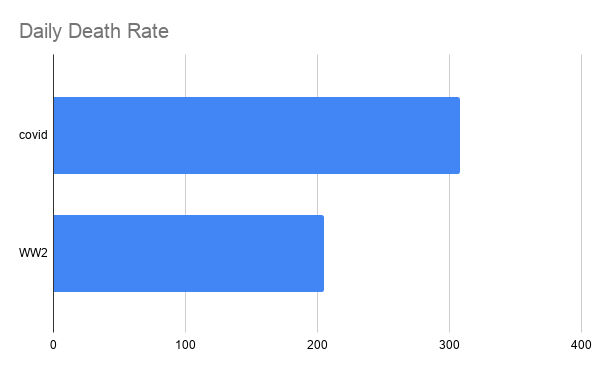
There have been 117,000 deaths since January 31st last year in 380 days; giving a daily death rate of 308.
There were 449,700 total UK casualties in the 2,190 days of World War 2; giving a daily death rate of 205.
The comparison looks like this.
So, in absolute absolute figures the Covid death rate is a third worse than that of WW2
Update 17/2/21
It has been pointed out that, if you take account of the increase in the UK population since the 1940s, the daily death rate per capita of those killed by Covid is about the same as all those killed by the Wehrmacht and Imperial Japanese armed forces between 1939 and 1945. It should not need saying that this is a pretty grim benchmark that no government should congratulate itself for presiding over.
It should also be stressed that British casualties per head of population in WW2 were low by comparison with other countries, just under 1% of the total, compared with 3-4% in China and 13% in the Soviet Union; while and our death rate from COVID is the third worst in the world. (1)
To stop this going on and on and on, we need a zero covid strategy to finish the job.
What a difference a week makes. From March 8th being the earliest possible time to reopen some schools, slowly, slowly, carefully, carefully, it seems to moved through being one of those target dates that become a matter of Ministerial virility to hit, all the way to being a “big bang” day on which all schools open at once. So, eight and a half million students and three quarters of a million educators all going in and out of workplaces every working day with “bubbles” 20 times the size allowed outside, then going home again. Rather a lot of vectors of transmission there. This is like watching a fly trying to get through a window. No matter how many times it bangs its head on the glass, it keeps trying to do the same thing. History repeating itself as tragic farce.
The media – doing their usual job of framing a discussion as though there isn’t one – have gone into overdrive hyping it up in that hopeful way that makes any criticism come across a curmudgeonly, likely to make children unhappy and ruin their lives and – in the case of the Daily Mail – targeting the NEU with a We Reveal Evil Teachers Plotting to Keep Children Safe story; as if demanding safe conditions to teach and learn in were an outrageous abuse by people who don’t know their place. The spirit they would prefer to see being that of the wounded trooper in the 11th Hussars at the end of Tony Richardson’s 1969 film Charge of the Light Brigade, who looks up from the carnage around him as Lord Cardigan rides slowly back up the valley and calls out in a cheery cockney way “Go again Sir?”
The line from the government is that the roll out of the vaccines – a fabulous job by the NHS, thankfully not outsourced to SERCO – will bring the level of infections down to a point that opening up again from March 8th is something they can get away with without overwhelming the Health Service. At the same time they are flying kites with “Great Barrington Declaration” written all over them – arguing that vaccinating the most vulnerable (once) makes it an acceptable risk to go for ” a big wave” of infections among everyone else. Back to “herd immunity”. Here are the problems with this.
If you look at the graph that shows infections in the UK, the pattern is very clear Fig 1.
Fig 1.
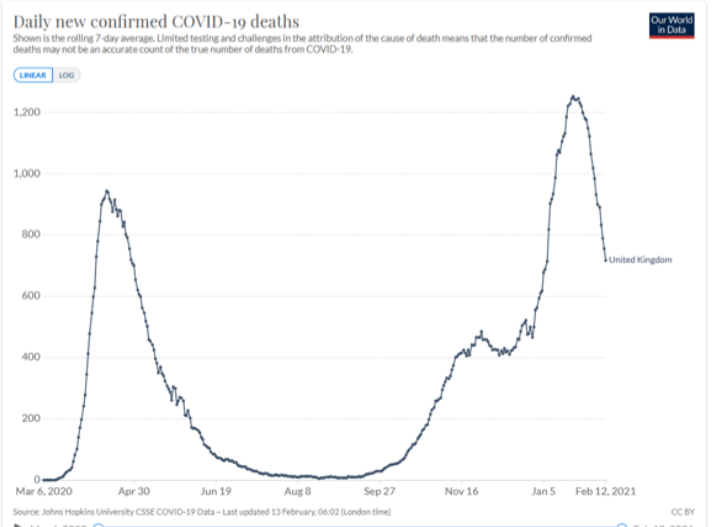
During the first lockdown, schools were closed to all but a very few pupils and we were only dealing with the original variant of the virus, which had not yet evolved so that it could spread more quickly. The peak for infections is quite low when you compare it to where we got to over the winter. The point at which infections began to rise again was as soon as the lockdown was lifted in mid summer. This was initially not very apparent because the numbers were low, and its slow growth helped by schools being shut for the summer holidays (despite “Eat out to help out”). Then we had September. Schools reopening evidently had a significant effect on transmission of the virus. Look at the date. Look at the rising curve. The failure to circuit break when absolute numbers were still low enough, then the half hearted lockdown in November followed by the attempt to open up for Xmas shopping can be tracked exactly on this graph. As can the rapid drop resulting from the current lockdown.
It is possible to argue – so people do it – that the rise in infections is down to an increased level of testing, but this is only true in what might be called a limited and specific way. The pattern of deaths follows the same curves; the slowdowns during lockdowns and the increases when they open up. Fig 2. the minimal downturn in November can partly be attributed to the government’s mulish insistence on keeping schools open. The current, much sharper, downturn is at least partly because schools are currently running with between 20-25% of students in. It would be sharper still if those numbers were down to the 3-10% that was the case in the Spring.
Fig 2
The notion that the sharp fall is attributable to the vaccine roll out is not based on facts. The government and media can be a bit allergic to these if they are inconvenient, but the ONS data on infection by age group shows that the rate of infection has dropped most sharply among the school age cohorts and barely at all among the over 70s; who are the age group that have primarily received their first jab. See the graphs here. https://twitter.com/chrisgiles_/status/1360219174476406788?s=27
So, the contribution of vaccinations to reducing infections has so far been marginal at best. Further, at the current rate of 2.5 million vaccinations a week, it will take until summer to give everyone over 16 one jab – and this will be even slower because everyone who has already had one will have to have their follow up within 12 weeks. So, a wide and rapid reopening on the hope that the vaccines alone will do the job is on a bit of a wing and a prayer.
It should also be stressed that no vaccine is currently liscenced for use on anyone aged under 16. So, children will have no vaccine protection at all. The call from Labour for all teachers to have one jab this week to provide some protection – ignored by the government (who presumably either think that it can be defeated with “British Pluck” or that teachers should be prepared to pay the final sacrifice in an undaunted way) also misses the point that you need TWO jabs to be fully vaccinated. The vaccines also – while offering significant protection against serious illness and death do not in themselves prevent infection and transmission.
Opening schools up wholesale on March 8th – even with all the safety measures that Heads and educators have struggled to put into place – is therefore another attempt at a triumph of the will over scientific reality (of a similar sort to the way they are trying to bluff their way through on climate breakdown) and will have comparable effects. It is likely to become the beginning of a super spreader event across the whole of society.
This continual in and out, stop and start has given the virus time to evolve. As it has evolved the variants that are more infectious are the ones that will survive best. Some of these, like the South African variant, have also become more deadly and resistant to the vaccines. It stands to reason that as the mass vaccinations are carried through, the only variants that survive will be those that resist them.
The decisive question therefore is why, given that this is common knowledge, the government does not adopt a strategy to eliminate the virus – as advocated by the Zero Covid coalition. Using the vaccines as an aid, but not relying solely on them. A key demand is that raised by the education unions throughout – for full disclosure of the scientific advice from SAGE.
Reading the comments made by the 50 strong Tory backbench – and profoundly misnamed – “Covid Recovery Group”, that although wholesale reopening of schools will make it impossible to keep the R rate below 1 that this is “worth it” – it is possible to conclude that this is just bluff and ignorance. The calls for “the scientists” to be taken out of political decision making – so that MPs like them don’t have to be troubled by awkward facts when they have to strike a posture – echoing the long muscular sporty traditions of the Public Schools so many of them went to, with their deep suspicion of intellectuals (dubiously continental and probably effete) and the boys comics they read when they were growing up – full of evil villains with big, sneaky brains and weedy little bodies. This – however – is simply a matter of style. These are not stupid people. But they are remarkably unconcerned about deaths among the sorts of people most likely to die – ethnic minorities, front line workers, the unproductive elderly, those with “underlying conditions” making them not fully work fit, and the worst off in general, who have made the “poor lifestyle choice” of living in overcrowded accommodation – if their lives are an obstacle to letting the economy rip and profits made. “Herd immunity to protect the economy and if that means some pensioners die, too bad” as Dominic Cummings put it. Daily Telegraph business editor Jeremy Warner put it like this last March. “Not to put too fine a point on it, from an entirely disinterested economic perspective, the COVID-19 might be mildly beneficial in the long term by disproportionately culling (sic) elderly dependents”.
The skinny goblin Santa still suspended from his rope off that house in Kingsbury Road is looking increasingly like a hostage waiting in vain for a rescue from being trapped out of season.
One of my neighbours down the hill comes out of her house negotiating a shopping list over her shoulder with an elderly relative, gets to her car and calls to the toddlers strapped in the back seat- in a voice half way between forced jollity and grim determination – “Right. Who wants to go to ASDA?” – as though the tone would make it sound like Disneyland. From the back seats…silence.
Sadly, one of my downstairs neighbours – Mum, Dad, daughter, are moving. All COVID related. The landlords – who are getting on – have left for Ireland to quarantine in a quieter, sparser, greener place and are selling it out from under them. At the end of the first furlough period, both the Mum and the Dad downstairs were made redundant from their managerial roles in a hotel. Luckily, the Dad has found a job deputy managing a store – a rather posh one in Chelsea – and says he is the one member of the management team that hasn’t contracted the virus even though the streets are like a ghost town. This makes both him and his boss very nervous. Unfortunately the Mum has not and has had to claim Universal Credit. That makes them unacceptably precarious renters for far too many landlords; unwilling to accept tenants on benefit or solely dependent on one job in an uncertain environment. They have nevertheless found an unexpectedly affordable flat in Fitzrovia, near Regents Park, as the expected rent has dropped by 40% since last year – a sign of how much the centre of the city is hollowing out. This is part of the zone in the West End that is dead at the best of times, as so many houses and flats are owned as investments by absentee, often oversea, landlords and often not even rented out; so there are empty, lifeless streets lined with dark flats, and the occasional pedestrian scuttling nervously through the shadows.
All through the night, the foxes scream in the snow.
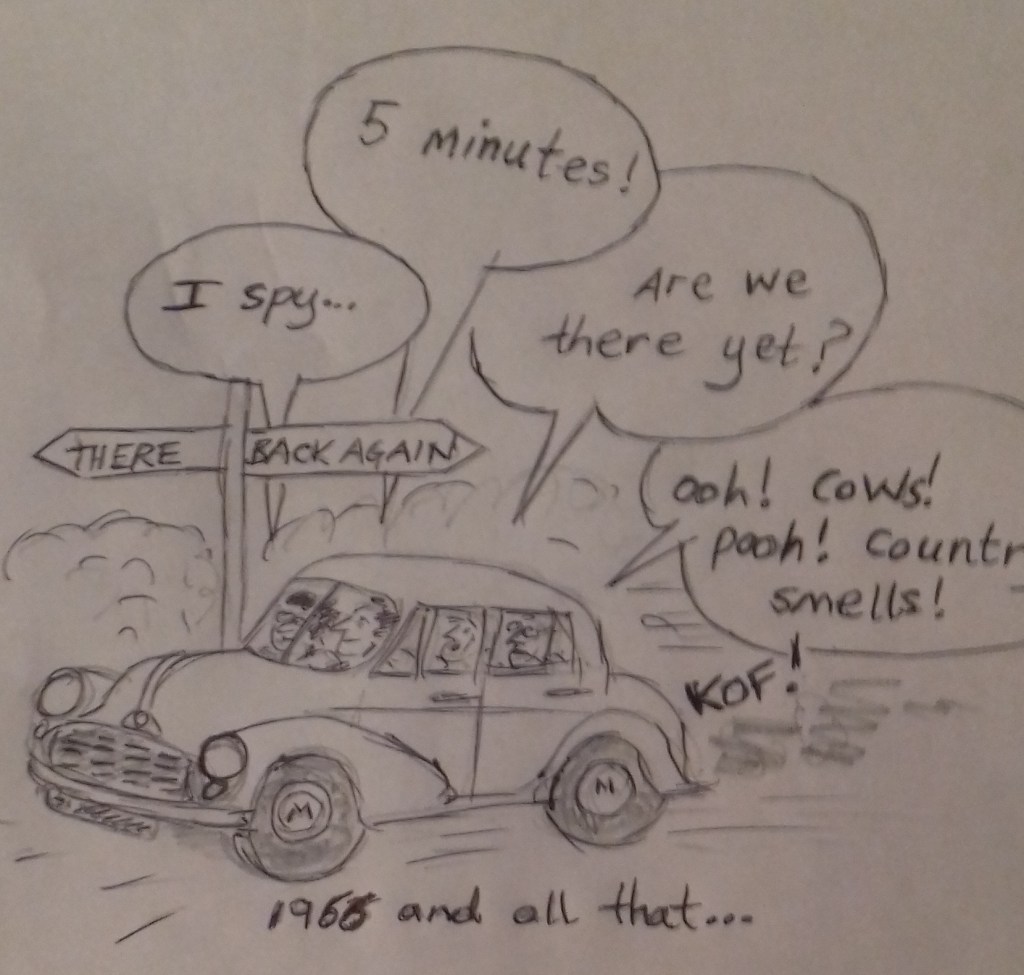
The first car my family had in the mid 1960s was a split windscreen Morris Minor. Now rare and venerable antiquities, whose owners salute each other as they cough slowly by, they were common as muck at the time. The first British manufactured car ever to sell a million vehicles, the millionth unit (or as near as they could estimate) was painted a fetching shade of lilac.
Nothing so spring like for us: ours was in a shade of grim battleship grey; possibly surplus Royal Navy issue left over from HMS Vanguard. Instead of tail lights, its indicators were little illuminated flags that popped out between the front and back seat windows like a cyclist indicating with an arm but a lot harder to see. With a lot of people at the time thinking that driving drunk was a human right, its a wonder any of us are still here.
“Right, you go down this brown road…”
It had a 1930s model 930cc engine which gave off a determined throaty purr* – although it was only about four and a bit times stronger than a motorised lawn mower – and, when fully laden with my Dad, Mum, me, my brother and as as much luggage as could be got in the boot, had to be willed up hills during our Summer expeditions to “the country”. We would all lean forward and mentally push. It was as small as most first generation affordable family cars, like the Baby Austin, Ford Popular, or the 2CV or Fiat 500 on the continent**; and my dad, who was 6 foot one at the time, had to fold himself up like a concertina to get into the front seat.
We called it “Ada”.
After several years of hard service, it started wheezing and chugging beyond the point that constant tinkering by my dad and uncle could patch up; and so was sold for scrap. My dad said that on the way to the scrapyard it ran like a dream. “It was as if it knew“. And he walked away and got the bus feeling “like a traitor”.
I feel much the same way about our fridge. We have had it since we moved in 25 years ago. It does not work as well as it did. On Monday we have a newer, more ecologically efficient, version arriving and old faithful is being consigned to scrap. Its odd to anthropomorphise a piece of white goods, but somehow impossible not to. Every time I look at it, I feel guilty, like I am letting it down after a quarter of a century of service, without even a gold watch.
One of the books I used to use to teach children to read was called “Chug the Tractor” – PM Books, Reading Recovery Level 10 – which in many ways was dealing with intimations of mortality for six year olds. The battered old tractor can’t make it up the hill. The big, shiny, new model arrives with the comforting words “You are too old. You are going to the dump!” Brutal stuff. So, the farmer puts the old tractor on the back of his truck and takes it to the dump…then drives on past to a Park in town – a kind of vision of heaven, or an afterlife – or possibly retirement – and Chug becomes a “Play Tractor” for the local kids. I’m not sure about the risk assessment on that one, but the subliminal message for kids to relate to “olds” is mutually beneficial I feel.
This feature of older technology having its power more overtly expressed is even more the case with trains. I saw the Flying Scotsman pulling out of York station once; and while electric trains hum and glide – and diesel trains fart and smut – the steamer was like a barely restrained dragon, deafening explosions of force slowly gathering rhythm vibrating under our feet, chuffing out huge gouts of steam from every orifice, invading our nostrils, making our clothes smell of cinders and scalded water. Just a glimpse of it was an adventure, a wonder at forces barely tamed.
** The notable exception to this was the VW Beetle. Conceived in the 1930s as a mass vehicle for the master race of a Thousand Year Reich – it had a bit more internal liebensraum. An unease with this association – not helped either by the term Volk, nor the false rumour that Hitler had designed it (when it was actually Ferdinand Porsche working up an original idea from Josef Ganz, a Jewish designer arrested by the Gestapo) – made the Beetle and anyone driving it a bit suspect at least until the release of the Disney Film “The Love Bug” in 1968 – which completely rewrote its character and associations as Hippy and quirky. The name “Herbie” a clue as to what its writers may have been smoking when they made a talking VW Beetle the main supporting character.
In the park the rapidly receding snow unveils an emerging sea of green; a microcosm of the receding arctic punctuated with the lumpish remains of snowmen; like icebergs, or standing stones to a vanished god, ghosts of lost faiths and colder climes. A parakeet at the top of an oak tree screeches its bewilderment at where it is and how it got here.
It has to be said that the quality of snowmen round here took a qualitative upturn around about 2005, when so many people arrived from Eastern Europe. Up until then, snowmen had been a bit perfunctory and amateurish, people unused to significant snow going out and making a gesture, then rushing home before they got chilblains. I recall going down to the park with the kids and rolling together an attenuated skinny looking thing with stick arms about three feet high, and looking across at cheerful groups of young Polish people erecting competing versions of the colossi of Kingsbury with construction tools, all of which had the girth of Henry VIII and towered above them. One guy was jumping up and down trying to get high enough to plant a hat on its enormous round head. Of course, since Autumn 2019, what with Brexit and COVID, 1.3 million overseas born workers have left the country, over half of them from London, leaving the bigger, better snowmen as a momento.
The skinny Santa climbing the walls on the last house on Kingsbury Road still festooned with Xmas decorations now looks like a suspended hostage.
Walking up the hill in startling late January sunlight, a half moon looms low and large, dusty seas clearly visible, as a more eloquent warning of what a dead planet looks like than all the articles I’ve been reading this morning. Sometimes we need to cast our eyes up.
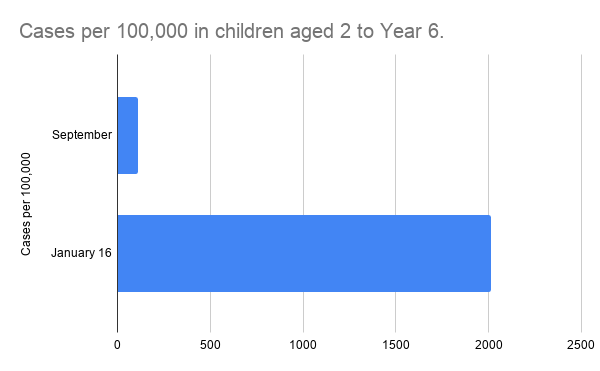
Recent figures show why the pressure from Tory connected lobby groups to reopen schools for wholesale face to face learning – and that primary school children do not get infected or spread the virus – are just plain wrong. (1)
This shows how rapidly cases have spread among the children considered most “safe”.
And this shows why.
Ten times as many going in to school now as in the Spring with a virus that is 30-40% more infectious. Do the sums!
Pressure is on from the deeply misnamed “Covid Recovery Group” of Tory MPs and the “Us for Them” lobby – which argues that “natural immunity” should be allowed to build up, presumably by letting everyone get the illness and allowing God to choose his own – for Primary schools especially to be reopened well before it is safe to do so. Because, if you’re argument is that lockdowns are an obstacle to the most rapid spread of herd immunity via survival of the fittest, all this namby-pamby concern with health and wellbeing is simply evidence of the decline in our moral fibre.
Which of these parent groups do you think the DFE listens to?
“Us for Them” has had far more access to Ministers than the far larger and more representative “Parents United Against Unsafe Schools”, getting a response from Gavin Williamson to their petition against mask wearing in schools – which had just 16,588 names on it – while he ignored one from PUAUS against fining parents keeping their children off school for safety concerns – which had 288,294. They have also met DFE officials twice in advance of key decisions, while PUAUS have not been met at all, despite regular requests. (2)
And which petition do you think they responded to?
As both UsForThem and the Covid Recovery Group are being advised by failed Conservative candidate for derby South, former Boris Johnson leadership campaigner and Westminster PR man Ed Barker; this looks like a case of “its who you know, not what you know- let alone how much support you have.”
Premature reopening will make control of the virus impossible – and therefore allow the potential evolution of more infectious or lethal variants – meaning that either we have a far higher number of deaths or that we are continually going in and out of lockdowns, with no recovery in either the economy of learning. We need a zero covid strategy.





 Urban ramblings