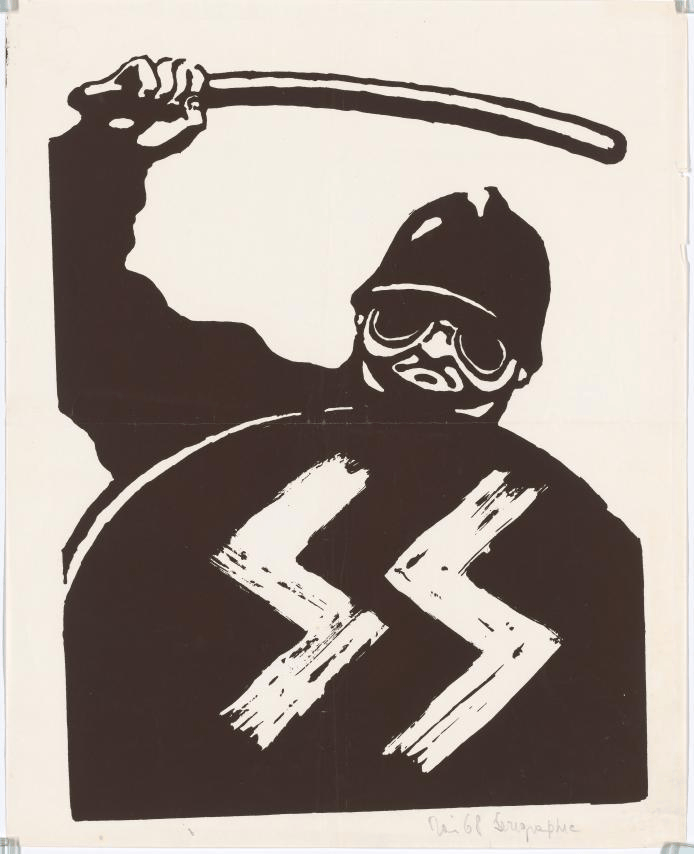
Plus ca change, le plus c’est le meme chose. Poster from the Ateliers Populaires from Mai 68 in France accusing the CRS (riot police) of being fascist. According to opinion polls 75% of French police vote for the Rassemblement Nationale (Marine Le Pen’s Party) and even more of the CRS do. Their brutality in 1968 was evident. As it is now.
The Czech writer Milan Kundera once remarked, after living in France for a few years in the 1980s, that he liked it because nothing significant ever happened there. May you live in uninteresting places. Which I suppose shows how wrong you can be.
In my fifth, and probably final, attempt to learn French, I just spent a month in a 30 day French challenge on Geraldine Lepere’s site, learning through the history of French songs of the last 100 years. Highly recommended course btw.
The one version of La Marseillaise that came up was Serge Gainsborough’s reggae spoof version from the 80s, aux armes etcetera! that had a lot of Right Wingers aux armes – with former paratroopers turning up to smash up one of his concerts in 1980 which he neatly subverted by asking them to sing it straight while he spoke the lyrics in English, underlining its character as a revolutionary song.
Contre nous de la Tyrannie L’étendard sanglant est levé ! Against us tyranny’s bloody flag is raised.
How unlike the home lyrics of our own dear national anthem. That piece of Hanoverian stodge, a tugged forelock in dirge form, still containing, tucked away in its final verse, a celebration of raising just such a bloody flag.
May he sedition hush,
And like a torrent rush,
Rebellious Scots to crush.
God save the King!
Not a popular verse North of the Border of course, but, the British ruling class, like all people whose lives are lived in a nostalgia for past glories, have never been willing to actually chuck it out. You never know when it might come in handy after all.
The revolutionary quality of La Marseillaise allows it to have been merged by members of La Parti de Gauche, the core group of La France Insommise, with L’Internationale into one song, L’Intermarseillaise.
Its hard to watch the school students scratch orchestra playing La Marseillaise outside L’Hotel de Ville in Paris last week, closely followed by L’Internationale, without getting a lump in your throat, because its sounds and looks like a generation that has been denied hope seizing some for itself in a collective festival of the oppressed.
And L’Internationale itself is a French song. Born of the Paris Commune.
And with lyrics that lose quite a bit in translation.
Dans la lutte finale, gruppons nous et demain, L’internationale sera le genre humaine is usually rendered in English as then comrades come rally and the last fight let us face, the internationale unites the human race which doesn’t quite get it. Sera means will be, which is a lot more transformative than unites; which implies everyone just stands together, rather than is transformed into something transcendent by the struggle to do so.
Final song. Possibly the most terrifying song, scarily sung, is Edith Piaf’s version of the ca ira. Another popular song from the first wave of the Revolution of the 1790s, its lyrics are pretty direct. It was sung by the massed columns of the levee en masse as they smashed through the brittle ranks of the European Ancien Regime armies sent in to crush them.
Ah! Ça ira! Ça ira! Ça ira! Les aristocrates à la lanterne ! Ah! Its ok its ok its ok! Aristocrats to the lamp posts!
When she gets to the end of this, Piaf is a long way from La vie en rose. As is France now.

