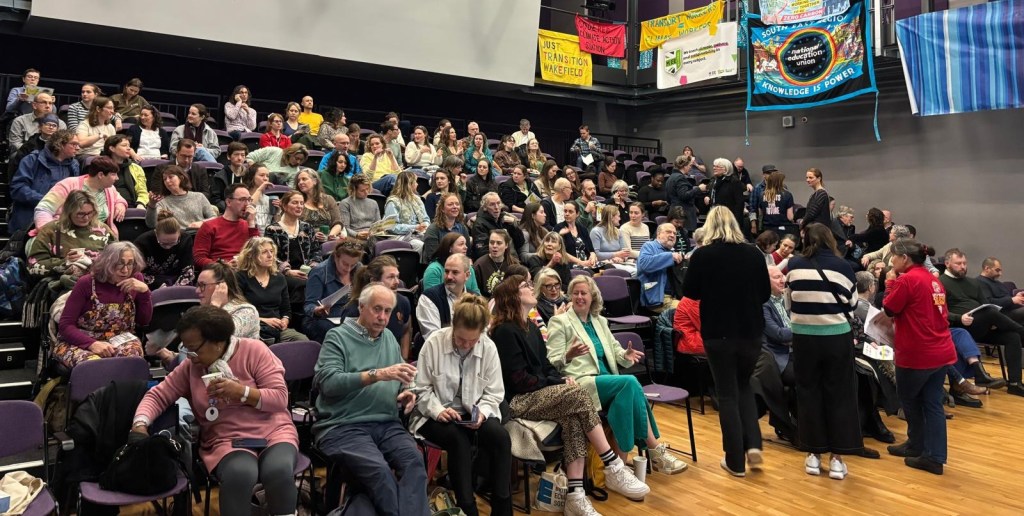
Photo: Suzanne Jeffery
This is the text of my talk at the Climate and Nature Education Festival on 14th March.
- It is obviously in the interests of humanity as a whole to act together to limit the damage done by GHG emissions.
- But this isn’t happening – fast enough – because the society/economy/polity/education system we have globally isn’t based on the interests of humanity as a whole and the interests of nations not on the interests of the nation as a whole. When Donald Trump says “America will make a lot of money” on the back of the current oil price strike arising from his attack on Iran, he means the US oil companies that will rake it in from inflated prices, not the people paying through the nose for increased petrol prices at the pumps. On a more parochial level, we hear a lot about “the national interest” and it’s important to be clear that this is not the interests of the people who live in the country, but that of the people who OWN it; which is not only not the same thing but often – usually – contradicts it.
- An anecdote. My Dad worked for Proctor and Gamble at the West Thurrock factory for most of his life. When he was about 40 he and several other shop floor “mature work oriented individuals”, as the company put it, were put on a course to make them more valuable and motivated human capital for the company. As part of this they were asked “What do you think the company is for?” Thinking about what they did all day, and being use value oriented, as working class people tend to be, they said “to make soap powder”. “That’s where you’re wrong” they said “The purpose of the company is to make money (Exchange Value in Marxist terms) If we could make more money doing something else, we’d do it”. That’s probably why P&G manufactured both Sunny Delight and Napisan (and in blind taste tests…)
- And that’s the crunch. When it comes to many aspects of the green transition that we need, it cuts across profitability. Take insulation. If done properly that cuts demand, costs and CO2 emissions. Win, win, win for us. But lose, lose, lose for the companies that make money off selling the fuel. The same goes for efficiency standards. It’s why Trump is relaxing them.
- And on the level of profitability, for Oil and Gas companies that were flirting with renewable divisions a few years ago (Beyond Petroleum and all that) Fossil Fuel investment has a rate of return between 4 and 5 times greater than investment in renewables. It may be going to kill us to keep doing it, but the bottom line is the bottom line. This is judged in quarterly returns…and in the long term, as Keynes so rightly said, we’re all dead. And that doesn’t just motivate the direct FF companies, but also the banks that lend to them. A CEO of one of the big US banks that pulled out of Mark Carney’s attempt to set up a global financial alliance for transition investment said they were doing so because putting any consideration other than maximum returns for shareholders is “immoral”. This was also expressively put by Sam Altman, CEO of Open AI who said “I think AI will probably, most likely, sort of lead to the end of the world. But in the meantime, there will be great companies created with serious machine learning.” So, that’s alright then…
- So, the transition won’t simply not be led by these people, they have been, are and will resist it. And this is not simply at the level of companies and civil society, but state capture. The Trump administration in the US is the acme of this. I’d argue that Trump is not an aberration but an expression of Tech Bro Fossil Fuel dominance in the world’s leading imperialist and petro state in an attempt to reassert its slipping global dominance by bullying other countries into buying their oil and LNG and throwing its immense military weight around ($1.5 Trillion war budget coming next year, so the manic pace that we’ve already seen this year is just an overture) before the 60% of the world that has already passed peak FF use really consolidate that with a flood of cheap Chinese solar panels and get out from under.
- A central aspect of this is a war on scientific truth on climate and environmental protection that defunds and deplatforms both study and teaching – presumably on the philosophy that what you don’t know can’t hurt you. And the promotion of abject subaltern political formations that will do likewise across the world, like Reform here. And not just Reform. “The model” for Kemi Badenoch (and this is a quote) “is Javier Millei”. We can guarantee that a Reform/Tory government will mean a direct assault on any attempt to address climate change in schools.
- I’d also argue it is no accident that the core of industrial/energy transition globally is China – where, even though they have a very powerful private sector – in the final analysis, the economic plan is determined by the state (and 50% of wind/solar installations are done by state owned enterprises).
I’ll end with some thoughts from Antonio Gramsci, who argued that any education system exists to replicate the social order that it serves. And that’s not just a matter of educating for necessary technical skills, but also attitudes, morals, aspiration and narrative frameworks that sustain that society as it is. Our problem is that the society/economy/polity that we have is unsustainable and that sets up a tension and contradictions that we have to fight our way through. The need to anticipate and prepare not simply for “the jobs of the future” but prepare future citizens for a social and economic order that we don’t have yet runs slap up against all the inertia and commanding heights of an education system designed to sustain the order that we have. In that context we have to use whatever levers and footholds we have within the system – embodied in eg the DFE NZ strategy like sustainability leads, climate action plans, national education nature park etc to prise these contradictions apart and push them further – for whole school curricular and campus transformation initiatives and pushing through the ambiguities of the DFE’s “Impartiality Guidance” – on the basis that recognising the reality of climate change is – as the guidance states – true; so Parties that deny it are not basing their politics on reality…and should be treated as such. A clear consensus for the education unions on this point – that climate change is not “above politics” but foundational to any relevant politics is essential – if we want to safeguard our students from Fossil Fuel glove puppets and charlatans.
 Urban ramblings