Ukraine, Ecocide and Complicity – or, why the climate movement should not allow itself to become a fig leaf for NATO.

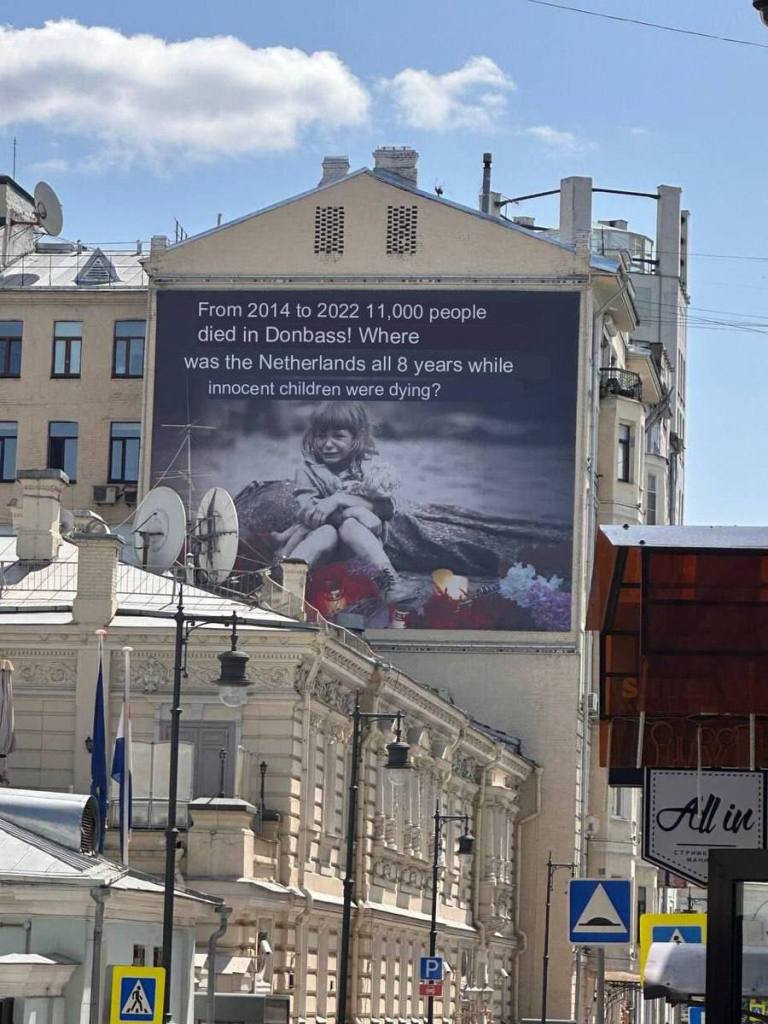
This poster is displayed on the side of the Dutch Embassy in Moscow and shows the number of people killed in the Donbass between 2014 and 2022. If you walk down the Arbat in the same city you will see hundreds of poster sized billboards memorialising the children killed by Ukrainian shelling into the Donbass in that time. If you go to Donetsk City, you will see a memorial garden for these children. That shelling continues daily even now.

Framing an argument to bury the truth

There is a manipulative form of polemic that starts with a particular image, or emotive incident, that is guaranteed to mobilise an empathetic emotional response from a viewer or reader. If you watch BBC News reports on Ukraine, and think about what they are doing as well as what they are saying (and not saying) you will see this in an almost perfect form. Everything is geared to eliciting an emotional, sympathetic response on the calculation that – because emotion always trumps reason – this will then blot out questions about why these events are taking place; because it will be taken for granted who is to blame.

You might argue that that’s what I’ve done here, but images like that above will never appear on the BBC, or in the Guardian, because its the wrong sort of emotional response. The wrong dead children. The wrong sympathy. None of these kids will have Fergal Keane deployed, with sad backing music and beautifully filmed mordant images of grieving parents, your heart strings will not be expertly plucked to resonate with theirs. But they are just as dead. And the imposition of an ideological no fly zone, through the current banning of RT and policing of social media, means that you are very unlikely to see them anywhere else either. But they are just as real. So, this is just a small challenging counter image to stick onto the gigantic montage of images that have created the one sided picture that you’ve been exposed to already.

And if the deaths of those poor people in the pizza restaurant in Kramatorsk this week is to be taken as justification and fuel for sacrificing even more people to pursue this war with an enhanced sense of moral indignation; is that not equally true for the people in Donetsk?

Because in narrative framing, anything that is out of sight is out of mind. In the case of wars, some people’s deaths are framed as their just deserts because they have the misfortune to belong to a people or state targeted by ours. As the infamous Sun headline crowing over Croatia’s ethnic cleansing of the Krajina in the Yugoslav wars put it, “Serbs you right”.

The Climate Movement and truth

There is now a move to align the climate movement in the Global North/West with the war aims of NATO. A press conference in Kyiv at the end of June, with President Zelensky, Mary Robinson and Greta Thunberg, announced a European body to evaluate “the environmental damage resulting from the war, formulating mechanisms to hold Russia accountable and undertaking efforts to restore Ukraine’s ecology”.

A Commission to examine the ecological damage done by the war as such is, however, not what this Commission is. Such a Commission would have to recognise that the way to stop the ecological damage is to end the war. NATO does not, yet, want to do that, so this Commission is structured to attribute all the blame to one side. Participants in this Commission from the climate movement, whatever their intentions, will find themselves providing a moral fuel to continue the war with single minded righteousness: thereby providing a thin green fig leaf for the most destructive militaries in the world. These are now rapidly expanding and increasing their carbon boot print to an unprecedented degree; and intend to use it. This Commission’s effect will be to prolong the war; thereby generating ever greater ecological damage and human loss.

A frame that aims to “hold Russia”… and only Russia…“accountable” means that ecological damage committed by Ukraine or NATO are either outside their purview, or considered not to exist.

Shells and missiles fired by the Ukrainian armed forces are no more ecologically benign than those fired by the Russians. In the case of the depleted uranium shells supplied for British Conqueror tanks, they can be worse. Ignoring this requires a level of cognitive dissonance that can only be sustained by an act of intense will; or generated by a red mist of moral indignation – generated by the the narrative framing above – sufficient to enable people to look straight at it, and not see it.

Anyone arguing that any ecological damage is ultimately the Russians’ fault “because they invaded” should not forget that this war started in 2014; when the Ukrainian Air Force bombed Donetsk city, opting for a military solution to a political crisis. Does anyone doubt that this would have led the Kyiv government being universally denounced in the West as a regime that “bombs its own people” had they been US opponents?

If you think that the road to peace runs through a Ukrainian victory, have another look at the picture of that girl in the ruins in Donetsk, and the picture of the Crimean Theatre students below, and reflect on the fact that the full realisation of Ukrainian/NATO war aims will involve the ethnic cleansing of their whole region; and that Kyiv has been completely explicit about that.

Theatre students in Simferopol Crimea wearing orange and black ribbons and singing songs on Victory Day May 6th 2023. Photo Dan Kovalic. For a view of how Crimea broke from Ukraine in 2014 and what it is like now see Dan’s article with Rick Sterling here.

President Zelensky was quite blunt that this Commission will be “support for Ukraine”, in the context in of him rejecting any prospect of a ceasefire and frozen conflict and promising to continue the war regardless of the cost. That cost will be measured in escalating environmental damage and human lives and the devastation of his country. The remark of the US officer in Vietnam who remarked that “in order to save the village, it was necessary to destroy it” haunts his speeches.

Collusion in confusion

Participation in a Commission on partisan lines will by definition require collusion with an a priori propagandist interpretation of any event. Four extreme examples of this that pass for conventional wisdom in the West so far.

  • The oft repeated narrative that the Russians were shelling the Zaporozhe nuclear power plant, when it was occupied by their own troops. Even after the Ukrainians admitted they were doing it, the media here still tried to muddy the waters. Ukraine being not only willing to shell a nuclear power station but having actually done it is not something they want us to dwell on. Especially now. The statement from President Zelensky at that press conference with Thunberg and Robinson alleging a Russian plan to blow up the Zaporozhe power station in the coming weeks is particularly alarming in this context; because it might be a cover to resume the shelling – with the blame preemptively allocated -as a pivot for global outrage and mobilisation, as argued by Dmitriy Kovalevich here.*
  • The bizarre accusation that the Russians blew up their own Nordstream gas pipelines releasing up to 350,000 tonnes of methane, doing an enormous amount of environmental damage. It has been a US aim to cut Europe off from Russian gas supplies for over a decade; well before the war. Blocking the certification of Nordstream 2 in February 2022 was a big victory for them. But only a provisional one, because the Russians remained in control of the pipelines and any peace settlement would see them turned back on. Blowing them up rules that out and stops the Russians having that option. It takes peculiar mental gymnastics to imagine that the Russians would destroy their own infrastructure to hand a geopolitical advantage to the United States. Articles by Seymour Hersch detailing US involvement have been largely suppressed in the media here.
  • The case of the ammonia pipeline blown up in Kharkiv is similar, in that the flow of ammonia from Russia to the West had been shut down by the Russians weeks previously as a tit for tat for the West not fulfilling its obligations under the Russia- Ukraine grain/fertilizer deal; so blowing it up would only make sense for a force trying to cut all potential trade between Russia and the West.
  • Claims from the UK Ministry of Defence that the depleted uranium shells they have supplied with their Conqueror tanks are really nothing to worry about, repeated in the media with a straight face. The use of these munitions in Iraq has had horrific impacts. For example The Falluja Hospital’s birth defects Facebook page, where medical staff catalogue cases, reveals the striking diversity and quantity of congenital anomalies. Babies in Falluja are born with hydrocephaly, cleft palates, tumors, elongated heads, overgrown limbs, short limbs and malformed ears, noses and spines. The use of these shells will poison wherever they are used in Ukraine for years after the guns fall silent, while the British politicians who supplied them have roads named after them in Kyiv.

A further example and exemplar of the approach that we are likely to see more of in the framework of this Commission is a recent article on Open Democracy Khakhovska dam destruction is part of the climate emergency. This makes the valid point that the dam’s collapse is environmentally disastrous, but then rests the gigantic accusation of “ecocide” on a conditional presumption, that the destruction of the dam is likely to have been the work of Russian forces”. “Likely”. Not definitely. Not even probably.

“Likely”. So, how likely? If your brief is that all ecocide is carried out by the Russians, it becomes necessary not even to ask this question; allowing carte blanche to the Ukrainian/NATO side to do their worst and just attribute the consequences to the other side. “Likely” is a small word, easily passed on from when reading at speed, but it is an admission that everything that follows by way of emotional mobilisation could very well be applied against the cause the author supports if readers allow themselves to think and question a bit.

Because its a matter of public record that the Ukrainian armed forces have been shelling and firing HIMARS missiles at this dam for months.

Their military and political leaders hastened to delete posts bragging about doing so as soon as it was breached, but many of them have been recorded and are in the public domain.

Taking a step back, there are three possibilities for how this dam was destroyed. Longer analyses of this can be read here and here, but in a brief summary these are the theories.

  1. The Russians blew up the dam to enable them to withdraw troops from the riverside to redeploy them against the main expected thrust of the Ukrainian army offensive further east; even though this would deplete water supplies to the Crimea. Resecuring this supply after Ukraine cut it off has been one of their main military objectives, and remains one. So, it would be an oddly self destructive to imperil it. It has also been reported, from Ukrainian sources, that Russian troops dug in on the east bank of the Dnieper were taken by surprise by the inundation; which would not be likely if their command were responsible for blowing the dam. More to the point, the Russians were in control of the dam. All they had to do to create a flood would be to open the sluice gates. No need to blow it up, so, why do so?
  2. The Ukrainians blew it up to wash away Russian minefields and defensive positions on the lower lying eastern bank of the river. Their earlier attempts to do so, to cut off the Russian forces on the West Bank before their withdrawal last Autumn, are well publicised. So, whatever the case in this instance, it was something they were prepared to do, it was well within their moral compass, with all the consequences that flow from that. They also appear to have been releasing water from dams higher up the Dnieper in order to keep the flood going; which is odd behaviour by anyone trying to minimise damage.
  3. The dam had been so weakened by the long term effects of the shelling and missile attacks on it that a build up of pressure from a greater volume of water building up behind it in the run up to the breach was too much for it; and both the Russians and Ukrainians have had to improvise a response.

Its hard to see the first option as anything other than the least “likely”, but judge it for yourself.

The media narrative in the UK, however, is not characterised by rational analysis or balanced judgement. The sort of spluttering rage you get from Simon Tisdall in the Observer is more characteristic;. “Of course the Russians did it…Only this malevolent Kremlin regime would wilfully inflict human and environmental havoc on so vast a scale…That’s what they do, these mobsters.” The sound of a man shouting down his own doubts because, as he admits “It’s impossible to prove at this point.” Obviously also a man with no memory of the 4.5 million people killed by the “War on Terror”, nor the far greater environmental destruction in Iraq inflicted by us and our US allies nor, more recently Yemen, thanks partly to the expert training provided by the RAF and RN to their Saudi counterparts; not to mention the after sales service provided by BAE systems making sure that their missiles were accurately targeted.

That’s why the argument on Open Democracy that “it is not enough to just lobby against fossil fuel extraction; we must recognise that the end of Russian imperialism is key to the struggle for climate justice” is so disoriented. It lets the the US and its allies, the world’s dominant imperialism, with the biggest military carbon boot print, completely off the hook to such a degree that it lines up behind its war aims. Anyone who thinks that the route away from the environmental damage caused by this war is via a Ukrainian/NATO victory has lost touch with reality; both in the concrete practical terms of the enormous human and environmental damage that would be required to secure one, and the horrendous consequences for the world of a triumphant retooled US alliance seeking to partition the Russian Federation, take charge of its fossil fuel reserves, really get stuck into oil and gas extraction in the Arctic, and get ready for the war in the South China Sea they’ve been pushing for; with Taiwan as the same sort of sacrificial victim that Ukraine has been.

Taking this stance would also sever links with movements and governments in the Global South; where people who have been on the receiving end of the US imperial system for decades see through its pretensions and fear its ambitions. It would be a disastrous course for the climate movement in the Global North to take. This is particularly in the context of governments like the UK cutting its commitment to global climate finance citing, among other things, “the costs of including help for Ukraine being included in the aid budget.”

Instead of becoming partisans of either side in this war, or any other, whatever our individual views, the climate movement here should stand for an end to the war, oppose militarisation, and campaign to get the global military boot print fully included in the Paris process, with a target to measure, monitor and cut it as fast as possible.

Post script. * The International Atomic Energy Agency has now confirmed that there are no Russian explosives set on the power station.

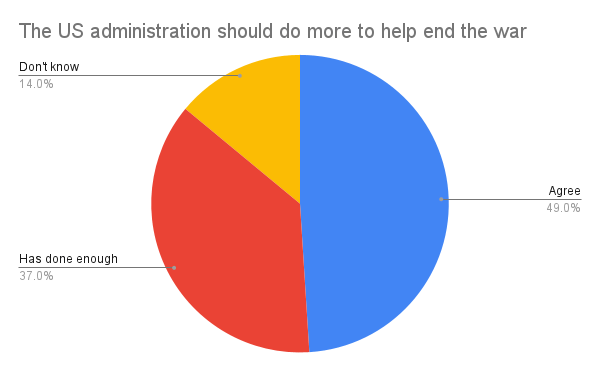
How Americans see the War in Ukraine

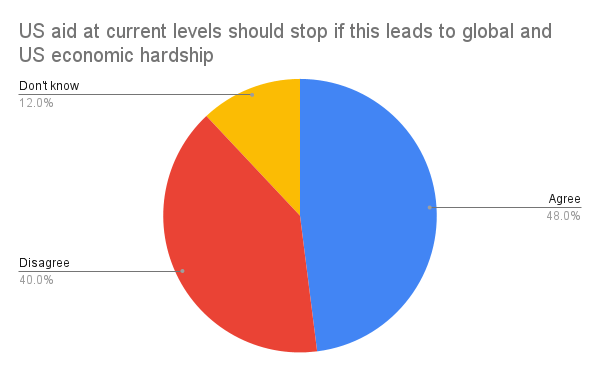
Following on from the information that 77% of Germans support the West initiating peace negotiations in Ukraine, a survey published by the Quincy Institute for Responsible Statecraft and Data for Progress shows that 57% of likely American voters support the US pursuing diplomatic negotiations as soon as possible to end the war, even if it requires Ukraine making compromises with Russia. 

More people think that the Biden Administration should do more to initiate peace talks than think it has done enough.

More people think that continuing US military aid – amounting to $53 Billion so far with another $12 Billion under discussion – should be not continue unless there is ongoing diplomacy to end the war than those who think it should be unconditional.

There is a similar level of opposition to continuing support at current levels if this leads to long term global and US economic hardship.

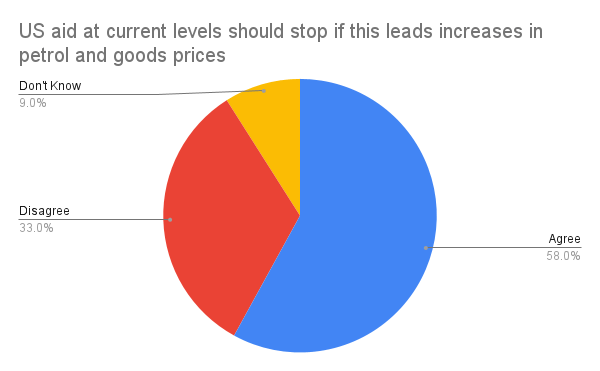
This is made even stronger when specific examples of domestic hardship are identified, with a strong majority opposing continued support at current levels if it leads to increases in gas (petrol) and good prices in the US.

Trita Parsi, executive vice president at the Quincy Institute, put it rather well, “Americans recognize what many in Washington don’t: Russia’s war in Ukraine is more likely to end at the negotiating table than on the battlefield. And there is a brewing skepticism of Washington’s approach to this war, which has been heavy on tough talk and military aid, but light on diplomatic strategy and engagement.

‘As long as it takes’ isn’t a strategy, it’s a recipe for years of disastrous and destructive war — conflict that will likely bring us no closer to the goal of securing a prosperous, independent Ukraine. US leaders need to show their work: explain to the American people how you plan to use your considerable diplomatic leverage to bring this war to an end.” 

It should also be noted that only 6% considered that the war in Ukraine is a top 3 issue for the US, with 94% disagreeing.

How Germans see the war in Ukraine

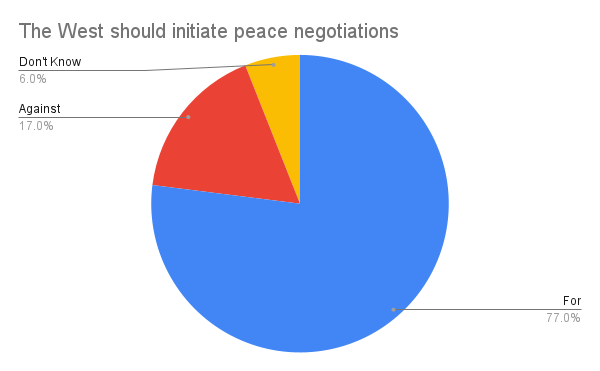
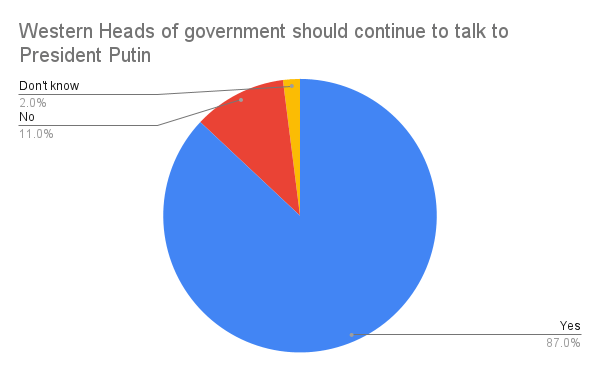
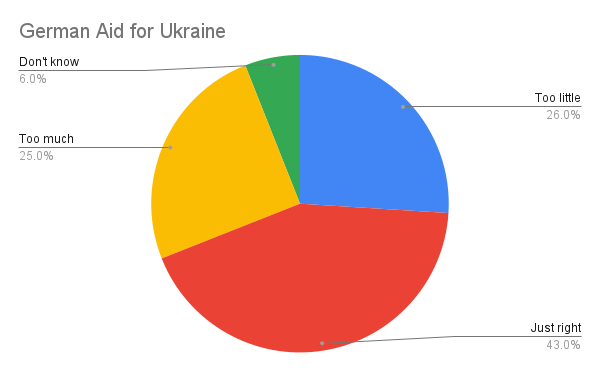
In a survey conducted recently by opinion research institute Forsa for the RTL / ntv “Trend barometer” there are very strong majorities for “the West” to initiate peace negotiations (Graph 1) for “Western leaders” to keep talking to Russian President Putin (Graph 2).

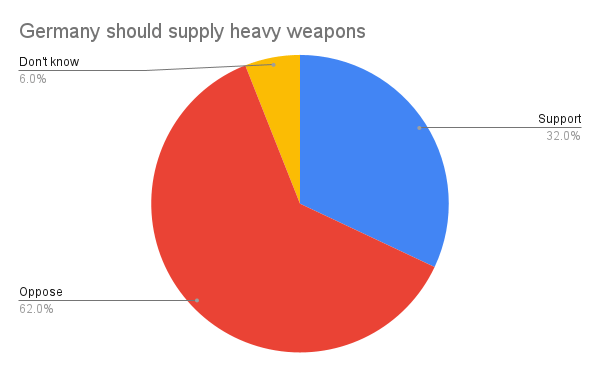
While there is majority support for supporting Ukraine at least at the current level about a quarter of people think that it is too much, balancing similar numbers who think it too little (graph 3) but there is equally strong opposition to specific escalation (graph 4).

Opinion in the UK – with less dependence on Russian gas and a bigger role for the military in its national psyche – is more bellicose, but the strong sentiment for the sort of peace negotiations that China and India have called for in the key state in the EU indicates that its government will face increasing difficulties in maintaining a pro war stance as the winter crisis unravels.

This Winter’s Reckoning.

A recent article in the Financial Times puts things very starkly, albeit in very restrained language.

“This coming winter will bring a reckoning. Western governments must either invite economic misery on a scale that would test the fabric of democratic politics in any country, or face the fact that energy supply constrains the means by which Ukraine can be defended.”

Put more bluntly, this means that the cost of energy is now so high – a recent email from Octopus Energy to its customers stated that wholesale natural gas is now eight times more expensive than it was before the war – that unless it is stopped soon, the economic and political consequences will be catastrophic.

We can have war, or social stability. We can’t have both.

This is already unfolding in parts of the Global South, which has nothing to do with fuelling this war either way, but as always suffers the blowback first and hardest. Sri Lanka is an example.

This means that “Western governments”, should they decide to keep fuelling the war with loans, munitions and rhetoric, will face the blowback of an economic crisis beyond their control; with unpredictable political consequences and an unprecedented level of turmoil.

A straw in the wind for this is advice given to their workers by the Austrian Supermarket chain SPAR, not to intervene to try to stop mass looting in the event of energy blackouts this Winter, on the grounds that the looters would then become enraged and smash the shops.

Governments, like Italy’s, or, in Boris Johnson’s case, Prime Ministers, are already beginning to topple. Olaf Scholtz is looking shaky. Ukraine is the Trojan Horse for the Latin Americanisation of Europe. Local instability the price for an increased US grip.

Recent moves, reported in the FT but not much more widely, that the US had pressured the EU to ease off on sanctioning insurance for Russian oil shipments, indicates that the impact of the price of gasoline at petrol stations on how people vote in the mid term elections is a material consideration for the Biden administration. So, they will soft pedal aspects of sanctions which are too much to bear; for them.

But, this is a tactical nudge within a framework of seeking a long war “to weaken Russia” on the lines of the Afghan war in the 1980s; so, there’s the tension.

The problem for the “West”/Global North/NATO is that anything less than a sudden Russian collapse this Autumn will see such a severe level of economic blowback that they may not be able to sustain it.

There is no sign that such a Russian collapse is on the cards. Quite the contrary. The most optimistic assessment from the Ukrainian Ministry of Defence this week is that the war is at a “strategic stalemate”. This is not the case, but, even if it were, Winter is coming, and a frozen conflict would freeze the economic crisis into place; with everything that flows from it. There needs to be a quick resolution.

Even when looking through the filtered reports in the media here, the military situation on the ground appears to be one of continuing incremental Russian advances in the Donbass, where they seem to be punching through both flanks of the fortified Ukrainian defences opposite Donetsk City, with the infantry trying to hold the line taking heavy casualties; as well as making advances around Kharkiv in the North. The massive Ukrainian counter offensive to retake Kherson in the South, that was widely broadcast as in the offing at the end of July, has not materialised, and is unlikely to; being replaced with small but spectacular sabotage operations, or possibly drone strikes, in Crimea. This could continue for a horribly long time.

Meanwhile, the Ukrainian economy is in a state of collapse (60% down even from the beginning of the year, when the Ministry of Finance was warning of its then unviability). The response has been to organise a massive fire sale of state assets to the private sector and cement in place legislation that removes the trade union and contract rights of the workers the government is conscripting to fight at the front. While the military conflict is going badly for Ukrainian oligarchs, the class war within Ukraine is all in their favour. But short term gains of this sort have no long term viability if the war continues to degrade the country.

More to the point, aiming to reconquer the Donbass and Crimea is beyond Ukraine’s current capacity. It implies a war without end, requiring permanent Western loans to keep the economy functioning on life support level. This would reduce Ukraine to even more of a client/frontiersman state than it already is – a source of raw materials and foot soldiers, and assets to be gobbled up, but not a genuinely independent sovereign nation on any part of its territory.

So, a continuation of the war is far more disastrous to Ukraine than it is to Russia; in the short, medium and long terms.

The G20 in Indonesia on 15/16th November, with the NATO powers, Putin, Xi Xinping and the Presidents of the BRIC countries and Turkiye attending could be a point at which the outlines of a cease fire and peace deal could be set up, global tensions reduced, food and energy supplies boosted, the suffering in the war stopped and the world’s attention turned back to cooperation to deal with climate breakdown and global poverty. Or not.

For that to happen, we need countries currently pushing and fueling the war to start pushing for a solution to it instead. This is difficult, because they have invested so much face in it – and bluff is nine tenths of power. The first instinct of government’s like the one we can expect from Liz Truss will be to brass it out – having already signalled that they will promote the war, expect workers to see their living standards fall “in the national interest”, face down any domestic unrest, pass laws to make lawful strikes or protest harder. And that’s just for starters.

The issue for the labour movement therefore, is whether it allows itself to be dragged behind such a policy. We can expect enormous pressure to be put on “enemies within”, dissent interpreted as treason, peace campaigns put on proscription lists.

We can also expect an even louder emphasis on atrocity stories, as, if you are going to mobilise a population behind a war, you need them to fear and loathe the other side. The argument is essentially that the suffering in the war has been, and is, so bad that we should keep it going until the Russians are punished for “starting” it. The continuing suffering of everyone involved as the fighting drags on is somehow collateral damage that can be disregarded. News of the last atrocity fuels the next one, and the one after that.

It is essential in stories like these to project the other side as the sole source of atrocities, or morally culpable for all of them. Hence the need to talk about “Russia’s unprovoked attack” – a constantly repeated phrase used by everyone from President Biden to the Ukraine Solidarity Campaign aimed to mesmerise anyone listening into ignoring everything that happened in Ukraine from 2014 onwards.

You don’t have to agree with Sergei Lavrov that all accusations of Russian atrocities are made up – because all armies commit atrocities in war, which is why the UK government recently passed legislation making British soldiers immune from prosecution for the war crimes the same government likes to pretend they wouldn’t dream of committing – to recognise that many of them have been exaggerated (in exactly the same sort of way that those committed by German soldiers in Belgium in 1914 were) to moralise the public response behind the war drive. But it is helpful to be oblivious that the scale of Russian attacks on civilian infrastructure in Ukraine has been limited compared to what the Americans do in “Shock and Awe” attacks – in which all power stations and water treatment plants are smashed on Day 1.

The need to moralise the public response also requires that people are guided away from any awareness of atrocities committed by the side that “we” support. In the interests of balance, here’s four.

In recent weeks the Ukrainian army has taken to firing thousands of petal mines into Dontesk City. This is an anti personal mine designed to maim; essentially to blow people’s legs off. Firing them into a city is targeting civilians in an indiscriminate way. Thousands of them. We can be sure that any victims of this won’t be given the full Feargal Keene treatment. No instrumentally useful sympathy due there.

In the last fortnight, Ukrainian artillery has been shelling the Zaporozhzhia nuclear power station. The potential consequences of this hardly need spelling out. This is unhinged. But, instead of a simple demand that this stops, we have had surreal reports in the press here echoing Ukrainian claims that the Russians themselves are actually shelling a power station that they control, before moving quickly on before anyone has a chance to reflect on how absurd this is; the same sort of ludicrous stretch in credulity that conspiracy thinking depends on. Everything bad must be done by the bad people so we can stay comfortable in our moral certainty.

In the case of the Bucha massacre, the public claim by the Press Officer of the Azov battalion that their troops were moving through Bucha after the Russian withdrawal to “cleanse” the town of “saboteurs and collaborators” would account for why so many of the victims were found with Russian ration packs or water bottles. This does not mean that no civilians were killed by the Russians, but it takes a real act of will not to conclude that many of them were killed by Azov. This is dismissed in Western media, but, as its a public statement by them on Twitter, I think we can take them at their word.

And there are over 1000 warrants out for treason, and dissidents have been “disappeared” or just shot (and their bodies posted on social media with tags like “one less traitor”).

The bottom line here is that war brings out the worst in everyone. Which underlines why we need to end it.

To conclude. The war is slowly going Russia’s way. Ukraine’s economy is collapsing. Continued NATO arms and financial support won’t change the dynamic of either. Without a resolution – or basis for it – at the latest by the G20, we face a scale of economic and political crisis – even in the wealthiest countries – that is off the map.

We need to campaign for opposition Parties to break with the government line of fuelling the war if we want to avoid economic misery on a scale that would test the fabric of democratic politics.

Historical Note

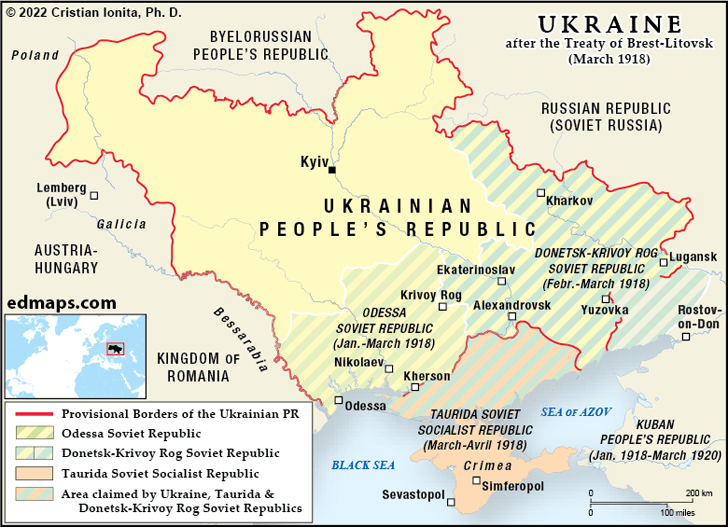
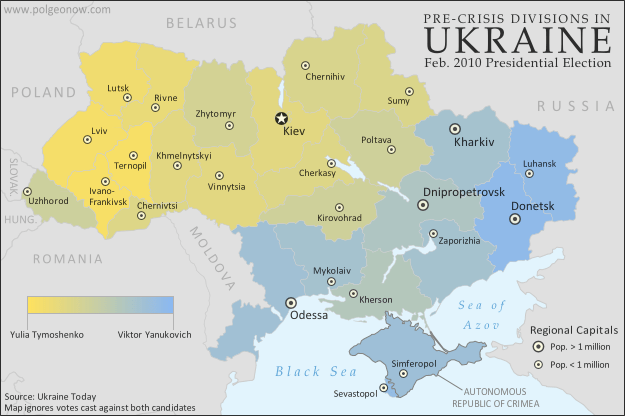
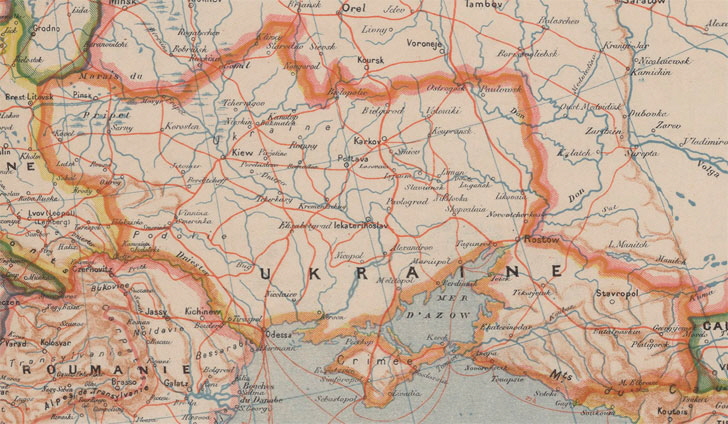
Sometimes in these discussions, people put the argument that Ukraine has been struggling for independence against Russia for over 100 years. This map from time of the Treaty of Brest Litovsk in 1918 is very interesting when you compare it with the map showing votes in the 2010 Presidential election. Leaving aside the parts of Western Ukraine that were still parts of the Austro Hungarian Empire in 1918, the division between the rest of Western Ukraine and the areas in the South and East that formed Soviet Republics foreshadows almost exactly the political/national fault line shown up by the way people voted in 2010. This shows that the Nationalist movements that are presented as the representation of the people of Ukraine as a whole are not representative of all of it, and never were.

https://www.edmaps.com/html/ukraine_march_1918.html
http://antifon.blogspot.com/2014_11_01_archive.html
https://www.edmaps.com/html/ukraine_claims_1919.html

This map from 2019 showing an aspirational Greater Ukraine, incorporating both Novaya Rossiya and the lands of the Don Cossacks as far as the Caspian Sea, shows that inside every thin nation struggling for self determination, yearning to breathe free, there can be a bloated expansionist version busting to get out and impose itself on others if given the chance.

NATO spends 18 times as much on “defence” as Russia does.

This morning, the newspapers were hyping up the possibility of a Russian attack on NATO territory, and commentators at the weekend arguing for a No Fly Zone were pushing the idea that Ukraine could just be the beginning. This has its counterpart on the Left, where people argue that the Russian invasion is “just imperial expansion”.

People lose their heads in wars – sometimes deliberately – so its worth checking the reality and coming down to earth.

  • We should never lose sight of the fact that a direct clash between NATO and Russia set up by a No Fly Zone would push us over the edge of mutual nuclear annihilation. Hundreds of millions would die. That vast number – too likely to be treated as a statistic that does not engage with our emotions and move us – nevertheless contains an almost infinite multitude of individual tragedies. You would die. So would I. So would everyone you know and love.
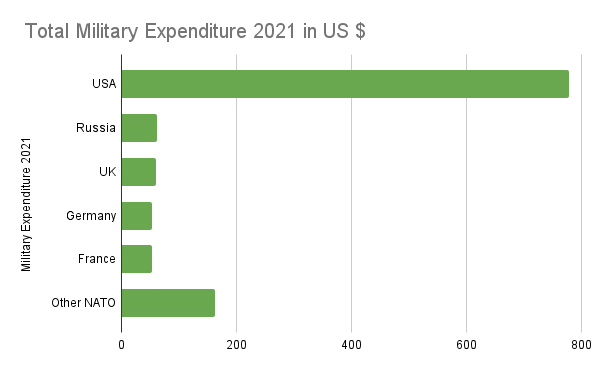
  • NATO spends more than 18 times as much on its military as Russia does. That makes makes a direct Russian attack on NATO absurd. In fact, NATO arms spending is more than half of the global total. Projected increases in “defence” spending will make this proportion even greater. The “defence experts” projecting fantasies of Russian incursions into the Baltic States or Poland know this; but have either lost all grasp of reality, or don’t want their readers to have one.
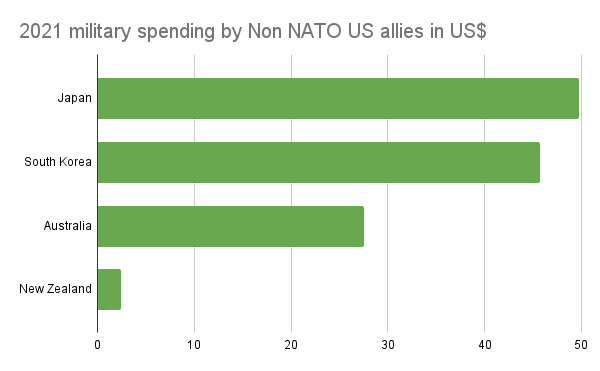
The non NATO countries listed here are the others in the top 20 military spenders table.

Japan, South Korea, Australia and New Zealand are also bound to the US by non NATO military alliances. Add their 6.3% to NATO’s 55.8% and you get 62.1% of global military spending made by countries in US led military alliances. In addition, some of the other countries in the top 20 military spenders also tend to align with the US even without a treaty obligation to do so, like Israel and Saudi Arabia.

Even in Europe, three NATO allies each spend about the same amount on their military as Russia does.

As the Brookings Institute candidly puts it, “America’s alliances in Asia and Europe have formed the backbone of what has become known as the “liberal international order.” Over the past 70 years, this order has helped protect American interests and values.”

That has also involved starting most of the world’s wars in that period.