Where the main enemy is.

William I Robinson’s conclusion to his essay The Unbearable Manicheanism of the “anti imperialist” Left implicitly contradicts the rest of his argument.

He writes The U.S. may be the top dog and the most dangerous criminal among competing cartels of criminal states.  We must condemn Washington for instigating a New Cold War and for prodding Russia through aggressive NATO expansion into invading Ukraine.  

Quite so. This point makes it an odd post to be recommended by the editor of Labour Hub, which in lockstep with the hegemonic ruling class narrative in the UK, has spent the last 18 months arguing doggedly that NATO expansion had nothing to do with causing the war. No prods or provocations acknowledged.

But the wider point, that the US “may be the top dog and the most dangerous criminal among competing cartels of criminal states” means that the Tricontinental Institute, Code Pink, The International Manifesto Group and No Cold War among others critiqued in his article, have got it right; that the US is the core of the imperial system that needs to be opposed in the global struggle for socialism; because that “may be” is a way of saying “is” without quite saying “is”.

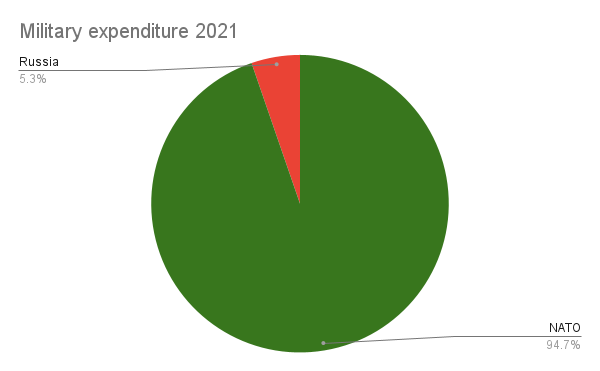
The way Robinson poses it in the rest of his article however is that we are almost in a multipolar world already, and the USA is just first among equals. This is far from the case. Its capacity to subordinate the rest of the developed world to its economic, political and military needs makes it the lynch pin of the global imperial system. The EU, Japan, UK, and even smaller wealthy countries like Australia and New Zealand, are tied to it as auxiliaries prepared to sacrifice their own economies for its needs, and integrate their militaries into US global leadership. This integration of all the major developed imperial powers, subordinates the weaker to the US, but allows them together to dominate the rest of the world. Between them, direct US allies account for 67% of global military spending; and the US alone accounts for more than half of that. “Top dog” indeed.

And the US has almost 800 overseas military bases in over 80 countries, as we can see here. China, by contrast, has one (8 fewer than Turkey).

What a Global Empire looks like

This is not a matter of show. The war on terror, from 2001 to the debacle of the flight from Afghanistan, killed 4.5 million people; and did so without establishing a single viable, functioning, let alone democratic, state anywhere they intervened. It has been argued that the creation of chaos in countries like Syria and Libya has been seen in Washington as preferable to allowing regimes they disapprove of to function effectively.

This is underpinned by the Death Star level planet destroying weight of the US nuclear arsenal, the biggest of big sticks, which has hitherto allowed them to speak as softly or loudly as they like. And this is not simply for “deterrence”, or to threaten non nuclear states. The US nuclear “first strike” doctrine envisages an exterminist attack on China or Russia. This would be suicidal, as the scale of such an attack would generate a nuclear winter, but the top brass are as deeply into denial about this as they are about their equally fatal failure to rise to the level of the challenge of climate breakdown, and their planning is regularly updated.

Direct military intervention, by their own forces or using proxies, as they are trying to do with ECOWAS in the current crisis of Mali, Burkina Faso and Niger trying to get out from under France Afrique in the Sahel, are only the sharpest form of intervention. Sanctions are also devastating and are imposed “against countries that violate the interests of the United States” as Wikipedia puts it with disarming frankness. At any one point, this is a significant slice of, primarily, the Global South, as we can see here.

These sanctions are designed to cripple economies but also kill people in large numbers. Half a million children in Iraq in the 1990s, over 40,000 in Venezuela in the last decade, to pick just two examples.

This is sustains the (“rules based”) world economic order, which keeps the Global South underdeveloped through the normal functioning of the international trade system, US dominance of finance, low prices for Global South commodities and high prices for loan capital, including from international institutions like the IMF and World Bank, that have imposed the “Washington consensus” privatising development agenda that is anything but developmental. The utter failure of the US allied countries in the Global North to provide the – completely token – $100 billion a year contribution to the Global South to enable fossil fuel free development, at the same time as the US alone has stumped up more than $120 billion to fuel the Ukraine war, is emblematic of how this rotten system works. As Vijay Prasad has pointed out “one in three lightbulbs in France are powered by uranium from Niger, at the same time as 42 percent of the African country’s population lived below the poverty line” and fewer than 20% have access to electricity.

At the outset of World War 1, Karl Leibknecht argued rather bravely in the Reichstag that “the main enemy is at home”. In the light of the above assessment of the structure of global imperialism, we have to recognise that the main enemy, while the Pax Americana exists and the struggle for full spectrum dominance and a “New American Century” is driven onwards, is always in Washington.

Footnotes. Short points on the rest of Robinson’s article

“Manicheanism” is a Persian theology from 300 BC that poses the world as the site of a cosmic struggle between good and evil; which are posed as moral absolutes.

Cold War thinking is Manichean. “Win, win” global cooperation is not. Demonisation of rivals, or just people who think differently, as “evil” is a characteristic of Manichean thinking.

It makes a rational assessment of the motives of opposing forces very difficult, because all analysis is shrouded in a red mist of moral repugnance; which is itself all too often a form of projection. This is evident in most establishment media coverage of the Ukraine war, in which all atrocities are attributed to the Russians, while butter wouldn’t melt in the mouths of the Azov battalion.

This is often given added vehemence by sections of the Left who back this line, partly because they they need to stoke a lot of moral outrage to drown out the awareness in the backs of their minds that doing so is becoming an auxiliary of “the top dog”.

Its the same the whole world over?

The core of Robinson’s argument is that, while “the 2022 Russian invasion of Ukraine and the West’s radical political, military and economic response to it may signal the coup de grace of a decadent post-WWII inter-state order” and “the emerging global capitalist pluralism may offer greater maneuvering room for popular struggles around the world “ nevertheless, “the crisis of hegemony in the international order takes place within this single, integrated global economy.” Essentially all states are capitalist and much of a muchness. No state is any different from any other. All are converging on nationalist revivalism and this is the primary context for the “escalating economic turbulence and political chaos” we are heading for.

The paradox of this argument is that the Manichean zero sum calculations made by the US Foreign Policy establishment, that confrontation, decoupling and, in extremis, war with China is necessary to stop its rise, is not reflected in a Manichean mirror image in China’s stance. Their approach is to maintain globalisation, for global cooperation to find “win win” solutions and “a common home for humanity”. The former is leading us towards Armageddon and sections of the Left are being swept up with it. The latter is the basis of a way out.

Because China, and other states that see themselves as Socialist, dance to a different drum. Robinson acknowledges China’s “rapid industrialization, technological progress, and advanced infrastructure” and that “China has not followed the neo-liberal route to transnational capitalist integration.  The state plays a key role in the financial system, in regulating private capital, in massive public expenditure, especially in infrastructure, and in planning“. And that’s the point. “The state plays a key role” The key role in fact. And it is a state run by a Communist Party with 90 million members. It is not run by the private sector. It hasn’t been since China “stood up” in 1949. That’s the difference.

Four ways this shows.

  1. Poverty Reduction Robinson acknowledges that China “has lifted millions out of extreme poverty” then moves swiftly on. Let’s be more precise about this. 850 million people lifted out of poverty in the last 40 years. To make that relatable, because statistics don’t have an emotional impact, think of one friend and what it would mean for their life to be lifted out of extreme poverty. Then imagine a city the size of London full of friends like that. Then imagine 100 of those cities full of friends like that. That’s the scale of China’s achievement. Another way of looking at it is to imagine the whole population of Europe (740 million people) living in extreme poverty in 1993, and being lifted out of it by now. Plus an additional 100 million people. This is not normal for developing countries subject to imperialist domination. It has been a state driven mission.
  2. Wages As you can see from this graph, wages in China have consistently grown faster than in the rest of the world. This is one reason that the rule of the CPC is popular and most people in China see their country as a democracy, in the sense of it being run in the interests of the mass of the population. Fewer than half of respondents in the United States thought the same about their country, because they know full well it isn’t.

3. Belt and Road Initiative The overall impact of this is genuinely developmental and far more “greening” than Robinson makes out. As argued here, “Research indicates that the BRI has significantly promoted the carbon intensity reduction of countries along the route”, and, though this is uneven, a recent study by CGS analysing “17 environmental, economic, and social indicators” in Africa found “consistent improvements across 12 indicators through 2050 across 1.5°C scenarios” thanks to to BRI impacts. Even the World Bank projects that “BRI transport projects could reduce travel times along economic corridors by 12%, increase trade between 2.7% and 9.7%, increase income by up to 3.4% and lift 7.6 million people from extreme poverty.

4. Climate Breakdown The investment that China is putting into the energy transition is projected by the IEA to be double that of the US and EU put together next year, as you can see here.
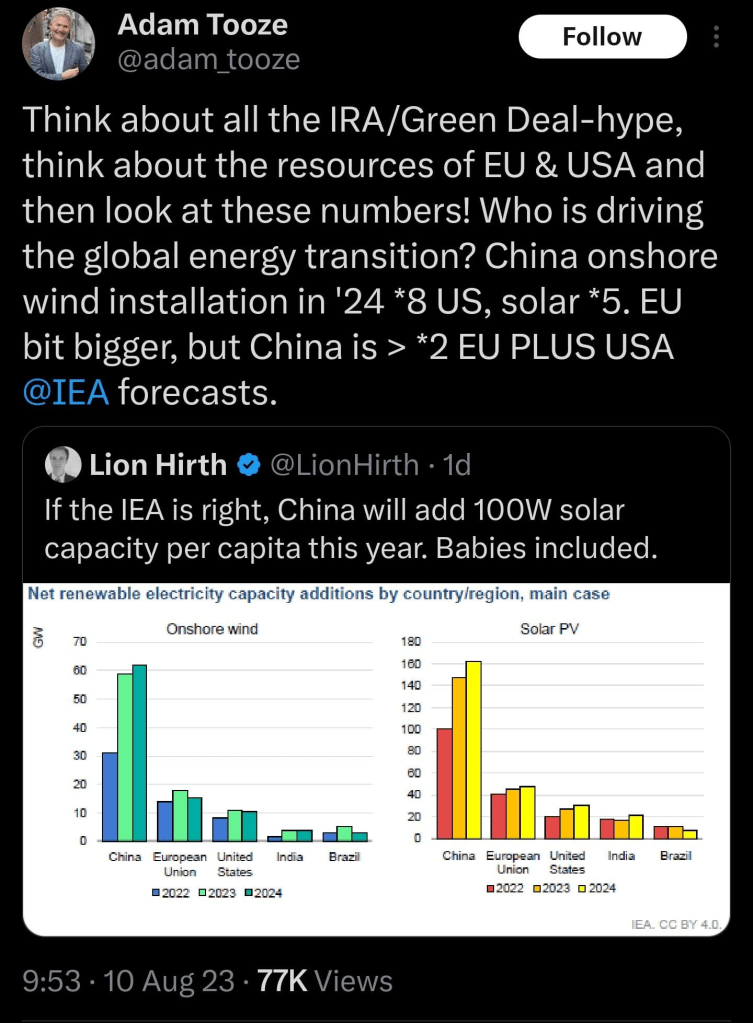
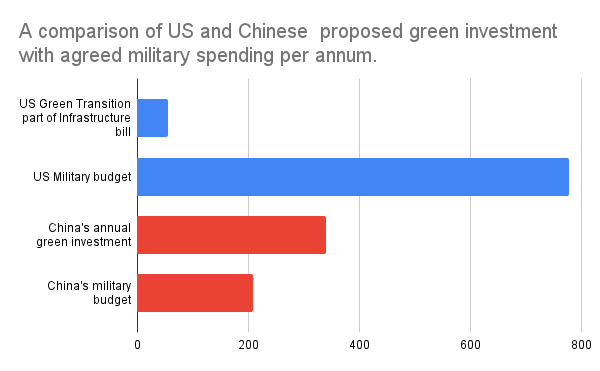
They are also spending twice as much on energy transition as they are on their military. The US is spending 18 times as much on its military as on the energy transition. Which sums up their relative priorities.

The Left in the Global North – which has never overthrown its own ruling class and lives in a relatively comfortable niche of permanent opposition made bearable by the higher standards of living made possible by global exploitation- tends to be dismissive of the struggles of people in developing countries who have. This niche has been tolerated hitherto here, but, with US dominance increasingly under challenge, both economic concessions and democratic spaces are being inexorably squeezed, and dissent increasingly categorised at treasonous.

Currents on the Left who, to prove their independence of mind, find themselves habitually parroting the same attack lines on the same targets as the State Department (and at the same time) should reflect that perhaps their opposition to “campism” has led them to pitch their tents in the wrong camp.
The bankruptcy of an “anti- imperialism” that sides with imperialism.

The recent article on Labour Hub from Pierre Dardot and Christian Laval – reprising the Euston Manifesto in a French accent – makes up in tetchiness what it lacks in analysis. Without dropping to their level and accusing them of “stupidity”, I’d like to put some of their assertions and arguments under a bit of scrutiny in the hope that, even in the impassioned polarisation of current arguments, a bit of light can be generated amidst the heat.

Their argument, that the Left has more than one enemy, is a statement of the obvious that no one could disagree with. What they don’t do, however, is examine the actually existing power relations between different states and draw any conclusions about who the main enemy is.

Since the object of the argument is the reality of imperialism, and how that is revealed in the Ukraine crisis and war – as the latest front line of an aggressive expansion of the NATO alliance right up to the borders of Russia – lets examine the forces involved and their scale.

  • Russia has a GDP slightly smaller than Italy and spends $62 billion on its military.
  • NATO includes all the major imperial predators on the global stage, corralled into one bloc by the USA so that it can intervene at will throughout the rest of the world; knowing that all of its smaller rivals will be lined up behind it (or, in the case of the UK, trying to jump up and down alongside it in a desperate attempt to be noticed and approved of). It has a collective GDP 20 times the size of Russia’s and its military spending is 19 times as much (before recently announced increases which will make this gap even bigger). NATO is the military lynch pin of the global imperial system centred on the United States. Russia is not included in it.

The proportionate military spend looks like this.

These are from 2021. Very large increases are planned by Germany and the USA from this year. UK military expenditure is also increasing.

A quick glance at this imbalance should put paid to any notion that the NATO powers face any kind of threat from Russia’s military, that “Ukraine is just the start” or that revived “Great Russian chauvinism” or “neo Stalinist fascism” is about to steamroller across Europe, restore the Russian Empire and put paid to “democracy”; and therefore plans to significantly increase military expenditure have any “defence” rationale at all. Offence is another matter.

Even more absurd is any notion that that the active expansion of NATO across Eastern Europe since 1991 – amassing East Germany, Poland, Hungary, the Czech Republic, Bulgaria, Estonia, Latvia, Lithuania, Romania, Slovakia, Slovenia, Albania, Croatia, Montenegro and North Macedonia into the bloc, with Ukraine, Georgia and Bosnia added to the active waiting room in 2022, following a US Ukraine Security Agreement signed in November 2021 – has been a passive act; let alone “reactive” in Diderot and Laval’s words. The ante has been consistently upped from the US.

The Russian response to this has been to try to be incorporated in it; or to seek “common security arrangements” in Europe with it. Approaches have been made repeatedly since 1991 and consistently rebuffed by the USA. So, no incorporation , no accommodation, just inexorably increasing pressure.

So, Russia has reacted with aggressive defensiveness when this pressure has got too much.

  • defending the South Ossetian enclave after the Rose Revolution installed a pro US President in Georgia, who launched an attack on it-
  • and, in Ukraine – reacting to the 2014 US backed overthrow of a President who had just signed a trade deal with Russia rather than the EU – by annexing Crimea and moving forces into the Donbass; after the rebellion there was about to be crushed by the Ukrainian army and Azov battalion.

The expansion of NATO up to Russia’s borders is not simply a matter of “humiliation” for Russia, as Dardot and Laval put it. It is an existential military and political threat; and seen as such across the full spectrum of Russian political opinion. It has been repeatedly stated as a red line which will lead to a violent reaction if crossed. This is not a mystery to NATO or the USA. It takes a real act of will to ignore it on the Left. The question is, knowing this, why did the USA and NATO push across it and provoke the reaction they had been warned about?

Dardot and Laval explain that in reaction to the Russian response, “pacifism is not an option” and “the immediate imperative is to help the Ukrainians resist” and “let’s not play non-intervention again”. So, theirs is not an anti war stance.

  • They would have no sympathy with the Italian and Greek airline and rail workers who have refused to move NATO munitions to stop fuelling the war.
  • In arguing for arms to be sent to Ukraine until the 2014 borders are reestablished they are calling for the forcible reoccupation of the Donbass and Crimea, against the wishes of the people who live there. So much for self determination and human rights.
  • They are in favour of anti war demonstrations in Russia, not anti war demonstrations against NATO in NATO countries.
  • They don’t specify how far they want to go to “intervene”, but NATO is intervening already. And Dardot and Laval line up behind it.

They try to cover this by turning their polemical fire on “campism”, which they characterise as “one sided anti imperialism”, even though they themselves are forming a bloc with their own imperialism and its allies. You can’t get more “one sided” than that.

They argue that “my enemy’s enemy is not necessarily my friend”,

  • but pose a delusionary framework in which there are no hierarchies of power, as though we were already in a multi polar world,
  • and at the same time pose the actions and values of any powers opposed to the dominant imperialism as worse. “The terrible reality of Communism in either Russia or China” or “post colonial regimes” during the first Cold War.

This follows the well worn trope of every “human rights” intervention by the US and its allies, that the enemy of the day is the new Hitler. So, in practice, my enemy’s enemy is more my enemy than my enemy is. At best, the currents that espouse this sort of position are an opposition within imperialism, not an opposition to it. Firmly in their home camp.

This is not a new phenomena on the European Left. It has been the dominant tradition of Social Democracy since 1914. Lest we forget, at the outset of the First World War, the overwhelming majority of Socialist and Labour Parties across Europe voted for the war budgets of their own countries to “defend” them against the threatening barbarism of their enemies, firmly subordinating themselves to the barbarism of their own ruling classes. At the start of the war, there were already plenty of atrocities to choose from. Looking only at those committed by the other side became almost a moral imperative to justify looking away from those committed by our own. Plus ca change. Plus c’est le meme chose.

As the Left in the imperialist countries has stagnated in reformist parties – sometimes allowed into government if self consciously subaltern enough – or small revolutionary currents with a weakness for syndicalism, and nowhere overthrown capitalist rule; revolutions have taken place at imperialism’s weakest links, in countries that are poorer, with lower standards of living, smaller infrastructure development, often devastated by the struggle and having to build up economic, health and education infrastructure almost from scratch. These have faced military threats, and interventions, from the USA and its allies, and constant economic pressure. The Labour movements of the Global North have been at best ambiguous about the struggles of these countries, with small solidarity movements largely outweighed by an insular condescension, even on the far left, which has considered the judgement of small Western European groupuscules on what is or is not “socialism” to be of more weight than, say, the Chinese Communist Party; which sees itself as a Marxist Party, is running its country with significant success and has 90 million members.

Following in this tradition, Dardot and Laval are quite clear than in a confrontation between developed capitalist countries/imperialist countries/the Global North/ the “democracies”/the “international community”/the “West” (delete description according to political taste) and any actual challenge to it, even from countries that see themselves as Socialist, or “post colonial regimes”, in the final analysis, they plump for the former.

They seem to presume that the “West” supporting dictatorships – and invasions and coups and terrorist movements – across the Global South was a function of the old Cold War, and seem unable to explain why it is a constant feature of what they have continued doing since. The dramatic shift from the “End of History” in 1991, the USA’s dominant unipolar moment, in which it was possible to imagine that the future of the world would be to become a gigantic American suburb, to the current moment in which the USA is for the first time since 1871, no longer the World’s largest economy in real terms is registered in the Global South by a series of political realignments around the Chinese model of investment led development , but in the Global North by a movement among both the ruling class and labour movements that could best be described as “nostalgic”(in the UK ranging from the swashbuckling imperial delusions of Brexit to Keir Starmer’s oddly retro political framing; so he looks like a Labour Prime Minister, but a Labour Prime Minister from the last century). The US is no longer able to subsidise its allies in the way it did after World War 2. It doesn’t generate the capital any more. In fact, it sucks it in, and this has a destabilising effect, primarily on the Global South but increasingly on its allies; the stagnation of Japan since 1989 being a stark example. And this is driving an increasingly delirious domestic politics in the US too.

Because the USAs global dominance is slipping, it is using its armed forces to reassert itself, pushing beyond previously sacrosanct red lines and provoking confrontations – today with Russia in Ukraine and, if it gets away with it, tomorrow with China in the South China Sea. This is designed to spark conflicts it can “win”, lead on to regime change in its interests and the Balkanisation of rival powers before China, in particular gets beyond its threats. It is this that is the threat to world peace, just as it is the current wave of US driven sanctions that is the biggest threat to the wellbeing of the global population, as this briefing from No Cold war makes clear.

We should always bear in mind that this is the country that

  • dropped more munitions on Iraq on the first day of the second Iraq war than the Russians have managed in the whole 5 weeks of the Ukraine invasion,
  • carpet bombed Vietnam, killing 2 million people,
  • imposed sanctions on Iraq in the 1990s that killed 500,000 Iraqi children (a price “worth paying” according to Madeline Albright)
  • killed up to a million Iraqis in the ensuing war,
  • is currently imposing sanctions on Venezuela which have killed 40,000
  • and on Afghanistan which have led to a situation in which a million children are on the verge of starvation.
  • We could add to this the situation in Yemen, ably abetted by its UK vassal, backing the Saudi intervention which has killed almost 400,000 people according to the UN, has directly led to a cholera epidemic and “the worst humanitarian disaster in the world.”

This is what global misleadership looks like. That’s what imperialism IS. That is why the USA is the main enemy, along with our own ruling classes, who are aligned with it. No other country has the capacity to inflict so much pain simultaneously around the world. No other country has 800 military bases in other countries or the capacity to use the world’s financial system to “make the economy” of any given target country “scream.” That’s why an “anti US lens” is essential to any sense of proportion on global developments and, whatever we might think of their opponent in any given conflict, or of what they do in the course of it, a victory for the US is a defeat for all of us and no one on the Left should aid or abet it.

We can add to this the complete failure of the USA – and the ruling class more broadly – to lead humanity in combatting our greatest collective threat; climate breakdown. This is the clearest indication that the capitalist class – through its most powerful states – is no longer capable of leading humanity anywhere except to disaster. The USA is spending 14 times as much on its military as it does in combatting climate change. China is spending one and a half times as much on climate change as on its military. The USA would need a change of regime to begin to do what is necessary.

This shows that imperialism will kill us – in more ways than one.

Dardot and Laval, writing in France – which is about to have a Presidential election between a fascist matron and a centrist blancmange, vying with each other for who can demonise France’s 6 million Muslims the most – note that the other enemies of the Left include “dangerous ideologies” which support “forms of oppression and domination, notably religious”, giving an unmistakable genuflection to the boorish laicity that is barely distinguishable from the Islamophobia that runs virally through the French Left and disables its anti racist solidarity. The only Presidential candidate, in this context, that they take a pop at is Jean Luc Melenchon, the only Left candidate in spitting distance of Len Pen and Macron, presumably on the basis that “the honour of the Left” would not be safe with him.

Their attempted parallel between Ukraine and Palestine – that the Left should support the nationalist side of Ukraine in the same way it supports the Palestinians – shows exactly what is wrong with their argument. For the Palestinians to be free, they would either have to have equality within a common state with Israeli Jews from the river to the sea, or, if this could not be achieved, a viable separate state. The cause of the rebellion in the Donbass against nationalist Ukraine in 2014 was that equality was no longer guaranteed for the Russian population. Support for nationalist Ukraine is therefore – in fact – more like support for the current state of Israel than for the Palestinians who are oppressed by it.

Their central argument is that what they describe as “great movements of democratic emancipation” throughout the world have an independent dynamic and take place completely independently of outside influence or support or direction.

They lump together in this

  • movements like the Arab Spring; that developed organically from large numbers of people rebelling against economic conditions that were becoming sufficiently unbearable that the inhibitions of a repressive state and the ingrained habits of just getting by and making the best of things could be overcome in a great rush of inchoate solidarity – which the US struggled to get a grip on and divert
  • with movements that have been described as “colour revolutions” because they followed a script written in the State Department and could be most accurately described as creatures of it. As good capitalists, the US State Department can’t help themselves in branding these events, even though doing so is a bit of a giveaway that they are their products.

Dardot and Laval argue that “the peoples have free will and they are not the puppets of the great powers” which is true up to a point. Free will is nevertheless often expressed in a way that does indeed make the movements concerned a creature of Foggy Bottom; and given the weight of US finance, expertise and media power, it can be very hard to avoid being suborned by them. The contrary also applies. The existence of the USSR provided a pole of attraction for movements in the Global South/Third World which, at the time, tended to take a secular form and aspire to socialism in some form. The collapse of the USSR meant that such forces have tended to dissipate and be replaced by millennialist style religious movements. The current rise of China is leading to significant political realignment. Each struggle in each country is a unique combination of common elements, but whatever the local specifics, none is innocent of the influence of outside forces. Sometimes this is simply the weight of example or cultural aspiration, sometimes the power of investment or trade, sometimes conscious manipulation and intervention.

The USA, in particular, runs a vast international network of human rights organisations and social media networks, funded through the National Endowment for Democracy, and it intervenes everywhere. Sometimes it initiates a movement. Sometimes it moves in on one and bends it to its will. They have cultivated an international network of “democracy activists” and hold cadre schools to refine their tactics and compare notes. Anyone involved in these networks will in practice be acting as an agent of the USA. Many of them are conscious of that and proud of it.

Some rebellions are not in the USA’s pocket. These tend to be the ones that are demonised by it. Hezbollah in Lebanon is one, the Houthis in Yemen are another, as are the Cubans, Venezuelans and Bolivians.

So, the question is what is the relationship between any movement and the US and its local relays. This is not predetermined, as we make our own history, but not – as Marx once noted – in conditions of our own choosing.

  • Dardot and Laval argue that ISIS was not the inevitable result of the Syrian uprising against the Assad regime, but the involvement of the USA and its local allies certainly helped push it that way. ISIS has been in some ways an irregular frontier version of Saudi Arabia.
  • Similarly, the Rose Revolution in Georgia didn’t have to end up with military adventurism from President Saakashvili, but US involvement and the prospect of NATO membership certainly encouraged him.
  • And in Ukraine, the dynamic of the Maidan movement was inexorably towards the far right. The least that can be said about US involvement is that it inhibited that not at all.

Sometimes the US is aiming for regime change, sometimes to create chaos as a preferable alternative to a government that does not do its bidding.

The current sanctions being imposed on Russia by the US are going to have an immense blowback across the Global South that will be more severe the longer they are in place. Millions are being thrown into poverty right now. The rebellions that erupt as a result will be almost certainly too much for the US to handle. The US war drive is leading to Global chaos and misery. No support should be given it.