14 Questions for John McDonnell (and others) on Ukraine

John McDonnell’s article for Labour Hub The Ukrainian Question for Socialists has so many missing dimensions its hard to know where to start. It is a story with a middle, but no explanation of the beginning, nor any projection of where the course of action he supports might end.

John’s judgement on the war is oddly flat, missing whole dimensions of the conflict and lacking any sense of causation beyond a kind of moralism, the 21st century equivalent of WW1 “German War Guilt”. The assessment of the conflict as Five Wars in One in the most recent New Left Review Editorial gives a fuller picture, every aspect of which has to be grasped to understand the dynamics of it.

  1. There is a civil conflict within Ukraine itself.
  2. The Russian intervention after February 2014, which NLR defines as having “a double character”, interventionist against Ukraine, and defensive against NATO at the same time, leading to
  3. A Ukrainian war of national self defence combined with
  4. What former CIA chief Leon Panetta describes as a “proxy war” against Russia carried out by the US using Ukrainian soldiers on the ground, but also imposing global sanctions that have had a terrible blowback on food prices in the Global South and energy prices in Europe. NLR describes this as “unambiguously imperialist” in that “it aims at regime change… (in Russia) …and the assertion of American hegemony over the Eurasian continent”.
  5. “The prospect of a Sino-American conflict, the real focus of the last three administrations in Washington, is the final lock determining the Ukraine war’s dynamic”.

John only looks at 3 and half of 2. Does he recognise that he’s missing the determining forces driving this process?

In the context of a “civil war in Ukraine itself”, John’s article acknowledges fighting since 2014, but does not acknowledge that there is any popular legitimacy in the pro Russian side of the civil war. This disorients him from the off, as important facts have to be denied to maintain his posture.

The Guardian last week quoted a Ukrainian junior officer fighting around Vuhledar on the southern Donetsk front complaining that troops recruited locally didn’t want to fight. Most Ukrainian troops are conscripted. Some are unwilling. Aleksey Arestovich, an adviser to the office of the Ukrainian president, said in January that many Ukrainian soldiers fighting in Soledar simply fled and there were “a substantial number” of refuseniks who declared they “cannot fight any longer in this terrible war”. Arestovich said, “We have people who refused to dig trenches, and when they were led into ready-made trenches, they just stood still. Many said the enemy (Russian soldiers) were too close and it was better to move several miles back from the front lines.” This has meant that that month President Zelenskyy in January signed into force a punitive law introducing harsher punishment for deserters and wayward soldiers, even stripping them of their right to appeal.

At the same time Ukrainian dissident Dmitriy Kovalevich reports that refugees and residents in the south of Ukraine …are attending protest rallies organized by the wives and mothers of servicemen.

Perhaps more significantly, the soldier in Donetsk went on to note that “about half” of the local population was “pro Russian” anyway. Does John acknowledge this?

NLR describes the uprisings that led to the formation of the Donbass People’s Republics in 2014 like this.

  • After the Maidan events “opposition to the new government was broad. In late February, some 3,500 elected officials gathered at an anti-Maidan conference in Kharkiv. The following day, the Kiev parliament repealed protections for Russian as a regional language. The anti-Maidan uprisings in Eastern Ukraine copied the Kiev model of occupying central squares and taking over government buildings. The security forces were also divided; in some areas the local police made no effort to stop the anti-Maidan protestors. In cities like Kharkiv or Odessa, Kiev’s authority prevailed. In hardscrabble towns like Donetsk and Luhansk, popular militias made up of miners, truck drivers, security guards and the local unemployed stormed the regional-administration offices and declared peoples republics…”

In Odessa, Kiev’s authority “prevailed” through far right thugs trained in from the capital for a football match burning down the local trade union HQ with anti-Maidan protestors inside it, killing nearly 50 people. Is John unaware of this?

This division in the country is widely recognised inside it. NLR notes a student in Kiev remarking of workers rebelling in the Donbass, “They can’t help it. They’re all Sovoks over there”. Sovoks being a term applied to people nostalgic for the Soviet Union. “All Sovoks over there“. Does John think that these people should be occupied against their will?

In the context of this civil war since 2014, has John not noticed the steady stream of fighters from the European and North American far right who have signed up to fight in the Donbass, and get tooled up for future fights at home once they’ve gained the combat experience? While John mentions people in Ukraine that he knows and identifies with who are not like this, there are a lot of people fighting on the Ukraine side who are; some of them local, some from all over in a kind of fascist foreign legion.

John also does not note what happens when the Ukrainian army reoccupies an area and carries out “cleansing” operations against “saboteurs and collaborators”. Some of the dead bodies are posted on Instagram. Is that ok?

The same applies to Crimea. I don’t think there’s anyone even amongst the most gung ho Ukraine Solidarity Campaign supporters who argue that the population of Crimea is clamouring to be reconquered by Ukraine.

And there is a recognition now being freely expressed by the United States that, given the concentration of Russian armed forces, including nuclear weapons, on the peninsular, pushing to retake it could trip over the threshold into nuclear war, so best not try. Would John agree with that assessment, that surrendering territory will be necessary to avoid of tripping nuclear thresholds?

If so, would he be prepared to concede that this is a principle that may have to be applied more broadly; and that there is no level of escalation that is capable of reconquering the Donbass without pushing through nuclear red lines; so that has to be ruled out too?

In the first month of the war, President Zelensky called for a NATO enforced No Fly Zone. Arguing for Ukraine to be able to “defend” itself with all possible means would imply support for that. As this is an obvious invitation to Armageddon, it hasn’t been taken up, so far. Am I wrong to presume that John would be against that?

I hope so, but he doesn’t mention it, so its hard to say. The problem is that that’s where we are heading. The latest USC statement – signed by John – lists lots of additional sets of equipment that could be supplied by the British Army, including fighter jets. Where does this end?

Its important to be clear on this, because starting from the need to pull back from escalation to World War 3 requires the Labour movement to push for peace and a negotiated settlement, rather than going along with the step by step escalation in munitions. And pressure for that has to start with the Left.

There is a domestic dimension to this too. The UK government and Labour front bench support an increase in military expenditure at a time of collapsing public services and impoverishment of the working population. That means “hard choices” to build up the military at the expense of the population in a country that already spends more on it than any other country in the world apart from the USA, China and India. In fact the per capita burden on the UK population is already double what it is for Russian citizens and five times that on the Chinese. Does John support that?

To have an idea of how this could end short of escalation to mutually assured destruction, you need to go back to why it started in the first place and how it could have been avoided. John does not examine this at all. He just gives the invasion a pair of labels – “illegal” and “imperialist” – and leaves it at that. Any closer examination can’t help but look at NATO, and whether the Russians have any legitimate security concerns about it. I wonder if John thinks they do? He doesn’t say.

Just taking the months in the run up to 24th Feb,

  • the Russians were asking for NATO to rule out Ukrainian membership and for mutual security guarantees that could defuse the crisis – and implementation of the Minsk accords that would have gone some way to restoring a peaceful modus operandi; with autonomy within Ukraine for the Donbass Republics.
  • It also would have allowed Europe to sustain its supply of relatively cheap Russian natural gas, instead of being forced to buy expensive LNG from the USA and Qatar.
  • Just to spell out the obvious, NATO outspends Russia on its military by a factor of 19 to 1 – and that’s before the current proposed increases.
  • NATO is the core alliance of global imperialism centred on the USA.
  • “The West” is the same place as “The Global North”. It has armed forces to maintain its system of global dominance and exploitation.
  • Russia has never been included in this core because doing so would set up the potential for a Russo German bloc that would edge the USA out of its dominance in Europe.
  • So, Russia is not at the table (despite asking to be let in on numerous occasions). And, as they say, if you’re not at the table, you’re on the menu.
  • What this might look like is Dick Cheney’s 1991 plan to balkanise Russia into three more easily manageable countries, the European part, Siberia and the Far East.
  • A less drastic bottom line might be the replacement of Putin with a more compliant oligarch who knew his place in the US world order. more like Yeltsin.
  • The Russians are acutely aware of this. Which is why they feel under threat. And why the Ukrainian oligarchy being so eager to sign itself up as a US henchman in NATO feels like an existential threat.
  • The refusal of NATO to even discuss their proposals, couldn’t help but confirm the impression in Moscow that NATO was preparing for war.

Does John think that these concerns on the part of the Russians should have been negotiated about then and, more to the point, should addressing them be an essential aspect of any attempt to secure peace?

We should be clear here that framing the war as simply one of national defence in which NATO is just helping out, implies that the tail is wagging the dog. The power in this situation is in Washington not Kyiv. The Americans are now beginning to argue about the risks, costs and advantages of a long war versus a short one with a diplomatic off ramp. This is all within the framework of US national interests of course – which the UK political establishment will go along with; whatever it is.

The phrase “proxy war” was coined by Leon Panetta long before anyone in Stop the War started using it. But whatever its origin, it is a very accurate description of what’s happening. All the finance for the war and to sustain the Ukrainian state is coming from NATO powers. All the training for the army, targeting for missiles and artillery systems, is coming from NATO too. The USA will be perfectly happy to destroy Ukraine in order to save it. Does John not realise that that is what his position is supporting?

John’s call for a new Marshall Plan to rebuild Ukraine is the opposite of what’s on the cards. Since 2014 Ukraine has become increasingly neo liberal, with “Sovok” holdovers in state property sold off to multi national capital, including Monsanto in agriculture and negotiations around EU convergence noting that Ukraine is moving away from EU standards on regulations and labour standards. Were it to be fast tracked into EU membership it would act as a Trojan Horse to undermine them in the rest of the continent. The plan for reconstruction agreed at Geneva last Autumn sets Ukraine up to be asset stripped, with Blackrock presiding over the dismemberment. Fighting for a “victory” for the Kyiv government, is fighting for that.

The views of the Social Movement will count for nothing in that context. Does John really think that because there are small groups of left wingers who wanted to be part of the Maidan -but were marginalised and driven off by the right sector – and have opposed the neo liberal dystopia that Ukraine has become – but failed to make any headway – and are hoping that, in the event of a military victory by the world’s most powerful imperialisms, they will be in a position to move the country towards “socialism” that this is remotely realistic?

A United Kingdom that looks outward, with no self-awareness at all – David Lammy’s speech to Labour’s Conference.

Atlanticist Labour Shadow Foreign Secretaries have the difficult job of squaring the circle between the reality of UK subordination to US global dominance – with everything that flows from that – with the desire of the Party membership to be – and to be seen to be – “ethical”. This is usually covered by rhetorical devices that touch nerves and mobilise emotions, while obscuring awkward realities. A classic of its kind was Emily Thornberry’s speech in 2019 in which she included Venezuela’s Nicolas Maduro in a list of “Trump inspired strongmen” that the Party had to oppose, sliding over the awkward fact that, far from being one of Trump’s acolytes, Maduro was one of his targets, and Venezuela to object of ruthless US sanctions that were responsible for the deaths of over 40,000 people. Details, details…

With the banishment of that awkward internationalist Jeremy Corbyn and the reassertion of a new era of unapologetic Atlanticism from the front bench, David Lammy has gone further.

He did not reflect, in his foreign policy speech to Labour conference this year, that the role of “Britain in the World” has historically been rather like that of the policemen he mentions who used to stop and search him when he was “a skinny kid in NHS glasses on the streets of Tottenham“; and for very similar reasons. At one time as dominant world cop and enforcer, latterly as the new world cop’s most eager henchman.

His speech provides a cover for it to continue to do so.

His list of challenges faced by the world is odd, and in a strange order.

Conference, the world faces more challenges today than at any other time in my 22 years in parliament. The rise of China. Conflicts in Yemen, Syria, Ethiopia and South Sudan. A global food crisis. And a climate crisis.

“And a climate crisis”. The climate crisis is the framework in which everything else takes place – or doesn’t. It’s not an item on a list. Least of all the last item. And the central problem is that the world’s most powerful state is prioritising military interventionism over dealing with it. The USA is spending more than 20 times as much on its military as it is on dealing with climate change, claims to “global leadership” notwithstanding.

China, by contrast, is spending one and a half times as much on climate change as on its military.

Who is doing the right thing?

The UK already spends more on its military than every other country in the world apart from the USA, China and India. It spends more than Russia. Through NATO and AUKUS it is in direct alliance with countries that account for two thirds of total global military spending. But the Truss government wants to increase spending by 50% by 2030 and the Labour front bench is going along with this. This is not a polict that tends to peace.

Lammy’s “green dimension” is subordinate to Cold War imperatives and inwardly oriented. The UK should not be dependent of “fossil fuel dictators” he says. Which ones does he mean? Will imports be stopping from Saudi Arabia any time soon?

And “we will seek to work with allies and partners to create a new international law of ecocide to criminalise the wanton and widespread destruction of the environment.” There’s that presumption of leadership from the Global North again, Britain’s “allies and partners” in setting and policing the ecological rule book for everyone else.

And note the weasel words – “we will seek to…” This will be rather tricky for the Global North because most of the fossil fuel companies seeking to develop the 350 carbon Bombs (projects which each have a carbon footprint of over a billion tonnes of CO2) that will bust us well beyond 1.5C on their own are companies that are based here; and so are most of the banks that finance them.

The news has just come through this week that major US Banks are threatening to withdraw from Mark Carney’s Climate alliance, because “they fear being sued over the alliance’s stringent decarbonisation commitments” and you can make your own judgement on whether the “law of ecocide” would target them or not, even if the UN made climate action its “fourth pillar”.

This also applies to the specific crisis that Lammy uses to frame his speech. The USA has for years explained to the Global South how hard it is to squeeze out a few billion dollars to help get to the 2020 target of $100 billion a year agreed at Copenhagen ten years earlier which has still not been met and that, with a bit of luck and a following wind (and a bit of redefinition of private sector loans) they might be good enough to get up to the target by 2024. Maybe. If the Global South is good. And nothing else comes along that is more urgent.

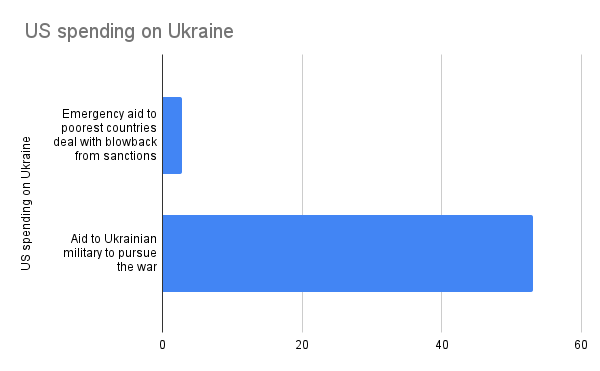
By contrast, they have magicked up $53 billion to fuel the Ukraine war in 6 months. Just like that. Easy. Whatever your view of the rights and wrongs of the war in Ukraine, and more on this later, it’s shocking how both the quantity and the speed are so dramatically different and provide such a clear demonstration of US priorities. Perhaps the way that a lot of this aid will go in orders for munitions and ammunition from US arms manufacturers may have something to do with that, but most of it reflects the war drive the USA is carrying out to try to shore up its economic decline relative to China.

In this framing, its odd that Lammy poses “the rise of China” as a challenge “for the world”. It is certainly a challenge for the US world order, Pax Americana, New American Century, Unipolar US domination; call it what you like. But that’s not the same as a challenge “for the world”.

For most of the world, benefitting from Chinese investment and trade, it looks more like an opportunity; and this is explicitly embraced by the Left in the Global South, Latin America particularly; where they are very clear about who runs the “Empire” and who has carried out coup after coup to install “dictatorships” across the continent.

It is peculiarly bizarre when considering that UK overseas aid is lauded for raising 3 million people a year out of poverty. This is not a figure I have seen anywhere else and have not been able to find online. It would be odd if true, because the impact of the COVID pandemic everywhere in the Global South outside China has been to throw back development and increase poverty. It would, of course, be a good thing if true, but pales into insignificance compared to China’s record as a developing country of raising 850 million people out of poverty in 40 years (21 million a year); seven times the rate. This was described in a Labour Foreign Policy Group document, generally rather hostile to China, as “perhaps the single most significant contribution to human wellbeing in world history”. But let’s not dwell on that. Let’s move swiftly on and not think about how this statistic is actual people whose lives have been immeasurably improved. It’s only the same number of people as the entire UK population thirteen times over. Just think of how many people that is. In forty years. And that includes everyone in Xinjiang, whose living standards are rising by 6% a year and whose labour is no more forced than that of anyone else who works in a factory.

It is also odd that Lammy does not mention that the “conflict in Yemen” is fueled by British made arms, of the sort that Conference sadly voted to boost, and the Saudi Air Force and Navy are trained to bomb and blockade ports by the RAF and Royal Navy – leading to famine and the world’s worst cholera epidemic. Nothing to see here. Let’s talk about Ukraine instead.

Lammy says “No act of imperialism is ever the same. But Vladimir Putin’s barbaric invasion of Ukraine this year was just the latest front in an age-old war between democracy and dictatorship. Freedom and subjugation. Empire and independence.” From the country and allies that have – just since 1990 -brought us two wars each in Iraq and Yugoslavia, the invasion and twenty year occupation of Afghanistan and the reduction of Libya from the most prosperous country in North Africa to a war ravaged basket case, this might be considered a little ironic. Quite what kind of “act of imperialism” Lammy considers these to be is unclear, who was fighting for “freedom” and who for “subjugation”, who for “Empire” and who for “independence“, he doesn’t say. Possibly because it’s too obvious if you think about it for a moment. Does he have no self-awareness at all?

“Vladimir Putin’s barbaric invasion of Ukraine” is an oft repeated mantra that conceals more than it explains. Deliberately. The war in Ukraine did not start with the Russian intervention this February. It started with the overthrow of a democratically elected President in 2014, aided and abetted by the considerable resources of the USA and EU, in cahoots with the local far right. This led to a rebellion on the Donbass region and an eight year civil war. As Sir Richard Sherriff, the former NATO Deputy Commander, remarked, a little off script, “this war started in 2014”.

The invasion this February followed attempts by the Russians to get an agreed mutual security arrangement that was spurned with complete contempt by NATO.

The Russian decision to recognise the Donbass Republics in February was not carried out by Putin alone but had the support of the overwhelming majority of the State Duma, including the main opposition Party, the Communist Party of the Russian Federation, reflecting concerns at the failure to implement the Minsk Agreement, refusal of NATO to engage in any talks about mutual security, and a build up of 130,000 Ukrainian troops – whose pay was tripled in December – opposite Donetsk and Lugansk threatening their liquidation.

All war is barbaric, but it may seem odd to viewers of the atrocity porn produced by Feargal Keene and the like that by comparison with what the Americans do, the Russians have been relatively restrained. There have been a number of specific strikes on infrastructure like power stations or dams, but in US air campaigns they aim to smash the entire power and water treatment systems on day one to reduce the population to a state of rebellious despair. “Shock and Awe”*. In fact, the US dropped as much explosives on Iraq on the first day of the second Iraq war as it took the Russians a month and half to do in Ukraine. All relative? Up to a point. But not if you’re underneath it.

The term “Special Military Operation” incidentally, is not a weaselly euphemism to cover all out war, but an internationally accepted definition of a particular sort of limited war, and everyone who reports on this knows it. This is now escalating and will continue to do unless peace negotiations can get going.

Worse, Lammy’s way forward is both delusory and condemns Ukraine and its people to being a permanent proxy war zone for NATO. “Whether it takes six months, three years or ten, Ukraine will win.” Ten years of war? Seriously? “Ukraine will win“? With Russia incorporating the South and East into the Russian Federation and mobilising accordingly, I can’t see that. Lammy is calling for war without end.

At a point that even EU Foreign Representative Jose Barroso is calling for a negotiated peace acceptable to both sides – “we stand ready to assist the peace plan just launched and we urge all parties to seize this opportunity to de-escalate the crisis and end violence of this developing tragedy,” it is deeply depressing that Labour’s Foreign policy spokesperson striking the same sort of bellicose posture that Boris Johnson did when he intervened to sabotage the last serious attempts at peace talks back in April.

If he wants the “global food crisis”, not to mention the energy crisis that he, again oddly, didn’t mention, to end, we need to end the war. That starts with pushing for peace, not a ten year war.

Lammy envisages a war crimes tribunal for Putin. On the model of the sort we have seen for George W Bush and Tony Blair for the hundreds of thousands of deaths in Iraq that their war led to? One like that? Or perhaps the one for Putin after the Chechen war, at a time he was considered a “strategic partner” by NATO? War crimes, it seems, are always committed by our enemies. Never by us, or anyone allied with us. The numbers don’t count. Especially if they are in the Global South.

Lammy is also right that the Tories tend to craft a Foreign Policy that is a wolf in wolf’s clothing and that the current government, delirious on Brexit Kool Aid is picking fights with everyone and thinking it can get away with it. It won’t. But his version of looking outward is simply to reassert traditional alliances with the rest of the Global North as it rearms on a colossal scale, while hoping a wee bit of extra aid will keep the Global South sweet enough not to start lining up with the Chinese model of development.

While Lammy is right to argue for restoring overseas aid to 0.7% of GDP, his argument is less that this is the right thing to do as partial reparations for the damage and exploitation done by the Empire and slave trade, more about enhancing the “soft power” of the UK as the beneficiary of it, even though, as he said his “ancestors knew what it was like to have their freedom taken away. They heard the twisted lies of imperialism as they were stolen from their homes in shackles and turned into slaves.” Quite so.

“A voice for peace, development and freedom across the globe” is sorely needed. A voice for expanded UK military expenditure, for an unquestioning alliance with the USA in its provocative militarist dotage as it pushes for wars it thinks it can win in Ukraine and the South China Sea, won’t provide any of that.

Historical Note

“Shock and awe” marries the two US bombing traditions of precision targeting with colossal force. But, unlike the initial advocates of precise targeting, who argued for overwhelming strikes on key targets of military significance, “choke points” like the Schweinfurt ball bearing factory in the case of Nazi Germany, these strikes combine taking out military HQs but also decisive civilian infrastructure. So, from day 1, there is no power, no clean water, no functioning sewage system. It seems odd that advocates of this approach are trying to argue that “the Russian way of making war” is more barbaric than that.

Have Brylreem, will bomb! US Air Force General Curtis Lemay in 1954. Sketch taken from the photo by A.Y. Owen in the Getty Images Collection which, if anything, is even more alarming to look at.

The idea that destroying civilian infrastructure makes a population less inclined to resist has never been vindicated in practice; unless it reaches the almost genocidal scale of the B29 raids on Japan in 1945 led by Curtis LeMay, who went on to bomb North Korea “back to the Stone Age” a few years later; in which the state of mind of the shattered survivors barely counts. In the initial argument in WW2 between the US Air Force, who thought they could “hit a pickle barrel from 6 miles up” using a precision bombsight in daylight (they couldn’t) and the RAF, which went into carpet bombing wide civilian areas at night, the British side disregarded its own experience during the Blitz, that the raids had made the civilian population hate the bombers harder and strengthened resistance to them, thinking this wouldn’t apply in Germany because the people were “a different sort”. No stiff upper…A racialised argument within white supremacy, indicating that the British took it for granted they were ubermensch, but that it was rather vulgar to proclaim it.

All quotes from “The Bomber Mafia” by Malcolm Gladwell.

Stats for Socialists: US priorities on Ukraine

The $4billion in aid to the world’s poorest countries to help them cope with the blowback from US sanctions (with $2.7billion coming from the US) is a desperate attempt to manage a situation that risks running out of control so that the war can be prolonged without two, three, many Columbias.

The US commitment, so far, to nineteen times as much spending on munitions (most of which will make its way to US arms manufacturers) shows what their priorities are.

On the one hand, hunger, primarily produced by their own sanctions. On the other hand, a war they want to pursue into next year if they can keep their own polities and those of the Global South stable enough.

Stop the War. Cut the Bills

From Labour List this morning, with my emphasis.

Ofgem’s chief executive Jonathan Brearley told MPs today that the energy regulator expects to increase the cap on energy bills by more than £800 in October. The cap is currently £1,971, having increased by £693 in April.

He said, looking beyond October, Ofgem are “managing between two extreme versions of events.

One where the price falls back down to where it was before – for example, if we did see peace in Ukraine. And one where prices could go even further if we were to see, for example, a disruptive interruption of gas from Russia,” he said.

So, a continuation of the war, and deepening the sanctions on Russia, leads directly to energy bills that are increasing 23 times greater than wages and 38 times greater than benefits, and could, as Brearley states quite clearly “go even further”.

The UK government’s bellicose interventions against peace negotiations will come back to bite it. As it will bite Labour too unless it starts mobilising for peace.