When I was an over serious teenager in the early 1970s, making myself very unpopular by putting a CND poster showing a mushroom cloud erupting out of a skull in a 6th Form Common Room full of people who just wanted to listen to Led Zeppelin and have a good time, I developed a philosophy of life that decreed that, in the face of global hunger, the threat of nuclear war and the destruction of the natural world it was immoral to enjoy it.
At the time, this was described as a “denial of life” by some of my closest friends and partners. But it seemed to me that a sense of guilt was a motivator, that the resolution of inhuman acts was a precondition for any happiness that could be justified; without reflecting that moments of joy don’t have to be justified; and a capacity to carry on wouldn’t be possible without them.
I expect I am not alone in getting vicarious imaginary montages, seeing horrific scenes from the news projected onto everyday landscapes. The first time J and I went into central London after the IDF started its mass bombing campaign in Gaza, we talked about how fragile the buildings in Leicester Square now seemed, how easily they could be shattered. Going to Basildon Hospital for my Mum’s most recent appointment we passed the three tower blocks that mark the northern edge of Chadwell and dominate the surrounding countryside, and I couldn’t help thinking that in Ukraine they would be a heavily shelled command post, a fortress in a waste land. While the hospital, so calm, friendly and orderly, humming along so functionally with its shops and cafe and pharmacy, would be a smoking hulk with desperate hungry staff trying to treat patients in the ruins with no anaesthetic, little or no medicine and no beds were it in Gaza. These are virtual, vicarious flash backs, not part of lived experience with no smells, little sound, just images, like a ghostly son et lumiere in the mind, but becoming an everyday part of psychic life.
In this context, when S and I were an hour early to the pots and pans protest for Gaza outside Downing Street last night, we took our sandwiches and sat under the shade of the plane trees in St James Park to catch a breath. We watched the geese and herons, moor hens and ducks like we had when she was little; the children eating ice creams in the sunlight.
On one level, given what we were there for, it seemed almost obscene to be enjoying this, the peace of it; even eating while 2 million people are being deliberately starved, but on another level it was an act of defiance. Finding moments of peace, moments of joy, moments of human kindness or wonder is a reprieve when under unendurable attack. When not under such attack, but aware of it, it becomes almost a duty to experience as much of our humanity as we can in the face of such strenuous efforts to degrade and dehumanise.
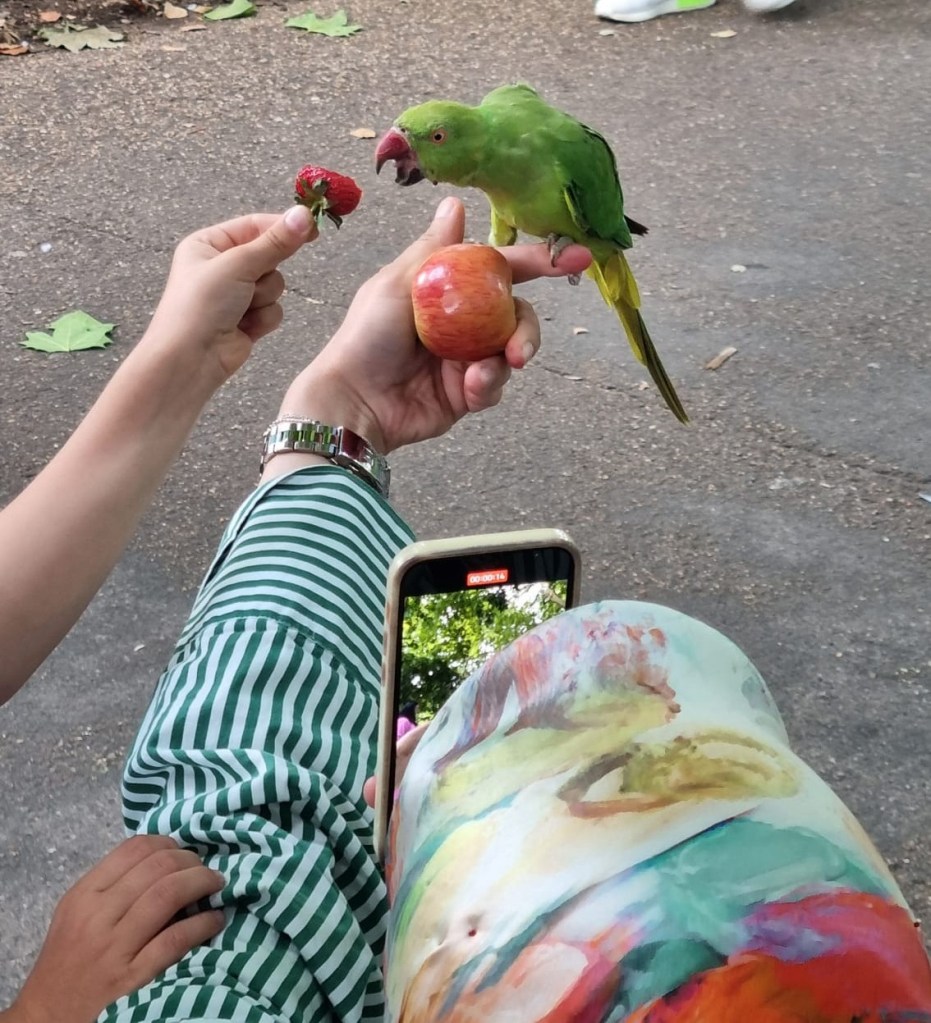
On the way out of the park we came across a Mum in a bright hijab and her daughter feeding a parakeet with an apple and half a strawberry. Parakeets are always exhilarating. This one kept fluttering down from rustling about in the tree above with the rest of its loudly chattering squadron, stretching out its neck and its bright red beak, then flinching back as it got too close. The little girls eyes were wide and bright with wonder.
In Moments of Reprieve, Primo Levi is making an argument for finding any human salvage you can in the most inhumne possible conditions, writing a set of short stories as an elegy to prisoners in Auschwitz, who through tiny affirmations of their humanity – a juggling trick, finding a slice of apple – discover ‘bizarre, marginal moments of reprieve’ amidst the horror.
In a discussion of the finale of Beethoven’s 7th Symphony on Radio 3 this morning, Tom Service argued that the ending of the movement is “off the wall”, because Beethoven has the double basses at the bottom of the register accompanied by the rest of the strings in a grinding and remorseless grim cycle of a theme in a lower key than the rest of the orchestra, which is hurtling around in a whirlwind of a joyful dance that ends in a blazing triumph; and the one is the condition for the other.
The conductor Charles Hazelwood, who was abused as a child, has said that “when I conduct Beethoven I feel the abuse in every bar”, because Beethoven’s Dad punched lumps out of him as a child, and as a result “It’s horribly uncomfortable for me to work with, right until the final performance which is always pure ecstasy”. Even when that mournful, somewhat depressive teenager, Beethoven always did that for me too, because his music absorbs the horror and misery and is driven by it to triumph over it.
As we must now.
 Urban ramblings