Ca ira! France celebrates avoiding Far Right government in surreal Olympic ceremony.

Taking place in a torrential rainstorm, the opening ceremony at the Olympics was as much under the water as on it.

A parade of random sized boats with national atheletic contingents that reflected in size the wealth and power of the countries sending them – more for the USA, fewer for Djibouti – all grinning and waving gamely, processed up the Seine alongside cartoon giant heads emerging from the water like an animation by Terry Gilliam accompanied by performances for the TV audience on the bridges and buildings alongside.

These had a extraordinarily surreal feel that had the Rassamblement Nationale spluttering over their post election tarte au ressentiment. Aya Nakamura’s magnificent mash up with the band of the Republican Guard providing accompaniment, where their rigid ranks tapping out rhythm on snare drums broke into a mildly bopping circle around her, which Marion Marechal described as a “humiliation”, may have been inspired by the delirious and liberating scene in the Tin Drum where Oscar taps his drum as the Nazi leaders march into a rally, the band loses the beat for the bombastic march they are playing and settle into the Blue Danube instead; and the iron ranks of the rally break into a swirl of people waltzing. This would be appropriate given how much fuss the French far right made about her singing at the event because, having been born in Mali, she “isn’t French”. Not an issue they raised for Celine Dione or Lady Gaga oddly enough.

For me, the most striking performance was the one in the Conciergerie, the rather grim former prison on the river bank, in which every window was occupied by a Marie Antoinette figure in flame red, singing the “Ca Ira” from a head tucked under her arm, while some dreadful French heavy metal band hammered and shrieked a demonic descant from the balconies, and a boat representing the Paris coat of arms floated by underneath with a soprano at the front – who bore a disturbing resemblance to Rachel Reeves (same Laurence Olivier playing Richard III hair thing going on) – singing “L’amour est enfant de boheme” (Love is a Gypsy child) from Carmen. Lacking the historical context, the BBC commentators translated “Ca ira” as “all will be well”, when it was actually the chant of the columns of the French revolutionary armies as they went into the attack at the armies of the European Ancien Regime in the 1790s. “Ca ira!” We’ll get through! To underline the point, the performance ended with an explosion of red streamers. Take that aristocrats! How unlike the Olympic ceremony of our own dear Queen…

As the tiny Palestinian delegation sallied past, the commentators talked of how they were performing under the shadow of Gaza and added “we wish them well”. The best thing they said all evening.
Scooters – to E or not to E?

News that Paris is to ban rented e-scooters from September after a public consultation in which there was a very low turn out, but in which most of those who did turn out were very antagonistic to e-scooters, poses a number of questions.

3 people have been killed in e-scooter accidents and 459 injured in 2022.

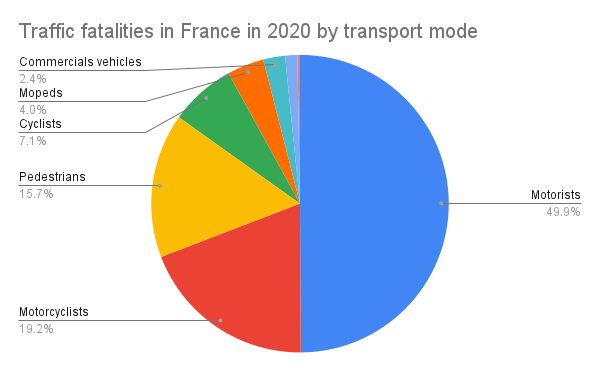
To put this is perspective, the French government’s road traffic safety annual report noted that across the whole of France “In 2020, there were 45,121 injury accidents in metropolitan France. 2,541 people were killed within 30 days of their accident, including 391 pedestrians, 7 users of personal mobility devices (such as electric scooters), 178 cyclists, 100 moped riders, 479 motorcyclists, 1,243 motorists, 59 users of commercial vehicles, 33 users of heavy goods vehicles.

It should be noted that e-scooters are a sub set of PMVs, but that, in nay case, this is by far the smallest source of fatal traffic accidents. That looks like this on a graph. The PMV segment is the little sliver at just before “12 o clock”. Though these figures are from 2020, Its unlikely that these proportion s have changed qualitatively since then.

The report goes on to note that, across France as a whole in 2020 “The number of users killed on e-scooters and other motorised personal mobility devices (PMD) is stable in 2020, but the number of people injured increases by 40%, also reflecting an increase in use since the end of the first lockdown. This number is still 5 times lower than the number of people injured on bicycles in urban areas.”

If fatalities and injuries are the issue, banning motor vehicles would have far more impact on reducing them. In fact, if the increased popularity of e-scooters in Paris has, as the Guardian reports, cut out one in five journeys that would otherwise have been carried out by car, motorbike or moped, then it is reasonable to extrapolate that, given the much higher fatality rate in collisions involving these vehicles, there have been fewer deaths as a result of e-scooters being available for hire.

As a new form of urban transport, better regulation would be a better way to go. As one opponent admitted “its better than it was”. Technical adjustments to limit potential speed and stricter enforcement of pavement surfing bans and “zipping in and out of traffic” alongside expansion of bike routes. Clear rules for users displayed on the handlebars and in tourist guides. Teaching in schools on the same lines as cycling proficiency classes. All that would have an effect worth having if we want to reduce the overall impact of motorised traffic.

So, on these figures, cars are 36 times more lethal than PMVs.

Part of the problem perhaps is that we expect cars to kill us. The background stress of car centred cities, all that noise, motion and potential threat swishing by us constantly, which we only notice when its suddenly not there in a place we expect it to be. Several thousand fatalities a year has become taken for granted. Wallpaper. It should not be. And the problems posed by other modes of transport should be considered in a proportionate way.

Debates about modes of urban transport in Paris – and even in other cities where cars are driven with less panache – should take in all modes of transport at the same time, so we can properly rebalance the ways we get around.