Emotive Plagues instead of Analysis on Ukraine – A Reply to Présumey and Bekier.

The most recent apologia for a pro war stance on Labour Hub from Vincent Présumey and Stefan Bekier claims to be dispelling myths, but is transparently erecting many of its own. The most glaring is this statement slipped in towards the end. “This all-out war since February 2022 was in no way caused by NATO expansion or any aggression towards Russia on its part.” There is no attempt to justify this statement. It is simply an assertion. The most obvious rejoinder to it is that it does not look that way in Russia.

If an assessment of this war and the historical background to it has any prospect of being taken seriously, it is necessary to have some analysis of Russian motivation that goes beyond trivialised prolefeed notions that its all a manifestation of a belated mid life crisis on Vladimir Putin’s part or that Russia is inherently, timelessly imperialist, but one of the strangest things about the wall to wall coverage in the media here since Feb 24th last year has been how little of it has seriously examined why the Russians sent their troops over the border, and this piece is no exception.

Here is a list of why they did, from their point of view; which can largely be summarised as the massive increase in Ukrainian military spending and NATO military aid, training and technical assistance from 2014 to 2021.

  • The signing of a new military doctrine (2015) which explicitly named Russia as Ukraine’s enemy (in violation of the Ukrainian constitution).
  • The number of soldiers increased from 140k in 2014 to 250k in 2015, and then by 2020 with 900K reserves). Even without the reserves, this is three times bigger than the British Army and about half the size of that of the US! It is also, again, even without reserves, significantly larger than the force the Russians invaded with (around 150K).
  • The growth of the Ukrainian nationalist national guard from 15k in 2014 to 60k men in 2019. These included overtly fascist elements.
  • The ongoing war in the Donbass in which 14,000 people were killed, including over 3,000 civilians in the Donetsk Rebel Republics.
  • The ongoing flow of far right volunteers to fight in the Donbass.
  • US military aid alone amounting to almost $3 billion dollars by the end of 2021. This has, of course, been dwarfed since, with a level of expenditure comparable to what they were putting into Vietnam in the late 60s.
  • The presence of NATO advisers in military units along the frontlines in the Donbass, sometimes as contractors from western military security companies.
  • The presence of a large contingent of US intelligence officers in the headquarters of the SBU (Ukrainian intelligence service) in Kiev (according to former SBU chief).
  • Statements from senior Ukrainian figures (including a former Foreign Minister and the head of the armed forces) that discussed a future war with Russia, the targeting of Russian cities and power stations, and the annexation of Russian territory in the Kuban.
  • In that context, Ukrainian claims that they had developed and would begin producing long-range cruise missiles (2019). Not hard to see who they would be aimed at.
  • Statements by a senior Ukrainian politician that the Russian population of the Donbass and Crimea should be put in concentration camps following their ‘liberation’ by Ukraine.
  • Statements by various officials during 2021 that Ukraine would seek to acquire nuclear weapons, which substantiated a long-term far right desire for Ukraine to become a nuclear armed power.
  • Increasing verbal expressions of support for a future Ukrainian membership of NATO by senior western politicians.
  • The cutting of military-to-military relations between NATO and Russia in late 2021.
  • Recent admissions by Hollande and Merkel that they used the Minsk 1 and 2 agreements to buy time for the Ukrainian military to grow.
  • The cutting off of water supplies to Crimea and the Donbass, which affected the civilian population.
  • The January-February 2022 incursions by Ukrainian special forces into Russia and the shelling of border posts near the Donbass.
  • The massing of Ukrainian forces around the Donbass, which Russia interpreted as preparation for an invasion of the rebel provinces of Donetsk and Lugansk.
  • Border incursions by NATO ships in the Black Sea during late 2021.
  • The use of Ukrainian territory for flights by US reconnaissance drones and aircraft.

    And this is without considering the political context within Ukraine since 2014:
  • The post 2014 purging of the state, and the promotion of fascist nationalists within its institutions.
  • The glorification of Nazi Germany and its collaborators in Ukraine, and the justification of their war against the peoples of the USSR, by both the state (in education especially) and the media.
  • The effective banning of socialist symbols and imagery through the twin effects of a ‘de-communisation’ law and a law on extremist symbolism which clearly defined socialist symbols, left Nazi symbols undefined, and which was exacerbated by selective application only to Soviet symbols such as the red star and flag, the hammer and sickle and so on.
  • Allowing nationalists and fascists to create a widespread network of social organisations, youth movements and businesses which propagated fascist ideology targeting Russians, Russian-ness (what they call the ‘internal occupation’) and manifestations of ‘Sovietism’.
  • Legal and social repression of the use of the Russian language, including in the education and state systems.
  • The imprisonment and judicial harassment of opposition activists and critical academics, the assassination of critical journalists and social leaders.
  • The adoption of laws that equated dissent with ‘separatism’ and ‘sedition’, which meant that even calls for peace and a negotiated solution to the Donbass crisis became criminalised.
  • And the total refusal of NATO to even consider negotiating about any of this in the period between November 2021 and February 24th, during which Russian attempts to propose a mutual security arrangement that would have demilitarised the crisis were turned down flat, mobilisations were treated as bluff and concessions seen as signs of weakness.

This is not simply rationally calculated on the Russian side. but emotionally felt. If you were to walk down the Arbat in Moscow, you would pass poster sized black and white portrait photographs of the hundreds of children killed by Ukrainian shelling in Donetsk since 2014. This might be considered as emotionally manipulative as the coverage we have on the BBC, though it lacks Orla Guerin’s mordant voiceovers, but it makes the point that, in any war, no one has a monopoly on suffering. Coverage that downplays that of the other side, or attempts to ignore their motivation leads to decisions based on outrage and lack of understanding.

On the Left, those that support the escalation of this war rely a lot on emotive propaganda of this sort. The point of which is to emotionally short circuit awkward questions, rule out of consideration any awkward facts, with a fierce emotional response that has to feed on itself more and more as the war drags on, digging so deep into a trench that it becomes impossible to see beyond it. This necessarily leads to some weird rewriting of history to justify it and a realignment alongside the traditional Atlanticist right in the Labour Movement in their bloc with the British ruling class and their “Special Relationship” with the USA. Ukraine Solidarity is calling a conference next weekend with the aim of generating a “new internationalism” which will gather together the currents that prioritise targeting enemies of the United States.

The Presumey and Bekier piece also contains a number of very strange historical assertions that simply don’t bear scrutiny.

  • That 19th Century cultural figures like Gogol and Tchaikovsky were Ukrainian because they were born on current Ukrainian territory. I may be wrong here, but I don’t think that Gogol or Tchaikovsky considered themselves to be Ukrainian; or indeed, Trotsky, Khrushchev or Brezhnev, all of who were born in Ukraine, would have either. Identity is more complex than birthplace, and this kind of claim is crude, misleading and ahistorical.
  • The “specific Ukrainian and peasant revolution in 1917-1918” occurred within two broad developments; an attempt to set up Soviet Republics in the Industrial South and East and an attempt to set up a nationalist regime under Petliura in the rural West. In the Civil War that followed the Russian Revolution, the Petliura forces distinguished themselves by carrying out even more antisemitic pogroms that the Whites, who were hardly restrained on that front. That political division from 1917 to 1921 reflected the split between urban/industrial and Russian speaking on the one hand and rural and Ukrainian speaking on the other, and has been broadly replicated in voting patterns within modern Ukraine since 1991.
  • The existence within Ukrainian nationalism of left wing currents is taken to imply that the movement itself was overall leftish or progressive and still is. This does not look reality in the face. All national movements are diverse, but the question is, which current is dominant/hegemonic and why, (which relates to where such movements get their external support from), Given that Ukrainian nationalism’s core was in Western Ukraine, gaining sustenance initially from the Habsburgs, then later the Nazis is why even Presumey and Bekier have to concede points like “The majority of the ‘Banderist’ forces (in fact split into several armed factions) actively engaged in anti-Semitic genocide” and “Ukrainian peasants, while they were oppressed for centuries, undoubtedly had their own victims: the Jews, and a substantial part of the population had been favourably disposed towards, and even participated in, the Shoah” and today “a part of the oppressed Ukrainian youth has internalized the stigma and turned it around, taking up Banderite or Fascist emblems and flags.” While this is not original sin, there is no doubt that it is an accurate description of what the dominant current in Ukrainian nationalism has been, and still is.
  • The 1991 independence referendum is taken as still an accurate reflection about which state the peoples in the Donbass and Crimea want to be part of, without reflecting that at that time it was considered feasible to have a binational state with equal rights peacefully coexisting with Russia on the one side and the EU/USA on the other. Rather a lot has happened since then, and it no longer is.
  • The description of the 2014 crisis presents the Maidan movement as purely popular and anti oligarchic, with ne’r a whiff of Western intervention misses both the role of the US and EU and the reaction against it in other parts of Ukraine, which was equally popular. Putting “colour revolution” in inverted commas for the earlier movement of 2004 is of a piece with this and the statement about NATO having no role in the crisis. The most powerful actor in these crises is painted over, ignored, looked at and not noticed. Its as if it wasn’t (and isn’t) there. The movement against the results of the Maidan in the South and East is presented as though it had no popular support. This is an equally serious evasion of reality that makes a mockery of the fact that over 3,000 civilians have been killed by Ukrainian army shelling and thousands of Donbass residents have been actively fighting the Ukrainian Army since 2014 in the Donbass militias. They have a memorial garden in Donetsk City to all the children that have been killed. And these kids are just as dead as any killed in Western Ukraine. They won’t get the full Fergal Keane treatment on the BBC, but they are just as dead. While Donetsk holds these graves…So, any attempt to get a peace settlement has to take their rights into account as much as those of people in Western Ukraine. There is a distinct sense that Presumey and Bekier don’t think they should and that “pro Russian” forces and currents deserve everything they get for being “pro Russian”. It being OK to ban Parties, close down media outlets and even take reprisals against individuals because they are “pro Russian”. In taking this position they concede that “pro Russian” forces are sufficiently present to require such repression, which ought to make them wonder why.
  • This is also expressed in their attempt to downplay the Odessa massacre – nearly 50 people burnt to death – with a piece of nit picking about what the name of the building they were burnt to death in was, and that the people killed were “pro Russian” not just “trade unionists” as if that makes it OK somehow. They were still burnt to death. At the hands of a right wing nationalist mob.
  • If anyone thinks the Azov battalion have been sanitised, have a look at some of their films. The influence of the far right is not demonstrated in their showing in elections but by what role they play in the state. This assertion “the ethnic or culturally exclusive conception of the nation, expressed by the extreme right-wing currents claiming to be more or less Banderist, has in fact been in retreat since the Maïdan surge of social self-activity in favour of a democratic, inclusive and civic conception” is the direct opposite of the truth. Consider these points from Freedom House, quite a right wing source, from 2018. After Ukraine’s 2014 Euromaidan Revolution and Russia’s subsequent aggression, extreme nationalist views and groups, along with their preachers and propagandists, have been granted significant legitimacy by the wider society. Extremist groups are, however, aggressively trying to impose their agenda on Ukrainian society, including by using force against those with opposite political and cultural views. They are a real physical threat to left-wing, feminist, liberal, and LGBT activists, human rights defenders, as well as ethnic and religious minorities. In the last few months, extremist groups have become increasingly active. The most disturbing element of their recent show of force is that so far it has gone fully unpunished by the authorities. Their activities challenge the legitimacy of the state, undermine its democratic institutions, and discredit the country’s law enforcement agencies.
  • The notion that Ukraine since 2014 has been primarily characterised by ” the self-organisation of civil society” misses both this and the overarching pattern of privatisation in both industry and agriculture that has gained pace since then; and which the agreement signed between President Zelensky and Blackrock will copper bottom it if Ukraine “wins”. Negotiations with the EU on a path to Ukrainian membership have been marked by complaints from the EU that Ukraine is diverging from EU standards on labour rights and environmental standards and corruption is rife and deep rooted, with twice as many Ukrainian Oligarchs named in the Panama papers as the next most corrupt country (Russia). President Zelensky was one of the people named. This was leading to a structural crisis in which 600,000 people, mostly men, were emigrating every year, both to find better prospects and avoid being conscripted and the economy was close to collapse according to the Finance Minister speaking in January last year.
  • As “the essence of montage is conflict” these two sentences coming one after the other create a dissonance that the authors seem unaware of. There is an oligarchic faction behind Zelenskiy – that of Kolomoiski, of Dnipro, which financed his studios – but he will emancipate himself from it. He began by trying to move towards the implementation of the Minsk agreements, before backing down. Funny kind of “emancipation”. As with an earlier statement about the supporters of the Orange Revolution being deceived by the politicians it had put in power, this is noted without examination, the better to move quickly on. That Zelensky was elected on peace ticket accounts for his landslide win over Poroshenko. But the way that he was rapidly brought to heel by both the far right and the US and carried on with the war as before is passed over in silence.

Their summary – that the Russian intervention is a “genocide” – that to Russia “Ukrainians can only be Russians or dead” is the complete nonsense of people made delirious by their own rhetoric. The Russian war aims are for a demilitarised Ukraine that is outside NATO and without far right influence, was initially for autonomy for the Donbass but is now for its incorporation within the Russian Federation. That is still a reasonable basis for a peace settlement that could begin to ratchet down tensions and allow people to live, if not together, at least side by side.

Not settling on this sort of basis begs a number of questions, which no one from Ukraine Solidarity ever addresses. As Russia has military superiority and the supply of NATO arms at the current rate isn’t stopping them making slow but definite military progress, at terrible cost in casualties on the Ukrainian side, and with increasing damage to infrastructure like power stations and railways, USC has called for a specific escalation of arms supplies. So, as they think the reconquest of the part of Ukraine that does not want to be part of a nationalist Ukraine is a justifiable objective, they should answer these four questions;

  1. How much additional weaponry would be needed to do it?
  2. How would this be paid for, and what else would be sacrificed to do so?
  3. Do support escalating beyond nuclear thresholds, which the Americans have already broadly concluded it would be crossed if there were an attempt to reconquer Crimea?
  4. What would be the impact of the prolonged war that such an extension of military supply would entrench be on what’s left of Ukraine and the people who live there?

Give a little to NATO, and you end up capitulating a lot.
Kherson Quagmire bodes ill for NATO Narrative

“…military press releases tend to be loaded with so many euphemisms, elaborations and aggressive improvements on the truth that if placed in any body of water, they would sink immediately to the bottom” Malcolm Gladwell in The Bomber Mafia.

Information in wars is even more heavily controlled than it is in peacetime*. This is partly about what is reported and partly how. This is sometimes deliberate, sometimes an unconscious function of a set of ideas so taken for granted that contrary information becomes impossible to process. This can therefore be profoundly misleading. Reliance on solely Western/Global North/NATO sources for news on the Ukraine war produces a disorienting bubble in which it becomes necessary to believe that the Russians would shell a nuclear power station occupied by their own troops; because accepting that the Ukrainians are doing it disturbs an otherwise untroubled moral compass. As a trigger warning, this blog contains info from sources like the Military Summary channel and the Duran, which take info from both Russian and Ukrainian official statements as well as info sent in from people on the ground.

This is supplemented by analyses in specialised journals, like this one, which originally appeared in the Journal of the US Marine Corps, and is essential reading to understand both how the Russians have operated on all three fronts, and how this is viewed from within sections of the US military establishment – when they are not spinning a line for popular consumption as a TV talking head. This analysis is illuminating because it is not distorted by a need to emotionally manipulate its readers. A debate among serious military leaders has to be more objective than that, so they can be clear eyed about what they are dealing with; so the information given will be more objective than the prolefeed in the mass media.

However, Western media imperatives can lead to catastrophic developments on the ground if military actions are taken to provide raw material for politically necessary myths.

The current Kherson offensive is a case in point. At the time of writing (evening 5th September) it is unclear if the current stabilisation of the front line reflects the culmination of the attack, the point at which it runs out of steam, or whether it is an operational pause before another attempt to push forward.

In a Blog last week, I noted that this long heralded Ukrainian counter offensive to retake Kherson Region had not materialised and opined that it probably wouldn’t. I had quite a lot of company at the time. The day before it started, the Daily Telegraph – which has a huge retired military readership much in evidence in its letter columns actively taking a keen professional interest – published an article citing Ukrainian military sources saying that such an offensive was off the cards, because they didn’t have the air or artillery cover to make it viable.

While this may have been classic wartime misdirection – on the presumption that the Russian General Staff would read the Telegraph, relax and let their guard down – that assessment seems to be accurate and have borne out by events so far.

The Press Release from the British Ministry of Defence on Saturday that redefined this offensive as having “strictly limited tactical objectives” might be seen as a post facto rationalisation that, whatever the objectives at the outset, strictly limited tactical objectives appears to be all that it is achieving – at enormous cost to the soldiers sent into it; while seriously depleting Ukraine’s already limited stock of armoured vehicles at the same time. Gains of a few kilometers. Thousands of men dead to gain them. Like the Somme. Or Passchendaele. President Zelensky yesterday proudly proclaimed the reconquest of four small settlements – and a “marines at Iwo Jima” type photo of a soldier putting a flag up is doing the rounds – while the hospitals in every city behind the front line are full of wounded soldiers.

Sending thousands of infantrymen with limited and vulnerable armoured support across open fields without air cover or sufficient artillery backing, and expecting them to press on regardless potentially for 50 kilometres to reach the Dnieper River, is a forlorn hope. The terrain for the attack is doubly unfavourable because it is so open and flat. Very little in the way of woodland or built up areas. No cover. This is a contrast to the Donbass, which is heavily urbanised, with the main roads between major towns strung out with linear settlements almost all the way along.

Speculation that this offensive was ordered for political reasons against the advice of the General Staff appears vindicated by the way the Ukrainian military have published no bulletins at all about what’s going on – theirs not to reason why, but also theirs to reserve their right not to put a positive spin on it. A sort of silent protest.

The political reason for it being the need to give some backing to stories in the West/Global North that “the Ukrainians have the initiative”, as General Petraeus put it on one US News programme a day or two before the offensive went in. This is not because support from the ruling class in the West/Global North is in any question, as the Ukrainians are acting as proxy fighters for them, but support among their populations might. A couple of months in which the Russians have consolidated in Luhansk and made steady progress in Donetsk, and appear to be gearing up to push on to Mykolaiv, is not conducive to keeping NATO populations geared up for sustaining the cost of the war with their fuel bills over the Winter. The 70,000 strong demonstration in Prague on Sunday against energy prices and NATO being the first of many in prospect. If its all going tits up, the feeling that its time to cut losses becomes stronger; whatever anyone’s sympathies.

Nevertheless, an offensive which would require a minor miracle to be successful does not seem a very good way to try to go about this; and indicates a certain desperation.

Petraeus, in the same programme, used the revealing phrase “IF Europe can survive this Winter”… (my emphasis) all will be well because the EU will have weaned itself off Russian gas and oil, which will hit Russia’s economy hard. He hasn’t noticed that the Russians are selling gas and oil east and south and will continue to do so, that their income from this has strengthened the rouble, and that some of this oil and gas is finding its way back to Europe; having been sold on at a mark up by countries like India and China. With the US itself now less willing to sell its own oil and gas overseas, to keep domestic prices down, whether Europe can survive this Winter without unpredictable upheavals that will bring down governments and put all sorts of issues up for question is doubtful. But it is also overshadowed by a deeper shift, that, having started out thinking they still held the whip hand that they are used to in weaponising energy, NATO countries find that they have accelerated a shift in global trade patterns and energy supply to their own disadvantage and the cost of their populations. Backing down would be a destabilising humiliating defeat, but not doing so risks upheavals that may be beyond their control in their own heartlands.

Back in Kherson, so far, these attacks have either gained a few kilometres, been held off, or driven back; or, in the case of one salient in the centre of the line south of the Ingulets river that defines the front line for quite some way, could have become a trap – with the three pontoon bridges that enabled the troops and their vehicles to get across, and provided their only escape route too, blown up – and the soldiers in it coming under ferocious bombardment; which has left the area littered with burnt out armour.

This offensive is beginning to look more like the last effort of the Iranian military in the Iran Iraq war – in which a comparable superiority in manpower enabled a push into an sparsely populated area of Southern Iraq, which then became a killing zone for superior Iraqi artillery – than the successful Croatian offensive into the Krajina in 1995 – in which better trained troops with superiority in artillery and tanks overwhelmed a strong but outclassed militia. The Ukrainians don’t have this.

A Russian push north of the same river on the edge of the pocket, has nevertheless been driven back by the Ukrainians, and they have captured the pontoon bridge the Russians constructed to get across. They will presumably now try to get resources across this bridge, either to reinforce or resupply the soldiers trapped in the pocket; or will have to try to use it to extricate them from an impossible position. Either way, this is a slender thread to be relying on, as anything moving across it in either direction will be a sitting duck for attack from the air or from artillery which will have it in their sights. And the bridge itself could be destroyed quite easily, unless the Russians calculate that it is to their advantage to keep it in being as a magnet for targets; as supplies, reinforcements or retreating troops are funnelled narrowly towards it.

So, it looks as though this attack will achieve neither its military nor its political objectives. If you listen solely to the news here, reporting of developments has been very limited, bigging up limited gains, within a framework of an upbeat view of the Ukrainian military’s potential for ultimate victory that fits rather well with Malcolm Gladwell’s comments at the top of this blog. The latest line from MiniDef is that the Russian army will mutiny this Winter; which reads very like wishful thinking.

How long they can keep this up with any credibility remains to be seen.

*Orwellian post script.

The description in Orwell’s 1984 of Winston Smith’s job falsifying propaganda – a real event eliminated here, a totally fictional one broadcast as truth there – drew directly on his experience of working for the British Ministry of Information during WW2.

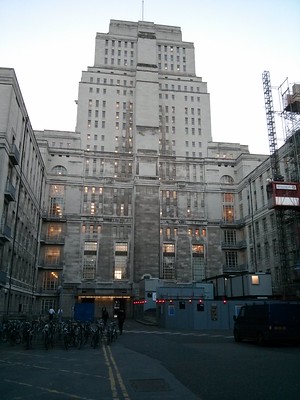
This was housed in the University of London’s Senate House – then the tallest building in London and a model for the Ministry of Truth – and, as the University history puts it,  was “responsible for subterfuge, censorship and propaganda” for the duration.

Plus ca change…so, pinches of salt all round I think.

Senate House – The Ministry of Truth Photo David Alves. https://www.flickr.com/photos/64097751@N00/33631514211

Class Struggle inside Ukraine

Two recent articles in Open Democracy report responses from Ukrainian trade unions to the “Lugano Declaration”, which came out of a conference between high Western and Ukrainian officials in Switzerland last week and sets out plans for economic reconstruction “after the war is over” by the Ukrainian Oligarchy* and its major imperial sponsors; the US, UK and EU.

This exposes the way that Ukrainian Oligarchs are ruthlessly using the war to entrench their position against the working class.

Natalia Zemlyanska, head of Ukraine’s Union of Manufacturers and Entrepreneurs commented, “No representatives from Ukrainian trade unions, nor our social partners from the employers’ side, were invited to help develop the reconstruction plan.“

Thus, Ukrainian unions are not considered by their ruling class to be a significantly valuable part of their nation to deserve any voice in discussions about helping shape its future economy. This is not new. As Zemlanskya noted, the principle of social dialogue “died in Ukraine long before the Russian invasion”.

Its worth bearing in mind what the pre war baseline they are “reconstructing” was. Overall, Ukraine was a country in structural crisis and decline. In 2019 the population was down 10 million from the level of 1993, declining at about half a million a year. Its GDP was lower than it was in 1989, with an aging population despite a low life expectancy of just 71.76 years (67 for men) and the shortest healthy life expectancy in Europe. Unemployment was consistently around 9%. It was 88th out of 189 countries on the Human Development Index – well below Russian and Belarus, just below China, Ecuador and Azerbaijan; and just above the Dominican Republic, Saint Lucia and Tunisia.

The reconstruction planned at Lugano will entrench these trends by consolidating the liberalisation of labour legislation that has accelerated since the Maidan events in 2014 – which has now been entrenched by emergency wartime regulations – to further squeeze the space for trade unions to operate, to give employers a free hand, and remove state oversight of the labour market.

This has been supported by countries like the UK for some years. Alongside the military training delivered since 2014, in 2021 the UK Foreign, Commonwealth and Development Office funded a propaganda project to make labour deregulation popularly acceptable; in a clear demonstration of what making “development” subordinate to foreign policy imperatives looks like.

This highlights something that at first sight looks paradoxical. While seeking EU membership, Ukraine is moving sharply away from EU labour standards. In October 2020, eighteen months before the Russian invasion, the joint report of the Ukrainian unions and the European TUC , noted that obligations to enshrine “international labour norms in law and in practice, ensure freedom of association and collective bargaining in particular, strengthen social dialogue and capacities of social partners, and gradually align its legislation with the EU Acquis in the field of employment, remuneration, social policies and equal opportunities” were just not being done. As they noted, “no reasonable progress has been achieved“.

Now that the EU powers like Germany and France, which previously might have aimed for a modus operandi with Russia, both militarily and economically, have been brought to heel by the US and will be paying the economic price both for increased arms expenditure and being forcibly weaned off relatively cheap Russian energy supplies, negotiations on labour standards with Ukraine could well be used by neo liberal forces in the EU to leverage a weakening of its own current levels as an unaffordable luxury in straightened times – in an odd mirror image of the downward pressure exerted by the UKs trajectory of a post Brexit race to the bottom.

Before the war, wage levels were already among the lowest in Europe, with one quarter of the population receiving an income lower than the actual living wage, fuelling a persistent and massive exodus of younger workers in a search of better pay in the EU, particularly in the neighbouring countries, and avoiding being conscripted to fight in the Donbass at the same time.

It has got worse since. Employers are now able to suspend employment contracts: so employees do not receive wages, but are still considered employed. And this is being widely used. By 1 April, roughly five million citizens had applied for income loss benefits – 16 times more than the 308,000 registered number of unemployed at the end of May.

This gives carte blanche for ‘shadow employers’ who do not employ people officially. The state now no longer monitors wage debts – a long term problem in Ukraine.

In response to the war Parliament has further suspended parts of workplace protections and collective agreements, put forward legislation to take employees of small and medium-sized enterprises – 70% of Ukraine’s workforce –outside of the scope of current labour legislation and given employers the right to terminate employment contracts at will.

Wages fell by an average of 10% in May, compared to the pre-war period. Wages in raw material extraction, security and manual labour have almost halved.

Future Faking?

Right now, under the impact of the war, six million people, mostly women, have left the country. In Europe, many of them are now living in countries where wages are higher, laws are largely obeyed, and housing and Nurseries are affordable. Their return en masse gets less likely the longer the war goes on, and, after the end of martial law, which forbids men under the age of 60 from leaving the country, many who can will leave the country to join them. A long war will create tensions on this front too.

In the immediate term the state wants to develop microbusinesses to relaunch the economy: which amounts to lending to micro-entrepreneurs or training people in IT skills. This will be hampered by the destruction of Ukraine’s infrastructure, low purchasing power and general instability which present small businesses with enormous problems in setting up supply chains or finding customers.

The Lugano Declaration rests heavily on ‘A Blueprint for the Reconstruction of Ukraine’, published by a group of international economists in April, which aims to:

1) introduce more flexible employment contracts and eliminate labour legislation that precludes the development of liberal economic policy;

2) provide government subsidies for foreign companies;

3) large-scale privatisation, including Ukraine’s biggest banks;

4) priority credit support for export sector;

5) use of low-skilled and labour-intensive public works to fix infrastructure;

6) establish a technocratic agency that will distribute international aid.

The kind of future society envisaged here is quite clear.

And this is beginning to generate tensions. As Vitaliy Dudin notes, “Ukrainians were ready to endure any difficulties in the immediate aftermath of the Russian invasion. But as the tide of the war has changed, not everyone thinks the current situation – where business has advantages over workers – is fair”.

The extent to which this finds expression remains to be seen. This is a very important perception. “As the tide of the war has changed”. A spirit of unquestioning national unity might be viable in the immediate shock of an invasion, or when it looked, briefly, as though the Russian withdrawal from Kyiv might be the prelude for a general victory for Ukraine in the short term. But, the longer the war drags on, and the more Russia advances, the more the class contradiction on the Ukrainian side is likely to find expression.

Dudin’s argument that an alternative based on state investment to create secure, sustainable jobs, with popular engagement and trade union involvement, skills training, proper state scrutiny and regulation of employer practice because, as he puts it post-war Ukrainian society needs integration, and that will be ensured by the development of state-owned and cooperative enterprises that do not make profits to the detriment of society and environment, and this requires policies of redistribution through taxation and the confiscation of surplus wealth from Ukraine’s richest people runs counter the interests of those running the state – who are precisely “Ukraine’s richest people” – and contrary to the kind of society they are fighting the war for; in alliance with the most predatory imperialisms on the planet.

Achieving a programme like Dudin’s won’t be done with the Oligarchs in power, nor with NATO backing them. Zemlanskaya’s argument that “The most important thing is to win – and then to see in what form Ukraine has ended the war, and what the future will look like,” is declaring a class truce while the war lasts – a truce that is not being respected by the ruling class. It also begs two questions

  1. Is the neo liberal dystopia the Oligarchs and NATO have in mind worth fighting and dying for?
  2. When and in what circumstances will the war be over, and what interest do the working class in Ukraine have in the circumstances in which that happens? The US, UK and the gung ho wing of NATO are for fuelling it for as long as possible, years not months; and are quite insouciant what might be left of Ukraine at the end of it. They are pre-emptively opposing diplomatic negotiations.

This is also a question for the international labour movement, being hit increasingly hard by the economic blowback from the war itself and, more severely, the sanctions the US has imposed to pursue it by other means. None of us has an interest in this war continuing.

Arguing against negotiations on the grounds that this would “reward” Russia should bear in mind the consequences for all concerned if the war continues. And that peace on the Russian terms – Crimea and Donbass not part of nationalist Ukraine, Ukraine not in NATO, Mutual Security arrangement (or even long drawn out negotiations around them) – would be better than a resolution on NATO’s terms – forcible reconquest of Crimea and Donbass, Ukraine fully integrated into a triumphant and triumphalist NATO with rapidly increasing military budgets, readying its new 300,000 strong strike force for interventions further east against countries they would consider ripe for plucking.

*Ukraine, we should note, had more politicians named in the Pandora Papers than any other country; 38, twice as many as Russia’s 19. President Zelensky was one of them.

Don’t mention the North Atlantic Treaty Organisation.

In his latest piece for Labour Hub, Mike Phipps argues that it would be better to have an anti war movement that is not actually against the war aims of our own ruling class. His argument, and attempted intervention into the anti-war movement, rests on two dubious assertions.

  1. That NATO expansion and US militarism have nothing to do with the origins of this phase of the war in Ukraine and therefore the anti war movement should ignore it.
  2. That Ukrainian nationalism is a progressive “anti-colonial” current fighting for liberation from Russia as an imperial oppressor and therefore the anti war movement should support it.

Let’s look at each of these in turn.

1 NATO

The NATO summit that has just concluded has agreed to expand its membership, increase its arms expenditure, get 300,000 troops at a permanent state of “readiness” and forward deploy more of them to the frontier with Russia and to sustain a long war in Ukraine.

This is motivated as a way to “defend” members of the alliance from a Russian threat that they are very careful not to quantify. That is because Russian military expenditure is less than Britain’s and one twentieth that of NATO. The projected expansion of the alliance and large increases in expenditure will make NATO’s military dominance even more extreme. So, a reasonable question might be, who is threatening whom?

So, when the new chief of staff for the British armed forces, Sir Patrick Sanders, argues that we have to be ready to fight World War 3 in on land in Europe, its quite clear what that “readiness” is for, and who is on the offensive. His argument that if you want to preserve the peace you have to prepare for war, was exactly what all sides were arguing in 1914. It was an argument that worked very well. Until it didn’t.

Mike doesn’t engage at all with what NATO has been doing in Eastern Europe since 1991, or more particularly in Ukraine since 2014. Simply ignores it and tries to waft it away with an airy “I don’t see this as a central factor at all”. Jens Stoltenburg, NATO Secretary General, however, is very proud of what they have done and quite candid about it. “The reality is that we have been preparing for this since 2014…that is the reason we have increased our presence in the eastern part of the alliance, why NATO allies have started to invest more in defence, why we have increased our readiness”. My emphasis. I suspect that Stoltenburg has a better grasp of what he’s doing – and the significance of it – than Mike does, unless there is some conscious disavowal going on; seeing, understanding, but choosing not to acknowledge.

Stoltenburg’s comment is underlined by the remark of Sir Richard Shirreff, former NATO Deputy commander, on Radio 4 recently that “this war started in 2014”.

2014. Not on February 24th 2022. It has been noted widely that while Ukraine has not been in NATO, NATO has certainly been in Ukraine: training, re-equipping, getting the Ukrainian army ready to go beyond the shelling of the Donbass to try to retake it.

It takes a real act of will not to look at NATO, or the USA, and what it is trying to do, and how the war in Ukraine fits into it. Mike draws rage from the horrors of the war – in a determinedly one sided way that implies total barbarity on one side and saintliness on the other (because no lies have been told, butter wouldn’t melt in the Azov battalion’s mouth, issuing a decree to arm civilians en masse doesn’t erase the distinction between them and combatants, and no oppositionists have been “disappeared” or assassinated) – and is averse to looking up at the strategic picture because it is so obvious what’s happening when you do.

He reflects least of all on what NATO is.

NATO is a military alliance of the world’s major predatory imperial powers, under the aegis of the United States, pledged to defend a “rules based” imperial world order in which the rules are written in Washington. The European powers are part of it because they can’t take the US on, and do better being subordinate members of its global gang than trying to act as lone wolves. This maintains domination of the Global South, with $2 trillion flowing from it to the Global North in 2013 alone. NATO is the armed guarantee that that will keep happening. That’s why people like Paul Mason, who thinks that the working class in the rich countries should prosper at the expense of the peoples of the majority world, support it.

That means that taking active steps to join NATO – as US influenced Ukrainian governments have done -is not a neutral act. It is the repudiation of neutrality by definition. It is also a self limitation on national sovereignty. It is ganging up with the USA – essentially taking up a job as a henchman – and will be understood as a threatening act by any country in its sights, especially any nearby.

NATO’s expansion into Eastern Europe to pressure Russia serves two purposes – setting up the preconditions for a regime change colour revolution in Russia itself, so a more compliant Yeltsin like leadership can be brought in – and in the immediate term also to decouple Russia from the EU; the better to cement control of the rest of Europe, particularly Germany.

This explains the refusal of the US and NATO to even discuss Russia’s proposal for mutual security guarantees when the Ukraine crisis started brewing up from November last year onward. You’d think we’d all have an interest in that. But mutual security and reduction in tension – which would be good for all of us – would increase Russia’s weight in Europe with the EU, and make it harder for the US to dominate it. No chance to deploy those troops, sell those arms, export that fracked Liquid Natural Gas. So, we can’t have that, can we?

The demonstrative mobilisation of the Russian armed forces throughout the winter in response, was an attempt to show how seriously they took what they saw as an existential threat. It seems to me that what triggered the actual invasion was the NATO summit the week before in Munich, at which those European powers, principally Germany and France, that had been pushing for easing off on confrontation and continued negotiations within the Minsk framework, were very visibly brought to heel by the USA. A partial withdrawal of Russian forces in Belarus that week was taken not as a welcome gesture that could lead to a reciprocal step towards negotiation; but a sign of weakness to be exploited. Watching the news of that, I had a real sinking feeling. It sent a very clear message. Crowing on the news combined with Russian fears that the Ukrainian military build up in the Donbass heralded an imminent intervention to snuff out the Donbass republics with NATO backing. It seemed that war was inevitable. It was just a matter of when, and who struck first.

This war was generated in neither Kyiv nor Moscow, but Washington.

2 Ukrainian Nationalism

Mike’s attempt to ignore the entire geo-political context of the NATO build up and the self subordination to it by the Ukrainian government, means that he simply buys into the narrative of Ukrainian nationalism – effortlessly erasing from historical significance the large Russian population living in what is now part of Ukraine, but was Noviya Rossiya (New Russia) from the eighteenth century onwards – that the whole Ukrainian people have been engaged in a long term struggle to liberate themselves from Russian oppression. Small left currents in Ukraine put this in anti-colonial terms, and Mike quotes one of them. But the mainstream dominant tradition here is not anti colonial, but pro colonial; the far right. These were the hegemonic street forces in the Maidan movement. They have since become entrenched in the Ukrainian military; and wield an influence on the streets far greater than their formal electoral representation.

Again, it requires real disavowal to ignore this, to look and not see. But to give an indication of just how bad this is, here are some headlines from western media from before February 24th, when they weren’t trying to cover this up.

Ukraine celebrates Nazi collaborator; bans book critical of pogroms leader.

Ukraine’s got a real problem with far right violence (and, no, RT did not write this headline).

Hundreds march in Ukraine in annual tribute to Nazi collaborator.

Violent Anti-Semitism is gripping Ukraine – and the government is standing idly by.

Ukraine conflict: “White Power warrior” from Sweden.

Ukraine conflict: child soldiers join the fight.

Far- Right fighters from Europe fight for Ukraine.

Nazi symbols. salutes on display at Ukrainian nationalist march.

Yes. Its (still) OK to call Ukraine’s C14 neo Nazi.

A new Eurasian far right rising.

Far Right extremists in Ukrainian military bragged about Canadian training.

German TV shows Nazi symbols on helmets of Ukrainian soldiers.

Ukraine designates national holiday to commemorate Nazi collaborator.

Kiev’s far right groups refuse to disarm.

FBI: Militia trained by US military in Ukraine now training US White Supremacists

Ukrainian Neo Nazi C14 vigilantes drive out Roma families, burn their camp

Ukraine underplays role of far right in conflict

New “Glory to Ukraine” army chant invokes nationalist past

Britons join neo Nazi militia in Ukraine

Neo-Nazis and the far right are on the march in Ukraine

How the far right took top positions in power vacuum

Ukraine’s far right menace

With axes and hammers far right vigilantes destroy another Romany camp in Kyiv

“Defend the White Race” American extremists being targeted by Ukraine’s far right

Paints a picture that the BBC and others are now trying to consign to the memory hole.

A leader of the C14 far right militia group expressed a core belief of this movement when he said that the problem in Ukraine is that “certain people” had too much power and money. When pressed on who he meant, he said, “you know, Russians and Jews”.

Nationalism takes many forms. When fighting imperial domination, it can be progressive. When allying with a dominant imperialism against others, it is reactionary. Ukrainian nationalism – in its dominant tradition – lionises Stepan Bandera; who was a Nazi collaborator. Since 2014, he has, grotesquely, been celebrated as a hero across the country, had statues put up and the road leading to Babi Yar named after him. This is like, but even more offensive than, renaming the Finchley Road up to Golders Green Sir Oswald Mosley Way. Similarly, the renaming of the Molotov Cocktail as the Bandera Smoothie, is comparable to an Italian movement calling them Mussolini Milkshakes. Ukrainian nationalism, in its conscious subordination to greater imperial powers, Austria Hungary, Nazi Germany and now the USA, is not a progressive movement; and the small left wing currents that tried to take part in the Maidan were smashed out of it as surely as a Lexit contingent would have been on an EDL march.

It was when they took this south and burned down the trade union HQ in Odessa, killing 42 people, that the Donbass rebelled, Russia annexed Crimea with overwhelming local popular support; and the war in the East started.

The debacle of the “broad anti war movement”

In pursuit of the “broad anti war movement” that Mike proposed, a demonstration was called for 9 April with Paul Mason, recently exposed for having connections with the intelligence services, Peter Tatchell and others speaking, and supported by currents like the AWL. This was intended to eclipse Stop the War, so there could be an “anti war” movement at peace with the ruling class. One of the main chants was “Arm! Arm! Arm Ukraine!” – which is exactly what the British state is doing, what the Tory government and Labour front bench want to carry on doing. This is not “anti war”. It is pro war. A comparable position in 1991 would have been to support the 1991 war after the invasion of Kuwait by Iraq, and organise demonstrations with chants of “Arm! Arm! Arm Kuwait!” Despite having the formal support of a number of unions, it was very small. A couple of hundred. This is not a “broad anti war movement”. It is a fig leaf for the ruling class and has no independence from it.

As such, it is comfortably aligned with the Labour front bench which, instead of calling for a ceasefire, a negotiated settlement, and a redirection of “defence” spending to meet the cost of living and climate crises, never misses an opportunity to try to polish its patriotic credentials by calling for guns not butter. John Healey, Shadow Defence Secretary bemoaned a short term cut in army numbers like this.

“Now, this is embarrassing. It’s not responding to the growing threats we face, and it is putting into question Britain’s ability to fulfil our NATO obligations when I want Britain to continue to be the leading European nation within NATO” noting that the 1,000 additional soldiers committed to NATO’s new 300,000 strike force “might not even be based on the border with Russia, but back in Britain”. Forward, he cried, from the rear.

The Left – all of it, whatever its views on this war – should be opposing these increases in military expenditure and the deployments that go with them.

As the NATO war drive ups a gear, with no end in prospect, with the UK an enthusiastic participant, with “war austerity” already with us, and hitting the Global South very hard indeed, the anti war movement here will gain strength from opposing it, and clarity from analysing it. Hopefully we will build up enough strength to divert it from killing us all.

Post Script

I sent this Blog to Mike suggesting that it could go up on Labour Hub as a contribution to debate. This was turned down on the grounds that the views expressed were very much a minority on the Hub WhatsApp: which begs the question; who do you debate if not a minority? We had a thoughtful exchange of emails over whether I had misrepresented Mike’s view. I don’t believe I have. This Blog is open for any comments Mike, or anyone else, wishes to make.

Stats for Socialists: No case for increased military spending.

Boris Johnson has just announced an aim to increase British military spending from 2% of GDP to 2.5% as part of “strengthening NATO defences”, while the new Chief of the armed forces, Sir Patrick Sanders, calls on us to be prepared to fight World War Three on land in Europe.

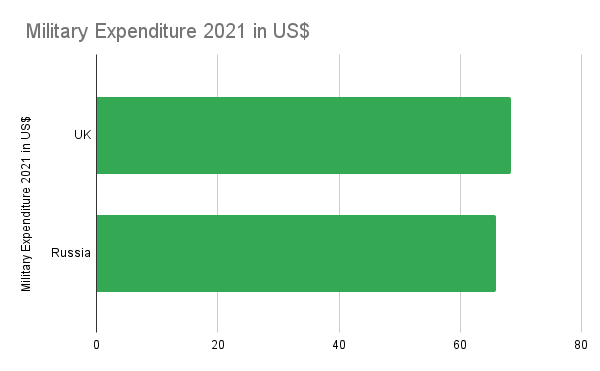
As this is supposed to counter a threat from Russia, it might make sense to examine what the military balance of forces is and who threatens whom.

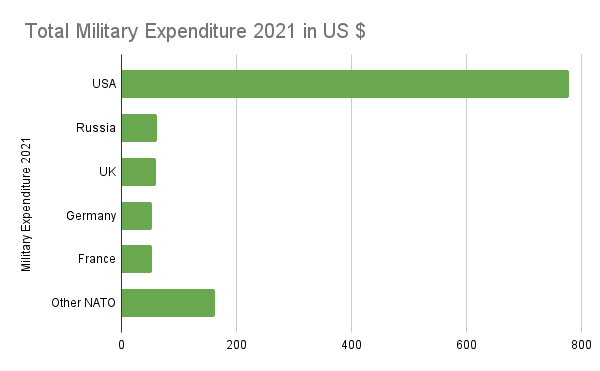
British military spending on its own is already larger than Russia’s.

Figures from Stockholm International Peace Institute

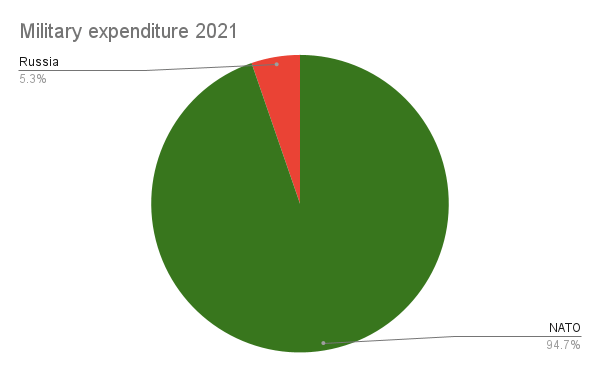
NATO military spending, taken together, is 19 times larger than Russia’s.

Figures from Stockholm International Peace Institute

The NATO summit this week has agreed to absorb more countries – at the price of extraditing Kurdish dissidents to Turkey, all in defence of “democracy” of course – increase expenditure still further, deploy more troops to “forward” positions, i.e. close to the Russian border and sustain a long war in Ukraine.

NATO Secretary General Jens Stoltenburg was quite open about what’s going on. “The reality is that we have been preparing for this since 2014…that is the reason we have increased our presence in the eastern part of the alliance, why NATO allies have started to invest more in defence, why we have increased our readiness”.

“Readiness” – with 300,000 troops geared up… for what?

Place yourself in either of these pie chart segments and ask yourself which one has more reason to feel threatened.

NATO spends 18 times as much on “defence” as Russia does.

This morning, the newspapers were hyping up the possibility of a Russian attack on NATO territory, and commentators at the weekend arguing for a No Fly Zone were pushing the idea that Ukraine could just be the beginning. This has its counterpart on the Left, where people argue that the Russian invasion is “just imperial expansion”.

People lose their heads in wars – sometimes deliberately – so its worth checking the reality and coming down to earth.

  • We should never lose sight of the fact that a direct clash between NATO and Russia set up by a No Fly Zone would push us over the edge of mutual nuclear annihilation. Hundreds of millions would die. That vast number – too likely to be treated as a statistic that does not engage with our emotions and move us – nevertheless contains an almost infinite multitude of individual tragedies. You would die. So would I. So would everyone you know and love.
  • NATO spends more than 18 times as much on its military as Russia does. That makes makes a direct Russian attack on NATO absurd. In fact, NATO arms spending is more than half of the global total. Projected increases in “defence” spending will make this proportion even greater. The “defence experts” projecting fantasies of Russian incursions into the Baltic States or Poland know this; but have either lost all grasp of reality, or don’t want their readers to have one.
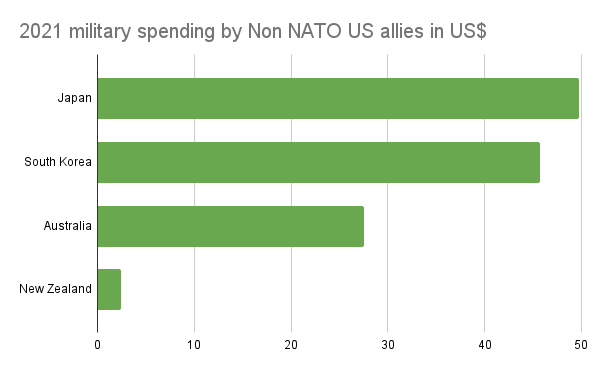
The non NATO countries listed here are the others in the top 20 military spenders table.

Japan, South Korea, Australia and New Zealand are also bound to the US by non NATO military alliances. Add their 6.3% to NATO’s 55.8% and you get 62.1% of global military spending made by countries in US led military alliances. In addition, some of the other countries in the top 20 military spenders also tend to align with the US even without a treaty obligation to do so, like Israel and Saudi Arabia.

Even in Europe, three NATO allies each spend about the same amount on their military as Russia does.

As the Brookings Institute candidly puts it, “America’s alliances in Asia and Europe have formed the backbone of what has become known as the “liberal international order.” Over the past 70 years, this order has helped protect American interests and values.”

That has also involved starting most of the world’s wars in that period.