Dancing in the Haunted Darkness – Moments of Reprieve

When I was an over serious teenager in the early 1970s, making myself very unpopular by putting a CND poster showing a mushroom cloud erupting out of a skull in a 6th Form Common Room full of people who just wanted to listen to Led Zeppelin and have a good time, I developed a philosophy of life that decreed that, in the face of global hunger, the threat of nuclear war and the destruction of the natural world it was immoral to enjoy it.

At the time, this was described as a “denial of life” by some of my closest friends and partners. But it seemed to me that a sense of guilt was a motivator, that the resolution of inhuman acts was a precondition for any happiness that could be justified; without reflecting that moments of joy don’t have to be justified; and a capacity to carry on wouldn’t be possible without them.

I expect I am not alone in getting vicarious imaginary montages, seeing horrific scenes from the news projected onto everyday landscapes. The first time J and I went into central London after the IDF started its mass bombing campaign in Gaza, we talked about how fragile the buildings in Leicester Square now seemed, how easily they could be shattered. Going to Basildon Hospital for my Mum’s most recent appointment we passed the three tower blocks that mark the northern edge of Chadwell and dominate the surrounding countryside, and I couldn’t help thinking that in Ukraine they would be a heavily shelled command post, a fortress in a waste land. While the hospital, so calm, friendly and orderly, humming along so functionally with its shops and cafe and pharmacy, would be a smoking hulk with desperate hungry staff trying to treat patients in the ruins with no anaesthetic, little or no medicine and no beds were it in Gaza. These are virtual, vicarious flash backs, not part of lived experience with no smells, little sound, just images, like a ghostly son et lumiere in the mind, but becoming an everyday part of psychic life.

In this context, when S and I were an hour early to the pots and pans protest for Gaza outside Downing Street last night, we took our sandwiches and sat under the shade of the plane trees in St James Park to catch a breath. We watched the geese and herons, moor hens and ducks like we had when she was little; the children eating ice creams in the sunlight.

On one level, given what we were there for, it seemed almost obscene to be enjoying this, the peace of it; even eating while 2 million people are being deliberately starved, but on another level it was an act of defiance. Finding moments of peace, moments of joy, moments of human kindness or wonder is a reprieve when under unendurable attack. When not under such attack, but aware of it, it becomes almost a duty to experience as much of our humanity as we can in the face of such strenuous efforts to degrade and dehumanise.

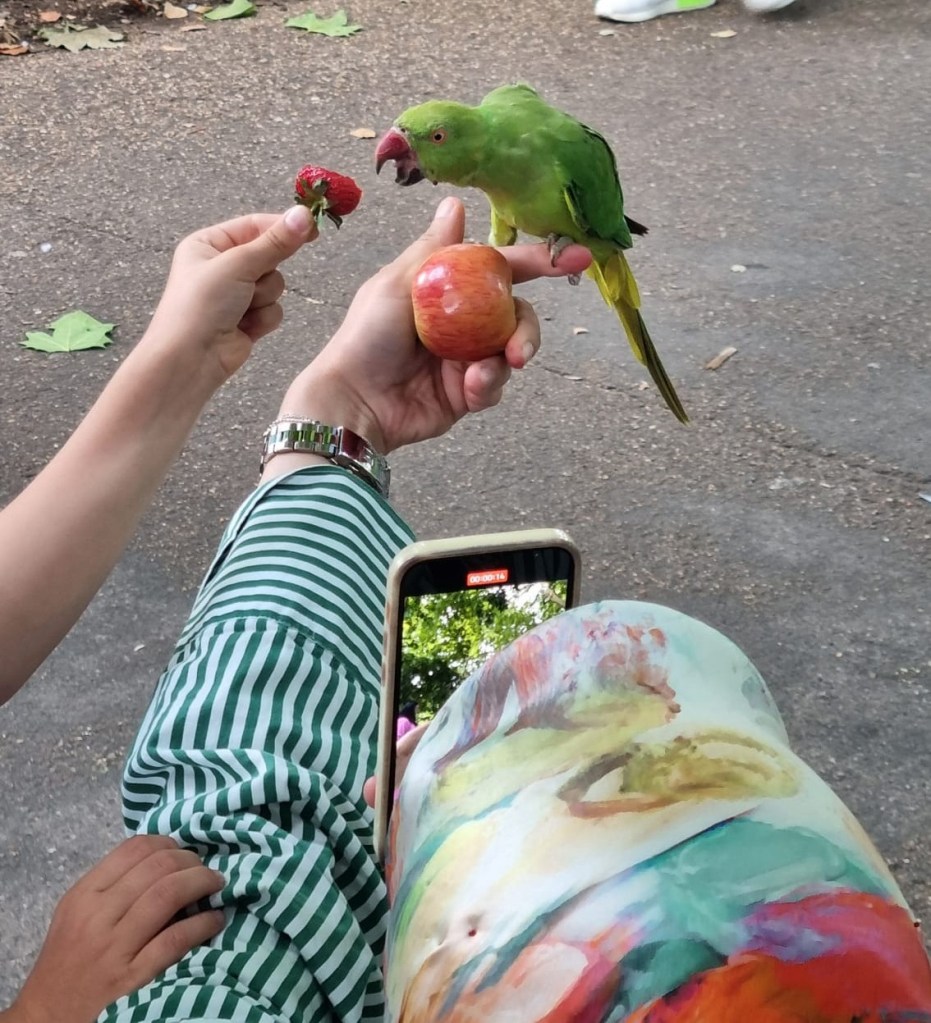
On the way out of the park we came across a Mum in a bright hijab and her daughter feeding a parakeet with an apple and half a strawberry. Parakeets are always exhilarating. This one kept fluttering down from rustling about in the tree above with the rest of its loudly chattering squadron, stretching out its neck and its bright red beak, then flinching back as it got too close. The little girls eyes were wide and bright with wonder.

In Moments of Reprieve, Primo Levi is making an argument for finding any human salvage you can in the most inhumne possible conditions, writing a set of short stories as an elegy to prisoners in Auschwitz, who through tiny affirmations of their humanity – a juggling trick, finding a slice of apple – discover ‘bizarre, marginal moments of reprieve’ amidst the horror.

In a discussion of the finale of Beethoven’s 7th Symphony on Radio 3 this morning, Tom Service argued that the ending of the movement is “off the wall”, because Beethoven has the double basses at the bottom of the register accompanied by the rest of the strings in a grinding and remorseless grim cycle of a theme in a lower key than the rest of the orchestra, which is hurtling around in a whirlwind of a joyful dance that ends in a blazing triumph; and the one is the condition for the other.

The conductor Charles Hazelwood, who was abused as a child, has said that “when I conduct Beethoven I feel the abuse in every bar”, because Beethoven’s Dad punched lumps out of him as a child, and as a result “It’s horribly uncomfortable for me to work with, right until the final performance which is always pure ecstasy”. Even when that mournful, somewhat depressive teenager, Beethoven always did that for me too, because his music absorbs the horror and misery and is driven by it to triumph over it.

As we must now.

The Power of Percussion

At the pots and pans protest at our government’s complicity in the attempted starvation of 2 million Gaza Palestinians in Whitehall this evening, I was attempting to beat out the rhythm of the Nibelungs in Wagner’s Rheingold – old moles hammering away in their mines – with a saucepan and wooden spoon. This was an effort to create an air of collective subteranean proletarian menace. Needless to say, loud though it was, it did not catch on.

The cacophony of thousands beating pans with spoons nevertheless settled into a series of steady rhythms, sometimes echoing chants, sometimes settling into that most basic one, two, one two that is like marching feet and a heartbeat at the same time.

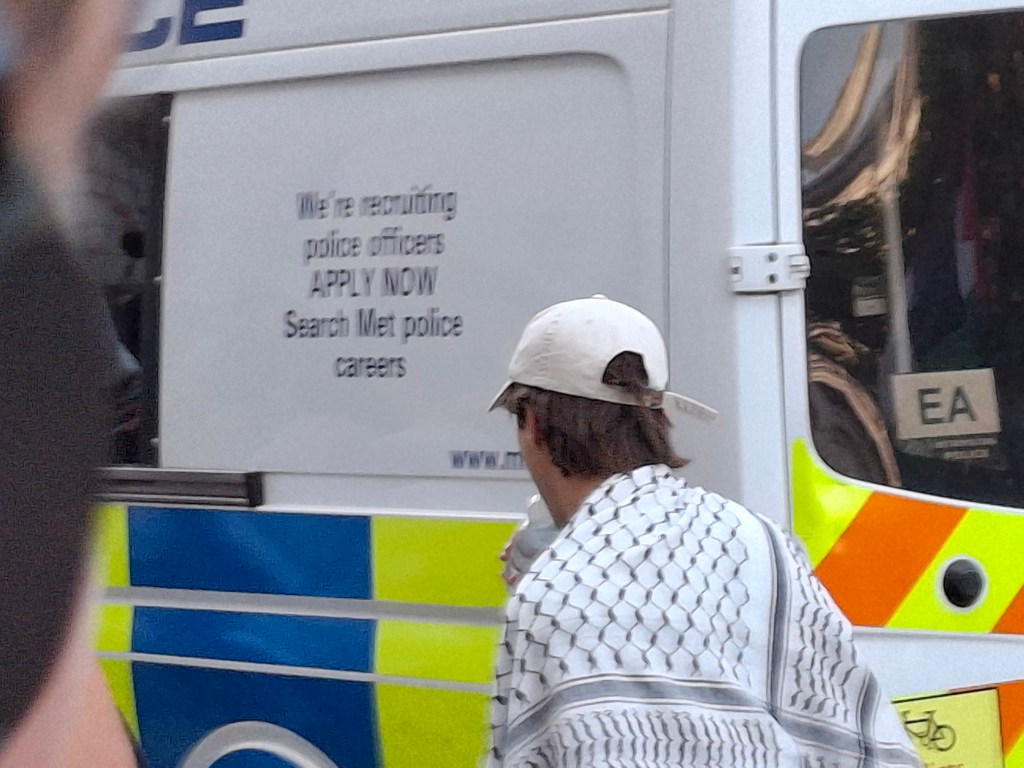
A kippah and a Keffiyah side by side against genocide.

The power of the percussion made me think of the scene in the Tin Drum in which Oscar subverts a Nazi Rally by beating a different rhythm under the grandstand, throwing the Nazi band off its stroke so its loses its bombastic march and only recovers by finding a waltz rhythm, leading the rally to dissolve as the rigid ranks melt into whirling dancers. A scene that shows the potential of people and nations to shift, affirm hope and life and fluidity over rigidity, conformity and racist militarism; and affirming that though Germany produced Hitler and Himmler and Heydrich, it also produced Beethoven and Schiller and Schubert.

In a way, when the Left is campaigning properly, it is attempting to do what Oscar does in this scene.

On the train on the way home there was that announcement; “if you see anything that doesn’t look right”…I see an awful lot of things, on the News mostly, but reporting them to the British Transport Police wouldn’t do a lot of good, sadly.

I don’t think they had many takers.

Sacred Chord in the High Street

The busker – Your Local Music Man – at the strategic pedestrianised T junction, where the shoppers from Morrisons wandering up George Street past the hulk of the State and the stalls selling funnel cakes, ersatz perfumes at £10 for a bag of three, and hunks of meat in plastic bags, interweave with those meandering along the High Street, is playing Leonard Cohen’s Hallelujah.

Now I’ve heard there was a secret chord
That David played and it pleased the Lord

But you don’t really care for music, do ya?
It goes like this, the fourth, the fifth
The minor fall, the major lift

The baffled king composing “Hallelujah”
Hallelujah, Hallelujah

I love this song. If only because you’ve got to admire the chutzpah of a man who can rhyme “Hallelujah”, with “do ya”. I realise, as I try to sing along (quietly) that that is the only line I can remember, apart from the chorus (which is a bit hard to forget). I notice a woman walking with her partner in the opposite direction who is also singing along quietly, almost under her breath; meaning that the busker has at least two private duets going on that he is probably unaware of.

An alternative title for this blog could have been “Loneliness of the long distance busker”: to try to capture the peculiarity of playing music to sparse streets and individuals who drift by without stopping. Only the buskers themselves are present for the whole performance. Everyone else picks up whisps and fragments, more present when you’re close and you know the song, gradually fading into the distance and past if you tune out, or when you turn a corner or get further away. A momentary intrusion, usually welcome, into constant internal monologues, derailing trains of thought in hopefully fruitful ways into wistful memories, or the communion with others that you get from singing along, even when no one else is doing it.

I realsie, also, that I’d done a mondegreen on the first line. The actual lyric is “secret chord” which, given the way that Cohen’s songs are so often drenched in religious poetry, I had always heard as “sacred”. I suppose this is the revenge of the light side to all those Faustian musical deals with the devil you get in crossroads blues and, indeed, School of Rock.

Why can’t our High Streets be Orchards?

Odd scenes in North West London and South East Essex

Walking past the Thameside Theatre and a woman is furtively picking what looks like lettuce leaves from the flower beds at the front. I assume that she is wild scavenging, and now that I look like a harmless old geezer, complete with arthritic limp and shopping trolley, I feel emboldened to talk to strangers, so I ask. “Are those edible?” Waving them to underline her point, she says, “They are for my tortoises”. In Todmorden this is what everyone does. For over ten years they have encouraged people to plant food on any vacant and unused land, and for anyone who needs it to pick it. This brightens and greens up the streetscape, creates community – as loads of people plant things in all sorts of places – and provides extra fresh food, in season, for anyone who needs it. This has been picked up in lots of other small towns, but Hull is about to try it out on a city wide scale. We should all do it. Why can’t our High Streets be orchards too?

Three shops in Rainham. Vape shop. Fried Chicken shop, Undertakers. In that order.

As the C2C train arrives at Dagenham Dock, the small girl wearing a blue jacket with white angel wings designed onto the back – who has hitherto been exploring the physical space around her Mum, who sits a bit careworn in her mac and hijab, and elder sister, who is glued to her phone – lifts her head and listens. Perhaps its because the recorded announcement is done in posh. Emphasising all three syllables – “Dag-en-ham”, not the local version that makes the middle one redundant – “Dag – nem”; thereby bringing out its full rhythm and range of sounds. The drum beat of the syllables too; Dagenham Dock, boo, ba, bum – BOM! The percusive consonants at the start of Dagenham, the extended hum at the end Dagenhmmmm– the sharp crack of “Dock!” She seems enchanted by it and, all the way to West Ham, she keeps repeating it in various forms – stretching it out, making it jerky and jumpy- making it an impromptu nursery rhyme with no meaning but a definite music.

Of course, the part of my brain that still thinks in Lesson Plans started working out how to canal this spontaneous exploration into a rhythm game: sit in a circle and clap and chant the the names of stations; always ending at Mornington Crescent obviously…

Outside the Magistrates Court on the Edgware Road, a couple of pararazzi snipers with huge photolens cameras lurk in ambush, presumably waiting for a celebrity wrong ‘un to emerge at the top of the steps; the name of the Court photogenically framing them in more ways than one. One scopes out a shot from behind a tree, perhaps nervous of being seen by his mark.