
And WAVE!
On a seemingly inaccesible girder opposite platform 4, someone has arranged a line of happy looking gnomes, some carrying rainbow flags.
The barrista at the Costa in the station now sees me as a regular, which I guess I am, passing through about once a week seeking a caffeine boost on my treek to Essex, and anticipates my order because its always the same. Creature of habit. Give it a year and I’ll have a mug hanging up behind the counter.
The tiny young barista in a hijab swiftly sets up six coffees of different sorts at once, causing the well spoken gent in the queue behind me – a man with a slight touch of the Alan Bennets – to complment her on her speed and efficiency. It occurs to me that had she been digging coal in the Soviet Union they’d have given her medals and put her on posters. Shock Barrista! She explains that getting the coffees done quickly en masse is essential when people are catching (or might miss) trains.
Fenchurch Street always used to be smoky, closed in, quite dingy, in a cosy and friendly sort of way. Rather down at heel bar and cafe with curly sandwiches, more routine than inspirational, dark brown tea and watery coffee. The recent remodelling has opened the concourse up to a floor to ceiling window at the back which floods it with light and a sense of space that makes getting to London somehow more optimistic.
Just round the corner towards Tower Hill is St Olaves church and graveyard, where Samuel Pepys and his wife are buried. The gateway to the graveyard is surmounted by a carving of three skulls – just as a reminder. “Now get you to my lady’s chamber, and tell her, let her paint an inch thick, to this favour she must come; make her laugh at that”, as Hamlet put it to another skull. The churchyard is tiny, green, a peaceful haven with a stone labyrinth in the corner. This is a representation of a labyrinth, being decidedly 2 dimensional, not an impenetrable stone maze that a Minotaur might be found at the heart of. The idea is to walk along the route from the edge to the centre while thinking about the almighty. The route loops around and back on itself, so it has the same disorienting effect as ecclesiastical architecture; designed to make you dizzy and vertiginous when you look up.
St Olaves itself is one of the few medieval City churches to survive the Great Fire. Going in, there’s only me and a middle aged black woman with a huge Bible, who seems slightly offended that I’m in there with such little Faith, but situating herself on a higher plane to cope with it. It is extraordinarily quiet and peaceful inside, set lower than the street, with colourful Tudor looking carvings of praying figures around the pulpit and beautiful stained glass that seemed to have survived being “knocked about a bit” by Oliver Cromwell and Restoration plaques and carvings of Pepys types with magnificent flowing wigs framing plump and sensuous faces.
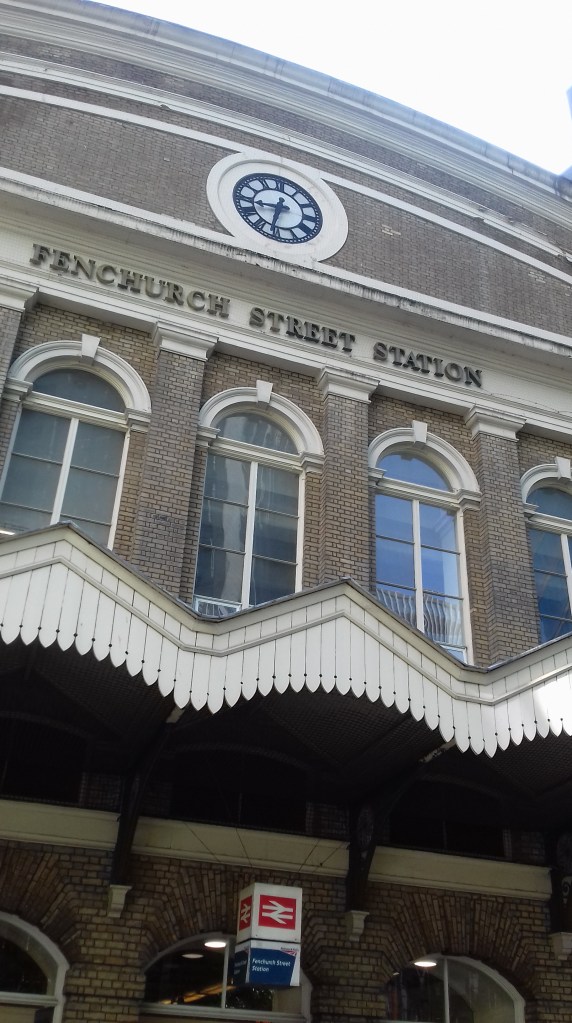
Stands still the station clock at nine thirty one…?
 Urban ramblings