In the market, a bloke is selling gift bags with four top of the range brand perfumes for a tenner. Ask no questions…
Outside the Eastern European Deli by Clarence Road a crowd of people gather round a man playing an accordion and sing the Rumanian version of Felice Navidad. Rumanian being a Latin language, the first word is the same. As is the tune. They seem to be having a good time. People passing by smile, even though they don’t understand the words. They can pick up on the good feeling.
Hurtling on a mobility scooter down George Street towards Morrisons at about 4 mph, a wild haired man with a rubbery twisted face mutters and gurns at passers by like Mick Jagger with Turettes.
Inside a tiny Rumanian owned finance shop on the riverward side of the level crossing by the station, a full scale service is going on. A priest in a cylindrical black hat, wearing an utterly gorgeous scarlet cloak covered with ornate gold embroidery with an icon like picture of the Virgin Mary on the reverse collar at the back of his neck, waves a heavy gold cross in one hand, while crossing himself with the other. Sometimes facing his small congregation of men with nylon suits and short haircuts, sometimes facing the wall behind him. This has an plaque celebrating the company’s Platinum award for HR successes, so it sometimes looks as though they are worshipping that. To his left, and facing the gawpers in the street through the plate glass windows, an attendant in an equally heavily gold embossed crimson robe stands guard with a serious look on his face. The overall effect is positively Byzantine in its mystical magnificence; humanised by the small table of snacks and orange squash along the wall.
At the bottom of Cromwell Road a tiny boy wearing one of those animal head hats that make him look like Max from “Where the Wild Things are”, is being pushed along by his Mum on a little purple plastic three wheel scooter which flashes lights as it trundles onwards. He is standing rigidly erect like a little Emperor, hands firmly on the handlebars, one of them grasping a sharpened pencil that he holds pointedly upwards like a staff of office.
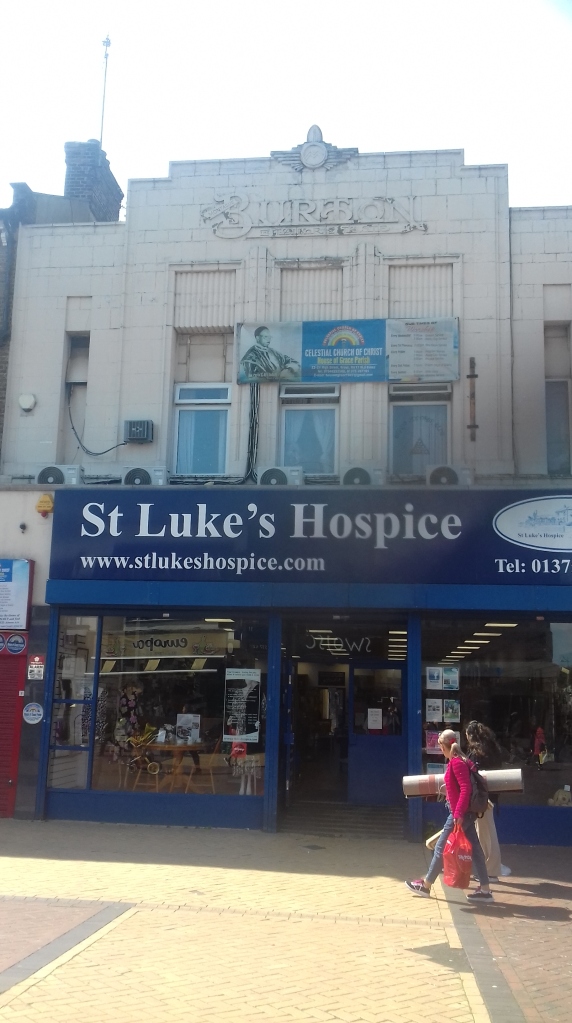
Coming out of the Church of Christ Celestial, a young woman dressed all in white like a cross between a pastry chef and a woman from the Handmaiden’s tale, bustles off down the road on Godly business. The Church is installed above the St Luke’s Hospice shop in what used to be the Burton’s Snooker Hall. Burton’s was a popular off the peg suit emporium that ran a snooker hall above the shop in the middle of the last century. My Dad told me that this was considered something of a den of iniquity among respectable folk – as in The Music Man song:
Oh yes we’ve got trouble
Right here in River City
With a capital T
And that rhymes with P
And that stands for Pool.
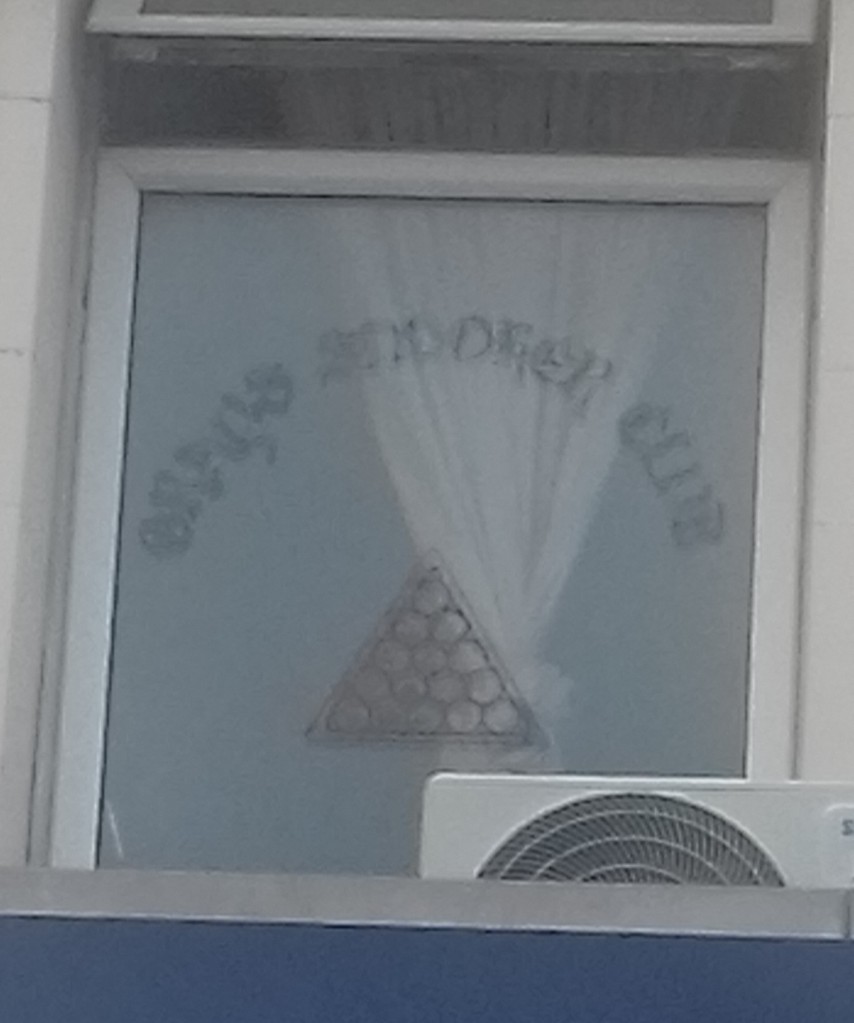
The logo for the snooker club – a triangle of racked balls – can still be seen faded but legible on the most southerly window. Hopefully the Church won’t disapprove as much as my grandparents did, and will leave it in place.
Although my Dad was forbidden to go in there, he’d sometimes surreptitiously nip up the stairs, not because he wanted to be Thurrock’s answer to Fast Eddie Felton, but accompanying a mate who’s Mum ran the tea bar as an alternative to the London Road Cafe on a Saturday night; for a heavily stewed tea and slice of “yellow cake” (a late 40s austerity version of Madeira, and nothing to do with Uranium…so they said).
Down Hathaway Road marches a small, slow, stately procession of elderly black matrons, all in their best church hats and sombre business like handbags, led by one of their number carrying a museum piece of a tall vertical banner in dark red with something Biblical in black written on it that could be straight out of the Shankill Road circa 1887. The strong influence of Black Evangelicals on the local Conservative Party indicating that the Saints might not be marching in, but they are definitely marching on; resolutely in the wrong direction.
Outdoor household Xmas decs look a bit sad in daylight, even before the day itself. Lights at night are one thing, but shopworn bows and slightly deflated snowmen and Santas blowing a bit desperately in the wind, are something else. Especially as seen from the top of the 100 bus to Basildon hospital, trundling through Stanford le Hope and Corringham, on a local road for local people, running alongside the huge six lane A roads that slice through and coil around the old towns like Boa Constrictors, with most traffic passing them by, trucking mountains of containers from the docks at Tilbury and Thames Gateway on up to the M25 and across the country. The relatively small and discrete railway line from Southend to London probably carries as much, or could, and makes a far lower impact on the landscape. Blink and you might miss it. You can’t miss the roads, making Stanford and Corringham feel by passed by their by passes. Both have a slightly tired and accidental higgeldy piggeldy feel to them, with no real centre, or heart, just successive layers of improvised development, clustered beyond Stanford’s handsome old church, with matching pub across what might have been a village green once.
Along the river run a row of giant cranes and gantries and the containers pile up 6 storeys high looking like the Martian machines from War of the Worlds. The sort of job done by my grandfather and great uncle consigned by them to rapid oblivion in the early 70s. An old family friend drops in and tells me that her job as a copywriter has gone the same way. At the beginning of last year, she had a waiting list and steady work with regular clients. ChatGPT comes along this year and wipes her out. She hasn’t had work for two months.
My Mum had quite a few cousins. Two of them had rhyming nicknames. Donk and Bronc. “Donk” because he would donk people on the nose if they were getting on his nerves too much. Bronc because, as a child, he was always playing cowboys.
An aspect of US hegemony is the extent to which the films and TV series we have watched all our lives make people think of them as the good guys. This is despite everything we have lived though, from Vietnam to Chile to Central America and the 4.5 million people killed in the war on terror, with Abu Ghraib and the Fallujah Free Fire zone providing a model for the IDF now in Gaza and the West Bank, while the US supplies them with the bombs and bullets to do what they are doing. All played down and deflected in our media of course.
The cavalry charge bugle call that heralded the goodies (white soldiers) arriving at the gallop at the end of so many Westerns to deal with the “savages” (native Americans) to the cheers of the Saturday matinee crowds of children in the 50s and 60s was played in a way intended to be darkly ironic at the end of that decade in the Helicopter gunship scene in Apocalypse Now, where the music shifts to the Apache helicopters playing Ride of the Valkyries through loudspeakers as they swoop in to strafe the Vietnamese village, and their commander comments, “I love the smell of Napalm in the morning”. Only the ironic intent and impact is inappropriate, because, think it back and project it forward, in the “war of civilisation against barbarism” (B. Netanyahu) its a call for the same armed forces to do the same damn thing over and over and over again.
Having made it to Hampton Court on our last riverside walk, Jamie and I plan to head East from Tower Bridge to the Thames Barrier, exploring on the way the murky dockside past of some of our ancestors.
On the way down to Tower Hill, a convivially crowded tube is full of people in a state of Bank holiday relaxation, chatting in a variety of languages – as we do in London – blissfully oblivious of offending Nigel Farage in absentia.
Looking at the fragment of Roman Wall still standing opposite the Tower, Jamie expresses a desire to climb it; taking parcours into Spring Heeled Jack territory.
On the North side of the Tower there is a statue that at first we take to be a war memorial; but on closer inspection proves to be a memorial to Construction – and other – workers killed in industrial accidents. Erected by UCATT, the construction workers union (part of UNITE since 2017) it has the same physical look as military memorials; and is very much modelled on them. A solid looking bloke in bronze, staring into the distance/future, wearing a hard hat instead of a tin bowler, with a spirit level over his shoulder where a rifle might go, and a tool belt where his ammo pouches and dagger would be. Recent wreaths from UNITE, probably laid for worker’s memorial day on April 28th, lie at the foot of the plinth. Not a ceremony of remembrance anyone much makes a fuss of. But, they shall not grow old either… (1)
Setting out, down the wide steps Eastwards into the St Katherine’s Dock basin we go. Between 1828 and 1968 a working dock, when “brandy for the parson, baccy for the clerk” started to come in in warehouse loads, stacked high in tall storehouses of fast blackening yellow brick, designed with the same early industrial brutalism as Kings Cross station and having that harsh beauty that functional confidence can confer if built in sufficiently grand dimensions; but now just a marina full of yachts, mostly white and sleek, and fringed with hotels, restaurants and bars for the sort of people, mostly white and sleek, who can afford them. Jamie suggest that it would make a great scene for a chase sequence in a spoof Bond film, with characters hopping from boat to boat. One of the yachts, appropriately enough, is called “Moneypenny”. Moored along the West side is a Thames barge, blunt nosed. solid, red sails furled, ready for a fair days pay for a hard days work; but kept for legacy display and exhibition reasons, just as the heavy overhead winches and pulleys on the warehouses are; mighty pieces of machinery painted glossy black and reduced to a decorative reminder of how far the world of money has moved on from mere mechanics. To one side is “Gloriana” a recreation of an eighteenth century Royal Barge with a sixteenth century name built for the Diamond Jubilee in 2012, and probably due a run out for the Platinum one later this summer- all red and gold, sharp prowed and elegant; a cabin for Royalty to loll in at the back – with Dieu et mon Droit carved above – and seats for rowers to plough the river with their oars in at the front (no God or rights for them). Brassy. All that’s missing is a crowd of musicians on other boats playing the water music; all trumpets and timpani. A wagtail gilded with delicate yellow under feathers dances delicately alongside, its light liveliness a kind of mute mockery of our pretensions to be able to design anything as sublime as it is.
Wapping High Street and the streets off it is more or less free of cars, but there are lots of people on rented bikes – chatting as they go – and joggers, mostly with earpieces in and proper kit. One woman has blue lipstick; which must be some sort of statement. The street is mostly luxury gated apartments, converted warehouses seven storeys tall, hemming in the cobbled road like a canyon, with, to landward, side streets leading to quiet social housing estates and, on the river side, sliced with neglected narrow alleyways leading to steep, treacherously slimy stair ways down to the river; which sucks and sloshes angrily with a smell of salt and sludge and a legacy of green slime far up the walls. A place for a quick scuttled escape to a waiting boat were there to be one there. But not a place to hang about. There is a definite sense of threat about it. The sort of alley way that might lead to a secret trap door to the hideout of an eighteenth century villain like the Spectre in The Valiant. Or a place a pirate might have been hanged, or chained up for the tide to drown him. Among the surviving pubs, which look like the sort of places that would have been really rough half a century ago but have scrubbed up nicely, even though they have a lot of the dame sort of shiny green bricks they used in Victorian public toilets, all gleaming glass and brass, scrubbed wood and real ales, is the Captain Kidd, which has a painting of him on the gibbet as part of its sign. Further up is The Prospect of Whitby, which says it is the oldest riverside pub in London; founded in 1520. The Inca Empire still had 12 years to run when they started. A list of all the monarchs since Henry VIII underlines just how long they have been pulling pints on that spot. There is room for just one more after Elizabeth II, which may or may not be prophetic.
Walking alongside the river for a short patch where it is accessible, we hear a distant chanting, slightly menacing, like a football crowd. It seems to be coming back in the direction of the Tower of London. Not possible to pin down. The swish flats built to look swashbucklingly futuristic by Michael Heseltine’s Docklands Development Corporation in the 1980s – an abortive model for a megalomaniac vision of a wholesale urbanisation of the North Bank of the estuary as far down as Southend jokingly referred to at the time as “Heselgrad” – are looking a bit battered close up. Weathered. Stained. Pooped on by gulls. Rickety and rotted a bit in places. The old pre war LCC council estate flats look as though they will be in better shape for a lot longer. Recently built estates look much more solid than either. Very square, but with handsome dimensions. Bright green privet hedges – a gesture at a Garden City revival perhaps – have the feel of holograms, as though we are walking through one of those computer generated scenes of what the new estate will look like when it is built and the sun is shining and it is inhabited entirely by fit, well dressed people who have places to go and things to do.
At the point that the Regents Canal meets the Thames we walk across a solid looking bridge, looking down at a flotilla of swans nosing around looking for food among the flotsam of plastic bottles and footballs and trying to groom themselves with water that is the colour of diahorrea. Needs must. As we near the far end, lights begin to flash and a siren sounds at both ends of the bridge as barriers begin to descend; so everyone scuttles off. Water is pouring out through the lock gates, with streams of algae spiralling out towards the river like an unappetising green sauce. As the lock gates open, so does the bridge. The whole thing lifts slightly, then swings away from our side to the left, upstream, with a stolid certainty, pivoting on the far bank and coming to rest parallel to the channel of water. Three two masted boats, crewed by quite elderly people and flying Dutch flags at their stern, cast off from the bollards inside the lock and motor swiftly through and out onto the river in a rapid convoy; before the bridge swings inexorably back, and settles itself down with a sigh and a solid THUNK. The small crowds of cyclists and walkers gathered at both ends are made convivial by being held up together; a common experience of no great significance in itself, but the power and the weight involved in the way that the bridge moved, making the forces we use for small everyday experiences visible is humbling and exhilarating; if the grins people are giving each other is anything to go by.
The river is busy all the way down to Greenwich and small children point and laugh at the river clippers; which are large, sleek and powerful and growl through the water like apex predators, churning a foaming wake. Fast orange speed boats operating out of St Katherine’s Dock, bounce across the surface with screaming tourists imagining they are in that chase from the imaginary Bond film- a riverine version of a white knuckle ride. Not to be outdone, a Police boat with its siren going hurtles down river towards Greenwich- sometimes taking flight momentarily – leaping forward in a series of stomach turning jumps; either giving chase to person or persons unknown, or late for tea, or having fun. A boat decorated with Horrible Histories logos lurks alongside former execution sites to give people that Weren’t we awful…! frisson. One of the slower tour boats, heading back up river, is full of people singing “Bring me Sunshine”– in a rather heartfelt way. This may be the possibly the same lot who were chanting earlier so menacingly, but now seem to be in a much mellower mood.
“Bring me sunshine, in your smile
Bring me laughter, all the while
In this world where we live,
There should be more happiness
So much joy you can give
To each brand new bright tomorrow…” (2)
I have to explain the cultural echoes this has for my generation; as it means nothing to today’s. It could be a prayer. You could intone it like an Anglican vicar if you add the words “Oh Lord”… at the beginning. Certainly of its time. Tomorrow might well be brand new, but its not likely to be very bright, and very few young people think it is opening up for them; with 75% in a recent survey afraid of what it might bring, 54% that humanity is doomed and 39% actively considering not having children.
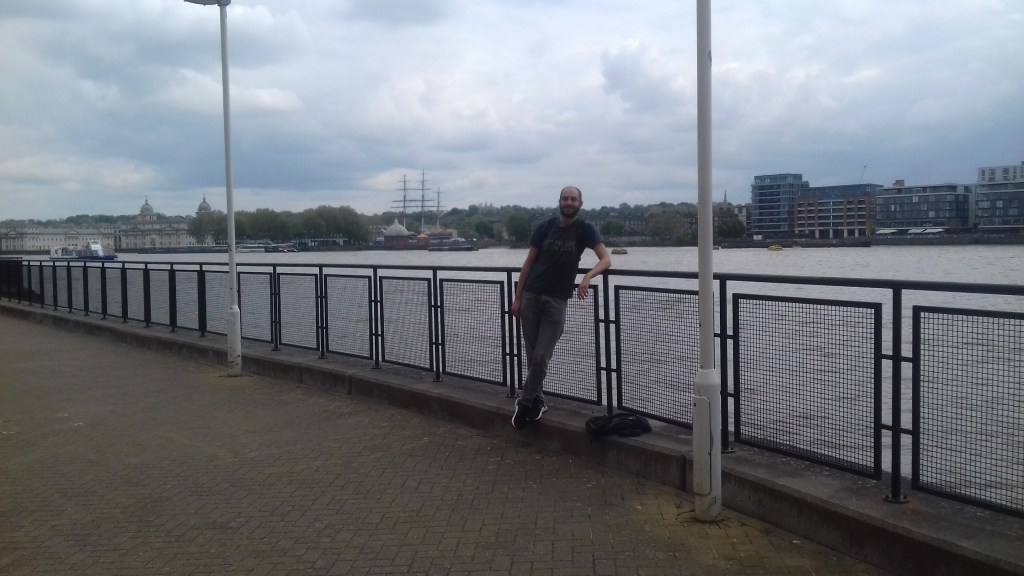
How not to take a scenic photo. Greenwich in the gloom, with the Cutty Sark’s masts centred, the Royal Naval College to the left, and Jamie in silhouette in foreground.
Greenwich from the other side presents as a montage of architectural styles – the stately elegance of the Royal Naval College, reclines with aristocratic languor, stretching effortlessly along the waterfront with green hills behind it. Alongside, and towering above it like an outsized Igor to the College’s Doctor Frankenstein, is a huge Victorian power station; vast vaulted brick halls, foursquare towering chimneys like the stiffened upturned legs of some dead beast, thoroughly Orcine, a hunk of Mordor built on the lawns of Arcadian fantasy.
Walking North up the East side of the Isle of Dogs and the river empties. Only the occasional Clipper prowls beyond Greenwich, giving a sense of abandonment and a quiet that feels a bit eery. On the far side, near the O2, a few dry docks are still working, a Go Cart track makes an enormous noise, and tiny figures can be seen walking across the top of the O2 like a queue of penguins on a very round ice floe. The South end of the Isle is not like the North, dominated as it is by gleaming towers of finance capital. Cubitt town was built on lands reclaimed from swamps as late as the 1840s. Housing estates from before “Docklands” dream in the sunlight, children throw stones into the oncoming waves in old dry docks, one of them, closed off from the river, is covered in algae, smooth and flat like a bilious billiard table dotted with cast off plastic bottles buoyed up high in the airless water beneath, while lots of people in new Shalwar Kamiz’s for Eid head for relatives houses. The ward that elected the first ever BNP councillor in 1993 now feels comfortably multicultural, with people of all descriptions chatting in the street. Another memorial to dead workers stands quietly by the waterfront. Six Fire fighters killed in a fire and explosion on a now demolished wharf in 1969 – a plaque from the Brigade and one for their union alongside each other; their names listed.
At the point that the River Lea reaches the Thames, we have to walk across a flyover on the A13 – an umbilical cord to home in my case (3) – in search of the Orchard peninsular; which was the site of a shipbuilding yard owned by my great, great, great grandfather (via my Dad’s paternal Grandmother’s line), Benjamin Crispin Wallis. The yard’s main claim to fame is to have built the paddle steamship Ruby for the Diamond Gravesend Steam Packet Company in 1836, claimed at the time to be “the fastest in Europe”; 160 feet long with two 50 Horse Power engines capable of 13 and a half miles per hour; allowing her to get to Gravesend ahead of all rivals in just 1 hour and forty minutes. This was such a success that he was bankrupt within a year. He was back in business by 1852, listed in the London Commercial and General Directory of that year as a Barge and Boat Builder at Orchard Place Blackwall, but went bust again by the end of the decade; “occupation 1859: Bankrupt.” His creditors received 1 shilling and 3 pence for every pound they were owed. (London Gazette July 24th 1860). He died in 1877 at 77 years old. (4)
Orchard Place is a backwater along Bow Reach that is almost as hard to get to now as it always was. Cut off by the Lea’s meanders, and the basin of the East India Dock, with no public transport, seen as an island by those who lived there and those who shunned visiting it; it was desperately poor. Marked dark blue on Charles Booth’s poverty map, denoting “very poor, casual, chronic want” – only black – “Lowest class, vicious, semi criminal” was rougher. People worked in the industries that grew up around the docks, notably rendering whale oil from blubber, glass polishing (mostly women) a lucky shift at the Docks for those with enough cash to buy drinks for the foremen in the many pubs, or “toshing”, scavenging along the shoreline for useable goods, or lumps of coal to use or sell. Largely isolated from the rest of London, three families dominated – the Scanlans, Jefferies and Lammins. A school report from the Bow Creek School noted that, “of 160 children in the school, 100 were Lammins”; which must have made taking the register interesting.
Lammin? Here.
Lammin? Here.
Lammin? Here.
Some of these children were reported as asking their mother for a candle, “so we can watch the rats”. Made our own entertainment in them days…
The view from the A13 flyover looking South across Orchard Place. To the right is the entrance to the East India Docks. Ahead is the river and Greenwich. The Wallis yard, I think, was where the flats are to the right. The Thames Cable Car can just be seen on the Greenwich side – a ski lift to nowhere much.
At the end of the peninsular there is a cafe in a prefab unit, which has a black cab on the roof with a tree growing through it, where we rest our aching feet and eat a vegan buttie (bit dry).
Across the flyover looking down to the right at scuzzy Leaside industrial leftovers, big, broken wooden drums dumped in piles, buddleia growing through the concrete of an industrial graveyard – ahead to the Tate and Lyle factory – Baking Britain Golden – a last citadel of production left isolated in brownfield desolation – and to the left to the Victoria Dock; which for a moment we are disoriented by; as it is so broad it looks like the river has been moved (by Jonathan Strange perhaps) or the universe has been turned inside out around us. The Thames Cable Car – the Dangleway – sways high up 300 feet over our heads and we wave back at some kids who are very excited to be in it.
Finally, the Thames Barrier and journey’s end. The park alongside is full of families out for Eid and the river flows muckily too and fro.
On the tube back, I notice in our reflections that we are sitting in a disturbingly identical way.
Deaths of front line workers in recent years, thanks partly to “health and safety gone mad”, have gone down quite sharply from 2.1 per 100,000 in 1981 to 0.44 per 100,000 in 2021. A total of 142 in 2020-21 (mostly falls from height or being hit by a vehicle) mostly still in construction and agriculture, with a much higher rate of deaths for the over 60s. Lest we forget, the death rate from Covid in the same year was running at about ten times that rate for front line workers in jobs like health, care and transport.
The theme song for Morcambe and Wise. Having known it for years- and assumed it was a late Music Hall type variety song – I’m slightly surprised to find that it was written and composed by Willie Nelson. This is his original. I think I prefer theirs, which is gentler; somehow ordinary, a couple of blokes singing a song with no great passion – but with a kind of sincerity; and definitely with the right notes in the right order.
Billy Bragg has a song about it – an Essex version of Route 66 (Dig the scene, on the A13). How could you not?


 Urban ramblings